Индуизм · Адвайта-веданта
Gaudapada
गौडपाद
Исторически документированная личность
Индийский философ, автор «Мандукья-карики», или «Агама-шастры», — древнейшего из сохранившихся систематических трактатов адвайта-веданты, написанного примерно в VI–VII веках. В четырёх главах он комментирует «Мандукья-упанишаду», уравнивает бодрствование со сновидением и отстаивает учение о нерождённости (аджативада): ничто никогда не рождалось. Традиция делает его учителем учителя Шанкары; исследователи спорят о том, чем он обязан буддийским мадхьямаке и йогачаре. О его жизни ничего не известно.
- трудов
- 10трудов
- изданий
- 19изданий
- цитат
- 11цитат
- видео
- 14видео
- изображений
- 7изображений
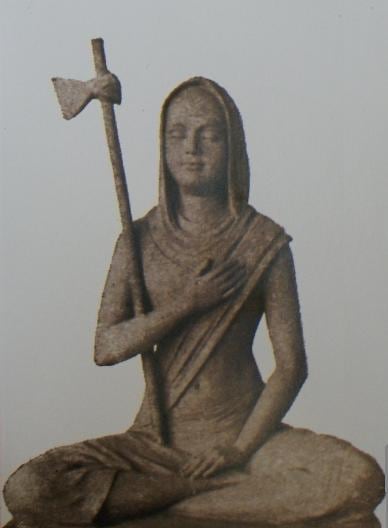
Estatua de Gauḍapāda · Public domain
Своими словами
«There is no dissolution and no origination, no one bound and no one striving, no seeker of liberation and no one liberated: this is the highest truth.»Māṇḍūkya Kārikā 2.32 (traducción propia); la estrofa reaparece en la Amṛtabindu y la Brahmabindu Upaniṣad

Главная мысль
Ajātivāda (the doctrine of non-origination): The central thesis of the Kārikā: in truth nothing is born.
В контексте
Биография
4 мин чтения
Перевод с испанского оригинала, выполненный с помощью ИИ; ожидает проверки носителем языка.
Наконец-то автор
В отличие от ведийских мудрецов, которых традиция ставит рядом с ним, Гаудапада — исторический автор: это имя, которым традиция подписывает трактат в 215 строфах, «Мандукья-карику», называемую также «Агама-шастрой» или «Гаудападия-карикой». Это древнейший из сохранившихся систематических трактатов адвайта-веданты. О его жизни, однако, не известно почти ничего: ни места рождения, ни дат, ни имени учителя. Загадкой остаётся и само имя; высказывалось предположение, что «почтенный из Гауды» указывает на Бенгалию, но это лишь догадка. Всё, что мы о нём знаем, почерпнуто из его сочинения, из цитат у других авторов и из предания адвайтских монастырей.
Датированный своими читателями
Даты выводятся из косвенных данных. «Карика» знакома с учениями мадхьямаки Нагарджуны и йогачары — буддийской школы «только сознания», систематизированной в IV веке, — а значит, написана позже них. С другой стороны, буддийский мыслитель Бхававивека в VI веке цитирует её строфы в своей «Мадхьямака-хридае», излагая учение веданты, а в VIII веке это делают Шантаракшита и Камалашила. Поэтому Карл Поттер относит Гаудападу примерно к 500 году; другие исследователи предпочитают VI или VII век, а те, кто понимает буквально его духовное родство с Шанкарой, которого традиция датирует 788–820 годами, отодвигают его вплоть до VIII века. Хадзимэ Накамура утверждал, что четыре главы были написаны не одновременно и что первая и третья содержат более древние идеи, чем четвёртая.
Четыре главы
Первая глава, «Агама», комментирует «Мандукья-упанишаду», двенадцать прозаических фраз которой передаёт вместе со строфами: у атмана четыре «четверти» — три состояния, бодрствование, сон со сновидениями и глубокий сон, и четвёртое, турия, которое есть не состояние, а то, в чём являются остальные, и которое слог ОМ выражает тремя своими звуками и своим безмолвием. Вторая, «Вайтатхья», «нереальность», доказывает, что предметы бодрствования столь же нереальны, как предметы сна, ибо то, чего нет в начале и в конце, нет и в середине. Третья, «Адвайта», объясняет отношение между атманом и индивидами через образ пространства, заключённого в сосудах, и описывает «йогу неприкосновения» (аспарша-йогу), перед которой робеют даже йогины. Четвёртая, «Алаташанти», «угасание головни», сравнивает мир с фигурами, которые рисует в воздухе раскрученная головня, и разбирает одну за другой теории причинности.
Ничто никогда не рождалось
Самое радикальное учение Гаудапады — учение о нерождённости, аджативада. Будь следствие тождественно своей причине, ничто новое не рождалось бы; будь оно отлично от неё, было бы непонятно, как оно из неё возникает; а то, чего нет, родиться не может, как не рождается сын бесплодной женщины. Вывод сгущается в строфе, которую позднейшая традиция повторила в нескольких поздних упанишадах: «Нет ни уничтожения, ни возникновения, ни связанного, ни стремящегося, ни ищущего освобождения, ни освобождённого — такова высшая истина». Освобождение — не перемена, а узнавание того, что атман никогда не рождался и никогда не был связан. Майкл Команс показал, как этот метод, исходящий из состояний сознания, был унаследован и преобразован Шанкарой и его учениками.
Тень Будды
Четвёртая глава ставит самый обсуждаемый вопрос. Она открывается почтительным приветствием «лучшему из двуногих», который «пробудился» (самбуддха) к природе явлений; использует технический словарь буддизма — дхарма, самврити, «вибрация сознания» — и завершается словами: «этого Будда не проповедовал». Видхушекхара Бхаттачарья в своём издании 1943 года пришёл к выводу, что Гаудапада глубоко усвоил мадхьямаку и йогачару, и даже высказал предположение, что сама «Мандукья-упанишада» возникла из строф «Карики». Р. Д. Кармаркар ответил ему в 1953 году, отстаивая всецело ведантийское прочтение. Т. Р. В. Мурти видел в «Карике» попытку истолковать веданту в свете буддизма, не отказываясь от атмана, который буддизм отрицает, а Ричард Кинг в 1995 году поместил сочинение в махаянский контекст и счёл возможным, что четвёртая глава имеет иное происхождение, поскольку позднейшие ведантийские авторы её почти не цитируют.
Учитель учителя Шанкары
Традиция адвайты делает Гаудападу учителем Говинды Бхагаватпады, в свою очередь учителя Шанкары, и включает его в преемственность, восходящую к Вьясе и его сыну Шуке. Шанкара цитирует его строфы в комментарии к «Брахма-сутрам», приписывая их «учителям, знающим предание веданты», а приписываемый Шанкаре комментарий к «Карике», подлинность которого оспаривается, завершается приветствием его «высшему учителю» (парамагуру). Сурешвара, ученик Шанкары, тоже цитирует «Карику» и с почтением упоминает «гаудов». Поздние агиографии Шанкары рассказывают о встрече обоих в Гималаях, которую хронология делает маловероятной.
Что ему приписывают
Под его именем ходят и другие сочинения сомнительной подлинности. Самое известное — комментарий к «Санкхья-карике» Ишваракришны, переведённый на английский Колбруком и Уилсоном в 1837 году; Джеральд Ларсон и Карл Поттер считают маловероятным, что он принадлежит тому же автору, — из-за стиля и тесной связи с другими комментариями санкхьи. Ему приписывают также комментарий к «Уттара-гите», сочинения тантрической традиции шри-видьи — гимн «Субхагодая» и «Шривидьяратна-сутру» — и комментарии к «Деви-махатмье» и другим упанишадам, хотя доказательств, позволяющих их принять, нет.
Наследие
«Карику» уважали даже соперничавшие ведантийские школы: Мадхва и традиция вишишта-адвайты считали частью откровения некоторые строфы первой главы. В Гоа монастырь Кавале, древнейший у общины гауда-сарасватов, хранит преемственность настоятелей, носящих титул Гаудападачарья. Первый английский перевод, выполненный Манилалом Двиведи, вышел в 1894 году, и с тех пор учение о нерождённости стало ориентиром современного недуализма, который представляет его как высшее учение веданты.
Источники: Bhattacharya, Vidhushekhara (ed. y trad.). The Āgamaśāstra of Gauḍapāda. Calcuta: University of Calcutta, 1943. Reimpr. Delhi: Motilal Banarsidass, 1989, con prólogo de Christian Lindtner. · King, Richard. Early Advaita Vedānta and Buddhism: The Mahāyāna Context of the Gauḍapādīya-kārikā. Albany: State University of New York Press, 1995. · Karmarkar, Raghunath Damodar (ed. y trad.). Gauḍapāda-Kārikā. Poona: Bhandarkar Oriental Research Institute, 1953 (Government Oriental Series, B 9). · Nakamura, Hajime. A History of Early Vedānta Philosophy, Part Two. Trad. de Trevor Leggett et al. Delhi: Motilal Banarsidass, 2004 (original japonés, 1950–1956). · Potter, Karl H. (ed.). Encyclopedia of Indian Philosophies, vol. III: Advaita Vedānta up to Śaṃkara and His Pupils. Princeton: Princeton University Press / Delhi: Motilal Banarsidass, 1981 (sección sobre Gauḍapāda).
Хронология
Жизнь год за годом
Каждая точка — документированное событие. Нажмите, чтобы прочитать о нём, с источником и степенью достоверности.
IV век
Background: Madhyamaka and Yogācāra
The Kārikā presupposes the doctrines of Nāgārjuna (second–third centuries) and of the Yogācāra of Asaṅga and Vasubandhu (fourth century); it is therefore later than them.
ВероятноKing, Richard. Early Advaita Vedānta and Buddhism: The Mahāyāna Context of the Gauḍapādīya-kārikā. Albany: State University of New York Press, 1995.
IV век
Background: Madhyamaka and Yogācāra
The Kārikā presupposes the doctrines of Nāgārjuna (second–third centuries) and of the Yogācāra of Asaṅga and Vasubandhu (fourth century); it is therefore later than them.
Вероятно
V век – 600
Composition of the Māṇḍūkya Kārikā
Potter places Gauḍapāda around 500; others in the sixth or seventh century. Nakamura believes the chapters took shape at different times.
Вероятно
VI век
Bhāvaviveka quotes the Kārikā
The Mādhyamika Bhāvaviveka records verses from the work when setting out Vedānta in his Madhyamakahṛdaya: this is the date before which it must have been composed.
Вероятно
VII век
Teacher of Govinda Bhagavatpāda (according to tradition)
The Advaita genealogy makes Gauḍapāda the teacher of Govinda, Śaṅkara's teacher. It may be a relation of lineage rather than a direct one.
Предание
VIII век
Śaṅkara calls him "supreme teacher"
Śaṅkara quotes the Kārikā in his Brahmasūtra commentary; the commentary on the Kārikā attributed to him pays homage to Gauḍapāda as paramaguru. Śaṅkara's date is debated (seventh–ninth centuries).
Вероятно
1837
The Sāṃkhya Kārikā commentary in English
Colebrooke and Wilson publish the Sāṃkhya Kārikā with the bhāṣya attributed to Gauḍapāda.
Документировано
1894
First English translation of the Kārikā
Manilal N. Dvivedi translates the Māṇḍūkya Upaniṣad with Gauḍapāda's verses and Śaṅkara's commentary.
Документировано
1943
Bhattacharya's edition
Vidhushekhara Bhattacharya publishes The Āgamaśāstra of Gauḍapāda and opens the modern debate on Buddhist influence.
Документировано
1953
Karmarkar's reply
R. D. Karmarkar publishes his edition and translation with a Vedāntic interpretation that disputes Bhattacharya's.
Документировано
1995
Richard King's study
Early Advaita Vedānta and Buddhism places the Kārikā in its Mahāyāna context.
Документировано
Труды
Главные труды
Труды, без которых не понять это наследие.
Письменный труд · VI век
Māṇḍūkya Kārikā (Āgama Śāstra, Gauḍapāda's Verses)
माण्डूक्यकारिका / आगमशास्त्र / गौडपादीयकारिका
A treatise in 215 verses divided into four chapters (prakaraṇa): Āgama (29), Vaitathya (38), Advaita (48) and Alātaśānti (100). It comments on the Māṇḍūkya Upaniṣad — whose twelve prose paragraphs it transmits interspersed in the first chapter — and develops from it a complete philosophy: the four states of the ātman and the syllable Om, the unreality of the waking world compared with dream, the non-duality of the ātman and individuals, the "yoga of no contact" and the doctrine of non-origination (ajātivāda). It is the oldest systematic text of Advaita Vedānta and the only one earlier than Śaṅkara to survive complete.
12 изданий
Все труды (10)
Gaudapada
Āgama Prakaraṇa (chapter I: the revealed tradition)
The Conscious LibraryĀgama Prakaraṇa (chapter I: the revealed tradition)
550
Gaudapada
Vaitathya Prakaraṇa (chapter II: unreality)
The Conscious LibraryVaitathya Prakaraṇa (chapter II: unreality)
550
Gaudapada
Advaita Prakaraṇa (chapter III: non-duality)
The Conscious LibraryAdvaita Prakaraṇa (chapter III: non-duality)
550
Gaudapada
Alātaśānti Prakaraṇa (chapter IV: the quenching of the firebrand)
The Conscious LibraryAlātaśānti Prakaraṇa (chapter IV: the quenching of the firebrand)
575
Gaudapada
Commentary on the Sāṃkhya Kārikā (Gauḍapāda-bhāṣya)
The Conscious LibraryCommentary on the Sāṃkhya Kārikā (Gauḍapāda-bhāṣya)
Gaudapada
Commentary on the Uttara Gītā
The Conscious LibraryCommentary on the Uttara Gītā
Gaudapada
Subhagodaya (hymn of the Śrīvidyā tradition)
The Conscious LibrarySubhagodaya (hymn of the Śrīvidyā tradition)
Gaudapada
Śrīvidyāratnasūtra
The Conscious LibraryŚrīvidyāratnasūtra
Gaudapada
Other attributed commentaries (Devīmāhātmya, Nṛsiṃha-uttara-tāpanīya, Anugītā, Bṛhadāraṇyaka)
The Conscious LibraryOther attributed commentaries (Devīmāhātmya, Nṛsiṃha-uttara-tāpanīya, Anugītā, Bṛhadāraṇyaka)
Изречения
Изречения, найденные в конкретном труде. Каждое сопровождается указанием происхождения и степени надёжности.
There is no dissolution and no origination, no one bound and no one striving, no seeker of liberation and no one liberated: this is the highest truth.न निरोधो न चोत्पत्तिर्न बद्धो न च साधकः । न मुमुक्षुर्न वै मुक्त इत्येषा परमार्थता ॥
ПровереноMāṇḍūkya Kārikā 2.32 (traducción propia); la estrofa reaparece en la Amṛtabindu y la Brahmabindu Upaniṣad
Последние слова
Проверяемых записей о последних словах не существует.
There is no record of his death or of his last words. Śaṅkara's much later hagiographies present him alive at Badarikāśrama in the Himalayas, without narrating his end.
Источник: Potter, Karl H. (ed.). Encyclopedia of Indian Philosophies, vol. III: Advaita Vedānta up to Śaṃkara and His Pupils. Princeton: Princeton University Press / Delhi: Motilal Banarsidass, 1981 (sección sobre Gauḍapāda).
Спросить
На что отвечают эти труды
Двенадцать великих вопросов человечества и то, что позволяют на них ответить эти тексты, со ссылками. Мы никогда не вкладываем слова в чужие уста.
Что такое Абсолют? Существует ли Бог?
The only reality is the fourth, turīya: non-dual, unborn, without mark
Безличный АбсолютСказано прямо
In the Māṇḍūkya Kārikā Gauḍapāda identifies the Absolute with the ātman in its «fourth» state, turīya, which is neither waking, nor dream, nor deep sleep, but the non-dual ground in which all three appear. He calls it the lord who puts an end to all suffering, immutable and all-pervading (1.10), but this language does not designate a creator: the first chapter reviews the theories of creation and sets them aside, and the third explains that the Upaniṣadic accounts of the world's origin are only a teaching device (3.15). Since the Absolute admits no attributes, the Kārikā points to it by negation, following the formula «not this, not this» (3.26). What has never been born has no prior source and no separate world to govern.
Сравнить этот вопрос с другими учителямиКто я? Существует ли истинное «я»?
Individuals are the one ātman, like the space inside jars
Самость есть АбсолютСказано прямо
For Gauḍapāda the true self is not a part of the Absolute but the Absolute itself. He explains it with the image of space and jars, developed in the third chapter of the Kārikā: space seems to be divided inside each vessel, with its shape, size and name, and if one jar fills with smoke the others are not soiled; but space was not born of them nor really divided, and when they break it goes nowhere (3.3–3.7). So individuals are the ātman apparently limited by bodies. What we call «I», with its states of waking, dream and deep sleep, appears on that non-dual ground, the fourth or turīya, which never ceases to be what it is.
Сравнить этот вопрос с другими учителямиПочему мы страдаем?
We suffer asleep in a beginningless illusion that imagines duality
Незнание того, кто мы естьСказано прямо
For Gauḍapāda suffering is born of an imagining: the agitated mind sees itself as subject and object, like the firebrand that, when moved, seems to trace lines and circles (4.47). The individual is asleep in a beginningless illusion and, until he wakes, lives waking life as one more dream, full of births, losses and fears; when he wakes he knows the unborn, without sleep or dream, non-dual (1.16). The fourth state, turīya, is therefore «the lord who puts an end to all suffering» (1.10). The Kārikā dwells on fear: even yogis fear the yoga of non-contact, seeing danger where there is none (3.39). Pain is not removed by improving the dreamt world, but by ceasing to imagine that it exists apart.
Сравнить этот вопрос с другими учителямиЧто происходит после смерти?
Nothing whatsoever is born; therefore nothing dies
То, что я есть, не рождается и не умираетСказано прямо
Gauḍapāda's answer is the most radical possible: the question presupposes a birth that has not in truth taken place. His doctrine of non-origination (ajātivāda) holds that no living being is born and that there is no cause of its birth: that is the supreme truth (3.48, repeated in 4.71). The existent cannot be born because it already exists, nor can the non-existent, just as the son of a barren woman is not born. If there is no birth, death and passage to another life belong to the same dream as waking: what does not exist at the beginning or at the end does not exist in the present either (2.6). Gauḍapāda does not deny that, in ordinary experience, people speak of being born and dying, but he treats it as an appearance, like the figures of the whirling firebrand.
Сравнить этот вопрос с другими учителямиКак достигается освобождение или спасение?
Waking to the unborn, and finding that no one was ever bound
Через прямое знаниеСказано прямо
Gauḍapāda proposes liberation through knowledge, but takes it to its paradoxical conclusion. When the individual, asleep in a beginningless illusion, wakes, he knows the unborn and non-dual (1.16); when, through understanding the truth of the ātman, the mind ceases to imagine, it reaches the state of no-mind (3.32). That stillness is the yoga of non-contact (asparśa), which demands patient effort, like emptying the ocean drop by drop with a blade of grass (3.41). But from the ultimate standpoint there is no liberation to achieve: there is no dissolution and no origin, no one bound and no one striving, no one seeking liberation and no one liberated; that is the supreme truth (2.32). The path serves to stop believing in bondage, not to escape from it.
Сравнить этот вопрос с другими учителямиНужен ли учитель?
He does not discuss the teacher: he relies on revelation and reasoning
Не высказывался
The Māṇḍūkya Kārikā devotes no passage to the need for a teacher. Its authority comes from two sources it names expressly: revelation (āgama), which gives the first chapter its title, and reasoning (upapatti), by which the following chapters demonstrate the unreality of duality and non-origination. It does mention the sages free from passion, fear and anger, versed in the Veda, who have seen this truth (2.35), and it opens the fourth chapter with a salutation to the «best of bipeds», who awoke to phenomena like the sky (4.1). Advaita tradition later made him a link in its lineage, as the teacher of Śaṅkara's teacher, but that genealogy is later and says nothing about what he taught concerning the guru.
Сравнить этот вопрос с другими учителямиРеален ли мир?
Waking is like dreaming: a city of gandharvas in the sky
Видимость поверх единой реальностиСказано прямо
Gauḍapāda holds the strongest thesis in Vedānta on the unreality of the world. The second chapter of the Kārikā, titled precisely «Unreality», equates waking with dreaming: in both objects are perceived, in both they seem effective, and both vanish; what does not exist at the beginning or at the end does not exist in the present either (2.6). As a dream, a magic show or a city of gandharvas in the sky are seen, so the wise see this universe (2.31). The fourth chapter adds the image of the firebrand: agitated consciousness seems to produce subject and object, and appearances neither come out of it nor enter it (4.47–4.52). And since nothing has been born, the world is not even a real effect of Brahman, but an appearance without origin.
Сравнить этот вопрос с другими учителямиЧто такое любовь?
He does not treat love; his yoga is offered for the good of all beings
Не высказывался
The Māṇḍūkya Kārikā is a metaphysical treatise on the states of consciousness, the unreality of duality and non-origination, and it says nothing about love, human or divine. The closest it comes are two features of tone. At the start of the fourth chapter it salutes the yoga of non-contact as a teaching that brings happiness and good to all beings, without dispute and without contradiction (4.2). And in the third it holds that non-duality is not in conflict with the dualists, who quarrel among themselves, because it includes them all (3.17–3.18). From this a benevolence without enemies may be inferred, but not a doctrine of love. Devotion (upāsanā) appears in the Kārikā as the path of those who still think that Brahman has been born (3.1).
Сравнить этот вопрос с другими учителямиСвободны ли мы или всё предопределено?
No one bound, no one striving: the agent belongs to the dream
Нет делающегоСледует из учения
Gauḍapāda does not frame the problem in terms of freedom and determinism, because from his standpoint both assumptions fail. If nothing has been born, there is no agent who chooses and no causal chain that determines him: the Kārikā examines causation and concludes that the effect can be neither identical with nor different from its cause, so that the cause-effect relation is as imaginary as birth (ch. IV). Hence the formula of 2.32: there is no one bound, no one striving, no one seeking liberation and no one liberated. The experience of choosing and suffering consequences belongs to waking, which the Kārikā equates with dreaming; within it, talk of action makes sense, but not in the light of the unborn.
Сравнить этот вопрос с другими учителямиЗачем медитировать или молиться?
Om leads to turīya; once the truth is understood, the mind stops imagining
Видеть реальность такой, как она естьСказано прямо
The Kārikā proposes two practices that culminate in an understanding. In the first chapter it asks one to fix the mind on the syllable Om, whose parts correspond to waking, dream and deep sleep, and whose final silence is turīya: Om is fearless Brahman, and whoever meditates on it thus fears nothing (1.24–1.29). In the third it describes the yoga of non-contact (asparśa): when, through understanding the truth of the ātman, the mind ceases to imagine objects, it reaches no-mind (3.32). Gauḍapāda carefully distinguishes that state from deep sleep and from the enjoyment of absorption (rasāsvāda), which is to be avoided (3.44–3.45). Meditation does not seek an experience, but to see that nothing has been born; devotion that worships a born Brahman seems to him a path of narrow minds (3.1).
Сравнить этот вопрос с другими учителямиМожет ли разум познать предельное?
Revelation teaches it and reasoning demonstrates it
Писание и рассуждениеСказано прямо
Gauḍapāda trusts reason more than almost any other author in Vedānta. The Kārikā is built on two pillars: the first chapter comments on revelation, the Māṇḍūkya Upaniṣad, and the following three argue. The second demonstrates the unreality of the world by comparing waking with dream; the third announces that non-duality will be established by scripture and by reasoning, and the fourth dialectically examines every theory of causation until it concludes that nothing can be born. Reason, however, does not grasp the ultimate as an object: it clears the way, removing what is imagined, and turīya is pointed to by negation, «not this, not this» (3.26). To reason well is, for the Kārikā, to show that duality does not survive examination.
Сравнить этот вопрос с другими учителямиУйти от мира или преобразить его?
The sage, without praise or rites, lives homeless on whatever comes
Уйти, чтобы найтиСказано прямо
In a single verse the Kārikā sketches the way of life that follows from its doctrine: whoever has understood non-duality should live without praise, without ritual salutations and without offerings to the ancestors, with body and ātman as his only dwellings, and be content with whatever comes (2.37). It is the ideal of the wandering renouncer, who remains faithful to the truth without being drawn towards the external (2.36, 2.38). Gauḍapāda does not propose transforming the world: if the world is like a dream and nothing has been born, improving it cannot be the goal. Nor, however, does he preach hostility towards others: the teaching of non-contact is offered for the good of all beings, without dispute (4.2).
Сравнить этот вопрос с другими учителями
Созвучия и противоречия
Созвучия и противоречия
Рассчитаны вопрос за вопросом на основе позиций. Причина каждого совпадения или расхождения — по нажатию.
Ближе всего к
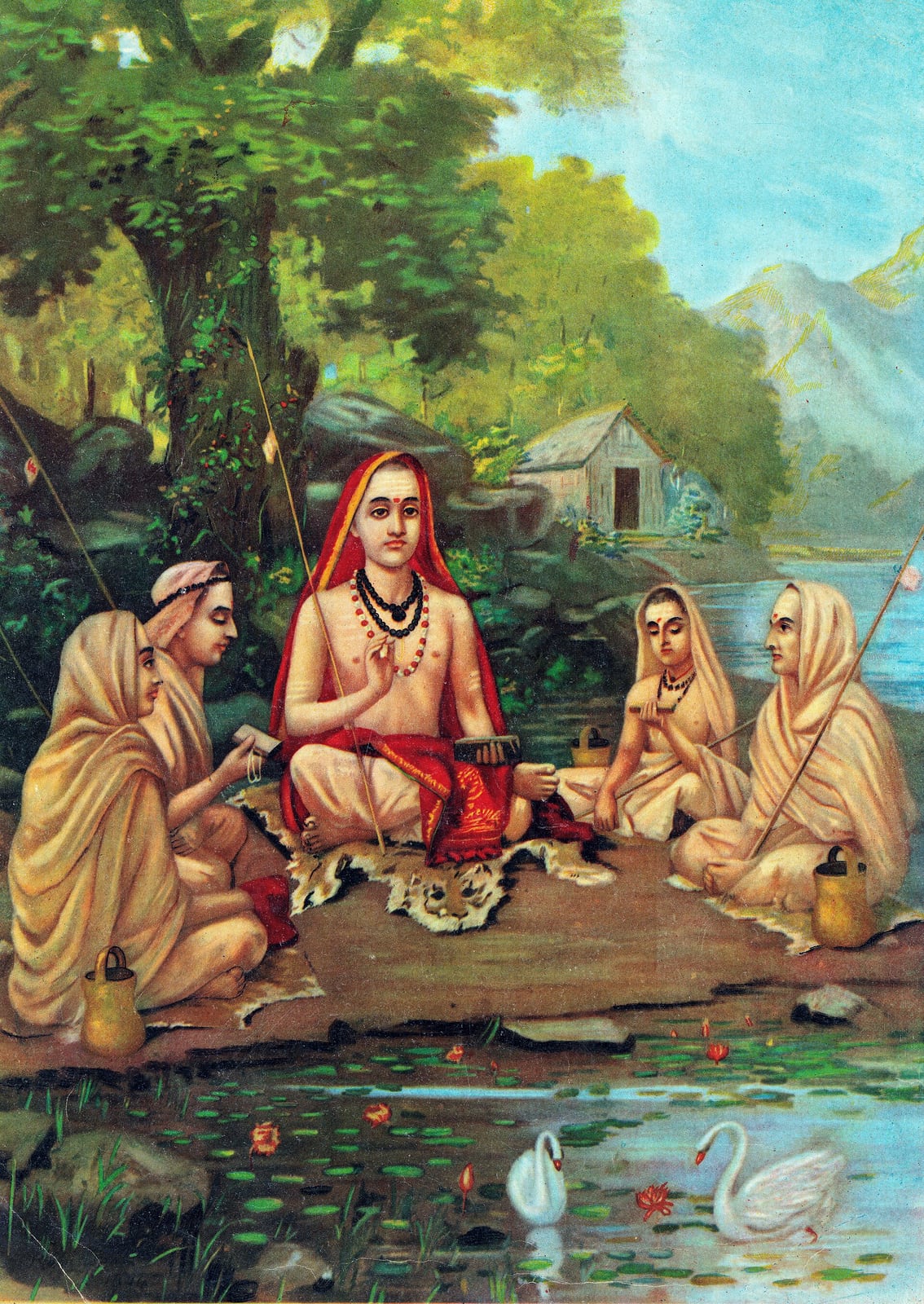
Adi Shankara
Совпадают в вопросах: Что такое Абсолют? Существует ли Бог? · Кто я? Существует ли истинное «я»? · Почему мы страдаем?
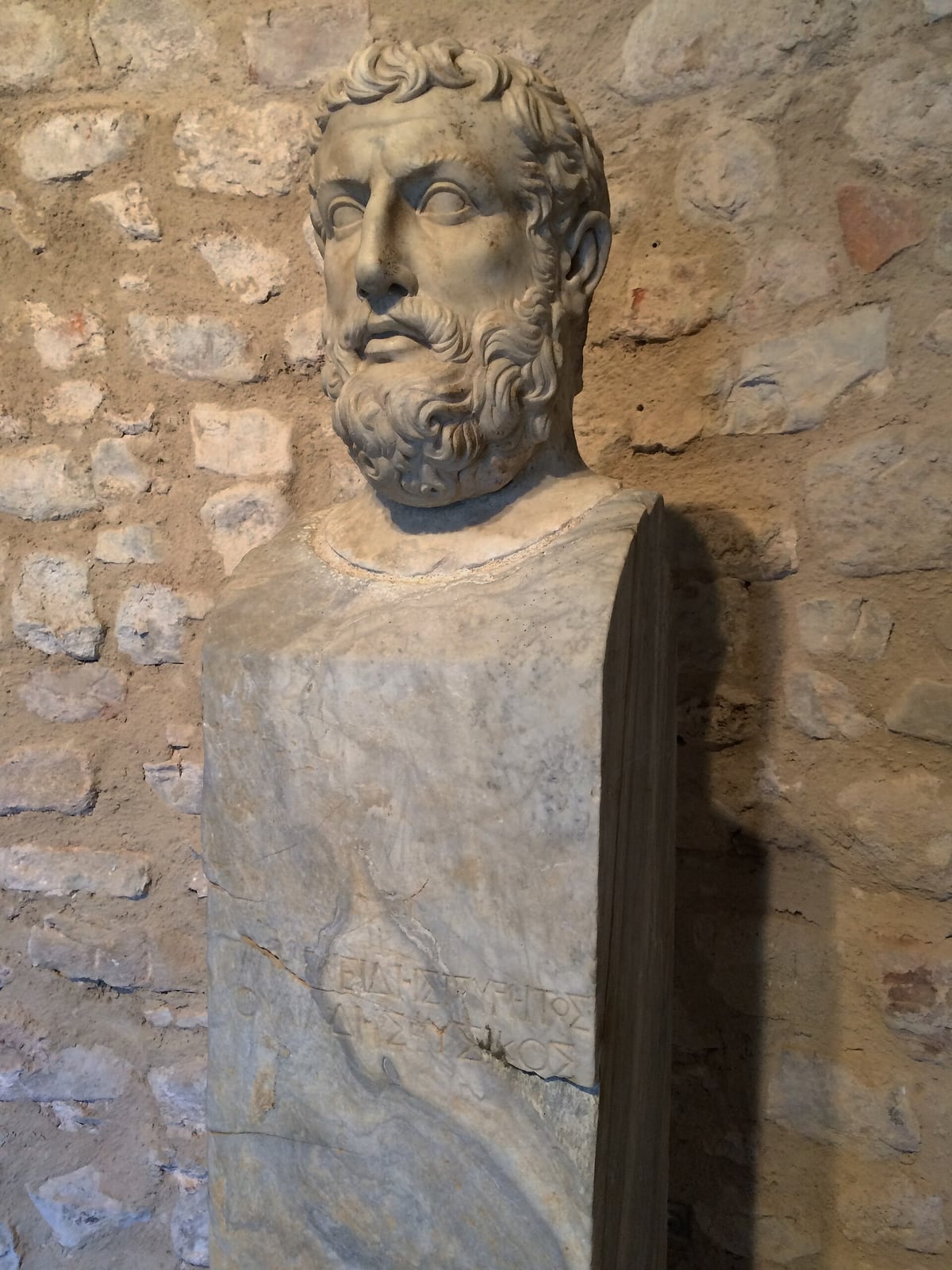
Parmenides
Совпадают в вопросах: Что такое Абсолют? Существует ли Бог? · Как достигается освобождение или спасение? · Реален ли мир?
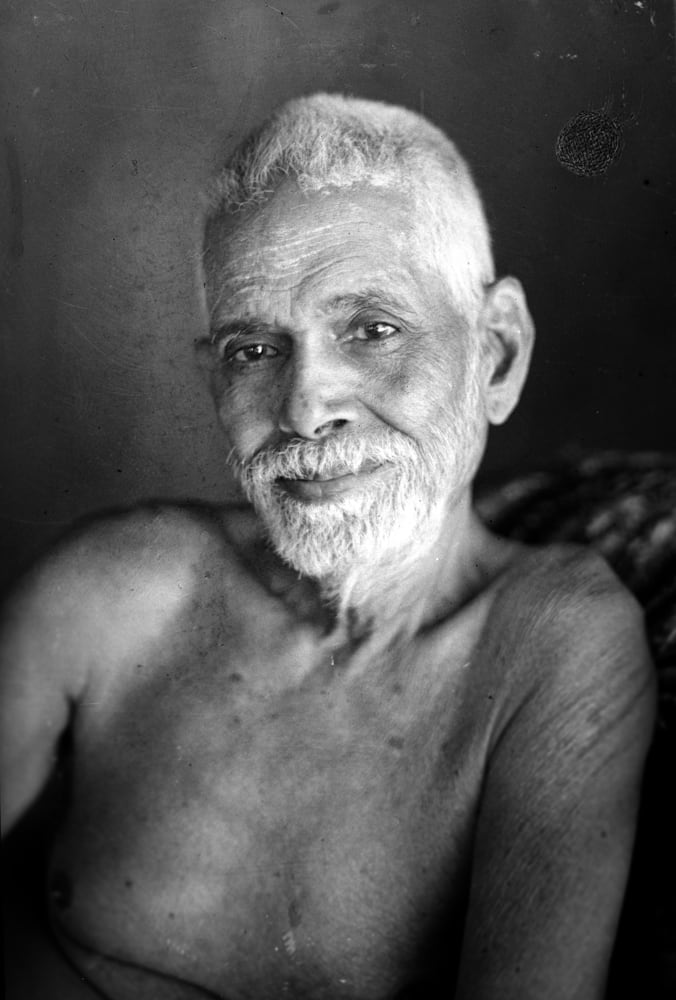
Ramana Maharshi
Совпадают в вопросах: Что такое Абсолют? Существует ли Бог? · Реален ли мир? · Кто я? Существует ли истинное «я»?
Ashtavakra
Совпадают в вопросах: Что такое Абсолют? Существует ли Бог? · Кто я? Существует ли истинное «я»? · Почему мы страдаем?
Дальше всего от

Francis of Assisi
Расходятся в вопросах: Кто я? Существует ли истинное «я»? · Реален ли мир?
Fyodor Dostoevsky
Расходятся в вопросах: Кто я? Существует ли истинное «я»? · Реален ли мир?
Guru Nanak
Расходятся в вопросах: Кто я? Существует ли истинное «я»? · Реален ли мир?
Ignatius of Loyola
Расходятся в вопросах: Кто я? Существует ли истинное «я»? · Реален ли мир?
Предания и рассказы
Предания и рассказы
Документированоss. VI–VII
The whirling firebrand
Происхождение рассказа: Māṇḍūkya Kārikā 4.47–52. It is classified as "documented" because it is an image from the text itself, not an event of his life.
Источник: King, Richard. Early Advaita Vedānta and Buddhism: The Mahāyāna Context of the Gauḍapādīya-kārikā. Albany: State University of New York Press, 1995.
Оспариваетсяss. VII–VIII
The teacher's teacher
Происхождение рассказа: Closing verses of the Māṇḍūkya-kārikā-bhāṣya ascribed to Śaṅkara; Potter's interpretation (1981). Comans (2000) argues for the Kārikā's direct influence on Śaṅkara from the number of quotations.
Источник: Potter, Karl H. (ed.). Encyclopedia of Indian Philosophies, vol. III: Advaita Vedānta up to Śaṃkara and His Pupils. Princeton: Princeton University Press / Delhi: Motilal Banarsidass, 1981 (sección sobre Gauḍapāda).
Житийное повествованиеrelato de las hagiografías de Śaṅkara (ss. XIV–XVII)
The meeting at Badarī
Происхождение рассказа: A tradition recorded in the Śaṅkaradigvijayas; the exact canto has not been located (see "pending"). Swami Nikhilananda, in the introduction to his translation, summarizes the tradition of his retreat at Badarikāśrama.
Документированоss. VI–VIII
Verses in a Buddhist book
Происхождение рассказа: Potter (1981), Nakamura and King (1995). The exact extent of the overlap with Bhāvaviveka (literal quotation or common source) is debated.
Источник: Potter, Karl H. (ed.). Encyclopedia of Indian Philosophies, vol. III: Advaita Vedānta up to Śaṃkara and His Pupils. Princeton: Princeton University Press / Delhi: Motilal Banarsidass, 1981 (sección sobre Gauḍapāda).
Учение
Учение
Понятия, на которых строится мысль учителя, объяснённые в их контексте.
Ajātivāda (the doctrine of non-origination)ajativada
Māṇḍūkya Kārikā 2.32, 3.15, 3.48, 4.3–4.23.
Источник: Wood, Thomas E. The Māṇḍūkya Upaniṣad and the Āgama Śāstra: An Investigation into the Meaning of the Vedānta. Honolulu: University of Hawaii Press, 1990 (Monographs of the Society for Asian and Comparative Philosophy, 8).
Turīya (the fourth)turiya
Māṇḍūkya Upaniṣad 7; Kārikā 1.10–1.29.
Asparśa-yoga (the yoga of no contact)asparsa-yoga
Māṇḍūkya Kārikā 3.31–3.46.
Источник: Bhattacharya, Vidhushekhara (ed. y trad.). The Āgamaśāstra of Gauḍapāda. Calcuta: University of Calcutta, 1943. Reimpr. Delhi: Motilal Banarsidass, 1989, con prólogo de Christian Lindtner.
Ghaṭākāśa (the space in the jar)ghatakasa
Māṇḍūkya Kārikā 3.3–3.9.
Alāta (the firebrand and the vibration of consciousness)alata-cakra
Māṇḍūkya Kārikā 4.45–4.52; Bhattacharya 1943; King 1995.
Источник: King, Richard. Early Advaita Vedānta and Buddhism: The Mahāyāna Context of the Gauḍapādīya-kārikā. Albany: State University of New York Press, 1995.
Видео
Видео
Записи, интервью и документальные фильмы. Видео воспроизводятся с YouTube; здесь они не хранятся.
The Essence of All Vedanta (Based on Mandukya Karika - Part One) - Swami Sarvapriyananda
Лекция· EN· 2021· 74 min
Vedanta Video
The Ultimate Truth (Based on Mandukya Karika - Part Two) - Swami Sarvapriyananda
Лекция· EN· 2021· 71 min
Vedanta Video
5. Mandukya Upanishad | Chapter 1 Karika 1-5 | Swami Sarvapriyananda
Лекция· EN· 2020· 97 min
Vedanta Society of New York - ArchivesОфициальный канал
16. Mandukya Upanishad | Chapter 1 Karika 24-29 | Swami Sarvapriyananda
Лекция· EN· 2020· 116 min
Vedanta Society of New York - ArchivesОфициальный канал
24. Mandukya Upanishad | Chapter 2 Karika 16-18 | Swami Sarvapriyananda
Лекция· EN· 2020· 93 min
Vedanta Society of New York - ArchivesОфициальный канал
Swami Sarvapriyananda | Mandukya Upanishad, 1 of 6 | Sivananda Ashram
Лекция· EN· 2020· 56 min
Vivekananda Samiti, IIT Kanpur
"Turiya - Based on Mandukya Upanishad" - 1 - Swami Sarvapriyananda
Лекция· EN· 2026· 123 min
Ramakrishna Vedanta Ashrama PittsburghОфициальный канал
Gaudapada - Shankaracharya's Guru's Guru | Swami Samarpanananda
Лекция· EN· 2021· 10 min
Amrit Setu
The doctrine Alatashanti in Gaudapadacarya's Mandukya Karika by Swamini Brahmaprakasananda
Лекция· EN· 2022· 83 min
Advaita Academy
Māṇḍūkya Upaniṣad and Kārikā (Āgama Prakaraṇa)
Лекция· EN· 2024· 16 min
Svatantra Institute
Mandukya-Karikas | Swami Paramarthananda
Лекция· EN· 2020· 48 min
Swami Paramarthananda - Topic
The Shortest Path to the Self | Mandukya Upanishad & Gaudapada Karika – Introduction [#1]
Лекция· EN· 2026· 18 min
Yes Vedanta - Andre Vas
Mandukya Upanishad pravachan मांडूक्योपनिषद आगम प्रकरण। by Akhandananda Saraswati ji maharaj
Лекция· HI· 2023· 42 min
Divya Aadhyatmik Gyan
4 - MANDUKYA - CAMINO A LA REALIZACIÓN
Разбор· ES· 2022· 13 min
Vedanta en Español
Галерея
Галерея
Изображения с проверенной лицензией. Каждое сохраняет своё авторство и атрибуцию.
Рукописи
Рукописи
Рукописные свидетельства и древние тексты, с указанием хранителя и условий доступа.
SA · Devanagari · c. ss. VI–VII
गौडपादकारिका
- Сохранившийся список
- Manuscrito en papel sin fecha publicada
- Оцифровка
- commons.wikimedia.org/wiki/File:Gaudapada_Manduk…
Связи
Связи
Влияния, ученичество и близость взглядов. Документированная связь отличается от сходства, выявленного путём анализа.
Учитель
Govinda Bhagavatpāda
According to the Advaita genealogy, Gauḍapāda was the teacher of Govinda, Śaṅkara's teacher. Potter and Comans warn that this may be a relation of lineage rather than a direct one.
Сходство, выявленное путём анализа
Повлиял на
Śaṅkara quotes the Kārikā in his Brahmasūtra commentary (e.g. 1.16 at 2.1.9) as the work of "the teachers who know the tradition of Vedānta"; the commentary on the Kārikā ascribed to him calls him "supreme teacher".
Документированная связь
Испытал влияние
Bhattacharya, Murti and King show the Kārikā's debt, especially in the fourth chapter, to Madhyamaka dialectic (non-origination, conventional and ultimate truth).
Документированная связь
Испытал влияние
The Kārikā (3.26) quotes the Bṛhadāraṇyaka's "neti neti" and relies on its analysis of the states of consciousness.
Документированная связь
Испытал влияние
The Kārikā (3.15) reinterprets the clay and iron examples of Chāndogya 6.1 as teaching devices for introducing non-duality.
Документированная связь
Испытал влияние
The traditional Advaita genealogy (Nārāyaṇa, Brahmā, Vasiṣṭha, Śakti, Parāśara, Vyāsa, Śuka, Gauḍapāda, Govinda, Śaṅkara) makes him a disciple of Śuka, Vyāsa's son. It is a devotional, not historical, lineage.
Сходство, выявленное путём анализа
Испытал влияние
Vasiṣṭha appears in the same traditional Advaita genealogy that ends with Gauḍapāda and Śaṅkara.
Сходство, выявленное путём анализа
Расходился во взглядах с
The fourth chapter of the Kārikā (4.11–4.13) refutes the Sāṃkhya theory of causation, according to which the cause is transformed into the effect. The commentary on the Sāṃkhya Kārikā circulating under Gauḍapāda's name is probably by a namesake.
Документированная связь
Идеи, близкие к
The Avadhūta Gītā and the Avadhūta Upaniṣad, linked to Dattātreya, share the language of non-origination; verse 2.32 of the Kārikā reappears in texts of this milieu.
Сходство, выявленное путём анализа
Идеи, близкие к
The Aṣṭāvakra Gītā expresses a radical non-duality, without bondage or liberation, close to that of the Kārikā.
Сходство, выявленное путём анализа
Идеи, близкие к
Ramana often presented non-origination (ajātivāda) as the ultimate truth, in terms very close to Gauḍapāda's.
Сходство, выявленное путём анализа
Идеи, близкие к
His insistence that one has never been born recalls the doctrine of non-origination.
Сходство, выявленное путём анализа
Источники
Источники
Библиография и каталоги, использованные для этой статьи.
- Wikidata, «Gaudapada», QID Q1771062.
- Bhattacharya, Vidhushekhara (ed. y trad.). The Āgamaśāstra of Gauḍapāda. Calcuta: University of Calcutta, 1943. Reimpr. Delhi: Motilal Banarsidass, 1989, con prólogo de Christian Lindtner.
- King, Richard. Early Advaita Vedānta and Buddhism: The Mahāyāna Context of the Gauḍapādīya-kārikā. Albany: State University of New York Press, 1995.
- Karmarkar, Raghunath Damodar (ed. y trad.). Gauḍapāda-Kārikā. Poona: Bhandarkar Oriental Research Institute, 1953 (Government Oriental Series, B 9).
- Nakamura, Hajime. A History of Early Vedānta Philosophy, Part Two. Trad. de Trevor Leggett et al. Delhi: Motilal Banarsidass, 2004 (original japonés, 1950–1956).
- Potter, Karl H. (ed.). Encyclopedia of Indian Philosophies, vol. III: Advaita Vedānta up to Śaṃkara and His Pupils. Princeton: Princeton University Press / Delhi: Motilal Banarsidass, 1981 (sección sobre Gauḍapāda).
- Wood, Thomas E. The Māṇḍūkya Upaniṣad and the Āgama Śāstra: An Investigation into the Meaning of the Vedānta. Honolulu: University of Hawaii Press, 1990 (Monographs of the Society for Asian and Comparative Philosophy, 8).
- Comans, Michael. The Method of Early Advaita Vedānta: A Study of Gauḍapāda, Śaṅkara, Sureśvara and Padmapāda. Delhi: Motilal Banarsidass, 2000.
- Dvivedi, Manilal Nabhubhai (trad.). The Māṇḍūkyopanishad with Gauḍapāda's Kārikās and the Bhāshya of Śaṅkara. Bombay: Tookaram Tatya (Bombay Theosophical Publication Fund), 1894.
- Colebrooke, Henry Thomas, y Horace Hayman Wilson (trads.). The Sánkhya Káriká, or Memorial Verses on the Sánkhya Philosophy, by Íswara Krishńa; also the Bháshya or Commentary of Gaurapáda. Oxford: Oriental Translation Fund, 1837 (reimpr. Bombay, 1887).
- Larson, Gerald James, y Ram Shankar Bhattacharya (eds.). Encyclopedia of Indian Philosophies, vol. IV: Sāṃkhya. A Dualist Tradition in Indian Philosophy. Princeton: Princeton University Press / Delhi: Motilal Banarsidass, 1987 (sobre el Gauḍapāda-bhāṣya).
- Murti, T. R. V. The Central Philosophy of Buddhism: A Study of the Mādhyamika System. Londres: George Allen and Unwin, 1955.
- Wikipedia (en inglés), «Gaudapada», consultada el 26 de octubre de 2026 (obras atribuidas, recepción en Dvaita y Viśiṣṭādvaita, Kavale maṭha, opiniones de Mayeda y Nikhilananda).
- Wikisource en sánscrito, «गौडपादकारिका», texto por prakaraṇa (प्रथमप्रकरणम् – चतुर्थप्रकरणम्), con numeración de estrofas.
- Bouy, Christian (ed. y trad.). Gauḍapāda, L'Āgamaśāstra: un traité vedāntique en quatre chapitres. París: Collège de France, Institut de civilisation indienne, 2000.
- Dalal, Neil. «Śaṅkara». En Edward N. Zalta (ed.), The Stanford Encyclopedia of Philosophy, 2021.
- Wikimedia Commons, ficheros y metadatos de licencia consultados mediante la API (imageinfo/extmetadata).
- Wikidata, «Shri Gaudapadacharya Math» (Kavale maṭha, Goa), QID Q13479755.
- Jones, Richard H. Gauḍapāda: Advaita Vedānta's First Philosopher. Nueva York: Jackson Square Books, 2014.
- Raphael (trad. y coment.). Māṇḍūkyakārikā: The Metaphysical Path of Vedānta. Nueva York: Aurea Vidyā Foundation, 2002.
- Правообладатель
- El texto sánscrito es de dominio público. Las traducciones modernas tienen derechos propios: Advaita Ashrama (Nikhilananda), Motilal Banarsidass (Bhattacharya), University of Hawaii Press (Wood), Aurea Vidyā (Raphael), Central Chinmaya Mission Trust, Biblioteca Nueva, Collège de France (Bouy), E. Richter. Las de Dvivedi (1894) y de Colebrooke y Wilson (1837) son de dominio público.
Ожидает подтверждения
То, что в этой статье пока не удалось установить. Мы предпочитаем сказать об этом, а не заполнять пробел.
- Śaṅkaradigvijaya: localizar el canto exacto en que se narra el encuentro de Śaṅkara con Gauḍapāda (edición de Mādhava/Vidyāraṇya) y otras hagiografías que lo recogen.
- Sureśvara: comprobar en la Naiṣkarmyasiddhi (4.41–4.44) las citas de la Kārikā y la mención de «los gauḍa».
- Bhāvaviveka: precisar qué estrofas de la Kārikā coinciden con el capítulo 8 del Madhyamakahṛdaya y si se trata de cita literal o de fuente común (Lindtner, Nakamura, King).
- Edición española de Biblioteca Nueva (ISBN 9788497423670): identificar traductor y comentarista.
- Karmarkar (1953): confirmar la fecha de muerte de R. D. Karmarkar para resolver los derechos de la transcripción de Wikisource.
- Ediciones: buscar ISBN de traducciones al italiano (edición original de Raphael, Āśram Vidyā), ruso e hindi; buscar una traducción española con ISBN además de la de Biblioteca Nueva.
- Relación con Ramana Maharshi: localizar en los Talks o en otras obras documentadas la cita exacta en la que Ramana habla del ajātivāda o de la estrofa 2.32.
- Relaciones: el slug govinda-bhagavatpada no existe todavía en el Atlas (lo usa también adi-shankara).
- Vídeos: no se ha encontrado una clase universitaria ni un documental de televisión pública sobre Gauḍapāda; tampoco una conferencia monográfica en español de una institución solvente.
Исследовано 2026-10-26