Filosofia socratica
Socrates
Σωκράτης
ca. 469 a.C. – 399 a.C.Persona storicamente documentata
Filosofo ateniese (c. 469-399 a.C.) che non scrisse nulla e cambiò il corso della filosofia facendo della domanda su come si debba vivere il suo oggetto centrale. Conversava nell'agorà, esaminando chi credeva di sapere, senza farsi pagare. Accusato di empietà e di corrompere i giovani, fu condannato a morte e bevve la cicuta. Lo conosciamo attraverso Platone, Senofonte, Aristofane e Aristotele, i cui ritratti non coincidono: è la «questione socratica».
- opere
- 31opere
- edizioni
- 104edizioni
- citazioni
- 9citazioni
- video
- 13video
- immagini
- 9immagini
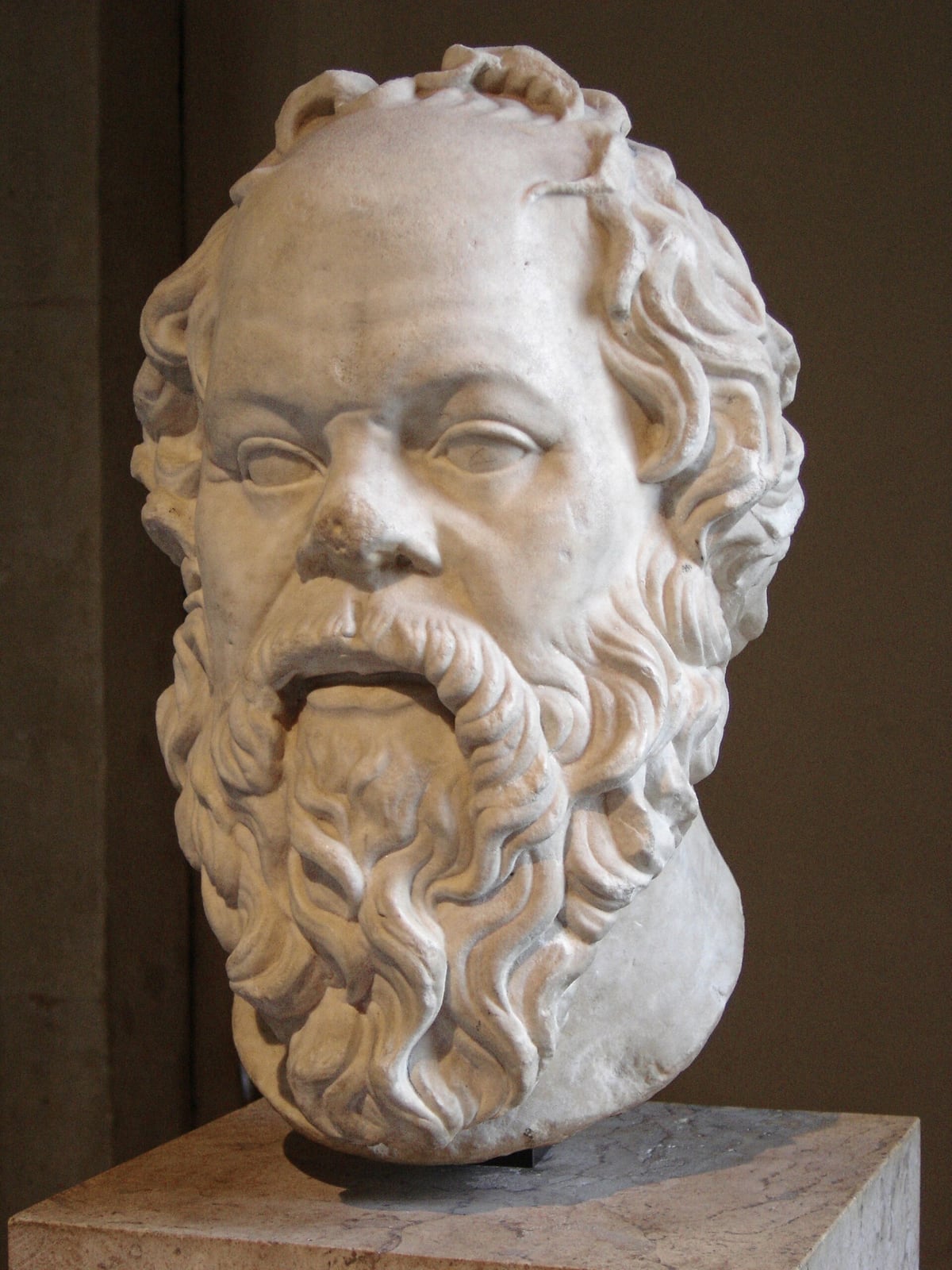
Busto de Sócrates (Louvre) · Public domain
Con le sue parole
«The unexamined life is not worth living.»Platón, Apología 38a. Griego: ed. Burnet (OCT); inglés: Benjamin Jowett (1892); español: traducción propia. Son palabras que Platón atribuye a Sócrates.

La sua idea centrale
Elenchus (Socratic refutation): The *elenchus*—"test", "refutation"—is the procedure Plato's early dialogues attribute to Socrates.
Vederlo nel contesto
Biografia
6 min di lettura
Traduzione assistita dall'originale spagnolo, in attesa di revisione da parte di un traduttore madrelingua.
L'uomo che non scrisse nulla
Socrate non lasciò una sola riga scritta. Tutto ciò che sappiamo di lui ci viene da altri: dai dialoghi del suo discepolo Platone, dagli scritti socratici di Senofonte, dalla commedia di Aristofane che lo mise in ridicolo quando era ancora in vita, dalle notizie che Aristotele — nato quindici anni dopo la sua morte — raccolse nell'Accademia e dalla tarda compilazione di Diogene Laerzio, del III secolo d.C. Queste testimonianze non concordano. Il Socrate di Aristofane è un ciarlatano che specula sulle nuvole e insegna a vincere cause ingiuste; quello di Senofonte, un moralista assennato che dà buoni consigli agli amici; quello di Platone, un pensatore di una profondità impareggiabile che, nei dialoghi tardi, diventa portavoce di dottrine che probabilmente non sostenne mai.
Questa distanza tra le fonti prende il nome di «questione socratica». La formulò Friedrich Schleiermacher nel 1818, chiedendosi che cosa potesse essere stato Socrate perché Platone e Senofonte lo ritraessero come lo ritrassero. Da allora alcuni si sono affidati a Senofonte per la sua apparente sobrietà; altri, come Gregory Vlastos, hanno ricostruito un Socrate storico a partire dai primi dialoghi platonici; altri ancora, come Olof Gigon o Charles Kahn, hanno sottolineato che i «discorsi socratici» erano un genere letterario coltivato da diversi discepoli, nessuno dei quali intendeva redigere un verbale. Quanto segue distingue, per quanto possibile, ciò che le fonti hanno in comune da ciò che ciascuna aggiunge di suo.
Alopece
Nacque ad Atene intorno al 469 a.C. — Diogene Laerzio, seguendo la cronologia di Apollodoro, colloca la nascita nel quarto anno della 77ª Olimpiade — nel demo di Alopece, della tribù Antiochide. Il padre, Sofronisco, era scalpellino o scultore; la madre, Fenarete, levatrice, mestiere che lo stesso Socrate avrebbe trasformato, nel Teeteto, in immagine del proprio metodo. Sposò tardi Santippe, da cui ebbe tre figli — Lamprocle, Sofronisco e Menesseno; Aristotele, citato da Diogene, gli attribuisce anche una seconda moglie, Mirto, notizia che la critica considera dubbia.
Crebbe nell'Atene di Pericle, nella generazione che vide sorgere il Partenone e fiorire la tragedia, la sofistica e l'indagine sulla natura. Platone lo fa conversare da giovane con Parmenide e Zenone, un incontro probabilmente letterario, e lo presenta interessato in gioventù alla fisica di Anassagora, alla quale avrebbe rinunciato non trovandovi risposta alla domanda sul bene.
Il soldato e il cittadino
Servì come oplita, il che presuppone in gioventù una certa agiatezza. Combatté a Potidea (432-430 a.C.), dove, secondo il racconto che Platone mette in bocca ad Alcibiade nel Simposio, gli salvò la vita e sopportò l'inverno a piedi nudi; nella ritirata di Delio (424 a.C.), dove la sua calma impressionò gli strateghi; e ad Anfipoli (422 a.C.). L'Apologia ricorda queste tre campagne come prova del fatto che non abbandonò mai il posto che gli era stato assegnato.
Ricoprì una sola carica pubblica, e per sorteggio. Nel 406 a.C., come membro del Consiglio durante la pritania della sua tribù, si oppose a che si giudicassero in blocco, contro la legge, gli strateghi vincitori alle Arginuse, accusati di non aver soccorso i naufraghi. Due anni dopo, sotto l'oligarchia dei Trenta, ricevette insieme ad altri quattro l'ordine di arrestare Leone di Salamina per metterlo a morte, e se ne tornò a casa. Platone e Senofonte concordano su entrambi gli episodi.
La domanda come mestiere
Il suo mestiere fu conversare. Lo faceva nell'agorà, nei ginnasi e nelle case degli amici, senza farsi pagare — a differenza dei sofisti, con i quali molti lo confondevano — e in una povertà che l'Apologia definisce estrema. Era celebre la sua bruttezza: naso camuso, occhi sporgenti, aria da sileno. Secondo l'Apologia, l'amico Cherefonte chiese a Delfi se ci fosse qualcuno più sapiente di lui e la Pizia rispose di no; Socrate, sconcertato, esaminò politici, poeti e artigiani, e concluse che il suo unico vantaggio consisteva nel non credere di sapere ciò che non sapeva. Da allora intese il suo esame degli altri come un servizio reso al dio.
Quell'esame — l'élenchos — consisteva nel chiedere una definizione del coraggio, della pietà o della giustizia, nell'ottenere l'assenso dell'interlocutore ad altre proposizioni e nel mostrargli che la definizione iniziale era incompatibile con esse. Aristotele gli attribuisce due contributi: i ragionamenti induttivi e la ricerca di definizioni universali, applicati alle questioni morali, senza separare quegli universali dalle cose, come avrebbe fatto Platone con le Idee. Socrate parlava anche di un segno divino, il suo daimónion, una voce che fin da bambino lo distoglieva da certi atti e non lo spingeva mai a fare nulla.
Le nuvole
Nel 423 a.C. Aristofane portò in scena Le nuvole, dove un Socrate sospeso in una cesta dirige un «pensatoio» in cui si studiano i fenomeni celesti, si sostituisce Zeus con i vortici e si insegna il discorso ingiusto. La commedia si classificò terza, ma la caricatura sopravvisse: nell'Apologia Socrate annovera tra i suoi «primi accusatori» coloro che diffusero quell'immagine e nomina espressamente il commediografo. Anche il legame di Socrate con Alcibiade, che tradì Atene, e con Crizia, il più radicale dei Trenta, pesò contro di lui.
Il processo
Nella primavera del 399 a.C. Meleto, sostenuto da Anito e Licone, lo accusò di non riconoscere gli dèi della città, di introdurre nuove divinità e di corrompere i giovani; chiese la pena di morte. Poiché l'amnistia del 403 impediva di perseguire i reati politici precedenti, l'accusa fu formulata in termini religiosi. Davanti a una giuria di circa cinquecento cittadini, Socrate si difese senza suppliche né lacrime. Fu condannato con uno scarto di una sessantina di voti, come si ricava dall'Apologia platonica; invitato a proporre una pena alternativa, suggerì dapprima di essere mantenuto a spese dello Stato nel Pritaneo e poi una multa di trenta mine garantita da Platone, Critone, Critobulo e Apollodoro. La giuria votò la morte.
L'esecuzione fu rinviata di una trentina di giorni perché la nave sacra inviata a Delo non era ancora tornata e la città non poteva giustiziare nessuno in sua assenza. Critone gli offrì la fuga, e Socrate la rifiutò: nel dialogo che porta il suo nome, le Leggi di Atene gli ricordano che ha vissuto settant'anni sotto la loro protezione e che non può rispondere a un'ingiustizia con un'altra.
La morte
Il Fedone narra l'ultimo giorno. Platone non era presente — «Platone, credo, era malato», dice il narratore — e il dialogo, incentrato sulle prove dell'immortalità dell'anima, è un'opera d'arte e di dottrina più che un verbale. Sul far della sera Socrate si lavò, si congedò dalla moglie e dai figli, bevve il veleno — la cicuta, secondo l'identificazione tradizionale — e camminò finché non sentì le gambe farsi pesanti. Quando il freddo gli saliva verso il cuore si scoprì il volto e disse a Critone che dovevano un gallo ad Asclepio e che non si dimenticassero di pagarlo. Furono, secondo Fedone, le sue ultime parole.
Ciò che rimase
Dalla sua cerchia nacquero scuole in contrasto tra loro: l'Accademia di Platone, i cinici che si richiamavano ad Antistene, i cirenaici di Aristippo, i megarici di Euclide. Gli stoici lo considerarono il modello del saggio, ed Epitteto lo cita di continuo. In età moderna Kierkegaard dedicò la sua tesi all'ironia socratica (1841), Nietzsche fece di lui il sintomo di una decadenza (1889) e Jacques-Louis David fissò nel 1787 l'immagine della sua morte serena. Resta, per la tradizione occidentale, la figura del filosofo che preferì morire piuttosto che smettere di esaminare la vita.
Fonti: Platón. Platonis Opera, ed. John Burnet, 5 vols. Oxford University Press (Oxford Classical Texts), 1900–1907; tomo I (Eutifrón, Apología, Critón, Fedón) consultado en la edición digital del Perseus Digital Library (Tufts University). · Plato. The Dialogues of Plato, trad. Benjamin Jowett, 3.ª ed., 5 vols. Clarendon Press, Oxford, 1892 (Project Gutenberg, n.º 1656 Apology, 1657 Crito, 1658 Phaedo y otros). · Platón. Obras completas, trad. Patricio de Azcárate, 11 vols. Medina y Navarro, Madrid, 1871–1872 (edición digital en Filosofía en español). · Jenofonte. Memorables (Recuerdos de Sócrates), Apología de Sócrates, Banquete y Económico. Texto griego: Xenophontis opera omnia, ed. E. C. Marchant, vol. 2, 2.ª ed., Clarendon Press, Oxford, 1921 (Perseus); trad. inglesa de H. G. Dakyns, The Works of Xenophon, Macmillan, Londres, 1890–1897 (Project Gutenberg). · Aristófanes. Las nubes (Νεφέλαι), representada en 423 a. C.; trad. inglesa de W. J. Hickie, The Comedies of Aristophanes, Bohn's Classical Library, Londres, 1853 (Project Gutenberg n.º 2562).
Cronologia
La vita, anno per anno
Ogni punto è un evento documentato. Fai clic per leggerlo, con la sua fonte e il suo grado di certezza.
ca. 469 a.C.0 anniAlopece (Atenas)
Birth
Born in the deme of Alopece, son of the stonemason Sophroniscus and the midwife Phaenarete. Diogenes Laertius (II 44), following Apollodorus, gives the fourth year of the 77th Olympiad (469/468 BCE); Wikidata records 470. Years BCE are expressed as negative numbers.
ProbabileDiógenes Laercio. Vidas y opiniones de los filósofos ilustres, libro II, 18–47 (Sócrates), s. III d. C. Trad. inglesa de C. D. Yonge, Bohn, Londres, 1853 (Project Gutenberg n.º 57342); trad. española de José Ortiz y Sanz, Madrid, 1792 (Wikisource).
Dopo la sua morte
- ca. 395 a.C.The "Socratic discourses"
- ca. 387 a.C.Founding of the Academy
- 1787David's Death of Socrates
- 1818Schleiermacher poses the "Socratic problem"
- 1841Kierkegaard on irony
ca. 469 a.C. · 0 anni
Birth
Born in the deme of Alopece, son of the stonemason Sophroniscus and the midwife Phaenarete. Diogenes Laertius (II 44), following Apollodorus, gives the fourth year of the 77th Olympiad (469/468 BCE); Wikidata records 470. Years BCE are expressed as negative numbers.
Probabile
ca. 432 a.C. · 37 anni
The Potidaea campaign
Serves as a hoplite at the siege of Potidaea (432–430 BCE). In the Symposium (219e–220e) Alcibiades says Socrates saved his life and endured the winter barefoot.
Probabile
424 a.C. · 45 anni
The retreat from Delium
Takes part in the Athenian defeat at Delium; the Laches (181b) and the Symposium (221a–b) praise his composure during the retreat.
Probabile
423 a.C. · 46 anni
Aristophanes' Clouds
Aristophanes stages the Clouds at the City Dionysia, caricaturing Socrates as a teacher of speculative physics and unscrupulous rhetoric. It comes third; the surviving text is a later revision that was never staged.
Documentato
422 a.C. · 47 anni
Amphipolis
Last military campaign attributed to him in the Apology (28e).
Probabile
406 a.C. · 63 anni
The Arginusae trial
As a member of the Council, during the prytany of the tribe Antiochis, he opposes trying the generals of Arginusae en bloc, against the law (Apology 32b; Xenophon, Hellenica I 7.15).
Documentato
404 a.C. · 65 anni
Leon of Salamis
Under the Thirty Tyrants he refuses the order to arrest Leon of Salamis for execution (Apology 32c–d; Xenophon, Memorabilia IV 4.3).
Documentato
403 a.C. · 66 anni
Democratic restoration and amnesty
Fall of the Thirty. The amnesty forbids prosecution for earlier political offences, which partly explains the religious framing of the 399 charge.
Documentato
399 a.C. · 70 anni
Trial
Meletus, Anytus and Lycon accuse him of impiety and of corrupting the youth. He is convicted by about sixty votes before a jury of some five hundred citizens and sentenced to death.
Documentato
399 a.C. · 70 anni
Death
After some thirty days' wait for the return of the Delian ship, he drinks the poison in prison, surrounded by his friends (Phaedo 116a–118a; Xenophon, Memorabilia IV 8.2).
Documentato
ca. 395 a.C.
The "Socratic discourses"
Plato, Xenophon, Aeschines of Sphettus, Antisthenes, Phaedo and others write dialogues with Socrates as protagonist; Aristotle (Poetics 1447b) treats them as a genre of their own. Except for Plato's and Xenophon's, almost all survive only in fragments.
Documentato
ca. 387 a.C.
Founding of the Academy
Plato founds his school in the grove of Academus; the dialogues read there will fix the image of Socrates for posterity.
Probabile
1787
David's Death of Socrates
Jacques-Louis David shows at the Salon the painting that fixes the modern image of Socrates' death, now in the Metropolitan Museum, New York.
Documentato
1818
Schleiermacher poses the "Socratic problem"
In "Über den Werth des Sokrates als Philosophen" Schleiermacher asks how to reconcile Plato's and Xenophon's portraits: the critical question of the historical Socrates is born.
Documentato
1841
Kierkegaard on irony
Søren Kierkegaard defends his dissertation On the Concept of Irony with Continual Reference to Socrates.
Documentato
Opere
Opere essenziali
Le opere senza le quali non si comprende la sua eredità.
Insegnamento orale raccolto · ca. 395 a.C.
Apology of Socrates
Ἀπολογία Σωκράτους
Socrates' defence speech before the Athenian court in 399 BCE, in three parts: the defence against the "first accusers" and against Meletus; the counter-proposal of a penalty after the verdict; and closing words to the jurors. It contains the account of the Delphic oracle, the image of the gadfly that rouses the city, the statement that he will obey the god rather than the Athenians and the dictum that the unexamined life is not worth living. It is the main source for reconstructing the trial and Socrates' understanding of himself.
6 edizioni
Insegnamento orale raccolto · ca. 395 a.C.
Crito
Κρίτων
In prison, at dawn, his old friend Crito tells Socrates that the ship from Delos is about to arrive and offers him an escape, already arranged and paid for. Socrates examines whether it is just to flee: one must not answer an injustice with another, and the personified Laws of Athens remind him that for seventy years he has accepted living under them. It is the classic text on the obligation to obey the law and one of the first arguments about the compact between citizen and city.
6 edizioni

Insegnamento orale raccolto · ca. 385 a.C.
Phaedo
Φαίδων
Account of Socrates' last day, told by Phaedo of Elis to Echecrates at Phlius. Socrates talks with the Thebans Simmias and Cebes, who had frequented Pythagoreans, about why the philosopher does not fear death, and sets out four arguments for the immortality of the soul and a myth about the fate of souls. The dialogue closes with the death scene: the bath, the farewell to his family, the cup of poison and the last words to Crito about the cock owed to Asclepius (118a).
6 edizioni

Raccolta posteriore · ca. 371 a.C.
Memorabilia (Memoirs of Socrates)
Ἀπομνημονεύματα
Four books that begin by refuting one by one the charges of impiety and corruption of the young, and go on to dozens of short conversations: Socrates advises his son Lamprocles to be patient with Xanthippe, talks with the sophist Antiphon about poverty, with Aristippus about self-mastery, with craftsmen and generals about their trades. It is the portrait of a practical and pious teacher and the second great source on Socrates alongside Plato.
4 edizioni
Tutta la sua opera (31)
Euthyphro
395
Symposium
380
Socrates
Laches
The Conscious LibraryLaches
390
Socrates
Charmides
The Conscious LibraryCharmides
390
Socrates
Lysis
The Conscious LibraryLysis
390

Protagoras
385

Gorgias
385

Meno
385
Socrates
Ion
The Conscious LibraryIon
395
Socrates
Lesser Hippias
The Conscious LibraryLesser Hippias
395
Socrates
Euthydemus
The Conscious LibraryEuthydemus
385

Theaetetus
369
Phaedrus
370

Republic
375
Socrates
Greater Hippias
The Conscious LibraryGreater Hippias
390
Socrates
First Alcibiades
The Conscious LibraryFirst Alcibiades
360
Socrates
Parmenides
The Conscious LibraryParmenides
365
Socrates
Other dialogues of the Platonic corpus featuring Socrates
The Conscious LibraryOther dialogues of the Platonic corpus featuring Socrates
360
Apology of Socrates (Xenophon)
380
Symposium (Xenophon)
380
Oeconomicus (The Estate Manager)
362

The Clouds (Aristophanes)
423
Socrates
Aristotle's testimonies on Socrates
The Conscious LibraryAristotle's testimonies on Socrates
340

Life of Socrates (Diogenes Laertius, Lives II 18–47)
230
Citazioni
Citazioni localizzate in un'opera precisa. Ciascuna porta con sé la sua provenienza e il suo grado di affidabilità.
The unexamined life is not worth living.ὁ δὲ ἀνεξέταστος βίος οὐ βιωτὸς ἀνθρώπῳ
VerificataPlatón, Apología 38a. Griego: ed. Burnet (OCT); inglés: Benjamin Jowett (1892); español: traducción propia. Son palabras que Platón atribuye a Sócrates.
Citazioni apocrife o di attribuzione discussa (5)
«I know that I know nothing.»
The formula appears in no ancient text about Socrates. It is a later simplification of Apology 21d, where Socrates says something more precise: that he does not think he knows what he does not know. In Plato Socrates claims to know some things (for instance, that doing wrong is bad, Apology 29b).
«Know thyself.»
It is one of the maxims inscribed at the temple of Apollo at Delphi, older than Socrates and ascribed in antiquity to several of the Seven Sages. Socrates quotes and discusses it (Phaedrus 229e, Charmides 164d), but it is not his.
«There is only one good, knowledge, and one evil, ignorance.»
Only Diogenes Laertius (II 31) transmits it, more than six centuries later and without naming a source. It sums up Socratic intellectualism as a slogan, but it is not found in Plato or Xenophon.
«Education is the kindling of a flame, not the filling of a vessel.»
Attributed to Socrates online, it comes from Plutarch, On Listening (Moralia 48c), who says the mind is not a vessel to be filled but kindling to be set alight. Plutarch lived five centuries later.
«The "triple filter test": before you tell me something, is it true, is it good, is it useful?»
A moralising anecdote circulating in self-help books and chain emails since the late twentieth century. It has no ancient source.
Ultime parole
Racconto posteriore di testimoni
«"Crito, we owe a cock to Asclepius. Pay it and do not neglect it."»ὦ Κρίτων, ἔφη, τῷ Ἀσκληπιῷ ὀφείλομεν ἀλεκτρυόνα· ἀλλὰ ἀπόδοτε καὶ μὴ ἀμελήσητε.
Plato, Phaedo 118a. According to the narrator, Phaedo of Elis, he spoke them when the chill of the poison had reached his abdomen: he uncovered his face and said these words, "which were his last". Crito answered that it would be done and asked whether he had anything else to say; Socrates no longer replied. The testimony is literary and second-hand—Plato states in the same dialogue (59b) that he was ill and absent—hence its classification as a witness account transmitted by another. The Greek verb is plural, "we owe": Jowett translates "I owe", Azcárate "debemos un gallo a Esculapio". Asclepius was the god of healing, to whom a cock was offered after recovery. The sentence has been interpreted in many ways: Nietzsche saw in it the confession that life is a disease; Georges Dumézil (1984), thanks for the cure of a false opinion; others, an outstanding vow for Plato's illness or a simple act of piety. Xenophon transmits no last words.
Fonte: Platón. Platonis Opera, ed. John Burnet, 5 vols. Oxford University Press (Oxford Classical Texts), 1900–1907; tomo I (Eutifrón, Apología, Critón, Fedón) consultado en la edición digital del Perseus Digital Library (Tufts University).
Chiedi
Ciò a cui risponde la sua opera
Dodici grandi domande dell'umanità e ciò che i suoi testi permettono di rispondere, con riferimenti. Non gli mettiamo mai parole in bocca.
Che cos'è l'Assoluto? Dio esiste?
A god who entrusts him with a mission and warns him by a sign
Un Dio personaleLo dice espressamente
Socrates wrote nothing; his relation to the divine is known through Plato and Xenophon, who agree on the essentials. In Plato's Apology he speaks of “the god” of Delphi as someone who has assigned him a post in the city and whom he will obey rather than the Athenians, and he describes a divine sign, a voice that since childhood turns him away from what he should not do. Xenophon, in the Memorabilia, attributes to him an argument from design: eyes, eyelids or affection for offspring show the work of a wise craftsman who loves living beings, and the gods care for humans and see everything. It is a personal dealing with the divine, though Socrates avoids speculating about its nature.
Confronta questa domanda con altri maestriChi sono io? Esiste un vero sé?
What we are is the soul, and caring for it matters above all
Un'anima creata e immortaleSi deduce dalla sua dottrina
In Plato's Apology Socrates sums up his life in an exhortation: not to care for the body or for wealth before the soul, so that it may become as good as possible. The Alcibiades I, of disputed authenticity, draws the conclusion that the human being is his soul, and the Delphic command to know oneself becomes a lifelong task. On immortality, the Socrates of the Apology is cautious and leaves two possibilities open; the arguments of the Phaedo are already Plato's elaboration. Xenophon, for his part, attributes to him the idea that the soul is what in the human shares in the divine. The core attributable to Socrates is that the true self is the soul.
Confronta questa domanda con altri maestriPerché soffriamo?
Nobody does wrong knowingly: evil is ignorance and harms the soul
L'ignoranza di ciò che siamoSi deduce dalla sua dottrina
Plato's dialogues attribute to Socrates two theses that together answer the question. First: no one errs willingly; whoever does wrong does so because he takes for good what is not, so that evil is a form of ignorance. Second: the greatest harm is not to suffer injustice but to commit it, because it spoils the only thing that matters, the soul; hence he would rather suffer it than commit it. Thus his reproach to the Athenians in the Apology: they care for wealth, fame and honours and not for the soul or for truth. The suffering that truly counts arises from not knowing oneself and confusing the goods of the body with one's own good.
Confronta questa domanda con altri maestriChe cosa accade dopo la morte?
Either a dreamless sleep or a journey: in either case, not an evil
Silenzio o riserboLo dice espressamente
In Plato's Apology, already condemned, Socrates reasons that fearing death is thinking one knows what one does not know. He proposes two possibilities: either death is being nothing and feeling nothing, like a dreamless sleep, which would be a gain; or it is a migration of the soul to another place, where he could converse with poets and heroes of the past, which would be an immense good. To the good man, he concludes, no evil befalls in life or after death. His last words to the court leave the question open: who goes to the better lot, nobody knows but the god. The proofs of immortality in the Phaedo are already Plato's.
Confronta questa domanda con altri maestriCome si raggiunge la liberazione o la salvezza?
Examining oneself and others: an unexamined life is not worth living
Con la conoscenza direttaLo dice espressamente
Socrates promises no salvation, but his whole life is a method for making the soul better. In Plato's Apology he says that the greatest good for a man is to converse every day about virtue and to examine himself and others, and that an unexamined life is not worth living. The instrument is refutation: questioning until the interlocutor discovers that he does not know what he thought he knew, the first step to truly seeking it. If virtue is knowledge, as Aristotle attributes to him, knowing oneself — in the Delphic sense — is the way to become good. His own death, accepted without committing injustice, appears in the dialogues as proof of that freedom.
Confronta questa domanda con altri maestriServe un maestro?
He does not teach: like a midwife, he delivers what the other carries
Il maestro è dentroLo dice espressamente
Plato's Socrates rejects the title of teacher: in the Apology he states that he has never been anyone's teacher nor charged for conversation. In the Theaetetus he describes himself as a midwife: barren of wisdom himself, he helps others give birth to what they carried within and to tell whether it is true or false offspring; what they find they learn not from him but from themselves. His own guidance was inner: a divine sign that turned him away from certain actions. The Meno adds the Platonic theory of recollection, by which seeking and learning are remembering. The outer teacher only asks; truth lies in the soul of the seeker.
Confronta questa domanda con altri maestriIl mondo è reale?
A world arranged by provident gods, though physics does not occupy him
Una creazione buona e realeSi deduce dalla sua dottrina
The sources agree that Socrates turned away from the investigation of nature. Aristotle states that he dealt with moral questions and not with nature as a whole; Xenophon says he did not discuss how the cosmos came about and considered those who did so foolish. In Plato's Apology he denies knowing anything of what lies beneath the earth or in the sky. But when he speaks of the world he does so in terms of providence: in the Memorabilia he argues that the arrangement of the organs and the beauty of the universe reveal a wise craftsman who cares for living beings, and that the gods have ordered the cosmos for the benefit of humans.
Confronta questa domanda con altri maestriChe cos'è l'amore?
He claims to know only love: the desire that improves the beloved
Anelito e unioneSi deduce dalla sua dottrina
The man who claimed to know nothing declared himself expert in one thing alone: love. So Plato has him say in the Symposium and the Lysis. In the Symposium Socrates sets out what, he says, Diotima taught him: Eros is the desire to possess the good for ever and to beget in beauty, and it leads by degrees from beautiful bodies to Beauty itself. The Alcibiades of Aeschines of Sphettus, another Socratic, presents his love for the young man as a force that, by divine gift, could make him better without teaching him anything. Xenophon adds conversations on friendship. Socratic love is longing for the good that raises both lover and beloved.
Confronta questa domanda con altri maestriSiamo liberi o è tutto determinato?
The god assigned him a post, and he answers for how he holds it
Destino e responsabilitàSi deduce dalla sua dottrina
Socrates does not discuss the theoretical problem of freedom, but his life, as Plato and Xenophon tell it, is ordered by a charge. In the Apology he interprets the Delphic oracle as a mission: the god has set him beside the city like a gadfly, and abandoning that post for fear of death would be like deserting in battle. The divine sign turns him away from certain actions and, significantly, did not stop him on the day of the trial. At the same time, responsibility is fully his: in the Crito he chooses not to flee because committing injustice is never permitted. The thesis that nobody errs willingly, however, complicates any reading in terms of free will.
Confronta questa domanda con altri maestriPerché meditare o pregare?
Asking the gods for the good, unspecified, and to be beautiful within
Rito e coltivazione di séLo dice espressamente
The sources show a Socrates pious in the ways of his city. Xenophon relates that he sacrificed at home and at the public altars, consulted divination and asked the gods simply for good things, since they know best what is fitting; modest sacrifices from someone with little please them no less than great ones. In Plato's Phaedrus, at the end of the conversation, he prays to Pan and the gods of the place to grant him to be beautiful within and that what is outside be in friendship with what is within. Plato also relates that at Potidaea he stood absorbed in thought from dawn to the following dawn.
Confronta questa domanda con altri maestriPuò la ragione conoscere l'ultimo?
He knows he does not know: he tests the god's word by reason
Fede e ragione si aiutanoLo dice espressamente
Plato's Apology relates how Socrates received the reply of the Delphic oracle — no one was wiser than he — and, instead of simply accepting it, set out to examine it by questioning politicians, poets and craftsmen. He concluded that his wisdom lay in not thinking he knew what he did not know, and that human wisdom is worth little or nothing: the truly wise one is the god. Reason, exercised in dialogue, does not reach a final science of the ultimate, but it purges false opinions and guides life; divine signs and dreams complete that limited knowledge. Aristotle credits him with the search for universal definitions and inductive arguments.
Confronta questa domanda con altri maestriRitirarsi dal mondo o trasformarlo?
True politics is making the citizens' souls better
La rivoluzione è interioreLo dice espressamente
Socrates did not withdraw from Athens: he spent his life in the agora, served as a hoplite and fulfilled his public offices, opposing the majority and the Thirty when justice required it. But, according to Plato's Apology, he abstained from active politics because his divine sign prevented him and because whoever truly fights for justice does not survive long in it. His task was another: to urge each citizen, in private, to care for the soul before wealth. In the Gorgias he claims to be one of the few Athenians practising the true political art, because he seeks his fellow citizens' good and not their pleasure. Changing the city begins with changing souls.
Confronta questa domanda con altri maestri
Affinità e tensioni
Affinità e tensioni
Calcolate domanda per domanda a partire dalle sue posizioni. Il perché di ogni accordo o contrasto, con un clic.
La pensa in modo simile a
Augustine of Hippo
Concordano su: Che cos'è l'Assoluto? Dio esiste? · Chi sono io? Esiste un vero sé? · Serve un maestro?
Thomas à Kempis
Concordano su: Che cos'è l'Assoluto? Dio esiste? · Chi sono io? Esiste un vero sé? · Serve un maestro?
Carl Gustav Jung
Concordano su: Perché soffriamo? · Che cosa accade dopo la morte? · Serve un maestro?
Al-Ghazali
Concordano su: Che cos'è l'Assoluto? Dio esiste? · Chi sono io? Esiste un vero sé? · Il mondo è reale?
La pensa diversamente da

Dōgen
Si scontrano su: Che cos'è l'Assoluto? Dio esiste? · Chi sono io? Esiste un vero sé?

Siddhartha Gautama, the Buddha
Si scontrano su: Che cos'è l'Assoluto? Dio esiste? · Chi sono io? Esiste un vero sé?
Tsongkhapa
Si scontrano su: Che cos'è l'Assoluto? Dio esiste? · Chi sono io? Esiste un vero sé?
Śāntideva
Si scontrano su: Che cos'è l'Assoluto? Dio esiste? · Chi sono io? Esiste un vero sé?
Aneddoti e racconti
Aneddoti e racconti
Testimonianzaantes del 431 a. C. (incierto)
The Delphic oracle
Origine del racconto: Plato, Apology 20e–23b, where Socrates calls Chaerephon's brother as witness, Chaerephon being dead. Xenophon (Apology 14) gives a different version: the oracle supposedly said no one was more free, just or sensible than Socrates. Some scholars doubt the consultation took place; others accept it because it appears in a speech delivered before hundreds of Athenians.
Testimonianza432–424 a. C.
Potidaea and Delium
Origine del racconto: Plato, Symposium 219e–221c; the Laches (181b) confirms the conduct at Delium through the general Laches. It is a literary testimony in a character's mouth, but it agrees with the Apology (28e) on the three campaigns. The Aristophanes quotation comes from the Clouds (362).
Documentato406–404 a. C.
The Arginusae generals and Leon of Salamis
Origine del racconto: Plato, Apology 32b–e; Xenophon, Hellenica I 7.14–15 and Memorabilia I 1.18 and IV 4.2–3. It is one of the few episodes in Socrates' life attested by two independent authors and by a historian narrating the events apart from Socrates.
Contestato423 a. C.
Socrates stands up in the theatre
Origine del racconto: Aelian, Varia Historia II 13 (2nd–3rd century CE). There is no contemporary testimony. Plutarch (On the Education of Children 14) attributes a similar reaction to Socrates when mocked by comedy. The story of a bribe to Aristophanes is incompatible with the chronology.
Fonte: Eliano, Claudio. Historias curiosas (Varia historia) II 13, s. II–III d. C. Trad. esp. de Juan Manuel Cortés Copete, Gredos, Madrid, 2006.
Non verificabiles. V a. C. (tradicional)
Xanthippe and the water
Origine del racconto: Diogenes Laertius II 36–37 (3rd century CE); the image of the difficult wife is already in Xenophon, Symposium 2.10, where Antisthenes calls her "the most intolerable of women", and Memorabilia II 2. The bucket scene appears only in late sources and belongs to a repertoire of jokes about philosophers; it inspired many Baroque paintings.
Testimonianza401 a. C.
Xenophon asks for advice
Origine del racconto: Xenophon, Anabasis III 1.4–7, in which the author himself narrates the episode. It is the only surviving autobiographical testimony of a private conversation with Socrates.
Insegnamenti
Insegnamenti
Le nozioni che articolano il suo pensiero, spiegate nel loro contesto.
Elenchus (Socratic refutation)elenchos
The method of Plato's "aporetic" dialogues (Euthyphro, Laches, Charmides, Lysis); Aristotle links it to the search for universal definitions.
Fonte: Vlastos, Gregory. Socrates, Ironist and Moral Philosopher. Cambridge University Press / Cornell University Press, Cambridge e Ithaca, 1991.
Socratic ironyironia-socratica
A character trait attributed to Socrates by Plato, Xenophon and Aristotle; a central category of later rhetoric and philosophy.
Fonte: Vlastos, Gregory. Socrates, Ironist and Moral Philosopher. Cambridge University Press / Cornell University Press, Cambridge e Ithaca, 1991.
The daimonion (the divine sign)daimonion
The religious element in Socrates' figure, central to the impiety charge of 399 BCE.
No one does wrong willingly (moral intellectualism)nadie-obra-mal-voluntariamente
The core of Socratic ethics in the Protagoras, the Gorgias and the Meno.
Care of the soulcuidado-del-alma
The ethical programme of the Apology and the First Alcibiades; the basis of the ancient idea of philosophy as spiritual exercise.
Maieuticsmayeutica
An image from the Theaetetus, associated with the Meno and Platonic recollection.
Video
Video
Registrazioni, interviste e documentari. I video vengono riprodotti da YouTube; non sono ospitati qui.
2. Socratic Citizenship: Plato's Apology
Conferenza· EN· 2008· 46 min
YaleCoursesCanale ufficiale
3. Socratic Citizenship: Plato's Crito
Conferenza· EN· 2008· 47 min
YaleCoursesCanale ufficiale
Ancient Philosophies as a Way of Life: Socrates
Conferenza· EN· 2012· 61 min
StanfordCanale ufficiale
Bettany Hughes | Socrates and his Athens
Conferenza· EN· 2021· 61 min
The Ramsay Centre for Western CivilisationCanale ufficiale
PBS Broadcast - The Trial of Socrates
Documentario· EN· 2025· 58 min
National Hellenic MuseumCanale ufficiale
Paul Woodruff, "In Socrates' Footsteps: A Better Model for Virtue Ethics."
Conferenza· EN· 2020· 85 min
International Society for Socratic StudiesCanale ufficiale
Socrates & Plato's Philosophy - Myles Burnyeat & Bryan Magee (1987)
Intervista· EN· 1987· 44 min
Philosophy Overdose
Conferencia de Francesc Casadesús: 'Sócrates y sus enemigos'
Conferenza· ES· 2022· 63 min
Fundación BBVACanale ufficiale
Carlos Fernández Liria "Sócrates y el problema de la democracia"
Conferenza· ES· 2021· 55 min
G.I. UCM: Metafísica, Crítica y PolíticaCanale ufficiale
«Apología de Sócrates» | Notas a Platón (3/27)
Analisi· ES· 2020· 107 min
Ernesto CastroCanale ufficiale
El juicio a Sócrates: ¿Por qué Atenas mató a su hombre más sabio? - H. Grecia #48
Conferenza· ES· 2024· 40 min
Darío Sánchez VendraminiCanale ufficiale
Portrait de Socrate | Cours méthodiques et populaires de philosophie
Conferenza· FR· 2014· 98 min
Bibliothèque nationale de France BnFCanale ufficiale
Geschichte der Philosophie (2): Von Sokrates zu Platon, Prof. Dr. Torsten Wilholt
Conferenza· DE· 2013· 88 min
InstPhilCanale ufficiale
Galleria
Galleria
Immagini con licenza verificata. Ciascuna conserva la sua paternità e la sua attribuzione.
Manoscritti
Manoscritti
Testimoni manoscritti e testi antichi, con il loro custode e le loro condizioni di consultazione.
GRC · Minúscula griega · Diálogos compuestos c. 399–347 a. C.; copia de 895
Codex Oxoniensis Clarkianus 39 («Clarke Plato», B)
- Testimone conservato
- Códice de pergamino de 418 folios, copiado por Juan el Calígrafo para Aretas de Patras
- Custode
- Bodleian Library, Oxford · MS. E. D. Clarke 39
- Digitalizzazione
- medieval.bodleian.ox.ac.uk/catalog/manuscript_40…
Relazioni
Relazioni
Influenze, discepolati e affinità. Si distingue la relazione documentata dalla somiglianza individuata per analisi.
Maestro di
Plato frequented Socrates in his youth, attended the trial (Apology 34a, 38b) and made him the protagonist of almost all his dialogues.
Relazione documentata
Maestro di
Jenofonte
A pupil in his youth; he wrote the Memorabilia, the Apology, the Symposium and the Oeconomicus, and recounts in the Anabasis how he asked him for advice.
Relazione documentata
Maestro di
Antístenes
A follower of Socrates present at his death (Phaedo 59b); founder of the tradition that would lead to Cynicism.
Relazione documentata
Contemporaneo di
Aristófanes
He caricatured him in the Clouds (423 BCE); Plato seats them together in the Symposium.
Relazione documentata
Influenzò
He never knew him, but in the Metaphysics credits him with induction and universal definition and discusses his moral intellectualism in the Nicomachean Ethics.
Relazione documentata
Influenzò
A pupil of Antisthenes according to Diogenes Laertius (VI 21); Plato allegedly called him "a Socrates gone mad" (VI 54).
Relazione documentata
Influenzò
According to Diogenes Laertius (VII 2–3), he became a philosopher after reading the second book of Xenophon's Memorabilia in Athens.
Relazione documentata
Influenzò
The Discourses recorded by Arrian hold up Socrates as the constant model of the philosophical life.
Relazione documentata
Incontrò
Plato narrates a meeting between a very young Socrates and the aged Parmenides in the dialogue Parmenides; it is almost certainly a literary fiction.
Somiglianza individuata per analisi
Idee affini a
The speakers of the Phaedo, Simmias and Cebes, had frequented the Pythagorean Philolaus; the immortality of the soul and the philosophical life as purification bring Plato's Socrates close to the Pythagorean tradition.
Somiglianza individuata per analisi
Idee affini a
Oral teachers known through their disciples, centred on virtue and self-examination; Karl Jaspers grouped them among the "paradigmatic individuals".
Somiglianza individuata per analisi
Idee affini a
Neither wrote anything, both were executed by the authority of their city and their figure reaches us through disciples who disagree; the comparison has been a commonplace since the Christian apologists.
Somiglianza individuata per analisi
Collegato da altre schede
- Aristotle · Ricevette l'influenza di
- Heraclitus · Influenzò
- Marcus Aurelius · Ricevette l'influenza di
- Parmenides · Incontrò
- Zeno of Citium · Ricevette l'influenza di
- Epicurus · Dissentì da
- Diogenes of Sinope · Ricevette l'influenza di
- Epictetus · Ricevette l'influenza di
- Pythagoras · Idee affini a
- Plotinus · Ricevette l'influenza di
- Augustine of Hippo · Idee affini a
- Plato · Discepolo di
Fonti
Fonti
Bibliografia e cataloghi consultati per questa scheda.
- Wikidata, entidad Q913 «Socrates» (276 enlaces entre wikis; P31=Q5). Registra nacimiento en 470 a. C. (precisión: año) y muerte en 399 a. C. (15 de febrero o mayo, fechas sin base antigua); lugar de nacimiento Alopece y Atenas.
- Platón. Platonis Opera, ed. John Burnet, 5 vols. Oxford University Press (Oxford Classical Texts), 1900–1907; tomo I (Eutifrón, Apología, Critón, Fedón) consultado en la edición digital del Perseus Digital Library (Tufts University).
- Plato. The Dialogues of Plato, trad. Benjamin Jowett, 3.ª ed., 5 vols. Clarendon Press, Oxford, 1892 (Project Gutenberg, n.º 1656 Apology, 1657 Crito, 1658 Phaedo y otros).
- Platón. Obras completas, trad. Patricio de Azcárate, 11 vols. Medina y Navarro, Madrid, 1871–1872 (edición digital en Filosofía en español).
- Jenofonte. Memorables (Recuerdos de Sócrates), Apología de Sócrates, Banquete y Económico. Texto griego: Xenophontis opera omnia, ed. E. C. Marchant, vol. 2, 2.ª ed., Clarendon Press, Oxford, 1921 (Perseus); trad. inglesa de H. G. Dakyns, The Works of Xenophon, Macmillan, Londres, 1890–1897 (Project Gutenberg).
- Aristófanes. Las nubes (Νεφέλαι), representada en 423 a. C.; trad. inglesa de W. J. Hickie, The Comedies of Aristophanes, Bohn's Classical Library, Londres, 1853 (Project Gutenberg n.º 2562).
- Aristóteles. Metafísica A 6, 987b1–4, y M 4, 1078b17–32; Poética 1, 1447b11. Trad. inglesa de W. D. Ross (Oxford, 1908; Internet Classics Archive, MIT); trad. española de Patricio de Azcárate, Obras de Aristóteles, vol. 10, Madrid, 1875.
- Diógenes Laercio. Vidas y opiniones de los filósofos ilustres, libro II, 18–47 (Sócrates), s. III d. C. Trad. inglesa de C. D. Yonge, Bohn, Londres, 1853 (Project Gutenberg n.º 57342); trad. española de José Ortiz y Sanz, Madrid, 1792 (Wikisource).
- Guthrie, W. K. C. A History of Greek Philosophy, vol. III: The Fifth-Century Enlightenment, parte 2: Socrates. Cambridge University Press, Cambridge, 1969 (publicado aparte como Socrates, 1971; trad. esp. Historia de la filosofía griega, vol. III, Gredos).
- Vlastos, Gregory. Socrates, Ironist and Moral Philosopher. Cambridge University Press / Cornell University Press, Cambridge e Ithaca, 1991.
- Nails, Debra y Monoson, S. Sara. «Socrates». The Stanford Encyclopedia of Philosophy, ed. Edward N. Zalta; primera publicación 2005, revisión sustancial del 26 de mayo de 2022.
- Kahn, Charles H. Plato and the Socratic Dialogue: The Philosophical Use of a Literary Form. Cambridge University Press, Cambridge, 1996.
- Brickhouse, Thomas C. y Smith, Nicholas D. (eds.). The Trial and Execution of Socrates: Sources and Controversies. Oxford University Press, Nueva York, 2002.
- Waterfield, Robin. Why Socrates Died: Dispelling the Myths. Faber and Faber / W. W. Norton, Londres y Nueva York, 2009.
- «Socrates», Wikipedia en inglés, y «Sócrates», Wikipedia en español (consultadas para contrastar datos y bibliografía; texto propio).
- Giannantoni, Gabriele (ed.). Socratis et Socraticorum Reliquiae, 4 vols. Bibliopolis, Nápoles, 1990 (fragmentos de Esquines de Esfeto, Antístenes y demás socráticos).
- Eliano, Claudio. Historias curiosas (Varia historia) II 13, s. II–III d. C. Trad. esp. de Juan Manuel Cortés Copete, Gredos, Madrid, 2006.
- The Metropolitan Museum of Art. Jacques-Louis David, «The Death of Socrates» (1787), n.º de inventario 31.45.
- Bodleian Libraries, Universidad de Oxford. MS. E. D. Clarke 39 («Clarke Plato»), códice de las tetralogías I–VI de Platón copiado en 895 por Juan el Calígrafo para Aretas. A Catalogue of Western Manuscripts at the Bodleian Libraries.
- Open Library (Internet Archive): ediciones de Platón, Jenofonte, Aristófanes y Diógenes Laercio verificadas por ISBN.
- Titolare dei diritti
- Textos antiguos en dominio público; cada traducción y edición crítica pertenece a su traductor o editorial
In attesa di conferma
Ciò che questa scheda non ha ancora potuto chiarire. Preferiamo dirlo piuttosto che riempirlo.
- Fecha de nacimiento: se adopta 469 a. C. (Apolodoro en Diógenes Laercio II 44; Nails y Monoson); Wikidata da 470. Las fechas de muerte de Wikidata (15 de febrero o 1 de mayo de 399) no tienen base antigua: solo se sabe que fue en primavera, unos treinta días después del juicio.
- Ediciones españolas con ISBN verificado de Gorgias, Menón, Eutidemo, Teeteto, Parménides y Alcibíades I (Gredos, Diálogos II y V; Alianza): no localizadas en Open Library en esta sesión.
- «Las nubes» en español: solo se ha verificado la edición de Ediciones Clásicas (1999) sin traductor identificado; falta la de Gredos (Comedias I) con ISBN y contenido comprobados.
- Traducción española de dominio público de las Memorables y el Banquete de Jenofonte (p. ej., Diego Gracián, s. XVI): no localizada en línea con URL estable.
- Programas de afiliación: ninguno verificado (Gredos, Alianza, Penguin, Hackett). Lista vacía.
- Año de los vídeos: es el de la grabación cuando la descripción lo indica y, si no, el de publicación en YouTube.
Ricerca effettuata il 2026-10-25