Hindouisme · Yoga
Sri Yukteswar
শ্রীযুক্তেশ্বর গিরি · श्रीयुक्तेश्वर गिरि
1855 – 1936Personne historiquement documentée
Sri Yukteswar Giri (1855-1936), né Priya Nath Karar à Serampore, fut disciple de Lahiri Mahasaya, maître de kriya yoga et gourou de Paramahansa Yogananda. Il écrivit le Kaivalya Darshanam (La Science sacrée, 1894), qui cherche l'unité entre le sâmkhya indien et le Nouveau Testament et propose une chronologie des yugas fondée sur un cycle de 24 000 ans. Astrologue, éducateur et fondateur des ermitages de Serampore et de Puri, il nous est surtout connu à travers l'Autobiographie d'un yogi.
- œuvres
- 8œuvres
- éditions
- 18éditions
- citations
- 10citations
- vidéos
- 12vidéos
- images
- 7images
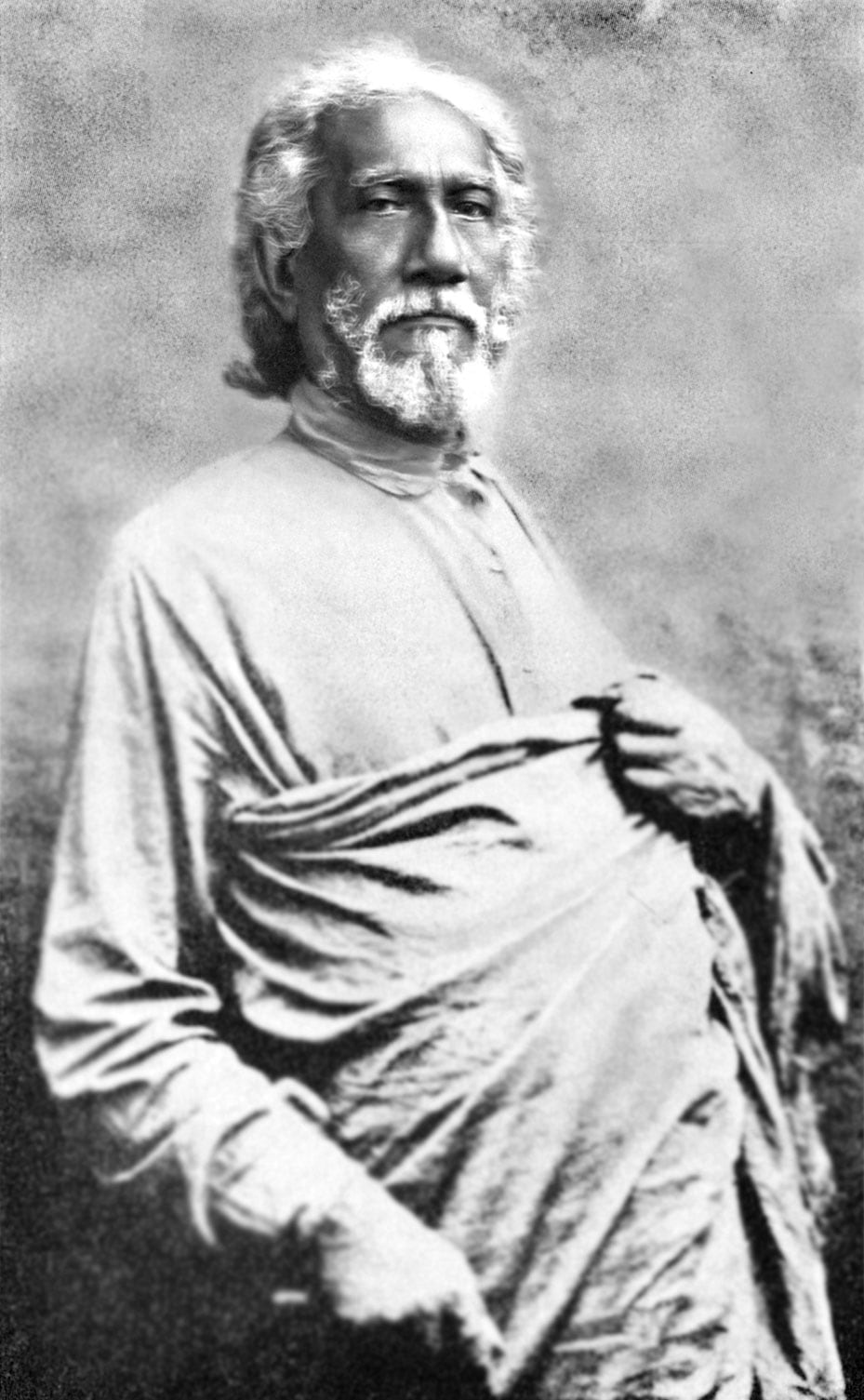
Sri Yukteswar, retrato de la primera edición de la Autobiografía · Public domain
Dans ses propres mots
«The purpose of this book is to show as clearly as possible that there is an essential unity in all religions; that there is no difference in the truths inculcated by the various faiths; that there is but one method by which the world, both external and internal, has evolved; and that there is but one Goal admitted by all scriptures.»The Holy Science, ed. SRF 1972 (texto de 1894), Introducción

Pour commencer, une œuvre
Kaivalya Darsanam: The Holy ScienceSon idée centrale
The 24,000-year cycle of the yugas: In the introduction to *The Holy Science*, Sri Yukteswar holds that the Sun, with its planets, revolves around a companion star in a period of about 24,000 years, and that nearness to or distance from a 'grand centre' of divine magnetism determines the development of human intelligence.
Le voir en contexte
Biographie
5 min de lecture
Traduction assistée à partir de l'original espagnol, en attente de relecture par un traducteur natif.
Un fils de propriétaires terriens à Serampore
Priya Nath Karar naquit le 10 mai 1855 à Serampore, ancien comptoir danois sur les rives de l'Hooghly, à une vingtaine de kilomètres de Calcutta. Ses parents, Kshetranath Karar et Kadambini, appartenaient à une famille de propriétaires ruraux ; le père mourut tôt, et le jeune homme dut prendre en charge les terres familiales. Il étudia au collège missionnaire chrétien de la ville, où il noua avec la Bible une familiarité qu'il ne devait jamais abandonner, et suivit près de deux années d'études de médecine à Calcutta sans obtenir de diplôme. Il se maria, eut une fille et devint veuf au bout de quelques années. C'est la période de sa vie la moins documentée : ce que nous en savons provient de la biographie bengalie écrite par son disciple Swami Satyananda Giri et des pages que lui consacra Paramahansa Yogananda, deux textes dus à des fidèles.
Lahiri Mahasaya et le kriya yoga
En 1884, il rencontra à Bénarès Shyama Charan Lahiri, que ses disciples appelaient Lahiri Mahasaya, comptable de l'administration britannique qui enseignait à des chefs de famille une technique de méditation fondée sur la maîtrise du souffle, le kriya yoga. Priya Nath reçut de lui l'initiation et, dans les années qui suivirent, lui rendit souvent visite. La tradition de la lignée rapporte que le maître l'appelait affectueusement « Priya », le bien-aimé. De Lahiri, il hérita deux traits qui allaient définir son enseignement : la conviction que la pratique méditative peut se vivre sans renoncer au monde, et une lecture des Écritures comme des cartes d'états intérieurs.
Allahabad, 1894 : la Science sacrée
En janvier 1894, lors de la Kumbh Mela d'Allahabad, selon son propre témoignage, il fut appelé par un inconnu sur les rives du Gange et conduit devant Babaji, le maître de Lahiri Mahasaya, figure dont il n'existe aucune documentation historique indépendante. Au cours de cet entretien, toujours selon le récit de l'auteur, Babaji lui demanda un bref ouvrage montrant l'harmonie entre les Écritures chrétiennes et hindoues, et lui conféra le titre de swami. Ce livre, Kaivalya Darshanam, « exposé de la vérité ultime », se présente dès sa première page comme écrit par « Priya Nath Swami » à la demande de Babaji, en l'an 194 du Dvapara Yuga. Les chapitres parurent d'abord dans sa revue Sadhusambad ; en 1920, son disciple Atul Chandra Chowdhury les imprima en volume, et en 1949 la Self-Realization Fellowship en publia une version révisée sous le titre The Holy Science (La Science sacrée).
Le livre compte quatre chapitres — l'Évangile, le But, la Méthode et la Révélation —, organisés en aphorismes sanskrits composés par l'auteur lui-même et commentés en anglais, avec d'abondantes citations du Nouveau Testament et, surtout, de l'Apocalypse. Son armature est la cosmologie du sâmkhya ; sa thèse, que toutes les religions partagent un seul et même but. L'introduction en contient la partie la plus célèbre et la plus discutée : une chronologie des yugas qui remplace les centaines de milliers d'années de la tradition des Purâna par un cycle de 24 000 ans, lié à une prétendue orbite du Soleil autour d'une étoile compagne, et qui situe l'humanité non pas dans le Kali Yuga mais dans la phase ascendante du Dvapara depuis 1699. L'astronomie académique ne cautionne pas l'hypothèse de l'étoile double ; la chronologie, en revanche, a connu une longue postérité dans la littérature spirituelle.
Deux ermitages et une discipline sévère
Après son ordination formelle dans l'ordre des swamis, reçue de l'abbé de Bodh-Gaya dans la branche Giri, il transforma la maison familiale de Serampore en ermitage et fonda en 1903 un second ermitage à Puri, face au golfe du Bengale, le Karar Ashram, dont il fixa l'inauguration, selon la tradition de la maison, à l'équinoxe de printemps. Il partageait l'année entre les deux. Il fonda une association, la Sadhu Sabha, pour réunir des religieux de différents courants ; rédigea des programmes scolaires de physique, de physiologie, de géographie et d'astronomie, un manuel d'anglais et d'hindi à l'usage des Bengalis et un traité élémentaire d'astrologie, et s'intéressa à l'éducation des femmes. Il pratiquait le jyotisha, l'astrologie indienne, et prescrivait à ses disciples des bracelets de métaux et de pierres, convaincu que la science des astres pouvait servir de raccourci tant que l'âme n'était pas libérée.
Il eut peu de disciples durables. Yogananda attribua cette rareté à une méthode qu'on « ne peut qualifier autrement que de draconienne » : il réprimandait en public, exigeait l'ordre domestique et ne tolérait aucune complaisance. L'anthropologue et tibétologue W. Y. Evans-Wentz, qui lui rendit visite à Serampore, se souvenait d'un homme grand, droit, à la voix douce et à la présence sereine.
Le maître de Yogananda
En 1910, dans une rue de Bénarès, il croisa Mukunda Lal Ghosh, un garçon de dix-sept ans qui fuyait la maison familiale en quête d'un maître. Pendant une décennie, il le forma à Serampore et à Puri ; en juillet 1915, il l'ordonna swami sous le nom de Yogananda et l'encouragea à accepter, en 1920, l'invitation à un congrès religieux à Boston. Lorsque Yogananda revint en Inde en 1935, Sri Yukteswar lui conféra le titre de paramahansa et le désigna comme son successeur à la tête de la Sadhu Sabha et de ses ermitages. D'autres disciples, comme Swami Satyananda Giri, Sailendra Bejoy Dasgupta ou Swami Hariharananda, fondèrent ensuite des lignées parallèles de kriya yoga, qui lisent sa figure avec des accents différents de ceux de la Self-Realization Fellowship.
La mort à Puri et la construction du récit
Il mourut au Karar Ashram de Puri à sept heures du soir, le 9 mars 1936, après une brève fièvre, assis dans la posture du lotus selon ceux qui découvrirent son corps. Yogananda, qui se trouvait à Calcutta, arriva le lendemain et présida à son inhumation dans le jardin de l'ermitage, conformément à la coutume des swamis, qui ne sont pas incinérés. L'Amrita Bazar Patrika de Calcutta salua en lui l'un des grands interprètes de la Bhagavad-Gîtâ. Dans l'Autobiographie d'un yogi (1946), Yogananda ajouta un chapitre où il raconte l'avoir revu en chair et en os dans un hôtel de Bombay, le 19 juin 1936, et avoir reçu de lui une longue description du monde astral. C'est un témoignage de foi du disciple, non un fait vérifiable, et il convient de le lire comme tel.
Héritage
L'image de Sri Yukteswar qui circule dans le monde est, dans une large mesure, celle qu'a tracée Yogananda : le jnanavatar, l'« incarnation de la sagesse », exigeant et affectueux, astrologue et lecteur de la Bible. Son visage figure parmi ceux de la pochette de Sgt. Pepper's Lonely Hearts Club Band (1967), et La Science sacrée continue d'être éditée dans une douzaine de langues. Son commentaire bengali de la Gîtâ, traduit en anglais en 2004 par Yoga Niketan, et la biographie de Satyananda révèlent un auteur plus technique et moins légendaire, qu'il convient de lire en regard du portrait de l'Autobiographie.
Sources: Yogananda, Paramhansa. Autobiography of a Yogi. Nueva York: The Philosophical Library, 1946 (1.ª ed.), caps. 10, 12, 14-16, 36, 42 y 43; prefacio de W. Y. Evans-Wentz. Texto en Wikisource y Project Gutenberg #7452. · Yukteswar Giri, Swami Sri. The Holy Science (Kaivalya Darsanam). Los Ángeles: Self-Realization Fellowship, 7.ª ed. 1972, 3.ª reimpr. 1977 (texto de 1894; copyright de la revisión, 1949). Consultado en Internet Archive. · Satyananda Giri, Swami. «Swami Sri Yuktesvar Giri Maharaj: A Biography», en A Collection of Biographies of 4 Kriya Yoga Gurus. Trad. Yoga Niketan. Lincoln (Nebraska): iUniverse, 2006. ISBN 9780595386758. · Selbie, Joseph, y David Steinmetz. The Yugas: Keys to Understanding Our Hidden Past, Emerging Present and Future Enlightenment. Nevada City: Crystal Clarity Publishers, 2010. ISBN 9781565892538. · Dasgupta, Sailendra Bejoy. Kriya Yoga and Swami Sriyukteshvar. Calcuta: S. B. Dasgupta, 1979.
Chronologie
La vie, année après année
Chaque point est un événement documenté. Cliquez pour le lire, avec sa source et son degré de certitude.
10 mai 18550 ansSerampore
Birth of Priya Nath Karar
Born into a family of Bengali landowners, son of Kshetranath Karar and Kadambini.
DocumentéYogoda Satsanga Society of India, «Swami Sri Yukteswar».
Après sa mort
- décembre 1946*Autobiography of a Yogi* spreads his figure
- 1949Revised Self-Realization Fellowship edition
- juin 1967On the cover of *Sgt. Pepper*
10 mai 1855 · 0 ans
Birth of Priya Nath Karar
Born into a family of Bengali landowners, son of Kshetranath Karar and Kadambini.
Documenté
v. 1875
Studies at the missionary college and the medical college
Studies at the Christian missionary college of Serampore, where he becomes interested in the Bible, and spends about two years at medical college in Calcutta. Approximate dates.
Probable
v. 1880
Marriage, a daughter and widowhood
After his father's death he marries at his mother's wish; he has a daughter and is widowed a few years later.
Probable
1884 · 29 ans
Initiation into kriya yoga by Lahiri Mahasaya
Meets Lahiri Mahasaya, who initiates him into kriya yoga; he will visit him often in the following years.
Documenté
janvier 1894 · 38 ans
Meeting with Babaji at the Kumbha Mela
By his own account in the introduction to *Kaivalya Darsanam*, Babaji asks him for a book on the harmony of Christian and Hindu scriptures and gives him the title of swami. Babaji has no independent historical documentation.
Tradition
1894 · 39 ans
Writes *Kaivalya Darsanam*
Writes the work in a short time, dated to the 194th year of the Dvapara Yuga; the chapters first appear in his journal *Sadhusambad*.
Documenté
22 mars 1903 · 47 ans
Founding of the Karar Ashram
Founds his seaside hermitage in Puri; his lineage's tradition dates the opening to the spring equinox, chosen for astrological reasons.
Tradition
1910 · 55 ans
Meeting with Mukunda Lal Ghosh
Meets the future Paramahansa Yogananda, who will spend ten years training in his hermitages.
Documenté
juillet 1915 · 60 ans
Ordains Yogananda a swami
Gives Mukunda the vows of the Swami order, Giri branch, with the name Yogananda.
Documenté
1920 · 65 ans
First book edition of *Kaivalya Darsanam*
His disciple Atul Chandra Chowdhury, secretary of the Sadhu Sabha, privately prints the book.
Documenté
1935 · 80 ans
Confers on Yogananda the title of paramahansa
During Yogananda's visit to India he grants him the monastic title of paramahansa and charges him with continuing his work.
Documenté
9 mars 1936 · 80 ans
Death at the Karar Ashram
Dies at about seven in the evening after a brief fever; he is buried on 10 March in the hermitage garden. The funeral bhandara is held on 21 March.
Documenté
décembre 1946
*Autobiography of a Yogi* spreads his figure
Yogananda devotes several chapters of his autobiography to him, including the account of his appearance after death, which builds his international image.
Documenté
1949
Revised Self-Realization Fellowship edition
SRF publishes *The Holy Science* with a foreword by Yogananda and changes to terminology and grammar; in 1963 an English translation of the Sanskrit sutras is added.
Documenté
juin 1967
On the cover of *Sgt. Pepper*
His portrait appears among the figures on the cover of the Beatles' album.
Documenté
Œuvres
Œuvres essentielles
Les œuvres sans lesquelles on ne comprend pas son héritage.
Œuvre écrite · 1894
Kaivalya Darsanam: The Holy Science
Kaivalya Darsanam (The Holy Science)
A treatise in four chapters—the Gospel, the Goal, the Procedure and the Revelation—that sets out Samkhya cosmology and yogic practice through commented Sanskrit aphorisms and places them alongside passages from the New Testament and Revelation. It argues that all religions share a single goal and describes five states of the heart through which the seeker advances, guided by the 'heart's natural love'. Its introduction proposes a 24,000-year cycle of yugas, tied to a hypothetical companion star of the Sun, and places humanity in an ascending Dvapara: the most famous and most disputed part of the book.
15 éditions

Œuvre écrite
Spiritual commentary on the Bhagavad Gita
Srimad Bhagavad Gita (comentario espiritual, bengalí)
A reading of the *Bhagavad Gita* as an allegory of kriya yoga practice, in the line begun by Lahiri Mahasaya: the poem's characters and battles are interpreted as forces and states of the practitioner's consciousness. It is the text that best shows the technical Sri Yukteswar, the meditation teacher, as against the literary character of *Autobiography of a Yogi*. Yogananda said his master encouraged him to give his own interpretation of the *Gita*, the distant origin of *God Talks with Arjuna*.
1 édition
Toute son œuvre (8)
Sri Yukteswar
First Book (English and Hindi primer)
The Conscious LibraryFirst Book (English and Hindi primer)
Sri Yukteswar
Elementary treatise on astrology
The Conscious LibraryElementary treatise on astrology
Sri Yukteswar
School science syllabi
The Conscious LibrarySchool science syllabi
Sri Yukteswar
Sadhusambad (journal)
The Conscious LibrarySadhusambad (journal)

Biography of Sri Yukteswar by Swami Satyananda Giri
Sri Yukteswar
Kriya Yoga and Swami Sriyukteshvar (S. B. Dasgupta)
The Conscious LibraryKriya Yoga and Swami Sriyukteshvar (S. B. Dasgupta)
1979
Citations
Citations localisées dans une œuvre précise. Chacune porte sa provenance et son degré de fiabilité.
The purpose of this book is to show as clearly as possible that there is an essential unity in all religions; that there is no difference in the truths inculcated by the various faiths; that there is but one method by which the world, both external and internal, has evolved; and that there is but one Goal admitted by all scriptures.VérifiéeThe Holy Science, ed. SRF 1972 (texto de 1894), Introducción
Dernières paroles
Il n'existe aucun témoignage vérifiable de ses dernières paroles.
No reliable record of his last words is known. Yogananda, his main biographer, was not present (he was in Calcutta and reached Puri the next day) and says so explicitly in a note to the *Autobiography*. The words 'My task on earth is now finished; you must carry on', addressed to Yogananda when conferring the title of paramahansa in 1935, are sometimes quoted as a farewell, but they precede his death by months.
Source: Yogananda, Paramhansa. Autobiography of a Yogi. Nueva York: The Philosophical Library, 1946 (1.ª ed.), caps. 10, 12, 14-16, 36, 42 y 43; prefacio de W. Y. Evans-Wentz. Texto en Wikisource y Project Gutenberg #7452.
Interroger
Ce que répond son œuvre
Douze grandes questions de l'humanité et ce que ses textes permettent d'y répondre, références à l'appui. Nous ne lui prêtons jamais de paroles.
Qu'est-ce que l'Absolu ? Dieu existe-t-il ?
Parambrahma, the one eternal substance, manifests as Father, Son and Om
Un Absolu impersonnelIl le dit expressément
In the Kaivalya Darsanam Sri Yukteswar opens with the statement that Parambrahma, Spirit, is the only real substance, eternal, complete and without beginning or end. From it he explains creation with a scheme meant to show the unity of Hinduism and Christianity: God the Father (Sat) is beyond creation; his manifestation as vibration, the Word or Om, is the Holy Ghost; and his conscious reflection in creation is the Son (Tat), the Christ consciousness. The ultimate is therefore not a person who acts but a substance of love and consciousness that expresses itself through vibration and maya. The personal figures of Father and Son are ways of naming those aspects, not beings distinct from the Absolute.
Comparer cette question avec d'autres maîtresQui suis-je ? Existe-t-il un vrai soi ?
Man is a son of God wrapped in five sheaths
Le Soi est l'AbsoluIl le dit expressément
In the Kaivalya Darsanam Sri Yukteswar describes the human being as a reflection of Spirit, the ‘son of God’, covered by five sheaths (koshas) ranging from the subtlest to the physical. Out of ignorance man identifies with those sheaths and with the body, and forgets his divine nature. Wisdom consists in progressively withdrawing consciousness from these layers until one recognises that the true self is one with the eternal Father, beyond creation. To describe that return he uses both the vocabulary of Samkhya and that of the Gospel: the prodigal son coming home is the soul recovering its unity with Spirit. Kaivalya, oneness, is the name of that goal.
Comparer cette question avec d'autres maîtresPourquoi souffrons-nous ?
Ignorance makes man think himself the body and exiles him from the inner Eden
L'ignorance de ce que nous sommesIl le dit expressément
In the Kaivalya Darsanam Sri Yukteswar explains that man suffers because, through avidya, ignorance, he identifies with the material body and its desires and forgets that he is a reflection of Spirit. From that identification arise attachment, aversion and fear, which he sets out in the vocabulary of yoga’s afflictions. Yogananda, in his Autobiography, attributes to him a biblical image of the same idea: outward longings drive us from the inner Eden and offer false pleasures that supplant the soul’s happiness, and the lost paradise is regained through meditation. Suffering is thus an exile from one’s own nature, and the way back is the heart’s natural love disciplined by yoga.
Comparer cette question avec d'autres maîtresQue se passe-t-il après la mort ?
The soul passes to subtle worlds and returns according to its karma
Renaissance selon le karmaCela se déduit de sa doctrine
Sri Yukteswar taught within the framework of reincarnation: as long as the soul is not freed from desires and karma it is born again, and his astrology presupposes that each birth matches that individual karma. In the Kaivalya Darsanam he describes creation as a series of spheres (lokas) of decreasing density between the physical world and Spirit, through which the soul descends and ascends. The best-known description of his teaching on the afterlife is not his own: in Autobiography of a Yogi Yogananda relates a posthumous appearance of his master in which he describes the astral and causal worlds where souls live between one incarnation and the next.
Comparer cette question avec d'autres maîtresComment atteint-on la libération ou le salut ?
Kriya yoga, discipline and the heart’s natural love
Par une pratique disciplinéeIl le dit expressément
Sri Yukteswar, a disciple of Lahiri Mahasaya, transmitted Kriya Yoga as a precise method for withdrawing consciousness from the body and directing it towards Spirit. In the Kaivalya Darsanam he makes the heart’s natural love the main requirement and defines faith (sraddha) as its intensification; from there he sets out the steps of yoga: ethical discipline, breath control, interiorisation and meditation on the vibration of Om. His teaching combines method with moral demand: according to Yogananda he was a stern master who corrected without indulgence. Liberation is a gradual process the disciple travels by his own effort, guided by a true master, until he recognises himself one with the Father.
Comparer cette question avec d'autres maîtresFaut-il un maître ?
The true master, the sadguru, is the disciple’s saviour
IndispensableIl le dit expressément
In the Kaivalya Darsanam Sri Yukteswar describes the meeting with the sadguru, the true master, as the decisive step: the heart’s natural love leads the seeker into the company of the saints, and from there to the master who initiates him into practice and guides him to the goal. He himself lived that relationship with Lahiri Mahasaya and exercised it with his disciples. Yogananda describes in his Autobiography the strict discipline of the Serampore ashram, where the master corrected each of the disciple’s faults so that he could receive the teaching. For Sri Yukteswar the guru does not replace the disciple’s effort, but without his transmission and guidance practice bears no fruit.
Comparer cette question avec d'autres maîtresLe monde est-il réel ?
Creation is the vibration of Om in fourteen spheres
Des plans d'existenceIl le dit expressément
In the Kaivalya Darsanam Sri Yukteswar explains creation as the manifestation of Spirit through the vibration of Om, which gives rise to maya, the illusion of separateness, and to a series of spheres of increasing density. He describes seven worlds (lokas), from the subtlest, close to Spirit, to the material, together with their corresponding regions of darkness, forming a hierarchical creation. To that scheme he adds a cyclical theory of time, that of the yugas, which he adjusts to his own astronomical calculations. The physical world is not false, but it is the densest plane of a stratified reality, and the human being is called to climb back through those planes to their source.
Comparer cette question avec d'autres maîtresQu'est-ce que l'amour ?
The heart’s natural love is the gateway to the holy life
Le désir ardent et l'unionIl le dit expressément
In the Kaivalya Darsanam Sri Yukteswar places love at the start of the path: the heart’s natural love is the main requirement for a holy life, and faith (sraddha) is its intensification. That love is the soul’s attraction to its source, Spirit, and when rightly directed it leads to the company of saints and to the master. Yogananda attributes to him in his Autobiography a clear distinction: ordinary love is selfish, rooted in desires and gratifications, whereas divine love has no condition, no limit and no change. Sri Yukteswar, known for his severity, understood the demanding correction of the disciple as a form of that unconditional love.
Comparer cette question avec d'autres maîtresSommes-nous libres ou tout est-il déterminé ?
The stars reflect karma, but spiritual effort overcomes it
Le karma et le choixIl le dit expressément
Sri Yukteswar was an astrologer and defended astrology as a science, but not as fatalism. According to Yogananda’s account in Autobiography of a Yogi, he taught that a child is born at the moment when the celestial rays are in mathematical harmony with its individual karma: the horoscope does not cause destiny, it reflects it. And that karma can be changed. The same account attributes to him the exhortation to forget the past, since human conduct is uncertain until anchored in the divine, and all will improve if spiritual effort is made now. He even recommended astrological remedies, but insisted that wisdom and the practice of yoga are the real means of freeing oneself from such influences.
Comparer cette question avec d'autres maîtresPourquoi méditer ou prier ?
Reverse the current inward and regain the inner Eden
Revenir à la source du jeIl le dit expressément
For Sri Yukteswar meditation is the return of consciousness to its source. In the Kaivalya Darsanam he describes how, through regulation of the breath and interiorisation, the yogi withdraws attention from the senses, perceives the light and sound of Om and climbs back through the sheaths that separate him from Spirit. This is the logic of the Kriya Yoga he received from Lahiri Mahasaya: not a prayer addressed to an external God but a technique for reversing the life current that flows outward. Yogananda attributes to him the image of the lost paradise quickly regained through divine meditation. To meditate is to return home, to where the soul knows itself one with the Father.
Comparer cette question avec d'autres maîtresLa raison peut-elle connaître l'ultime ?
A holy science that reconciles scriptures and is verified within oneself
Une connaissance ésotériqueIl le dit expressément
Sri Yukteswar wrote the Kaivalya Darsanam, translated as The Holy Science, with a purpose stated in its opening: to show as clearly as possible the essential unity of all religions. To that end he compares passages of the Bible and Hindu texts with reasoned arguments and presents his system as a science. But that science is not merely intellectual: it rests on a technique transmitted from master to disciple, Kriya Yoga, and on a cosmic chronology, that of the yugas, which he regards as recovered knowledge. Yogananda attributes to him the warning not to confuse understanding with a larger vocabulary: wisdom is assimilated not with the eyes but with the atoms.
Comparer cette question avec d'autres maîtresSe retirer du monde ou le transformer ?
From home to ashram: inner discipline does not require flight
La contemplation dans l'actionCela se déduit de sa doctrine
Sri Yukteswar lived most of his life as a householder and property owner in Serampore, and only after being widowed did he take monastic vows in the Giri order. His master, Lahiri Mahasaya, was the model of the yogi who attains realisation without leaving work or family, and Kriya Yoga was transmitted precisely as a practice compatible with life in the world. Sri Yukteswar took an interest in education, astronomy and medicine, wrote science syllabuses for schools and guided his disciples with practical rigour. For him what mattered was not where one lives but inner discipline and the heart’s love directed towards Spirit.
Comparer cette question avec d'autres maîtres
Affinités et tensions
Affinités et tensions
Calculées question par question à partir de ses positions. La raison de chaque accord ou de chaque désaccord s'affiche d'un clic.
Pense comme
Helena Blavatsky
Ils concordent sur: Sommes-nous libres ou tout est-il déterminé ? · Qu'est-ce que l'Absolu ? Dieu existe-t-il ? · Que se passe-t-il après la mort ?
Sadhguru
Ils concordent sur: Comment atteint-on la libération ou le salut ? · Qu'est-ce que l'Absolu ? Dieu existe-t-il ? · Qui suis-je ? Existe-t-il un vrai soi ?
Paramahansa Yogananda
Ils concordent sur: Que se passe-t-il après la mort ? · Comment atteint-on la libération ou le salut ? · Le monde est-il réel ?
Helena Roerich
Ils concordent sur: Qu'est-ce que l'Absolu ? Dieu existe-t-il ? · Que se passe-t-il après la mort ? · Faut-il un maître ?
Pense autrement que

Nikolai Berdyaev
Ils s'opposent sur: Qui suis-je ? Existe-t-il un vrai soi ? · Que se passe-t-il après la mort ? · Faut-il un maître ?
Julian of Norwich
Ils s'opposent sur: Qui suis-je ? Existe-t-il un vrai soi ? · Que se passe-t-il après la mort ?
Seraphim of Sarov
Ils s'opposent sur: Qui suis-je ? Existe-t-il un vrai soi ? · Que se passe-t-il après la mort ?
Catherine of Siena
Ils s'opposent sur: Qui suis-je ? Existe-t-il un vrai soi ? · Que se passe-t-il après la mort ?
Anecdotes et récits
Anecdotes et récits
Témoignage1910
'How many years I have waited for you!'
Origine du récit: Yogananda's account in *Autobiography of a Yogi* (1946), ch. 10, written thirty-five years later. There are no independent witnesses.
Témoignagec. 1910-1915
The cauliflower robbery
Origine du récit: *Autobiography of a Yogi* (1946), ch. 15, 'The Cauliflower Robbery'. Sole source; the element of clairvoyance is the narrator's interpretation.
Témoignagec. 1910-1911
A tap on the chest
Origine du récit: *Autobiography of a Yogi* (1946), ch. 14, 'An Experience in Cosmic Consciousness'. A subjective experience narrated by the one who lived it.
Témoignage1894
The commission at Allahabad
Origine du récit: Two sources from the protagonist himself: the introduction to *Kaivalya Darsanam* (1894) and his account recorded by Yogananda in *Autobiography of a Yogi*, ch. 36. Babaji's historical existence is not documented outside his lineage.
Récit hagiographique1936
The appearance in the Bombay hotel
Origine du récit: *Autobiography of a Yogi* (1946), ch. 43. A vision narrated by a single witness, Yogananda himself, beyond verification; the Kriya Yoga International lineage relates similar appearances to Swami Hariharananda.
Témoignagec. 1915
The bangle against the stars
Origine du récit: *Autobiography of a Yogi* (1946), ch. 16, 'Outwitting the Stars'. The prediction and its fulfilment are recorded only in the disciple's account.
Enseignements
Enseignements
Les notions qui structurent sa pensée, expliquées dans leur contexte.
The 24,000-year cycle of the yugasciclo-de-los-yugas
A reinterpretation of the Puranic doctrine of the four ages (*caturyuga*) with nineteenth-century astronomical arguments.
The essential unity of religionsunidad-de-las-religiones
A commission attributed to Babaji in 1894; inherited by Self-Realization Fellowship as a founding principle.
The heart's natural love (sraddha)amor-natural-del-corazon
Aphorisms 5-6 of chapter 3; takes up the notion of *śraddhā* from the *Yoga Sutras* (I.20).
Kriya yogakriya-yoga
Lineage Babaji – Lahiri Mahasaya – Sri Yukteswar – Yogananda.
The guru as guide, not saviourguru
The conception of the guru in the kriya yoga lineage.
Astrology as a science of karmaastrologia-como-ciencia
The Indian astrological tradition (*jyotisha*) read in a yogic key.
Vidéos
Vidéos
Enregistrements, entretiens et documentaires. Les vidéos sont lues depuis YouTube ; elles ne sont pas hébergées ici.
Sri Yukteshwar video 2
Enregistrement original· UND· 1 min
Avatarsandyogis
Sri Yukteshwar video 1
Enregistrement original· UND· 1 min
Avatarsandyogis
Paramahansa Yogananda & Swami Sri Yukteswar
Enregistrement original· UND· 1 min
Fred McCabe (cgny69)
The Yugas and Spiritual Awakening: The Revolutionary Wisdom of Swami Sri Yukteswar
Conférence· EN· 58 min
Ananda Sangha WorldwideChaîne officielle
Swami Sri Yukteswar: Inspiration from the "Holy Science"
Conférence· EN· 44 min
Ananda Sangha WorldwideChaîne officielle
Sri Yukteswar's Advice on How to Develop the Natural Love of the Heart
Conférence· EN· 51 min
Ananda Sangha WorldwideChaîne officielle
"What are the Yugas?" with Joseph Selbie, co-author of "The Yugas"
Entretien· EN· 6 min
Ananda Sangha WorldwideChaîne officielle
Puri - with the Kriya Yoga Ashram founded by Sri Yukteswar, India 1977
Documentaire· EN· 1977· 34 min
Kriya Yoga Masters of Kriya Yoga InternationalChaîne officielle
Online Class on The Holy Science by Sri Yukteswar April & May 2020
Conférence· EN· 2020· 12 min
Kriya Yoga Online with Ryan Kurczak
The Spiritual Guidance of Swami Sri Yukteswar: Navigating Life's Challenges
Conférence· EN· 51 min
Yogacharya Ellen Grace O'Brian
Swami Sri Yukteswar Giri: O Leão da Bengala | Grandes Mestres Ep. 6
Analyse· PT· 32 min
Guilherme Romano
Home of Swami Sri Yukteshwar ji, Ananda Lok & Babaji's Banyan Tree | Serampore
Documentaire· HI· 12 min
Connect with Thyself - Ruchi Shukla
Galerie
Galerie
Images dont la licence a été vérifiée. Chacune conserve son auteur et son attribution.
Relations
Relations
Influences, filiations et affinités. On distingue la relation documentée de la similitude identifiée par analyse.
Disciple de
Lahiri Mahasaya
His guru; initiated him into kriya yoga in 1884.
Relation documentée
A rencontré
Mahavatar Babaji
A meeting the author himself relates in his book's introduction (Allahabad, 1894); Babaji's historical existence is not documented outside the lineage.
Relation documentée
Maître de
His best-known disciple (1910-1936); ordained him swami in 1915 and gave him the title of paramahansa in 1935.
Relation documentée
Maître de
Swami Satyananda Giri
Disciple and biographer; ran the Ranchi school.
Relation documentée
Maître de
Paramahamsa Hariharananda
Disciple who spread kriya yoga from the Karar Ashram and founded Kriya Yoga International.
Relation documentée
A reçu l'influence de
Comments on the words of Jesus and Revelation in *Kaivalya Darsanam* as expressions of the same truths as the Vedas.
Relation documentée
A reçu l'influence de
The practice and the notion of *śraddhā* in his third chapter closely follow the *Yoga Sutras*.
Similitude identifiée par analyse
A rencontré
W. Y. Evans-Wentz
The scholar visited him at Serampore and described him in the preface to the *Autobiography*.
Relation documentée
Contemporain de
A Bengali contemporary who, like him, presented yoga to the West as a universal science of religion.
Similitude identifiée par analyse
Contemporain de
A contemporary from the Calcutta region; both defended the convergence of religions, by different paths.
Similitude identifiée par analyse
Lié depuis d'autres fiches
Sources
Sources
Bibliographie et catalogues consultés pour cette fiche.
- Yogananda, Paramhansa. Autobiography of a Yogi. Nueva York: The Philosophical Library, 1946 (1.ª ed.), caps. 10, 12, 14-16, 36, 42 y 43; prefacio de W. Y. Evans-Wentz. Texto en Wikisource y Project Gutenberg #7452.
- Yukteswar Giri, Swami Sri. The Holy Science (Kaivalya Darsanam). Los Ángeles: Self-Realization Fellowship, 7.ª ed. 1972, 3.ª reimpr. 1977 (texto de 1894; copyright de la revisión, 1949). Consultado en Internet Archive.
- Satyananda Giri, Swami. «Swami Sri Yuktesvar Giri Maharaj: A Biography», en A Collection of Biographies of 4 Kriya Yoga Gurus. Trad. Yoga Niketan. Lincoln (Nebraska): iUniverse, 2006. ISBN 9780595386758.
- Wikidata, «Yukteswar Giri» (Q380790).
- Wikipedia (en), «Swami Sri Yukteswar Giri» (apoyada en la biografía de Satyananda y en la Autobiografía).
- «The Holy Science – 1920 Original Edition: Introduction and Study». Yogananda Harmony (estudio de la historia editorial: Sadhusambad, edición de Atul Chandra Chowdhury de 1920, revisiones de SRF de 1949, 1963 y 1972).
- Yogoda Satsanga Society of India, «Swami Sri Yukteswar».
- Kriya Yoga International (linaje de Paramahamsa Hariharananda), «Swami Shriyukteshwar Giri».
- Yoga Niketan, «Scriptural Commentaries» (Srimad Bhagavad Gita, Spiritual Commentary by Swami Sriyukteshvar Giri).
- Open Library, ediciones de The Holy Science y del comentario a la Gita (ISBN 9780876120514, 9780876120569, 9780595665211, 9788189955038, etc.).
- Selbie, Joseph, y David Steinmetz. The Yugas: Keys to Understanding Our Hidden Past, Emerging Present and Future Enlightenment. Nevada City: Crystal Clarity Publishers, 2010. ISBN 9781565892538.
- Dasgupta, Sailendra Bejoy. Kriya Yoga and Swami Sriyukteshvar. Calcuta: S. B. Dasgupta, 1979.
- Ayant droit
- El texto original de 1894/1920 es de dominio público (autor fallecido en 1936). Self-Realization Fellowship (Los Ángeles) y Yogoda Satsanga Society of India son titulares de la edición revisada de 1949 y de sus traducciones; Yoga Niketan, de la traducción inglesa del comentario a la Gita.
- Site officiel
- yssofindia.org/about/swami-sri-yukteswar
En attente de confirmation
Ce que cette fiche n'a pas encore pu établir. Nous préférons le dire plutôt que de combler.
- Localizar un facsímil o transcripción con OCR limpio de la edición de 1920 de Kaivalya Darsanam (dominio público en EE. UU., UE y España): las copias de Internet Archive son de la edición revisada de SRF (copyright 1949) y no sirven para la sala de lectura.
- Confirmar fechas y alcance del comentario bengalí a la Bhagavad Gita (¿primeros capítulos?) y la fecha de su primera edición en Bengala.
- Identificar título y ejemplares del tratado de astrología y del «First Book», conocidos solo por la biografía de Satyananda.
- Consultar directamente la biografía de Satyananda (iUniverse, 2006) para fijar las fechas de los estudios, el matrimonio y la ordenación en Bodh Gaya.
- Vídeos: no se encontró material serio en español sobre él; las filmaciones históricas están subidas por terceros sin datos de procedencia (posiblemente la película de C. Richard Wright de 1935-1936).
- Imágenes: la serie «Sri-Yukteswar-1» a «-8» de Commons tiene metadatos inverosímiles (fechas inventadas, el propio Yukteswar como autor); no se ha usado.
- Relaciones con slugs fuera del catálogo (lahiri-mahasaya, mahavatar-babaji, swami-satyananda-giri, swami-hariharananda, w-y-evans-wentz): la ficha de Yogananda usa «sri-yukteswar-giri» como slug de esta persona; conviene unificarlo con «sri-yukteswar».
Recherche effectuée le 2026-10-25