Hinduism · Bhakti · Sikhism
Kabir
कबीर · कबीरदास · ਕਬੀਰ · کبیر
c. 1440 – c. 1518Historically documented person
Poet and mystic of northern India (c. 1440–1518, or 1398–1448 according to others), a weaver of Benares of Muslim origin and a major figure of nirguna devotion. His songs and couplets, transmitted orally and fixed in three traditions (the Sikh Adi Granth, the Dadupanthi anthologies from which the Kabir Granthavali derive, and the Kabirpanthi Bijak), criticise Brahmins and mullahs alike. Most of the 'One Hundred Poems' Tagore translated in 1915 are of doubtful authenticity.
- works
- 6works
- editions
- 19editions
- quotes
- 8quotes
- videos
- 13videos
- images
- 7images
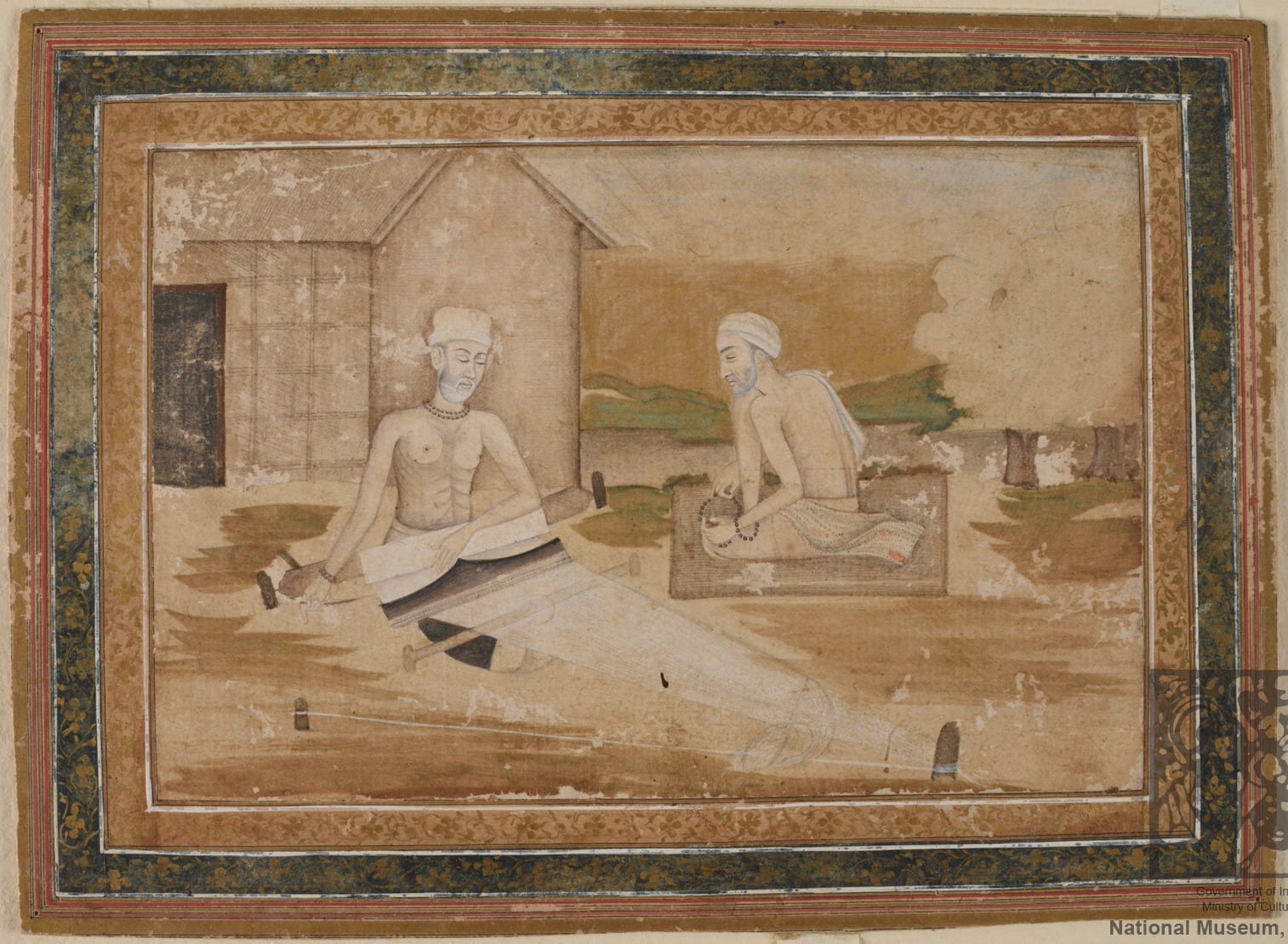
Kabir y Ravidas · Public domain
In their words
«If God be within the mosque, then to whom does this world belong? If Ram be within the image which you find upon your pilgrimage, then who is there to know what happens without?»Guru Granth Sahib, Prabhati, p. 1349 (texto gurmukhi según BaniDB); trad. española propia; versión inglesa de Tagore (*Songs of Kabir*, 1915, poema LXIX, uno de los seis que V. C. Mishra tiene por auténticos).

Their central idea
Nirguna: the divine without attributes: Kabir's devotion is directed to a *nirguna* absolute, 'without qualities', which has no form, no incarnations and no image in temples.
See in context
Biography
5 min read
A weaver of Benares
Of Kabir, the most quoted poet of northern India, only two things can be stated with certainty on the basis of the verses most reliably ascribed to him: that he lived most of his life in Benares, today's Varanasi, and that he was a weaver, a julaha, a member of a low-ranked caste that had by his time become largely Muslim. His very name, one of the ninety-nine names of God in Islam, betrays a Muslim origin. Everything else (his parents, his master, his miracles) belongs to the traditions that later claimed him: for Sikhs he is a precursor of Guru Nanak, for Muslims a Sufi, for Hindus a Vaishnava devotee with universalist leanings.
Not even his dates are firm. The tradition of the sect that bears his name has him born in 1398 and dying in 1518, aged a hundred and twenty; scholars are divided between those who, like Jaroslav Strnad, prefer 1398–1448 and those who, with the Encyclopaedia Britannica, place his life between 1440 and 1518. David Lorenzen considers that he must have died near the traditional date of 1518, at Magahar near Gorakhpur, as the Kabirpanthi tradition and a Mughal document of 1698–1699 unanimously maintain.
The legends
Hagiographies filled that void. According to one, he was the son of a Brahmin widow who abandoned him and was taken in by a Muslim weaver, Niru, and his wife, Nima, beside the Lahartara pond; according to another, he appeared on a lotus flower. The most famous tells how the boy, knowing that a Hindu guru would not accept a Muslim, lay down on the steps of the Ganges where Ramananda bathed: the master trod on him as he came down, exclaimed "Ram, Ram!", and Kabir proclaimed that he had thus received the mantra of initiation. Others show him tried by Sultan Sikandar Lodi and victorious over Brahmins, qadis and merchants. The first hagiographies, Anantadas's Kabir parachai, date from around 1590, almost a century after his death.
Evelyn Underhill, in her 1915 introduction to Tagore's versions, still narrated as facts the trial before Sikandar Lodi, which she dated to 1495, and the death in 1518. And she passed on the most beautiful of the legends: when the poet died, his Hindu disciples wanted to cremate him and the Muslims to bury him; Kabir appeared and asked them to lift the shroud, beneath which they found only a heap of flowers, which they shared out. At Magahar a Muslim tomb and a Hindu samadhi still stand a few steps apart.
The reports that are not hagiography are few and late. Abul Fazl, Akbar's chronicler, mentions at the end of the sixteenth century two tombs of Kabir, one at Puri and another at Ratanpur, proof that several places were already claiming him. The Dabestan-e mazaheb, a seventeenth-century Persian treatise on religions, describes him as a bairagi, a Vaishnava ascetic, disciple of Ramananda: according to the historian Irfan Habib, it is the earliest text to provide biographical information about him.
A voice that was sung
Kabir did not write: he composed and sang. His work consists of padas, short songs for a musical mode; sakhis, couplets or 'testimonies'; and didactic ramainis, in a mixed language of northern India that scholars call sadhukkari, the tongue of the sadhus. These verses circulated for centuries orally and in writing, and on the way they were transformed and multiplied, and compositions by admirers were assigned to his name. Today it is impossible to say exactly which words are his; what they all share is a rough, ironic frankness against hypocrisy, arrogance and religious formalism.
The oldest written witnesses are late and do not come from his sect. The Goindval pothis, forerunners of the Sikh scripture, assembled around 1570–1572, contain fifty of his songs; the Fatehpur manuscript of 1582, fifteen. From there the work divides into three great regional traditions. The Sikh one fixed it in the Adi Granth, completed by Guru Arjan in 1604, in which Kabir's verses are the largest contribution by an author outside the line of the gurus, including a section of 243 shaloks. That of the Dadupanthis of Rajasthan gathered it in the great anthologies called Panch-vani, 'the five voices', where Kabir's part is the second largest, after Dadu's own: it is the basis of the modern Kabir Granthavali. The eastern one, that of the Kabirpanthis of Benares, is the Bijak, held to be the oldest and most genuine version, although its oldest surviving manuscript is no earlier than the beginning of the nineteenth century and few of its verses coincide with those of the other two.
Neither Hindu nor Muslim
Kabir was not a reconciler of religions, as the twentieth century presented him, but an equally relentless critic of both. For him, reciting without understanding was the same before the Vedas as before the Qur'an; the Brahmin and the qadi, the sacred thread and circumcision, pilgrimage to Benares and pilgrimage to Mecca, were parallel forms of error. All that counted was fidelity to the one truth of life, which he called both Allah and Ram, understanding Ram as a name of the divine and not as the hero of the Ramayana. That truth without attributes, nirguna, is sought within: "search in your heart," says a hymn in the Adi Granth, "that is His dwelling." And in another he boasts of having left Benares, the city where dying brings liberation, to go and die in Magahar, where popular belief promised a bad rebirth.
Legacy
Kabir founded no sect, but his disciples gradually organised the Kabir Panth in the sixteenth century; by the end of the seventeenth there were centres all over northern India, and today its followers, many of them Dalits, number in the millions. His presence in the Adi Granth made him an interlocutor of Guru Nanak, although scholars debate how far he influenced him. In the West he became known in 1915 through Songs of Kabir, a hundred poems translated by Rabindranath Tagore with the help of Evelyn Underhill from the collection Kshitimohan Sen had gathered from books and wandering singers. The book became a classic, but V. C. Mishra argued in 1987 that only six of those hundred poems are authentic and that Tagore projected the theology of his own day onto Kabir. The critical translations of Charlotte Vaudeville, Linda Hess and Shukdev Singh, and the recitals of popular singers such as Prahlad Tipanya, have given Kabir back his rough voice.
Sources: Kabir. Songs of Kabir, trad. Rabindranath Tagore, introducción de Evelyn Underhill. Nueva York: Macmillan, 1915 (en Londres: One Hundred Poems of Kabir, India Society). Project Gutenberg n.º 6519.
Timeline
A life, year by year
Each point is a documented event. Click to read it, with its source and degree of certainty.
1398Benarés
Birth according to tradition
Kabirpanthi tradition places his birth in 1398 (full moon of *Jyeshtha*, Samvat 1455), which would make him a hundred and twenty at his death in 1518. Strnad accepts 1398 but moves his death to 1448.
Tradition«Kabir». Wikipedia en inglés (leyendas de nacimiento y persecución según Lorenzen; Dabestan-e Mazaheb; recensiones; crítica de V. C. Mishra, «Two Truths Are Told: Tagore's Kabir», en K. Schomer y W. H. McLeod (eds.), The Sants, 1987, pp. 167–180; Kabir Panth).
After their death
- c. 1570 – 1572The Goindval pothis
- 1582Fatehpur manuscript
- c. 1590First hagiography
- 1604Kabir in the Adi Granth
- c. 1699Mughal document on the Magahar tomb
- 1910 – 1911Kshitimohan Sen's collection
- 1915Tagore's Songs of Kabir
- 1928Shyamsundar Das's Kabir Granthavali
- 1983Hess and Singh's Bijak
- 1987V. C. Mishra's critique of Tagore
1398
Birth according to tradition
Kabirpanthi tradition places his birth in 1398 (full moon of *Jyeshtha*, Samvat 1455), which would make him a hundred and twenty at his death in 1518. Strnad accepts 1398 but moves his death to 1448.
Tradition
c. 1440 · age 0
Birth according to much scholarship
The *Britannica* and other scholars place his birth around 1440 in Benares, into a family of Muslim weavers (*julaha*).
Probable
c. 1460 – 1518
Weaver and singer in Benares
He lives by his loom in Benares, married with a family according to the legends; he composes and sings *padas* and *sakhis* criticising Brahmins and mullahs alike. His relationship with Ramananda is the stuff of legend.
Probable
c. 1495
The trial before Sikandar Lodi (legend)
The hagiographies show him tried by Sultan Sikandar Lodi (r. 1489–1517) and banished from Benares; Underhill (1915) dated the episode to 1495, but there is no independent evidence.
Disputed
c. 1518
Death at Magahar
He dies, according to the traditional date Lorenzen considers approximately correct, at Magahar near Gorakhpur. A hymn in the *Adi Granth* has Kabir say that he left Benares to die at Magahar.
Probable
c. 1570 – 1572
The Goindval pothis
The Sikh Goindval manuscripts, copies of an anthology assembled around 1570–1572, include fifty songs by Kabir: the oldest written witness to his work.
Documented
1582
Fatehpur manuscript
The Fatehpur manuscript, mainly a collection of Surdas's songs, is the oldest dated manuscript containing poems by Kabir (fifteen).
Documented
c. 1590
First hagiography
Anantadas writes the *Kabir parachai*, the oldest hagiography; in 1712 Priyadas comments on the stanza about Kabir in Nabhadas's *Bhaktamal*.
Documented
1604
Kabir in the Adi Granth
On 29 August Guru Arjan completes the *Adi Granth*, the first edition of the Sikh scripture, with a large number of Kabir's hymns and a section of 243 *shaloks* under his name.
Documented
c. 1699
Mughal document on the Magahar tomb
A document from Aurangzeb's reign (1698–1699) records the gift of a village for the upkeep of the Muslim tomb of 'Shah Kabir' at Magahar: the first documentary evidence of institutions linked to Kabir.
Documented
1910 – 1911
Kshitimohan Sen's collection
Kshitimohan Sen publishes his four-part *Kabir* at Santiniketan (1910–1911), gathered from books, manuscripts and wandering singers; it will be the basis of Tagore's version.
Documented
1915
Tagore's Songs of Kabir
Rabindranath Tagore publishes, with Evelyn Underhill, a hundred poems of Kabir in English (New York, Macmillan; in London, *One Hundred Poems of Kabir*). It becomes the West's Kabir.
Documented
1928
Shyamsundar Das's Kabir Granthavali
Shyamsundar Das edits the *Kabir Granthavali* from manuscripts of the Rajasthani tradition, one of them bearing a date of 1504 that later scholarship does not accept as reliable.
Documented
1983
Hess and Singh's Bijak
Linda Hess and Shukdev Singh publish their English translation of the *Bijak*, with essays and notes, a reference for modern Kabir studies.
Documented
1987
V. C. Mishra's critique of Tagore
In *The Sants* (ed. Schomer and McLeod), V. C. Mishra argues that only six of Tagore's hundred poems (15, 32, 34, 35, 69 and 94) are authentic.
Documented
Works
Essential works
The works without which their legacy cannot be understood.
Later compilation
Bijak
बीजक (Bījak)
Scripture of the Kabirpanthis: didactic *ramainis*, *shabdas* (songs) and *sakhis* (couplets), plus some popular forms. It is the most polemical and disconcerting Kabir, that of the direct attacks on caste, rites and sacred books, and of the *ulatbansi*, 'upside-down language' riddles that jolt the listener's mind. Linda Hess and Shukdev Singh translated it in full in 1983, and their edition remains the English reference.
4 editions · amazon.com
Kabir
Kabir Granthavali
Later compilation
Kabir Granthavali
कबीर ग्रंथावली (Kabīr granthāvalī)
A corpus of *sakhis* arranged by theme (*ang*), *padas* for singing and some *ramainis*, preserved by the followers of Dadu Dayal in Rajasthan. According to Hawley, the western Kabir is more devotional than the Punjabi one; in it Nath yogi influence, devotion to Ram and sant ethics coexist. Its couplets are the ones that have passed into everyday speech in northern India. Charlotte Vaudeville translated the *dohas* into French (1957) and English (1974).
5 editions · amazon.com

Later compilation · 1604
Hymns and shaloks in the Guru Granth Sahib
ਭਗਤ ਕਬੀਰ ਜੀ ਕੀ ਬਾਣੀ — ਸ੍ਰੀ ਗੁਰੂ ਗ੍ਰੰਥ ਸਾਹਿਬ (Bāṇī Bhagat Kabīr jī kī)
Hymns (*shabad*) distributed through the ragas of the Sikh scripture (Gauri, Asa, Sorath, Bhairo, Prabhati and others) and, in the final section, the *Salok Bhagat Kabir* (243 couplets). Here appears a more earthly Kabir, the householder swept away by the intensity of love, and many of his best-known verses: seeking God in the heart and not in mosque or temple, mocking the fasts of Brahmins and Muslims, telling how he left Benares to die at Magahar. They are sung daily in gurdwaras.
2 editions · amazon.com
Kabir
Songs of Kabir / One Hundred Poems of Kabir (Tagore's version)
Traditional attribution · 1915
Songs of Kabir / One Hundred Poems of Kabir (Tagore's version)
Songs of Kabir / One Hundred Poems of Kabir (versión de Tagore)
The book that made Kabir known in the West: a hundred poems in poetic prose about the God within man, the true master, the unstruck music (*anahad*), the inadequacy of words and the unity of all things. With Evelyn Underhill's introduction, which recounted the legends as facts, it was endlessly reprinted, retranslated into Spanish (Joaquín V. González, 1918), French (Henriette Mirabaud-Thorens and, in versions unpublished until 2012, André Gide) and many other languages, and it inspired Robert Bly's paraphrases. It is literature in its own right, but only a small part of it can be read as Kabir.
4 editions · amazon.fr

Quotations
Quotations located in a specific work. Each carries its provenance and its level of confidence.
If God be within the mosque, then to whom does this world belong? If Ram be within the image which you find upon your pilgrimage, then who is there to know what happens without?ਅਲਹੁ ਏਕੁ ਮਸੀਤਿ ਬਸਤੁ ਹੈ ਅਵਰੁ ਮੁਲਖੁ ਕਿਸੁ ਕੇਰਾ ॥ ਹਿੰਦੂ ਮੂਰਤਿ ਨਾਮ ਨਿਵਾਸੀ ਦੁਹ ਮਹਿ ਤਤੁ ਨ ਹੇਰਾ ॥
VerifiedGuru Granth Sahib, Prabhati, p. 1349 (texto gurmukhi según BaniDB); trad. española propia; versión inglesa de Tagore (*Songs of Kabir*, 1915, poema LXIX, uno de los seis que V. C. Mishra tiene por auténticos).
Apocryphal quotes or disputed attributions (2)
«O servant, where dost thou seek Me? Lo! I am beside thee. I am neither in temple nor in mosque: I am neither in Kaaba nor in Kailash.»
First poem of *Songs of Kabir* (Tagore, 1915), perhaps the most quoted 'Kabir' in the West. It comes from Kshitimohan Sen's collection and is not among the six V. C. Mishra regards as authentic: it may be the work of a later admirer imitating his style.
«Do not go to the garden of flowers! O Friend! go not there; In your body is the garden of flowers.»
Poem IV of *Songs of Kabir* (Tagore, 1915), widely circulated; like most of the selection, its attribution to Kabir is not proven according to Mishra's critique.
Last words
There are no verifiable records of their last words.
No attested last words survive. A hymn in the *Adi Granth* (Gauri, p. 326) has Kabir say that, having spent his life in Benares, 'at the time of death' he went to Magahar, and ends: 'Kabir died repeating the name of Ram'; it is poetry, not testimony. The legend of the flowers under the shroud comes from hagiography and is recorded by Underhill in 1915.
Source: Sri Guru Granth Sahib, bani de Bhagat Kabir (texto gurmukhi por página o *ang*: Gauri 326, Prabhati 1349–1350, Salok 1364–1377). BaniDB.
Ask
What their work answers
Twelve great human questions and what their texts allow us to answer, with references. We never put words in their mouth.
What is the Absolute? Does God exist?
Ram without attributes: not in mosque or idol, but in the heart
The unnameableStated explicitly
Kabir calls the ultimate Ram, Hari or Allah, but insists that it is not the Rama of the avatars nor a God enclosed in a temple: it is nirguna, without attributes, and its story is ‘unspeakable’. In verses preserved in the Guru Granth Sahib he asks whose the rest of the world would be if Allah lived only in the mosque, and says he found the truth neither in the Hindu image nor in the Muslim rite; Hari and Allah dwell neither in the south nor in the west but deep in the heart. His language of paradox (ulatbansi) shows that ordinary thought cannot reach that One. And yet Kabir addresses it with a servant’s tenderness: the formless Lord is also the one with whom love cannot be broken.
Compare this question with other teachersWho am I? Is there a true self?
What you seek outside is within: search deep in the heart
The Self is the AbsoluteInferred from their doctrine
Kabir develops no doctrine of the soul, but his verses agree in turning the search inward: Hari and Allah dwell neither in the south nor in the west but deep in the heart, which is their abode. The tradition bearing his name abounds in images of the drop and the ocean, or of the deer that searches outside for the musk it carries within. The self that boasts of caste, learning or piety is for Kabir a mask that death tears off; what remains is the place where the Name dwells. His language oscillates between identity with the divine and the relation of a servant to his Lord, and never turns that tension into a system.
Compare this question with other teachersWhy do we suffer?
Maya deceives, and separation from the Beloved burns
Separation from GodInferred from their doctrine
In Kabir’s verses suffering has two faces. One is maya, which he calls the great swindler: attachment to wealth, body, caste and rites, which makes one forget the Name and leaves the human being at the mercy of death. The other is viraha, the pain of separation from the Beloved, which Kabir describes as a snake living in the body or a fire that will not go out. This second pain is not merely an evil: it is the sign that the soul has woken to its absence, and the one who suffers it is closer to Ram than the one who feels satisfied. The death that terrifies the world, says one of his verses, fills his mind with joy.
Compare this question with other teachersWhat happens after death?
Dying while alive: the death that terrifies the world is his joy
Dying each day to the knownStated explicitly
Kabir speaks of death with unusual insistence and turns it upside down. In a verse of the Guru Granth Sahib he says that the death which terrifies the world fills his mind with joy, because only by dying is supreme bliss attained: the point is to die while living, for the ego to die before the body. His final gesture, according to tradition, was to go and die in Magahar, a place said to bring a bad rebirth, rather than in Benares, where dying guaranteed liberation; one of his verses recalls it. With this he denied that place or rite decide the soul’s fate. Kabir shares the belief in cycles of births, but his interest lies in the inner death that frees now.
Compare this question with other teachersHow is liberation or salvation attained?
The Name of Ram and the true master, not rituals
Through devotion and surrenderStated explicitly
Kabir rejects every external path to liberation: ablutions, fasts, pilgrimage, the study of the Vedas and the Qur’an, caste and the ascetic’s garb. Not even the place of death saves, as he showed by going to die in Magahar. What frees is the loving repetition of the Name of Ram (ram nam), received from the satguru, and the inner devotion that transforms the one who lives it. The tradition bearing his name also speaks of sahaj, a natural and spontaneous state, as opposed to the forced techniques of yoga. One of his most quoted verses offers itself in sacrifice for his own humble caste, in which he was able to repeat the Creator’s name: devotion knows no lineage.
Compare this question with other teachersIs a teacher necessary?
The satguru opens the eyes; without him one cannot cross over
IndispensableStated explicitly
The satguru, the true master, holds a central place in Kabir’s verses. The section on the guru (gurudev ko ang) in the Rajasthani recension describes him as the one who opens the disciple’s eyes, shows him the infinite and gives him the word that frees. A much-quoted doha imagines guru and God standing before the disciple and asks to whom one should bow first, concluding: to the guru, for he has shown God. Kabir, who mercilessly criticises Brahmins, mullahs and ascetics, does not confuse that master with religious authority: the satguru is the one who transmits the experience of the Name. In some readings the true guru is the Word (shabad) itself.
Compare this question with other teachersIs the world real?
The world is a passing market; only the Name endures
Appearance over the one realityInferred from their doctrine
In Kabir’s verses the world is above all transient and deceptive. He compares it to a fair being taken down, to a dream, to a clay pot that breaks; maya, the great swindler, makes people cling to house, body and wealth as if they would last. Only the Name of Ram is real and endures. Yet the world is not sheer nothingness for Kabir: one of his verses in the Guru Granth Sahib states that the whole world sprang from a single light, so no one can be called good or bad by origin. What deceives is not the world’s existence but taking it for the ultimate.
Compare this question with other teachersWhat is love?
Like the lotus leaf on water: a love that cannot break
Longing and unionStated explicitly
Kabir makes love (prem) the centre of his path and sets it against book learning: according to a much-quoted doha, no one became wise by reading books, but whoever learns the few letters of the word love is wise. In a verse preserved in the Guru Granth Sahib he asks how the love between his Lord and him could ever break, and answers with an image: as the lotus leaf rests on the water, so He is his Lord and he his servant. That love is also made of separation and seeking, and in his verses the soul appears as a bride waiting for the Beloved. For Kabir love is not one feeling among others: it is the only key that opens Ram’s door.
Compare this question with other teachersAre we free, or is everything determined?
He does not debate fate: all is Ram’s doing; the choice is love
Did not address it
The verses attributed to Kabir do not pose the philosophical problem of freedom and fate. On the one hand they repeat that everything happens by the Lord’s will and that human beings own nothing, not even their next breath. On the other they constantly challenge the listener to change: to give up hypocrisy, wake up before death comes and repeat the Name while there is still time. That constant exhortation presupposes that something depends on the hearer, but Kabir never reconciles the two claims or turns them into doctrine. His interest is not in explaining how the will works but in shaking it. It would strain the texts to attribute to him a theory of free will.
Compare this question with other teachersWhy meditate or pray?
Search your heart: there the unstruck music plays
Returning to the source of the IStated explicitly
Kabir scorns ritual prayer: he mocks the muezzin who shouts as if God were deaf and the Brahmin who tells his rosary beads while his mind wanders. What he proposes is turning inward: Hari and Allah live neither in the south nor in the west but deep in the heart, and it is there one must search. His practice is continuous remembrance of the Name (simran) and listening to the inner sound, the unstruck music (anahad) which in one of his verses plays by itself where rivers of light flow. Meditation is not a separate exercise but a natural state (sahaj) that accompanies the whole of life. To pray is to discover that what was sought was in the seeker.
Compare this question with other teachersCan reason know the ultimate?
No one became wise by reading books: the ultimate is known by loving
The ultimate lies beyond the mindStated explicitly
Kabir, a low-caste weaver and probably illiterate, mocks the scholars who recite the Vedas and the qazi who quotes the Qur’an without knowing God. In his verses scriptures and theological debate are an obstacle when they replace experience: the pandit speaks of what he has not seen. His paradoxical language (ulatbansi), with impossible images such as the cow milking the calf or the river on fire, deliberately baffles the logical mind to point to what lies beyond it. The ultimate is known through direct experience, love and the grace of the true master. Kabir does not set faith against reason: he sets experience against empty talk.
Compare this question with other teachersWithdraw from the world or transform it?
Weaver and householder: the divine is not in the ascetic’s robe
Contemplation in actionStated explicitly
Kabir lived, according to tradition, as a weaver in Benares, married with children, and never took up the renunciant’s life. His verses mock the yogis who smear themselves with ash, grow their hair or pierce their ears, and the ascetics who flee to the forest thinking to find God there. For Kabir the divine is found neither in a place nor in a robe but in the heart, and can be remembered while working at the loom. His ideal of sahaj, the natural and spontaneous, rejects both worldliness and ostentatious renunciation. At the same time his critique of caste and religious hypocrisy had a social reach that his low-caste followers claimed.
Compare this question with other teachers
Affinities & tensions
Affinities and tensions
Calculated question by question from their positions. The reason for each agreement or clash, on click.
Thinks most like
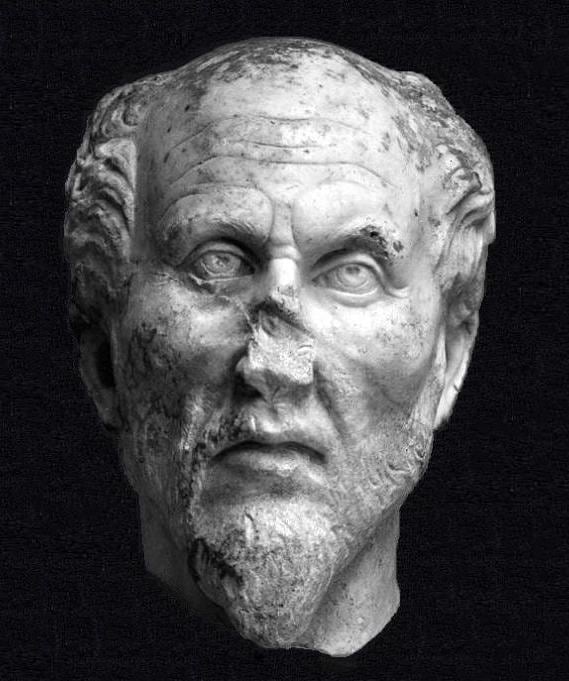
Plotinus
They agree on: What is the Absolute? Does God exist? · Who am I? Is there a true self? · Why do we suffer?
Meher Baba
They agree on: Who am I? Is there a true self? · How is liberation or salvation attained? · Is a teacher necessary?

Mirabai
They agree on: Why do we suffer? · How is liberation or salvation attained? · Is a teacher necessary?

Al-Hallaj
They agree on: Who am I? Is there a true self? · Why do we suffer? · How is liberation or salvation attained?



Anecdotes and stories
Anecdotes and stories
Hagiographic accounts. XV (según la leyenda)
The child of the Lahartara pond
Origin of the story: Legends from Hindu and Kabir Panth hagiographies, nearly a century later than his death (the oldest, Anantadas's *Kabir parachai*, c. 1590). The *Britannica* records the Brahmin widow; Wikipedia, the lotus and Niru and Nima. His name and trade point to a Muslim origin.
Hagiographic accounts. XV (según la leyenda)
Initiated by a footstep
Origin of the story: A hagiographic story told by Evelyn Underhill in her introduction to *Songs of Kabir* (1915). The *Dabestan-e mazaheb* (17th century) already calls him Ramananda's disciple; the *Britannica* allows for a strong influence from Ramananda, but the scene on the steps has no contemporary source.
Hagiographic accountc. 1495 (según la leyenda)
Before Sultan Sikandar Lodi
Origin of the story: A narrative cycle developed in Anantadas's *Kabir parachai* (c. 1590) and later hagiographies (Lorenzen, *Kabir Legends and Ananta-Das's Kabir Parachai*, 1991). Underhill (1915) presented it as fact; many scholars doubt its historicity for lack of independent evidence.
Hagiographic accountc. 1518 (según la leyenda)
The flowers under the shroud
Origin of the story: A hagiographic legend recorded by Underhill (1915). That he died at Magahar is unanimously held by Kabirpanthi tradition and by a Mughal document of 1698–1699 on the tomb of 'Shah Kabir' (Lorenzen, 2019); the *Adi Granth* itself contains a hymn about his move from Benares to Magahar to die.
Documented1604
Guru Arjan takes Kabir into the Sikh scripture
Origin of the story: Facts documented by the Sikh manuscripts themselves; dates according to the history of the *Adi Granth* and Strnad (2023) for the Goindval *pothis*. The count of *shaloks* checked against the BaniDB text (pp. 1364–1377).
Documented1910–1915
How Tagore's Kabir was born
Origin of the story: Preface and introduction of *Songs of Kabir* (1915) and the Wikipedia article on the book; V. C. Mishra's critique, 'Two Truths Are Told: Tagore's Kabir', in Schomer and McLeod (eds.), *The Sants* (1987), pp. 167–180, is cited at second hand.
Teachings
Teachings
The notions that structure their thought, explained in context.
Nirguna: the divine without attributesnirguna
A feature shared by the *sants* of northern India (Ravidas, Dadu, Nanak) as opposed to *saguna* devotion to incarnate Krishna or Rama (Tulsidas, Surdas, Mirabai).
The Name: Ram, Allah, Hariram-nam
The practice of *nam-simran*, shared with the *sants* and central to Sikhism.
The true master (satguru)satguru
A concept common to the *sant* tradition and to Sikhism, where the guru acquires an institutional dimension.
Sahaj: the spontaneous and naturalsahaj
A term inherited from the tantric *siddhas* and the *nath* yogis, reinterpreted by the *sants*.
Ulatbansi: upside-down languageulatbansi
A genre related to the *sandhya-bhasha* of the Buddhist tantric *siddhas* and the *naths*.
Videos
Videos
Recordings, interviews and documentaries. Videos play from YouTube; they are not hosted here.
Had Anhad: Journeys with Ram & Kabir
Documentary· HI· 103 min
Ajab Shahar — Kabir ProjectOfficial channel
Kabira Khada Bazaar Mein: Journeys with Sacred & Secular Kabir
Documentary· HI· 94 min
Ajab Shahar — Kabir ProjectOfficial channel
Chalo Hamara Des: Journeys with Kabir & Friends
Documentary· EN· 97 min
Ajab Shahar — Kabir ProjectOfficial channel
Linda Hess introduces Kabir — Episode 3 of 'Chalo Hamara Des'
Interview· EN· 4 min
Ajab Shahar — Kabir ProjectOfficial channel
Kabir: Revisiting 'Bodies of Song', a talk by Prof. Linda Hess
Lecture· EN· 2020· 97 min
Ulatbansi
Bodies of Song: The Legacy of Kabir — Linda Hess in conversation with Sanjoy K. Roy
Interview· EN· 41 min
JLF InternationalOfficial channel
Understanding Kabir: Life, Philosophy and Poetry by Purushottam Agarwal (Module 1)
Lecture· HI· 2026· 41 min
Jashn-e-RekhtaOfficial channel
Kabir Das | Documentary | Story of Kabir Das
Documentary· HI· 26 min
Prasar Bharati ArchivesOfficial channel
'Kahaan Se Aaya Kahaan Jaaoge?' by Prahlad Tipanya
Third-party recording· HI· 10 min
Ajab Shahar — Kabir ProjectOfficial channel
'Nirbhay Nirgun Gun Re' sings Pt. Kumar Gandharva
Third-party recording· HI· 10 min
Ajab Shahar — Kabir ProjectOfficial channel
Salok Bhagat Kabir Ji — Bhai Maninder Singh Ji (Gurbani Kirtan)
Third-party recording· PA· 21 min
Amrit Baani — Goyal MusicOfficial channel
KABÎR — Une vie, une œuvre : le vagabond céleste (France Culture, 1991)
Documentary· FR· 1991· 80 min
ÉCLAIR BRUT
Kabir: the poet, saint and weaver of Ancient India (full version)
Documentary· EN· 2004· 29 min
Peter Steven MalakoffOfficial channel
Gallery
Gallery
Images with verified licences. Each keeps its authorship and attribution.
Manuscripts
Manuscripts
Manuscript witnesses and ancient texts, with their custodian and conditions of access.
PA · Gurmukhi · s. XV–XVI
Goindval pothis (Mohan pothis)
- Surviving witness
- Dos manuscritos, copias de una antología reunida hacia 1570–1572, con cincuenta canciones de Kabir; solo uno lleva una fecha, equivalente a 1595
- Custodian
- Colección de los descendientes de Baba Mohan
HI · Devanagari · s. XV–XVI
Manuscrito de Fatehpur
- Surviving witness
- Antología fechada en 1582 (Samvat 1639), sobre todo de canciones de Surdas: el manuscrito fechado más antiguo con poemas de Kabir
HI · Devanagari · s. XV–XVII
Panch-vani dadupanthi
- Surviving witness
- Antologías manuscritas del siglo XVII de la secta de Dadu Dayal, en las que la *Kabir vani* es la segunda sección en extensión
- Custodian
- Diversas bibliotecas y monasterios dadupanthis de Rajastán
Connections
Connections
Influences, discipleships and affinities. Documented relations are distinguished from similarities identified by analysis.
Influenced
Documented: Kabir's verses appear in the Goindval *pothis* (c. 1570) and in the *Adi Granth* (1604), where they dialogue with the gurus'. Disputed: W. H. McLeod places Nanak in Kabir's *sant* tradition and sees in him a reproduction of its fundamental doctrines; Surjit Singh Gandhi and J. S. Grewal deny it. No meeting between them is recorded; accounts of one are traditional.
Documented relation
Ideas akin to
Great voices of vernacular *bhakti* in northern India, partly contemporaries if Kabir died in 1518; but Mirabai sings to Krishna with form (*saguna*) and Kabir to the divine without attributes (*nirguna*). The Kabir Project has brought them together in its films.
Similarity identified by analysis
Ideas akin to
Vaudeville, Lorenzen and Adrián Muñoz relate Kabir's *nirguna* absolute to the Brahman of Advaita Vedanta, albeit with differences; Kabir scorns the Brahmanical learning Shankara embodies.
Similarity identified by analysis
Ideas akin to
The mysticism of love and separation brings them together, and Underhill (1915) assumed an influence from the Persian Sufi poets; scholars debate whether Sufism influenced the *sants* or whether both developed through mutual interaction.
Similarity identified by analysis
Ideas akin to
Both teach that what is sought lies within the seeker and distrust outward religion; no historical connection is known.
Similarity identified by analysis
Ideas akin to
Both aim their sharpest verses at outward religion (the ascetic, the preacher, the pandit and the mullah) in the name of inner sincerity.
Similarity identified by analysis
Sources
Sources
Bibliography and catalogues consulted for this profile.
- Wikidata, Q312551 «Kabir» (P31=Q5; 85 enlaces entre wikis; P569 1398 y 1440; P570 1518; P19 Varanasi; P20 Maghar).
- The Editors of Encyclopaedia Britannica. «Kabir». Encyclopaedia Britannica (consultada en la copia de Wayback Machine de 2024).
- Lorenzen, David N. Reseña de Purnendu Ranjan, Kabirpanth till the end of the Medieval India (Chandigarh: Gyankosh, 2016). Kervan. International Journal of Afro-Asiatic Studies 23/1 (2019), pp. 261–263.
- Strnad, Jaroslav. «Kabīr's Pads». En Triveṇī: Texts of Three Literary Traditions in Early Modern Languages of North India. Osaka: Osaka University, 2023, pp. 61–128. DOI 10.18910/94760.
- Kabir. Songs of Kabir, trad. Rabindranath Tagore, introducción de Evelyn Underhill. Nueva York: Macmillan, 1915 (en Londres: One Hundred Poems of Kabir, India Society). Project Gutenberg n.º 6519.
- «Kabir». Wikipedia en inglés (leyendas de nacimiento y persecución según Lorenzen; Dabestan-e Mazaheb; recensiones; crítica de V. C. Mishra, «Two Truths Are Told: Tagore's Kabir», en K. Schomer y W. H. McLeod (eds.), The Sants, 1987, pp. 167–180; Kabir Panth).
- «Songs of Kabir». Wikipedia en inglés (fuentes de Tagore: colección de Kshitimohan Sen y traducción inédita de Ajit Kumar Chakravarty; autenticidad).
- Sri Guru Granth Sahib, bani de Bhagat Kabir (texto gurmukhi por página o *ang*: Gauri 326, Prabhati 1349–1350, Salok 1364–1377). BaniDB.
- «Guru Granth Sahib». Wikipedia en inglés (compilación del Adi Granth por Guru Arjan, completada el 29 de agosto de 1604; bhagats incluidos).
- Rights holder
- Dominio público (obra oral del siglo XV). Las traducciones de Tagore (1915) y Underhill son de dominio público; las ediciones críticas y traducciones modernas (Oxford University Press, Motilal Banarsidass, Penguin, NYRB, SUNY Press, Brill, Gallimard) están sujetas a los derechos de sus editores y traductores.
Pending confirmation
What this profile has not yet been able to settle. We would rather say so than fill it in.
- Recuento exacto de los himnos (*shabad*) de Kabir en el Guru Granth Sahib por raga: solo se ha comprobado la sección de 243 *shaloks* (pp. 1364–1377); no se ha encontrado una fuente fiable para las cifras que circulan.
- Sala de lectura en español: la traducción de Joaquín V. González (1918, dominio público) solo se ha hallado en una adaptación de 2023 con notas de Luis Cárdenas Camus (archive.org, con derechos); buscar el texto de 1918.
- Sala de lectura en hindi: localizar una transcripción de las *Kabir Granthavali* de Shyamsundar Das (1928; Das m. 1945, dominio público en España desde 2026) o del *Bijak* en Wikisource hindi; la API de hi.wikisource no respondió.
- Confirmar la fecha de muerte de Ahmad Shah, traductor del *Bijak* (1917), para decidir si su texto entra en la sala de lectura.
- Leer directamente el ensayo de V. C. Mishra (Schomer y McLeod, *The Sants*, 1987, pp. 167–180) y la introducción de Hess y Singh al *Bijak*; aquí se citan de segunda mano a través de Wikipedia.
- Confirmar el ISBN de *Kabir: Ecstatic Poems* (Robert Bly, Beacon Press): el que da Wikipedia (9780807063804) corresponde en Open Library a otro libro.
- Vídeos en español: no se ha encontrado ninguno de un canal institucional.
- Confirmar los datos editoriales de la edición de Parasnath Tiwari (1961) y de la traducción francesa de Vaudeville (Pondichéry, 1957).
Researched on 2026-10-25