Islam · Sufism
Hafez
خواجه شمسالدین محمد حافظ شیرازی · حافظ
c. 1315 – c. 1390Historically documented person
Fourteenth-century Persian lyric poet (Shiraz, c. 1315–1390), regarded as the summit of the ghazal. He lived under the Inju and Muzaffarid dynasties, to whose princes he addressed poems, and his Divan, compiled after his death, gathers about five hundred ghazals (495 in the Qazvini-Ghani edition) in which love, wine and the satire of false piety merge in deliberate ambiguity. In Iran it is opened at random to seek an augury. The poems by Daniel Ladinsky circulating under his name are not translations of his work.
- works
- 8works
- editions
- 25editions
- quotes
- 9quotes
- videos
- 14videos
- images
- 9images
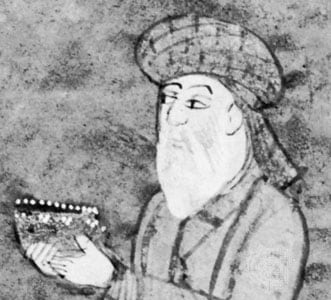
Hafez en una miniatura del siglo XVIII · Public domain
In their words
«Arise, oh Cup-bearer, rise! and bring / To lips that are thirsting the bowl they praise, / For it seemed that love was an easy thing, / But my feet have fallen on difficult ways.»Diván, gazal 1, v. 1 (Qazvini-Ghani; texto persa según Ganjoor); trad. inglesa de Gertrude Bell (1897), poema I; trad. española propia. El primer hemistiquio es árabe.

Their central idea
The rend (sincere libertine): In ordinary Persian a *rend* was a scoundrel, a brawler of ill repute.
See in context
Biography
6 min read
A poet without a biography
Khwaja Shams al-Din Muhammad, known throughout the Persian-speaking world by his pen name, Hafez, is the extreme case of a classic whose life can barely be seen. The anthologies of poets (tazkiras) that mention him are late and, in the words of the Encyclopaedia Iranica, often unreliable or purely fictitious. The earliest document is the preface to his Divan, written by a contemporary who may have been called Muhammad Golandam, and even that text is disputed by specialists. The sources agree on his name and on the meaning of his sobriquet: a hafez is one who knows the Qur'an by heart, and in one ghazal he boasts of reciting it "in fourteen readings". The epithet Lisan al-ghayb, "Tongue of the Unseen", was first used of the book and only later of the man.
He was born in Shiraz between 1315 and 1325: Qasem Ghani argued for 717 AH (1317) and Mohammad Mo'in for 715 (1315). Of his father there are only late and contradictory reports (a Baha al-Din from Isfahan, a Kamal al-Din from Tuyserkan), and the image of the boy delivering bread for a bakery belongs to legend. A few elegiac poems, especially a ghazal for the "light of his eyes" and a qit'a about a gravestone, suggest that he lost a child. He studied the curriculum of his day, Qur'anic sciences and Arabic, and in one poem he praises the five notables who made the province of Fars prosper, among them the theologian Adud al-Din Iji, who died in 1355.
Shiraz between dynasties
Hafez lived in the turbulent interval between Genghis Khan and Tamerlane, when petty dynasties fought over southern Iran. His first great patron was Abu Ishaq Inju, lord of Shiraz, a splendid patron and a reckless ruler, executed in 1357 by the Muzaffarid Mubariz al-Din Muhammad. The poet addressed to him a qasida and an elegiac ghazal, "I remember when my dwelling was at the head of your street", which tradition reads as a lament for that short reign. The victor was a rigorous zealot, so severe that his own son called him the muhtasib, the inspector of public morals, and Hafez advises in one verse to drink in secret because the muhtasib has sharp ears.
In 1358 Shah Shuja deposed and blinded his father, and most of Hafez's poetic life was spent under his reign. Ghani calculated that thirty-nine of the seventy allusions to rulers in the Divan refer to him. He was a cultivated prince and a poet himself; according to the Habib al-siyar, he was the first critic to reproach Hafez for the lack of unity of his ghazals, which leap from wine to Sufism and from Sufism to the beloved. Hafez also sang of viziers, of Shah Mansur and of the Jalayirids of Baghdad. Late sources speak of invitations from India, a disappointing visit to Yazd and a journey to Hormuz abandoned before he embarked; there is documentary proof of almost none of it.
Tamerlane, death and the tomb
Tamerlane took Shiraz in 1387. The famous meeting in which the conqueror reproaches him for giving away Samarkand and Bukhara for a Turkish girl's mole first appears in the Anis al-nas of Shuja Shirazi (1426) and was embellished by Dawlatshah of Samarkand in 1486: it is a literary anecdote, not a fact. The date of his death also varies. Jami and Khwafi give 792 AH (1390), followed by Qazvini and most modern scholars; the inscription on the tomb, through a chronogram, gives 791 (1389). He was buried in the Musalla garden he had so often celebrated. The first mausoleum was raised in 1451–1452; the present building was designed by André Godard in the 1930s.
A book nobody fixed
There is no evidence that Hafez collected his own work. According to Golandam's preface, it was compiled after his death, and the text has come down in hundreds of manuscripts that differ in the number of poems, the order of lines and the readings. The oldest witnesses belong to the fifteenth century, such as a Tashkent copy dated 803 (1401) or the manuscript of 827 (1424) edited by Khalkhali in 1927. On this and seventeen further copies, Mohammad Qazvini and Qasem Ghani published in 1941 the edition that remains the common reference, with 495 ghazals; that of Parviz Natel Khanlari (1959, revised 1983), based on fourteen early manuscripts, admits 486, and other critical editions fall below 450. The authentic core thus amounts to about five hundred ghazals; the qasidas, qit'as, the Saqi-nama and a short masnavi complete a Divan of modest size, while the authenticity of the quatrains ascribed to him is much weaker.
Form and irony
Hafez's ghazal usually has seven to nine couplets bound by one metre and one rhyme, sometimes by a refrain (radif). Each couplet stands on its own, and the poet plays with iham, the word that means two things at once. His motifs are those of Persian lyric (the aloof beloved, the cupbearer, the nightingale and the rose, the tavern), but Ehsan Yarshater stresses a theme that is not lyrical and that obsesses him: the hypocrisy of the sham ascetic, the preacher, the mufti, the muhtasib and also the Sufi in his patched cloak. That satire appears in some 170 of the 486 ghazals of Khanlari's edition, and against it he sets, with deliberate provocation, the rend, the sincere libertine, and the old Magian who keeps the tavern.
Whether Hafez was a mystic is the question that divides his readers. William Jones read him as a Persian Petrarch; Wilberforce Clarke as a Sufi whose wine is always a metaphor; Yarshater argues that he belonged to no Sufi school and that many lines admit only a worldly reading; Leonard Lewisohn, on the contrary, places him within the "religion of love" of Persian mysticism. The poetic language of the fourteenth century was so saturated with spiritual vocabulary that ambiguity is not a flaw of interpretation but the very substance of the poem.
The afterlife of an oracle
Few works have had a comparable social life. The Divan is used for divination, the fal-e Hafez: it is opened at random and the ghazal that appears is read as an answer. A manuscript that passed through the Mughal court preserves notes by Humayun and Jahangir on their auguries, and in Iranian homes the custom survives on Yalda night and at Nowruz. Tradition even tells that, when it was debated whether a poet of such dubious reputation deserved funeral rites, the book was opened and out came the verse asking not to withhold one's step from Hafez's bier, for though drowned in sin he is going to paradise.
Europe discovered him in stages: Thomas Hyde's Latin version around 1690, William Jones's "Persian Song" in 1771 and, above all, the complete German translation by Joseph von Hammer-Purgstall (1812–1813), which inspired Goethe's West-östlicher Divan (1819). In English, Parvin Loloi considers Gertrude Bell's versions (1897) the most lucid and musical of the rhymed translations, and Clarke's (1891) complete but weighed down by a dogmatic Sufi reading.
The Hafez that Hafez did not write
Since 1996 the American Daniel Ladinsky has published widely read books (I Heard God Laughing, The Subject Tonight Is Love, The Gift) presented as "renderings" of Hafez. Ladinsky does not read Persian, worked from Clarke's translation and has acknowledged that they are not translations; scholars such as Christopher Shackle, Aria Fani and Omid Safi have shown that these poems correspond to no original. Many of the "Hafez quotes" circulating today, such as the one about the sun that never says to the earth "you owe me", are Ladinsky's. This entry records them separately, as apocryphal, so that readers can tell the poet of Shiraz from his contemporary echo.
Sources: Bell, Gertrude Lowthian (trad.). Poems from the Divan of Hafiz. Londres: William Heinemann, 1897 (introducción biográfica y notas). Project Gutenberg n.º 74883. · Clarke, H. Wilberforce (trad.). The Dīvān, written in the fourteenth century by Khwāja Shamsu-d-Dīn Muḥammad-i-Ḥāfiẓ-i-Shīrāzī. 2 vols. Calcuta: Government of India Central Printing Office, 1891. · Lewisohn, Leonard (ed.). Hafiz and the Religion of Love in Classical Persian Poetry. Londres: I. B. Tauris / Iran Heritage Foundation, 2010. ISBN 9781848853393.
Timeline
A life, year by year
Each point is a documented event. Click to read it, with its source and degree of certainty.
c. 1315 – 1326age 0Shiraz
Birth in Shiraz
Shams al-Din Muhammad is born. Ghani proposed 717/1317 and Mo'in 715/1315; other estimates reach 1325–1326.
ProbableKhorramshahi, Baha al-Din y EIr. «HAFEZ ii. Hafez's Life and Times». Encyclopaedia Iranica, vol. XI, fasc. 5, pp. 465–469. Publicado el 15-12-2002, actualizado el 01-03-2012.
After their death
- c. 1401First dated copy of the Divan
- c. 1451First mausoleum
- 1771First English translation
- 1791First printed edition
- 1812 – 1819Hammer-Purgstall's translation
- 1897Gertrude Bell's versions
- 1941Qazvini-Ghani edition
- 1983Khanlari's revised edition
- 1996Ladinsky's first 'renderings'
c. 1315 – 1326 · age 0
Birth in Shiraz
Shams al-Din Muhammad is born. Ghani proposed 717/1317 and Mo'in 715/1315; other estimates reach 1325–1326.
Probable
c. 1343 – 1353
Under the patronage of Abu Ishaq Inju
Abu Ishaq Inju rules Shiraz (c. 1343–1353) and becomes the poet's first great patron, celebrated in a qasida and several ghazals.
Documented
1355
Death of Adud al-Din Iji
Death of the theologian Adud al-Din Iji, one of the 'five notables' of Fars praised by Hafez in a qit'a.
Documented
1357
Execution of Abu Ishaq
The Muzaffarid Mubariz al-Din Muhammad executes Abu Ishaq. Hafez writes a chronogram of his death and an elegiac ghazal; the new ruler imposes a rigorist morality the poet satirises through the figure of the *muhtasib*.
Documented
1358 – 1384
Shah Shuja's reign begins
Shah Shuja deposes and blinds his father. Most of Hafez's poetic life is spent under his long reign (to 1384): 39 of his 70 allusions to rulers concern him.
Documented
1366
Shah Shuja's triumphant return
Having lost Shiraz to his brother, Shah Shuja returns to the city (767/1366); several ghazals celebrate the event.
Probable
1387
Tamerlane takes Shiraz
Tamerlane occupies Shiraz. The meeting with Hafez about 'Samarkand and Bukhara' is an anecdote first attested in 1426.
Documented
c. 1390
Death in Shiraz
He dies in Shiraz: 792/1390 according to Jami and Khwafi (the date Qazvini preferred), 791/1389 according to the 'Khak-e Musalla' chronogram on his tomb. He is buried in the Musalla garden.
Probable
c. 1401
First dated copy of the Divan
A Tashkent manuscript (Oriental Institute, no. 12770) dated by its colophon to 803/1401 contains some 407 ghazals; it is the oldest known copy, edited in Tehran in 2000.
Probable
c. 1451
First mausoleum
After the Timurid Abu'l-Qasim Babur conquers Shiraz (855/1451), his minister Muhammad Mamai raises a monument over the tomb.
Documented
1771
First English translation
William Jones publishes the 'Persian Song', a version of the Shirazi Turk ghazal, in his *Grammar of the Persian Language*.
Documented
1791
First printed edition
Abu Taleb Khan prepares in Calcutta, from twelve manuscripts, the first movable-type edition of the *Divan* (1,200 copies).
Documented
1812 – 1819
Hammer-Purgstall's translation
Joseph von Hammer-Purgstall publishes the first complete German translation (1812–1813), which Goethe reads and which gives rise to the *West-östlicher Divan* (1819).
Documented
1897
Gertrude Bell's versions
Gertrude Bell publishes *Poems from the Divan of Hafiz* in London, regarded by Parvin Loloi as the most lucid of the English verse translations.
Documented
1941
Qazvini-Ghani edition
Mohammad Qazvini and Qasem Ghani publish in Tehran (1320 Š.) the edition of the *Divan* based on the 827/1424 manuscript and seventeen further copies: 495 ghazals. It remains the common reference.
Documented
1983
Khanlari's revised edition
Parviz Natel Khanlari publishes the second edition of his *Divan* (fourteen manuscripts of 807–836 AH), with 486 ghazals.
Documented
1996
Ladinsky's first 'renderings'
Daniel Ladinsky publishes *I Heard God Laughing*, the first of a series of original works presented as 'renderings' of Hafez; *The Gift* follows in 1999.
Documented
Works
Essential works
The works without which their legacy cannot be understood.
Written work · c. 1390
Divan: ghazals
دیوان حافظ — غزلیات (Divan-e Hafez: gazaliyat)
The heart of Hafez's work and, by common consent, the summit of the Persian ghazal. Each poem, of seven to nine couplets on a single rhyme, links lines that stand on their own and play on double meaning (*iham*). The aloof beloved, the cupbearer, the tavern, the nightingale and the rose live alongside a constant satire of the hypocritical ascetic, the preacher and the morals inspector, and alongside lines of wisdom on transience and fate. The book opens with an Arabic line ascribed to the caliph Yazid ("O cupbearer, pass round the cup!") and its reading oscillates, never resolved, between human and divine love. It is the book of poetry most present in Iranian homes and the one consulted as an oracle.
19 editions · amazon.com
Complete works (8)
Hafez
Qasidas
The Conscious LibraryQasidas
Hafez
Qit'as (fragments)
The Conscious LibraryQit'as (fragments)
Hafez
Saqi-nama (Book of the Cupbearer)
The Conscious LibrarySaqi-nama (Book of the Cupbearer)
Hafez
Masnavi of the wild gazelle
The Conscious LibraryMasnavi of the wild gazelle
Hafez
Rubaiyat (attributed quatrains)
The Conscious LibraryRubaiyat (attributed quatrains)
Hafez
Attributed poems
The Conscious LibraryAttributed poems

Daniel Ladinsky's 'renderings' (The Gift and others)
1999
Quotations
Quotations located in a specific work. Each carries its provenance and its level of confidence.
Arise, oh Cup-bearer, rise! and bring / To lips that are thirsting the bowl they praise, / For it seemed that love was an easy thing, / But my feet have fallen on difficult ways.الا یا ایها الساقی ادر کأسا و ناولها / که عشق آسان نمود اول ولی افتاد مشکلها
VerifiedDiván, gazal 1, v. 1 (Qazvini-Ghani; texto persa según Ganjoor); trad. inglesa de Gertrude Bell (1897), poema I; trad. española propia. El primer hemistiquio es árabe.
Apocryphal quotes or disputed attributions (4)
«Even after all this time the sun never says to the earth, "You owe me." Look what happens with a love like that. It lights the whole sky.»
A poem by Daniel Ladinsky in *The Gift* (1999), circulated as Hafez's. Omid Safi cites it as an example of 'fake Hafez': it corresponds to no Persian ghazal. Text under its author's copyright; quoted briefly for identification.
«Fear is the cheapest room in the house. I would like to see you living in better conditions.»
A line by Daniel Ladinsky that Omid Safi identifies among the 'Hafez' quotes with no Persian original.
«I wish I could show you, when you are lonely or in darkness, the astonishing light of your own being.»
By Daniel Ladinsky. Safi acknowledges its quality but stresses that Hafez said nothing of the kind.
«Your heart and my heart are very very old friends.»
By Daniel Ladinsky; cited by Safi among the examples of poems falsely attributed to Hafez.
Last words
There are no verifiable records of their last words.
No account of his last moments survives. What tradition associates with his death is an augury: according to the story transmitted by late biographers (recorded by Gertrude Bell in 1897), when it was debated whether he deserved funeral rites the *Divan* was opened at random and out came the line 'Do not withhold your step from Hafez's bier…' (ghazal 79 in Qazvini-Ghani). These are not deathbed words of his.
Source: Bell, Gertrude Lowthian (trad.). Poems from the Divan of Hafiz. Londres: William Heinemann, 1897 (introducción biográfica y notas). Project Gutenberg n.º 74883.
Ask
What their work answers
Twelve great human questions and what their texts allow us to answer, with references. We never put words in their mouth.
What is the Absolute? Does God exist?
A Friend of grace, glimpsed behind the ambiguity of the ghazal
A personal GodInferred from their doctrine
Hafez wrote no theology, and his Divan deliberately avoids definitions: the Friend or Beloved of his ghazals may be a prince, a youth of Shiraz or God, and is often all three at once. Even so, the God glimpsed in his verses is personal. He is the Lord of the pre-eternal covenant, the day of Alast when souls answered the Qur'anic question, whose memory runs through his poetry; He is a grace hoped for rather than earned, which is why the poet trusts he will reach paradise even though drowned in sin. Before this God there is no speculation about the essence, but dealings: complaint, entreaty, irony and gratitude addressed to Someone who listens. What Hafez rejects is not God but the ostentatious religion of those who preach in His name.
Compare this question with other teachersWho am I? Is there a true self?
A bird of the heavenly garden fallen into the world's snare
A created, immortal soulInferred from their doctrine
Hafez does not reason about the self, but his ghazals reveal an image traditional in Persian poetry. The soul is a bird of the garden of holiness that has fallen into the snare of this world's events and does not know how to tell of its separation; it comes from above and longs to return. At the same time, the empirical self, with its vanity and calculations, is the main obstacle: in a famous verse the poet tells himself that between lover and beloved there is no veil at all, that he himself is his own veil and must step out of the way. This double view, a soul of heavenly origin and an ego that gets in the way, is that of the Sufism Shiraz breathed, expressed without system and almost always with irony.
Compare this question with other teachersWhy do we suffer?
Love seemed easy; then came the hardships of separation
Separation from GodInferred from their doctrine
Hafez's Divan opens with a confession: love seemed easy at first, but then difficulties arose. The pain running through his ghazals is that of separation (firaq) from the Beloved, whether human or divine: the dark night, the fear of the waves, the wait for the messenger, the complaint before a beauty that does not answer. To this is added the pain of an unstable world, in which kingdoms pass and fortune turns, and of a society in which preachers do not practise what they preach. Hafez offers no doctrine of suffering, but an attitude: to accept grief as part of love, to seek consolation in wine, music and grace, and not to trust those who promise salvation through the appearance of piety.
Compare this question with other teachersWhat happens after death?
Seize the moment; grace will bring the sinner to paradise
Eternal life and resurrectionInferred from their doctrine
Hafez does not speculate about the hereafter, but neither does he deny it. His ghazals insist on the brevity of life and the fragility of kingdoms: the world is an old bride of a thousand grooms who keeps faith with none, and one should not postpone the cup or love. That urgency is not nihilism: the horizon of his verses is Islam, with its paradise and its judgement, and his wager is on grace rather than merit. In one ghazal he asks that no one refuse to follow Hafez's funeral procession, for though drowned in sin he is going to paradise. Tradition tells that when it was debated whether he deserved funeral honours, the Divan was opened at random and that very verse came out. Irony, faith in mercy and distrust of the pious mingle in his view of death.
Compare this question with other teachersHow is liberation or salvation attained?
Only love and grace save, not piety put on display
Through grace and loveStated explicitly
Hafez distrusts salvation by merit. His favourite target is the ascetic (zahid) and the preacher who show off in the pulpit and, alone, do something else: piety turned into spectacle leads nowhere. Against it he sets love and grace. In a famous verse he states that love will come to the poet's aid even if he recites the Qur'an by heart in its fourteen readings, as if to say that not even that feat of piety saves on its own. And he trusts that he will reach paradise even though drowned in sin. Liberation, in his Divan, is a gift awaited with humility and without hypocrisy, from the condition of the rend, the sincere libertine, who claims no virtue and therefore remains open to mercy.
Compare this question with other teachersIs a teacher necessary?
If the tavern elder bids it, stain the prayer rug with wine
IndispensableInferred from their doctrine
In the first ghazal of the Divan, Hafez advises staining the prayer rug with wine if the pir-e moghan, the elder of the Magi or of the tavern, says so, for the wayfarer is not ignorant of the customs of the stages of the path. That figure, who returns again and again in his poems, is Hafez's master: not a shaykh of an order nor a preacher, but a sage of disorderly life in the eyes of the pious, who knows the way from experience. In another verse he warns not to travel this stage without the company of Khidr, the mysterious guide of Qur'anic tradition, for there is darkness and danger of going astray. Hafez needs a guide; what he rejects is the authority of the official clergy, whose piety he considers feigned.
Compare this question with other teachersIs the world real?
The Friend's face is mirrored in the cup; the world, a faithless bride, passes
Manifestation of the divineInferred from their doctrine
Hafez's world has two faces. On one side it is fleeting and faithless: an old bride who has had a thousand husbands and keeps faith with none. One should not cling to its kingdoms or honours. On the other side, that same world is where beauty is reflected: in a famous verse the poet says he has seen in the cup the reflection of the Friend's face, and the cup of Jamshid, which in Persian legend showed the whole universe, becomes in his ghazals an image of the heart that sees. Hafez does not deny the reality of things; he loves them because they let something shine through that does not pass away with them.
Compare this question with other teachersWhat is love?
Love is the only path, even when it brings hardships
Longing and unionStated explicitly
Love is the theme of almost all of Hafez's ghazals, and its ambiguity is deliberate: the Beloved has a face, a mole and curls, and at the same time points to the divine. The Divan opens by recalling that love seemed easy at first and that difficulties then arose; another famous poem offers Samarkand and Bukhara for the dark mole of a girl from Shiraz. In both cases love is excess, detachment and risk, the opposite of the ascetic's calculation. If one seeks the Beloved's presence, the poet advises, one must not be absent from Him; and when one finds Him, one must leave the world. For Hafez only love saves, and only love allows one to see through the hypocrisy of those who boast of piety.
Compare this question with other teachersAre we free, or is everything determined?
My lot was settled in pre-eternity: if you dislike it, change destiny
Destiny and responsibilityInferred from their doctrine
Hafez often returns to the theme of the lot fixed in pre-eternity (azal): what each person is to drink was poured on the day of the primordial covenant, and no piety or calculation will change it. In a well-known verse he answers someone who reproaches him for his bad name that they did not let him pass through the street of good repute, and that if he dislikes it, he should change the divine decree. This fatalism is above all ironic: it serves to disarm the pride of the pious, who ascribe their virtue to their own merit, and to justify the sincere libertine who does not pretend. Hafez does not deny responsibility, but he places it before a grace and a destiny no one controls, and answers both with humility and humour.
Compare this question with other teachersWhy meditate or pray?
If you seek the presence, do not be absent from Him
Being presentStated explicitly
Hafez mocks prayer turned into display — the preachers who show off in the pulpit and do something else in private — and sets against it another way of praying. The first ghazal of the Divan ends with advice addressed to himself: if you seek the presence (hozur), do not be absent from Him; when you find the one you love, leave the world. Presence here is that of the heart before the Beloved, the undivided attention Sufism asks for in prayer. In his poems there appear the dawn supplication and the night vigil, often alongside the cup and the musician. What Hafez values is not the number of prayers or their outward form, but that the heart should be where it claims to be.
Compare this question with other teachersCan reason know the ultimate?
No one has solved nor will solve the riddle of the world by wisdom
The ultimate lies beyond the mindStated explicitly
In the same ghazal in which he offers Samarkand and Bukhara for the mole of a girl from Shiraz, Hafez advises speaking of the minstrel and the wine and seeking less the secret of time, for no one has solved nor will solve that riddle by wisdom. It is one of his most constant convictions: philosophy and speculative theology do not reach the mystery, and those who boast of knowing everything, the ascetic, the jurist, the preacher, are often the blindest. What reason does not open, love opens, or it is left open. This renunciation is not intellectual laziness: Hafez was a scholar who knew the Qur'an by heart and mastered the poetic tradition. It is the irony of one who knows learning and its limits.
Compare this question with other teachersWithdraw from the world or transform it?
Neither convent nor pulpit: sincerity is lived in the tavern of the world
Contemplation in actionInferred from their doctrine
Hafez lived in Shiraz, in the world: a court poet under several princes, a teacher of the Qur'an according to his biographers, witness to wars and dynastic changes. His ghazals often set the dervish convent (khanqah) and the mosque of hypocrites against the tavern of the Magi (kharabat), where the rend, the sincere libertine, lives without pretence. He chooses neither the ascetic's retreat, which he mocks, nor political action, which he distrusts, but a third way: to be in the world with an awake heart, to enjoy what life gives without clinging, to unmask false piety and to keep faith with the Beloved. His poetry itself, recited everywhere, was his way of intervening.
Compare this question with other teachers
Affinities & tensions
Affinities and tensions
Calculated question by question from their positions. The reason for each agreement or clash, on click.
Thinks most like
Rumi
They agree on: What is the Absolute? Does God exist? · Who am I? Is there a true self? · Why do we suffer?

Chaitanya Mahaprabhu
They agree on: What is the Absolute? Does God exist? · Who am I? Is there a true self? · Why do we suffer?
Baal Shem Tov
They agree on: Who am I? Is there a true self? · Why do we suffer? · What happens after death?

Francis of Assisi
They agree on: What is the Absolute? Does God exist? · Who am I? Is there a true self? · Why do we suffer?
Thinks most unlike

Pema Chödrön
They clash on: What is the Absolute? Does God exist? · Who am I? Is there a true self? · What happens after death?

Epicurus
They clash on: What is the Absolute? Does God exist? · Who am I? Is there a true self? · What happens after death?

The 14th Dalai Lama (Tenzin Gyatso)
They clash on: What is the Absolute? Does God exist? · Who am I? Is there a true self? · What happens after death?
Kapila
They clash on: What is the Absolute? Does God exist? · What happens after death?
Anecdotes and stories
Anecdotes and stories
Unverifiable1387 (según el relato)
Samarkand and Bukhara for a mole
Origin of the story: It first appears in Shuja Shirazi's *Anis al-nas* (1426), some thirty-five years after the poet's death, and was expanded by Dawlatshah Samarqandi in his *Tadhkirat al-shu'ara* (1486). The *Encyclopaedia Iranica* warns that anecdotes from these sources reflect the later image of the poet and cannot be used as facts.
Oral traditionc. 1390
The augury at the funeral
Origin of the story: A story transmitted by late biographers and recorded by Gertrude Bell in the introduction to *Poems from the Divan of Hafiz* (1897); it is not found in fourteenth-century sources.
Disputed1358–1384
The king who asked for unity
Origin of the story: It comes from the *Habib al-siyar* of the historian Khwandamir (sixteenth century), more than a century later; it is recorded by Bell (1897) and the *Encyclopaedia Iranica* (Khorramshahi).
Disputedc. 1390
Persian sugar for the parrots of India
Origin of the story: The correspondence with the sultan of Bengal is asserted in the Indo-Persian tradition and recorded by English Wikipedia; Bell (1897, note to poem XXI) ascribes the invitation to a 'Shah Mahmud Purabi' and tells of the interrupted journey. There is no contemporary documentation.
Unverifiables. XIV (según la leyenda)
Shakh-e Nabat and the forty-day vigil
Origin of the story: Modern oral tradition spread in Iran and in Western anthologies; English Wikipedia presents it as legend and the *Encyclopaedia Iranica* warns against reconstructing the poet's life from literal readings of his verse.
Documented1812–1819
Goethe finds his twin
Origin of the story: Facts of literary history documented in the editions of Hammer-Purgstall and Goethe; see Hamid Tafazoli, 'Hafez xi. Translations of Hafez in German', *Encyclopaedia Iranica*.
Source: Tafazoli, Hamid. «HAFEZ xi. Translations of Hafez in German». Encyclopaedia Iranica.
Teachings
Teachings
The notions that structure their thought, explained in context.
The rend (sincere libertine)rendi
A figure inherited from the *qalandari* poetry of Sanai and Attar, which Hafez brings to its most elaborate form.
Riya: religious hypocrisyriya
Part of the rise of fourteenth-century Persian satire, alongside Obeyd Zakani.
Iham: amphibologyiham
A figure codified by classical Persian rhetoric; in Hafez it merges with the convergence of love lyric, panegyric and mysticism.
Wine and the cupbearermay-o-saqi
Bacchic symbolism inherited from Arabic and Persian poetry (Abu Nuwas, Khayyam, Sufi lyric), to which Hafez gives its canonical form.
Source: Lewisohn, Leonard (ed.). Hafiz and the Religion of Love in Classical Persian Poetry. Londres: I. B. Tauris / Iran Heritage Foundation, 2010. ISBN 9781848853393.
Fal-e Hafez: the Divan as oraclefal-e-hafez
Bibliomancy comparable to the *sortes Vergilianae*; part of the Islamic tradition of *fal-namas*.
Videos
Videos
Recordings, interviews and documentaries. Videos play from YouTube; they are not hosted here.
Hafiz and the Religion of Love — Lecture by L. Lewisohn
Lecture· EN· 115 min
Golha Project Videos
Leonard Lewisohn «One Day with Hafez», Leiden University, Sep. 2012
Lecture· EN· 2012· 4 min
Persian Dutch Network
Scholar reflects bringing medieval Persian verse to the West
Interview· EN· 2013· 6 min
PBS NewsHourOfficial channel
Dick Davis reads 'I see no love in anyone'
Third-party recording· EN· 2013· 2 min
PBS NewsHourOfficial channel
بزرگان ایرانزمین: حافظ (Grandes de Irán: Hafez)
Documentary· FA· 2012· 24 min
BBC PersianOfficial channel
Hafez and Persian Poetry in Song (Part One)
Lecture· EN· 59 min
OxfordSongOfficial channel
Hafez and Persian Poetry in Song (Part Two)
Lecture· EN· 65 min
OxfordSongOfficial channel
How to Love Like A Poet: Why Rumi, Hafez, and Saadi Shirazi Matter Today
Lecture· EN· 2023· 80 min
Renovatio: The Journal of Zaytuna CollegeOfficial channel
Hafez: inmortal y magistral poeta
Lecture· ES· 2019· 63 min
Espacio Persa
La poesía como experiencia cotidiana en Irán
Documentary· ES· 2020· 28 min
INAH TVOfficial channel
Hafez Commemoration — Shajarian & Pirniakan (بزرگداشت حافظ)
Third-party recording· FA· 1988· 52 min
Khosousi
غزلیات حافظ با دکلمه شاملو و موسیقی فرهاد فخرالدینی
Third-party recording· FA· 64 min
EngineeringMath
Hafezieh | The Timeless Shrine of Hafez in Shiraz, Iran
Documentary· EN· 3 min
Visit Iran - Official Travel Guide of IranOfficial channel
Poems from the Divan of Hafiz by Gertrude Bell — full audiobook
Third-party recording· EN· 88 min
Best Audiobooks
Gallery
Gallery
Images with verified licences. Each keeps its authorship and attribution.
Manuscripts
Manuscripts
Manuscript witnesses and ancient texts, with their custodian and conditions of access.
FA · Perso-árabe · s. XIV
دیوان حافظ (Divan-e Hafez), copia de Taskent
- Surviving witness
- Copia que su colofón (fol. 140a) fecha en 803/1401, con unos 407 gazales; la más antigua conocida
- Custodian
- Instituto de Estudios Orientales, Taskent · n.º 12770
FA · Perso-árabe · s. XIV
Antología de Iskandar Sultán (con gazales de Hafez)
- Surviving witness
- Antología copiada en 813–814/1410–1411 para el príncipe timúrida Iskandar Sultán
- Custodian
- British Library, Londres · Add. MS 27261
FA · Perso-árabe · s. XIV
دیوان حافظ، نسخهٔ خلخالی (manuscrito de Jaljali)
- Surviving witness
- Copia fechada en 827/1424, unos treinta y cinco años después de la muerte del poeta
- Custodian
- Colección particular
FA · Nastaliq · s. XIV
دیوان حافظ، نسخهٔ شاهان مغولیه (copia real mogola)
- Surviving witness
- Manuscrito probablemente del s. XV con inscripción de Husayn Bayqara; anotaciones de augurios de Humayun (una de 962/1554–1555) y Yahangir
- Custodian
- Khuda Bakhsh Oriental Public Library, Patna
Connections
Connections
Influences, discipleships and affinities. Documented relations are distinguished from similarities identified by analysis.
Ideas akin to
The two summits of the Persian ghazal, a century apart. Legend says Hafez knew Rumi's work by heart, but his ghazal derives rather from the school of Saadi and Khwaju of Kerman; the affinity lies in the mysticism of love and the language of wine and the tavern.
Similarity identified by analysis
Ideas akin to
The figure of the *rend* and the *qalandari* poetry that Hafez brings to its most refined form have precedents in Attar's ghazals. Farid al-Din Attar should not be confused with the shaykh Mahmud (or Zayn al-Din) Attar of Shiraz, whom tradition makes Hafez's master.
Similarity identified by analysis
Ideas akin to
Some critics (Lewisohn and others) read the *Divan* in the light of the 'religion of love' and the metaphysics of Ibn Arabi's school as spread in Iran; no direct dependence is documented.
Similarity identified by analysis
Ideas akin to
Both aim their sharpest verses at outward religion (the ascetic, the preacher, the pandit and the mullah) in the name of inner sincerity.
Similarity identified by analysis
Sources
Sources
Bibliography and catalogues consulted for this profile.
- Wikidata, Q6240 «Hafez» (P31=Q5; 163 enlaces entre wikis; P569 1325 y 1326; P570 1389; P1559 خواجه شمسالدین محمد حافظ شیرازی).
- Khorramshahi, Baha al-Din y EIr. «HAFEZ ii. Hafez's Life and Times». Encyclopaedia Iranica, vol. XI, fasc. 5, pp. 465–469. Publicado el 15-12-2002, actualizado el 01-03-2012.
- Yarshater, Ehsan. «HAFEZ i. An Overview». Encyclopaedia Iranica, vol. XI, fasc. 5. Publicado el 15-12-2002.
- Khorramshahi, Baha al-Din y EIr. «HAFEZ vi. Printed Editions of the Divān of Hafez». Encyclopaedia Iranica. Publicado el 15-12-2002.
- Loloi, Parvin. «HAFEZ x. Translations of Hafez in English». Encyclopaedia Iranica. Publicado el 15-12-2002.
- Tafazoli, Hamid. «HAFEZ xi. Translations of Hafez in German». Encyclopaedia Iranica.
- Bell, Gertrude Lowthian (trad.). Poems from the Divan of Hafiz. Londres: William Heinemann, 1897 (introducción biográfica y notas). Project Gutenberg n.º 74883.
- Hafez. Divan, texto según la edición de Mohammad Qazvini y Qasem Ghani (Teherán, 1320 Š./1941): 495 gazales, 3 casidas, 34 qit'as, 42 rubaiyat, Saqi-nama, masnaví «Ala ey ahu-ye vahshi», prefacio del compilador y 118 poemas atribuidos. Ganjoor (biblioteca digital de poesía persa).
- Clarke, H. Wilberforce (trad.). The Dīvān, written in the fourteenth century by Khwāja Shamsu-d-Dīn Muḥammad-i-Ḥāfiẓ-i-Shīrāzī. 2 vols. Calcuta: Government of India Central Printing Office, 1891.
- Safi, Omid. «Fake Hafez: How a supreme Persian poet of love was erased». Al Jazeera, 14-06-2020.
- Fani, Aria. «Rewriting Hafez: Re-theorizing Untranslatability in Persian Poetry». Ajam Media Collective, 08-07-2014.
- «Shirazi Turk». Wikipedia en inglés (origen de la anécdota de Tamerlán: Shuja Shirazi, Anis al-nas, 1426; Dawlatshah Samarqandi, Tadhkirat al-shu'ara, 1486).
- «Daniel Ladinsky». Wikipedia en inglés (obras, método de trabajo a partir de Clarke, críticas de Christopher Shackle, Aria Fani, Murat Nemet-Nejat y Omid Safi).
- Lewisohn, Leonard (ed.). Hafiz and the Religion of Love in Classical Persian Poetry. Londres: I. B. Tauris / Iran Heritage Foundation, 2010. ISBN 9781848853393.
- «Hafez». Wikipedia en inglés (mausoleo de André Godard, día de Hafez, fal-e Hafez, correspondencia con Ghiyath al-Din Azam Shah de Bengala, traducciones modernas).
- Rights holder
- Dominio público (obra del siglo XIV). Las ediciones críticas modernas y las traducciones (Archetype, Mage, Penguin, Verdier, Gallimard, Visor…) están sujetas a los derechos de sus editores y traductores. Los libros de Daniel Ladinsky (Penguin) son obra original suya con derechos vigentes, no traducciones de Hafez.
Pending confirmation
What this profile has not yet been able to settle. We would rather say so than fill it in.
- Localizar un ISBN de una reimpresión moderna de la edición de Qazvini y Ghani y de la 2.ª edición de Janlari (Jarazmi, 1983); Open Library las registra sin ISBN.
- Confirmar en catálogo el traductor y la naturaleza de «El despertar del amor» (Sufí, 2003) y «La canción de Saki» (Alif): no se han incluido porque Open Library no da traductor ni permite saber si traducen a Hafez o a Ladinsky.
- No se ha encontrado una traducción española de Hafez de dominio público; tampoco una alemana de Hammer-Purgstall o Rosenzweig transcrita en Wikisource (solo escaneos).
- Vídeos: los recitados de Shajarian y Shamlu proceden de canales no oficiales; buscar ediciones oficiales (Delawaz, herederos de Shamlu) y algún documental en francés o alemán de televisión pública.
- Comprobar el enlace estable de la British Library para Add. MS 27261 (antología de Iskandar Sultán) cuando se restablezca su visor de manuscritos.
- Verificar con una fuente impresa (Limbert, *Shiraz in the Age of Hafez*, 2004) la datación de la correspondencia con Ghiyath al-Din Azam Shah de Bengala.
- Precisar la autoría del retrato de la British Library (File:Mohammad Shams al-Din Hafez.jpg): Commons no indica signatura ni pintor.
Researched on 2026-10-25