Hinduismus · Bhakti · Vedische Tradition
Valmiki
वाल्मीकि · Vālmīki · रामायण · வால்மீகி
Legendäre Gestalt
Legendärer Dichter, dem die Überlieferung das Rāmāyaṇa zuschreibt und den sie ādikavi, »den ersten Dichter«, nennt. Alles, was man über ihn weiß, stammt aus dem Gedicht selbst, in dem er als der Weise erscheint, der den Schmerz über einen getöteten Kranich in Verse fasst, als Beschützer Sītās und Lehrer ihrer Söhne, sowie aus späten Legenden wie der vom bekehrten Räuber. Die Philologie datiert den Kern des Epos ins 8. bis 5. Jahrhundert v. Chr. und hält das erste und das letzte Buch für spät. Ihm wird auch die Erzählung des Yoga Vāsiṣṭha zugeschrieben.
- Werke
- 12Werke
- Ausgaben
- 24Ausgaben
- Zitate
- 4Zitate
- Videos
- 14Videos
- Bilder
- 8Bilder
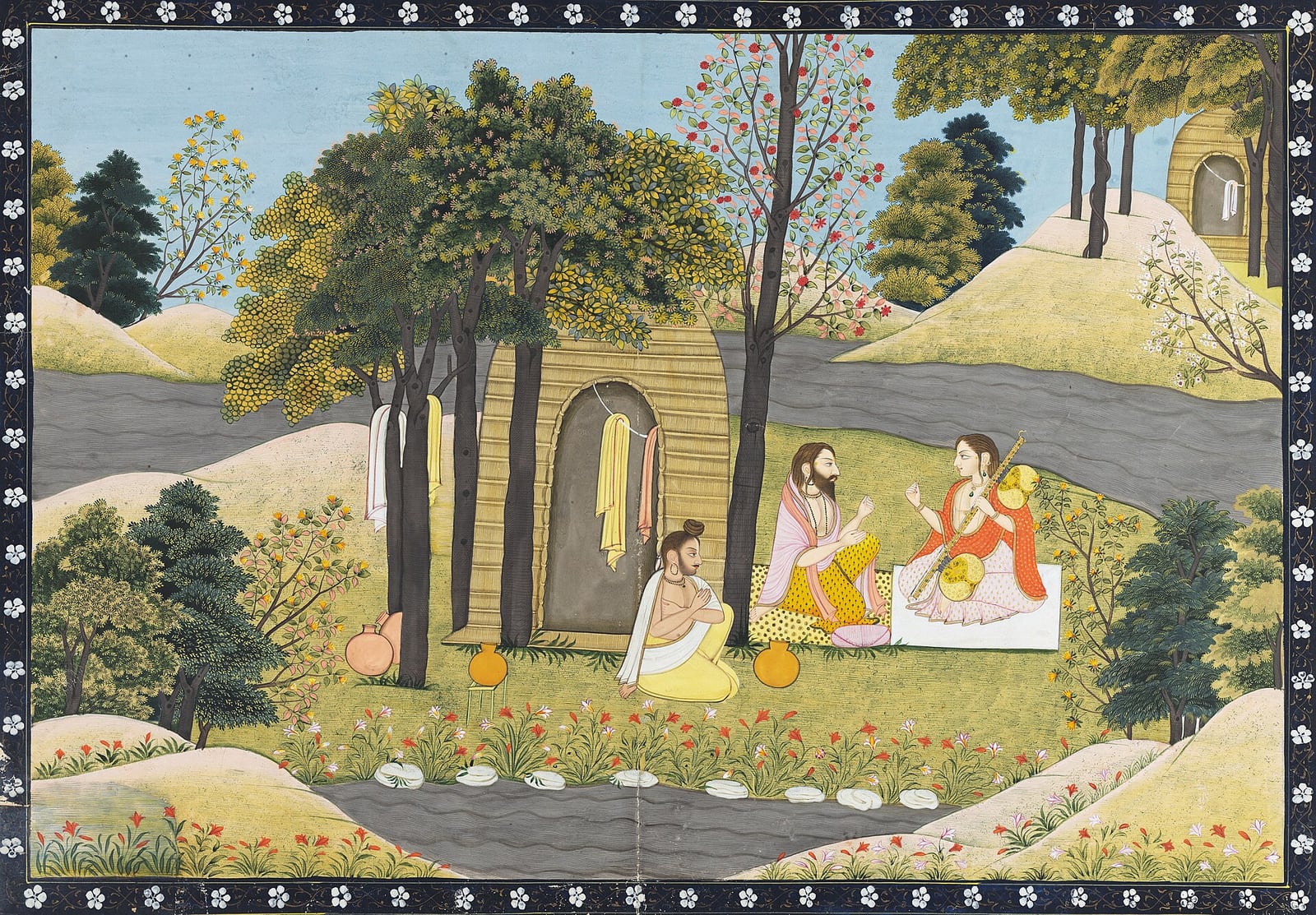
Nārada en la ermita de Vālmīki · Public domain
In eigenen Worten
«No fame be thine for endless time, / Because, base outcast, of thy crime, / Whose cruel hand was fain to slay / One of this gentle pair at play!»Rāmāyaṇa, Bālakāṇḍa, canto II (1.2.14 de la edición crítica); trad. en verso de R. T. H. Griffith (1870, dominio público); versión española del investigador

Der zentrale Gedanke
Śloka (the stanza born of grief): The śloka is the stanza of two lines of sixteen syllables, divided into four feet of eight (anuṣṭubh), which became the metre par excellence of the epic and of classical Sanskrit literature.
Im Zusammenhang sehen
Biografie
4 Min. Lesezeit
Unterstützte Übersetzung aus dem spanischen Original, Durchsicht durch einen muttersprachlichen Übersetzer ausstehend.
Der erste Dichter
Die indische Überlieferung nennt Vālmīki ādikavi, »den ersten Dichter«, und sein Rāmāyaṇa ādikāvya, »das erste Gedicht«: das Werk, mit dem die gelehrte Dichtung in Sanskrit entstanden sein soll. Das ist eine Aussage über den Ursprung einer Gattung, nicht über die Lebensgeschichte eines Menschen. Über Vālmīki gibt es kein Zeugnis außerhalb der Texte; alles, was man weiß, stammt aus dem Gedicht selbst, in dem er als Figur auftritt, und aus sehr viel späteren Legenden. Die Philologie behandelt ihn als den Namen, den die Überlieferung dem Verfasser – oder den Verfassern – eines über mehrere Jahrhunderte hinweg verfassten und erweiterten Epos gab.
Ein Gedicht, das seine eigene Entstehung erzählt
Das Rāmāyaṇa beginnt mit einer Erzählung über sich selbst. Vālmīki fragt den Weisen Nārada, ob es auf der Welt einen Menschen gebe, der tugendhaft, tapfer, wahrhaftig und mitfühlend sei, und Nārada fasst ihm das Leben Rāmas zusammen. Bald darauf sieht der Dichter am Ufer des Flusses Tamasā, wie ein Jäger das Männchen eines krauñca-Kranichpaares tötet, während das Weibchen neben dem Leichnam schreit. Erschüttert verflucht er den Jäger, und seine Worte fügen sich ihm zum Maß, zu zwei Zeilen mit Versfüßen von je acht Silben: Der Schmerz (śoka) ist zur Strophe (śloka) geworden. Brahmā erscheint ihm und befiehlt ihm, in diesem Versmaß die Geschichte Rāmas zu erzählen. Robert Goldman hat gezeigt, dass diese ersten Gesänge ein später Rahmen sind, der das Epos zum Ursprungsmythos der Dichtung macht; Jahrhunderte später sollte Ānandavardhana in der Szene den Beweis dafür sehen, dass die Seele der Dichtung das Gefühl ist.
Figur seines eigenen Werkes
Im letzten Buch, dem Uttarakāṇḍa, tritt der Dichter in die Handlung ein. Rāma, nun König in Ayodhyā, verstößt Sītā wegen des Geredes im Volk, und sie findet schwanger Zuflucht in der Einsiedelei Vālmīkis, wo ihre Zwillingssöhne Kuśa und Lava zur Welt kommen. Der Weise erzieht sie und lehrt sie das Gedicht, das die Knaben beim großen Pferdeopfer vor Rāma selbst singen werden. Daraufhin führt Vālmīki Sītā vor die Versammlung und schwört bei seiner Askese, dass sie unschuldig ist: »Ich bin der zehnte Sohn des Pracetas, und die Lüge keimt nicht einmal in meinem Geist.« Sītā bittet die Erde, sie aufzunehmen, wenn sie treu gewesen sei, und die Erde öffnet sich. So ist der Dichter Zeuge, Beschützer und Bürge für die Wahrheit seiner eigenen Erzählung.
Ein Text aus vielen Jahrhunderten
Das Rāmāyaṇa umfasst der Überlieferung nach rund vierundzwanzigtausend Strophen in sieben Büchern (kāṇḍa) und ist in zwei großen Rezensionen, einer nördlichen und einer südlichen, mit zahlreichen regionalen Varianten überliefert. Zwischen 1960 und 1975 veröffentlichte das Oriental Institute in Baroda die kritische Ausgabe, die den ältesten erreichbaren Text zu rekonstruieren sucht. Einigkeit besteht darüber, dass die Bücher II bis VI den Kern bilden und das erste und das siebte spätere Zusätze sind: Ralph Griffith schrieb schon 1874, das Uttarakāṇḍa sei »nur ein Anhang«. Die Datierungen gehen auseinander: Goldman setzt die Entstehung des Kerns zwischen das 8. und das 6. Jahrhundert v. Chr.; John Brockington beschreibt einen Wachstumsprozess vom 5. Jahrhundert v. Chr. bis in die ersten Jahrhunderte n. Chr. Hat es einen historischen Vālmīki gegeben, so wäre er der Dichter dieses Kerns – heute nicht mehr zu identifizieren.
Der Räuber, der zum Heiligen wurde
Die volkstümlichste Legende über Vālmīki steht nicht im Rāmāyaṇa. Nach späteren devotionalen Texten wie dem Adhyātma-Rāmāyaṇa war er ein Wegelagerer, der bei der Begegnung mit einigen Weisen erkannte, dass seine Familie die Schuld seiner Verbrechen nicht mittragen würde; da er den Namen Rāma nicht auszusprechen vermochte, erhielt er die Weisung, marā zu wiederholen, was umgekehrt den Namen ergibt, und meditierte so lange reglos, bis ihn ein Ameisenhügel (valmīka) bedeckte – daher sein Name. Julia Leslie hat untersucht, wie diese kanonisch gewordene Bekehrungsgeschichte mit der Frömmigkeit der Gemeinschaften kollidiert, die Vālmīki als ihren geistlichen Führer verehren und das Bild des Räubers zurückweisen.
Die Autorität eines Namens
Wie der Vyāsas diente auch der Name Vālmīkis dazu, anderen Werken Autorität zu verleihen. Ihm wird die Erzählung des Yoga Vāsiṣṭha zugeschrieben, des großen mittelalterlichen Dialogs, in dem Vasiṣṭha Rāma unterweist, ferner das Adbhuta-Rāmāyaṇa und das Ānanda-Rāmāyaṇa, späte Neufassungen der Rāma-Geschichte, sowie einige Hymnen wie das Gaṅgāṣṭaka. Die Dramatiker machten ihn zur Bühnenfigur: Bhavabhūti lässt ihn im 8. Jahrhundert in seinem Uttararāmacarita ein Stück im Stück verfassen.
Nachwirkung
Vālmīkis Rāmāyaṇa ist die Quelle Hunderter Fassungen in den Sprachen Indiens und Südostasiens, von der Kampans auf Tamil bis zum Rāmcaritmānas des Tulsīdās auf Awadhi, und einer langen Bildtradition: Die Werkstätten der Moguln illustrierten es gegen Ende des 16. Jahrhunderts. 1881 schrieb der junge Rabindranath Tagore Vālmīki Pratibhā, eine Oper über die Bekehrung des Dichters, und trat selbst darin auf. Die erste englische Versübersetzung war die von Ralph Griffith (1870–1874), die das letzte Buch ausließ; die Prosaübersetzung von Manmatha Nath Dutt (1891–1894) nahm es auf; die der Princeton University unter der Leitung von Robert und Sally Goldman wurde 2016 mit dem Band des Uttarakāṇḍa nach vier Jahrzehnten Arbeit abgeschlossen.
Was sich sagen lässt
Der Historiker kann vertreten, dass ein großes Epos über Rāma, über mehrere Jahrhunderte vor und nach der Zeitenwende in Sanskrit verfasst, unter dem Namen Vālmīkis überliefert wurde und dass sein erzählerischer Rahmen diesen Namen zu dem des Erfinders der Dichtung machte. Vom Menschen, falls es ihn gab, ist nichts Überprüfbares geblieben: keine Daten, kein Ort, kein Werk, das sich mit Gewissheit von den Händen trennen ließe, die es erweiterten.
Quellen: Goldman, Robert P. (trad. e introd.). The Rāmāyaṇa of Vālmīki: An Epic of Ancient India. Vol. I: Bālakāṇḍa. Princeton: Princeton University Press, 1984. Introducción (autor, fecha, el episodio de las grullas y el marco del poema). · Brockington, John. The Sanskrit Epics. Leiden: Brill, 1998 (Handbuch der Orientalistik, 2. Abt., Bd. 12). Capítulos sobre el Rāmāyaṇa: transmisión, recensiones, estratos y datación. · Brockington, John. Righteous Rāma: The Evolution of an Epic. Delhi: Oxford University Press, 1984. · Griffith, Ralph T. H. (trad.). The Rámáyan of Válmíki, translated into English verse. 5 vols. Londres: Trübner; Benarés: E. J. Lazarus, 1870–1874. Project Gutenberg n.º 24869 (cantos I–II del libro I; nota sobre el Uttarakáṇḍa). · Bhatt, G. H., y U. P. Shah (eds. gen.). The Vālmīki-Rāmāyaṇa: Critical Edition. 7 vols. Baroda: Oriental Institute, 1960–1975.
Zeitleiste
Das Leben, Jahr für Jahr
Jeder Punkt ist ein belegtes Ereignis. Klicken Sie, um es mit Quelle und Grad der Gewissheit zu lesen.
um 500 v. Chr. – 100 v. Chr.Norte de la India
The core of the Rāmāyaṇa
Composition of books II to VI, the core of the epic, orally transmitted. Brockington describes growth in stages from the fifth century BCE; Goldman proposes older dates for the core (eighth to sixth centuries BCE). If there was a historical Vālmīki, he would be its poet.
UmstrittenBrockington, John. The Sanskrit Epics. Leiden: Brill, 1998 (Handbuch der Orientalistik, 2. Abt., Bd. 12). Capítulos sobre el Rāmāyaṇa: transmisión, recensiones, estratos y datación.
um 500 v. Chr. – 100 v. Chr.
The core of the Rāmāyaṇa
Composition of books II to VI, the core of the epic, orally transmitted. Brockington describes growth in stages from the fifth century BCE; Goldman proposes older dates for the core (eighth to sixth centuries BCE). If there was a historical Vālmīki, he would be its poet.
Umstritten
um 100 – 300
The first and last books are added
The Bālakāṇḍa, with the account of the birth of poetry, and the Uttarakāṇḍa, where Vālmīki shelters Sītā and teaches the poem to her sons, are incorporated as late strata. Griffith already considered the last book an appendix in 1874.
Umstritten
1597 – 1605
The illustrated Freer Rāmāyaṇa
Painters of the Mughal workshop illustrate a Persian manuscript of Vālmīki's Rāmāyaṇa, now in the Freer Gallery in Washington, with scenes such as that of the hunter and the cranes.
Belegt
1870 – 1874
Griffith's verse translation
Ralph T. H. Griffith publishes in five volumes the first English verse translation of the first six books, with a summary of the Uttarakāṇḍa.
Belegt
1881
Tagore's Vālmīki Pratibhā
Rabindranath Tagore writes and performs Vālmīki Pratibhā, a Bengali opera on the conversion of the bandit into a poet.
Belegt
1891 – 1894
M. N. Dutt's prose translation
Manmatha Nath Dutt publishes the complete English prose translation, including the Uttarakāṇḍa (1894).
Belegt
1900
Vivekananda speaks on the Rāmāyaṇa
Swami Vivekananda devotes a lecture to the Rāmāyaṇa before an American audience and presents Vālmīki as India's first poet.
Belegt
1960 – 1975
The critical edition
The Oriental Institute of Baroda publishes in seven volumes the critical edition of Vālmīki's Rāmāyaṇa, based on the collation of the northern and southern recensions.
Belegt
1984 – 2016
The Princeton translation
The first volume of the annotated translation directed by Robert P. Goldman, based on the critical edition, appears; the seventh, the Uttarakāṇḍa, completes the work in 2016.
Belegt
Werke
Grundlegende Werke
Die Werke, ohne die sich das Vermächtnis nicht verstehen lässt.
Traditionelle Zuschreibung · um 500 v. Chr.
Rāmāyaṇa (The Journey of Rāma)
रामायण (Rāmāyaṇa)
Sanskrit epic of some twenty-four thousand stanzas, according to tradition, in seven books: Bāla, Ayodhyā, Araṇya, Kiṣkindhā, Sundara, Yuddha and Uttara. It narrates the life of Rāma, prince of Ayodhyā: his fourteen-year exile, the abduction of his wife Sītā by Rāvaṇa, king of Laṅkā, the alliance with the monkeys and with Hanumān, the war and the return to the throne. A model of learned poetry (kāvya) and of the ideal of dharma, it is the source of hundreds of versions across Asia.
12 Ausgaben

Traditionelle Zuschreibung · um 1100
Yoga Vāsiṣṭha (Mahārāmāyaṇa)
योगवासिष्ठ (Yogavāsiṣṭha), también महारामायण
A great philosophical dialogue in six books in which Vasiṣṭha teaches the young Rāma that the world is a projection of the mind and that liberation is possible in life. Vālmīki appears as narrator within a chain of frames, which made it possible to present the work as a 'Great Rāmāyaṇa' complementing the epic poem. Its main entry is under Vasiṣṭha.
2 Ausgaben
Das gesamte Werk (12)

Bālakāṇḍa (Book of Childhood)
Valmiki
Ayodhyākāṇḍa (Book of Ayodhyā)
The Conscious LibraryAyodhyākāṇḍa (Book of Ayodhyā)
Valmiki
Araṇyakāṇḍa (Book of the Forest)
The Conscious LibraryAraṇyakāṇḍa (Book of the Forest)

Kiṣkindhākāṇḍa (Book of Kiṣkindhā)
Valmiki
Sundarakāṇḍa (The Beautiful Book)
The Conscious LibrarySundarakāṇḍa (The Beautiful Book)
Valmiki
Yuddhakāṇḍa (Book of the War)
The Conscious LibraryYuddhakāṇḍa (Book of the War)
Valmiki
Uttarakāṇḍa (The Last Book)
The Conscious LibraryUttarakāṇḍa (The Last Book)
Valmiki
Adbhuta Rāmāyaṇa (The Wondrous Rāmāyaṇa)
The Conscious LibraryAdbhuta Rāmāyaṇa (The Wondrous Rāmāyaṇa)
Valmiki
Ānanda Rāmāyaṇa
The Conscious LibraryĀnanda Rāmāyaṇa
Valmiki
Gaṅgāṣṭaka (Eight Stanzas to the Ganges)
The Conscious LibraryGaṅgāṣṭaka (Eight Stanzas to the Ganges)
Zitate
Zitate, die in einem bestimmten Werk nachgewiesen sind. Jedes trägt seine Herkunft und seinen Grad an Verlässlichkeit.
No fame be thine for endless time, / Because, base outcast, of thy crime, / Whose cruel hand was fain to slay / One of this gentle pair at play!mā niṣāda pratiṣṭhāṃ tvam agamaḥ śāśvatīḥ samāḥ / yat krauñcamithunād ekam avadhīḥ kāmamohitam
GeprüftRāmāyaṇa, Bālakāṇḍa, canto II (1.2.14 de la edición crítica); trad. en verso de R. T. H. Griffith (1870, dominio público); versión española del investigador
Apokryphe Zitate oder Zitate umstrittener Zuschreibung (1)
«Mother and motherland are greater than heaven (jananī janmabhūmiś ca svargād api garīyasī).»
It is constantly quoted as a verse of Vālmīki's, spoken by Rāma before Laṅkā, but it does not appear in the Baroda critical edition; it circulates in some late versions and anthologies. It should be regarded as of doubtful attribution.
Letzte Worte
Es gibt keine überprüfbaren Aufzeichnungen der letzten Worte.
There is no record of his death. Vālmīki is a legendary figure whose only 'biography' comes from the Rāmāyaṇa and later legends; none of them narrates his end.
Quelle: Goldman, Robert P. (trad. e introd.). The Rāmāyaṇa of Vālmīki: An Epic of Ancient India. Vol. I: Bālakāṇḍa. Princeton: Princeton University Press, 1984. Introducción (autor, fecha, el episodio de las grullas y el marco del poema).
Fragen
Was das Werk beantwortet
Zwölf große Fragen der Menschheit und was sich aus den Texten darauf antworten lässt, mit Belegen. Wir legen niemandem Worte in den Mund.
Was ist das Absolute? Gibt es Gott?
The gods act in history, and Rāma is finally revealed as Viṣṇu
Ein persönlicher GottAus der Lehre abgeleitet
The Rāmāyaṇa does not formulate a theology, but its world is peopled by personal gods who deliberate, ask for help and grant boons: Brahmā grants Rāvaṇa invulnerability against gods and demons, and the gods turn to Viṣṇu so that he may be born as a man and kill him. In the Bālakāṇḍa that incarnation is explicit, and in the Yuddhakāṇḍa, after Sītā's ordeal by fire, Brahmā reveals to Rāma that he is Nārāyaṇa. The divine thus appears as someone who intervenes to restore dharma. The core of the poem, however, tells the life of a prince who suffers, doubts and weeps as a man, and its opening question is not who God is, but whether there exists in the world a fully virtuous man.
Diese Frage mit anderen Meistern vergleichenWer bin ich? Gibt es ein wahres Selbst?
The poem shows characters and duties, not a doctrine of the self
Nicht geäußert
The Rāmāyaṇa does not ask who the self is. Its interest lies in what a person does with his position and his word: Rāma accepts exile so that his father may not break a promise, Sītā keeps her fidelity in captivity, Bharata rules in his brother's name with his sandals on the throne. The self that appears in the poem is that of a character tested in duty and in grief, not a substance to be discovered. When later tradition sought to give Rāma's story a doctrine of the Self, it did so in other texts: the Adhyātma Rāmāyaṇa or the Yoga Vāsiṣṭha, in which Vālmīki appears only as narrator and the teaching on the Self is given by Vasiṣṭha.
Diese Frage mit anderen Meistern vergleichenWarum leiden wir?
Pain comes when dharma is broken; the poem is born of grief
Soziale und moralische UnordnungAus der Lehre abgeleitet
The Rāmāyaṇa begins with grief: Vālmīki sees a hunter kill one of a pair of cranes and, moved, utters a curse that comes out metrical; he calls it śloka because it was born of śoka, sorrow. The whole poem rests on that emotion. The misfortunes it narrates almost always originate in a breach of order: the promise Kaikeyī extracts from Daśaratha, Sītā's abduction by Rāvaṇa. Daśaratha attributes his own death to an old fault, the accidental killing of an ascetic's son. Rāma, consoling his brother Bharata, adds a sober teaching: all that is accumulated is exhausted, every union ends in separation and every life in death. The remedy is to restore dharma, and Rāma's Ayodhyā is the image of a kingdom where no one weeps.
Diese Frage mit anderen Meistern vergleichenWas geschieht nach dem Tod?
Every life ends in death; what matters is keeping one's word
Schweigen oder ZurückhaltungAus der Lehre abgeleitet
The Rāmāyaṇa is full of deaths, funeral rites and heavens, but it develops no doctrine of the beyond. Its most explicit teaching on death is given by Rāma to Bharata, who comes to the forest after their father's death to ask him to return: everything accumulated is exhausted, everything raised falls, every union ends in separation and every life in death; man is not his own master, and grieving for the dead is useless. The consequence is not speculation about the fate of the dead, but a demand on the living: Rāma refuses to return, so that his father's word may not be broken. The poem takes for granted that the virtuous reach heaven, and the last book ends with Rāma entering the river Sarayū and returning to the form of Viṣṇu.
Diese Frage mit anderen Meistern vergleichenWie erlangt man Befreiung oder Erlösung?
The ideal is the virtuous man who never strays from dharma
Durch Tugend und HarmonieAus der Lehre abgeleitet
The Rāmāyaṇa is not about liberation from the cycle of rebirth, but about how to live rightly. Its opening question, which Vālmīki addresses to Nārada, is whether there exists in the world a man who is virtuous, brave, truthful, firm in his vows, grateful and benevolent to every creature (Bālakāṇḍa 1). Rāma is the answer: he accepts exile so that his father may not break his word, treats allies and enemies with respect, and places his duty as king above his own happiness. What the poem proposes is not to flee the world, but to embody dharma in it, and the reward it promises the virtuous is heaven and fame. In the frame of the Yoga Vāsiṣṭha, which tradition has him narrate, the sage Agastya says that knowledge and action lead to the goal like the two wings of a bird.
Diese Frage mit anderen Meistern vergleichenBraucht es einen Lehrer?
The word is received, learned by heart and sung to others
Gemeinschaft und TraditionAus der Lehre abgeleitet
The Rāmāyaṇa presents itself as the fruit of a transmission. Vālmīki receives Rāma's story from Nārada, Brahmā commissions him to compose it, and he teaches it to Kuśa and Lava, Sītā's twin sons who grow up in his hermitage, who later recite it before the assembly and before Rāma himself (Bālakāṇḍa 1–4). The poem is also full of teachers: Vasiṣṭha, preceptor of the royal house, and Viśvāmitra, who instructs Rāma in arms and entrusts him with secret knowledge. Knowledge, in this world, passes from mouth to mouth within a community of sages, reciters and disciples. The text does not ask whether one can do without a teacher; what it shows is that what is valuable is learned from another and sung to others.
Diese Frage mit anderen Meistern vergleichenIst die Welt wirklich?
The poem celebrates the visible world, but does not ask whether it is real
Nicht geäußert
The Rāmāyaṇa does not raise the question of the world's reality. On the contrary, it is one of the great poems of the visible: it describes in detail forests, rivers, the seasons —the coming of the rains and of autumn in Kiṣkindhā—, cities, palaces and the emotions of its characters, and Indian poetics took it as the model of cultivated poetry precisely for that richness. Its world is a real stage, governed by dharma and by time, in which acts have consequences. The thesis that the world is an appearance is developed by the Yoga Vāsiṣṭha, which tradition has Vālmīki narrate, but there the doctrine is Vasiṣṭha's, not the poet's.
Diese Frage mit anderen Meistern vergleichenWas ist Liebe?
Poetry is born of compassion for a wounded crane
Grenzenloses MitgefühlAus der Lehre abgeleitet
The Rāmāyaṇa places an act of compassion at the origin of poetry. Vālmīki sees a hunter shoot one of two cranes in love, hears the female's lament and, moved, utters a stanza that becomes the first śloka. The whole epic is thus marked by love and separation: that of Rāma and Sītā, parted by abduction, exile and finally repudiation, and Rāma's grief for his lost wife, which fills entire books. Its hero answers Vālmīki's opening question about a man «benevolent to every creature», and his dealings with allies of other species —the vulture Jaṭāyu, the monkeys, the demon Vibhīṣaṇa— extend that benevolence beyond his own.
Diese Frage mit anderen Meistern vergleichenSind wir frei, oder ist alles vorherbestimmt?
Fate brings the blows; keeping dharma is each person's task
Schicksal und VerantwortungAus der Lehre abgeleitet
The Rāmāyaṇa dramatises the debate between fate and effort at the moment Rāma learns of his exile. Lakṣmaṇa, furious, argues that only the weak submit to fate and proposes seizing the kingdom by force; Rāma replies that what has happened, Kaikeyī's sudden demand, can only be explained by fate (daiva), and that no one can oppose it. Later, consoling Bharata, he adds that man is not his own master and that time drags him hither and thither. But this acceptance exempts him from nothing: what Rāma does control is his conduct, and he chooses to keep his father's word though no one compels him. Circumstances are given; the rectitude with which one responds to them is one's own responsibility.
Diese Frage mit anderen Meistern vergleichenWozu meditieren oder beten?
Sacrifice, austerity and daily rites order the life of the poem
Ritual und SelbstkultivierungAus der Lehre abgeleitet
The Rāmāyaṇa teaches no meditation technique, but its world is organised by religious practice. Daśaratha obtains his sons through a sacrifice; Rāma and Lakṣmaṇa perform the dawn and dusk rites; the forest sages live devoted to austerity (tapas), and Rāma comes to defend their hermitages from the demons who defile their rites. Vālmīki himself appears as an ascetic by the river Tamasā, and the poem ends with Rāma's great horse sacrifice (aśvamedha), during which his sons recite the epic. Practice here is not an inner path to transform consciousness, but the cultivation of order: rite, asceticism and right conduct sustain both the person and the world.
Diese Frage mit anderen Meistern vergleichenKann die Vernunft das Letzte erkennen?
Rāma rejects the reasoning that mocks the Veda and dharma
Schrift und DenkenAus der Lehre abgeleitet
The Rāmāyaṇa is not a treatise, but it contains an episode in which it confronts sceptical reason. In the Ayodhyākāṇḍa, the brahmin Jābāli tries to persuade Rāma to return and reign with materialist arguments: ties of kinship are fleeting, there is no other world, offerings to the dead are a waste, and the precepts of the texts were invented by clever men to obtain gifts. Rāma rejects him harshly: whoever abandons truth and dharma for such reasonings is lost, and he will not break his father's word. The poem places authority in the Veda, in dharma and in the promised truth; the reasoning that undermines them is, for it, a straying.
Diese Frage mit anderen Meistern vergleichenSich von der Welt zurückziehen oder sie verwandeln?
Rāma's kingdom: wisdom is realised in good government
Die Gesellschaft ordnenAus der Lehre abgeleitet
The Rāmāyaṇa is, among other things, a treatise in narrative form on the just king. Rāma places duty above happiness, protects ascetics, keeps his father's word and, once restored to the throne, governs in such a way that his reign becomes proverbial: the poem describes a kingdom without weeping widows, without disease or thieves, where rain falls in its season and no one dies before their time. Tradition calls Rāma maryādā-puruṣottama, the best of men in respecting limits. Withdrawal appears in the poem —the exile, the hermitages, Vālmīki's own hermitage—, but as trial or refuge, not as goal: the ideal is a just order embodied in the ruler.
Diese Frage mit anderen Meistern vergleichen
Affinitäten und Spannungen
Affinitäten und Spannungen
Frage für Frage aus den Positionen berechnet. Den Grund jeder Übereinstimmung und jedes Widerspruchs zeigt ein Klick.
Denkt ähnlich wie
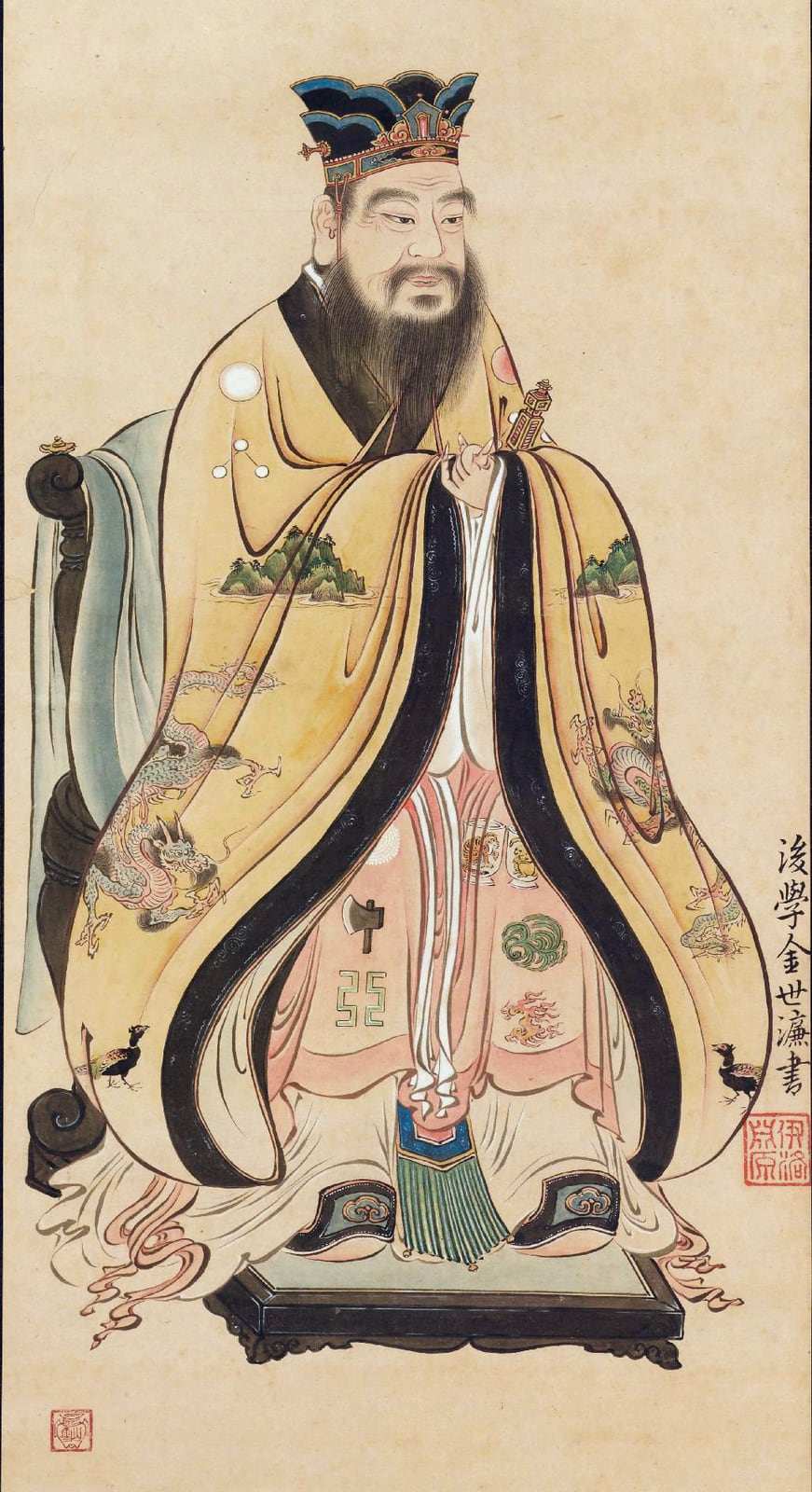
Confucius
Übereinstimmung bei: Warum leiden wir? · Was geschieht nach dem Tod? · Wie erlangt man Befreiung oder Erlösung?
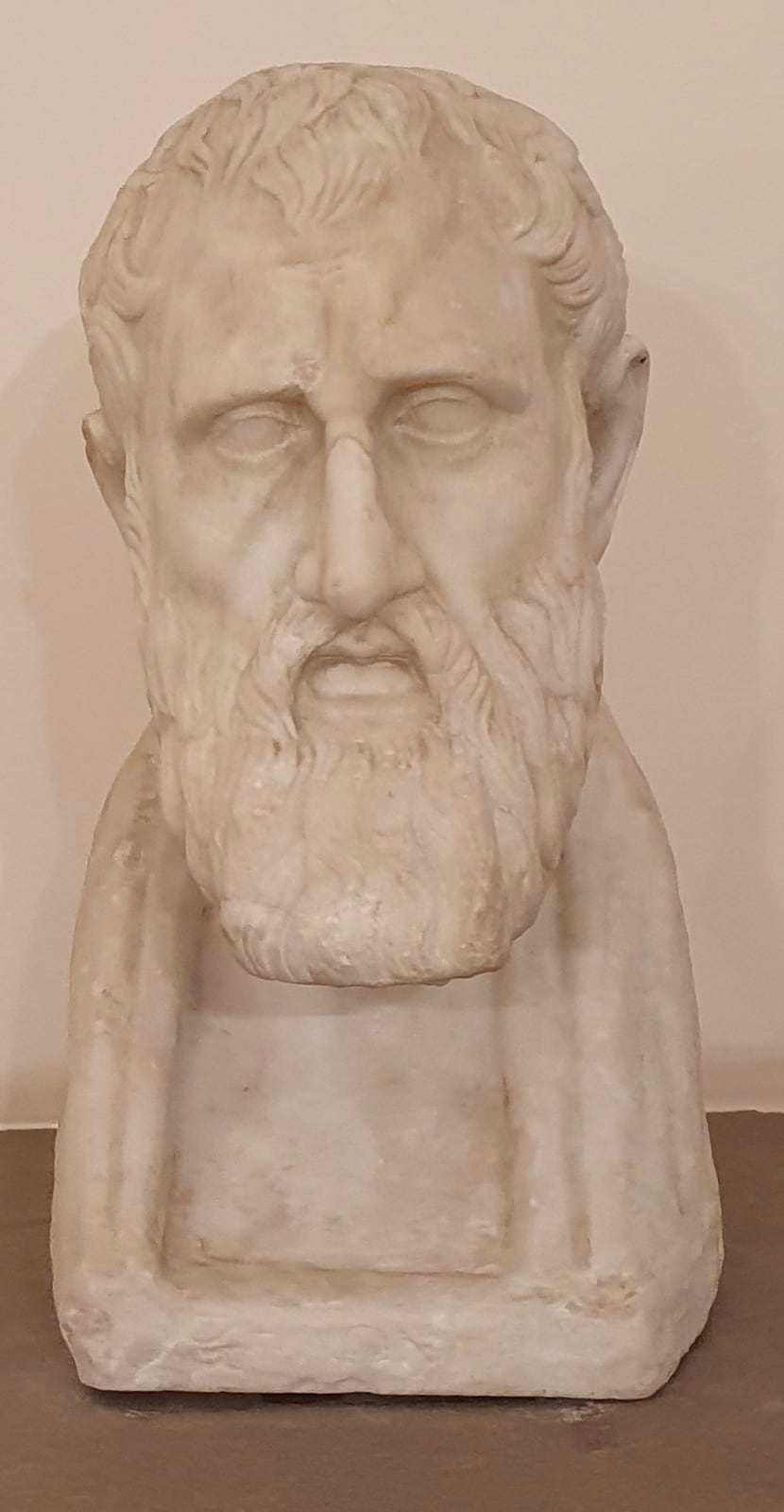
Zeno of Citium
Übereinstimmung bei: Warum leiden wir? · Was geschieht nach dem Tod? · Wie erlangt man Befreiung oder Erlösung?
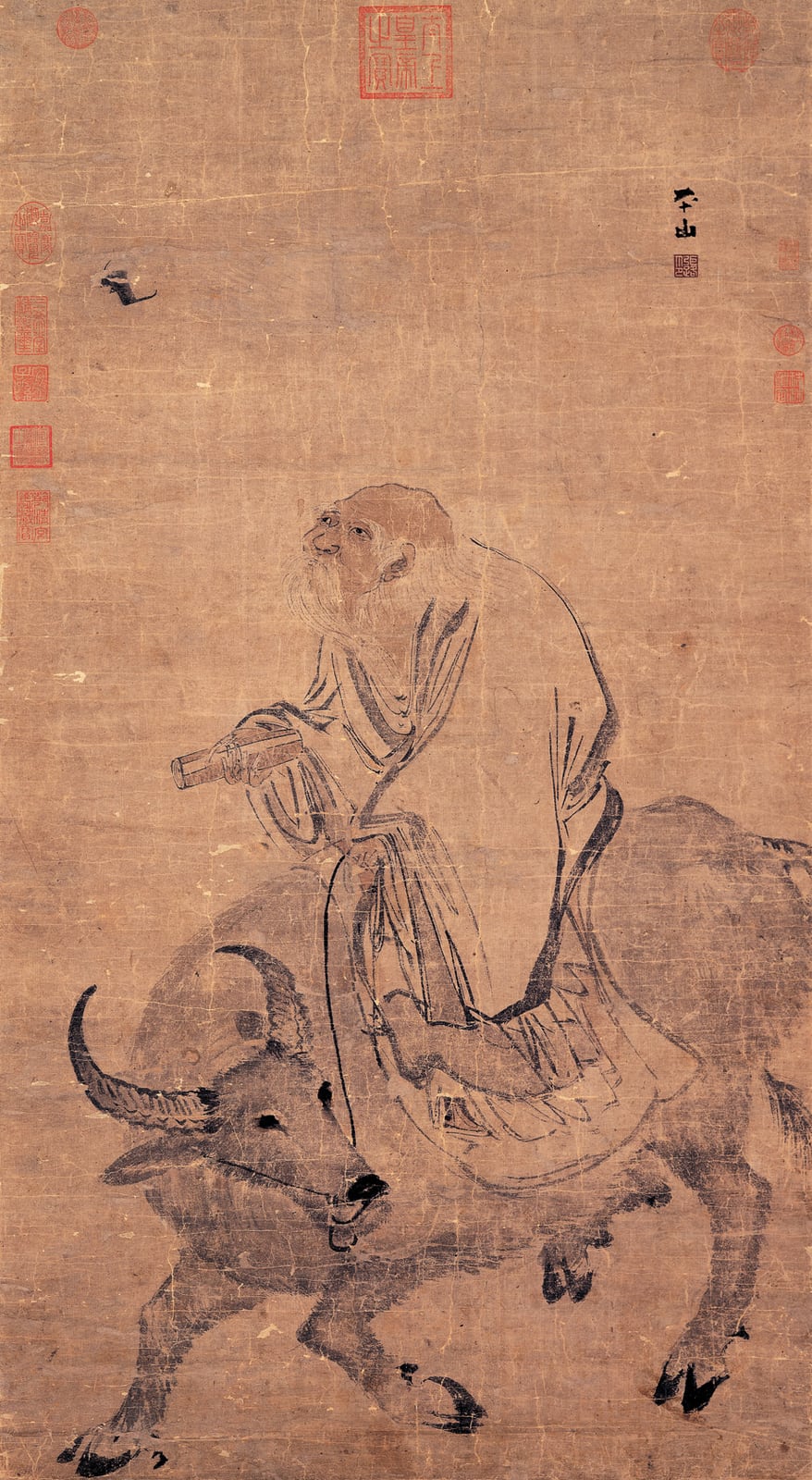
Laozi
Übereinstimmung bei: Warum leiden wir? · Was geschieht nach dem Tod? · Wie erlangt man Befreiung oder Erlösung?

Emanuel Swedenborg
Übereinstimmung bei: Was ist das Absolute? Gibt es Gott? · Wie erlangt man Befreiung oder Erlösung? · Wozu meditieren oder beten?
Denkt anders als
Kapila
Widerspruch bei: Was ist das Absolute? Gibt es Gott?
Dattatreya
Widerspruch bei: Was ist das Absolute? Gibt es Gott? · Warum leiden wir? · Was geschieht nach dem Tod?
Uddalaka Aruni
Widerspruch bei: Was ist das Absolute? Gibt es Gott? · Was geschieht nach dem Tod? · Wie erlangt man Befreiung oder Erlösung?
Vasishtha
Widerspruch bei: Was ist das Absolute? Gibt es Gott? · Warum leiden wir? · Was geschieht nach dem Tod?
Anekdoten und Erzählungen
Anekdoten und Erzählungen
Hagiographische Erzählungrelato épico
The grief that became verse
Herkunft der Erzählung: Rāmāyaṇa, Bālakāṇḍa, sarga 2 (Griffith's translation, canto II). Goldman regards it as part of the poem's late frame. Ānandavardhana (9th c.) cites it in the Dhvanyāloka as an example that the soul of poetry is emotion.
Hagiographische Erzählungrelato épico
The question to Nārada
Herkunft der Erzählung: Rāmāyaṇa, Bālakāṇḍa, sarga 1 (Griffith's translation, canto I). It belongs to the poem's late frame.
Hagiographische Erzählungrelato épico
The hermitage that sheltered Sītā
Herkunft der Erzählung: Rāmāyaṇa, Uttarakāṇḍa (Dutt's translation, vol. 4). It is a late stratum of the poem, which philology regards as an addition.
Hagiographische Erzählungrelato épico
The poet's oath
Herkunft der Erzählung: Rāmāyaṇa, Uttarakāṇḍa, section CIX of M. N. Dutt's translation (1894), checked against the text.
Hagiographische Erzählungleyenda medieval y moderna
The bandit of the anthill
Herkunft der Erzählung: It does not appear in Vālmīki's Rāmāyaṇa. It is documented in the Adhyātma Rāmāyaṇa (Ayodhyākāṇḍa) and in later texts and vernacular versions; the name Ratnākara belongs to late versions. Julia Leslie (2003) studied its history and its rejection by the Vālmīki community.
Quelle: Leslie, Julia. Authority and Meaning in Indian Religions: Hinduism and the Case of Vālmīki. Aldershot: Ashgate, 2003.
Belegt1881
Tagore in the role of Vālmīki
Herkunft der Erzählung: A fact documented by the history of Bengali theatre and by the photograph of the performance (Commons, from Indira Devi Chaudhurani's memoirs, Visva-Bharati, 1974). The exact date of the premiere should be confirmed in a Tagore biography.
Lehren
Lehren
Die Begriffe, die das Denken gliedern, in ihrem Zusammenhang erklärt.
Śloka (the stanza born of grief)sloka
Sanskrit metrics; Bālakāṇḍa, sarga 2.
Ādikāvya and ādikavi (the first poem, the first poet)adikavya
Sanskrit poetics and literary genres.
Quelle: Goldman, Robert P. (trad. e introd.). The Rāmāyaṇa of Vālmīki: An Epic of Ancient India. Vol. I: Bālakāṇḍa. Princeton: Princeton University Press, 1984. Introducción (autor, fecha, el episodio de las grullas y el marco del poema).
Karuṇa rasa (the compassionate sentiment)karuna-rasa
Ānandavardhana's Dhvanyāloka (9th c.), 1.5.
Quelle: Goldman, Robert P. (trad. e introd.). The Rāmāyaṇa of Vālmīki: An Epic of Ancient India. Vol. I: Bālakāṇḍa. Princeton: Princeton University Press, 1984. Introducción (autor, fecha, el episodio de las grullas y el marco del poema).
The recensions and the critical editionrecensiones-ramayana
Textual criticism of the Rāmāyaṇa.
Quelle: Bhatt, G. H., y U. P. Shah (eds. gen.). The Vālmīki-Rāmāyaṇa: Critical Edition. 7 vols. Baroda: Oriental Institute, 1960–1975.
Rāma, the ideal man of dharmamaryada-purushottama
Ethics and theology of the Rāmāyaṇa.
Quelle: Brockington, John. Righteous Rāma: The Evolution of an Epic. Delhi: Oxford University Press, 1984.
Videos
Videos
Aufnahmen, Gespräche und Dokumentarfilme. Die Videos werden von YouTube wiedergegeben; sie werden nicht hier gespeichert.
Robert Goldman sings from the Ramayana
Vortrag· SA· 2016· 2 min
UC BerkeleyOffizieller Kanal
Famous Ramayana epic now in modern English
Dokumentarfilm· EN· 2016· 4 min
UC BerkeleyOffizieller Kanal
CMTC workshop (02.06.2021) Mary Brockington (Oriental Studies, Oxford)
Vortrag· EN· 2021· 53 min
CMTC Media
Reading Ramayana in the 21st Century | Arshia Sattar | India ki Khoj
Vortrag· EN· 2019· 52 min
IIT GandhinagarOffizieller Kanal
A critical edition of the Valmiki Ramayana
Vortrag· HI· 2025· 11 min
Pandulipi Sanvadah
Bharat Ek Khoj | Episode-7 | Ramayana, Part-I
Dokumentarfilm· HI· 1988· 48 min
Prasar Bharati ArchivesOffizieller Kanal
Bharat Ek Khoj | Episode-8 | Ramayana, Part II
Dokumentarfilm· HI· 1988· 44 min
Prasar Bharati ArchivesOffizieller Kanal
Mewar Ramayana brought alive
Dokumentarfilm· EN· 2014· 5 min
Chhatrapati Shivaji Maharaj Vastu SangrahalayaOffizieller Kanal
Ramayana Storytelling Performance
Aufnahme Dritter· EN· 2016· 93 min
Asian Art MuseumOffizieller Kanal
Rama and the Ramayana: Crash Course World Mythology #27
Analyse· EN· 2017· 13 min
CrashCourseOffizieller Kanal
Complete Chant of SundaraKanda from Valmiki Ramayanam in Sanskrit
Aufnahme Dritter· SA· 2021· 693 min
The Sanskrit Channel
Life and Teachings of Maharishi Valmiki, Author of Ramayana also known as Adi Kavi
Analyse· HI· 2020· 21 min
StudyIQ IAS
RAMAYANA
Aufnahme Dritter· ES· 2020· 18 min
Casa de la India in SpainOffizieller Kanal
Râmâyana : la légende de Rama, avatar de Vishnou - Mythologie hindoue
Analyse· FR· 2020· 20 min
Arcana les Mystères du Monde
Galerie
Galerie
Bilder mit geprüfter Lizenz. Jedes bewahrt seine Urheberschaft und seinen Herkunftsnachweis.
Handschriften
Handschriften
Handschriftliche Zeugen und alte Texte, mit ihrer verwahrenden Einrichtung und ihren Einsichtsbedingungen.
FA · Nastaʿlīq (persa) · Texto épico sánscrito (s. V a. C.–III d. C. aprox.); traducción persa de época de Akbar
Rāmāyaṇa de Vālmīki (traducción persa), copia ilustrada conocida como «Freer Ramayana»
- Erhaltener Textzeuge
- Manuscrito ilustrado de 1597–1605
- Verwahrende Einrichtung
- Freer Gallery of Art, Smithsonian National Museum of Asian Art (Washington) · F1907.271
- Digitalisierung
- www.asia.si.edu/collections/singleObject.cfm?Obj…
Beziehungen
Beziehungen
Einflüsse, Schülerschaften und Verwandtschaften. Die belegte Beziehung wird von der durch Analyse ermittelten Ähnlichkeit unterschieden.
Begegnete
In the first canto of the Rāmāyaṇa, Nārada answers Vālmīki's question and tells him the life of Rāma. A textual, not a historical, relation.
Belegte Beziehung
Zeitgenosse von
In the Rāmāyaṇa, Vasiṣṭha is the purohita of Ayodhyā in Rāma's time; the Yoga Vāsiṣṭha puts in Vālmīki's mouth the narration of Vasiṣṭha's dialogue with Rāma. A literary relation.
Belegte Beziehung
Verwandte Gedanken mit
The two 'authors' of the Sanskrit epics are at once characters in their works and names that authorise whole corpora; tradition pairs them as the first poet and the compiler of history.
Durch Analyse ermittelte Ähnlichkeit
Beeinflusste
In 1900 Vivekananda devoted a lecture to the Rāmāyaṇa, in which he presents Vālmīki as India's first poet.
Belegte Beziehung
Beeinflusste
Tulsīdās
Tulsīdās's Rāmcaritmānas (16th c.), in Awadhi, is the great devotional rewriting of the story told in the Rāmāyaṇa; it also draws on the Adhyātma Rāmāyaṇa.
Belegte Beziehung
Verwandte Gedanken mit
The repetition of Rāma's name as a path of salvation, central to the late legend of Vālmīki, is also the core of Kabīr's devotion; the affinity is thematic.
Durch Analyse ermittelte Ähnlichkeit
Von anderen Einträgen aus verknüpft
Quellen
Quellen
Für diesen Eintrag herangezogene Bibliografie und Kataloge.
- Wikidata, «Valmiki», QID Q715607 (LCCN n80036601; GND 118840274; BnF 11927528q; VIAF 288016626).
- Goldman, Robert P. (trad. e introd.). The Rāmāyaṇa of Vālmīki: An Epic of Ancient India. Vol. I: Bālakāṇḍa. Princeton: Princeton University Press, 1984. Introducción (autor, fecha, el episodio de las grullas y el marco del poema).
- Brockington, John. The Sanskrit Epics. Leiden: Brill, 1998 (Handbuch der Orientalistik, 2. Abt., Bd. 12). Capítulos sobre el Rāmāyaṇa: transmisión, recensiones, estratos y datación.
- Brockington, John. Righteous Rāma: The Evolution of an Epic. Delhi: Oxford University Press, 1984.
- Griffith, Ralph T. H. (trad.). The Rámáyan of Válmíki, translated into English verse. 5 vols. Londres: Trübner; Benarés: E. J. Lazarus, 1870–1874. Project Gutenberg n.º 24869 (cantos I–II del libro I; nota sobre el Uttarakáṇḍa).
- Bhatt, G. H., y U. P. Shah (eds. gen.). The Vālmīki-Rāmāyaṇa: Critical Edition. 7 vols. Baroda: Oriental Institute, 1960–1975.
- Goldman, Robert P., y Sally J. Sutherland Goldman (trads.). The Rāmāyaṇa of Vālmīki: An Epic of Ancient India. Vol. VII: Uttarakāṇḍa. Princeton: Princeton University Press, 2016; edición completa en un volumen: The Rāmāyaṇa of Vālmīki: The Complete English Translation, 2021.
- Leslie, Julia. Authority and Meaning in Indian Religions: Hinduism and the Case of Vālmīki. Aldershot: Ashgate, 2003.
- Dutt, Manmatha Nath (trad.). The Rāmāyaṇa. 4 vols. Calcuta: edición y publicación del traductor, 1891–1894. Vol. 4: Uttara Kāṇḍa, sección CIX (el juramento de Vālmīki). Project Gutenberg n.º 57265, 57826, 60188, 62496.
- Wikipedia (inglés), «Valmiki», sobre la leyenda de Ratnākara en el Adhyātma Rāmāyaṇa y otras fuentes tardías, y sobre la comunidad que lo venera.
- Mitra, Vihari-Lala (trad.). The Yoga-Vásishtha Mahárámáyana of Válmiki. 4 vols. en 7 partes. Calcuta: Bonnerjee & Co., 1891–1899. Project Gutenberg n.º 71326 y siguientes.
- Smithsonian, National Museum of Asian Art, Freer Gallery of Art: Rāmāyaṇa de Vālmīki ilustrado (la «Freer Ramayana»), taller mogol, 1597–1605, F1907.271.
- Wikipedia (inglés), «Valmiki Pratibha» (ópera de Rabindranath Tagore, 1881) y «Uttararamacharita» (drama de Bhavabhūti, s. VIII).
- Vivekananda, Swami. «The Ramayana», conferencia en Pasadena, 31 de enero de 1900. The Complete Works of Swami Vivekananda, vol. 4 (Wikisource).
- Rechteinhaber
- Texto sánscrito de dominio público. Traducciones con derechos propios: Princeton University Press (Goldman et al.), Penguin India (Debroy; Sattar), Gallimard (Pléiade), Diederichs, Clásicos Bergua, Iberia. Son de dominio público las de Griffith (1870–1874), Dutt (1891–1894) y Fauche (1854–1858).
Bestätigung ausstehend
Was dieser Eintrag noch nicht klären konnte. Wir sagen es lieber, als es aufzufüllen.
- Fechas: no hay nacimiento ni muerte; la línea de tiempo usa las fechas de la composición del Rāmāyaṇa. Precisar con la introducción de Goldman (1984) la horquilla que propone para el núcleo y con Brockington (1998) las etapas.
- Ediciones en español: las de Clásicos Bergua (2001), Iberia (1990) y Juventud (1984) no indican traductor en Open Library; identificarlo y comprobar si son traducciones íntegras o adaptaciones. Buscar ediciones en italiano, ruso e hindi (Gita Press) con ISBN.
- Obras atribuidas (Adbhuta Rāmāyaṇa, Ānanda Rāmāyaṇa, Gaṅgāṣṭaka): falta fuente académica propia y ediciones; precisar fechas.
- Anécdota de Vālmīki Pratibhā: confirmar la fecha exacta del estreno (febrero de 1881) en una biografía de Tagore.
- Cita apócrifa «jananī janmabhūmiś ca…»: localizar en qué manuscritos o versiones aparece y citar el aparato de la edición crítica.
- Mitra (Yoga Vāsiṣṭha): fecha de muerte del traductor sin verificar (caution en la sala de lectura).
- Manuscritos: añadir el Rāmāyaṇa de Mewar (British Library y CSMVS, s. XVII) con signaturas verificadas.
Recherchiert am 2026-10-26