Vierter Weg
G. I. Gurdjieff
Георгий Иванович Гурджиев · Գեորգի Գյուրջիև
um 1872 – 1949Historisch belegte Person
Spiritueller Lehrer, Schriftsteller und Komponist, geboren zwischen etwa 1866 und 1877 im russischen Armenien, gestorben 1949 in Paris. Er lehrte, dass der Mensch schlafend lebt wie eine Maschine und dass das Erwachen eine gleichzeitige Arbeit von Körper, Gefühl und Denken mitten im gewöhnlichen Leben verlangt. Er gründete das Institut für die harmonische Entwicklung des Menschen, schuf die Movements, komponierte mit Thomas de Hartmann rund zweihundert Stücke und hinterließ die Trilogie „Alles und Alles", angeführt von „Beelzebubs Erzählungen für seinen Enkel".
- Werke
- 14Werke
- Ausgaben
- 60Ausgaben
- Zitate
- 7Zitate
- Videos
- 10Videos
- Bilder
- 8Bilder
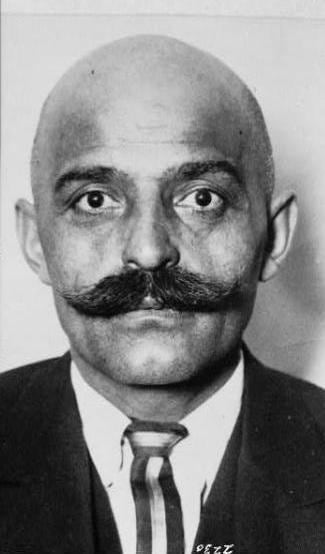
Retrato de G. I. Gurdjieff, 1925 · Public domain
In eigenen Worten
«In life never do as others do.»Beelzebub's Tales to His Grandson, cap. 1, «The Arousing of Thought»: consejo de la abuela moribunda

Der zentrale Gedanke
Ordinary man has no single, permanent I but a multitude of small I's that take turns according to circumstance; each speaks in the name of the whole, which is why no one keeps what he promises.
Im Zusammenhang sehen
Biografie
5 Min. Lesezeit
Unterstützte Übersetzung aus dem spanischen Original, Durchsicht durch einen muttersprachlichen Übersetzer ausstehend.
Ein Kind der Grenze
Georg Iwanowitsch Gurdjieff wurde in Alexandropol – dem heutigen Gjumri in Armenien – geboren, einer Garnisonsstadt des Russischen Reiches, in der Armenier, Griechen, Russen, Kurden und Türken nebeneinander lebten. Das Jahr steht nicht sicher fest, und das sollte man gleich zu Beginn sagen: Pässe und amtliche Dokumente nennen 1877, mit dem 28. Dezember als Tag; Gurdjieff selbst sprach vor seinen Schülern von einem Datum um 1866 oder 1867, was seine Nichte Luba Gurdjieff Everitt und sein Biograf James Moore stützen; eine Familienüberlieferung und die Grabplatte in Avon verweisen auf 1872. Er feierte seinen Geburtstag am 1. Januar des julianischen Kalenders, dem 13. des gregorianischen. Sein Vater, Iwan Iwanowitsch Georgiades, stammte aus einer griechischen Familie; er war ein durch eine Viehseuche verarmter Herdenbesitzer und ein Aschugh, ein Volkssänger, der lange Epen aus dem Gedächtnis vortrug. Die Mutter war Armenierin, auch wenn manche neuere Forscher sie ebenfalls für eine Griechin halten. Die Familie ließ sich im gerade von Russland eroberten Kars nieder, wo der Junge im Chor der Kathedrale sang und in die Obhut des Dekans Borsch kam, dem er eines der liebevollsten Porträts in Begegnungen mit bemerkenswerten Menschen widmen sollte.
Die Jahre der Suche
Was folgt, etwa zwischen 1887 und 1911, kennen wir fast nur aus seiner eigenen Erzählung, und diese ist bewusst allegorisch. In Begegnungen mit bemerkenswerten Menschen stellt sich Gurdjieff als Mitglied einer Gruppe von „Wahrheitssuchern" dar, die auf der Spur eines alten Wissens Ägypten, Abessinien, Persien, Turkestan und den Hindukusch durchstreift habe, bis sie das Kloster einer Sarmoung-Bruderschaft in Zentralasien erreichte. Kein unabhängiges Dokument bestätigt diese Reisen oder die Existenz der Bruderschaft. Die Historiker – James Webb, James Moore – räumen ein, dass er weit gereist ist und den Sufismus, das östliche Christentum sowie die Musik und die Tänze des Kaukasus und Zentralasiens aus erster Hand kannte, lesen das Buch aber als symbolische Autobiografie; sein Verfasser selbst mahnte, man müsse zwischen den Zeilen lesen. Er erzählte auch, er habe sich als Händler, Hypnotiseur, Reparateur aller möglichen Dinge und Teppichhändler durchgeschlagen und sogar Spatzen gefärbt, um sie als amerikanische Kanarienvögel zu verkaufen.
Moskau, Revolution und Exodus
Um 1912 taucht er in Moskau auf, verheiratet mit Julia Ostrowska, einer jungen Frau polnischer Herkunft, und beginnt Schüler um sich zu sammeln. 1915 lernt ihn P. D. Ouspensky kennen, ein Journalist und Autor mathematischer und esoterischer Schriften, der gerade aus Indien zurückgekehrt war. Dessen Bericht, Auf der Suche nach dem Wunderbaren, 1949 veröffentlicht, ist bis heute die geordnetste Darstellung der Lehre jener Jahre: der Mensch als Maschine, die schlafend lebt, das Fehlen eines bleibenden „Ich", die drei Zentren, das Gesetz der Drei und das Gesetz der Sieben, das Enneagramm, die Notwendigkeit der „Selbsterinnerung". 1916 stoßen der Komponist Thomas de Hartmann und seine Frau Olga hinzu. Mit der Revolution führt Gurdjieff eine kleine Gruppe nach Jessentuki im Kaukasus; 1919 gründet er in Tiflis das Institut für die harmonische Entwicklung des Menschen, dem sich Alexandre und Jeanne de Salzmann anschließen. Über Konstantinopel und Berlin gelangt er 1922 nach Paris.
Das Prieuré von Avon
Im Oktober 1922 richtet er das Institut im Château du Prieuré des Basses Loges in Avon bei Fontainebleau ein. Zwischen erschöpfender Feldarbeit, Bauarbeiten, Küchendienst und Aufmerksamkeitsübungen wurden dort die Movements gelehrt, Tänze von enormem Anspruch, die Gurdjieff nach eigener Aussage in Klöstern und Bruderschaften des Orients gesammelt hatte. Die an Tuberkulose erkrankte Schriftstellerin Katherine Mansfield verbrachte dort ihre letzten Monate und starb am 9. Januar 1923, was dem Prieuré in der britischen Presse einen skandalösen Ruf eintrug. Ende 1923 wurden die Movements im Théâtre des Champs-Élysées gezeigt, 1924 gingen sie nach New York und in weitere amerikanische Städte. A. R. Orage, der frühere Herausgeber von The New Age, wurde sein Vertreter in Amerika.
Der Unfall und das Schreiben
Im Juli 1924 erlitt Gurdjieff in der Nähe von Fontainebleau einen schweren Autounfall. Nach seiner Genesung kündigte er die Schließung des Instituts in seiner bisherigen Form an und wandte sich dem Schreiben zu. Im Dezember desselben Jahres begann er Beelzebubs Erzählungen für seinen Enkel, eine gewaltige kosmische Allegorie, in der ein Wesen aus einem anderen Sonnensystem seinem Enkel die seltsame Psychologie der Erdbewohner erklärt. Ein Jahrzehnt lang arbeitete er daran, schrieb auf Russisch und Armenisch in Pariser Cafés, ließ die Kapitel vor seinen Schülern vorlesen und schrieb sie um, damit sie einer hastigen Lektüre weniger zugänglich würden. 1925 starb seine Mutter, 1926 seine Frau. Aus der Zusammenarbeit mit de Hartmann, vor allem zwischen 1925 und 1927, gingen etwa zweihundert Klavierstücke hervor. 1932 wurde das Prieuré, von Schulden bedrängt, geschlossen. 1933 ließ Gurdjieff im Privatdruck Der Bote des kommenden Guten erscheinen, das einzige Buch, das er zu Lebzeiten veröffentlichte, und zog es bald darauf zurück.
Paris, das „Seil" und die Besatzung
Von 1936 an wohnte er in einer Wohnung in der Rue des Colonels-Renard Nr. 6. Dort unterrichtete er „das Seil", eine Gruppe von Frauen – Jane Heap, Margaret Anderson, Solita Solano, Kathryn Hulme – und ab 1940 die Gruppe Jeanne de Salzmanns in Sèvres. Während der deutschen Besatzung hielt er an seinen rituellen Mahlzeiten mit den Trinksprüchen auf die verschiedenen Arten von „Idioten" fest, ebenso an Zusammenkünften, deren Mitschriften erhalten sind. Nach dem Krieg kehrten frühere Schüler zurück, und es kamen die Schüler des 1947 gestorbenen Ouspensky; J. G. Bennett sah ihn 1948 nach fünfundzwanzig Jahren wieder.
Tod und Erbe
1949, bereits krank, bereitete er die Ausgabe des Beelzebub vor. Er starb am 29. Oktober 1949 im Amerikanischen Krankenhaus von Neuilly-sur-Seine und wurde in Avon, unweit des Prieuré, beigesetzt. Das Buch erschien 1950; Begegnungen mit bemerkenswerten Menschen 1960 auf Französisch und 1963 auf Englisch; Das Leben ist nur dann wirklich, wenn „Ich bin" Mitte der Siebzigerjahre im Privatdruck. Jeanne de Salzmann, der er die Weitergabe anvertraut hatte, baute das Institut Gurdjieff in Paris, die 1953 gegründete Gurdjieff Foundation in New York, die Gurdjieff Society in London und die Stiftung in Caracas auf. Außerhalb dieses Netzes entstanden andere Linien, etwa die von Bennett oder Willem Nyland. Peter Brook brachte Begegnungen mit bemerkenswerten Menschen 1979 ins Kino.
Gurdjieff bleibt unbequem. Seine Schüler beschreiben eine überwältigende Präsenz, fähig zu einem sehr praktischen Mitgefühl wie zu berechneter Härte; seine Kritiker einen Mann, der ungeniert Geld verlangte, manipulierte und mit Schülerinnen mehrere Kinder hatte. Beide Bilder sind durch Dokumente gestützt. Unbestritten ist sein Einfluss: Der Gedanke, dass der Mensch schlafend lebt und dass das Erwachen verlangt, zugleich mit dem Körper, dem Gefühl und dem Denken zu arbeiten – mitten im gewöhnlichen Leben und nicht außerhalb davon, was Ouspensky den „Vierten Weg" nannte –, zieht sich durch einen großen Teil der westlichen Spiritualität des 20. Jahrhunderts.
Quellen: Ouspensky, P. D. In Search of the Miraculous: Fragments of an Unknown Teaching. Nueva York: Harcourt, Brace, 1949. · Moore, James. Gurdjieff: The Anatomy of a Myth. Shaftesbury: Element, 1991. · De Hartmann, Thomas y Olga de Hartmann. Our Life with Mr. Gurdjieff. Nueva York: Cooper Square, 1964 (ed. ampliada, Harper & Row, 1983). · Gurdjieff, G. I. Meetings with Remarkable Men. Londres: Routledge & Kegan Paul, 1963 (ed. francesa: Rencontres avec des hommes remarquables, París: Julliard, 1960). · Gurdjieff, G. I. All and Everything: Beelzebub's Tales to His Grandson. Nueva York: Harcourt, Brace, 1950; Londres: Routledge & Kegan Paul, 1950.
Zeitleiste
Das Leben, Jahr für Jahr
Jeder Punkt ist ein belegtes Ereignis. Klicken Sie, um es mit Quelle und Grad der Gewissheit zu lesen.
um 18720 JahreAlexandropol (hoy Gyumri, Armenia)
Birth (disputed date)
Born in Alexandropol. Three versions: 1877 (28 December, in passports and official papers); c. 1866–1867 (what he told pupils; supported by his niece Luba Gurdjieff Everitt and James Moore); 1872 (a family recollection and the plaque on his grave at Avon). He celebrated his birthday on 1/13 January.
UmstrittenWikipedia (en), «George Gurdjieff», sección sobre la fecha de nacimiento (remite a Churton, Tobias. Deconstructing Gurdjieff, Inner Traditions, 2017, pp. 3–4 y 316–317).
Nach dem Tod
- 1950Beelzebub published
- 1953Gurdjieff Foundation
- 1979Peter Brook's film
um 1872 · 0 Jahre
Birth (disputed date)
Born in Alexandropol. Three versions: 1877 (28 December, in passports and official papers); c. 1866–1867 (what he told pupils; supported by his niece Luba Gurdjieff Everitt and James Moore); 1872 (a family recollection and the plaque on his grave at Avon). He celebrated his birthday on 1/13 January.
Umstritten
um 1878
The family in Kars
After his father's ruin the family moves to Kars, newly taken by Russia. He sings in the cathedral choir and is tutored by Dean Borsh (according to Meetings with Remarkable Men).
Überlieferung
um 1887
The years of search
Period of travels (c. 1887–1911) known almost only from his allegorical account: the 'Seekers of Truth', the Sarmoung Brotherhood. No independent documentary confirmation.
Überlieferung
um 1912
First groups in Moscow
He appears in Moscow, married to Julia Ostrowska, and begins to gather pupils in Moscow and St Petersburg.
Wahrscheinlich
1915
Meeting with Ouspensky
P. D. Ouspensky meets him in a Moscow café; from that meeting comes In Search of the Miraculous.
Belegt
1916
The de Hartmanns join
The composer Thomas de Hartmann and his wife Olga become his pupils.
Belegt
1917
Essentuki
With the revolution he withdraws with a small group to Essentuki, where intensive work continues.
Belegt
1919
Institute for the Harmonious Development of Man
He founds the Institute in Tiflis; Alexandre and Jeanne de Salzmann join.
Belegt
Oktober 1922
The Prieuré
After Constantinople and Berlin, he installs the Institute at the Château du Prieuré des Basses Loges.
Belegt
9. Januar 1923
Death of Katherine Mansfield
The writer, ill with tuberculosis, dies at the Prieuré after spending her last months there.
Belegt
Januar 1924
The Movements in America
After the Paris demonstrations (December 1923), he presents the Movements in New York and other cities.
Belegt
Juli 1924
The accident
Serious car accident. On recovering he closes the Institute in its former shape and turns to writing.
Belegt
Dezember 1924
Beelzebub begun
He begins writing Beelzebub's Tales to His Grandson, on which he will work for a decade.
Belegt
Juni 1926
Death of his wife
Julia Ostrowska dies of cancer; his mother had died in 1925.
Belegt
1932
The Prieuré closes
The Prieuré ceases to operate, beset by debts.
Belegt
1933
The Herald of Coming Good
He prints privately the only book published in his lifetime; he soon withdraws it.
Belegt
1936
The Rope
He settles in the flat on rue des Colonels-Renard, where he teaches the women's group 'the Rope'.
Belegt
1940
The Occupation
He begins teaching Jeanne de Salzmann's group at Sèvres; during the Occupation he keeps up meetings and ritual meals.
Belegt
1948
Ouspensky's pupils arrive
After Ouspensky's death (1947), his pupils and J. G. Bennett come to Paris.
Belegt
29. Oktober 1949
Death
He dies at the American Hospital in Neuilly; funeral at the Russian Orthodox cathedral on rue Daru and burial at Avon.
Belegt
1950
Beelzebub published
All and Everything: Beelzebub's Tales to His Grandson appears.
Belegt
1953
Gurdjieff Foundation
The Gurdjieff Foundation of New York is established, within the network organised by Jeanne de Salzmann.
Belegt
1979
Peter Brook's film
Release of Meetings with Remarkable Men, directed by Peter Brook in collaboration with Jeanne de Salzmann.
Belegt
Werke
Grundlegende Werke
Die Werke, ohne die sich das Vermächtnis nicht verstehen lässt.
Nachgelassenes Werk · 1950
Beelzebub's Tales to His Grandson
Рассказы Вельзевула своему внуку / Beelzebub's Tales to His Grandson
First series of All and Everything. Beelzebub, a cosmic being travelling on the ship Karnak, tells his grandson Hassein what he observed on Earth over centuries: the history of a humanity that, through a cosmic accident and the atrophy of an organ that let it see reality, lives ruled by vanity, self-love and suggestibility. Beneath outsized humour and an invented vocabulary, the book sets out a complete cosmology—the law of three, the law of seven, the reciprocal feeding of everything that exists—and a relentless critique of religion, science, art and war. Gurdjieff wanted it read three times and in different ways.
14 Ausgaben · amazon.de

Nachgelassenes Werk · 1963
Meetings with Remarkable Men
Встречи с замечательными людьми / Meetings with Remarkable Men
A memoir of youth organised as portraits: the bard father, Dean Borsh, Prince Yuri Lubovedsky, Professor Skridlov, Ekim Bey and other companions among the 'Seekers of Truth', up to the arrival at the monastery of the Sarmoung Brotherhood. It is at once autobiography, adventure story and training manual: each meeting teaches a quality. Critics agree it should not be read as literal chronicle; none of its exotic episodes has independent documentary confirmation. Peter Brook filmed it in 1979.
9 Ausgaben · amazon.com

Nachgelassenes Werk · um 1975
Life Is Real Only Then, When 'I Am'
Жизнь реальна только тогда, когда «Я есть» / Life Is Real Only Then, When 'I Am'
Gurdjieff's most personal book: the account of the crisis after the 1924 accident, the decision to 'remember himself' through constant effort, the break with the New York pupils in 1931 and a series of lectures on 'I am', the body and sensation. Fragmentary and sometimes abrupt, it shows the teacher applying his own method to himself and doubting it.
8 Ausgaben · amazon.com

Schriftliches Werk · 1933
The Herald of Coming Good
A programmatic booklet subtitled 'First appeal to contemporary humanity'. It sets out the history of the Institute, the aims of the work, the plan of the All and Everything trilogy and a long declaration of intent, in a deliberately convoluted style. Its withdrawal made it a rarity; reprinted since 1969, it is a key document for dating the crisis of 1931–1933.
6 Ausgaben · amazon.com
Das gesamte Werk (14)

Views from the Real World
1973

The Struggle of the Magicians
1957
G. I. Gurdjieff
Gurdjieff–de Hartmann Music for the Piano
The Conscious LibraryGurdjieff–de Hartmann Music for the Piano
1996
G. I. Gurdjieff
Transcripts of Gurdjieff's Meetings 1941–1946
The Conscious LibraryTranscripts of Gurdjieff's Meetings 1941–1946
2008
G. I. Gurdjieff
Gurdjieff's Early Talks 1914–1931
The Conscious LibraryGurdjieff's Early Talks 1914–1931
2014

Paris Meetings 1943
2017

In Search of the Miraculous (P. D. Ouspensky)
1949

Our Life with Mr. Gurdjieff (Thomas and Olga de Hartmann)
1964

The Reality of Being (Jeanne de Salzmann)
2010

In Search of Being
2012
Zitate
Zitate, die in einem bestimmten Werk nachgewiesen sind. Jedes trägt seine Herkunft und seinen Grad an Verlässlichkeit.
In life never do as others do.GeprüftBeelzebub's Tales to His Grandson, cap. 1, «The Arousing of Thought»: consejo de la abuela moribunda
Wesentliche Gedanken (redaktionelle Zusammenfassung)
Aus Achtung vor dem Urheberrecht werden diese Gedanken mit eigenen Worten zusammengefasst und nicht als wörtliche Zitate dargestellt.
- Ordinary man has no single, permanent I but a multitude of small I's that take turns according to circumstance; each speaks in the name of the whole, which is why no one keeps what he promises.
- Man cannot do: in him everything happens, as it rains or clears. True doing presupposes a unified being, and that unity is not a gift but the result of long work.
- Work on oneself requires conditions of friction: difficult people, uncomfortable tasks, fatigue. Without resistance there is no effort and without effort no transformation.
- Knowledge must be accompanied by an equivalent development of being; knowledge that grows without being becomes theoretical, useless or dangerous.
Apokryphe Zitate oder Zitate umstrittener Zuschreibung (1)
«'I leave you all in a fine mess' ('Je vous laisse dans de beaux draps'), as last words.»
It circulates online as Gurdjieff's final words, but it has not been found in the published testimonies of his pupils or in the biographies consulted. No primary source.
Letzte Worte
Widersprüchliche Fassungen
«Do everything, even the impossible, to develop what I have brought.»Do everything, even the impossible, to develop what I have brought.
There is no single, unambiguously attested final phrase; several versions of differing weight circulate. (1) Testimony attributed to Jeanne de Salzmann: the phrase above, which she reportedly received as his last words to her; it recurs in the literature on Gurdjieff, but its original publication has not been located (Wikipedia flags it 'citation needed'). (2) Instructions from his last weeks, passed on by de Salzmann and recorded by W. P. Patterson (Struggle of the Magicians, pp. 224–225): publish the first and second series 'as and when you are sure that the time has come', first prepare a nucleus of people, and the third need not be published. These are not last words in the strict sense. (3) J. G. Bennett, who saw him often in 1948–1949, narrated his last months (Witness, 1962; the diaries published as Idiots in Paris), but it has not been verified that he records a final phrase; pending. (4) His American physician William Welch left a testimony on the manner of his death—'he died like a king'—which are not Gurdjieff's words. (5) The phrase 'I leave you all in a fine mess' has no source and is treated as apocryphal.
Quelle: The Gurdjieff Legacy Foundation, «Jeanne de Salzmann» (archivo), que cita a William Patrick Patterson, Struggle of the Magicians, pp. 224–225.
Fragen
Was das Werk beantwortet
Zwölf große Fragen der Menschheit und was sich aus den Texten darauf antworten lässt, mit Belegen. Wir legen niemandem Worte in den Mund.
Was ist das Absolute? Gibt es Gott?
Our Common Father Endlessness created the universe and suffers for it
Ein persönlicher GottAusdrücklich gesagt
G. I. Gurdjieff speaks of God chiefly in Beelzebub's Tales to His Grandson (1950), a cosmic allegory in deliberately strange language. There the creator bears names such as Our Common Father, His Endlessness or Our Lord Sovereign Endlessness; He dwells on the Sun Absolute and creates the universe to counter the destructive action of time, the Heropass, establishing a system of reciprocal exchange of substances. This God has purpose, sends messengers to humanity and, according to the tale, grieves over the state of beings. The aim of inner work is partly to help Him: the conscious human being can lighten the burden of his Creator. Unlike the abstract account transmitted by Ouspensky, here the Absolute is someone with will and feeling, though wrapped in a myth designed to disconcert the reader.
Diese Frage mit anderen Meistern vergleichenWer bin ich? Gibt es ein wahres Selbst?
Man is born without a soul or an I: work must form them
Es gibt kein bleibendes SelbstAusdrücklich gesagt
According to G. I. Gurdjieff's teachings as recorded by Ouspensky, ordinary man lacks individuality, a single I and will: he is a plurality of I's following one another mechanically. In one of the Moscow talks reproduced in chapter 2 of In Search of the Miraculous, Gurdjieff compares the human being to a carriage, a horse, a coachman and a master who is absent, and states that man is not born with an immortal soul: he may come to form higher bodies, and with them a permanent I, only through intense work. In Beelzebub's Tales to His Grandson he develops this idea in mythic language, speaking of bodies that a being may or may not crystallise. The self, then, is not a given substance but a possibility that most people do not realise.
Diese Frage mit anderen Meistern vergleichenWarum leiden wir?
The legacy of the organ Kundabuffer: man lives asleep and suffers senselessly
Unwissenheit über das, was wir sindAusdrücklich gesagt
G. I. Gurdjieff offers in Beelzebub's Tales to His Grandson a mythic explanation of human suffering. According to the tale, at the dawn of humanity higher powers implanted in human beings an organ, the Kundabuffer, which made them perceive reality upside down and prevented them from seeing their true situation; although it was later removed, its properties — vanity, self-love, suggestibility, egoism — were passed down from generation to generation. Hence war, reciprocal destruction and mechanical life, which plunge people into a sleep of which they are unaware. In the teachings transmitted by Ouspensky, this state appears as identification and sleep. Gurdjieff distinguishes mechanical suffering, which serves no purpose, from intentional suffering, consciously accepted, which together with conscious labour is the means of the being's evolution.
Diese Frage mit anderen Meistern vergleichenWas geschieht nach dem Tod?
Immortality is not possessed: it is acquired by first dying to oneself
Jeden Tag dem Bekannten sterbenAusdrücklich gesagt
Gurdjieff denies that ordinary man possesses an immortal soul. According to the teaching recorded by Ouspensky in In Search of the Miraculous, man is a machine without a permanent I, and the only thing that could survive death are the higher bodies — the astral and those beyond it — which are formed only through conscious work and voluntary suffering; whoever has not formed them dies completely. In Beelzebub's Tales he speaks of the Kesdjan body and the higher being-body as achievements, not gifts. Hence the importance of an earlier death: Gurdjieff taught that to be born again one must die, and to die one must awaken; what must die is false personality, with its vanity and self-love. The decisive question is not what happens after death, but whether there is already someone capable of surviving it.
Diese Frage mit anderen Meistern vergleichenWie erlangt man Befreiung oder Erlösung?
Awakening through conscious effort and voluntary suffering: the Fourth Way in ordinary life
Durch bewusste innere ArbeitAusdrücklich gesagt
George I. Gurdjieff taught that human beings are born without a finished soul and, unless they work on themselves, remain asleep and mechanical. According to Ouspensky's testimony, he distinguished four ways: the fakir's, working on the body; the monk's, on the emotions; the yogi's, on the mind; and a Fourth Way working on all three at once without leaving ordinary life. Its means are self-observation, self-remembering, the movements and dances he designed, and what Beelzebub's Tales to His Grandson calls conscious labours and intentional sufferings. The work requires a teacher who knows and a group; the result is the formation of a real and permanent «I».
Diese Frage mit anderen Meistern vergleichenBraucht es einen Lehrer?
Only one who knows can wake the sleeper: teacher and school are necessary
UnverzichtbarAusdrücklich gesagt
According to Ouspensky's testimony, George I. Gurdjieff taught that ordinary human beings cannot escape their sleep alone, because the very means they would use to wake up are asleep. They need someone who is awake, or more awake, who knows the way and enables them to work on themselves; and that knowledge is not invented but received from a source that possesses it. Gurdjieff played that role demandingly, often disconcertingly, with his pupils in Russia and later at the Prieuré in Fontainebleau. In Meetings with Remarkable Men he presents his own formation as a search for teachers and ancient knowledge through Central Asia and the Near East.
Diese Frage mit anderen Meistern vergleichenIst die Welt wirklich?
A hierarchical cosmos of laws and matters, where everything feeds on everything
DaseinsebenenAusdrücklich gesagt
George I. Gurdjieff taught a cosmology in which the universe is a hierarchy of worlds governed by two fundamental laws, the law of three and the law of seven (the octave). According to Ouspensky's testimony, everything in it is material, though with different degrees of density and vibration, and everything forms part of a reciprocal exchange of substances in which each level feeds others. In Beelzebub's Tales to His Grandson he develops it in mythic form, with a Sun Absolute at the centre and the Earth as a peripheral place where mechanical humanity serves cosmic purposes it does not know. The world is fully real, but ordinary human beings do not see it as it is, because they live asleep.
Diese Frage mit anderen Meistern vergleichenWas ist Liebe?
Mechanical man cannot love: only one who is conscious truly loves
Was erscheint, wenn das Ich aufhörtAusdrücklich gesagt
Gurdjieff denies that ordinary man is capable of loving. According to the teaching recorded by Ouspensky, mechanical man can do nothing, and cannot love either: what he calls love is a mixture of attraction, habit, identification and self-love, which changes with circumstances and easily turns into its opposite. In a talk collected in Views from the Real World he distinguishes love of the body, which depends on type and polarity; love of feeling, which evokes its opposite; and conscious love, which evokes the same in response. In Beelzebub's Tales, vanity and self-love appear as consequences of the organ Kundabuffer and as the main obstacles to development. Real love is possible only for one who, through conscious labour and intentional suffering, has ceased to be governed by those forces.
Diese Frage mit anderen Meistern vergleichenSind wir frei, oder ist alles vorherbestimmt?
No one does anything: only one who works on himself gains a will
Wir sind Maschinen, bis wir erwachenAusdrücklich gesagt
The thesis of human mechanicalness is the core of Gurdjieff's teaching as his pupils recorded it. Man has no self but a multitude of contradictory «I»s; he is not conscious but lives asleep, and what he calls his decisions are reactions of a machine driven by external influences. In his talks collected in *Views from the Real World* and in his major work, *Beelzebub's Tales to His Grandson*, he adds that humanity, being mechanical, serves cosmic purposes it does not understand. Only conscious labour and intentional suffering can create a permanent self and a real will. Freedom is not a birthright but something that must be manufactured.
Diese Frage mit anderen Meistern vergleichenWozu meditieren oder beten?
Remembering oneself amid life, through conscious effort
Gegenwärtig seinAusdrücklich gesagt
For Gurdjieff the human being lives asleep, and all practice has a single aim: to wake up. The main instrument, according to his pupils' testimony, is self-remembering, divided attention that includes the perceiver along with the perceived, exercised amid ordinary activities and not in retreat. To this he added practices of his own: the Movements, sacred dances requiring simultaneous attention of body, emotions and mind, exercises in sensing the body, hard physical work and what he called intentional suffering. In *Life Is Real Only Then, When «I Am»*, his last book, he describes that effort of presence as the condition for a real «I» to arise in man.
Diese Frage mit anderen Meistern vergleichenKann die Vernunft das Letzte erkennen?
Real knowledge is scarce, material and transmitted; knowledge without being is useless
Esoterisches WissenAusdrücklich gesagt
According to Ouspensky's testimony in *In Search of the Miraculous*, Gurdjieff held that there is a true knowledge, preserved by an esoteric circle of humanity and transmitted through schools, and that this knowledge is in a certain sense material and limited: it cannot be shared out to everyone. He insisted on distinguishing knowledge from being: a man may know a great deal and be unable to do anything, and knowledge that grows without the development of being produces only theories. In *Meetings with Remarkable Men* he narrates his youthful search for that knowledge across the East, with the «Seekers of Truth». Ordinary reason belongs to the man-machine; real understanding requires transformation.
Diese Frage mit anderen Meistern vergleichenSich von der Welt zurückziehen oder sie verwandeln?
Wars cannot be stopped from outside: mechanical man cannot do
Die Revolution ist innerlichAusdrücklich gesagt
Gurdjieff holds that ordinary man cannot do anything: everything happens to him, as rain happens. According to the 1915 conversation recorded by Ouspensky, when asked in the midst of the world war whether war could be stopped, he answered that it could not, because it is the result of cosmic influences and of the mechanicalness of millions of people, and that only men who had ceased to be machines could change things. In Beelzebub's Tales the periodic «reciprocal destruction» of the beings of the Earth is the most terrible symptom of their lack of consciousness. That is why he proposes no social reforms but work on oneself. Nor withdrawal: his Institute for the Harmonious Development of Man, at the Prieuré in Fontainebleau-Avon, was a community of intense physical work, sacred dances and deliberate friction between people, that is, life in the world used as a school.
Diese Frage mit anderen Meistern vergleichen
Affinitäten und Spannungen
Affinitäten und Spannungen
Frage für Frage aus den Positionen berechnet. Den Grund jeder Übereinstimmung und jedes Widerspruchs zeigt ein Klick.
Denkt ähnlich wie
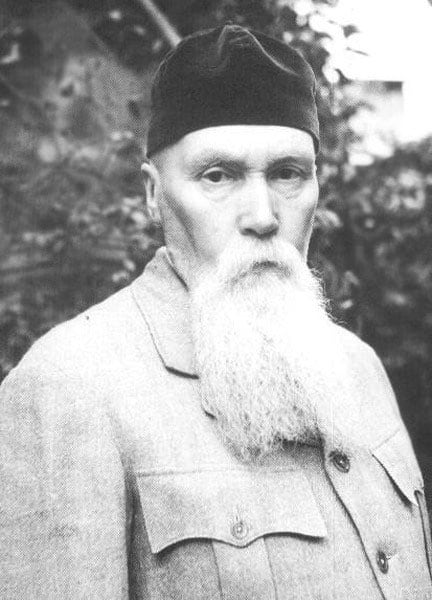
Nicholas Roerich
Übereinstimmung bei: Braucht es einen Lehrer? · Ist die Welt wirklich? · Kann die Vernunft das Letzte erkennen?
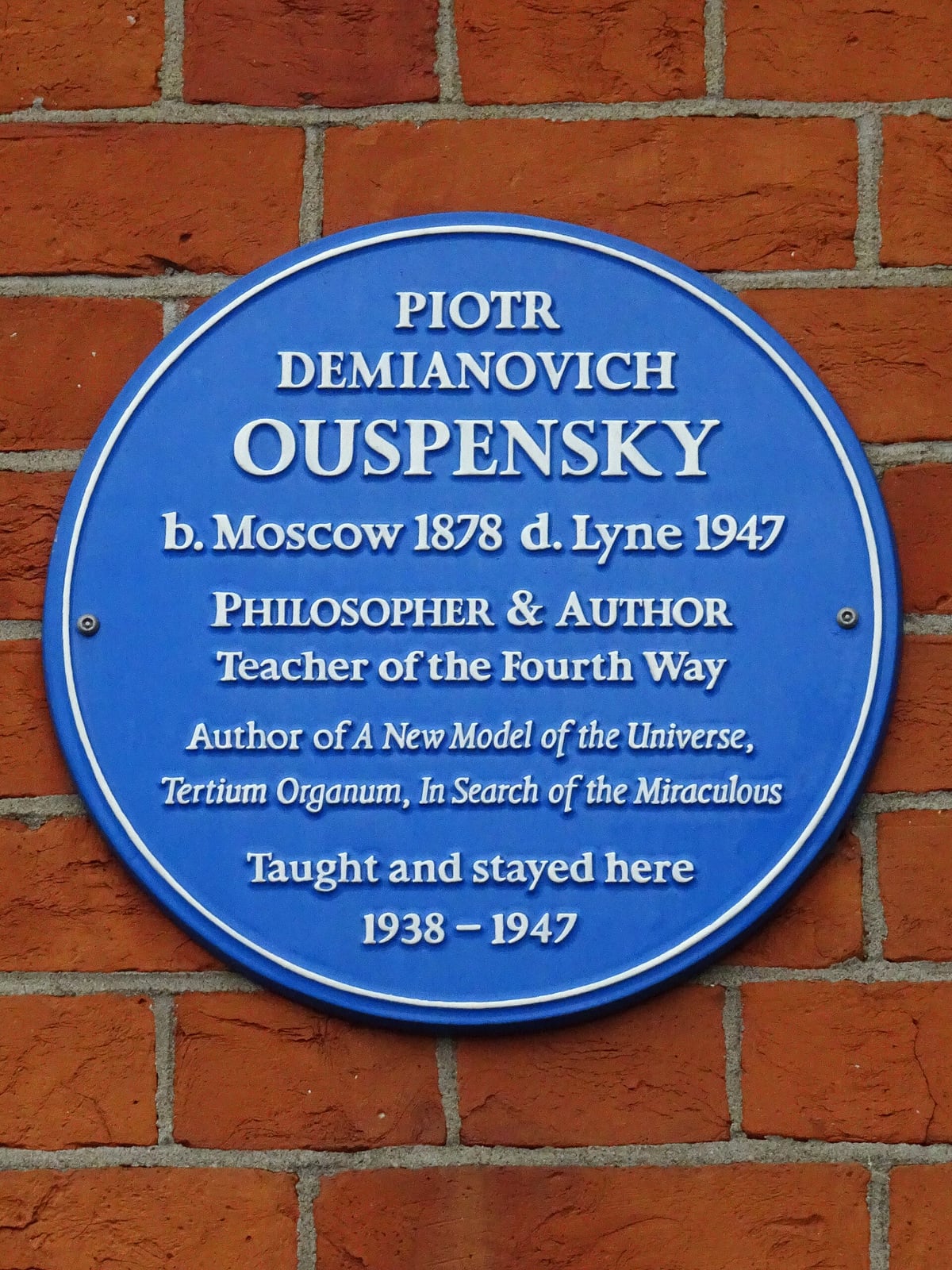
P. D. Ouspensky
Übereinstimmung bei: Wer bin ich? Gibt es ein wahres Selbst? · Warum leiden wir? · Wie erlangt man Befreiung oder Erlösung?
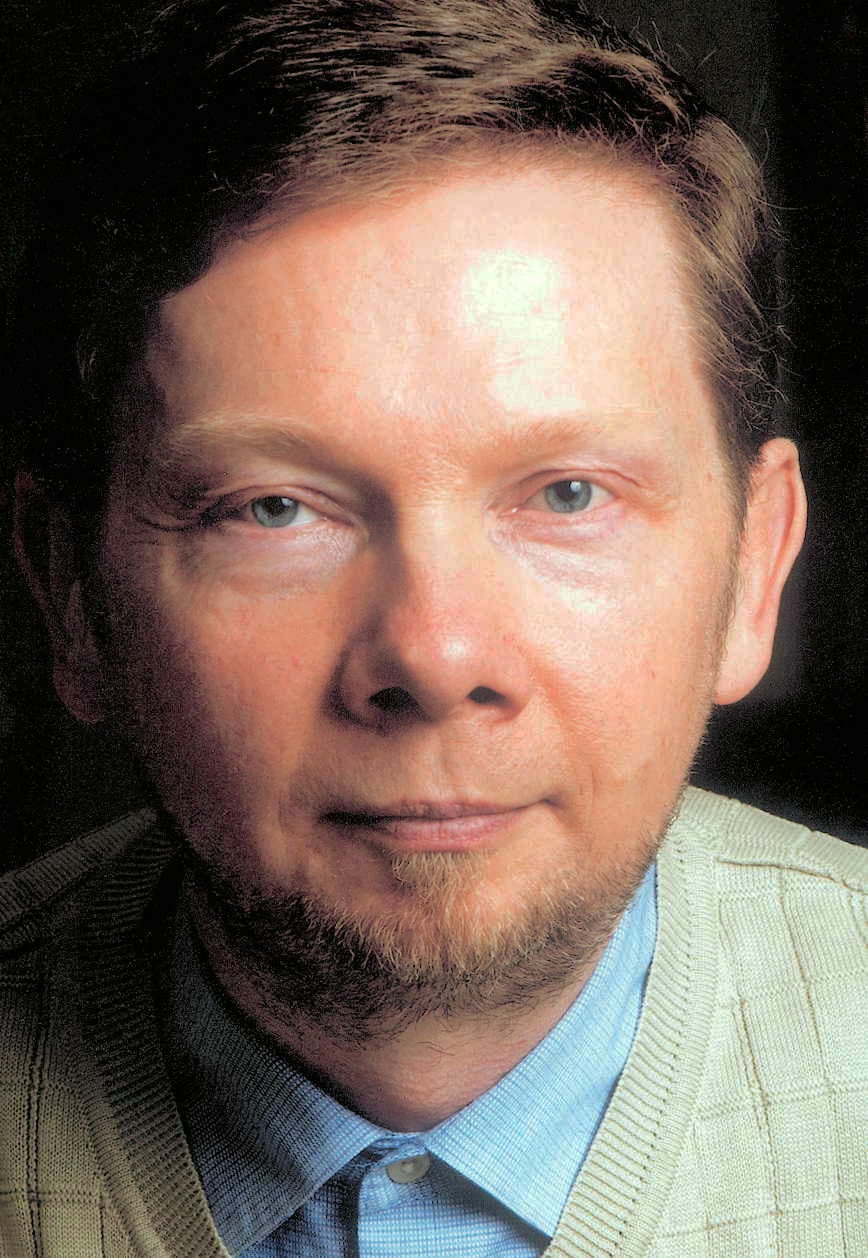
Eckhart Tolle
Übereinstimmung bei: Was ist Liebe? · Sind wir frei, oder ist alles vorherbestimmt? · Wozu meditieren oder beten?
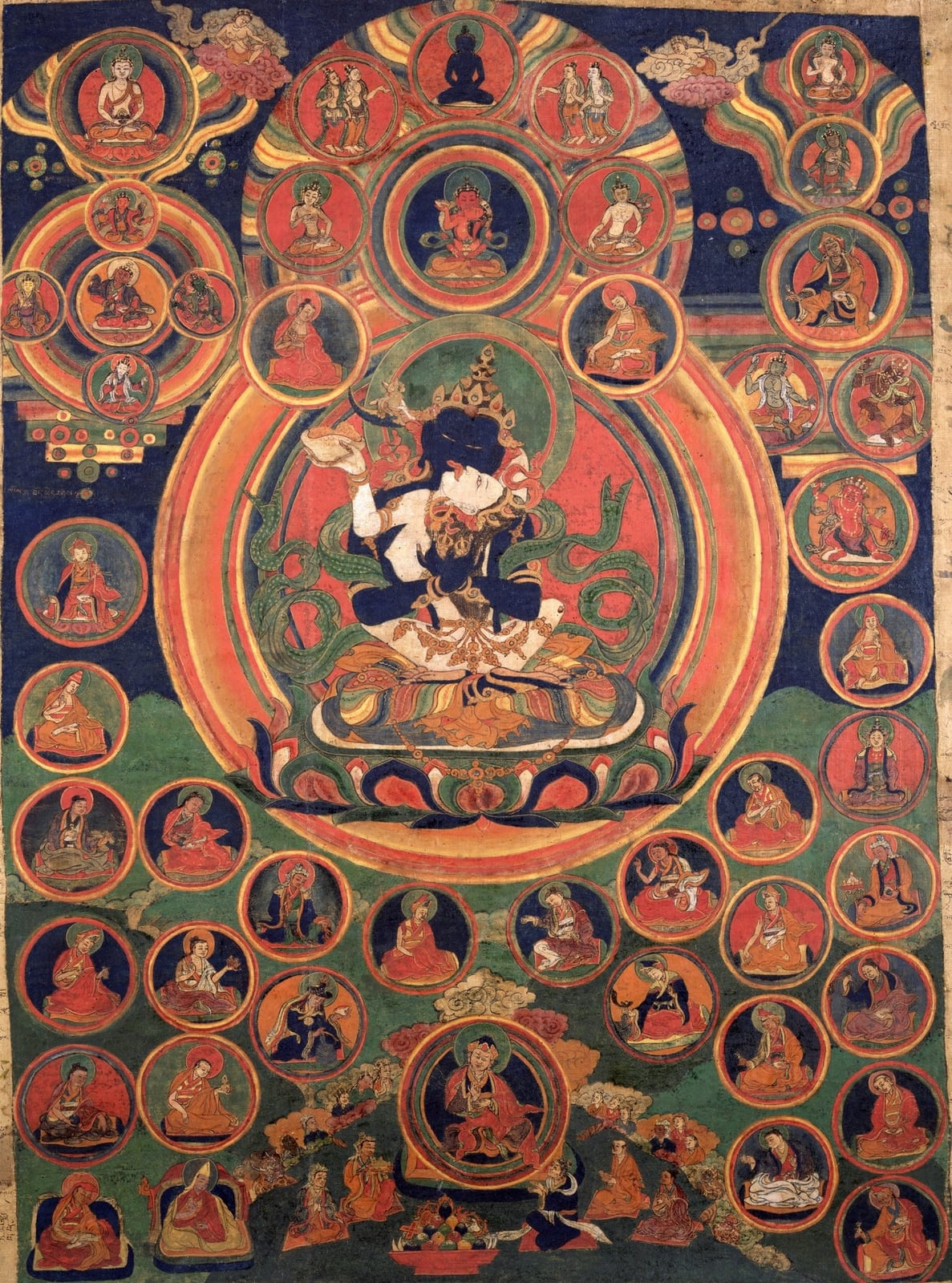
Padmasambhava
Übereinstimmung bei: Wer bin ich? Gibt es ein wahres Selbst? · Warum leiden wir? · Braucht es einen Lehrer?
Denkt anders als
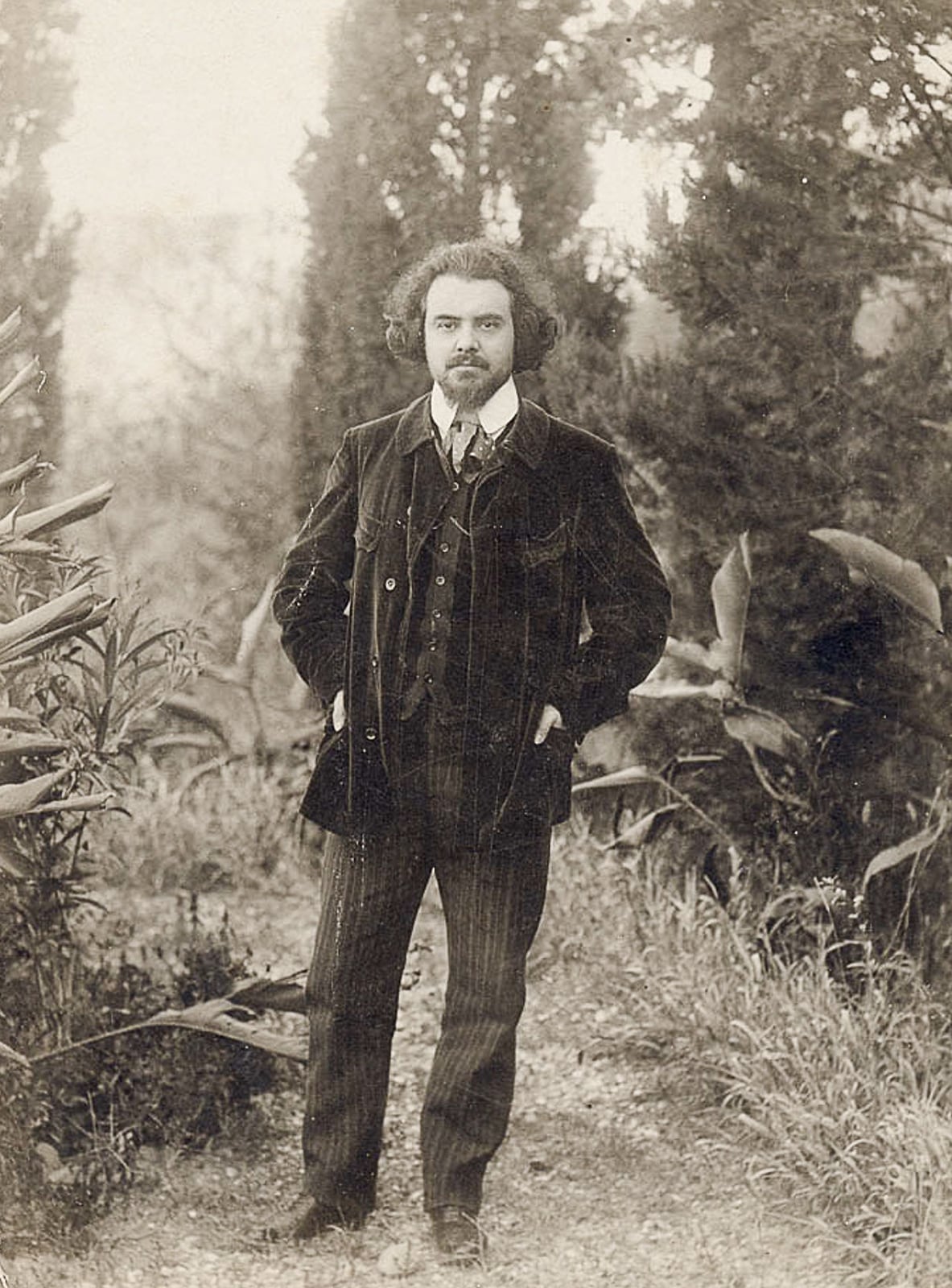
Nikolai Berdyaev
Widerspruch bei: Wer bin ich? Gibt es ein wahres Selbst? · Braucht es einen Lehrer?

Patañjali
Widerspruch bei: Was ist das Absolute? Gibt es Gott? · Wer bin ich? Gibt es ein wahres Selbst?
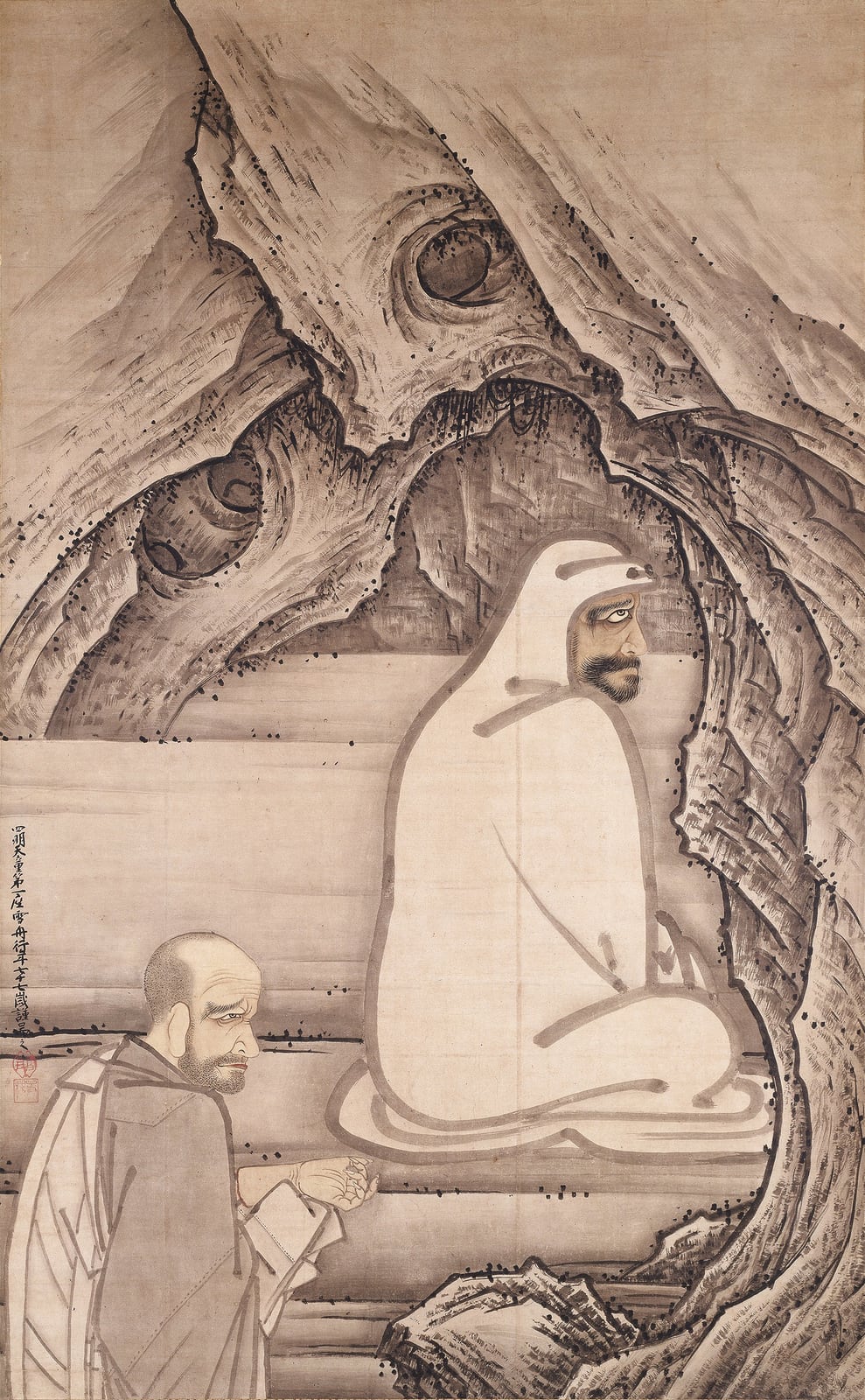
Bodhidharma
Widerspruch bei: Wer bin ich? Gibt es ein wahres Selbst?
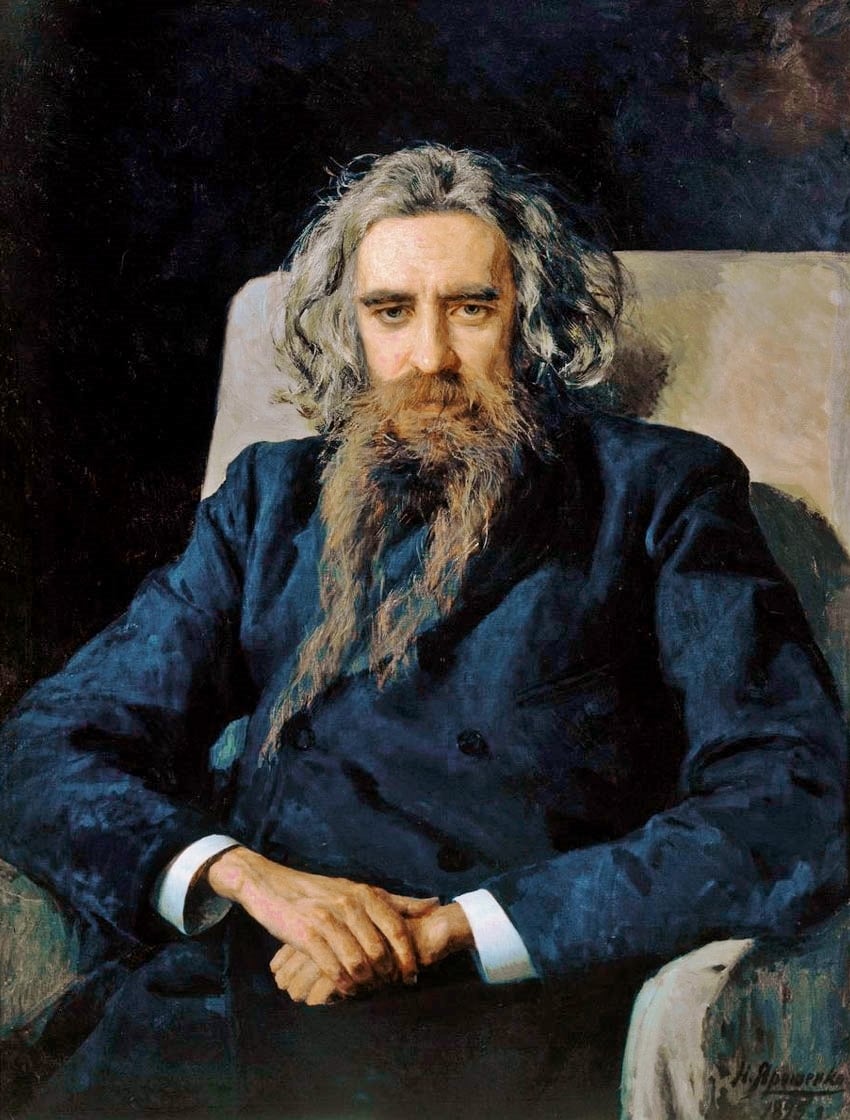
Vladimir Solovyov
Widerspruch bei: Wer bin ich? Gibt es ein wahres Selbst?
Widerspruch beiScheinbarer Widerspruch
G. I. Gurdjieff · Ramana Maharshi
Conscious effort versus being what one already is: a smaller conflict than it seems
Warum: The contradiction is largely apparent because they speak from different levels. Gurdjieff describes the human being from the side of sleep and the machine, and his effort is the condition for something to awaken; Ramana speaks from the Self, for which effort produces nothing new, and he admits it only as a means of stopping the ego from interfering. Both deny the ordinary doer. A real difference remains, however, and should not be glossed over: for Gurdjieff the permanent self does not exist and must be created; for Ramana it already exists and one need only stop veiling it. In one effort builds; in the other, it clears away.
Übereinstimmung bei
G. I. Gurdjieff · P. D. Ouspensky
Man is a machine: the master and the disciple who systematised his teaching
Warum: The affinity is that of a master and his most systematic disciple: Ouspensky worked with Gurdjieff in Russia between 1915 and 1918 and transmitted that teaching in In Search of the Miraculous, published posthumously in 1949. The relationship broke down: Ouspensky withdrew in 1918 and definitively in the 1920s, and led his own groups in London, centred on the study of the system rather than on the figure of the master. They agree in doctrine, not in style: Gurdjieff taught in a demanding and disconcerting way, with dances, movements and provoked situations; Ouspensky, intellectually and in an orderly fashion. Hence they part on the question of the master: one deems him indispensable; the other stresses the school.
Widerspruch beiGrundsätzliche Meinungsverschiedenheit
G. I. Gurdjieff · Teresa of Ávila
The soul as gift or as achievement: the diamond castle versus an immortality to be manufactured
Warum: The contradiction is real and touches the core of both anthropologies. Teresa speaks from the Christian doctrine of creation, in which God gives each soul its immortal being and grace precedes effort. Gurdjieff builds a cosmology of his own, of laws and materials, in which immortality is conditional and must be acquired. There is nonetheless a point of contact: both think that most people live outside themselves, in the outer courtyard of the castle or in sleep, and that knowing oneself demands long and painful work. But in Teresa what is unknown is already there, and in Gurdjieff what is unknown is that there is not yet anyone.
Widerspruch beiGrundsätzliche Meinungsverschiedenheit
G. I. Gurdjieff · Jiddu Krishnamurti
Both see man as conditioned; one demands a school and effort, the other forbids them
Warum: The contradiction is real and comes from two opposite experiences of teaching. Gurdjieff presents himself as a seeker of an ancient knowledge transmitted in schools of Central Asia, and believes that this knowledge, scarce and almost material, can pass only from one who has it to one who works. Krishnamurti was raised precisely within an esoteric organisation with masters, grades and initiations, and his break in 1929 made the rejection of all authority the centre of his teaching. Both distrust comfortable spirituality and inherited beliefs; they part over whether directed effort awakens or lulls.
Anekdoten und Erzählungen
Anekdoten und Erzählungen
Zeugnisc. 1870s–1880s
The grandmother's advice
Herkunft der Erzählung: It comes from Gurdjieff himself, in chapter 1 of Beelzebub's Tales ('The Arousing of Thought'). There are no independent witnesses; it is an autobiographical account within an allegorical work.
Quelle: Gurdjieff, G. I. All and Everything: Beelzebub's Tales to His Grandson. Nueva York: Harcourt, Brace, 1950; Londres: Routledge & Kegan Paul, 1950.
Zeugnisc. 1890s
The sparrows of Samarkand
Herkunft der Erzählung: Gurdjieff's own account in Meetings with Remarkable Men. No independent confirmation; its parable-like character is obvious.
Quelle: Gurdjieff, G. I. Meetings with Remarkable Men. Londres: Routledge & Kegan Paul, 1963 (ed. francesa: Rencontres avec des hommes remarquables, París: Julliard, 1960).
Zeugnis1915
Ouspensky in the Moscow café
Herkunft der Erzählung: Ouspensky's testimony in chapter 1 of In Search of the Miraculous (1949), written years after the events.
Quelle: Ouspensky, P. D. In Search of the Miraculous: Fragments of an Unknown Teaching. Nueva York: Harcourt, Brace, 1949.
Belegt1922–1923
Katherine Mansfield in the cowshed
Herkunft der Erzählung: Documented by Mansfield's letters (ed. Murry, 1928) and by Moore's biographies (Gurdjieff and Mansfield, 1980; The Anatomy of a Myth, 1991).
Quelle: Mansfield, Katherine. The Letters of Katherine Mansfield. Ed. J. Middleton Murry. Londres: Constable, 1928 (cartas desde el Priorato, octubre de 1922 – enero de 1923).
Zeugnis1920s
Rachmilievitch, the necessary irritant
Herkunft der Erzählung: Fritz Peters's testimony in Boyhood with Gurdjieff (1964), written some thirty years later; Gurdjieff's words are the author's reconstruction.
Quelle: Peters, Fritz. Boyhood with Gurdjieff. Nueva York: E. P. Dutton, 1964.
Belegt1924
The 1924 accident
Herkunft der Erzählung: The accident is documented (Moore; de Hartmann; WRSP). The details of the cushion and of the recovery come from pupils' testimonies; the interpretation, from Gurdjieff himself.
Quelle: Moore, James. Gurdjieff: The Anatomy of a Myth. Shaftesbury: Element, 1991.
Nicht überprüfbarc. 1900
The Sarmoung Brotherhood
Herkunft der Erzählung: Sole source: Meetings with Remarkable Men. Webb (The Harmonious Circle) and Moore analyse the hypotheses about its location without finding confirmation.
Quelle: Gurdjieff, G. I. Meetings with Remarkable Men. Londres: Routledge & Kegan Paul, 1963 (ed. francesa: Rencontres avec des hommes remarquables, París: Julliard, 1960).
Lehren
Lehren
Die Begriffe, die das Denken gliedern, in ihrem Zusammenhang erklärt.
Self-rememberingrecuerdo-de-si
Set out in Fragments (ch. 7) and in the Prieuré aphorisms; it runs through every phase of the teaching.
Quelle: Ouspensky, P. D. In Search of the Miraculous: Fragments of an Unknown Teaching. Nueva York: Harcourt, Brace, 1949.
Sleep and man-machinesueno-y-mecanicidad
Core of the Russian teaching (1915–1918) according to Ouspensky; it reappears satirically in Beelzebub.
Quelle: Ouspensky, P. D. In Search of the Miraculous: Fragments of an Unknown Teaching. Nueva York: Harcourt, Brace, 1949.
The three centrestres-centros
Basis of the Institute's name and of the 'fourth way' concept, which works on all three centres at once as against the ways of the fakir, the monk and the yogi.
Quelle: Ouspensky, P. D. In Search of the Miraculous: Fragments of an Unknown Teaching. Nueva York: Harcourt, Brace, 1949.
The law of three and the law of sevenley-de-tres-y-ley-de-siete
Set out by Ouspensky (chs. 4–5 and 7) and developed in mythic key in Beelzebub.
Quelle: Ouspensky, P. D. In Search of the Miraculous: Fragments of an Unknown Teaching. Nueva York: Harcourt, Brace, 1949.
The enneagrameneagrama
Ouspensky transmits it in chapter 14 of Fragments.
Quelle: Ouspensky, P. D. In Search of the Miraculous: Fragments of an Unknown Teaching. Nueva York: Harcourt, Brace, 1949.
The fourth waycuarto-camino
Origin of the tradition's name (fourth-way) in the Atlas.
Quelle: Ouspensky, P. D. In Search of the Miraculous: Fragments of an Unknown Teaching. Nueva York: Harcourt, Brace, 1949.
Conscious labour and intentional sufferingtrabajo-consciente-y-sufrimiento-intencional
Doctrine of the Prieuré period and of Beelzebub.
Quelle: Gurdjieff, G. I. All and Everything: Beelzebub's Tales to His Grandson. Nueva York: Harcourt, Brace, 1950; Londres: Routledge & Kegan Paul, 1950.
Retreats
Retreats und Zentren
Orte und Begegnungen, die mit dieser Lehre verbunden sind. Wir stellen den Kontakt zu den Veranstaltern her.
Nueva York (Upper East Side) · Estados Unidos
Gurdjieff Foundation of New York
The Gurdjieff Foundation of New York
The Gurdjieff Foundation of New York belongs to the network of foundations established after Gurdjieff's death by his pupil Jeanne de Salzmann, together with the Institut Gurdjieff in Paris and the Gurdjieff Society in London. Its first president, Lord Pentland, had been a pupil of Ouspensky before working with Gurdjieff, and many of Ouspensky's pupils joined this work. It offers weekly group meetings led by senior students, classes in the Movements, the sacred dances and exercises Gurdjieff taught, meditation and retreats. Access is gradual and begins with introductory events.
San Francisco y Guerneville (Sonoma), California · Estados Unidos
Gurdjieff Foundation of California
The Gurdjieff Foundation of California
The Gurdjieff Foundation of California was founded in 1955 under the direction of Lord John Pentland, whom Gurdjieff himself had entrusted with the early American groups, and describes itself as the oldest group in California devoted to his teaching of inner development. It is a non-profit voluntary community based in San Francisco, with a second property in Guerneville, Sonoma County, where practical work takes place. It offers group meetings, Movements, sittings, study of the ideas and music, and belongs to the International Association of the Gurdjieff Foundations alongside Paris, New York and London.
Londres · Reino Unido
Gurdjieff Studies, London
Gurdjieff Studies Ltd (organización benéfica registrada)
Gurdjieff Studies is a London charity devoted to the Fourth Way that offers group meetings, reading groups, practical activities, Movements classes and intensive residential stays. It holds that the teaching is passed on from teacher to pupil in direct lines of transmission, and maintains two reference websites: one on Gurdjieff's life and work, with his music, dances and chronology, and another devoted to P. D. Ouspensky, reconstructing his work in England, including the Lyne Place period. It is independent of the network of foundations established by Jeanne de Salzmann.
Videos
Videos
Aufnahmen, Gespräche und Dokumentarfilme. Die Videos werden von YouTube wiedergegeben; sie werden nicht hier gespeichert.
June 18, 1949 (improvisación al armonio)
Originalaufnahme· ZXX· 1949· 2 min
G. I. Gurdjieff - Topic
Mme de Salzmann in New York 1988
Originalaufnahme· EN· 1988· 3 min
Gurdjieff Meetings
Jacob Needleman - Gurdjieff: A Life in the Work
Vortrag· EN· 116 min
CommonwealNewSchoolOffizieller Kanal
'Meetings with Remarkable Men' – An interview with Peter Brook
Gespräch· EN· 10 min
Clarendon Events
The Gurdjieff Work and Gurdjieff Movements – J.G. Bennett at Sherborne, 1973
Originalaufnahme· EN· 1973· 3 min
Avrom Altman
Gurdjieff: The Rascal Saint – Sadhguru Exclusive
Analyse· EN· 7 min
SadhguruOffizieller Kanal
Gurdjieff : un maître spirituel unique en son genre
Analyse· FR· 7 min
Sadhguru FrançaisOffizieller Kanal
L'avenir de Gurdjieff avec Pierre Schaeffer par Michel Camus
Gespräch· FR· 20 min
Résonance[s]
El Cuarto Camino, Gurdjieff, 1992 (documental de TVE2, La tabla redonda)
Dokumentarfilm· ES· 1992· 56 min
beapuertas
Георгий Гурджиев / George Gurdjieff. Жизнь Замечательных Людей
Dokumentarfilm· RU· 62 min
ЖИЗНЬ ЗАМЕЧАТЕЛЬНЫХ ЛЮДЕЙ
Galerie
Galerie
Bilder mit geprüfter Lizenz. Jedes bewahrt seine Urheberschaft und seinen Herkunftsnachweis.
Beziehungen
Beziehungen
Einflüsse, Schülerschaften und Verwandtschaften. Die belegte Beziehung wird von der durch Analyse ermittelten Ähnlichkeit unterschieden.
Lehrer von
His pupil from 1915; he separated from him in the 1920s and taught independently in London. His In Search of the Miraculous is the main exposition of the Russian teaching.
Belegte Beziehung
Lehrer von
Thomas de Hartmann
Composer, pupil from 1916 and collaborator on some two hundred piano pieces until 1929.
Belegte Beziehung
Lehrer von
Jeanne de Salzmann
Pupil from 1919 in Tiflis; continuer of the teaching and organiser of the foundations after 1949.
Belegte Beziehung
Lehrer von
J. G. Bennett
Met him in Constantinople in 1920 and studied with him in 1923 and 1948–1949; later founded his own line at Coombe Springs and Sherborne.
Belegte Beziehung
Lehrer von
A. R. Orage
Editor of The New Age; pupil from 1922 and his representative in New York (1924–1931); collaborated on the translation of Beelzebub.
Belegte Beziehung
Begegnete
Katherine Mansfield
Spent her last months at the Prieuré (1922–1923).
Belegte Beziehung
Verwandte Gedanken mit
Both presented ancient knowledge transmitted by Eastern masters; Gurdjieff nonetheless mocked Theosophists and parlour occultism.
Durch Analyse ermittelte Ähnlichkeit
Zeitgenosse von
Contemporaries in interwar Europe; both gave movement—eurythmy or dance—a central place in spiritual training. No meeting is recorded.
Durch Analyse ermittelte Ähnlichkeit
Verwandte Gedanken mit
Both insisted on self-observation without illusions about the 'I'; unlike Gurdjieff, Krishnamurti rejected every method and every school.
Durch Analyse ermittelte Ähnlichkeit
Von anderen Einträgen aus verknüpft
Quellen
Quellen
Für diesen Eintrag herangezogene Bibliografie und Kataloge.
- Ouspensky, P. D. In Search of the Miraculous: Fragments of an Unknown Teaching. Nueva York: Harcourt, Brace, 1949.
- Wikidata, «George Gurdjieff» (Q217771).
- Moore, James. Gurdjieff: The Anatomy of a Myth. Shaftesbury: Element, 1991.
- De Hartmann, Thomas y Olga de Hartmann. Our Life with Mr. Gurdjieff. Nueva York: Cooper Square, 1964 (ed. ampliada, Harper & Row, 1983).
- Gurdjieff, G. I. Meetings with Remarkable Men. Londres: Routledge & Kegan Paul, 1963 (ed. francesa: Rencontres avec des hommes remarquables, París: Julliard, 1960).
- Gurdjieff, G. I. All and Everything: Beelzebub's Tales to His Grandson. Nueva York: Harcourt, Brace, 1950; Londres: Routledge & Kegan Paul, 1950.
- Gurdjieff, G. I. Views from the Real World: Early Talks of Gurdjieff. Nueva York: E. P. Dutton, 1973.
- World Religions and Spirituality Project (Virginia Commonwealth University), «Gurdjieff» (perfil y cronología).
- The Gurdjieff Legacy Foundation, «Jeanne de Salzmann» (archivo), que cita a William Patrick Patterson, Struggle of the Magicians, pp. 224–225.
- The Gurdjieff Legacy Foundation, «Final Years» (últimos años, muerte y funeral).
- Wikipedia (en), «George Gurdjieff», sección sobre la fecha de nacimiento (remite a Churton, Tobias. Deconstructing Gurdjieff, Inner Traditions, 2017, pp. 3–4 y 316–317).
- Webb, James. The Harmonious Circle: The Lives and Work of G. I. Gurdjieff, P. D. Ouspensky, and Their Followers. Londres: Thames & Hudson, 1980.
- Peters, Fritz. Boyhood with Gurdjieff. Nueva York: E. P. Dutton, 1964.
- Bennett, J. G. Witness: The Story of a Search. Londres: Hodder & Stoughton, 1962.
- Open Library, registros de autor y ediciones de Georges Ivanovitch Gurdjieff (consultados para los ISBN).
- Gurdjieff Society of Austin, «Aphorisms» (aforismos inscritos en la Study House del Priorato; recogidos en Views from the Real World).
- Mansfield, Katherine. The Letters of Katherine Mansfield. Ed. J. Middleton Murry. Londres: Constable, 1928 (cartas desde el Priorato, octubre de 1922 – enero de 1923).
- Shambhala Publications, ficha de In Search of Being: The Fourth Way to Consciousness, por G. I. Gurdjieff, ed. Stephen A. Grant (2012; reed. 2021).
- Rechteinhaber
- Derechos vigentes sobre los textos póstumos y sus traducciones. Las ediciones autorizadas en inglés salen bajo el sello Triangle Editions (vinculado a la Gurdjieff Foundation de Nueva York) y Penguin; en francés, las de la red del Institut Gurdjieff. Pendiente de confirmar el titular exacto en cada territorio.
- Offizielle Website
- institut-gurdjieff.com/
Bestätigung ausstehend
Was dieser Eintrag noch nicht klären konnte. Wir sagen es lieber, als es aufzufüllen.
- Fecha de nacimiento: no resoluble con las fuentes disponibles (1866/1867, 1872, 1877); el campo birth usa 1872 «approx» como valor central, con las tres versiones en la cronología.
- Localizar la publicación original de las palabras «Do everything, even the impossible, to develop what I have brought», atribuidas a Jeanne de Salzmann.
- Comprobar en Witness (Bennett, 1962/1974) y en Idiots in Paris si Bennett recoge una frase final de Gurdjieff.
- Cotejar contra un ejemplar de Views from the Real World la redacción y la página de los aforismos citados (verificados contra la lista de la Gurdjieff Society of Austin).
- ISBN de las ediciones inglesas de Book Studio (Transcripts 1941–1946; Early Talks) y de Paris Meetings 1943; editor de la edición de 2008 de Struggle of the Magicians.
- Ediciones italianas de editoriales establecidas (Incontri con uomini straordinari, Racconti di Belzebù): no localizadas con ISBN en Open Library.
- Titular exacto de los derechos por territorio (Triangle Editions / herederos / Institut Gurdjieff).
- Fechas de fundación del Institut Gurdjieff (París) y de la Gurdjieff Society (Londres): solo se ha confirmado 1953 para Nueva York.
- Obras completas (2026-10-25): cotejado el catálogo de Open Library (OL767343A y variantes). Todo lo publicado de Gurdjieff está registrado; además existen grabaciones de sus improvisaciones al armonio (1948–1949) editadas en disco, que no son libros y no se registran como obras. Las entradas atribuidas a Gurdjieff de Psychology of Man's Possible Evolution, Tertium Organum, A Further Record o The Theory of Conscious Harmony son errores de catálogo (obras de Ouspensky y de Rodney Collin).
- Sala de lectura (2026-10-25): sin textos registrables. Lo único publicado en vida, The Herald of Coming Good (París, 1933, en inglés, traductores no identificados), tiene escaneo en Internet Archive (in.ernet.dli.2015.127965), pero su OCR no es limpio y la obra no cumple los tres derechos: libre en la UE desde 2020 (autor fallecido en 1949), no en España hasta 2030 (80 años) ni en EE. UU. hasta 2029 (obra extranjera de 1933 restaurada por la URAA, 95 años). Las demás obras son póstumas (1950 en adelante) y tienen derechos vigentes de Triangle Editions y de sus traductores. Revisar en 2030.
Recherchiert am 2026-10-23