Filosofia presocratica
Empedocles
Ἐμπεδοκλῆς ὁ Ἀκραγαντῖνος
ca. 494 a.C. – ca. 434 a.C.Persona storicamente documentata
Filosofo, medico e politico di Akragas, in Sicilia (c. 494-434 a.C.), autore di due poemi in esametri, Sulla natura e le Purificazioni, dei quali restano circa cinquecento versi e il papiro di Strasburgo. Insegnò che tutto si compone di quattro radici eterne, mescolate dall'Amore e separate dalla Contesa, e che l'anima, esiliata per il sangue versato, trasmigra attraverso tutte le forme viventi. La leggenda del suo salto nell'Etna ne fece una figura letteraria.
- opere
- 11opere
- edizioni
- 25edizioni
- citazioni
- 14citazioni
- video
- 10video
- immagini
- 7immagini
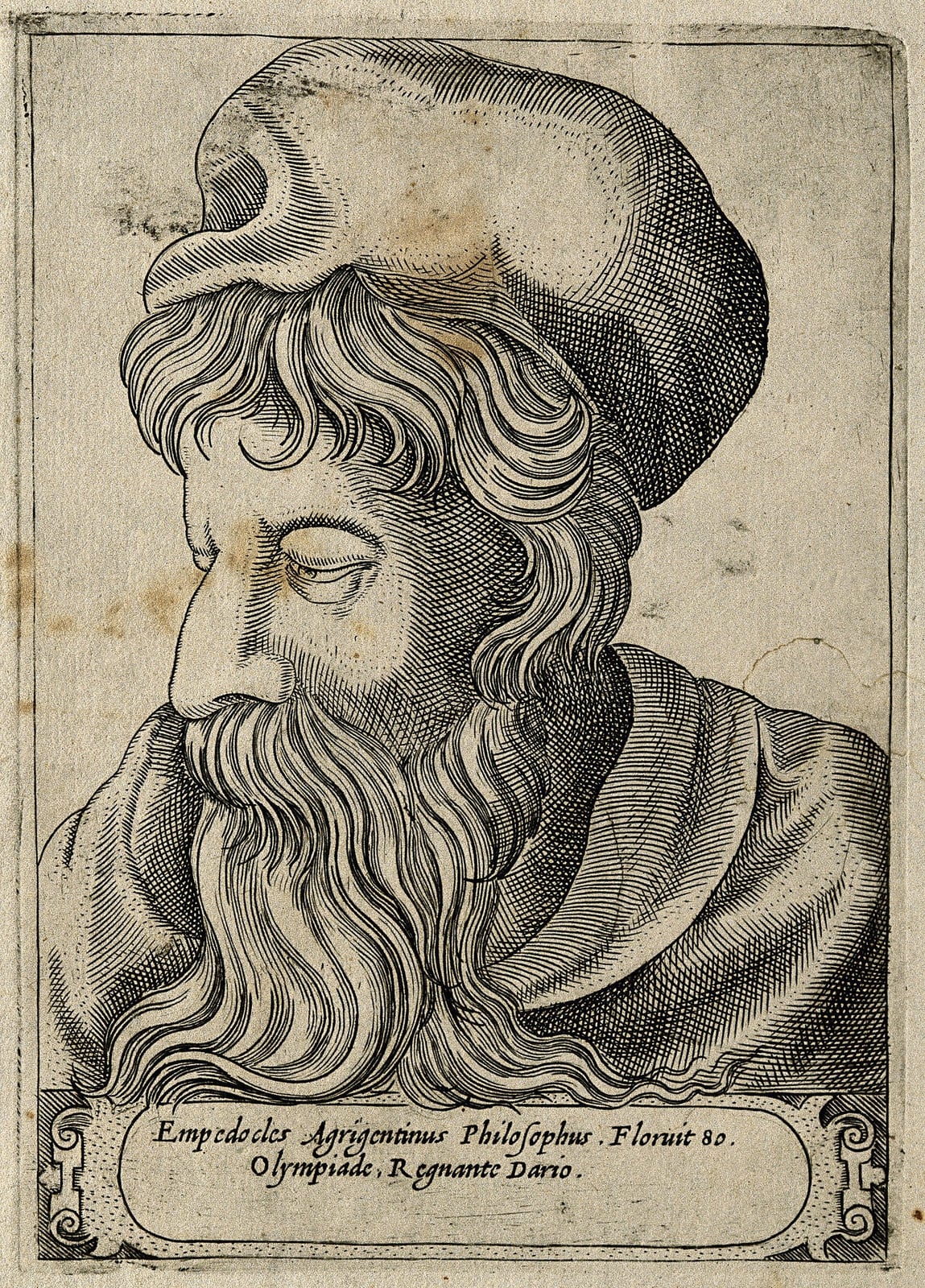
Empédocles, grabado de 1580 · CC BY 4.0
Con le sue parole
«For straitened are the powers that are spread over their bodily parts.»DK 31 B2.1, en Sexto Empírico, Contra los matemáticos VII 123. Griego: texto de Fairbanks (1898), basado en la edición de Stein; numeración Diels-Kranz. Inglés: John Burnet, Early Greek Philosophy (1908). Español: traducción propia.

La sua idea centrale
The four roots (rhizomata): Empedocles accepts with Parmenides that nothing comes from what is not or is annihilated, but he does not give up explaining change.
Vederlo nel contesto
Biografia
5 min di lettura
Traduzione assistita dall'originale spagnolo, in attesa di revisione da parte di un traduttore madrelingua.
Il filosofo che si disse dio
Di nessun presocratico si conservano tanti versi quanti di Empedocle: quasi cinquecento, ai quali il papiro di Strasburgo ne aggiunse nel 1999 alcune decine. Scrisse, come Parmenide, in esametri, e fu insieme fisico, medico, oratore, politico democratico, profeta della purezza e taumaturgo. La sua teoria delle quattro «radici» — fuoco, aria, acqua e terra — mosse dall'Amore e dalla Contesa dominò la scienza europea per duemila anni; il suo annuncio di essere «un dio immortale, non più un mortale» e la leggenda del suo salto nell'Etna fecero di lui una delle figure più romanzesche dell'Antichità. Aristotele lo chiamò inventore della retorica e, al tempo stesso, gli rimproverò di non avere del poeta altro che il metro.
Akragas
Nacque ad Akragas, l'odierna Agrigento, la città più ricca della Sicilia greca, i cui templi dorici dominano ancora la valle. Suo padre si chiamava Metone e suo nonno, anch'egli Empedocle, vinse la corsa dei cavalli a Olimpia nel 496 a.C., secondo Aristotele citato da Eratostene. Apollodoro fissò la sua akmè al 444-443 a.C., anno della fondazione di Turi, che Glauco di Reggio dice che visitò; Aristotele affermava che morì a sessant'anni. Burnet ha riassunto ciò che si può sapere: era fanciullo sotto il tiranno Terone, era attivo ad Akragas dopo il 472, quando cadde suo figlio Trasideo e la città riconquistò un governo libero, e morì dopo il 444. Da qui le date consuete, intorno al 494-434 a.C.
Il democratico
Lo storico siceliota Timeo, che scrisse un secolo e mezzo dopo raccogliendo tradizioni locali, raccontava che la sua carriera politica cominciò durante un banchetto: un magistrato vi si comportò da aspirante tiranno ed Empedocle, il giorno seguente, lo trascinò in tribunale e ne ottenne la condanna a morte. Si oppose anche a che il consiglio concedesse al medico Acrone un terreno per il sepolcro del padre e sciolse l'assemblea dei Mille, forse un'associazione oligarchica. Aristotele aggiungeva che rifiutò la regalità quando gliela offrirono. Secondo Timeo, i discendenti dei suoi nemici impedirono in seguito il suo ritorno, ed Empedocle morì esule nel Peloponneso.
Medico, oratore e mago
Galeno lo collocò, insieme a Filistione e Pausania, all'origine della scuola medica italica, rivale di quelle di Cos e di Cnido. Il suo discepolo Gorgia di Leontini, il grande sofista, raccontava secondo Satiro di averlo visto praticare la magia; Eraclide Pontico narrò come avesse tenuto in vita per trenta giorni una donna senza respiro né polso. Timeo lo chiamò «colui che ferma i venti» per aver appeso pelli d'asino allo scopo di frenare i venti etesii, e altri gli attribuirono la bonifica delle paludi di Selinunte. Burnet osservò che quasi tutti questi prodigi si ricavano dai suoi stessi versi, nei quali promette al discepolo Pausania rimedi contro la vecchiaia, potere sui venti e sulla pioggia e perfino la facoltà di ricondurre un morto dall'Ade.
Due poemi
Diogene Laerzio attribuisce ai suoi due grandi poemi, Sulla natura e le Purificazioni, circa cinquemila versi. Il primo, dedicato a Pausania, espone una fisica: nulla nasce e nulla muore, soltanto si mescolano e si separano quattro radici eterne, alle quali dà nomi divini — Zeus, Era, Aidoneo e Nesti —, sotto l'azione alterna dell'Amore, che unisce, e della Contesa, che separa. Il cosmo oscilla così tra l'unità perfetta dello Sfero e la dispersione totale, e nelle fasi intermedie sorgono i viventi, dapprima come membra sparse — teste senza collo, braccia senza spalle — che si combinano a caso. Il secondo poema, rivolto ai suoi concittadini di Akragas, parla di un dàimon esiliato per trentamila stagioni per aver versato sangue, che si reincarna in tutte le forme mortali; da qui il divieto di mangiare carne e di sacrificare animali.
La critica moderna discusse per un secolo se i due poemi fossero compatibili — un fisico meccanicista e un profeta religioso — o se fossero in realtà uno solo. Brad Inwood e altri giunsero a proporre che formassero un'unica opera; Catherine Osborne sottolineò la continuità tra fisica e religione.
Il papiro di Strasburgo
Nel 1904 la Bibliothèque nationale et universitaire di Strasburgo acquistò in Egitto alcuni frammenti di papiro provenienti da Panopoli (Akhmim), che rimasero non identificati per novant'anni. Nel 1994 il papirologo Alain Martin vi riconobbe versi di Empedocle, e nel 1999 li pubblicò con Oliver Primavesi. Copiati alla fine del I secolo d.C., contengono resti di circa settantaquattro versi, in parte sconosciuti, del primo libro della fisica, con un segno che indica il trecentesimo verso. La scoperta mostrò che in quel libro il ciclo cosmico compariva accanto a lamenti per il «giorno spietato» in cui si mangiò carne, cioè che la fisica e la dottrina della colpa erano più intrecciate di quanto si credesse.
L'Etna e le altre morti
Diogene Laerzio raccoglie versioni inconciliabili della sua fine. Eraclide Pontico raccontava che, dopo un sacrificio, scomparve di notte; un servo udì una voce che lo chiamava e vide una luce nel cielo, e Pausania ordinò di onorarlo come un dio. Ippoboto aggiungeva che si gettò nel cratere dell'Etna perché lo si credesse immortale, ma il vulcano restituì uno dei suoi sandali di bronzo. Timeo lo negava: Empedocle partì per il Peloponneso e non tornò mai più. Neante diceva che morì per una caduta dal carro, altri che si impiccò. Orazio fissò per i posteri la versione dell'Etna. Ava Chitwood ha mostrato che, come nel caso di Eraclito, queste morti furono fabbricate a partire dai suoi poemi: chi si proclamava dio immortale e faceva del fuoco una radice del mondo doveva morire divinizzato o divorato dal fuoco.
Eredità
Aristotele adottò i suoi quattro elementi, aggiungendovi l'etere, e con essi la medicina dei quattro umori; Platone alluse alle «muse sicule» e Lucrezio lo celebrò come il più grande dei figli della Sicilia. In età moderna Hölderlin scrisse, senza terminarla, la tragedia La morte di Empedocle (1797-1800); Matthew Arnold, il poema drammatico Empedocle sull'Etna (1852), e Freud riconobbe nell'Amore e nella Contesa un precedente della sua opposizione tra Eros e pulsione di morte. Resta l'esempio più chiaro del fatto che, alle sue origini, la filosofia greca non separava la scienza, la poesia e la salvezza.
Fonti: Diógenes Laercio. Vidas y opiniones de los filósofos ilustres VIII 51–77 (Empédocles), s. III d. C. Trad. inglesa de C. D. Yonge, Bohn, Londres, 1853 (Project Gutenberg n.º 57342); trad. inglesa de R. D. Hicks, Loeb, 1925 (Wikisource). · Diels, Hermann y Kranz, Walther. Die Fragmente der Vorsokratiker, 6.ª ed. Weidmann, Berlín, 1951–1952, cap. 31 (Empedokles), A (testimonios) y B 1–154. · Kirk, G. S., Raven, J. E. y Schofield, M. The Presocratic Philosophers, 2.ª ed. Cambridge University Press, 1983, cap. X (Empedocles of Acragas). Trad. esp. de Jesús García Fernández, Gredos, 1987. · Burnet, John. Early Greek Philosophy, 2.ª ed. A. and C. Black, Londres, 1908, cap. V (Empedokles of Akragas), §§ 98–105 y traducción de los fragmentos (Project Gutenberg n.º 67097). · Martin, Alain y Primavesi, Oliver. L'Empédocle de Strasbourg (P. Strasb. gr. Inv. 1665–1666): introduction, édition et commentaire. Walter de Gruyter / Bibliothèque Nationale et Universitaire de Strasbourg, Berlín, Nueva York y Estrasburgo, 1999.
Cronologia
La vita, anno per anno
Ogni punto è un evento documentato. Fai clic per leggerlo, con la sua fonte e il suo grado di certezza.
496 a.C.Olimpia
His grandfather's Olympic victory
His grandfather Empedocles wins the horse race at the 71st Olympiad (496 BCE), according to Eratosthenes citing Aristotle (Diogenes Laertius VIII 51). Years BCE are expressed as negative numbers.
ProbabileDiógenes Laercio. Vidas y opiniones de los filósofos ilustres VIII 51–77 (Empédocles), s. III d. C. Trad. inglesa de C. D. Yonge, Bohn, Londres, 1853 (Project Gutenberg n.º 57342); trad. inglesa de R. D. Hicks, Loeb, 1925 (Wikisource).
Dopo la sua morte
- 427 a.C.Gorgias in Athens
- ca. 90 a.C.Copy of the Strasbourg papyrus
- ca. 55 a.C.Lucretius praises him
- ca. 1798Hölderlin's Death of Empedocles
- 1852Matthew Arnold's Empedocles on Etna
- 1994Identification of the papyrus
- 1999L'Empédocle de Strasbourg
496 a.C.
His grandfather's Olympic victory
His grandfather Empedocles wins the horse race at the 71st Olympiad (496 BCE), according to Eratosthenes citing Aristotle (Diogenes Laertius VIII 51). Years BCE are expressed as negative numbers.
Probabile
ca. 494 a.C. · 0 anni
Birth
Born at Acragas, son of Meton, of a wealthy and distinguished family. The date is inferred from his death at sixty (Aristotle) and his activity after 472; Wikidata records 494, 492 and 490.
Probabile
ca. 471 a.C. · 23 anni
Fall of Thrasydaeus and free government
After Theron's death (472 BCE), his son Thrasydaeus is defeated by Hieron of Syracuse and expelled; Acragas recovers a free government in which Empedocles will be a democratic leader.
Documentato
ca. 460 a.C.
Dissolution of the assembly of the Thousand
According to Timaeus (in Diogenes Laertius VIII 64–66), he prosecutes two magistrates with tyrannical airs, opposes Acron's funerary privilege and dissolves the assembly of the Thousand. He refuses the kingship offered to him (Aristotle). Dates unknown.
Tradizione
ca. 450 a.C.
Composition of the poems
He composes On Nature, dedicated to Pausanias, and the Purifications, addressed to the people of Acragas. The date and order of composition are conjectural.
Discusso
444 a.C.
Visit to Thurii
Glaucus of Rhegium relates that he came to Thurii shortly after its foundation (444–443 BCE); Apollodorus fixed his prime in that year.
Probabile
ca. 440 a.C.
Exile
According to Timaeus, the descendants of his enemies oppose his return to Acragas and he withdraws to the Peloponnese. Date unknown.
Tradizione
ca. 434 a.C. · 60 anni
Death
Dies at about sixty (Aristotle in Diogenes Laertius VIII 52 and 74). The versions of the manner and place—vanishing after a sacrifice, leaping into Etna, falling from his chariot, dying in the Peloponnese—are contradictory.
Discusso
427 a.C.
Gorgias in Athens
His pupil Gorgias of Leontini comes to Athens as ambassador and dazzles with an artistic prose that, according to Diels, owed much to Empedocles' style.
Documentato
ca. 90 a.C.
Copy of the Strasbourg papyrus
A scribe copies the first book of Empedocles' physics on a roll; its remains, reused in a funerary ornament, are the only direct witness to the poem.
Documentato
ca. 55 a.C.
Lucretius praises him
In De rerum natura (I 716–733) Lucretius celebrates Empedocles as the most admirable man Sicily produced, though he criticises his theory of elements.
Documentato
ca. 1798
Hölderlin's Death of Empedocles
Friedrich Hölderlin writes three unfinished versions of the tragedy Der Tod des Empedokles (1797–1800).
Documentato
1852
Matthew Arnold's Empedocles on Etna
Matthew Arnold publishes the dramatic poem Empedocles on Etna, and Other Poems.
Documentato
1994
Identification of the papyrus
Alain Martin identifies as lines of Empedocles the fragments P. Strasb. gr. Inv. 1665–1666, acquired in 1904.
Documentato
1999
L'Empédocle de Strasbourg
Alain Martin and Oliver Primavesi publish the edition of the papyrus, adding some seventy-four lines, partly new, to the corpus.
Documentato
Opere
Opere essenziali
Le opere senza le quali non si comprende la sua eredità.
Opera scritta · ca. 450 a.C.
On Nature
Περὶ φύσεως (Φυσικά)
A didactic poem in hexameters setting out Empedocles' physics. Nothing is born or perishes: four eternal roots—Zeus, Hera, Aidoneus and Nestis, that is, fire, air or earth, and water depending on the interpretation—are only mixed and separated under Love, which unites, and Strife, which separates. The cosmos alternates between the unity of the Sphere and dispersion, and in the intermediate phases living beings arise, first as loose limbs combining at random. It includes a theory of perception through effluences and pores, the comparison of breathing with the clepsydra and a physiology of the blood as the seat of thought.
12 edizioni · amazon.com

Opera scritta · ca. 445 a.C.
Purifications
Καθαρμοί
A poem addressed to the "friends who dwell in the great city by yellow Acragas", to whom Empedocles presents himself as "an immortal god, no longer mortal", followed by crowds asking for oracles and cures. It sets out the oracle of Necessity: the daimon who stains his hands with blood is banished for thirty thousand seasons and reborn in every mortal form; the poet himself has been boy, girl, bush, bird and fish. Hence the condemnation of animal sacrifice and meat-eating—the father who kills his transformed son without recognising him—and the evocation of a golden age under Cypris when no altar was stained with bulls' blood. Favorinus relates that the rhapsode Cleomenes recited it at Olympia.
9 edizioni · amazon.com

Manoscritto · ca. 90
Strasbourg papyrus (fragments of On Nature, book I)
P. Strasb. gr. Inv. 1665–1666
Remains of a papyrus roll from Panopolis (Akhmim, Egypt), acquired in 1904 by the Strasbourg library and reused in antiquity, according to its editors, for a funerary ornament. Its fragments—52, according to the editors—fall into several ensembles; the main one (a) contains lines 233–300 of the first book, identified by a stichometric mark (the letter gamma, 300), and connects with fragment B17. Besides new details of the cosmic cycle and zoogony, it includes first-person lines on the "pitiless day" on which the crime of eating flesh was committed, forcing a rethinking of the separation between the two poems.
4 edizioni · amazon.com
Tutta la sua opera (11)
Empedocles
The Crossing of Xerxes (lost)
The Conscious LibraryThe Crossing of Xerxes (lost)
Empedocles
Proem to Apollo (lost)
The Conscious LibraryProem to Apollo (lost)
Empedocles
Tragedies (disputed attribution)
The Conscious LibraryTragedies (disputed attribution)
Empedocles
Political writings (lost)
The Conscious LibraryPolitical writings (lost)
Empedocles
Medical Discourse (lost)
The Conscious LibraryMedical Discourse (lost)
Empedocles
Epigrams (doubtful attribution)
The Conscious LibraryEpigrams (doubtful attribution)
Empedocles
The Sphere (spurious)
The Conscious LibraryThe Sphere (spurious)
Empedocles
Book of the Five Substances and other Arabic texts (spurious)
The Conscious LibraryBook of the Five Substances and other Arabic texts (spurious)
Citazioni
Citazioni localizzate in un'opera precisa. Ciascuna porta con sé la sua provenienza e il suo grado di affidabilità.
For straitened are the powers that are spread over their bodily parts.στεινωποὶ μὲν γὰρ παλάμαι κατὰ γυῖα κέχυνται.
VerificataDK 31 B2.1, en Sexto Empírico, Contra los matemáticos VII 123. Griego: texto de Fairbanks (1898), basado en la edición de Stein; numeración Diels-Kranz. Inglés: John Burnet, Early Greek Philosophy (1908). Español: traducción propia.
Citazioni apocrife o di attribuzione discussa (3)
«Everything is composed of four elements: earth, water, air and fire.»
The doctrine is his, but not the vocabulary: Empedocles speaks of "roots" (rhizomata) and names them after gods. The term "elements" (stoicheia) comes from Plato and Aristotle.
«The nature of God is a circle whose centre is everywhere and whose circumference is nowhere.»
Often ascribed to Empedocles, it comes from the Book of the Twenty-Four Philosophers (12th century), proposition II, and was spread by Alan of Lille, Meister Eckhart, Nicholas of Cusa and Pascal.
«The people of Acragas indulge in pleasure as if they were to die tomorrow, and build their houses as if they were to live for ever.»
Diogenes Laertius (VIII 63) puts it in Empedocles' mouth, but Aelian (Varia Historia XII 29) ascribes an almost identical saying to Plato. It is a wandering apophthegm with no secure source.
Ultime parole
Non esistono testimonianze verificabili delle sue ultime parole.
No record of his last words survives. The versions of his death collected by Diogenes Laertius (VIII 67–75) are contradictory and legendary; in Heraclides of Pontus' version the only thing heard is a voice calling him in the night.
Fonte: Diógenes Laercio. Vidas y opiniones de los filósofos ilustres VIII 51–77 (Empédocles), s. III d. C. Trad. inglesa de C. D. Yonge, Bohn, Londres, 1853 (Project Gutenberg n.º 57342); trad. inglesa de R. D. Hicks, Loeb, 1925 (Wikisource).
Chiedi
Ciò a cui risponde la sua opera
Dodici grandi domande dell'umanità e ciò che i suoi testi permettono di rispondere, con riferimenti. Non gli mettiamo mai parole in bocca.
Che cos'è l'Assoluto? Dio esiste?
A holy and ineffable mind, with neither head nor human limbs
Un Assoluto impersonaleLo dice espressamente
Empedocles fills his physics with divine names: the four roots are called Zeus, Hera, Aidoneus and Nestis, and the two forces that join and separate them are Love and Strife. When Love prevails, everything fuses in the Sphere, round and rejoicing in its solitude, which fragments B27–29 treat as a god. But in fragment B134 he explicitly rejects the anthropomorphic image: the divine has no human head upon its limbs, no arms or feet, but is only a holy and ineffable mind that darts through the whole cosmos with swift thoughts. The ultimate is thus divine and intelligent, yet faceless: a principle that thinks the world, not a lord who governs it from outside.
Confronta questa domanda con altri maestriChi sono io? Esiste un vero sé?
A daimon exiled from the gods, wandering through many forms
Un'anima in evoluzioneLo dice espressamente
In the Purifications Empedocles speaks of himself as one of the long-lived daimons who, for having stained their hands with blood and trusted in Strife, have been exiled far from the blessed for thrice ten thousand seasons, being born in all kinds of mortal forms. He claims to have been already a boy and a girl, a bush, a bird and a mute fish of the sea, and describes the weeping of the newcomer to an unfamiliar place. The end of the journey is return: the best become seers, poets, physicians and leaders, and from there they spring up as gods, table companions of the immortals. The true self is that daimon passing through lives until it recovers its divine condition.
Confronta questa domanda con altri maestriPerché soffriamo?
We suffer because Strife exiled us from the blessed
La separazione da DioLo dice espressamente
In the Purifications suffering has a precise origin. Empedocles counts himself among the daimons who, for having shed blood and trusted in raging Strife, were cast far from the gods and condemned to be born in mortal forms. The world they reach is a joyless place of murder, wrath and disease, and he himself says he wept on seeing the unfamiliar place. The slaughter continues: humans sacrifice and eat animals without seeing that they devour one another, and a father slaughters among prayers his son changed in form. Pain is exile, and its causes are bloodshed and the dominion of Strife over Love.
Confronta questa domanda con altri maestriChe cosa accade dopo la morte?
There is no birth or death, only mixture; the daimon transmigrates until it returns
Rinascita secondo il karmaLo dice espressamente
Empedocles answers in two registers. In On Nature he denies that there is properly birth or death of mortal things: there is only mixture and exchange of what is mixed, and “birth” is a name humans give them. In the Purifications the exiled daimon passes for thrice ten thousand seasons through every kind of form — boy and girl, bush, bird and fish — and that is why eating meat is killing a kinsman. At the end of the cycle, the purified are born as seers, poets, physicians and leaders, and from there rise as gods, free of human pains and table companions of the immortals. Death is a step in the journey home.
Confronta questa domanda con altri maestriCome si raggiunge la liberazione o la salvezza?
Abstain from blood, purify oneself and reach divine thoughts
Con una pratica disciplinataLo dice espressamente
The poem tradition calls the Purifications offers a way for the exiled daimon to return among the gods. Its core is an ethic of non-violence: to stop shedding blood, because the sacrificed animal may be a kinsman changed in form, and to abstain from certain foods, including beans and laurel. Knowledge is added to that discipline: blessed is he who has gained the wealth of divine thoughts, and wretched he who holds a dark opinion about the gods. The purified ascend through the highest callings — seers, poets, physicians, leaders — until they spring up as gods. It is a way of practice and sustained purification.
Confronta questa domanda con altri maestriServe un maestro?
A sage who speaks as a god passes a guarded knowledge to his disciple
IndispensabileSi deduce dalla sua dottrina
On Nature is addressed to a disciple, Pausanias, and Empedocles asks him to keep what he hears in his silent heart. He promises him knowledge of remedies against ills and old age, of stilling the winds and bringing a dead man back from Hades: a knowledge only he can impart. In the Purifications he presents himself to the citizens of Acragas as an immortal god, followed by crowds asking for oracles and cures. At the same time he acknowledges the limits of mortal knowledge and entreats the Muse. The figure that emerges is that of an inspired sage whose word is the necessary vehicle of truth, though the disciple must test it with all his senses.
Confronta questa domanda con altri maestriIl mondo è reale?
Four roots that Love unites and Strife divides, in an endless cycle
Un ordine naturale in trasformazioneLo dice espressamente
Empedocles accepts from Parmenides that nothing comes from nothing nor is annihilated, but he saves the reality of the sensible world: what there is are four eternal roots — fire, air, earth and water — which mix and separate. Two forces move them: Love, which unites, and Strife, which divides. The account is double: sometimes everything comes together into one through Love, sometimes each thing is borne apart by the hatred of Strife, and this alternating change never ceases. Living beings, including the strange creatures of a primitive zoogony, arise from these combinations. The world is real and is a cyclical process of union and separation.
Confronta questa domanda con altri maestriChe cos'è l'amore?
Love gathers what is separated until it fuses all in the Sphere
Anelito e unioneLo dice espressamente
In Empedocles Love (Philotes, also called Aphrodite or Cypris) is one of the two forces moving the cosmos. It unites the separated roots and, when it rules completely, everything gathers in the Sphere, a round god rejoicing in its solitude, in which there is no strife. Humans know that force in their own limbs, he says, when they think loving thoughts and perform works of concord, but they do not see that it is the same one that whirls in the universe. In the Purifications the reign of Cypris is the golden age when no blood was shed. Love is thus the cosmic force returning what is scattered to the original unity, the exiled soul included.
Confronta questa domanda con altri maestriSiamo liberi o è tutto determinato?
A decree of Necessity punishes shed blood, but purification is possible
Karma e sceltaLo dice espressamente
Empedocles opens fragment B115 with an oracle of Necessity, an ancient decree of the gods, eternal and sealed with broad oaths: when one of the daimons stains his limbs with blood or swears falsely following Strife, he wanders far from the blessed for thrice ten thousand seasons. There is thus a cosmic law binding faults to their consequences over many lives. But that law does not cancel responsibility: Empedocles urges his hearers to leave off slaughter and abstain from the impure, and states that the purified ascend until they become gods. The past conditions; the present can change the course.
Confronta questa domanda con altri maestriPerché meditare o pregare?
A bloodless worship and a pure mind contemplating what it has learned
Rito e coltivazione di séLo dice espressamente
The Purifications propose a reform of worship. In the golden age, when Cypris reigned, humans honoured the goddess with painted images, perfumes, myrrh and incense, and the altar was not drenched with the blood of bulls, which was the greatest abomination. The religious practice Empedocles defends consists in abstaining from slaughter and certain foods, purifying oneself and leading a pure life. In On Nature he adds a form of contemplation: if you fix these teachings in your firm mind and contemplate them with goodwill and pure meditation, they will stay with you all your life and grow. Purified rite and attention to doctrine form a single practice.
Confronta questa domanda con altri maestriPuò la ragione conoscere l'ultimo?
The means of knowing are narrow: the Muse helps the mortal mind
Fede e ragione si aiutanoLo dice espressamente
Empedocles opens On Nature with a warning about human limits: narrow are the means of knowing spread through the limbs, many the miseries that blunt thought, and humans, having seen a small part of life, think they have found the whole. He asks the gods to turn madness from his tongue and the Muse to grant him what is lawful for ephemeral beings to hear. And he advises the disciple not to trust one sense more than another, but to consider each thing by every way it becomes evident. Observation, reasoning and divine inspiration cooperate in a knowledge aware of its limits, though it promises divine thoughts.
Confronta questa domanda con altri maestriRitirarsi dal mondo o trasformarlo?
Physician, orator and democrat who refused kingship and toured the cities
Impegnarsi nel mondoSi deduce dalla sua dottrina
Empedocles lived in the midst of his city. According to Diogenes Laertius, drawing on Timaeus and Aristotle, he championed democracy in Acragas, helped dissolve an oligarchic assembly and refused the kingship offered to him; he was famed as a physician and Aristotle considered him the inventor of rhetoric. His own verses show him touring the cities, followed by thousands asking him the way to profit, oracles and remedies for disease. And the summit he promises the purified is not isolation but the callings that serve humans: seers, poets, physicians and leaders. Wisdom proves itself in service to the community.
Confronta questa domanda con altri maestri
Affinità e tensioni
Affinità e tensioni
Calcolate domanda per domanda a partire dalle sue posizioni. Il perché di ogni accordo o contrasto, con un clic.
La pensa in modo simile a
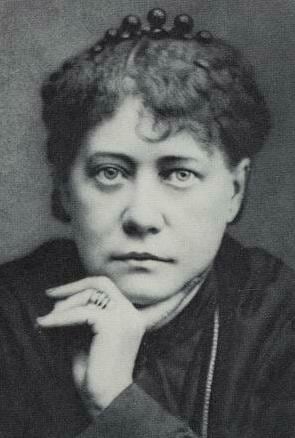
Helena Blavatsky
Concordano su: Siamo liberi o è tutto determinato? · Che cos'è l'Assoluto? Dio esiste? · Chi sono io? Esiste un vero sé?
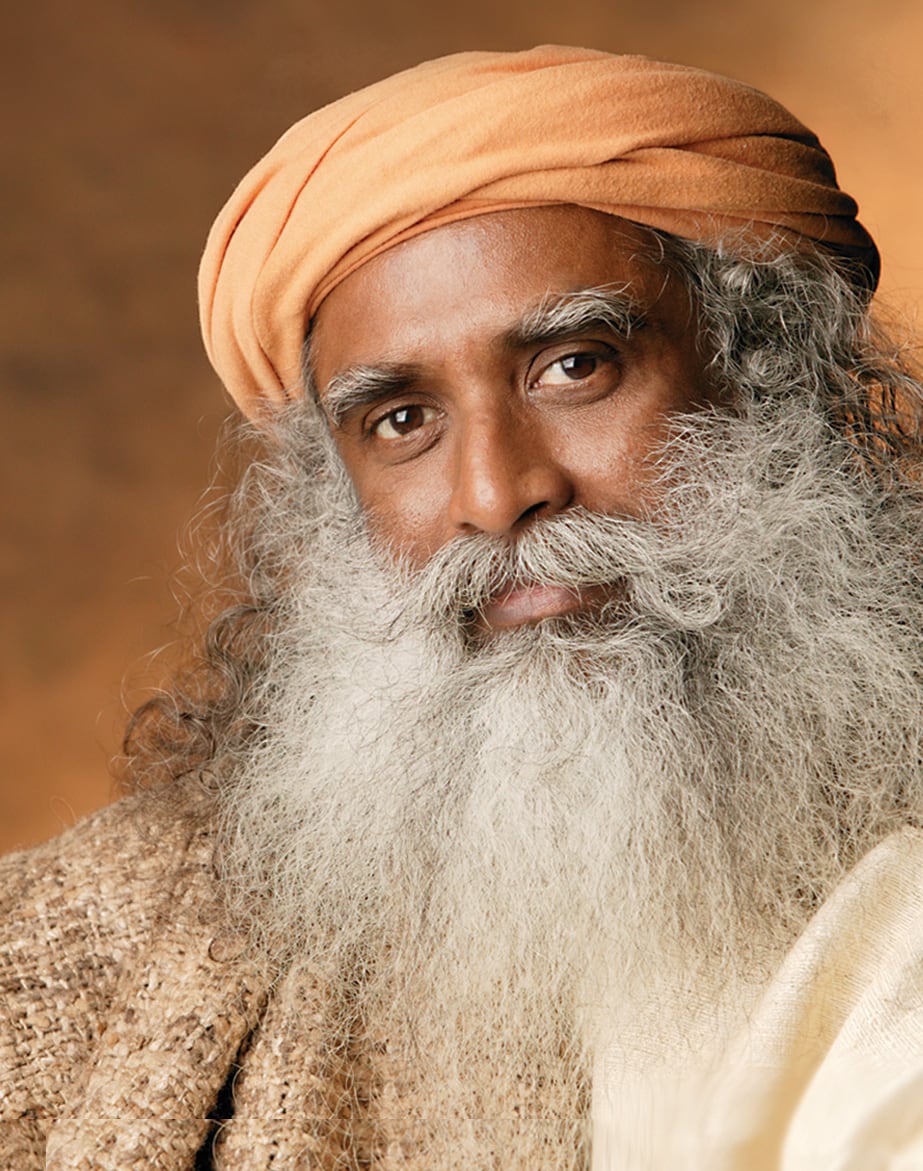
Sadhguru
Concordano su: Come si raggiunge la liberazione o la salvezza? · Che cos'è l'Assoluto? Dio esiste? · Che cosa accade dopo la morte?
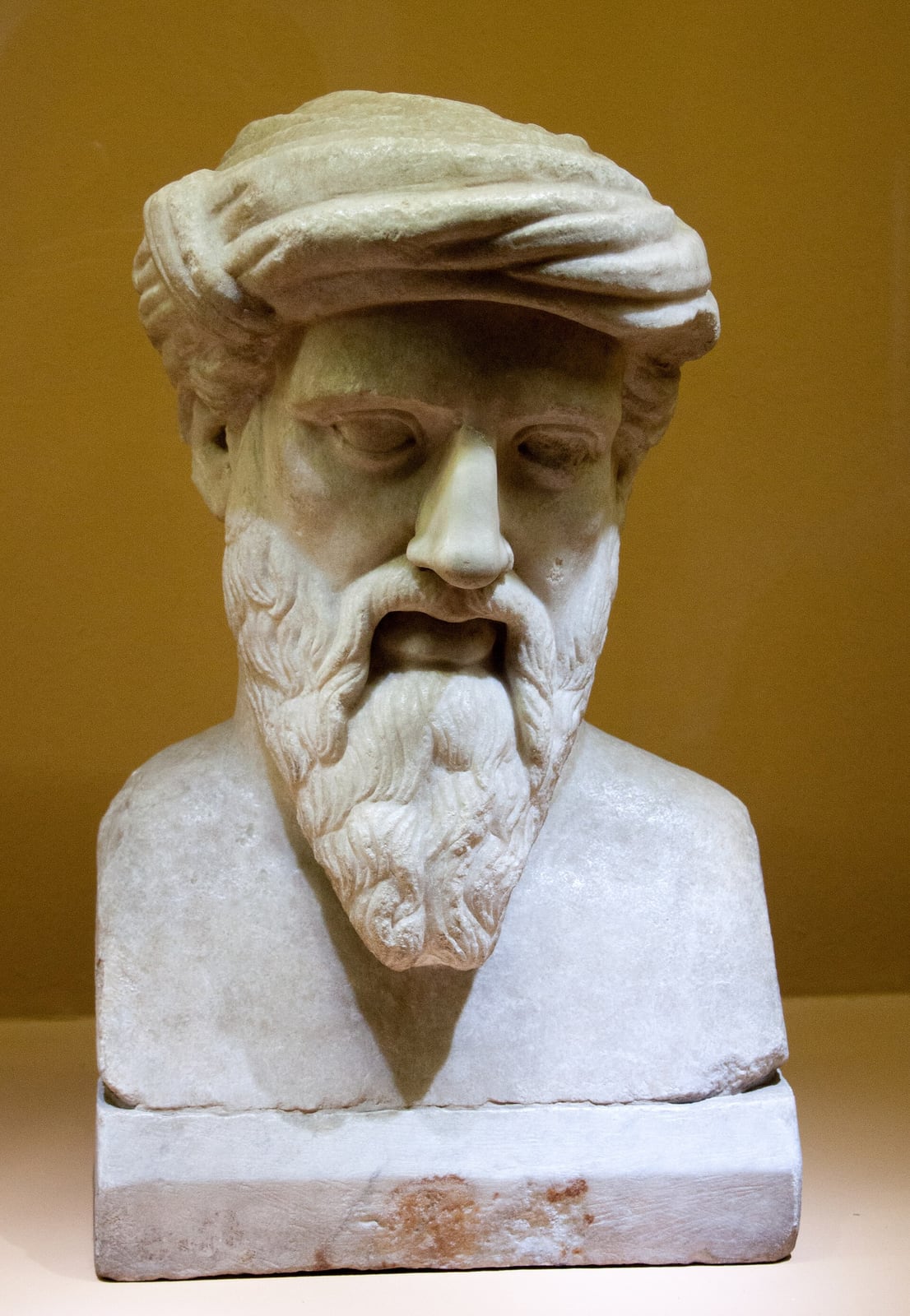
Pythagoras
Concordano su: Che cos'è l'Assoluto? Dio esiste? · Chi sono io? Esiste un vero sé? · Che cosa accade dopo la morte?
Annie Besant
Concordano su: Siamo liberi o è tutto determinato? · Chi sono io? Esiste un vero sé? · Che cosa accade dopo la morte?
La pensa diversamente da
Jiddu Krishnamurti
Si scontrano su: Come si raggiunge la liberazione o la salvezza? · Serve un maestro?

Nikolai Berdyaev
Si scontrano su: Che cosa accade dopo la morte? · Serve un maestro?
Shinran
Si scontrano su: Che cosa accade dopo la morte?
Alan Watts
Si scontrano su: Come si raggiunge la liberazione o la salvezza? · Serve un maestro?
Aneddoti e racconti
Aneddoti e racconti
Contestatoc. 434 a. C. (tradicional)
The bronze sandal of Etna
Origine del racconto: Diogenes Laertius VIII 67–75, with the versions of Heraclides of Pontus, Hippobotus, Diodorus of Ephesus, Timaeus, Neanthes and Demetrius of Troezen. Horace (Ars poetica 463–466) fixed the Etna version. Ava Chitwood (2004) analyses how they derive from the poems.
Fonte: Chitwood, Ava. Death by Philosophy: The Biographical Tradition in the Life and Death of the Archaic Philosophers Empedocles, Heraclitus, and Democritus. University of Michigan Press, Ann Arbor, 2004.
Racconto agiograficos. V a. C. (tradicional)
The breathless woman
Origine del racconto: Diogenes Laertius VIII 60–61 and 67–69 (Heraclides of Pontus, Hermippus). Heraclides' treatise, lost, was a literary work of a medico-philosophical kind, not a clinical record.
Non verificabiles. V a. C. (tradicional)
The wind-stopper
Origine del racconto: Diogenes Laertius VIII 60 (Timaeus); Plutarch, Against Colotes 1126b and On Curiosity 515c. Burnet (Early Greek Philosophy, § 100) considers it deduced from B111.
Tradizione oralec. 470–460 a. C.
The magistrate's banquet
Origine del racconto: Diogenes Laertius VIII 64–66, quoting Timaeus of Tauromenium (4th–3rd century BCE). Burnet (§ 99) considers them genuine local traditions gathered a century and a half later, though confused in their details.
Testimonianzas. V a. C.
The refused crown
Origine del racconto: Diogenes Laertius VIII 63 (Aristotle, probably in the Sophist; Xanthus) and VIII 73 (the attire). It is one of the few reports going back to Aristotle.
Contestatos. V a. C. (tradicional)
The marshes of Selinus
Origine del racconto: Diogenes Laertius VIII 70 (Diodorus of Ephesus). The Selinus coins showing the drainage (Head's Historia Numorum) prove the event, not Empedocles' involvement.
Non verificabiles. V a. C. (tradicional)
Expelled by the Pythagoreans
Origine del racconto: Diogenes Laertius VIII 54–55 (Timaeus, Neanthes). Fragment B129 is quoted by Porphyry (Life of Pythagoras 30) and Iamblichus (On the Pythagorean Life 67) as referring to Pythagoras.
Insegnamenti
Insegnamenti
Le nozioni che articolano il suo pensiero, spiegate nel loro contesto.
The four roots (rhizomata)cuatro-raices
Fragments B6, B8, B12, B17, B21, B23; reception in Aristotle, Metaphysics A 3–4.
Fonte: Kirk, G. S., Raven, J. E. y Schofield, M. The Presocratic Philosophers, 2.ª ed. Cambridge University Press, 1983, cap. X (Empedocles of Acragas). Trad. esp. de Jesús García Fernández, Gredos, 1987.
Love (Philotes) and Strife (Neikos)amor-y-discordia
Fragments B17, B20, B22, B26, B35; Aristotle, Metaphysics A 4, 985a21–b4.
The cosmic cycle and the Sphereciclo-cosmico
Fragments B17, B26–B31, B35; Strasbourg papyrus, ensemble a.
Fonte: Martin, Alain y Primavesi, Oliver. L'Empédocle de Strasbourg (P. Strasb. gr. Inv. 1665–1666): introduction, édition et commentaire. Walter de Gruyter / Bibliothèque Nationale et Universitaire de Strasbourg, Berlín, Nueva York y Estrasburgo, 1999.
The exiled daimon and transmigrationdaimon-y-transmigracion
Fragments B112, B115, B117, B136–B137, B146–B147.
Fonte: Zuntz, Günther. Persephone: Three Essays on Religion and Thought in Magna Graecia. Clarendon Press, Oxford, 1971.
Effluences and pores: perception and thoughtefluvios-y-poros
Fragments B84, B89, B100, B105, B109; Plato, Meno 76c–d; Theophrastus, On the Senses 7–24.
Zoogony: wandering limbs and combinationszoogonia
Fragments B57–B62; Aristotle, Physics II 8, 198b29–32.
Video
Video
Registrazioni, interviste e documentari. I video vengono riprodotti da YouTube; non sono ospitati qui.
Empedocles – Autobiography of a Demon
Conferenza· EN· 2020· 19 min
Jackman Humanities InstituteCanale ufficiale
HoP 011 - All You Need Is Love, and Five Other Things - Empedocles
Conferenza· EN· 2020· 17 min
history of philosophy without any gapsCanale ufficiale
4) The Pluralists and The Sophists
Conferenza· EN· 2016· 74 min
Adam RosenfeldCanale ufficiale
3-5 Empedocles
Conferenza· EN· 2026· 12 min
Nicholaos JonesCanale ufficiale
Aristotle, Metaphysics (Empedocles, love, and final causes) - Introduction to Philosophy
Analisi· EN· 2013· 64 min
Gregory B. Sadler - That Philosophy GuyCanale ufficiale
Empédocles de Agrigento
Documentario· ES· 2018· 27 min
UNEDCanale ufficiale
Conferencia David Hernández Castro "Empédocles"
Conferenza· ES· 2018· 88 min
Hercritia-Cátedra de Hermenéutica CríticaCanale ufficiale
Heráclito, Empédocles y Anaxágoras | Historia de la filosofía (7/61)
Conferenza· ES· 2017· 68 min
Ernesto CastroCanale ufficiale
EMPÉDOCLE – De l'un au multiple - Sur les traces du présocratique (France Culture, 1997)
Documentario· FR· 1997· 85 min
ÉCLAIR BRUT
EMPÉDOCLE d'Agrigente – Un présocratique en terre arabe (France Culture, 2007)
Intervista· FR· 2007· 46 min
ÉCLAIR BRUT
Galleria
Galleria
Immagini con licenza verificata. Ciascuna conserva la sua paternità e la sua attribuzione.
Manoscritti
Manoscritti
Testimoni manoscritti e testi antichi, con il loro custode e le loro condizioni di consultazione.
GRC · Escritura libraria griega sobre papiro · Poema compuesto en el s. V a. C.; copia de finales del s. I d. C.
P. Strasb. gr. Inv. 1665–1666
- Testimone conservato
- Fragmentos de un rollo de papiro (52 según los editores), con restos de unos 74 versos
- Custode
- Bibliothèque nationale et universitaire de Strasbourg · P. Strasb. gr. Inv. 1665–1666
- Digitalizzazione
- commons.wikimedia.org/wiki/File:Empedokles_fragm…
Relazioni
Relazioni
Influenze, discepolati e affinità. Si distingue la relazione documentata dalla somiglianza individuata per analisi.
Ricevette l'influenza di
Theophrastus calls him an "emulator and imitator" of Parmenides (Diogenes Laertius VIII 55); he accepts that nothing comes to be or perishes and writes, like him, in hexameters.
Relazione documentata
Ricevette l'influenza di
Timaeus and Neanthes make him a pupil of the Pythagoreans; Porphyry and Iamblichus refer the praise of B129 to Pythagoras. He shares with Pythagoreanism transmigration and abstinence from meat.
Relazione documentata
Ricevette l'influenza di
Jenófanes
Hermippus, according to Diogenes Laertius (VIII 56), considered him an imitator of Xenophanes, with whom he supposedly lived; the report is isolated.
Somiglianza individuata per analisi
Contemporaneo di
Anaxágoras
Aristotle (Metaphysics A 3, 984a11) says Anaxagoras was older than Empedocles but later in his works; both explain change as mixture.
Relazione documentata
Contemporaneo di
Zenón de Elea
Alcidamas, according to Diogenes Laertius (VIII 56), made them fellow pupils of Parmenides.
Somiglianza individuata per analisi
Maestro di
Gorgias de Leontinos
Satyrus, probably following Alcidamas, makes him Empedocles' pupil (Diogenes Laertius VIII 58); Plato ascribes to Gorgias the Empedoclean theory of effluences (Meno 76c).
Relazione documentata
Maestro di
Pausanias de Gela
Physician, pupil and beloved of Empedocles, addressee of On Nature (B1).
Relazione documentata
Influenzò
He alludes to the "Sicilian muses" (Sophist 242d–243a), ascribes his theory of effluences to Gorgias (Meno 76c) and adopts the four elements in the Timaeus.
Relazione documentata
Influenzò
He adopts the four roots as elements, calls him the inventor of rhetoric and discusses his zoogony (Physics II 8) and his causes (Metaphysics A 4).
Relazione documentata
Influenzò
Lucrecio
In De rerum natura (I 716–733) he praises him as Sicily's most admirable man and takes from him the model of the physical poem.
Relazione documentata
Idee affini a
The alternation of Love and Strife extends, in another key, the Heraclitean tension between harmony and war.
Somiglianza individuata per analisi
Idee affini a
Approximate contemporaries: the doctrine of transmigration through all living forms and the refusal to kill animals bring the Purifications close to Jain ethics, without known historical contact.
Somiglianza individuata per analisi
Influenzò
Sigmund Freud
In Analysis Terminable and Interminable (1937) he recognises in Empedocles' Love and Strife a precedent of his theory of Eros and the death drive.
Relazione documentata
Fonti
Fonti
Bibliografia e cataloghi consultati per questa scheda.
- Open Library (Internet Archive): ediciones de los fragmentos de Empédocles verificadas por ISBN.
- Wikidata, entidad Q83375 «Empedocles» (107 enlaces entre wikis; P31=Q5). Registra varios años de nacimiento (494, 492, 490 a. C.) y de muerte (444, 434, 432, 430 a. C.), Acragante como lugar de nacimiento y el Etna o el Peloponeso como lugar de muerte.
- Diógenes Laercio. Vidas y opiniones de los filósofos ilustres VIII 51–77 (Empédocles), s. III d. C. Trad. inglesa de C. D. Yonge, Bohn, Londres, 1853 (Project Gutenberg n.º 57342); trad. inglesa de R. D. Hicks, Loeb, 1925 (Wikisource).
- Diels, Hermann y Kranz, Walther. Die Fragmente der Vorsokratiker, 6.ª ed. Weidmann, Berlín, 1951–1952, cap. 31 (Empedokles), A (testimonios) y B 1–154.
- Kirk, G. S., Raven, J. E. y Schofield, M. The Presocratic Philosophers, 2.ª ed. Cambridge University Press, 1983, cap. X (Empedocles of Acragas). Trad. esp. de Jesús García Fernández, Gredos, 1987.
- Kingsley, K. Scarlett y Parry, Richard. «Empedocles». The Stanford Encyclopedia of Philosophy, ed. Edward N. Zalta y Uri Nodelman; primera publicación el 26 de septiembre de 2019, revisión sustancial del 25 de septiembre de 2024.
- Burnet, John. Early Greek Philosophy, 2.ª ed. A. and C. Black, Londres, 1908, cap. V (Empedokles of Akragas), §§ 98–105 y traducción de los fragmentos (Project Gutenberg n.º 67097).
- Martin, Alain y Primavesi, Oliver. L'Empédocle de Strasbourg (P. Strasb. gr. Inv. 1665–1666): introduction, édition et commentaire. Walter de Gruyter / Bibliothèque Nationale et Universitaire de Strasbourg, Berlín, Nueva York y Estrasburgo, 1999.
- Laks, André y Most, Glenn W. (eds. y trads.). Early Greek Philosophy, vol. V: Western Greek Thinkers, Part 2. Loeb Classical Library 528, Harvard University Press, 2016.
- Inwood, Brad. The Poem of Empedocles: A Text and Translation with an Introduction, ed. revisada. University of Toronto Press, Toronto, 2001 (1.ª ed. 1992).
- Wright, M. R. Empedocles: The Extant Fragments. Yale University Press, New Haven, 1981 (reed. Bristol Classical Press, 1995).
- Chitwood, Ava. Death by Philosophy: The Biographical Tradition in the Life and Death of the Archaic Philosophers Empedocles, Heraclitus, and Democritus. University of Michigan Press, Ann Arbor, 2004.
- Aristóteles. Metafísica A 3, 984a8–11, y A 4, 985a21–b4; Poética 1, 1447b17–20; Física II 8, 198b29–32; Sobre el alma I 2, 404b11–15; fragmentos del Sofista y de Sobre los poetas citados por Diógenes Laercio VIII 57 y 63. Trad. inglesa de W. D. Ross y otros (Internet Classics Archive, MIT).
- Kingsley, Peter. Ancient Philosophy, Mystery, and Magic: Empedocles and Pythagorean Tradition. Clarendon Press, Oxford, 1995.
- Zuntz, Günther. Persephone: Three Essays on Religion and Thought in Magna Graecia. Clarendon Press, Oxford, 1971.
- Lucrecio. De rerum natura I 716–733 (elogio de Empédocles), s. I a. C.
- Horacio. Arte poética 463–466 («deus immortalis haberi / dum cupit Empedocles, ardentem frigidus Aetnam / insiluit»).
- Hölderlin, Friedrich. Der Tod des Empedokles (tres versiones, 1797–1800); Arnold, Matthew, Empedocles on Etna, and Other Poems, B. Fellowes, Londres, 1852 (Internet Archive).
- Leonard, William Ellery (trad.). The Fragments of Empedocles, Translated into English Verse. Open Court, Chicago, 1908 (Internet Archive).
- Fairbanks, Arthur (ed. y trad.). The First Philosophers of Greece. Kegan Paul, Trench, Trübner, Londres, 1898, cap. X (Empedokles), texto griego según la edición de H. Stein (1852) (Project Gutenberg n.º 78670).
- «Empedocles», Wikipedia en inglés, y «Empédocles», Wikipedia en español (consultadas para contrastar datos y bibliografía; texto propio).
- De Smet, Daniel. Empedocles Arabus. Une lecture néoplatonicienne tardive. Paleis der Academiën (Koninklijke Academie voor Wetenschappen, Letteren en Schone Kunsten van België), Bruselas, 1998.
- Eggers Lan, Conrado (dir.), Cordero, Néstor Luis, Olivieri, Francisco J., La Croce, Ernesto y Santa Cruz, María Isabel. Los filósofos presocráticos II. Biblioteca Clásica Gredos 24, Gredos, Madrid, 1979 (Empédocles, trad. de Ernesto La Croce).
- Bollack, Jean. Empédocle, 3 vols. (4 tomos). Éditions de Minuit, París, 1965–1969; reed. Gallimard (Tel), 1992.
- Platón. Menón 76c–d (efluvios y poros); Sofista 242d–243a (las «musas sicilianas»). Trad. inglesa de Benjamin Jowett, 1892 (Project Gutenberg n.º 1643, Meno).
- Galeno. De methodo medendi I 1 (X 5–6 Kühn): la escuela médica itálica de Filistión, Empédocles y Pausanias.
- Primavesi, Oliver. Empedokles Physika I: eine Rekonstruktion des zentralen Gedankengangs. Archiv für Papyrusforschung, Beiheft 22, Walter de Gruyter, Berlín, 2008.
- Osborne, Catherine. «Empedocles Recycled». The Classical Quarterly, 37 (1987), pp. 24–50; y Trépanier, Simon, Empedocles: An Interpretation, Routledge, Nueva York, 2004.
- Freud, Sigmund. «Die endliche und die unendliche Analyse». Internationale Zeitschrift für Psychoanalyse, 23 (1937), sección VI (Empédocles, el Amor y la Discordia).
- Titolare dei diritti
- Textos antiguos en dominio público; cada traducción y edición crítica pertenece a su traductor o editorial
In attesa di conferma
Ciò che questa scheda non ha ancora potuto chiarire. Preferiamo dirlo piuttosto che riempirlo.
- Fechas: se adopta c. 494–434 a. C. (muerte a los sesenta años según Aristóteles y actividad posterior al 472, Burnet); Apolodoro situaba la madurez en 444–443 y Wikidata registra varios años alternativos.
- Ediciones españolas específicas de Empédocles (aparte de Gredos, Kirk-Raven-Schofield y Bernabé): no verificadas en catálogo en esta sesión (la API de Google Books agotó su cuota).
- «La esfera» pseudoempedoclea: verificar la edición de 1898 (probablemente E. Maass, Commentariorum in Aratum reliquiae) antes de citarla con detalle.
- Papiro de Estrasburgo: comprobar si la BNU de Estrasburgo ofrece digitalización completa y sus condiciones; fecha exacta de adquisición (1904 o 1905).
- Texto griego de las citas tomado de Fairbanks (edición de Stein, 1852); cotejar con Diels-Kranz (diferencias menores señaladas en B6 y B117).
- Vídeos: diez verificados; faltan clases universitarias en español dedicadas monográficamente al papiro de Estrasburgo.
- Programas de afiliación: ninguno verificado. Lista vacía.
- Año de los vídeos: el de la grabación cuando la descripción lo indica y, si no, el de publicación en YouTube.
Ricerca effettuata il 2026-10-25