Cristianesimo · Mistica cristiana · Cattolicesimo
Julian of Norwich
ca. 1342 – ca. 1416Persona storicamente documentata
Anacoreta e scrittrice inglese (1342 circa – dopo il 1416). Nel maggio del 1373, gravemente malata, ricevette sedici visioni della passione di Cristo e dell'amore di Dio, che narrò in due versioni: un Testo breve e, dopo decenni di meditazione, un Testo lungo, le Rivelazioni dell'amore divino, il più antico libro scritto in inglese da una donna che ci sia pervenuto. Visse murata accanto alla chiesa di San Giuliano a Norwich. La sua teologia della fiducia — «tutto sarà bene» —, di un Dio senza ira e della maternità di Cristo ne ha fatto un'autrice classica.
- opere
- 3opere
- edizioni
- 14edizioni
- citazioni
- 8citazioni
- video
- 13video
- immagini
- 5immagini
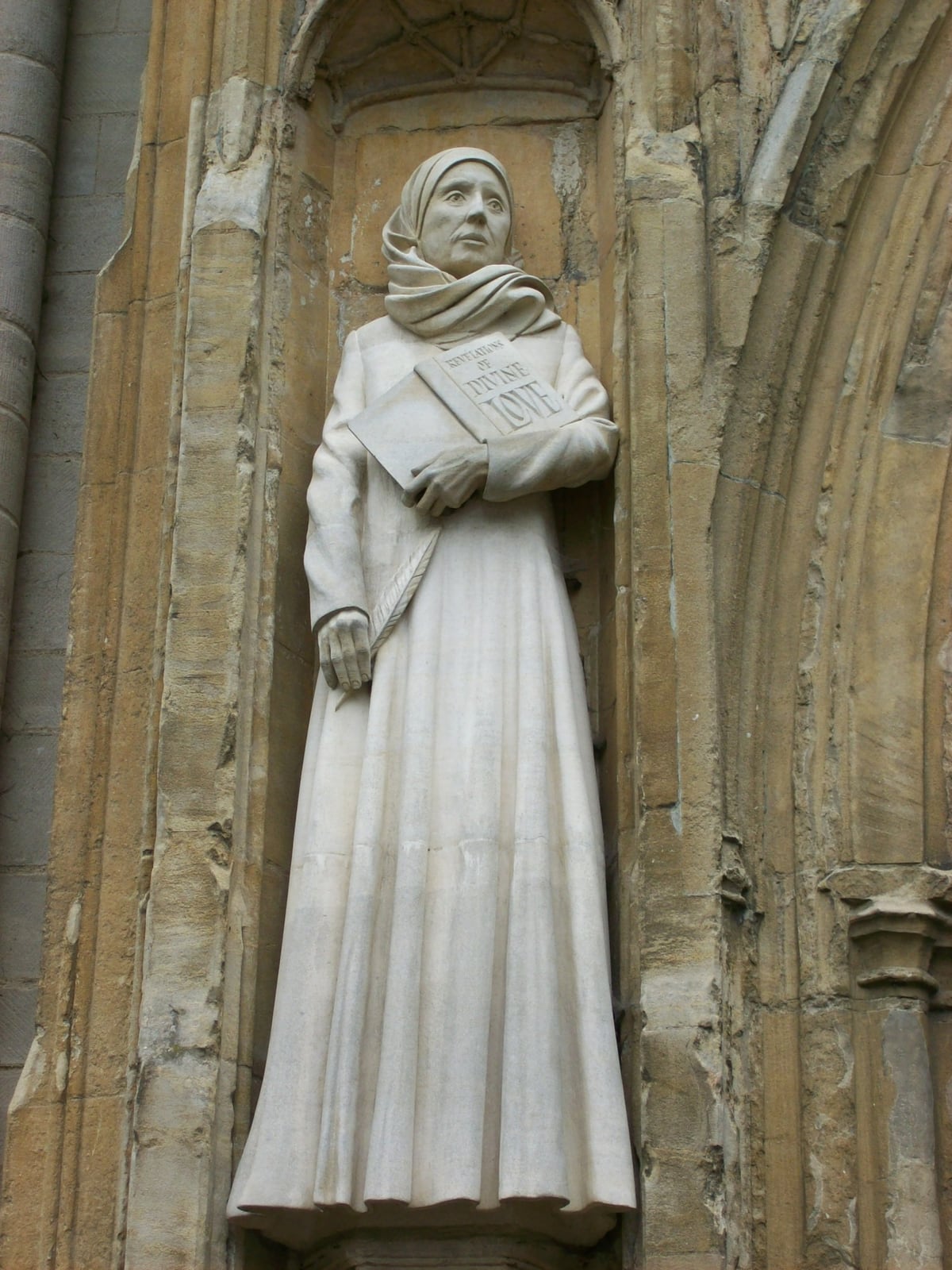
Estatua de Juliana en la fachada oeste de la catedral de Norwich (David Holgate) · CC0
Con le sue parole
«It behoved that there should be sin; but all shall be well, and all shall be well, and all manner of thing shall be well.»Texto largo según la versión modernizada del Sloane 2499 de Grace Warrack (1901), cap. 27 (decimotercera mostración)
Per cominciare, un'opera
The Short Text: A Vision Showed to a Devout WomanLa sua idea centrale
'All shall be well': behovely sin: In the thirteenth showing Julian asks why God in his wisdom did not prevent sin, which, she thinks, would have left everything well.
Vederlo nel contesto
Biografia
5 min di lettura
Traduzione assistita dall'originale spagnolo, in attesa di revisione da parte di un traduttore madrelingua.
Una donna senza nome proprio
Dell'autrice del più antico libro scritto in inglese da una donna che ci sia pervenuto non conosciamo il nome di battesimo, né quello dei genitori, né il luogo esatto di nascita. La chiamiamo Giuliana perché così la designano i testamenti e i copisti, e perché visse murata accanto alla chiesa di San Giuliano di Conisford, a Norwich; è possibile che abbia preso il nome dal santo titolare, come fecero altri reclusi. Ciò che sappiamo con certezza lo racconta lei stessa: nel maggio del 1373, quando aveva «trenta inverni e mezzo», ricevette una serie di visioni durante una malattia che la portò sull'orlo della morte. Se ne deduce che nacque verso la fine del 1342.
Norwich era allora una delle città più popolose d'Inghilterra, un centro del commercio della lana con decine di chiese parrocchiali, conventi dei quattro ordini mendicanti e un priorato benedettino cattedrale. La giovinezza di Giuliana coincise con la peste nera, che colpì la città nel 1349 e tornò nei decenni successivi, con la guerra dei Cent'anni e, nel 1381, con la rivolta dei contadini, repressa duramente nel Norfolk dal vescovo Henry Despenser. Nulla di tutto questo compare in modo esplicito nel suo libro, ma molti lettori hanno udito nella sua insistenza sul fatto che «tutto sarà bene» la risposta a un mondo ferito.
I tre doni e la malattia
Giuliana racconta che da giovane aveva chiesto a Dio tre grazie: un ricordo vivo della passione di Cristo, come se fosse stata ai piedi della croce con Maria Maddalena; una grave malattia del corpo a trent'anni; e tre «ferite»: la vera contrizione, la compassione e il desiderio di Dio. Le prime due richieste le dimenticò; la terza la conservò sempre. A trent'anni e mezzo si ammalò. Per tre giorni e tre notti il suo stato peggiorò, ricevette gli ultimi sacramenti e la madre, tra gli altri, la vegliava. Il parroco le mise davanti un crocifisso e le disse di guardare l'immagine del suo Creatore e Salvatore e di trarne conforto. La vista le si oscurò, tranne che intorno alla croce.
Sedici mostrazioni
Allora, l'8 o il 13 maggio 1373 — i manoscritti divergono —, vide sanguinare la corona di spine, e con questa visione cominciò una serie di sedici «mostrazioni» (shewings): quindici tra le quattro del mattino e metà pomeriggio, e l'ultima la notte seguente. Esse uniscono immagini della passione di un realismo fisico straordinario — il sangue che cade come le gocce di pioggia da una gronda, il volto che si secca e cambia colore —, parole interiori e «visioni spirituali» senza immagine. In una di esse vede nel palmo della mano una cosa grande quanto una nocciola: «è tutto ciò che è stato fatto», e dura perché Dio lo ama. Ormai migliorata, disse a un religioso di aver «delirato», e si pentì subito di aver negato ciò che aveva visto; quella notte subì l'assalto di una visione diabolica e ricevette l'ultima mostrazione, che confermava le precedenti.
Due libri
Poco dopo scrisse un primo racconto, oggi noto come Testo breve, in cui narra le visioni e il loro senso più immediato. Per decenni continuò a meditarle. Racconta che «quindici anni dopo e più» ricevette la risposta alla sua domanda sul senso di tutto: «L'amore era la sua intenzione». Vent'anni dopo le visioni, meno tre mesi, comprese l'esempio del signore e del servo, una parabola che aveva omesso nel primo racconto. Il risultato è il Testo lungo, ottantasei capitoli che trasformano l'esperienza in teologia: il peccato, che è «conveniente» e tuttavia non ha sostanza; un Dio in cui non vede ira; la maternità di Cristo; la preghiera che «unisce l'anima a Dio». Nicholas Watson ha proposto di posticipare la stesura del Testo breve agli anni Ottanta del Trecento e di prolungare quella del lungo fin dentro il XV secolo.
L'anacoreta di San Giuliano
Non sappiamo quando si rinchiuse nella cella addossata alla chiesa di San Giuliano, che dipendeva dal priorato delle monache benedettine di Carrow. La prima menzione documentaria è del 1394: il testamento di Roger Reed, rettore di San Michele di Coslany, le lascia due scellini. Seguono altri lasciti nel 1404, nel 1415 e nel 1416, l'ultimo di Isabel Ufford, contessa di Suffolk. Un'anacoreta viveva per tutta la vita in uno o due vani, con una finestra verso la chiesa per seguire la messa e un'altra verso la strada per consigliare chi vi si recava, mentre una o due serve provvedevano al suo sostentamento. Si è ipotizzato che prima fosse stata monaca a Carrow, oppure vedova e madre, vista la precisione con cui parla dell'allevamento dei figli; sono entrambe congetture.
Margery Kempe alla finestra
Verso il 1413 la visitò Margery Kempe, l'irrequieta mistica di King's Lynn, per domandarle se le sue lacrime e le sue rivelazioni venissero da Dio. Il Libro di Margery Kempe, dettato una ventina d'anni più tardi, ricorda che «donna Giuliana» la ascoltò per diversi giorni e le consigliò di obbedire a Dio, di confidare nella sua bontà e di non inquietarsi per l'incredulità altrui, perché chi dubita sempre è simile all'onda del mare. È l'unico ritratto di Giuliana fatto da qualcuno che la conobbe. In quello stesso 1413, secondo la rubrica del manoscritto del Testo breve, la sua autrice era ancora viva; la sua morte, posteriore al 1416, non ha lasciato traccia documentaria.
Una trasmissione fragile
Il Testo breve sopravvive in un unico manoscritto copiato alla metà del XV secolo, il cosiddetto manoscritto Amherst (British Library, Add. MS 37790). Il lungo è giunto fino a noi grazie alle benedettine inglesi esuli a Cambrai e a Parigi nel XVII secolo, che lo copiarono e lo custodirono: da quell'ambiente provengono il manoscritto di Parigi (Bibliothèque nationale de France, Fonds anglais 40) e gli Sloane 2499 e 3705 della British Library. Il benedettino Serenus Cressy lo diede alle stampe nel 1670. L'edizione di Grace Warrack del 1901 lo restituì ai lettori, e l'edizione critica di Edmund Colledge e James Walsh (1978) fissò il testo di entrambe le versioni.
La teologa della fiducia
Il Novecento ne fece un'autrice classica. T. S. Eliot chiuse «Little Gidding», l'ultimo dei suoi Quattro quartetti, con le sue parole sul peccato «conveniente» e sul fatto che tutto sarà bene; la Chiesa d'Inghilterra la commemora l'8 maggio e Benedetto XVI le dedicò un'udienza generale nel 2010. La chiesa di San Giuliano, distrutta dai bombardamenti tedeschi del 1942, fu ricostruita con una cella che oggi accoglie i pellegrini. Al di là delle etichette che le sono state attribuite — femminista, universalista, ecologica — resta una voce che si presentò come «creatura semplice e illetterata» e scrisse con una precisione teologica rara nel suo secolo, tenendo insieme l'insegnamento della Chiesa e una visione di Dio in cui non trovò collera.
Fonti: Colledge, Edmund, y James Walsh (eds.). A Book of Showings to the Anchoress Julian of Norwich. 2 vols. Studies and Texts 35. Toronto: Pontifical Institute of Mediaeval Studies, 1978. · Watson, Nicholas, y Jacqueline Jenkins (eds.). The Writings of Julian of Norwich: A Vision Showed to a Devout Woman and A Revelation of Love. University Park: Pennsylvania State University Press / Turnhout: Brepols, 2006. · Warrack, Grace (ed.). Revelations of Divine Love Recorded by Julian, Anchoress at Norwich, Anno Domini 1373. Londres: Methuen, 1901 (Project Gutenberg n.º 52958). · Windeatt, Barry (trad. e intr.). Julian of Norwich: Revelations of Divine Love. Oxford World's Classics. Oxford: Oxford University Press, 2015. · The Book of Margery Kempe. Ed. Sanford Brown Meech y Hope Emily Allen. Early English Text Society, o.s. 212. Londres: Oxford University Press, 1940, cap. 18.
Cronologia
La vita, anno per anno
Ogni punto è un evento documentato. Fai clic per leggerlo, con la sua fonte e il suo grado di certezza.
ca. 13420 anniProbablemente Norwich o Norfolk
Birth
Date inferred from her own statement that she was 'thirty winters and a half' old in May 1373 (Long Text, ch. 3). Her baptismal name and family are unknown.
ProbabileColledge, Edmund, y James Walsh (eds.). A Book of Showings to the Anchoress Julian of Norwich. 2 vols. Studies and Texts 35. Toronto: Pontifical Institute of Mediaeval Studies, 1978.
Dopo la sua morte
- ca. 1450The Amherst manuscript is copied
- 1670First printed edition
- 1901Grace Warrack's edition
- giugno 1942St Julian's church destroyed
- 1978Critical edition
- 1 dicembre 2010Benedict XVI's audience
ca. 1342 · 0 anni
Birth
Date inferred from her own statement that she was 'thirty winters and a half' old in May 1373 (Long Text, ch. 3). Her baptismal name and family are unknown.
Probabile
1349 · 7 anni
The Black Death in Norwich
The epidemic decimates the city; new waves in 1361–1362 and 1369. The context of her childhood.
Documentato
maggio 1373 · 30 anni
The sixteen showings
Gravely ill, she receives fifteen visions between early morning and afternoon and the sixteenth the following night. The manuscripts give 8 or 13 May.
Documentato
ca. 1380 – 1388 · 38 anni
The Short Text
Writing of the first account of the visions; the traditional date (soon after 1373) was challenged by Nicholas Watson, who places it in the 1380s.
Discusso
ca. 1388 · 45 anni
'Love was his meaning'
'Fifteen years after and more' she receives the understanding that closes the book: love is the meaning of all the showings (Long Text, ch. 86).
Documentato
ca. 1393 · 50 anni
The example of the lord and the servant
'Twenty years after the time of the showing, save three months' she understands the parable of the lord and the servant (Long Text, ch. 51), the core of the Long Text.
Documentato
marzo 1394 · 51 anni
First mention as an anchoress
The will of Roger Reed, rector of St Michael Coslany, leaves two shillings to 'Julian anakorite'.
Documentato
1404 · 61 anni
Bequest of Thomas Emund
A chantry priest of Aylsham leaves a bequest to the anchoress of St Julian's and to her servant Sara.
Documentato
ca. 1413 · 70 anni
Margery Kempe's visit
Margery Kempe consults her over several days about her experiences (Book of Margery Kempe, ch. 18). The rubric of the Amherst manuscript states she was alive in 1413.
Documentato
1416 · 73 anni
Last mention: the will of Isabel Ufford
The Countess of Suffolk leaves twenty shillings to 'Julian recluse a Norwich'. It is the last document mentioning her alive; the date of her death is unknown.
Documentato
ca. 1450
The Amherst manuscript is copied
A scribe copies the Short Text into an anthology of contemplative texts (British Library, Add. MS 37790), the only witness to that version.
Probabile
1670
First printed edition
The Benedictine Serenus Cressy publishes XVI Revelations of Divine Love from a Long Text manuscript related to the Paris one.
Documentato
1901
Grace Warrack's edition
Methuen publishes Grace Warrack's modernised version of Sloane 2499, which popularises the work.
Documentato
giugno 1942
St Julian's church destroyed
German bombing destroys the church; it is rebuilt in 1953 with a chapel on the site of the cell.
Documentato
1978
Critical edition
Edmund Colledge and James Walsh publish the critical edition of both versions (Pontifical Institute of Mediaeval Studies).
Documentato
1 dicembre 2010
Benedict XVI's audience
Benedict XVI devotes his general audience catechesis to Julian.
Documentato
Opere
Opere essenziali
Le opere senza le quali non si comprende la sua eredità.
Manoscritto · ca. 1385
The Short Text: A Vision Showed to a Devout Woman
A Vision Showed to a Devout Woman
The first version of the account of the visions of May 1373, in twenty-five chapters. It narrates the three gifts requested, the illness, the crucifix and the sixteen showings in a more personal and immediate tone than the long version: Julian presents herself as a woman and apologises for teaching ('Should I believe, because I am a woman, that I ought not to tell you of the goodness of God?'). It does not yet contain the example of the lord and the servant or the theology of Christ's motherhood. It is the earliest surviving English text known to be by a woman.
5 edizioni

Manoscritto · ca. 1393
The Long Text: Revelations of Divine Love
A Revelation of Love (Revelations of Divine Love)
A reworking of the same visions in eighty-six chapters, the fruit of twenty years or more of meditation. Besides expanding each showing, it adds theological chapters: the example of the lord and the servant (ch. 51), in which Adam and Christ are both the servant who falls in serving; the teaching that there is no wrath in God and that sin is 'behovely' but has no substance; the 'substance' and 'sensuality' of the soul; and the motherhood of Christ and of the Trinity (chs. 58–63). It closes with the answer received 'fifteen years after and more': 'Love was his meaning'. It is the major work of medieval English mysticism.
9 edizioni
Citazioni
Citazioni localizzate in un'opera precisa. Ciascuna porta con sé la sua provenienza e il suo grado di affidabilità.
It behoved that there should be sin; but all shall be well, and all shall be well, and all manner of thing shall be well.VerificataTexto largo según la versión modernizada del Sloane 2499 de Grace Warrack (1901), cap. 27 (decimotercera mostración)
Citazioni apocrife o di attribuzione discussa (1)
«Be a gardener. Dig a ditch, toil and sweat, and turn the earth upside down…»
It circulates online and on devotional cards as a quotation from Julian. It does not appear in that form in either version: it is a free reworking of the image of the servant labouring as a gardener in the example of the lord and the servant (Long Text, ch. 51).
Ultime parole
Non esistono testimonianze verificabili delle sue ultime parole.
Neither the date nor the circumstances of her death are known. The last document mentioning her alive is the will of Isabel Ufford, Countess of Suffolk (1416); no source transmits final words.
Fonte: Tanner, Norman P. The Church in Late Medieval Norwich, 1370–1532. Studies and Texts 66. Toronto: Pontifical Institute of Mediaeval Studies, 1984 (testamentos de Norwich con legados a anacoretas).
Chiedi
Ciò a cui risponde la sua opera
Dodici grandi domande dell'umanità e ciò che i suoi testi permettono di rispondere, con riferimenti. Non gli mettiamo mai parole in bocca.
Che cos'è l'Assoluto? Dio esiste?
God is Trinitarian love, Father and also Mother
Un Dio personaleLo dice espressamente
Julian of Norwich does not argue for God's existence: she describes what was «shown» to her in sixteen revelations during an illness in 1373. In them God is Trinity and is love: in the final chapter of the Long Text she sums up that the meaning of everything shown was love. This God is courteous, homely, rejoices in creatures and holds them in being, like the hazelnut that lasts because God loves it. Her most original contribution is to call God Mother with the same truth with which he is called Father, and to ascribe that motherhood especially to Christ, the second Person. The Absolute is for her a Thou who loves without wrath, whose love precedes creation and never lessens.
Confronta questa domanda con altri maestriChi sono io? Esiste un vero sé?
Our substance is in God; our sensuality awaits union with it
Un'anima creata e immortaleLo dice espressamente
Julian of Norwich distinguishes in the human being the «substance», the highest part, which was never separated from God, and the «sensuality», the embodied, temporal life where sin and pain occur. In chapter 54 of the Long Text she states that she saw no difference between God and our substance, as if it were all God, and yet understood that our substance is a creature in God. In the parable of the lord and the servant (ch. 51), the soul's fall arises not from malice but from haste to serve. The true self is a created soul, loved forever and kept in God, which is reconciled with itself when substance and sensuality are united through Christ.
Confronta questa domanda con altri maestriPerché soffriamo?
Sin was behovely, but all shall be well
La separazione da DioLo dice espressamente
Julian of Norwich asked why, if God is love, he did not prevent sin, which is the cause of all pain. The answer shown to her is one of the most famous sentences of English mysticism: sin was behovely, but all shall be well, and all manner of thing shall be well. She did not see sin, because she believes it has no substance, and knew it only by the pain it causes. In the parable of the lord and the servant, the fall appears as the stumbling of a servant running to do his lord's will. Suffering arises from separation, but God does not look on it with wrath, and every pain will be turned to honour.
Confronta questa domanda con altri maestriChe cosa accade dopo la morte?
A great deed at the end will make all things well
Vita eterna e resurrezioneLo dice espressamente
Julian of Norwich's revelations were born at the edge of death: she was thirty and a half, received the last rites, and the priest held a crucifix before her, before which the visions began. Her hope is the Church's: eternal life in God, joy and bliss. But she adds something of her own: in chapter 32 she is shown that there is a great deed that the Trinity will do on the last day, hidden from every creature, by which all shall be well. Julian acknowledges the tension with the Church's teaching on damnation and does not resolve it: she holds it in faith and in the promise that what is impossible for her is not so for God.
Confronta questa domanda con altri maestriCome si raggiunge la liberazione o la salvezza?
God is the ground of our beseeching
Attraverso la grazia e l'amoreLo dice espressamente
Julian of Norwich sees salvation as the work of God's love that precedes everything: in chapter 41 of the Long Text she is shown that God is the ground of our beseeching, that it is he who makes us desire and ask for what he wishes to give us. The human role is real but humble: to pray, to trust, not to despair of one's own sin, and to remain in the faith of the Church. In chapter 68 she receives the promise that the soul will not be overcome, though it be tossed and afflicted. Liberation consists in Christ, our Mother, restoring us to the union of substance and sensuality, and keeping us in a love that never withdraws.
Confronta questa domanda con altri maestriServe un maestro?
What was shown is received within the Church's common faith
Comunità e tradizioneSi deduce dalla sua dottrina
Julian of Norwich does not raise the question of the spiritual teacher; she received her revelations directly and spent some twenty years meditating on them. But she refuses to make them a separate authority. In chapter 9 of the Long Text she declares that she is not good because of the visions, but only if she loves God more, and that what she saw she believes according to the teaching of Holy Church. In chapter 80 she sums up the three things by which a human being stands in this life: the use of natural reason, the common teaching of the Church and the inward working of the Holy Spirit. Her text, moreover, is addressed to all her «fellow Christians», not to disciples.
Confronta questa domanda con altri maestriIl mondo è reale?
All creation fits in a hazelnut and lasts because God loves it
Una creazione buona e realeLo dice espressamente
Julian of Norwich's best-known image answers this question. In the first revelation, God shows her in the palm of her hand a little thing, the size of a hazelnut, round as a ball, and she is told that it is all that is made. Julian marvels that it can last, for it seems that, in its littleness, it might suddenly fall into nothing; and she is answered that it lasts and ever shall because God loves it. In that vision she understands three things: that God made it, that God loves it and that God keeps it. The world is real, fragile and small before its Creator, and good because it is loved.
Confronta questa domanda con altri maestriChe cos'è l'amore?
Love was the meaning of everything shown
Amore di Dio e del prossimoLo dice espressamente
Julian of Norwich's Long Text ends with the answer to the question she had asked herself for fifteen years: what the Lord's meaning was in what he showed her. She was answered that it was love: who showed it to her, love; what he showed her, love; why he showed it, for love. Julian adds that she saw with certainty that God loved us before he made us and that this love has never diminished nor ever shall. Love is God's essence, and from it proceeds the love creatures have for one another: her text is addressed to all her fellow Christians, because what was shown was for all, and in loving them she sees the concrete form of loving God.
Confronta questa domanda con altri maestriSiamo liberi o è tutto determinato?
God does all that is done; the how remains a secret
Non si è pronunciato
Julian of Norwich does not treat human freedom as a problem. What is shown to her points elsewhere: in the third revelation she sees God in a point and understands that he is in all things and does all that is done; nothing happens by chance, but by God's foreseeing wisdom. That raises for her the question of sin, which is no deed, and she resolves it by trusting that all that is done is well done. She neither denies human responsibility —she speaks of repentance, prayer and the fall— nor theorises about predestination: she leaves the how in God's secret, who in his time will make all things well.
Confronta questa domanda con altri maestriPerché meditare o pregare?
Prayer unites the soul to God, who is its ground
Amicizia con DioLo dice espressamente
Julian of Norwich devotes several chapters of the Long Text to prayer. There she is told that God is the ground of beseeching: it is he who makes us desire what he wants to give, and so prayer is never in vain, even when it seems dry or fruitless. Prayer unites the soul to God: although the soul is always like God in nature, it is often unlike him through sin, and prayer makes it like him in will. She distinguishes beseeching, which asks, from contemplation, in which the soul can no longer ask but only behold and give thanks. The tone is one of homely trust: God is courteous and wants to be spoken to with the simplicity of a child with its mother.
Confronta questa domanda con altri maestriPuò la ragione conoscere l'ultimo?
Natural reason, the Church's teaching and the Spirit's work
Fede e ragione si aiutanoLo dice espressamente
Julian of Norwich presents herself as an «unlettered creature», but her work shows great theological intelligence, and she gives reason an explicit place. In chapter 80 of the Long Text she lists the three things by which the human being stands in this life and by which God is honoured: the use of natural reason, the common teaching of Holy Church and the inward gracious working of the Holy Spirit, and adds that all three come from one God. The revelations do not replace reason: Julian spent twenty years meditating on them in order to understand them, and the Long Text is the fruit of that reflection. Reason helps; faith and grace complete.
Confronta questa domanda con altri maestriRitirarsi dal mondo o trasformarlo?
An anchoress who writes for all her fellow Christians
Ritirarsi per trovareSi deduce dalla sua dottrina
Julian of Norwich lived as an anchoress, enclosed in a cell attached to the church of Saint Julian in Norwich, from which she probably takes her name; wills of the period mention her as an anchorite in the early fifteenth century. Her form of life was thus the strictest withdrawal known to the medieval Church. But her work does not argue for enclosure or despise those who live in the world: she declares that what was shown is not only for her but for all her fellow Christians, and her theology of God's love addresses ordinary life, the falling and falling again of anyone. From the cell, the window opened onto the street.
Confronta questa domanda con altri maestri
Affinità e tensioni
Affinità e tensioni
Calcolate domanda per domanda a partire dalle sue posizioni. Il perché di ogni accordo o contrasto, con un clic.
La pensa in modo simile a

Seraphim of Sarov
Concordano su: Che cos'è l'Assoluto? Dio esiste? · Chi sono io? Esiste un vero sé? · Perché soffriamo?

Francis of Assisi
Concordano su: Che cos'è l'Assoluto? Dio esiste? · Chi sono io? Esiste un vero sé? · Perché soffriamo?

Theophan the Recluse
Concordano su: Perché soffriamo? · Che cos'è l'Assoluto? Dio esiste? · Chi sono io? Esiste un vero sé?
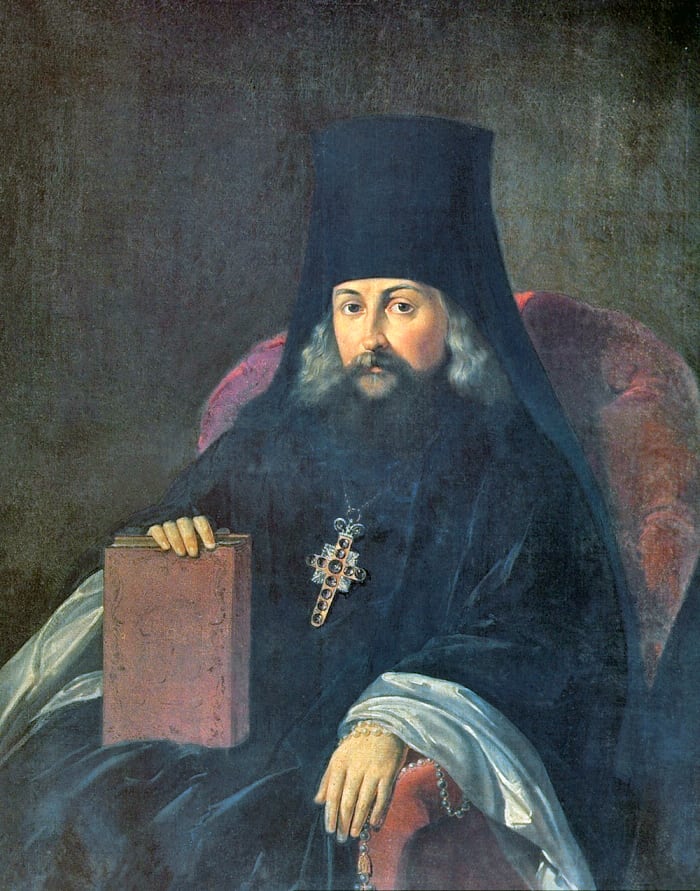
Ignatius Brianchaninov
Concordano su: Perché soffriamo? · Che cos'è l'Assoluto? Dio esiste? · Chi sono io? Esiste un vero sé?
La pensa diversamente da

Pema Chödrön
Si scontrano su: Che cos'è l'Assoluto? Dio esiste? · Chi sono io? Esiste un vero sé? · Che cosa accade dopo la morte?

Nāgārjuna
Si scontrano su: Che cos'è l'Assoluto? Dio esiste? · Chi sono io? Esiste un vero sé? · Che cosa accade dopo la morte?
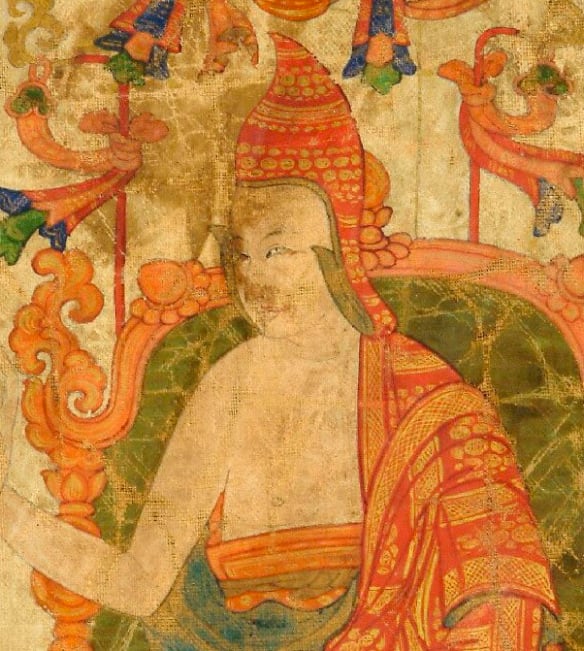
Śāntideva
Si scontrano su: Che cos'è l'Assoluto? Dio esiste? · Chi sono io? Esiste un vero sé? · Che cosa accade dopo la morte?

Sadhguru
Si scontrano su: Chi sono io? Esiste un vero sé? · Che cosa accade dopo la morte? · Il mondo è reale?
Aneddoti e racconti
Aneddoti e racconti
Testimonianzamayo de 1373
The parish priest's crucifix
Origine del racconto: Julian's own account in the Short Text (chs. 2–3) and the Long Text (chs. 3–4).
Testimonianzamayo de 1373
'I said I had raved'
Origine del racconto: Long Text, chs. 66–67; the episode also appears in the Short Text (chs. 21–22).
Documentatoc. 1413
Margery Kempe at the cell window
Origine del racconto: The Book of Margery Kempe, book I, ch. 18, dictated c. 1436–1438. The meeting is known only from this account.
Fonte: The Book of Margery Kempe. Ed. Sanford Brown Meech y Hope Emily Allen. Early English Text Society, o.s. 212. Londres: Oxford University Press, 1940, cap. 18.
Non verificabiles. XX (tradición)
The anchoress's cat
Origine del racconto: The rule comes from the Ancrene Wisse (part VIII). The attribution of a cat to Julian has no medieval source and spread with modern iconography.
Fonte: Jantzen, Grace M. Julian of Norwich: Mystic and Theologian. Londres: SPCK, 1987 (nueva ed. 2000).
Documentatos. XVII
The nuns of Cambrai
Origine del racconto: Watson and Jenkins (2006) and Colledge and Walsh (1978) study the provenance of the Long Text manuscripts in the milieu of the Cambrai and Paris communities.
Fonte: Watson, Nicholas, y Jacqueline Jenkins (eds.). The Writings of Julian of Norwich: A Vision Showed to a Devout Woman and A Revelation of Love. University Park: Pennsylvania State University Press / Turnhout: Brepols, 2006.
Insegnamenti
Insegnamenti
Le nozioni che articolano il suo pensiero, spiegate nel loro contesto.
'All shall be well': behovely sintodo-ira-bien
Late medieval debate on predestination and salvation, in the England of Wyclif and Langland.
Fonte: Colledge, Edmund, y James Walsh (eds.). A Book of Showings to the Anchoress Julian of Norwich. 2 vols. Studies and Texts 35. Toronto: Pontifical Institute of Mediaeval Studies, 1978.
A God without wrathdios-sin-ira
Contrast with fourteenth-century penitential preaching and with the image of judgement in scholastic theology.
Fonte: Jantzen, Grace M. Julian of Norwich: Mystic and Theologian. Londres: SPCK, 1987 (nueva ed. 2000).
The example of the lord and the servantsenor-y-siervo
Medieval multi-layered exegesis and the tradition of parable as a form of theological teaching.
Fonte: Watson, Nicholas, y Jacqueline Jenkins (eds.). The Writings of Julian of Norwich: A Vision Showed to a Devout Woman and A Revelation of Love. University Park: Pennsylvania State University Press / Turnhout: Brepols, 2006.
The motherhood of Christ and of Godmaternidad-de-cristo
Medieval tradition of Jesus as mother (Anselm, Bernard of Clairvaux, William of Saint-Thierry).
Fonte: Jantzen, Grace M. Julian of Norwich: Mystic and Theologian. Londres: SPCK, 1987 (nueva ed. 2000).
Substance and sensualitysustancia-y-sensualidad
Augustinian anthropology of the image and the English contemplative tradition (Hilton, The Cloud of Unknowing).
Fonte: Watson, Nicholas, y Jacqueline Jenkins (eds.). The Writings of Julian of Norwich: A Vision Showed to a Devout Woman and A Revelation of Love. University Park: Pennsylvania State University Press / Turnhout: Brepols, 2006.
The courtesy and homeliness of Godcortesia-de-dios
The courtly language of fourteenth-century England applied to theology.
Fonte: Windeatt, Barry (trad. e intr.). Julian of Norwich: Revelations of Divine Love. Oxford World's Classics. Oxford: Oxford University Press, 2015.
Video
Video
Registrazioni, interviste e documentari. I video vengono riprodotti da YouTube; non sono ospitati qui.
2024 Julian Festival Lecture, Julian and the Trinity, Archbishop Rowan Williams
Conferenza· EN· 2024· 89 min
Julian of NorwichCanale ufficiale
Julian of Norwich: mother, mystic, radical
Conferenza· EN· 2023· 81 min
Jesus College, CambridgeCanale ufficiale
Julian of Norwich: Revelations of Divine Love - Robert Fruehwirth
Conferenza· EN· 2016· 61 min
St Paul's CathedralCanale ufficiale
Prayer in the Teachings of Julian of Norwich: A Journey of Desire | Philip Sheldrake
Conferenza· EN· 2019· 84 min
Oblate School of TheologyCanale ufficiale
How to Read Julian of Norwich / Ryan McAnnally-Linz
Conferenza· EN· 2024· 54 min
Yale Center for Faith & CultureCanale ufficiale
Julian of Norwich and the English Mystics: A Lecture by Fr. Groeschel
Conferenza· EN· 2019· 73 min
International Institute for Culture
Cecilia Twinch: Julian of Norwich: All manner of things shall be well
Conferenza· EN· 2023· 42 min
Ibn 'Arabi SocietyCanale ufficiale
Revelations of Divine Love by Julian of NORWICH read by David Barnes | Full Audio Book
Registrazione di terzi· EN· 2018· 441 min
LibriVox Audiobooks
3º clase - Javier Melloni sj expone sobre Juliana de Norwich, teóloga de su propia experiencia
Conferenza· ES· 2022· 113 min
Fraternidad del Santo Nombre
Juliana de Norwich, Mística de la cortesía de Dios - El primer documental español
Documentario· ES· 2026· 15 min
Radio Monastero Interiore
El Papa dedica la audiencia general a Juliana de Norwich, mística inglesa
Registrazione di terzi· ES· 2010· 3 min
ROME REPORTS en EspañolCanale ufficiale
Juliana de Norwich
Conferenza· ES· 2026· 104 min
Cruzando Fronteras con Fernando Cordero sscc
Giuliana di Norwich, Mistica della cortesia di Dio - il primo documentario italiano
Documentario· IT· 2025· 16 min
Radio Monastero Interiore
Galleria
Galleria
Immagini con licenza verificata. Ciascuna conserva la sua paternità e la sua attribuzione.
Manoscritti
Manoscritti
Testimoni manoscritti e testi antichi, con il loro custode e le loro condizioni di consultazione.
ENM · Gótica cursiva inglesa (tipo no verificado) · Texto: c. 1373–1390; copia: c. 1435–1450
A Vision Showed to a Devout Woman (Texto breve), en antología contemplativa
- Testimone conservato
- Único testimonio del Texto breve, dentro de una antología de textos contemplativos (Rolle, Ruusbroec, Suso, entre otros). La rúbrica afirma que la autora seguía viva en 1413.
- Custode
- British Library, Londres · Add. MS 37790 (manuscrito Amherst)
ENM · Cursiva (tipo no verificado) · Copia de finales del s. XVI
Revelations of Divine Love (Texto largo), copia de París
- Testimone conservato
- Texto largo completo con el explicit «Explicit liber revelationum Julyane anatorite Norwyche»; texto próximo al de la edición de Cressy (1670).
- Custode
- Bibliothèque nationale de France, París · Fonds anglais 40
ENM · Cursiva del s. XVII · Mediados del s. XVII
Revelations of Divine Love (Texto largo), Sloane 2499
- Testimone conservato
- Texto largo completo con ortografía arcaizante; base de las ediciones de Warrack (1901), Glasscoe (1976) y Crampton (1993).
- Custode
- British Library, Londres · Sloane MS 2499
ENM · Cursiva del s. XVIII · S. XVIII
Revelations of Divine Love (Texto largo), Sloane 3705
- Testimone conservato
- Copia tardía del Texto largo, con ortografía modernizada.
- Custode
- British Library, Londres · Sloane MS 3705
ENM · Gótica cursiva inglesa (tipo no verificado) · c. 1500
Extractos del Texto largo (manuscrito de Westminster)
- Testimone conservato
- Antología de pasajes del Texto largo junto a comentarios a los salmos; el testimonio más antiguo de esa versión.
- Custode
- Westminster Cathedral Treasury, Londres · MS 4
Relazioni
Relazioni
Influenze, discepolati e affinità. Si distingue la relazione documentata dalla somiglianza individuata per analisi.
Ricevette l'influenza di
The sixteen showings centre on Christ's passion, which Julian had asked to behold 'as if she had been there', and her whole theology is built around him as servant, mother and saviour.
Relazione documentata
Idee affini a
Julian works within the Augustinian horizon (fall, original sin, grace, God's image in the soul), but her vision of a God who does not blame departs from the rigour of the late Augustine. No direct reading is documented.
Somiglianza individuata per analisi
Contemporaneo di
Exact contemporaries (Catherine was born in 1347 and Julian had her visions in 1373), both laywomen without Latin learning who dictated or wrote theology in the vernacular. There was no contact.
Somiglianza individuata per analisi
Idee affini a
Two women who wrote of their experience of God in domestic language and with a theological sharpness that exceeded their 'unlettered' status. Teresa did not know Julian's work.
Somiglianza individuata per analisi
Idee affini a
Both visionaries received visions in sickness and interpreted them over years; but Hildegard was an abbess, prophetic and cosmological, and Julian a recluse and introspective. No documented relation.
Somiglianza individuata per analisi
Idee affini a
Affective devotion to the suffering humanity of Christ, spread in fourteenth-century England by Franciscan spirituality, forms the background of her visions of the passion. No direct relation.
Somiglianza individuata per analisi
Idee affini a
Julian's 'substance' of the soul ever united to God recalls Eckhart's 'ground' of the soul, but her language is narrative and concrete, not speculative. There is no sign that she knew Rhineland mysticism.
Somiglianza individuata per analisi
Collegato da altre schede
Fonti
Fonti
Bibliografia e cataloghi consultati per questa scheda.
- Wikidata, Q236699 «Juliana de Norwich / Julian of Norwich» (P31=Q5; 45 enlaces entre wikis).
- Colledge, Edmund, y James Walsh (eds.). A Book of Showings to the Anchoress Julian of Norwich. 2 vols. Studies and Texts 35. Toronto: Pontifical Institute of Mediaeval Studies, 1978.
- Watson, Nicholas, y Jacqueline Jenkins (eds.). The Writings of Julian of Norwich: A Vision Showed to a Devout Woman and A Revelation of Love. University Park: Pennsylvania State University Press / Turnhout: Brepols, 2006.
- Warrack, Grace (ed.). Revelations of Divine Love Recorded by Julian, Anchoress at Norwich, Anno Domini 1373. Londres: Methuen, 1901 (Project Gutenberg n.º 52958).
- Windeatt, Barry (trad. e intr.). Julian of Norwich: Revelations of Divine Love. Oxford World's Classics. Oxford: Oxford University Press, 2015.
- The Book of Margery Kempe. Ed. Sanford Brown Meech y Hope Emily Allen. Early English Text Society, o.s. 212. Londres: Oxford University Press, 1940, cap. 18.
- Jantzen, Grace M. Julian of Norwich: Mystic and Theologian. Londres: SPCK, 1987 (nueva ed. 2000).
- Benedicto XVI. Audiencia general del 1 de diciembre de 2010: Juliana de Norwich. Libreria Editrice Vaticana.
- Spearing, Elizabeth (trad.), y A. C. Spearing (intr. y notas). Julian of Norwich: Revelations of Divine Love (Short Text and Long Text). Londres: Penguin Books, 1998.
- Watson, Nicholas. «The Composition of Julian of Norwich's Revelation of Love». Speculum 68, n.º 3 (1993), pp. 637–683.
- Ward, Benedicta. «Julian the Solitary». En Kenneth Leech y Benedicta Ward, Julian Reconsidered. Oxford: SLG Press, 1988.
- Glasscoe, Marion (ed.). Julian of Norwich: A Revelation of Love. Exeter Medieval English Texts. Exeter: University of Exeter, 1976 (ed. del Sloane 2499).
- Beer, Frances (ed.). Julian of Norwich's Revelations of Divine Love: The Shorter Version Ed. from B. L. Add. MS 37790. Heidelberg: Carl Winter, 1978.
- Open Library (Internet Archive), registros de edición consultados por ISBN para las ediciones listadas.
- Eliot, T. S. «Little Gidding» (1942), en Four Quartets. Londres: Faber & Faber, 1944, sección V.
- Tanner, Norman P. The Church in Late Medieval Norwich, 1370–1532. Studies and Texts 66. Toronto: Pontifical Institute of Mediaeval Studies, 1984 (testamentos de Norwich con legados a anacoretas).
- The Julian Shrine, St Julian's Church, Norwich: historia de la iglesia y de la celda reconstruida.
- Friends of Julian of Norwich (asociación que mantiene el Julian Centre y promueve su lectura).
- Holloway, Julia Bolton, Anna Maria Reynolds et al. (eds.). Julian of Norwich, Showing of Love: Extant Texts and Translation. Florencia: SISMEL – Edizioni del Galluzzo, 2001.
- Wikisource en inglés: Revelations of Divine Love (Grace Warrack, ed. de 1907), transcripción con subpáginas por capítulo.
- Titolare dei diritti
- Dominio público (obra del siglo XIV). Las ediciones críticas, traducciones y modernizaciones posteriores a 1955 (PIMS, Penn State, Penguin, Oxford, Paulist Press, Trotta…) están sujetas a los derechos de sus editores.
- Sito ufficiale
- www.julianshrine.org/
In attesa di conferma
Ciò che questa scheda non ha ancora potuto chiarire. Preferiamo dirlo piuttosto che riempirlo.
- Confirmar la fecha de muerte de Dundas Harford (n. 1858) para liberar su edición del Texto breve (1911) en la sala de lectura; hasta entonces queda con caution.
- Comprobar la calidad del OCR de la reimpresión de 1843 de la edición de Cressy en Internet Archive.
- Localizar el traductor de la edición española de Trotta (Libro de visiones y revelaciones, 2002; ISBN 9788481645590), que Open Library no registra, y buscar otras ediciones españolas con ISBN (Revelaciones del amor divino).
- Localizar ISBN de ediciones francesa, alemana e italiana: Open Library no devuelve registros fiables.
- Verificar si el manuscrito de París (BnF, Fonds anglais 40) y los Sloane 2499 y 3705 están digitalizados (Gallica; British Library Digitised Manuscripts, afectado por la caída del servicio de la BL desde 2023).
- Fijar con Colledge–Walsh y con Tanner (1984) las cuantías y fechas exactas de cada legado testamentario (Reed 1394, Emund 1404, Plumpton 1415, Ufford 1416).
- No hay traducción española de dominio público conocida; la sala de lectura queda solo en inglés.
- Programas de afiliación: ninguno verificado.
Ricerca effettuata il 2026-10-25