Tantra · Buddhismus · Mahayana · Tibetischer Buddhismus
Milarepa
རྗེ་བཙུན་མི་ལ་རས་པ། · rje btsun mi la ras pa
um 1052 – um 1135Historisch belegte Person
Tibetischer Yogi, Einsiedler und Dichter des 11. Jahrhunderts, Gründergestalt der Kagyü-Linie. Seiner Hagiographie zufolge rächte er seine Familie durch Schwarze Magie, sühnte seine Verbrechen unter den Prüfungen Marpas des Übersetzers und erlangte das Erwachen in einem Leben der Zurückgezogenheit in Höhlen des Himalaya, nur mit Baumwolle bekleidet und von Brennnesseln ernährt. Seine „Hunderttausend Gesänge“ der Verwirklichung, 1488 von Tsangnyön Heruka festgeschrieben, sind das meistgeliebte Buch Tibets.
- Werke
- 7Werke
- Ausgaben
- 26Ausgaben
- Zitate
- 3Zitate
- Videos
- 11Videos
- Bilder
- 9Bilder
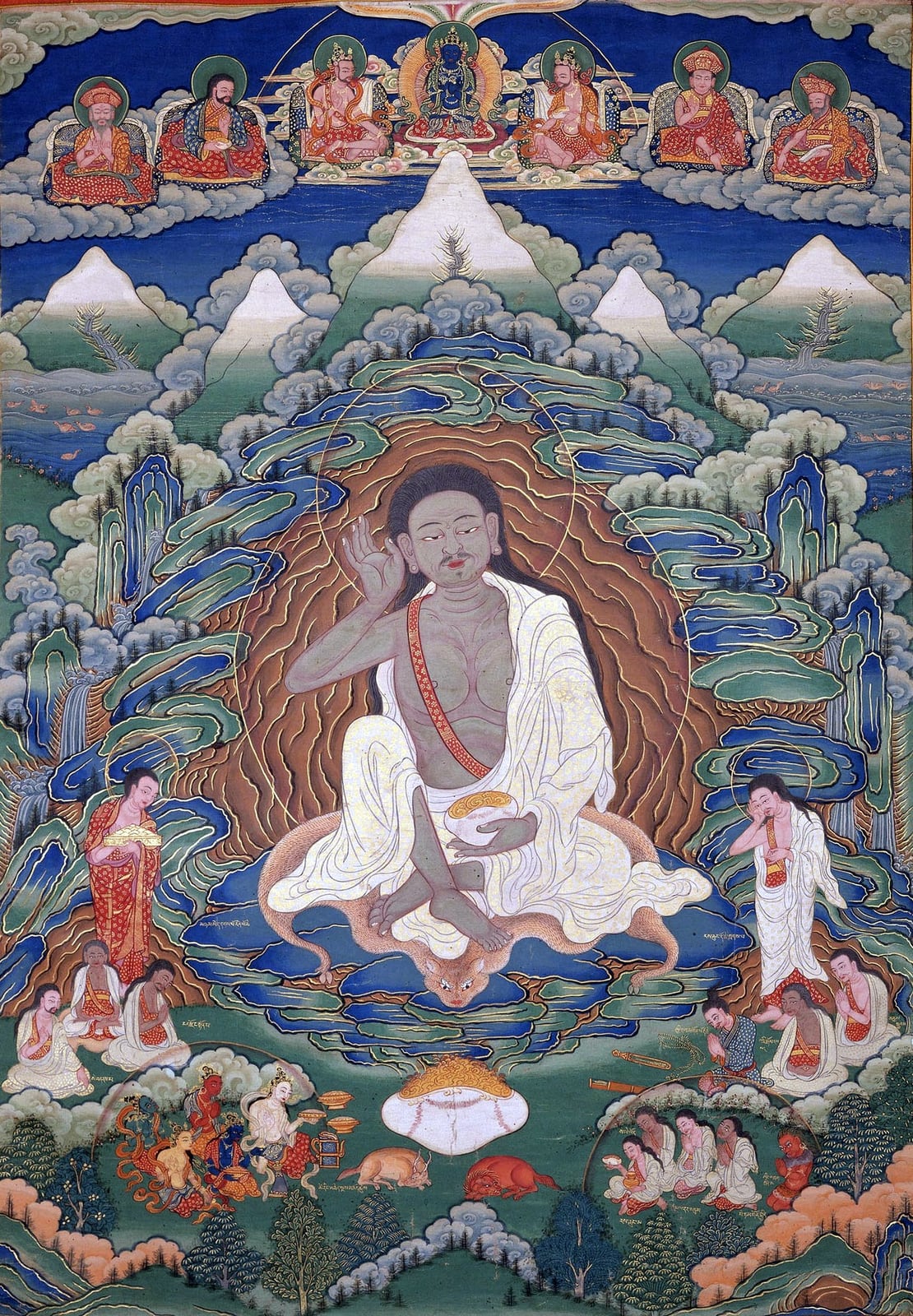
Tangka butanés de Milarepa, finales del s. XIX – principios del XX · Public domain
In eigenen Worten
«Seeing this Life, one is freed from the eight worldly concerns. Hearing it, faith arises of itself. Recollecting it, entanglements are severed at the root.»Versos de cierre del Namthar; son palabras del compilador Tsangnyön Heruka sobre el libro, no de Milarepa, y así deben presentarse. Quintman (2010), pp. 233–234, citado en Quintman (2023)

Der zentrale Gedanke
A single human life, however grave the guilt, suffices to reach awakening: Milarepa's story exists to show that a killer can become a buddha “in one body and one lifetime”, the promise of the tantric path as against the aeons of the gradual path.
Im Zusammenhang sehen
Biografie
6 Min. Lesezeit
Unterstützte Übersetzung aus dem spanischen Original, Durchsicht durch einen muttersprachlichen Übersetzer ausstehend.
Was man weiß und was man erzählt
Über Milarepa, den meistgeliebten Yogi Tibets, lässt sich mit historischer Gewissheit kaum etwas sagen. Dass er gelebt hat, dass er Schüler Marpas des Übersetzers und Lehrer Gampopas war, dass er als Einsiedler in den Bergen an der Grenze zu Nepal lebte und singend lehrte, räumt die gesamte Überlieferung ein und akzeptiert die moderne Forschung. Doch das Leben, das alle kennen – die Rache, die Türme, die Brennnesseln, das Gift –, stammt aus einem einzigen Buch, dem Namthar oder der „vollständigen Befreiung“, das Tsangnyön Heruka, der „Verrückte von Tsang“, 1488 verfasste, dreieinhalb Jahrhunderte nach den Ereignissen, auf der Grundlage älterer Biographien, die heute zum Teil wiederentdeckt sind. Nicht einmal die Daten sind sicher: Die vorherrschende Überlieferung nennt 1052–1135; die Kagyü-Gelehrten des 18. Jahrhunderts bevorzugten 1028–1111; ein guter Teil der heutigen Forscher 1040–1123. Dieser Eintrag folgt der Chronologie des Namthar und bezeichnet sie als das, was sie ist: Hagiographie, also ein Leben, das geschrieben wurde, um als Vorbild zu dienen.
Der Sohn aus dem Hause Mila
Er wurde, nach dieser Erzählung, in Kya Ngatsa im Tal von Gungthang geboren, im äußersten Südwesten Tibets, in eine zu Wohlstand gekommene Händlerfamilie aus dem Mila-Clan. Sein Vater, Sherab Gyaltsen, nannte ihn Thöpaga, „Freude beim Hören“, weil das Kind schön sang. Als der Vater starb, war Thöpaga sieben Jahre alt; das Testament vertraute den Besitz bis zur Volljährigkeit des Erben dem Onkel und der Tante väterlicherseits an, und diese rissen ihn an sich. Die Witwe, Nyangtsa Kargyen, und ihre beiden Kinder, Thöpaga und Peta, mussten fortan in dem Haus dienen, das einst das ihre gewesen war. Als der Junge fünfzehn wurde, sammelte die Mutter, was ihr geblieben war, für ein Festmahl, bei dem sie öffentlich das Erbe zurückforderte; Onkel und Tante demütigten sie vor dem ganzen Dorf. Daraufhin verkaufte sie ihr letztes Feld, um den Sohn die Schwarze Magie erlernen zu lassen.
Was folgt, ist der Teil der Erzählung, den die Überlieferung nie abmildern wollte: Thöpaga lernte, und was er lernte, wirkte. Während der Hochzeit des ältesten Sohnes des Onkels stürzte das Haus ein, und fünfunddreißig Menschen starben; Onkel und Tante überlebten, damit sie sähen, was sie verloren hatten. Als das Dorf sich rächen wollte, verlangte die Mutter mehr, und der Sohn ließ Hagel auf die Ernten niedergehen. Das Namthar mildert die Verbrechen nicht, weil es sie braucht: Der Heilige Tibets ist vor allem anderen ein Mörder.
Marpa und die Türme
Die Reue kam langsam, in Gestalt der Angst vor dem Tod und vor der Wiedergeburt in den Höllen. Thöpaga suchte einen Lehrer; ein Lama der Großen Vollkommenheit sagte ihm, seine Lehre befreie mühelos, und der Schüler nahm ihn beim Wort und legte sich schlafen. Da schickte ihn der Lama nach Lhodrag zu Marpa Chökyi Lodrö, dem Übersetzer, der dreimal nach Indien gereist war, um die Lehren Nāropas zu holen. Marpa, ein Mann großer Gelehrsamkeit und übler Laune, wusste im Traum, wer da kam, empfing ihn aber wie einen Tagelöhner: Er ließ ihn einen Turm bauen, ihn wieder abreißen, einen anderen an anderer Stelle bauen, auch diesen abreißen, jeden Stein an seinen Platz zurückbringen und schließlich den neunstöckigen Turm von Sekhar Gutok errichten, der noch heute steht. Unterdessen verweigerte er ihm die Einweihungen, jagte ihn mit Schlägen von den Zeremonien, an denen andere Schüler teilnahmen, und ließ ihn mit wundgescheuertem Rücken zurück. Marpas Frau, Dagmema, erbarmte sich seiner und schickte ihn mit einem gefälschten Brief zu einem anderen Meister, Ngokpa; als der Betrug aufflog, erklärte Marpa unter Tränen, jede der Prüfungen sei dazu bestimmt gewesen, ein Verbrechen zu läutern, hätte Milarepa sie alle vollendet, hätte er nicht mehr wiedergeboren werden müssen, und was noch fehle, werde die Meditation läutern. Er war achtunddreißig Jahre alt, als er nach Lhodrag kam, und vierundvierzig, als er ging, mit dem Einweihungsnamen Zhepa Dorje und den Unterweisungen über die innere Hitze, Tummo, und über das Große Siegel, Mahāmudrā.
Der Baumwollgekleidete
Er kehrte in sein Dorf zurück und fand das Haus in Trümmern und darin die Gebeine seiner Mutter. In jener Nacht, sagt der Text, begriff er mit einem Schlag die Vergänglichkeit, die er seit Jahren studiert hatte, und ging in die Berge, um nie mehr zurückzukehren. In der Höhle Drakar Taso, dem „Pferdezahn des Weißen Felsens“, meditierte er ganze Jahre lang, ohne andere Nahrung als die Brennnesseln, die am Eingang wuchsen, bis seine Haut grün wurde und sein Haar ebenso; als seine Schwester Peta ihn fand, glaubte sie, ein Gespenst zu sehen, und hielt ihm ein Leben vor, das ihr schlimmer erschien als das eines Bettlers. Milarepa antwortete ihr mit einem Lied. Petas Scham über seine Nacktheit, die Diebe, die nachts in die Höhle eindringen und nichts zu stehlen finden, die Dickmilch, die der Yogi dank der Kraft des Tummo nicht braucht: Jede Episode ist eine Lehre in Gestalt einer Szene. Nur mit einem Baumwolltuch bekleidet, wurde er zum Repa, „dem Baumwollgekleideten“, und unter diesem Namen kannte ihn der Himalaya.
Von hier an wird die Biographie zur Geographie: Lapchi, Chuwar, der Berg Kailash – wo er nach dem Mgur 'bum den Bön-Priester Naro Bönchung in einem Wettstreit der Kräfte besiegte, indem er auf einem Sonnenstrahl reitend den Gipfel erreichte –, Höhlen in Nepal und Westtibet, die bis heute besucht werden. Er lehrte jeden, der sich ihm näherte, Hirten, Jäger, Dämonen, einen gelehrten Geshe, und er tat es in improvisierten Liedern, den Mgur, die die Überlieferung zu einer Sammlung von „Hunderttausend“ zusammenfasste. Unter seinen Schülern prägten zwei die Zukunft: Rechungpa, der „Herzenssohn“, der als Kind kam und aus Indien mit den mündlichen Übertragungen zurückkehrte; und Gampopa, der in der Kadam-Schule ausgebildete Mönch und Arzt, der die Erfahrung des Yogis in die monastische Form goss und aus dessen Schülern die vier großen Kagyü-Zweige hervorgingen, darunter der der Karmapas.
Das Gift und das Gold
Er starb, immer nach dem Namthar, im Alter von vierundachtzig Jahren in Chuwar im Tal von Drin. Ein neidischer Geshe, Tsakpuwa, ließ ihm durch eine Konkubine, der er einen Türkis versprochen hatte, vergiftete Dickmilch bringen; Milarepa, der es wusste, nahm sie dennoch, weil seine Zeit gekommen war, und ließ vor seinem Tod den Geshe am eigenen Leib den Schmerz spüren, den er verursacht hatte, vergab ihm und bekehrte ihn. Er versammelte die Schüler, gab ihnen seine letzten Unterweisungen – den acht weltlichen Belangen zu entsagen, in der Einsamkeit zu meditieren – und kündigte ihnen an, unter der Feuerstelle liege Gold. Als sie danach suchten, fanden sie ein Stück Tuch, ein Messer, einen Klumpen Zucker und einen Zettel: Wer behaupte, Milarepa habe Gold besessen, solle sich den Mund mit Kot füllen. Der Leichnam, so heißt es, verschwand vom Scheiterhaufen, von den Dakinis davongetragen, und die Schüler stritten um Reliquien, die es nicht gab.
Wie ein Heiliger entsteht
Nichts davon ist überprüfbar, und das Aufschlussreiche ist, wie viel wir bereits darüber wissen, wie es zusammengefügt wurde. Die ersten Biographien schrieben im 12. Jahrhundert unmittelbare Schüler wie Gampopa und Ngendzong Repa; in den folgenden Jahrhunderten wurden sie zu Zyklen zusammengestellt – den Zwölf großen Schülern, dem Schwarzen Schatz der Karmapas –, die die Erzählung um Lieder erweiterten. Tsangnyön Heruka schrieb sie als eine Buddha-Biographie in tibetischem Gewand neu, teilte sie in zwei Bücher, Leben und Hunderttausend Gesänge, und ließ sie – das war entscheidend – im Holzdruck drucken, zu einer Zeit, als der Druck in Zentraltibet noch eine Neuheit war: daher ihre Allgegenwart. Die Nachdrucke von Gungthang aus den Jahren 1538, 1540 und 1550–1555 – teilweise in der Wellcome Collection und der British Library erhalten – legten zudem sein Bild fest: sitzend, die rechte Hand am Ohr, singend. Jacques Bacot übersetzte ihn 1925 ins Französische, Evans-Wentz veröffentlichte ihn 1928 auf Englisch; Garma C. C. Chang übertrug 1962 die Lieder, Lobsang Lhalungpa 1977 das Leben, und Andrew Quintman, der diesen ganzen Prozess rekonstruiert hat, übersetzte es 2010 erneut. Was am Ende bleibt, ist kein nachprüfbares Leben, sondern etwas Selteneres: ein Lebensmodell, das neun Jahrhunderte von Lesern glaubwürdig gefunden haben.
Quellen: Tsangnyön Heruka. The Life of Milarepa. Trad. Andrew Quintman; introducción de Donald S. Lopez Jr. Nueva York: Penguin Classics, 2010. ISBN 9780143106227. · Tsangnyön Heruka. The Life of Milarepa. Trad. Lobsang P. Lhalungpa. Nueva York: E. P. Dutton, 1977; Boston: Shambhala, 1985. ISBN 9780877732815. · Chang, Garma C. C. (trad. y anot.). The Hundred Thousand Songs of Milarepa. 2 vols. New Hyde Park (NY): University Books / Oriental Studies Foundation, 1962; reed. Boulder: Shambhala, 1977 y 1999 (ISBN 9781570624766). Vol. 1 digitalizado en Wikimedia Commons. · Quintman, Andrew. The Yogin and the Madman: Reading the Biographical Corpus of Tibet's Great Saint Milarepa. Nueva York: Columbia University Press, 2014. ISBN 9780231164153. · Evans-Wentz, W. Y. (ed.). Tibet's Great Yogī Milarepa: A Biography from the Tibetan. Trad. Lāma Kazi Dawa-Samdup. Londres: Oxford University Press, 1928. Digitalizado en Internet Archive.
Zeitleiste
Das Leben, Jahr für Jahr
Jeder Punkt ist ein belegtes Ereignis. Klicken Sie, um es mit Quelle und Grad der Gewissheit zu lesen.
um 10520 JahreKya Ngatsa, Gungthang
Birth of Mila Thöpaga
According to the Namthar he is born in a water-dragon year to a prosperous family of the Mila clan; his father, Mila Sherab Gyaltsen, names him Thöpaga, “delightful to hear”. The dominant tradition says 1052; other sources give 1040 or 1028.
ÜberlieferungTsangnyön Heruka. The Life of Milarepa. Trad. Andrew Quintman; introducción de Donald S. Lopez Jr. Nueva York: Penguin Classics, 2010. ISBN 9780143106227.
Nach dem Tod
- 1488Tsangnyön Heruka composes the Namthar and the Mgur 'bum
- 1538 – 1555The earliest surviving reprints
- 1928Arrival in the West: Bacot (1925) and Evans-Wentz (1928)
- 1962Garma C. C. Chang translates the Hundred Thousand Songs
- 2010 – 2014Quintman: new translation and study of the biographical corpus
um 1052 · 0 Jahre
Birth of Mila Thöpaga
According to the Namthar he is born in a water-dragon year to a prosperous family of the Mila clan; his father, Mila Sherab Gyaltsen, names him Thöpaga, “delightful to hear”. The dominant tradition says 1052; other sources give 1040 or 1028.
Überlieferung
um 1059 · 7 Jahre
Death of his father and ruin of the family
His father dies leaving the estate in the care of the paternal uncle and aunt, who seize it and reduce the widow Nyangtsa Kargyen, Mila and his sister Peta to servitude.
Überlieferung
um 1067 · 15 Jahre
Apprenticeship in sorcery and the revenge
At his mother's urging he learns black magic and the art of hail-casting; he brings down his uncle's house during a wedding, killing thirty-five people, and destroys the village harvest with hail.
Überlieferung
um 1090 – 1096 · 38 Jahre
Marpa's disciple: the towers
Repentant, he seeks the Dharma; after a Dzogchen teacher who does him no good he reaches Marpa Chökyi Lodrö, who refuses to teach him and makes him build and tear down several stone towers before raising the nine-storey tower of Sekhar Gutok. Only then does he receive initiations and instructions (tummo, mahāmudrā, the oral transmissions).
Überlieferung
um 1096 – 1108 · 44 Jahre
The retreat years
After returning to his village and finding his mother's bones, he withdraws to the cave of Drakar Taso (“White Rock Horse Tooth”), where he meditates for years living on nettles until his skin turns green. He then wanders the mountains as a repa, “cotton-clad one”, and attains realisation.
Überlieferung
um 1110 · 58 Jahre
Meeting with Gampopa
The monk and physician Gampopa (1079–1153), trained in the Kadam school, becomes his chief disciple; from him the four great Kagyu branches will descend. Rechungpa (1085–1161), his “heart disciple”, has accompanied him since youth.
Überlieferung
um 1135 · 84 Jahre
Death by poisoning
The Namthar relates that the envious geshe Tsakpuwa sent him poisoned curd through a concubine; Milarepa, knowing what he did, took it, gave his final teachings and died aged eighty-four. His testament revealed that the “gold” he claimed to keep was a scrap of cloth and a lump of sugar.
Überlieferung
1488
Tsangnyön Heruka composes the Namthar and the Mgur 'bum
The “Madman of Tsang” (1452–1507) fixes the canonical version of the life and songs from earlier biographies (Gampopa, Ngendzong Repa, the Twelve Great Disciples, the Black Treasury cycle) and has it woodblock-printed: the origin of the saint's universal fame.
Belegt
1538 – 1555
The earliest surviving reprints
Printing of the Namthar at Ron Wosel Puk (1538) under Tokden Chökyi Gyatso; of the Mgur 'bum at Lende Langpuk (1540, folio in the Wellcome Collection) and at Drakar Taso (1550–1555, folio in the British Library, OPB 19999a3), which fixes Milarepa's iconography with his hand to his ear.
Belegt
1928
Arrival in the West: Bacot (1925) and Evans-Wentz (1928)
Jacques Bacot publishes in French the first European translation of the Namthar; three years later Oxford University Press issues Kazi Dawa-Samdup's English version edited by W. Y. Evans-Wentz, which for half a century was Western readers' gateway.
Belegt
1962
Garma C. C. Chang translates the Hundred Thousand Songs
First complete translation of the Mgur 'bum into a Western language (University Books, 2 vols.), reissued by Shambhala in 1977 and 1999; the basis of nearly all versions into other languages until Christopher Stagg's new translation (2017).
Belegt
2010 – 2014
Quintman: new translation and study of the biographical corpus
Andrew Quintman publishes the Penguin Classics translation (2010) and The Yogin and the Madman (2014), the first systematic study of the biographies prior to Tsangnyön; with him the figure passes from devotional tale to the history of its own construction.
Belegt
Werke
Grundlegende Werke
Die Werke, ohne die sich das Vermächtnis nicht verstehen lässt.
Traditionelle Zuschreibung · 1488
The Life of Milarepa (Namthar)
རྗེ་བཙུན་མི་ལ་རས་པའི་རྣམ་ཐར། (rje btsun mi la ras pa'i rnam thar)
The canonical biography, divided into twelve chapters between “worldly deeds” (birth, ruin, revenge by sorcery) and “supreme deeds” (the trials with Marpa, the retreat at Drakar Taso, the teaching and the death by poison). Written as a life of the Buddha in a Tibetan key, it is at once a novel of formation, a practice manual and Tibet's most widely read book; its woodblock circulation from the late fifteenth century explains the figure's ubiquity.
10 Ausgaben · amazon.com
Das gesamte Werk (7)

The Hundred Thousand Songs of Milarepa (Mgur 'bum)
1488

Drinking the Mountain Stream: Songs of Tibet's Beloved Saint
1978
Milarepa
Sixty Songs of Milarepa
The Conscious LibrarySixty Songs of Milarepa
1966

The Yogin and the Madman
2014
Milarepa
Milarepa: Lessons from the Life and Songs of Tibet's Great Yogi
The Conscious LibraryMilarepa: Lessons from the Life and Songs of Tibet's Great Yogi
2017
Milarepa
Miraculous Journey: Further Stories and Songs of Milarepa
The Conscious LibraryMiraculous Journey: Further Stories and Songs of Milarepa
1986
Zitate
Zitate, die in einem bestimmten Werk nachgewiesen sind. Jedes trägt seine Herkunft und seinen Grad an Verlässlichkeit.
Whoever says that Milarepa possessed gold, let him fill his mouth with excrement.(tibetano; traducción libre del investigador a partir de Lhalungpa 1977 y Quintman 2010)
WahrscheinlichNamthar (Tsangnyön Heruka, 1488), capítulo final («Nirvana»): la nota hallada bajo el hogar junto a un trozo de tela, un cuchillo y un terrón de azúcar, tras anunciar a los discípulos que allí había oro
Wesentliche Gedanken (redaktionelle Zusammenfassung)
Aus Achtung vor dem Urheberrecht werden diese Gedanken mit eigenen Worten zusammengefasst und nicht als wörtliche Zitate dargestellt.
- A single human life, however grave the guilt, suffices to reach awakening: Milarepa's story exists to show that a killer can become a buddha “in one body and one lifetime”, the promise of the tantric path as against the aeons of the gradual path.
- The suffering imposed by the teacher is not cruelty but purification: each tower raised and razed for Marpa corresponds to a crime, and the devotion that endures the trial is the true initiation, prior to any ritual.
- Mountain solitude is the place of practice, not an escape: in the cave one finds what village, monastery and books do not give, and voluntary poverty—a cloth, a staff, nettles—is freedom, not lack.
- Death is certain and its hour uncertain; therefore every delay is a loss. The songs return again and again to impermanence not as consolation but as a goad: there is no time for the affairs of the world.
- Realisation is taught by singing: the improvised song (mgur) does not embellish doctrine, it embodies it, because what has been understood in the body comes out in verse and in plain speech, within reach of shepherds and hunters.
- Inner heat (tummo) and the Great Seal (mahāmudrā) are two faces of one experience: the body that needs no shelter and the mind that recognises its own nature; the cotton-clad repa in the snow is the visible proof of the invisible.
Apokryphe Zitate oder Zitate umstrittener Zuschreibung (3)
«My religion is to live and die without regret.»
Milarepa's most quoted sentence in the West, used as an epigraph by Shambhala and on countless pages, could not be located in that wording either in the Namthar (Lhalungpa, Quintman) or in the Mgur 'bum (Chang). It faithfully conveys the sense of his final teaching but is recorded as unverified.
«In the beginning nothing comes, in the middle nothing stays, at the end nothing goes.»
Circulates as a Milarepa song on the nature of mind; it could not be found in the Chang or Stagg translations. It may derive from genuine Mgur 'bum verses on the mind as “unborn, unabiding and unceasing”, reworded in popular literature.
«Hasten slowly and you shall soon arrive.»
Attributed to Milarepa in quotation anthologies; it is a variant of the Latin adage “festina lente”. Not found in any Tibetan source consulted.
Letzte Worte
Traditionelle Zuschreibung
«Do as I have done: give up the eight worldly concerns, homeland and kin, and meditate in the solitude of the mountains until realisation is firm. That is my final instruction; I have no other.»Hagiographic, not historical. The final chapter of Tsangnyön Heruka's Namthar (1488) has Milarepa, at Chuwar and already poisoned, deliver a last discourse and a last song to his disciples: he asks them to give up worldly concerns and practise in solitude, and declares that his only possessions are his cotton robe, his staff and a cup; then he enters meditation and dies. What is offered here is a free rendering of the sense of that instruction, written by the researcher from the Lhalungpa and Quintman translations, not a literal quotation from either. The Namthar was composed three and a half centuries after the events on the basis of earlier biographies; there is no contemporary testimony.
Quelle: Tsangnyön Heruka. The Life of Milarepa. Trad. Andrew Quintman; introducción de Donald S. Lopez Jr. Nueva York: Penguin Classics, 2010. ISBN 9780143106227.
Fragen
Was das Werk beantwortet
Zwölf große Fragen der Menschheit und was sich aus den Texten darauf antworten lässt, mit Belegen. Wir legen niemandem Worte in den Mund.
Was ist das Absolute? Gibt es Gott?
He seeks no creator: the ultimate is the nature of one's own mind
Kein SchöpfergottAus der Lehre abgeleitet
In the sources on Milarepa — the biography (namthar) and the Hundred Thousand Songs compiled by Tsangnyön Heruka in the fifteenth century — the question of a creator God does not arise as a problem. The horizon is tantric Buddhism of the Kagyü school: what must be recognised is the nature of mind, empty and luminous, which the songs describe again and again as impossible to grasp with concepts, without centre or limit. The meditation deities and dakinis who people his songs are not creators of the world but presences and manifestations on the path, and in the logic of Mahamudra they do not exist apart from mind. Liberation depends not on the grace of a God but on practice in solitude, devotion to the master Marpa and direct recognition. His work therefore falls within the non-theistic field.
Diese Frage mit anderen Meistern vergleichenWer bin ich? Gibt es ein wahres Selbst?
Sought for, the self is not found: mind is empty and luminous
Es gibt kein bleibendes SelbstAus der Lehre abgeleitet
The songs attributed to Milarepa in Tsangnyön Heruka's compilation return again and again to the search for mind and self: examined, they are found neither inside nor outside, and have no shape, colour or location. What follows is not nothingness but the nature of mind according to the Mahamudra of the Kagyü school: empty of a substantial self and at the same time clear and aware. Attachment to a self, by contrast, is the root of the passions and of the cycle of rebirth that Milarepa's biography narrates starkly, from his youthful crimes to his purification. Spiritual work consists in recognising this absence of self in one's own experience, in solitude and under the master's guidance, until the idea of a solid self no longer governs one's life.
Diese Frage mit anderen Meistern vergleichenWarum leiden wir?
Evil done returns: his trials under Marpa purified a terrible karma
Karma und das Lernen der SeeleAusdrücklich gesagt
Milarepa's biography is itself a lesson on the origin of suffering. According to the namthar compiled by Tsangnyön Heruka, as a young man, urged by his mother to take revenge on the relatives who had dispossessed them, he learned black magic and caused the deaths of many people. Remorse and fear of the karmic consequences of those acts led him to seek the dharma. His master Marpa subjected him to very harsh trials — building and tearing down stone towers again and again — which the tradition interprets as purification of that karma. In the songs, Milarepa insistently recalls impermanence, the imminence of death and the sufferings of samsara as reasons to practise without delay. Pain is the fruit of past acts and, at the same time, the spur that drives towards liberation.
Diese Frage mit anderen Meistern vergleichenWas geschieht nach dem Tod?
Fear of a bad rebirth drove him to liberation in a single life
Wiedergeburt nach dem KarmaAusdrücklich gesagt
In the Life of Milarepa, composed by Tsangnyön Heruka in the fifteenth century, rebirth according to karma is the engine of the whole narrative. Having caused deaths through black magic out of revenge, Milarepa is terrified at the prospect of rebirth in the hells, and that fear leads him to Marpa, to the trials of the tower and to years of solitary meditation. The songs of the tradition insist on impermanence: death comes without warning, the body is borrowed, and the only thing that accompanies the dead are their deeds; whoever does not practise now will be reborn dragged along by them. At the same time, the narrative presents Milarepa as proof that liberation is possible in a single life through Mahamudra and the yogas of Naropa, which include preparation for the intermediate state (bardo). For the realised yogi, dying is an occasion to recognise the nature of mind.
Diese Frage mit anderen Meistern vergleichenWie erlangt man Befreiung oder Erlösung?
Extreme purification under the master and years of solitary meditation: liberation in one lifetime
Durch disziplinierte ÜbungAusdrücklich gesagt
According to the Life of Milarepa compiled by Tsangnyön Heruka in the fifteenth century, Milarepa's path begins with heavy negative karma (the killings committed through black magic) and passes through two phases. First, purification: his master Marpa makes him build and demolish towers for years before transmitting the instructions. Then meditation in high mountain caves, with extreme asceticism, until realisation. The biography thus presents liberation as possible in a single life for whoever combines the transmission of a lineage, faith in the master and uncompromising perseverance. The songs gathered in The Hundred Thousand Songs insist on the same: renounce worldly concerns and practise without delay in the face of the certainty of death.
Diese Frage mit anderen Meistern vergleichenBraucht es einen Lehrer?
Without Marpa and his transmission no liberation: faith in the guru sustains everything
UnverzichtbarAusdrücklich gesagt
The Life of Milarepa is, to a large extent, the story of a relationship of discipleship. After a first teacher who cannot help him, Milarepa is sent to Marpa the Translator, who for years subjects him to apparently arbitrary trials, such as building and demolishing towers, and withholds teaching. The hagiography presents those humiliations as the necessary purification of his bad karma, and Milarepa's unshakeable obedience and faith as the condition for receiving the lineage's instructions. Only with that transmission can he then meditate fruitfully in solitude. The work thus reflects the Vajrayana conception of the guru as the source of blessings and of the efficacy of practice: without him, the path does not open.
Diese Frage mit anderen Meistern vergleichenIst die Welt wirklich?
Appearances are like a dream or a magical illusion: empty and luminous
Ein Geflecht von Ursachen ohne SubstanzAus der Lehre abgeleitet
In the songs attributed to Milarepa, the nature of the world is approached from the meditative experience of the Mahamudra tradition. Appearances are compared to a dream, a mirage or a magical illusion: they appear vividly but lack inherent existence. That emptiness is not presented as nothingness but as inseparable from the clarity of mind: appearance and emptiness are a unity. For Milarepa the error is not that there are phenomena but clinging to them as solid and pursuing worldly occupations as though they were lasting. Impermanence and death, constant themes in his songs, show that nothing in the world can be held on to, and therefore invite practice.
Diese Frage mit anderen Meistern vergleichenWas ist Liebe?
Breaking the bonds of worldly affection so that compassion for all may arise
Grenzenloses MitgefühlAusdrücklich gesagt
The Life of Milarepa shows two kinds of love in tension. On the one hand, family affection: the love for his mother, which drove him to revenge, and that of his sister Peta, who visits him in the cave and reproaches him for his poverty. When he returns to his village and finds the house in ruins and his mother's bones, Milarepa experiences that attachment as a source of pain and decides to renounce everything. On the other hand, the songs present him cultivating bodhicitta, the mind of awakening that seeks to free all beings, as the root of practice: compassion towards beings, whom the Tibetan tradition teaches one to see as former mothers, replaces attachment to one's own. Towards his persecutors, such as the lama Tsakpuhwa who ends up poisoning him, the tradition credits him with compassion rather than resentment.
Diese Frage mit anderen Meistern vergleichenSind wir frei, oder ist alles vorherbestimmt?
The repentant murderer who purifies his karma in a single lifetime
Karma und WahlAusdrücklich gesagt
In Tibetan tradition Milarepa's life is the supreme example that karma conditions but does not condemn. According to the *Namthar*, the young Thöpaga learns black magic to avenge his mother and causes the death of dozens of people; terrified by the consequences of those acts, he seeks the Dharma. Marpa makes him build and tear down towers again and again, trials the tradition reads as purification of the evil committed, and only then gives him the instructions. Milarepa attains realisation in that same life through years of retreat. The story does not deny the law of karma —fear of its fruits is what moves him— but shows that present action, sustained with extreme effort, can change its course.
Diese Frage mit anderen Meistern vergleichenWozu meditieren oder beten?
Meditating in the cave because death comes: recognising the nature of mind
Die Wirklichkeit sehen, wie sie istAusdrücklich gesagt
According to the *Namthar* and the *Hundred Thousand Songs*, Milarepa's meditation has an explicit driver: awareness of impermanence and death, which makes any worldly occupation a waste of time. After receiving the instructions from Marpa, he withdraws for years to high caves, lives on nettles and practises inner heat (*tummo*) and meditation on the nature of mind, in the line the Kagyu tradition would call *mahāmudrā*. His songs to disciples and visitors insist on two ideas: everything compounded falls apart, and the mind, looked at directly, is empty and luminous. To meditate is to see reality as it is until that seeing becomes continuous.
Diese Frage mit anderen Meistern vergleichenKann die Vernunft das Letzte erkennen?
The cave yogi against the scholar: practice, not books
Das Letzte liegt jenseits des VerstandesAusdrücklich gesagt
Milarepa's tradition often contrasts the meditator's realisation with bookish learning. In the *Namthar*, one of the last episodes pits the yogi against the scholar Geshe Tsakpuhwa, who tries to humiliate him with questions of logic and doctrine and, envious of his prestige, ends up having him poisoned. The *Hundred Thousand Songs* contain several answers to monks and scholars in which Milarepa declares that he has forgotten the words of the texts because he has become familiar with their meaning, and that the nature of mind is reached not by reasoning but by direct experience received from the master and matured in meditation. The ultimate is not proven: it is recognised.
Diese Frage mit anderen Meistern vergleichenSich von der Welt zurückziehen oder sie verwandeln?
The cave and total renunciation, without house, goods or family
Sich zurückziehen, um zu findenAusdrücklich gesagt
Milarepa is the model of the solitary yogi in Tibetan Buddhism. According to his Life, after completing the trials imposed by Marpa he withdrew for years to Himalayan caves, living on nettles until his skin turned greenish, without possessions and declining the offers of marriage or a comfortable life made to him. When his sister Peta reproaches him for his poverty and asks him to live like decent people, he answers with songs that set the eight worldly concerns — gain and loss, pleasure and pain, praise and blame, fame and disrepute — against the freedom of the practitioner. The tradition presents this renunciation as the condition of awakening in a single life. Yet it is not a fruitless isolation: in his maturity Milarepa receives disciples, such as Gampopa and Rechungpa, and teaches in song to herders, hunters and villagers.
Diese Frage mit anderen Meistern vergleichen
Affinitäten und Spannungen
Affinitäten und Spannungen
Frage für Frage aus den Positionen berechnet. Den Grund jeder Übereinstimmung und jedes Widerspruchs zeigt ein Klick.
Denkt ähnlich wie

Siddhartha Gautama, the Buddha
Übereinstimmung bei: Was ist das Absolute? Gibt es Gott? · Wer bin ich? Gibt es ein wahres Selbst? · Was geschieht nach dem Tod?

Śāntideva
Übereinstimmung bei: Was ist das Absolute? Gibt es Gott? · Wer bin ich? Gibt es ein wahres Selbst? · Was geschieht nach dem Tod?

Tsongkhapa
Übereinstimmung bei: Was ist das Absolute? Gibt es Gott? · Wer bin ich? Gibt es ein wahres Selbst? · Was geschieht nach dem Tod?

Dōgen
Übereinstimmung bei: Was ist das Absolute? Gibt es Gott? · Wer bin ich? Gibt es ein wahres Selbst? · Was geschieht nach dem Tod?
Denkt anders als

Francis of Assisi
Widerspruch bei: Was ist das Absolute? Gibt es Gott? · Wer bin ich? Gibt es ein wahres Selbst? · Was geschieht nach dem Tod?

Emanuel Swedenborg
Widerspruch bei: Was ist das Absolute? Gibt es Gott? · Wer bin ich? Gibt es ein wahres Selbst? · Was geschieht nach dem Tod?

Theophan the Recluse
Widerspruch bei: Was ist das Absolute? Gibt es Gott? · Wer bin ich? Gibt es ein wahres Selbst? · Was geschieht nach dem Tod?
Catherine of Siena
Widerspruch bei: Was ist das Absolute? Gibt es Gott? · Wer bin ich? Gibt es ein wahres Selbst? · Was geschieht nach dem Tod?
Widerspruch beiScheinbarer Widerspruch
Milarepa · The 14th Dalai Lama (Tenzin Gyatso)
Total obedience in the cave or critical discernment in the world: the guru in Tibet
Warum: The contradiction is apparent for two reasons. The first is genre: the Life of Milarepa is a fifteenth-century hagiography composed to exalt the Kagyu lineage, and its portrait of the perfect disciple is not a manual for choosing a master; the Dalai Lama speaks in public teachings, before global audiences exposed to unscrupulous teachers. The second is stage: the Tibetan tradition itself asks that the master be examined before acceptance and fully trusted afterwards, so the Dalai Lama's advice precedes the moment the Life recounts. Withdrawal and engagement, for their part, answer to different vocations, and Milarepa himself ended up teaching herdsmen, hunters and villagers.
Übereinstimmung bei
Milarepa · Teresa of Ávila
Suffering that purifies: Marpa's towers and the trials of the sixth dwelling places
Warum: The affinity is comparative: there is no relation between the eleventh-century Tibetan yogi and the sixteenth-century Castilian Carmelite. They converge because their traditions share an ascetic anthropology: the human being is bound by something that must be undone, and that undoing hurts. The explanation of pain, however, differs. In the Life of Milarepa suffering is the fruit of past actions and is exhausted through purification under a master; in Teresa it is participation in the cross of Christ and preparation for a union that God grants by grace. It should also be remembered that the Life is a fifteenth-century hagiography, whereas Teresa writes in the first person about what she lived.
Anekdoten und Erzählungen
Anekdoten und Erzählungen
Hagiographische Erzählungc. 1067
The house that collapsed at the wedding
Herkunft der Erzählung: Tsangnyön Heruka's Namthar (1488), chapter 3 (“worldly deeds”); the episode already appears in the earlier biographies of the Twelve Great Disciples cycle.
Hagiographische Erzählungc. 1090–1096
Marpa's towers
Herkunft der Erzählung: Namthar, chapters 5–6 (Quintman, 2010); the tower is a documented real building (photograph by H. E. Richardson, 1950, on Commons), and Quintman's essay (2023) describes it with its 1200–1250 mural.
Hagiographische Erzählungc. 1096–1105
The nettles of Drakar Taso
Herkunft der Erzählung: Namthar, chapters 9–10; Quintman's essay (2023) confirms the site's identification and its later history as a printery.
Hagiographische Erzählungc. 1100–1120
The hunter, the doe and the dog
Herkunft der Erzählung: Mgur 'bum (Tsangnyön Heruka), chapter “Milarepa and the hunter” (Chang, 1962, vol. 1, ch. 26, “The Hunter and the Deer”). The painting by Chöying Dorje, Tenth Karmapa (1613), is on Commons described as “Milarepa, Gonpo Dorje, the deer and the dog”.
Hagiographische Erzählungc. 1100–1120
The contest on Kailash
Herkunft der Erzählung: Mgur 'bum, chapter “Milarepa's meeting with Naro Bönchung on Kailash” (Chang, 1962, vol. 1). A religious-polemical narrative with no verifiable historical basis.
Hagiographische Erzählungc. 1110–1112
The last teaching to Gampopa
Herkunft der Erzählung: Mgur 'bum, chapter “Milarepa's meeting with Gampopa” (Chang, 1962, vol. 2, ch. 41, “The Meeting with Gampopa”); also in Gampopa's own biography.
Hagiographische Erzählungc. 1135
The geshe's poison and the gold that did not exist
Herkunft der Erzählung: Namthar, chapter 12 (“Nirvana”); also summarised in Lion's Roar (m14) from Quintman. No contemporary source for the death exists.
Lehren
Lehren
Die Begriffe, die das Denken gliedern, in ihrem Zusammenhang erklärt.
Songs of realisation (mgur)mgur
Indian tantric poetry (dohā) and the Tibetan song tradition; Kagyu literature.
Mahāmudrā (phyag rgya chen po), the Great Sealmahamudra
Vajrayāna; Kagyu lineage (Tilopa–Nāropa–Marpa–Milarepa–Gampopa); Indian mahāsiddhas.
Tummo (gtum mo), inner heattummo
Six yogas of Nāropa; Hevajra and Cakrasaṃvara tantras; completion stage of Anuttarayoga.
Guru devotion and purification through trialdevocion-al-guru
Vajrayāna guru-yoga; doctrine of karma; oral-transmission lineages (bka' brgyud).
Mountain retreat (ri khrod) and the life of the repari-khrod
Tantric asceticism; the mahāsiddha tradition; Kagyu hermitages of the Himalaya.
Awakening “in one body and one lifetime”una-vida-un-cuerpo
Vajrayāna versus gradual Mahāyāna; Tibetan hagiography (rnam thar); Lopez, introduction to Quintman 2010.
Retreats
Retreats und Zentren
Orte und Begegnungen, die mit dieser Lehre verbunden sind. Wir stellen den Kontakt zu den Veranstaltern her.
Woodstock, Nueva York · Estados Unidos
Karma Triyana Dharmachakra (KTD), Woodstock
Karma Triyana Dharmachakra
Karma Triyana Dharmachakra is a traditional Tibetan monastery in the Catskill Mountains above Woodstock and the North American seat of the 17th Gyalwang Karmapa Ogyen Trinley Dorje. It keeps daily practices, a weekly meditation class and retreats ranging from one-day calm-abiding sessions to eight-day retreats and Nyungne fasting practices; it also accepts personal retreats of up to two weeks and runs online study groups. Like every Kagyu centre, it regards itself as heir to the chain of transmission that runs through Tilopa, Naropa, Marpa and Milarepa, whose songs of realisation are recited and taught in the tradition.
Eskdalemuir, Dumfries and Galloway · Reino Unido
Kagyu Samye Ling, Scotland
Kagyu Samye Ling Monastery and Tibetan Centre
Samye Ling, founded in 1967 in the hills of southern Scotland, was the first Tibetan Buddhist centre in the West and is one of the great monasteries of the Kagyu lineage outside Tibet. That lineage, known as the lineage of oral transmission, descends directly from Marpa the Translator and his disciple Milarepa, whose songs and life of retreat in Himalayan caves remain the model of Kagyu practice. The centre offers meditation courses, teachings by masters of the tradition and retreats, along with a Tibetan-style temple and a monastic community that keeps up daily practice.
Saint-Léon-sur-Vézère, Dordoña · Francia
Dhagpo Kagyu Ling, Dordogne
Dhagpo Kagyu Ling
Dhagpo Kagyu Ling is the European seat of the Karma Kagyu lineage, in the Vézère valley in the French Dordogne, under the spiritual direction of the 17th Karmapa Thaye Dorje. It describes itself as a place to understand and live Buddhism, with teachings, retreats, a progressive cycle of study and meditation, regular practices and activities for young people, both in person and online. The Kagyu lineage counts Milarepa among its founding fathers: his life, from guilt to realisation through effort and devotion to his teacher Marpa, is one of the stories most often studied within the tradition.
Videos
Videos
Aufnahmen, Gespräche und Dokumentarfilme. Die Videos werden von YouTube wiedergegeben; sie werden nicht hier gespeichert.
Andrew Quintman: The Yogin and the Madman
Vortrag· EN
Yale University
The Making of Milarepa: Reading & Writing the Life of Tibet's Great Saint
Vortrag· EN
CU Boulder Libraries
The Making of Milarepa with Andrew Quintman
Vortrag· EN
Shantideva Center, FPMT
Andrew Quintman, Judy Lief, Tenzing Lamsang, Nikko Odiseos | Milarepa: The Master and His Teachings
Analyse· EN
Jaipur Literature Festival
The Life of Jetsun Milarepa
Vortrag· EN
LamaJampaThaye
Songs of Milarepa: Session 1
Vortrag· EN
Kagyu Samye Dzong Edinburgh
H.E. Sangye Nyenpa Rinpoche sings the Milarepa's Aspiration Song
Originalaufnahme· BO
Benchen Library
Jetsün MILARÉPA – Une Vie, une Œuvre : Un voyage de la magie à l'illumination (France Culture, 1993)
Dokumentarfilm· FR· 1993
ÉCLAIR BRUT
Milarépa // Entretien avec Matthieu Ricard
Gespräch· FR
Jupiter Films
Vida de Milarepa. El gran Yogui del Tibet. Escuela de Filosofía Nueva Acrópolis
Vortrag· ES
Nueva Acrópolis España
Carla Gianotti: "Vita di Milarepa"
Vortrag· IT
JAMTSE LING Centro Rimé
Galerie
Galerie
Bilder mit geprüfter Lizenz. Jedes bewahrt seine Urheberschaft und seinen Herkunftsnachweis.
Handschriften
Handschriften
Handschriftliche Zeugen und alte Texte, mit ihrer verwahrenden Einrichtung und ihren Einsichtsbedingungen.
BO · Tibetano (dbu can), xilografía · 1488
rje btsun mi la ras pa'i rnam thar
- Erhaltener Textzeuge
- Impresión xilográfica de 1538, Ron Wosel Puk (Gungthang): la edición impresa más antigua conservada del Namthar; folios de 8 × 44 cm con ilustraciones marginales de Milarepa, Rechungpa, Gampopa y Zhiwa Ö
- Verwahrende Einrichtung
- No indicado en la fuente (reproducido en el catálogo «Bod kyi shing spar lag rtsal gyi byung rim mdor bsdus», Lhasa, 2013)
BO · Tibetano (dbu can), xilografía · c. 1488
rje btsun mi la ras pa'i rnam thar rgyas par phye ba mgur 'bum
- Erhaltener Textzeuge
- Primer folio de la impresión de Lende Langpuk, 1540 (3½ × 19 in.), con Milarepa en gesto de cantar, la mano izquierda alzada
- Verwahrende Einrichtung
- Wellcome Collection, Londres · Imagen L0025571 (signatura del objeto no localizada; véase pending)
- Digitalisierung
- commons.wikimedia.org/wiki/File:Tibetan_Manuscri…
BO · Tibetano (dbu can), xilografía · c. 1488
mi la ras pa'i mgur 'bum
- Erhaltener Textzeuge
- Impresión de Drakar Taso, 1550–1555; primer folio (4⅛ × 20 in.) con Milarepa en la postura que se haría canónica: mano derecha en la oreja, cráneo-copa en la izquierda
- Verwahrende Einrichtung
- British Library, Londres · OPB 19999a3
BO · Tibetano (dbu can), xilografía en bloque · c. 1488 (impresión posterior)
mi la ras pa'i mgur 'bum
- Erhaltener Textzeuge
- Xilografía de Pekín, 342 folios, en un volumen
- Verwahrende Einrichtung
- Biblioteca Nacional de Mongolia (Ulán Bator); escaneo del Asian Classics Input Project y BDRC · BDRC bdr:MW1KG1252 (obra bdr:WA1KG1252; escaneo bdr:W1KG1252, volumen bdr:I1KG1274)
- Digitalisierung
- library.bdrc.io/show/bdr:MW1KG1252…
BO · Tibetano (dbu can), manuscrito con ilustraciones · Siglos XIII–XV (copia de los siglos XVII–XVIII)
Biografía ilustrada de Milarepa (ciclo del Tesoro Negro / Doce Grandes Discípulos)
- Erhaltener Textzeuge
- Manuscrito de 245 folios (4 × 23 in.), tinta y colores sobre papel, con personajes que recorren el texto
- Verwahrende Einrichtung
- Newark Museum of Art (Nueva Jersey) · 36.280.1.1–245
BO · Tibetano (dbu can), manuscrito ilustrado · Siglo XVI (copia)
Manuscrito del Tesoro Negro (mdzod nag ma): el Sueño de los Cuatro Pilares
- Erhaltener Textzeuge
- Folios de 8 × 42,5 cm, tinta y pigmentos sobre papel; Milarepa ante Marpa relatando la visión profética de los cuatro pilares
- Verwahrende Einrichtung
- Tibet Museum / Fondation Alain Bordier, Gruyères (Suiza) · ABS 039
Beziehungen
Beziehungen
Einflüsse, Schülerschaften und Verwandtschaften. Die belegte Beziehung wird von der durch Analyse ermittelten Ähnlichkeit unterschieden.
Schüler von
Marpa Chökyi Lodrö (Marpa el Traductor)
His root guru according to the whole tradition; the trials of the towers and the transmission of tummo and mahāmudrā are the core of the Namthar.
Belegte Beziehung
Lehrer von
Gampopa (Dakpo Lhaje, 1079–1153)
His chief disciple, from whose students the four great Kagyu branches descend; author of one of the oldest biographies of Milarepa.
Belegte Beziehung
Lehrer von
Rechungpa Dorje Drakpa (1085–1161)
The “heart disciple”, the narrative addressee of the Namthar and bearer of the oral transmissions brought from India.
Belegte Beziehung
Verwandte Gedanken mit
Both figures, according to Quintman, transformed the sacred geography of the Himalaya through their life stories; there is no historical relation (Padmasambhava belongs to the eighth century) nor a direct doctrinal one.
Durch Analyse ermittelte Ähnlichkeit
Verwandte Gedanken mit
Radical voluntary poverty, preaching to animals (the hunter's doe and dog; the wolf of Gubbio) and teaching in song; both born to merchant families. A parallel identified by the researcher, with no historical relation.
Durch Analyse ermittelte Ähnlichkeit
Verwandte Gedanken mit
Religious poetry sung in the vernacular, outside institutions and addressed to ordinary people; in both cases the corpus was fixed centuries later and mixes voices.
Durch Analyse ermittelte Ähnlichkeit
Verwandte Gedanken mit
Mysticism expressed in verse and later commented on; night and mountain as places of the path. A typological, not historical, parallel.
Durch Analyse ermittelte Ähnlichkeit
Von anderen Einträgen aus verknüpft
Quellen
Quellen
Für diesen Eintrag herangezogene Bibliografie und Kataloge.
- Wikidata, «Milarepa», QID Q58431 (VIAF 173200978; LCCN n80034328); BDRC bdr:P1853; Treasury of Lives P1853.
- Quintman, Andrew. «A Tibetan Liberation Tale Illustrated in Print and Manuscript: Earliest Extant Printed Edition of Milarepa's Life Story (Ron Wosel Puk, Gungtang, 1538)». Project Himalayan Art, Rubin Museum of Art, 2023.
- Tsangnyön Heruka. The Life of Milarepa. Trad. Andrew Quintman; introducción de Donald S. Lopez Jr. Nueva York: Penguin Classics, 2010. ISBN 9780143106227.
- Tsangnyön Heruka. The Life of Milarepa. Trad. Lobsang P. Lhalungpa. Nueva York: E. P. Dutton, 1977; Boston: Shambhala, 1985. ISBN 9780877732815.
- Chang, Garma C. C. (trad. y anot.). The Hundred Thousand Songs of Milarepa. 2 vols. New Hyde Park (NY): University Books / Oriental Studies Foundation, 1962; reed. Boulder: Shambhala, 1977 y 1999 (ISBN 9781570624766). Vol. 1 digitalizado en Wikimedia Commons.
- Quintman, Andrew. The Yogin and the Madman: Reading the Biographical Corpus of Tibet's Great Saint Milarepa. Nueva York: Columbia University Press, 2014. ISBN 9780231164153.
- Quintman, Andrew. «Wrinkles in Time: On the Vagaries of Mi la ras pa's Dates». Acta Orientalia 74 (2013): 3–26.
- Quintman, Andrew. «Milarepa». The Treasury of Lives (biografía académica en línea), P1853.
- Wikipedia (en). «Milarepa». Usada como índice de ediciones y de la bibliografía secundaria; contrastada con m2, m3 y m6.
- Buddhist Digital Resource Center (BDRC). «mi la ras pa'i mgur 'bum» (rje btsun mi la ras pa'i rnam thar rgyas par phye ba mgur 'bum), obra bdr:WA1KG1252; xilografía de Pekín bdr:MW1KG1252, 342 ff., escaneada en la Biblioteca Nacional de Mongolia (bdr:W1KG1252).
- Evans-Wentz, W. Y. (ed.). Tibet's Great Yogī Milarepa: A Biography from the Tibetan. Trad. Lāma Kazi Dawa-Samdup. Londres: Oxford University Press, 1928. Digitalizado en Internet Archive.
- Wikimedia Commons, API imageinfo (licencia, autor, fecha y descripción de cada fichero citado en images[]).
- Open Library (Internet Archive). Registros de ISBN de cada edición citada en works[].
- Lion's Roar staff. «The Life of Milarepa» (adaptado de Buddhadharma, invierno de 2010; cita las traducciones de Quintman y Lhalungpa).
- Tsangnyön Heruka. The Hundred Thousand Songs of Milarepa: A New Translation. Trad. Christopher Stagg (Nitartha Translation Network), bajo la dirección de Dzogchen Ponlop Rinpoche. Boulder: Shambhala, 2017. ISBN 9781559394482.
- Bacot, Jacques (trad.). Le poète tibétain Milarépa: ses crimes, ses épreuves, son nirvāna. París: Bossard, 1925 (reed. Fayard, 1971). Trad. española: Vida de Milarepa, Palma: José J. de Olañeta, 2013, ISBN 9788497166492.
- Sernesi, Marta. «A Continuous Stream of Merit: The Early Reprints of gTsang smyon Heruka's Hagiographical Works». Zentralasiatische Studien 40 (2011): 179–237.
- Wellcome Collection, Londres. Xilografía tibetana «rje btsun mi la ras pa'i rnam thar… mgur 'bum» (primer folio, impresión de Lende Langpuk, 1540), imagen L0025571, CC BY 4.0, vía Wikimedia Commons.
- Preciado Idoeta, Iñaki (trad.). Vida de Milarepa. Barcelona: Anagrama, 1994 (col. Argumentos). ISBN 9788433906564.
- YouTube: conferencias de Andrew Quintman (Yale University, CU Boulder Libraries, Shantideva Center FPMT, Jaipur Literature Festival) y canales de centros Kagyu (Kagyu Samye Dzong Edinburgh, Benchen Library, Lama Jampa Thaye); verificados por oEmbed el 2026-10-22.
- Rechteinhaber
- Obra original en dominio público (siglos XI–XV). Las traducciones modernas tienen derechos propios: Penguin Random House (Quintman 2010; Lhalungpa 1977/1984), Shambhala Publications (Chang 1962/1999, Stagg 2017, Trungpa 2017), Wisdom Publications (Kunga Rinpoche y Cutillo 1978), Anagrama (Preciado 1994), José J. de Olañeta (Bacot), Fayard (Lamothe), Yug (Cantos de Milarepa), Dover.
Bestätigung ausstehend
Was dieser Eintrag noch nicht klären konnte. Wir sagen es lieber, als es aufzufüllen.
- Las fechas 1052–1135 son las de la tradición hagiográfica dominante (Tsangnyön Heruka); los eruditos Kagyu de los siglos XVIII (Situ Panchen, Katok Tsewang Norbu) y Quintman (2023) usan c. 1028–1111, y buena parte de la erudición moderna 1040–1123. Ninguna es verificable; revisar si el Atlas decide unificar criterio.
- Custodio actual y signatura de los folios de la impresión de 1538 (Ron Wosel Puk): el ensayo de Quintman los reproduce a partir de un catálogo tibetano de 2013 (Bod kyi shing spar lag rtsal gyi byung rim mdor bsdus) sin indicar institución.
- Signatura (shelfmark) de la xilografía de 1540 en la Wellcome Collection: Commons solo da el número de imagen L0025571; el catálogo de Wellcome responde 403 a clientes automáticos.
- No se localizó en catálogo abierto ISBN de ediciones italianas modernas de los cantos (p. ej. «I centomila canti di Milarepa») ni de la edición de Diederichs en alemán; solo se incluyen las verificadas (Adelphi 1991; Norbu 2014).
- Las citas de Milarepa están en dominio público, pero las traducciones inglesas (Chang, Lhalungpa, Quintman, Stagg) no: las versiones en es/en de quotes[] son traducciones propias del investigador a partir del sentido del texto; revisar contra el tibetano antes de publicarlas como literales.
- Duraciones de los vídeos: la API oEmbed no las devuelve; quedan en null.
- Treasury of Lives (m8) devolvió 403 a las peticiones automáticas; su contenido se ha usado a través de las citas que hacen de él Wikipedia y el ensayo del Rubin, no por lectura directa.
- Sala de lectura (2026-10-25): «Tibet's Great Yogī Milarepa» (Evans-Wentz, 1928) NO se registra: la traducción de Kazi Dawa-Samdup (m. 1922) es libre, pero el libro lleva la edición, introducción y notas de W. Y. Evans-Wentz (m. 1965), protegidas en la UE hasta 2035 y en España hasta 2045 (solo es libre en EE. UU.). Lo mismo vale para Jacques Bacot (1925; m. 1965). Chang (1962), Lhalungpa (1977) y Quintman (2010) tienen derechos vigentes. No se ha encontrado el texto tibetano en Wikisource; existe en BDRC, que el importador no lee.
- Sala de lectura: comprobar si «Aus den Geschichten und Liedern des Milaraspa» (Berthold Laufer, Viena, Denkschriften der Kaiserlichen Akademie der Wissenschaften, 1902) está digitalizado con OCR limpio; sería otro texto libre en todas partes.
Recherchiert am 2026-10-22