Tantra · Buddismo · Mahayana · Buddismo tibetano
Milarepa
རྗེ་བཙུན་མི་ལ་རས་པ། · rje btsun mi la ras pa
ca. 1052 – ca. 1135Persona storicamente documentata
Yogi, eremita e poeta tibetano dell'XI secolo, figura fondatrice del lignaggio kagyu. Secondo la sua agiografia, vendicò la famiglia con la stregoneria, espiò i suoi crimini sotto le prove imposte da Marpa il Traduttore e raggiunse il risveglio in una vita di ritiro nelle grotte dell'Himalaya, vestito solo di cotone e nutrito di ortiche. I suoi «centomila canti» di realizzazione, fissati da Tsangnyön Heruka nel 1488, sono il libro più amato del Tibet.
- opere
- 7opere
- edizioni
- 26edizioni
- citazioni
- 3citazioni
- video
- 11video
- immagini
- 9immagini
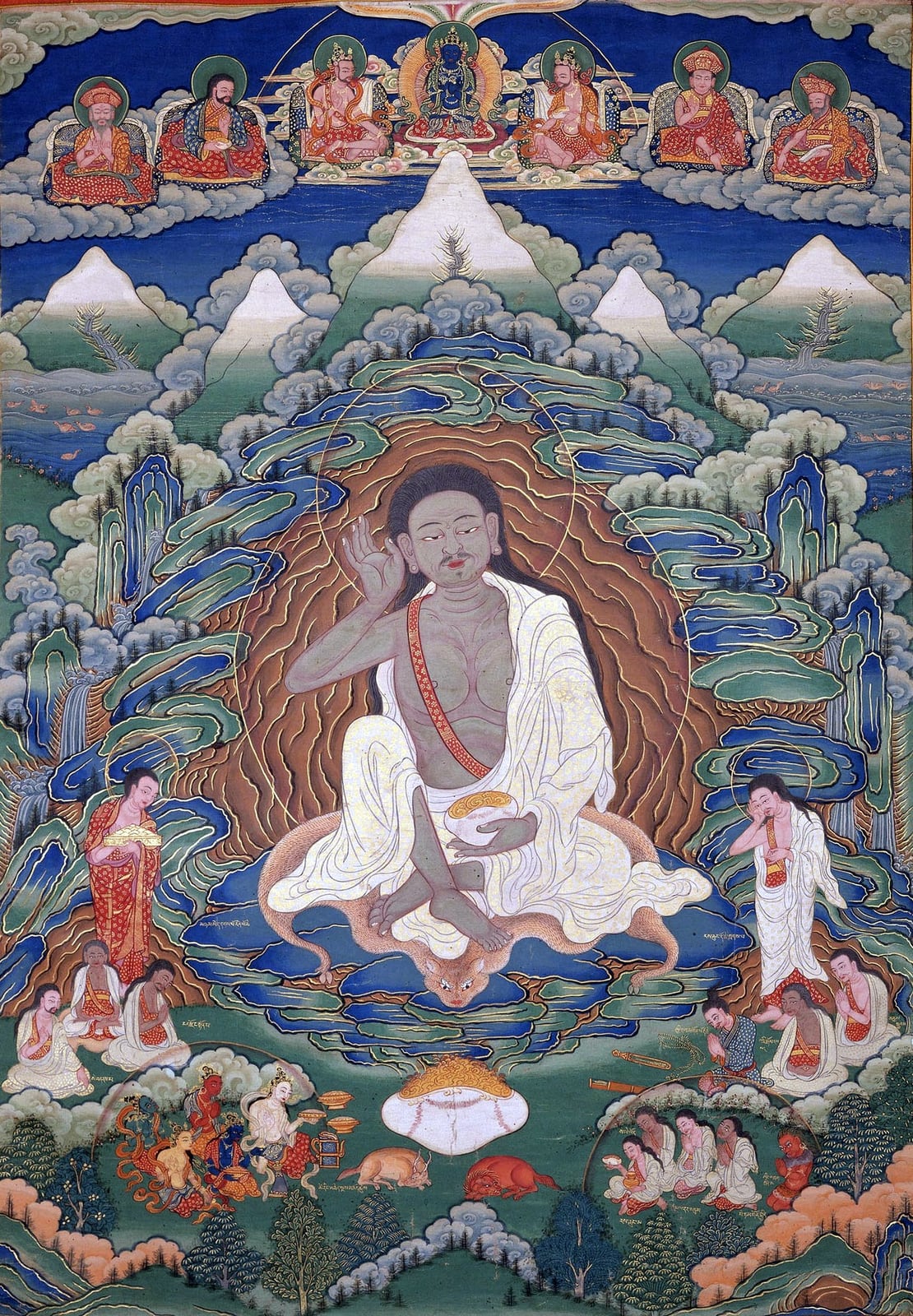
Tangka butanés de Milarepa, finales del s. XIX – principios del XX · Public domain
Con le sue parole
«Seeing this Life, one is freed from the eight worldly concerns. Hearing it, faith arises of itself. Recollecting it, entanglements are severed at the root.»Versos de cierre del Namthar; son palabras del compilador Tsangnyön Heruka sobre el libro, no de Milarepa, y así deben presentarse. Quintman (2010), pp. 233–234, citado en Quintman (2023)

La sua idea centrale
A single human life, however grave the guilt, suffices to reach awakening: Milarepa's story exists to show that a killer can become a buddha “in one body and one lifetime”, the promise of the tantric path as against the aeons of the gradual path.
Vederlo nel contesto
Biografia
6 min di lettura
Traduzione assistita dall'originale spagnolo, in attesa di revisione da parte di un traduttore madrelingua.
Ciò che si sa e ciò che si racconta
Di Milarepa, lo yogi più amato del Tibet, non si può affermare quasi nulla con certezza storica. Che sia esistito, che sia stato discepolo di Marpa il Traduttore e maestro di Gampopa, che sia vissuto da eremita sulle montagne al confine con il Nepal e che abbia insegnato cantando, lo ammette tutta la tradizione e lo accetta l'erudizione moderna. Ma la vita che tutti conoscono — la vendetta, le torri, le ortiche, il veleno — proviene da un solo libro, il namthar o «liberazione completa» composto nel 1488 da Tsangnyön Heruka, il «Folle dello Tsang», tre secoli e mezzo dopo i fatti, sulla base di biografie più antiche oggi in parte recuperate. Neppure le date sono al sicuro: la tradizione prevalente indica 1052–1135; gli eruditi kagyu del Settecento preferivano 1028–1111; buona parte degli studiosi attuali, 1040–1123. Questa scheda segue la cronologia del namthar e la indica per ciò che è: agiografia, cioè una vita scritta perché serva da modello.
Il figlio dei Mila
Nacque, secondo quel racconto, a Kya Ngatsa, nella valle di Gungthang, all'estremità sud-occidentale del Tibet, in una famiglia di mercanti arricchiti del clan Mila. Il padre, Sherab Gyaltsen, lo chiamò Thöpaga, «gioia da udire», perché il bambino cantava bene. Quando il padre morì, Thöpaga aveva sette anni; il testamento affidava il patrimonio agli zii paterni fino alla maggiore età dell'erede, e gli zii se ne impadronirono. La vedova, Nyangtsa Kargyen, e i suoi due figli, Thöpaga e Peta, finirono a servire in quella che era stata la loro casa. Quando il ragazzo compì quindici anni, la madre raccolse quel che le restava per un banchetto in cui reclamò pubblicamente l'eredità; gli zii la umiliarono davanti al villaggio. Ella vendette allora il suo ultimo campo per mandare il figlio a imparare la stregoneria.
Quel che segue è la parte del racconto che la tradizione non ha mai voluto addolcire: Thöpaga imparò, e ciò che imparò funzionò. Durante le nozze del figlio maggiore degli zii la casa crollò e morirono trentacinque persone; gli zii sopravvissero perché vedessero ciò che avevano perduto. Quando il villaggio volle vendicarsi, la madre chiese di più e il figlio scatenò la grandine sui raccolti. Il namthar non attenua i crimini perché ne ha bisogno: il santo del Tibet è, prima di ogni altra cosa, un assassino.
Marpa e le torri
Il rimorso giunse lentamente, sotto forma di paura della morte e della rinascita negli inferi. Thöpaga cercò un maestro; un lama della Grande Perfezione gli disse che il suo insegnamento liberava senza sforzo, e il discepolo, prendendolo in parola, si mise a dormire. Il lama lo mandò allora nel Lhodrak, da Marpa Chökyi Lodrö, il traduttore che si era recato tre volte in India per riportarne gli insegnamenti di Nāropa. Marpa, uomo di grande sapere e di pessimo carattere, seppe in sogno chi stava arrivando, ma lo accolse come un manovale: gli fece costruire una torre, demolirla, costruirne un'altra in un altro luogo, demolire anche quella, rimettere ogni pietra al suo posto, e infine innalzare la torre a nove piani di Sekhar Gutok, che esiste ancora. Nel frattempo gli negava le iniziazioni, lo scacciava a percosse dalle cerimonie cui assistevano altri discepoli e lo lasciava con la schiena in carne viva. La moglie di Marpa, Dagmema, ebbe pietà di lui e lo mandò con una lettera falsa da un altro maestro, Ngokpa; quando l'inganno fu scoperto, Marpa, in lacrime, spiegò che ciascuna delle prove era destinata a purificare un crimine, che se le avesse portate tutte a termine Milarepa non avrebbe più avuto bisogno di rinascere, e che ciò che mancava lo avrebbe purificato la meditazione. Aveva trentotto anni quando arrivò nel Lhodrak e quarantaquattro quando ne partì, con il nome iniziatico Zhepa Dorje e le istruzioni del calore interiore, il tummo, e del Grande Sigillo, la mahāmudrā.
Il vestito di cotone
Tornò al suo villaggio e trovò la casa in rovina e, all'interno, le ossa della madre. Quella notte, dice il testo, comprese d'un tratto l'impermanenza che studiava da anni, e partì per le montagne per non tornare più. Nella grotta di Drakar Taso, il «Dente di cavallo della Roccia Bianca», meditò per anni interi senz'altro cibo che le ortiche che crescevano all'ingresso, finché la pelle gli divenne verde, e i capelli pure; quando la sorella Peta lo trovò, credette di vedere un fantasma e gli rimproverò una vita che le pareva peggiore di quella di un mendicante. Milarepa le rispose cantando. La vergogna di Peta per la sua nudità, i ladri che entrano di notte nella grotta e non trovano nulla da rubare, il latte cagliato di cui lo yogi, per la forza del tummo, non ha bisogno: ogni episodio è un insegnamento in forma di scena. Vestito solo di una tela di cotone, divenne il repa, «colui che veste di cotone», e con quel nome lo conobbe l'Himalaya.
Da qui la biografia si fa geografia: Lapchi, Chuwar, il monte Kailash — dove, secondo il Mgur 'bum, sconfisse il sacerdote bön Naro Bönchung in un duello di poteri salendo sulla vetta a cavallo di un raggio di sole —, grotte del Nepal e del Tibet occidentale che ancora oggi si visitano. Insegnava a chiunque gli si avvicinasse, pastori, cacciatori, demoni, un geshe erudito, e lo faceva con canti improvvisati, i mgur, che la tradizione raccolse in una collezione di «centomila». Tra i suoi discepoli, due segnarono il futuro: Rechungpa, il «figlio del cuore», giunto bambino e tornato dall'India con le trasmissioni orali; e Gampopa, il monaco medico formato nella scuola kadam, che versò l'esperienza dello yogi nello stampo monastico e dai cui allievi nacquero i quattro grandi rami kagyu, tra cui quello dei Karmapa.
Il veleno e l'oro
Morì, sempre secondo il namthar, a ottantaquattro anni, a Chuwar, nella valle di Drin. Un geshe invidioso, Tsakpuwa, gli fece giungere del latte cagliato avvelenato tramite una concubina a cui aveva promesso un turchese; Milarepa, che lo sapeva, lo prese comunque perché il suo tempo era venuto, e prima di morire fece provare al geshe, nel proprio corpo, il dolore che aveva causato, lo perdonò e lo convertì. Riunì i discepoli, diede loro le ultime istruzioni — rinunciare alle otto preoccupazioni mondane, meditare in solitudine — e annunciò loro che sotto il focolare c'era dell'oro. Quando lo cercarono trovarono un pezzo di stoffa, un coltello, una zolletta di zucchero e un biglietto: chi avesse detto che Milarepa aveva avuto dell'oro si riempisse la bocca di escrementi. Il corpo, si dice, scomparve dalla pira, portato via dalle ḍākinī, e i discepoli si contesero reliquie che non esistevano.
La costruzione di un santo
Nulla di tutto questo è verificabile, e l'interessante è quanto sappiamo ormai di come fu costruito. Le prime biografie furono scritte nel XII secolo da discepoli diretti come Gampopa e Ngendzong Repa; nei secoli successivi vennero compilate in cicli — i Dodici grandi discepoli, il Tesoro nero dei Karmapa — che ampliarono il racconto con canti. Tsangnyön Heruka lo riscrisse come una biografia del Buddha in chiave tibetana, lo divise in due libri, la Vita e i Centomila canti, e, cosa decisiva, li fece stampare in xilografia in un momento in cui la stampa era ancora una novità nel Tibet centrale: di qui la loro ubiquità. Le ristampe di Gungthang del 1538, del 1540 e del 1550–1555 — conservate in parte alla Wellcome Collection e alla British Library — fissarono inoltre la sua immagine: seduto, con la mano destra all'orecchio, mentre canta. Jacques Bacot lo tradusse in francese nel 1925 ed Evans-Wentz lo pubblicò in inglese nel 1928; Garma C. C. Chang tradusse i canti nel 1962, Lobsang Lhalungpa la vita nel 1977, e Andrew Quintman, che ha ricostruito l'intero processo, la ritradusse nel 2010. Ciò che resta, alla fine, non è una vita verificabile ma qualcosa di più raro: un modello di vita che nove secoli di lettori hanno trovato credibile.
Fonti: Tsangnyön Heruka. The Life of Milarepa. Trad. Andrew Quintman; introducción de Donald S. Lopez Jr. Nueva York: Penguin Classics, 2010. ISBN 9780143106227. · Tsangnyön Heruka. The Life of Milarepa. Trad. Lobsang P. Lhalungpa. Nueva York: E. P. Dutton, 1977; Boston: Shambhala, 1985. ISBN 9780877732815. · Chang, Garma C. C. (trad. y anot.). The Hundred Thousand Songs of Milarepa. 2 vols. New Hyde Park (NY): University Books / Oriental Studies Foundation, 1962; reed. Boulder: Shambhala, 1977 y 1999 (ISBN 9781570624766). Vol. 1 digitalizado en Wikimedia Commons. · Quintman, Andrew. The Yogin and the Madman: Reading the Biographical Corpus of Tibet's Great Saint Milarepa. Nueva York: Columbia University Press, 2014. ISBN 9780231164153. · Evans-Wentz, W. Y. (ed.). Tibet's Great Yogī Milarepa: A Biography from the Tibetan. Trad. Lāma Kazi Dawa-Samdup. Londres: Oxford University Press, 1928. Digitalizado en Internet Archive.
Cronologia
La vita, anno per anno
Ogni punto è un evento documentato. Fai clic per leggerlo, con la sua fonte e il suo grado di certezza.
ca. 10520 anniKya Ngatsa, Gungthang
Birth of Mila Thöpaga
According to the Namthar he is born in a water-dragon year to a prosperous family of the Mila clan; his father, Mila Sherab Gyaltsen, names him Thöpaga, “delightful to hear”. The dominant tradition says 1052; other sources give 1040 or 1028.
TradizioneTsangnyön Heruka. The Life of Milarepa. Trad. Andrew Quintman; introducción de Donald S. Lopez Jr. Nueva York: Penguin Classics, 2010. ISBN 9780143106227.
Dopo la sua morte
- 1488Tsangnyön Heruka composes the Namthar and the Mgur 'bum
- 1538 – 1555The earliest surviving reprints
- 1928Arrival in the West: Bacot (1925) and Evans-Wentz (1928)
- 1962Garma C. C. Chang translates the Hundred Thousand Songs
- 2010 – 2014Quintman: new translation and study of the biographical corpus
ca. 1052 · 0 anni
Birth of Mila Thöpaga
According to the Namthar he is born in a water-dragon year to a prosperous family of the Mila clan; his father, Mila Sherab Gyaltsen, names him Thöpaga, “delightful to hear”. The dominant tradition says 1052; other sources give 1040 or 1028.
Tradizione
ca. 1059 · 7 anni
Death of his father and ruin of the family
His father dies leaving the estate in the care of the paternal uncle and aunt, who seize it and reduce the widow Nyangtsa Kargyen, Mila and his sister Peta to servitude.
Tradizione
ca. 1067 · 15 anni
Apprenticeship in sorcery and the revenge
At his mother's urging he learns black magic and the art of hail-casting; he brings down his uncle's house during a wedding, killing thirty-five people, and destroys the village harvest with hail.
Tradizione
ca. 1090 – 1096 · 38 anni
Marpa's disciple: the towers
Repentant, he seeks the Dharma; after a Dzogchen teacher who does him no good he reaches Marpa Chökyi Lodrö, who refuses to teach him and makes him build and tear down several stone towers before raising the nine-storey tower of Sekhar Gutok. Only then does he receive initiations and instructions (tummo, mahāmudrā, the oral transmissions).
Tradizione
ca. 1096 – 1108 · 44 anni
The retreat years
After returning to his village and finding his mother's bones, he withdraws to the cave of Drakar Taso (“White Rock Horse Tooth”), where he meditates for years living on nettles until his skin turns green. He then wanders the mountains as a repa, “cotton-clad one”, and attains realisation.
Tradizione
ca. 1110 · 58 anni
Meeting with Gampopa
The monk and physician Gampopa (1079–1153), trained in the Kadam school, becomes his chief disciple; from him the four great Kagyu branches will descend. Rechungpa (1085–1161), his “heart disciple”, has accompanied him since youth.
Tradizione
ca. 1135 · 84 anni
Death by poisoning
The Namthar relates that the envious geshe Tsakpuwa sent him poisoned curd through a concubine; Milarepa, knowing what he did, took it, gave his final teachings and died aged eighty-four. His testament revealed that the “gold” he claimed to keep was a scrap of cloth and a lump of sugar.
Tradizione
1488
Tsangnyön Heruka composes the Namthar and the Mgur 'bum
The “Madman of Tsang” (1452–1507) fixes the canonical version of the life and songs from earlier biographies (Gampopa, Ngendzong Repa, the Twelve Great Disciples, the Black Treasury cycle) and has it woodblock-printed: the origin of the saint's universal fame.
Documentato
1538 – 1555
The earliest surviving reprints
Printing of the Namthar at Ron Wosel Puk (1538) under Tokden Chökyi Gyatso; of the Mgur 'bum at Lende Langpuk (1540, folio in the Wellcome Collection) and at Drakar Taso (1550–1555, folio in the British Library, OPB 19999a3), which fixes Milarepa's iconography with his hand to his ear.
Documentato
1928
Arrival in the West: Bacot (1925) and Evans-Wentz (1928)
Jacques Bacot publishes in French the first European translation of the Namthar; three years later Oxford University Press issues Kazi Dawa-Samdup's English version edited by W. Y. Evans-Wentz, which for half a century was Western readers' gateway.
Documentato
1962
Garma C. C. Chang translates the Hundred Thousand Songs
First complete translation of the Mgur 'bum into a Western language (University Books, 2 vols.), reissued by Shambhala in 1977 and 1999; the basis of nearly all versions into other languages until Christopher Stagg's new translation (2017).
Documentato
2010 – 2014
Quintman: new translation and study of the biographical corpus
Andrew Quintman publishes the Penguin Classics translation (2010) and The Yogin and the Madman (2014), the first systematic study of the biographies prior to Tsangnyön; with him the figure passes from devotional tale to the history of its own construction.
Documentato
Opere
Opere essenziali
Le opere senza le quali non si comprende la sua eredità.
Attribuzione tradizionale · 1488
The Life of Milarepa (Namthar)
རྗེ་བཙུན་མི་ལ་རས་པའི་རྣམ་ཐར། (rje btsun mi la ras pa'i rnam thar)
The canonical biography, divided into twelve chapters between “worldly deeds” (birth, ruin, revenge by sorcery) and “supreme deeds” (the trials with Marpa, the retreat at Drakar Taso, the teaching and the death by poison). Written as a life of the Buddha in a Tibetan key, it is at once a novel of formation, a practice manual and Tibet's most widely read book; its woodblock circulation from the late fifteenth century explains the figure's ubiquity.
10 edizioni · amazon.it
Tutta la sua opera (7)

The Hundred Thousand Songs of Milarepa (Mgur 'bum)
1488

Drinking the Mountain Stream: Songs of Tibet's Beloved Saint
1978
Milarepa
Sixty Songs of Milarepa
The Conscious LibrarySixty Songs of Milarepa
1966

The Yogin and the Madman
2014
Milarepa
Milarepa: Lessons from the Life and Songs of Tibet's Great Yogi
The Conscious LibraryMilarepa: Lessons from the Life and Songs of Tibet's Great Yogi
2017
Milarepa
Miraculous Journey: Further Stories and Songs of Milarepa
The Conscious LibraryMiraculous Journey: Further Stories and Songs of Milarepa
1986
Citazioni
Citazioni localizzate in un'opera precisa. Ciascuna porta con sé la sua provenienza e il suo grado di affidabilità.
Whoever says that Milarepa possessed gold, let him fill his mouth with excrement.(tibetano; traducción libre del investigador a partir de Lhalungpa 1977 y Quintman 2010)
ProbabileNamthar (Tsangnyön Heruka, 1488), capítulo final («Nirvana»): la nota hallada bajo el hogar junto a un trozo de tela, un cuchillo y un terrón de azúcar, tras anunciar a los discípulos que allí había oro
Idee essenziali (sintesi editoriale)
Per rispetto del diritto d'autore, queste idee sono riassunte con parole nostre e non sono presentate come citazioni letterali.
- A single human life, however grave the guilt, suffices to reach awakening: Milarepa's story exists to show that a killer can become a buddha “in one body and one lifetime”, the promise of the tantric path as against the aeons of the gradual path.
- The suffering imposed by the teacher is not cruelty but purification: each tower raised and razed for Marpa corresponds to a crime, and the devotion that endures the trial is the true initiation, prior to any ritual.
- Mountain solitude is the place of practice, not an escape: in the cave one finds what village, monastery and books do not give, and voluntary poverty—a cloth, a staff, nettles—is freedom, not lack.
- Death is certain and its hour uncertain; therefore every delay is a loss. The songs return again and again to impermanence not as consolation but as a goad: there is no time for the affairs of the world.
- Realisation is taught by singing: the improvised song (mgur) does not embellish doctrine, it embodies it, because what has been understood in the body comes out in verse and in plain speech, within reach of shepherds and hunters.
- Inner heat (tummo) and the Great Seal (mahāmudrā) are two faces of one experience: the body that needs no shelter and the mind that recognises its own nature; the cotton-clad repa in the snow is the visible proof of the invisible.
Citazioni apocrife o di attribuzione discussa (3)
«My religion is to live and die without regret.»
Milarepa's most quoted sentence in the West, used as an epigraph by Shambhala and on countless pages, could not be located in that wording either in the Namthar (Lhalungpa, Quintman) or in the Mgur 'bum (Chang). It faithfully conveys the sense of his final teaching but is recorded as unverified.
«In the beginning nothing comes, in the middle nothing stays, at the end nothing goes.»
Circulates as a Milarepa song on the nature of mind; it could not be found in the Chang or Stagg translations. It may derive from genuine Mgur 'bum verses on the mind as “unborn, unabiding and unceasing”, reworded in popular literature.
«Hasten slowly and you shall soon arrive.»
Attributed to Milarepa in quotation anthologies; it is a variant of the Latin adage “festina lente”. Not found in any Tibetan source consulted.
Ultime parole
Attribuzione tradizionale
«Do as I have done: give up the eight worldly concerns, homeland and kin, and meditate in the solitude of the mountains until realisation is firm. That is my final instruction; I have no other.»Hagiographic, not historical. The final chapter of Tsangnyön Heruka's Namthar (1488) has Milarepa, at Chuwar and already poisoned, deliver a last discourse and a last song to his disciples: he asks them to give up worldly concerns and practise in solitude, and declares that his only possessions are his cotton robe, his staff and a cup; then he enters meditation and dies. What is offered here is a free rendering of the sense of that instruction, written by the researcher from the Lhalungpa and Quintman translations, not a literal quotation from either. The Namthar was composed three and a half centuries after the events on the basis of earlier biographies; there is no contemporary testimony.
Fonte: Tsangnyön Heruka. The Life of Milarepa. Trad. Andrew Quintman; introducción de Donald S. Lopez Jr. Nueva York: Penguin Classics, 2010. ISBN 9780143106227.
Chiedi
Ciò a cui risponde la sua opera
Dodici grandi domande dell'umanità e ciò che i suoi testi permettono di rispondere, con riferimenti. Non gli mettiamo mai parole in bocca.
Che cos'è l'Assoluto? Dio esiste?
He seeks no creator: the ultimate is the nature of one's own mind
Nessun Dio creatoreSi deduce dalla sua dottrina
In the sources on Milarepa — the biography (namthar) and the Hundred Thousand Songs compiled by Tsangnyön Heruka in the fifteenth century — the question of a creator God does not arise as a problem. The horizon is tantric Buddhism of the Kagyü school: what must be recognised is the nature of mind, empty and luminous, which the songs describe again and again as impossible to grasp with concepts, without centre or limit. The meditation deities and dakinis who people his songs are not creators of the world but presences and manifestations on the path, and in the logic of Mahamudra they do not exist apart from mind. Liberation depends not on the grace of a God but on practice in solitude, devotion to the master Marpa and direct recognition. His work therefore falls within the non-theistic field.
Confronta questa domanda con altri maestriChi sono io? Esiste un vero sé?
Sought for, the self is not found: mind is empty and luminous
Non c'è un sé permanenteSi deduce dalla sua dottrina
The songs attributed to Milarepa in Tsangnyön Heruka's compilation return again and again to the search for mind and self: examined, they are found neither inside nor outside, and have no shape, colour or location. What follows is not nothingness but the nature of mind according to the Mahamudra of the Kagyü school: empty of a substantial self and at the same time clear and aware. Attachment to a self, by contrast, is the root of the passions and of the cycle of rebirth that Milarepa's biography narrates starkly, from his youthful crimes to his purification. Spiritual work consists in recognising this absence of self in one's own experience, in solitude and under the master's guidance, until the idea of a solid self no longer governs one's life.
Confronta questa domanda con altri maestriPerché soffriamo?
Evil done returns: his trials under Marpa purified a terrible karma
Il karma e l'apprendimento dell'animaLo dice espressamente
Milarepa's biography is itself a lesson on the origin of suffering. According to the namthar compiled by Tsangnyön Heruka, as a young man, urged by his mother to take revenge on the relatives who had dispossessed them, he learned black magic and caused the deaths of many people. Remorse and fear of the karmic consequences of those acts led him to seek the dharma. His master Marpa subjected him to very harsh trials — building and tearing down stone towers again and again — which the tradition interprets as purification of that karma. In the songs, Milarepa insistently recalls impermanence, the imminence of death and the sufferings of samsara as reasons to practise without delay. Pain is the fruit of past acts and, at the same time, the spur that drives towards liberation.
Confronta questa domanda con altri maestriChe cosa accade dopo la morte?
Fear of a bad rebirth drove him to liberation in a single life
Rinascita secondo il karmaLo dice espressamente
In the Life of Milarepa, composed by Tsangnyön Heruka in the fifteenth century, rebirth according to karma is the engine of the whole narrative. Having caused deaths through black magic out of revenge, Milarepa is terrified at the prospect of rebirth in the hells, and that fear leads him to Marpa, to the trials of the tower and to years of solitary meditation. The songs of the tradition insist on impermanence: death comes without warning, the body is borrowed, and the only thing that accompanies the dead are their deeds; whoever does not practise now will be reborn dragged along by them. At the same time, the narrative presents Milarepa as proof that liberation is possible in a single life through Mahamudra and the yogas of Naropa, which include preparation for the intermediate state (bardo). For the realised yogi, dying is an occasion to recognise the nature of mind.
Confronta questa domanda con altri maestriCome si raggiunge la liberazione o la salvezza?
Extreme purification under the master and years of solitary meditation: liberation in one lifetime
Con una pratica disciplinataLo dice espressamente
According to the Life of Milarepa compiled by Tsangnyön Heruka in the fifteenth century, Milarepa's path begins with heavy negative karma (the killings committed through black magic) and passes through two phases. First, purification: his master Marpa makes him build and demolish towers for years before transmitting the instructions. Then meditation in high mountain caves, with extreme asceticism, until realisation. The biography thus presents liberation as possible in a single life for whoever combines the transmission of a lineage, faith in the master and uncompromising perseverance. The songs gathered in The Hundred Thousand Songs insist on the same: renounce worldly concerns and practise without delay in the face of the certainty of death.
Confronta questa domanda con altri maestriServe un maestro?
Without Marpa and his transmission no liberation: faith in the guru sustains everything
IndispensabileLo dice espressamente
The Life of Milarepa is, to a large extent, the story of a relationship of discipleship. After a first teacher who cannot help him, Milarepa is sent to Marpa the Translator, who for years subjects him to apparently arbitrary trials, such as building and demolishing towers, and withholds teaching. The hagiography presents those humiliations as the necessary purification of his bad karma, and Milarepa's unshakeable obedience and faith as the condition for receiving the lineage's instructions. Only with that transmission can he then meditate fruitfully in solitude. The work thus reflects the Vajrayana conception of the guru as the source of blessings and of the efficacy of practice: without him, the path does not open.
Confronta questa domanda con altri maestriIl mondo è reale?
Appearances are like a dream or a magical illusion: empty and luminous
Una rete di cause senza sostanzaSi deduce dalla sua dottrina
In the songs attributed to Milarepa, the nature of the world is approached from the meditative experience of the Mahamudra tradition. Appearances are compared to a dream, a mirage or a magical illusion: they appear vividly but lack inherent existence. That emptiness is not presented as nothingness but as inseparable from the clarity of mind: appearance and emptiness are a unity. For Milarepa the error is not that there are phenomena but clinging to them as solid and pursuing worldly occupations as though they were lasting. Impermanence and death, constant themes in his songs, show that nothing in the world can be held on to, and therefore invite practice.
Confronta questa domanda con altri maestriChe cos'è l'amore?
Breaking the bonds of worldly affection so that compassion for all may arise
Compassione senza limitiLo dice espressamente
The Life of Milarepa shows two kinds of love in tension. On the one hand, family affection: the love for his mother, which drove him to revenge, and that of his sister Peta, who visits him in the cave and reproaches him for his poverty. When he returns to his village and finds the house in ruins and his mother's bones, Milarepa experiences that attachment as a source of pain and decides to renounce everything. On the other hand, the songs present him cultivating bodhicitta, the mind of awakening that seeks to free all beings, as the root of practice: compassion towards beings, whom the Tibetan tradition teaches one to see as former mothers, replaces attachment to one's own. Towards his persecutors, such as the lama Tsakpuhwa who ends up poisoning him, the tradition credits him with compassion rather than resentment.
Confronta questa domanda con altri maestriSiamo liberi o è tutto determinato?
The repentant murderer who purifies his karma in a single lifetime
Karma e sceltaLo dice espressamente
In Tibetan tradition Milarepa's life is the supreme example that karma conditions but does not condemn. According to the *Namthar*, the young Thöpaga learns black magic to avenge his mother and causes the death of dozens of people; terrified by the consequences of those acts, he seeks the Dharma. Marpa makes him build and tear down towers again and again, trials the tradition reads as purification of the evil committed, and only then gives him the instructions. Milarepa attains realisation in that same life through years of retreat. The story does not deny the law of karma —fear of its fruits is what moves him— but shows that present action, sustained with extreme effort, can change its course.
Confronta questa domanda con altri maestriPerché meditare o pregare?
Meditating in the cave because death comes: recognising the nature of mind
Vedere la realtà così com'èLo dice espressamente
According to the *Namthar* and the *Hundred Thousand Songs*, Milarepa's meditation has an explicit driver: awareness of impermanence and death, which makes any worldly occupation a waste of time. After receiving the instructions from Marpa, he withdraws for years to high caves, lives on nettles and practises inner heat (*tummo*) and meditation on the nature of mind, in the line the Kagyu tradition would call *mahāmudrā*. His songs to disciples and visitors insist on two ideas: everything compounded falls apart, and the mind, looked at directly, is empty and luminous. To meditate is to see reality as it is until that seeing becomes continuous.
Confronta questa domanda con altri maestriPuò la ragione conoscere l'ultimo?
The cave yogi against the scholar: practice, not books
L'ultimo è al di là della menteLo dice espressamente
Milarepa's tradition often contrasts the meditator's realisation with bookish learning. In the *Namthar*, one of the last episodes pits the yogi against the scholar Geshe Tsakpuhwa, who tries to humiliate him with questions of logic and doctrine and, envious of his prestige, ends up having him poisoned. The *Hundred Thousand Songs* contain several answers to monks and scholars in which Milarepa declares that he has forgotten the words of the texts because he has become familiar with their meaning, and that the nature of mind is reached not by reasoning but by direct experience received from the master and matured in meditation. The ultimate is not proven: it is recognised.
Confronta questa domanda con altri maestriRitirarsi dal mondo o trasformarlo?
The cave and total renunciation, without house, goods or family
Ritirarsi per trovareLo dice espressamente
Milarepa is the model of the solitary yogi in Tibetan Buddhism. According to his Life, after completing the trials imposed by Marpa he withdrew for years to Himalayan caves, living on nettles until his skin turned greenish, without possessions and declining the offers of marriage or a comfortable life made to him. When his sister Peta reproaches him for his poverty and asks him to live like decent people, he answers with songs that set the eight worldly concerns — gain and loss, pleasure and pain, praise and blame, fame and disrepute — against the freedom of the practitioner. The tradition presents this renunciation as the condition of awakening in a single life. Yet it is not a fruitless isolation: in his maturity Milarepa receives disciples, such as Gampopa and Rechungpa, and teaches in song to herders, hunters and villagers.
Confronta questa domanda con altri maestri
Affinità e tensioni
Affinità e tensioni
Calcolate domanda per domanda a partire dalle sue posizioni. Il perché di ogni accordo o contrasto, con un clic.
La pensa in modo simile a
Śāntideva
Concordano su: Come si raggiunge la liberazione o la salvezza? · Che cos'è l'Assoluto? Dio esiste? · Chi sono io? Esiste un vero sé?
Tsongkhapa
Concordano su: Come si raggiunge la liberazione o la salvezza? · Che cos'è l'Assoluto? Dio esiste? · Chi sono io? Esiste un vero sé?

Siddhartha Gautama, the Buddha
Concordano su: Che cos'è l'Assoluto? Dio esiste? · Chi sono io? Esiste un vero sé? · Che cosa accade dopo la morte?

Dōgen
Concordano su: Che cos'è l'Assoluto? Dio esiste? · Chi sono io? Esiste un vero sé? · Che cosa accade dopo la morte?
La pensa diversamente da

Francis of Assisi
Si scontrano su: Che cos'è l'Assoluto? Dio esiste? · Chi sono io? Esiste un vero sé? · Che cosa accade dopo la morte?

Emanuel Swedenborg
Si scontrano su: Che cos'è l'Assoluto? Dio esiste? · Chi sono io? Esiste un vero sé? · Che cosa accade dopo la morte?
Catherine of Siena
Si scontrano su: Che cos'è l'Assoluto? Dio esiste? · Chi sono io? Esiste un vero sé? · Che cosa accade dopo la morte?

Meister Eckhart
Si scontrano su: Chi sono io? Esiste un vero sé? · Che cosa accade dopo la morte? · Come si raggiunge la liberazione o la salvezza?
Si scontrano suContraddizione apparente
Milarepa · The 14th Dalai Lama (Tenzin Gyatso)
Total obedience in the cave or critical discernment in the world: the guru in Tibet
Perché: The contradiction is apparent for two reasons. The first is genre: the Life of Milarepa is a fifteenth-century hagiography composed to exalt the Kagyu lineage, and its portrait of the perfect disciple is not a manual for choosing a master; the Dalai Lama speaks in public teachings, before global audiences exposed to unscrupulous teachers. The second is stage: the Tibetan tradition itself asks that the master be examined before acceptance and fully trusted afterwards, so the Dalai Lama's advice precedes the moment the Life recounts. Withdrawal and engagement, for their part, answer to different vocations, and Milarepa himself ended up teaching herdsmen, hunters and villagers.
Concordano su
Milarepa · Teresa of Ávila
Suffering that purifies: Marpa's towers and the trials of the sixth dwelling places
Perché: The affinity is comparative: there is no relation between the eleventh-century Tibetan yogi and the sixteenth-century Castilian Carmelite. They converge because their traditions share an ascetic anthropology: the human being is bound by something that must be undone, and that undoing hurts. The explanation of pain, however, differs. In the Life of Milarepa suffering is the fruit of past actions and is exhausted through purification under a master; in Teresa it is participation in the cross of Christ and preparation for a union that God grants by grace. It should also be remembered that the Life is a fifteenth-century hagiography, whereas Teresa writes in the first person about what she lived.
Aneddoti e racconti
Aneddoti e racconti
Racconto agiograficoc. 1067
The house that collapsed at the wedding
Origine del racconto: Tsangnyön Heruka's Namthar (1488), chapter 3 (“worldly deeds”); the episode already appears in the earlier biographies of the Twelve Great Disciples cycle.
Racconto agiograficoc. 1090–1096
Marpa's towers
Origine del racconto: Namthar, chapters 5–6 (Quintman, 2010); the tower is a documented real building (photograph by H. E. Richardson, 1950, on Commons), and Quintman's essay (2023) describes it with its 1200–1250 mural.
Racconto agiograficoc. 1096–1105
The nettles of Drakar Taso
Origine del racconto: Namthar, chapters 9–10; Quintman's essay (2023) confirms the site's identification and its later history as a printery.
Racconto agiograficoc. 1100–1120
The hunter, the doe and the dog
Origine del racconto: Mgur 'bum (Tsangnyön Heruka), chapter “Milarepa and the hunter” (Chang, 1962, vol. 1, ch. 26, “The Hunter and the Deer”). The painting by Chöying Dorje, Tenth Karmapa (1613), is on Commons described as “Milarepa, Gonpo Dorje, the deer and the dog”.
Racconto agiograficoc. 1100–1120
The contest on Kailash
Origine del racconto: Mgur 'bum, chapter “Milarepa's meeting with Naro Bönchung on Kailash” (Chang, 1962, vol. 1). A religious-polemical narrative with no verifiable historical basis.
Racconto agiograficoc. 1110–1112
The last teaching to Gampopa
Origine del racconto: Mgur 'bum, chapter “Milarepa's meeting with Gampopa” (Chang, 1962, vol. 2, ch. 41, “The Meeting with Gampopa”); also in Gampopa's own biography.
Racconto agiograficoc. 1135
The geshe's poison and the gold that did not exist
Origine del racconto: Namthar, chapter 12 (“Nirvana”); also summarised in Lion's Roar (m14) from Quintman. No contemporary source for the death exists.
Insegnamenti
Insegnamenti
Le nozioni che articolano il suo pensiero, spiegate nel loro contesto.
Songs of realisation (mgur)mgur
Indian tantric poetry (dohā) and the Tibetan song tradition; Kagyu literature.
Mahāmudrā (phyag rgya chen po), the Great Sealmahamudra
Vajrayāna; Kagyu lineage (Tilopa–Nāropa–Marpa–Milarepa–Gampopa); Indian mahāsiddhas.
Tummo (gtum mo), inner heattummo
Six yogas of Nāropa; Hevajra and Cakrasaṃvara tantras; completion stage of Anuttarayoga.
Guru devotion and purification through trialdevocion-al-guru
Vajrayāna guru-yoga; doctrine of karma; oral-transmission lineages (bka' brgyud).
Mountain retreat (ri khrod) and the life of the repari-khrod
Tantric asceticism; the mahāsiddha tradition; Kagyu hermitages of the Himalaya.
Awakening “in one body and one lifetime”una-vida-un-cuerpo
Vajrayāna versus gradual Mahāyāna; Tibetan hagiography (rnam thar); Lopez, introduction to Quintman 2010.
Ritiri
Ritiri e centri
Luoghi e incontri legati al suo insegnamento. Ti mettiamo in contatto con chi li organizza.
Eskdalemuir, Dumfries and Galloway · Reino Unido
Kagyu Samye Ling, Scotland
Kagyu Samye Ling Monastery and Tibetan Centre
Samye Ling, founded in 1967 in the hills of southern Scotland, was the first Tibetan Buddhist centre in the West and is one of the great monasteries of the Kagyu lineage outside Tibet. That lineage, known as the lineage of oral transmission, descends directly from Marpa the Translator and his disciple Milarepa, whose songs and life of retreat in Himalayan caves remain the model of Kagyu practice. The centre offers meditation courses, teachings by masters of the tradition and retreats, along with a Tibetan-style temple and a monastic community that keeps up daily practice.
Woodstock, Nueva York · Estados Unidos
Karma Triyana Dharmachakra (KTD), Woodstock
Karma Triyana Dharmachakra
Karma Triyana Dharmachakra is a traditional Tibetan monastery in the Catskill Mountains above Woodstock and the North American seat of the 17th Gyalwang Karmapa Ogyen Trinley Dorje. It keeps daily practices, a weekly meditation class and retreats ranging from one-day calm-abiding sessions to eight-day retreats and Nyungne fasting practices; it also accepts personal retreats of up to two weeks and runs online study groups. Like every Kagyu centre, it regards itself as heir to the chain of transmission that runs through Tilopa, Naropa, Marpa and Milarepa, whose songs of realisation are recited and taught in the tradition.
Saint-Léon-sur-Vézère, Dordoña · Francia
Dhagpo Kagyu Ling, Dordogne
Dhagpo Kagyu Ling
Dhagpo Kagyu Ling is the European seat of the Karma Kagyu lineage, in the Vézère valley in the French Dordogne, under the spiritual direction of the 17th Karmapa Thaye Dorje. It describes itself as a place to understand and live Buddhism, with teachings, retreats, a progressive cycle of study and meditation, regular practices and activities for young people, both in person and online. The Kagyu lineage counts Milarepa among its founding fathers: his life, from guilt to realisation through effort and devotion to his teacher Marpa, is one of the stories most often studied within the tradition.
Video
Video
Registrazioni, interviste e documentari. I video vengono riprodotti da YouTube; non sono ospitati qui.
Andrew Quintman: The Yogin and the Madman
Conferenza· EN
Yale University
The Making of Milarepa: Reading & Writing the Life of Tibet's Great Saint
Conferenza· EN
CU Boulder Libraries
The Making of Milarepa with Andrew Quintman
Conferenza· EN
Shantideva Center, FPMT
Andrew Quintman, Judy Lief, Tenzing Lamsang, Nikko Odiseos | Milarepa: The Master and His Teachings
Analisi· EN
Jaipur Literature Festival
The Life of Jetsun Milarepa
Conferenza· EN
LamaJampaThaye
Songs of Milarepa: Session 1
Conferenza· EN
Kagyu Samye Dzong Edinburgh
H.E. Sangye Nyenpa Rinpoche sings the Milarepa's Aspiration Song
Registrazione originale· BO
Benchen Library
Jetsün MILARÉPA – Une Vie, une Œuvre : Un voyage de la magie à l'illumination (France Culture, 1993)
Documentario· FR· 1993
ÉCLAIR BRUT
Milarépa // Entretien avec Matthieu Ricard
Intervista· FR
Jupiter Films
Vida de Milarepa. El gran Yogui del Tibet. Escuela de Filosofía Nueva Acrópolis
Conferenza· ES
Nueva Acrópolis España
Carla Gianotti: "Vita di Milarepa"
Conferenza· IT
JAMTSE LING Centro Rimé
Galleria
Galleria
Immagini con licenza verificata. Ciascuna conserva la sua paternità e la sua attribuzione.
Manoscritti
Manoscritti
Testimoni manoscritti e testi antichi, con il loro custode e le loro condizioni di consultazione.
BO · Tibetano (dbu can), xilografía · 1488
rje btsun mi la ras pa'i rnam thar
- Testimone conservato
- Impresión xilográfica de 1538, Ron Wosel Puk (Gungthang): la edición impresa más antigua conservada del Namthar; folios de 8 × 44 cm con ilustraciones marginales de Milarepa, Rechungpa, Gampopa y Zhiwa Ö
- Custode
- No indicado en la fuente (reproducido en el catálogo «Bod kyi shing spar lag rtsal gyi byung rim mdor bsdus», Lhasa, 2013)
BO · Tibetano (dbu can), xilografía · c. 1488
rje btsun mi la ras pa'i rnam thar rgyas par phye ba mgur 'bum
- Testimone conservato
- Primer folio de la impresión de Lende Langpuk, 1540 (3½ × 19 in.), con Milarepa en gesto de cantar, la mano izquierda alzada
- Custode
- Wellcome Collection, Londres · Imagen L0025571 (signatura del objeto no localizada; véase pending)
- Digitalizzazione
- commons.wikimedia.org/wiki/File:Tibetan_Manuscri…
BO · Tibetano (dbu can), xilografía · c. 1488
mi la ras pa'i mgur 'bum
- Testimone conservato
- Impresión de Drakar Taso, 1550–1555; primer folio (4⅛ × 20 in.) con Milarepa en la postura que se haría canónica: mano derecha en la oreja, cráneo-copa en la izquierda
- Custode
- British Library, Londres · OPB 19999a3
BO · Tibetano (dbu can), xilografía en bloque · c. 1488 (impresión posterior)
mi la ras pa'i mgur 'bum
- Testimone conservato
- Xilografía de Pekín, 342 folios, en un volumen
- Custode
- Biblioteca Nacional de Mongolia (Ulán Bator); escaneo del Asian Classics Input Project y BDRC · BDRC bdr:MW1KG1252 (obra bdr:WA1KG1252; escaneo bdr:W1KG1252, volumen bdr:I1KG1274)
- Digitalizzazione
- library.bdrc.io/show/bdr:MW1KG1252…
BO · Tibetano (dbu can), manuscrito con ilustraciones · Siglos XIII–XV (copia de los siglos XVII–XVIII)
Biografía ilustrada de Milarepa (ciclo del Tesoro Negro / Doce Grandes Discípulos)
- Testimone conservato
- Manuscrito de 245 folios (4 × 23 in.), tinta y colores sobre papel, con personajes que recorren el texto
- Custode
- Newark Museum of Art (Nueva Jersey) · 36.280.1.1–245
BO · Tibetano (dbu can), manuscrito ilustrado · Siglo XVI (copia)
Manuscrito del Tesoro Negro (mdzod nag ma): el Sueño de los Cuatro Pilares
- Testimone conservato
- Folios de 8 × 42,5 cm, tinta y pigmentos sobre papel; Milarepa ante Marpa relatando la visión profética de los cuatro pilares
- Custode
- Tibet Museum / Fondation Alain Bordier, Gruyères (Suiza) · ABS 039
Relazioni
Relazioni
Influenze, discepolati e affinità. Si distingue la relazione documentata dalla somiglianza individuata per analisi.
Discepolo di
Marpa Chökyi Lodrö (Marpa el Traductor)
His root guru according to the whole tradition; the trials of the towers and the transmission of tummo and mahāmudrā are the core of the Namthar.
Relazione documentata
Maestro di
Gampopa (Dakpo Lhaje, 1079–1153)
His chief disciple, from whose students the four great Kagyu branches descend; author of one of the oldest biographies of Milarepa.
Relazione documentata
Maestro di
Rechungpa Dorje Drakpa (1085–1161)
The “heart disciple”, the narrative addressee of the Namthar and bearer of the oral transmissions brought from India.
Relazione documentata
Idee affini a
Both figures, according to Quintman, transformed the sacred geography of the Himalaya through their life stories; there is no historical relation (Padmasambhava belongs to the eighth century) nor a direct doctrinal one.
Somiglianza individuata per analisi
Idee affini a
Radical voluntary poverty, preaching to animals (the hunter's doe and dog; the wolf of Gubbio) and teaching in song; both born to merchant families. A parallel identified by the researcher, with no historical relation.
Somiglianza individuata per analisi
Idee affini a
Religious poetry sung in the vernacular, outside institutions and addressed to ordinary people; in both cases the corpus was fixed centuries later and mixes voices.
Somiglianza individuata per analisi
Idee affini a
Mysticism expressed in verse and later commented on; night and mountain as places of the path. A typological, not historical, parallel.
Somiglianza individuata per analisi
Collegato da altre schede
Fonti
Fonti
Bibliografia e cataloghi consultati per questa scheda.
- Wikidata, «Milarepa», QID Q58431 (VIAF 173200978; LCCN n80034328); BDRC bdr:P1853; Treasury of Lives P1853.
- Quintman, Andrew. «A Tibetan Liberation Tale Illustrated in Print and Manuscript: Earliest Extant Printed Edition of Milarepa's Life Story (Ron Wosel Puk, Gungtang, 1538)». Project Himalayan Art, Rubin Museum of Art, 2023.
- Tsangnyön Heruka. The Life of Milarepa. Trad. Andrew Quintman; introducción de Donald S. Lopez Jr. Nueva York: Penguin Classics, 2010. ISBN 9780143106227.
- Tsangnyön Heruka. The Life of Milarepa. Trad. Lobsang P. Lhalungpa. Nueva York: E. P. Dutton, 1977; Boston: Shambhala, 1985. ISBN 9780877732815.
- Chang, Garma C. C. (trad. y anot.). The Hundred Thousand Songs of Milarepa. 2 vols. New Hyde Park (NY): University Books / Oriental Studies Foundation, 1962; reed. Boulder: Shambhala, 1977 y 1999 (ISBN 9781570624766). Vol. 1 digitalizado en Wikimedia Commons.
- Quintman, Andrew. The Yogin and the Madman: Reading the Biographical Corpus of Tibet's Great Saint Milarepa. Nueva York: Columbia University Press, 2014. ISBN 9780231164153.
- Quintman, Andrew. «Wrinkles in Time: On the Vagaries of Mi la ras pa's Dates». Acta Orientalia 74 (2013): 3–26.
- Quintman, Andrew. «Milarepa». The Treasury of Lives (biografía académica en línea), P1853.
- Wikipedia (en). «Milarepa». Usada como índice de ediciones y de la bibliografía secundaria; contrastada con m2, m3 y m6.
- Buddhist Digital Resource Center (BDRC). «mi la ras pa'i mgur 'bum» (rje btsun mi la ras pa'i rnam thar rgyas par phye ba mgur 'bum), obra bdr:WA1KG1252; xilografía de Pekín bdr:MW1KG1252, 342 ff., escaneada en la Biblioteca Nacional de Mongolia (bdr:W1KG1252).
- Evans-Wentz, W. Y. (ed.). Tibet's Great Yogī Milarepa: A Biography from the Tibetan. Trad. Lāma Kazi Dawa-Samdup. Londres: Oxford University Press, 1928. Digitalizado en Internet Archive.
- Wikimedia Commons, API imageinfo (licencia, autor, fecha y descripción de cada fichero citado en images[]).
- Open Library (Internet Archive). Registros de ISBN de cada edición citada en works[].
- Lion's Roar staff. «The Life of Milarepa» (adaptado de Buddhadharma, invierno de 2010; cita las traducciones de Quintman y Lhalungpa).
- Tsangnyön Heruka. The Hundred Thousand Songs of Milarepa: A New Translation. Trad. Christopher Stagg (Nitartha Translation Network), bajo la dirección de Dzogchen Ponlop Rinpoche. Boulder: Shambhala, 2017. ISBN 9781559394482.
- Bacot, Jacques (trad.). Le poète tibétain Milarépa: ses crimes, ses épreuves, son nirvāna. París: Bossard, 1925 (reed. Fayard, 1971). Trad. española: Vida de Milarepa, Palma: José J. de Olañeta, 2013, ISBN 9788497166492.
- Sernesi, Marta. «A Continuous Stream of Merit: The Early Reprints of gTsang smyon Heruka's Hagiographical Works». Zentralasiatische Studien 40 (2011): 179–237.
- Wellcome Collection, Londres. Xilografía tibetana «rje btsun mi la ras pa'i rnam thar… mgur 'bum» (primer folio, impresión de Lende Langpuk, 1540), imagen L0025571, CC BY 4.0, vía Wikimedia Commons.
- Preciado Idoeta, Iñaki (trad.). Vida de Milarepa. Barcelona: Anagrama, 1994 (col. Argumentos). ISBN 9788433906564.
- YouTube: conferencias de Andrew Quintman (Yale University, CU Boulder Libraries, Shantideva Center FPMT, Jaipur Literature Festival) y canales de centros Kagyu (Kagyu Samye Dzong Edinburgh, Benchen Library, Lama Jampa Thaye); verificados por oEmbed el 2026-10-22.
- Titolare dei diritti
- Obra original en dominio público (siglos XI–XV). Las traducciones modernas tienen derechos propios: Penguin Random House (Quintman 2010; Lhalungpa 1977/1984), Shambhala Publications (Chang 1962/1999, Stagg 2017, Trungpa 2017), Wisdom Publications (Kunga Rinpoche y Cutillo 1978), Anagrama (Preciado 1994), José J. de Olañeta (Bacot), Fayard (Lamothe), Yug (Cantos de Milarepa), Dover.
In attesa di conferma
Ciò che questa scheda non ha ancora potuto chiarire. Preferiamo dirlo piuttosto che riempirlo.
- Las fechas 1052–1135 son las de la tradición hagiográfica dominante (Tsangnyön Heruka); los eruditos Kagyu de los siglos XVIII (Situ Panchen, Katok Tsewang Norbu) y Quintman (2023) usan c. 1028–1111, y buena parte de la erudición moderna 1040–1123. Ninguna es verificable; revisar si el Atlas decide unificar criterio.
- Custodio actual y signatura de los folios de la impresión de 1538 (Ron Wosel Puk): el ensayo de Quintman los reproduce a partir de un catálogo tibetano de 2013 (Bod kyi shing spar lag rtsal gyi byung rim mdor bsdus) sin indicar institución.
- Signatura (shelfmark) de la xilografía de 1540 en la Wellcome Collection: Commons solo da el número de imagen L0025571; el catálogo de Wellcome responde 403 a clientes automáticos.
- No se localizó en catálogo abierto ISBN de ediciones italianas modernas de los cantos (p. ej. «I centomila canti di Milarepa») ni de la edición de Diederichs en alemán; solo se incluyen las verificadas (Adelphi 1991; Norbu 2014).
- Las citas de Milarepa están en dominio público, pero las traducciones inglesas (Chang, Lhalungpa, Quintman, Stagg) no: las versiones en es/en de quotes[] son traducciones propias del investigador a partir del sentido del texto; revisar contra el tibetano antes de publicarlas como literales.
- Duraciones de los vídeos: la API oEmbed no las devuelve; quedan en null.
- Treasury of Lives (m8) devolvió 403 a las peticiones automáticas; su contenido se ha usado a través de las citas que hacen de él Wikipedia y el ensayo del Rubin, no por lectura directa.
- Sala de lectura (2026-10-25): «Tibet's Great Yogī Milarepa» (Evans-Wentz, 1928) NO se registra: la traducción de Kazi Dawa-Samdup (m. 1922) es libre, pero el libro lleva la edición, introducción y notas de W. Y. Evans-Wentz (m. 1965), protegidas en la UE hasta 2035 y en España hasta 2045 (solo es libre en EE. UU.). Lo mismo vale para Jacques Bacot (1925; m. 1965). Chang (1962), Lhalungpa (1977) y Quintman (2010) tienen derechos vigentes. No se ha encontrado el texto tibetano en Wikisource; existe en BDRC, que el importador no lee.
- Sala de lectura: comprobar si «Aus den Geschichten und Liedern des Milaraspa» (Berthold Laufer, Viena, Denkschriften der Kaiserlichen Akademie der Wissenschaften, 1902) está digitalizado con OCR limpio; sería otro texto libre en todas partes.
Ricerca effettuata il 2026-10-22