Tantra · Buddismo · Mahayana · Buddismo tibetano
Padmasambhava
पद्मसम्भव · པདྨ་འབྱུང་གནས། · padma 'byung gnas · གུ་རུ་རིན་པོ་ཆེ། · 蓮花生
VII secolo – ?Storicità dibattuta
Maestro tantrico indiano dell'VIII secolo che il Tibet venera come Guru Rinpoche, «secondo Buddha» e fondatore della scuola Nyingma. Le fonti antiche lo presentano come un esorcista invitato dal re Trisong Detsen per sottomettere gli spiriti che ostacolavano la fondazione di Samye; la tradizione posteriore ne fece l'eroe della nascita da un loto, della conquista spirituale del Tibet e dei «tesori» nascosti (terma), tra cui il Bardo Thödol, il Libro tibetano dei morti.
- opere
- 14opere
- edizioni
- 22edizioni
- citazioni
- 0citazioni
- video
- 11video
- immagini
- 8immagini
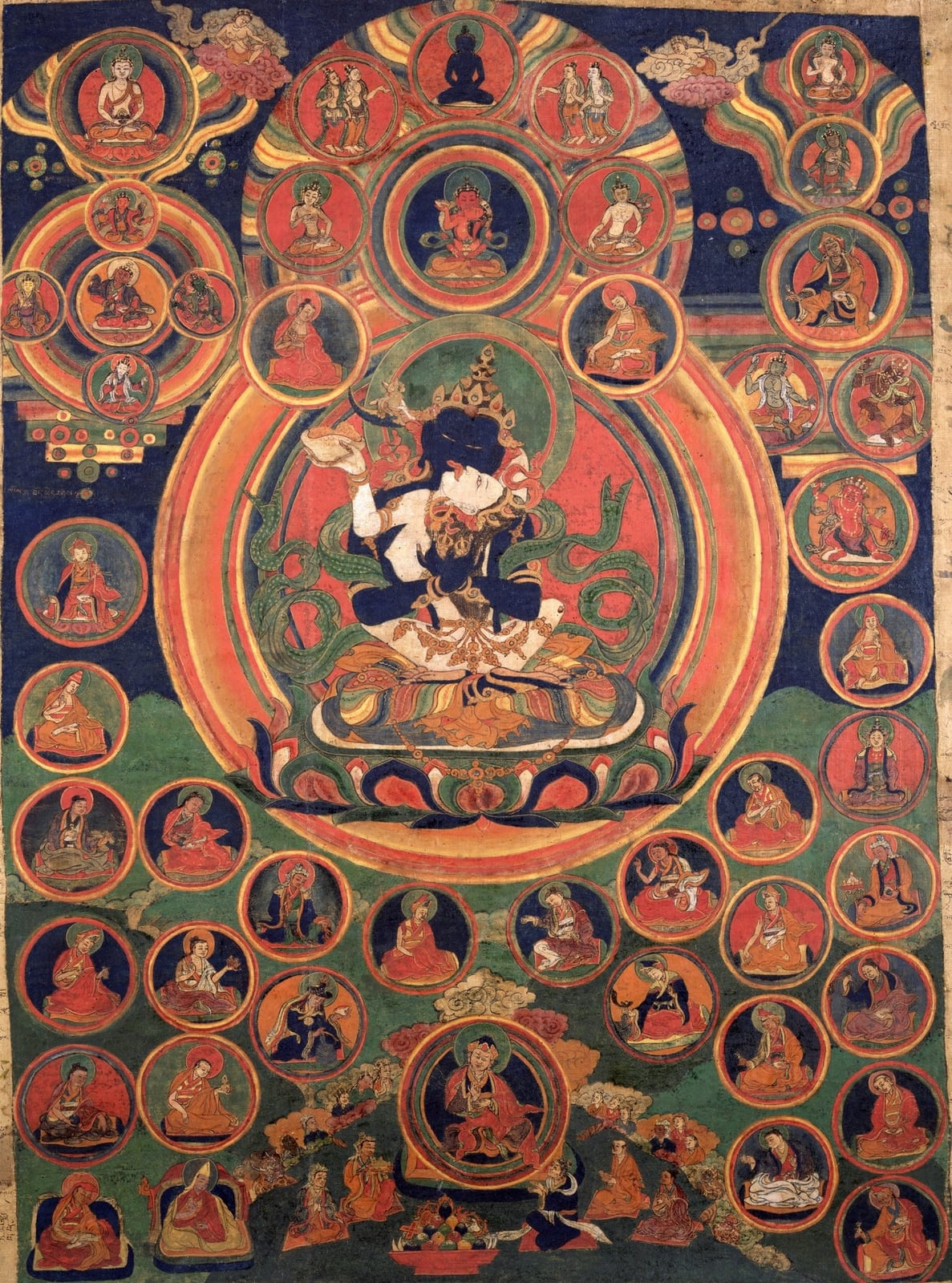
Padmasambhava (Orgyen Dorje Chang) con Yeshe Tsogyal, tangka tibetano del siglo XVII · Public domain

La sua idea centrale
Treasures (gter ma): A terma is a text or object that, according to tradition, Padmasambhava or one of his contemporaries hid in the eighth century to be discovered later by a predestined revealer (gter ston).
Vederlo nel contesto
Biografia
4 min di lettura
Traduzione assistita dall'originale spagnolo, in attesa di revisione da parte di un traduttore madrelingua.
Due figure con uno stesso nome
Esistono due Padmasambhava. Uno è un maestro tantrico indiano dell'VIII secolo di cui restano appena poche righe in fonti antiche; l'altro è Guru Rinpoche, il «Maestro prezioso», nato da un loto, conquistatore spirituale del Tibet e autore dei tesori che i suoi devoti continuano a scoprire da novecento anni. Per buona parte del Novecento l'erudizione occidentale dubitò che il primo fosse esistito. Oggi, come riassume Lewis Doney, la sua storicità è accettata con cautela: è esistito un Padmasambhava, ma quasi tutto ciò che si racconta di lui appartiene al secondo.
Che cosa dicono le fonti antiche
La testimonianza narrativa più antica è il Testamento di Ba (Dba' bzhed), cronaca dell'introduzione del buddhismo in Tibet la cui redazione si colloca tra il IX e il XII secolo. Secondo quel testo, il re Trisong Detsen (che regnò dal 755 alla fine dell'VIII secolo) aveva invitato il grande erudito indiano Śāntarakṣita, ma inondazioni, fulmini ed epidemie furono attribuiti all'ira degli dèi locali, e il saggio consigliò di chiamare uno specialista capace di sottometterli: Padmasambhava, giunto dall'Oḍḍiyāna. Il maestro domò gli spiriti, propose opere per portare l'acqua nei deserti e suscitò a corte tali sospetti che il re, temendo per il proprio potere, gli chiese di andarsene dopo un breve soggiorno.
Questo ritratto — un esorcista tantrico, efficace e scomodo — coincide con quello dei manoscritti di Dunhuang. Il Pelliot tibétain 44, copiato verso la fine del X secolo, narra come Padmasambhava portò da Nālandā i testi di Vajrakīla per vincere gli ostacoli che gli impedivano di praticare a Yanglesho, nella valle di Kathmandu. Altri due manoscritti, studiati da Jacob Dalton, lo mostrano già come domatore degli spiriti ostili del Tibet. Nessuna di queste fonti parla di una nascita miracolosa; tutte lo presentano come un ritualista al servizio della fondazione del buddhismo tibetano, il cui primo monastero, Samye, fu consacrato intorno al 779.
Il nato dal loto
La biografia che i tibetani conoscono si fissò molto più tardi, nei testi rivelati dal XII secolo in poi. Secondo questa, otto anni dopo la morte del Buddha, come egli aveva profetizzato, un bambino di otto anni apparve seduto su un loto nel lago Dhanakośa, nell'Oḍḍiyāna, il paese che la maggior parte degli studiosi identifica con la valle dello Swat. Il re Indrabhūti, che non aveva figli, lo adottò e ne fece un principe; ma il giovane uccise un ministro, fu bandito e visse come yogin nei luoghi di cremazione dell'India, dove ricevette gli insegnamenti delle ḍākinī e dei grandi maestri tantrici.
Seguono gli episodi che l'iconografia ripete: la principessa Mandāravā di Zahor, che il re suo padre volle bruciare insieme al maestro su un rogo che si trasformò in lago; il ritiro nella grotta di Māratika, dove entrambi ottennero il dominio sulla vita; la realizzazione a Yanglesho mediante le pratiche di Yangdak e di Vajrakīla. Ogni tappa corrisponde a una delle sue otto manifestazioni (il principe Padma Gyalpo, lo yogin Nyima Özer, l'erudito Loden Chokse, l'irato Dorje Drolö…), che sono, più che episodi biografici, i modi in cui il maestro si offre alla devozione.
La conquista del Tibet
Nella versione tradizionale, il viaggio in Tibet è una campagna militare. Padmasambhava sottomette gli dèi di ogni montagna e di ogni lago, li costringe a giurare protezione al buddhismo e, una volta domati, Samye si innalza. Inizia il re e venticinque discepoli principali, prende come consorte Yeshe Tsogyal, che trascriverà i suoi insegnamenti, e medita in grotte oggi meta di pellegrinaggio, da Chimphu, presso Samye, a Taktsang, il «Nido della Tigre» del Bhutan, dove giunse volando su una tigre. Prima di partire nasconde in tutto il Tibet testi e oggetti perché i suoi discepoli rinati li scoprano al momento opportuno. Poi lascia il paese per il passo di Gungthang, verso sud-ovest, nella terra dei rākṣasa, e non muore: dimora sulla Montagna color del rame.
I tesori
Quest'ultimo gesto spiega la figura. A partire dall'XI secolo comparvero in Tibet gli «scopritori di tesori» (gter ston), che presentavano testi trovati in grotte, in colonne o nella propria mente come insegnamenti di Padmasambhava nascosti quattro secoli prima. Nyangral Nyima Özer (1124-1192) rivelò lo Zangs gling ma, la prima biografia completa; Orgyen Lingpa, nel 1352, la Cronaca di Padma, che fissò la leggenda; Karma Lingpa, nel XIV secolo, il ciclo cui appartiene il Bardo Thödol. Come ha mostrato Janet Gyatso, la teoria del tesoro permetteva alla scuola antica, la Nyingma, di rinnovare il proprio canone senza rompere con il passato: ogni rivelazione rimandava all'autorità del Maestro dell'Oḍḍiyāna.
Il risultato è un'opera immensa che egli non scrisse. Risale all'Ottocento il Grande tesoro dei terma preziosi, la raccolta in oltre sessanta volumi di Jamgön Kongtrul; al Novecento la fama mondiale del Bardo Thödol, che la versione di Evans-Wentz (1927), con il suo titolo inventato di Libro tibetano dei morti e il commento psicologico di Carl Gustav Jung, trasformò in un classico della spiritualità occidentale. Tra le opere che portano il suo nome, solo la Ghirlanda delle visioni, un breve trattato sui nove veicoli incluso nel canone, sembra risalire al periodo imperiale.
Ciò che si può affermare
In sintesi: nel Tibet dell'VIII secolo vi fu un maestro tantrico di origine indiana, specialista in rituali di sottomissione, legato alla fondazione di Samye e alla tradizione di Vajrakīla, il cui soggiorno fu probabilmente breve e conflittuale. Tutto il resto — il loto, i luoghi di cremazione, le consorti, il volo sulla tigre, i tesori — è opera di secoli di memoria religiosa, e non per questo meno reale come fatto storico: Guru Rinpoche è la figura più venerata del buddhismo tibetano, il «secondo Buddha» cui sono dedicate le feste del decimo giorno lunare in Bhutan e nell'Himalaya, e il centro dell'identità della scuola Nyingma.
Fonti: Pasang Wangdu y Hildegard Diemberger (trad. y ed.). dBa' bzhed: The Royal Narrative concerning the Bringing of the Buddha's Doctrine to Tibet. Viena: Verlag der Österreichischen Akademie der Wissenschaften, 2000. ISBN 9783700129561. · Doney, Lewis. The Zangs gling ma: The First Padma bKa' thang Revelation. Andiast: International Institute for Tibetan and Buddhist Studies, 2014. · Hirshberg, Daniel A. Remembering the Lotus-Born: Padmasambhava in the History of Tibet's Golden Age. Somerville (MA): Wisdom Publications, 2016. · Cantwell, Cathy, y Robert Mayer. Early Tibetan Documents on Phur pa from Dunhuang. Viena: Verlag der Österreichischen Akademie der Wissenschaften, 2008 (cap. «Pelliot tibétain 44», pp. 41–56). · Kapstein, Matthew T. The Tibetan Assimilation of Buddhism: Conversion, Contestation, and Memory. Nueva York: Oxford University Press, 2000.
Cronologia
La vita, anno per anno
Ogni punto è un evento documentato. Fai clic per leggerlo, con la sua fonte e il suo grado di certezza.
VII secoloOḍḍiyāna (valle de Swat)
Birth (traditional)
Tradition has him born from a lotus in Lake Dhanakośa in Oḍḍiyāna; the early sources only say he came from that land. The date is conventional: eighth century.
TradizioneYeshe Tsogyal (atrib.); Nyangral Nyima Özer (revelador). The Lotus-Born: The Life Story of Padmasambhava. Trad. Erik Pema Kunsang. Boston: Shambhala, 1993. ISBN 9780877738695.
VII secolo
Birth (traditional)
Tradition has him born from a lotus in Lake Dhanakośa in Oḍḍiyāna; the early sources only say he came from that land. The date is conventional: eighth century.
Tradizione
755
Trisong Detsen accedes to the throne
The reign begins of the emperor who, according to the chronicles, invited Śāntarakṣita and Padmasambhava.
Documentato
anni 770
Invitation to Tibet
On Śāntarakṣita's advice the king invites him to subdue the spirits obstructing the founding of Samye; according to the Testament of Ba his stay was brief and ended with his departure at the king's request.
Probabile
ca. 779
Consecration of Samye
Samye, Tibet's first Buddhist monastery, is consecrated; the sources place Padmasambhava at its founding.
Probabile
ca. 1000
Earliest written witnesses
Dunhuang manuscripts (Pelliot tibétain 44 and 307, IOL Tib J 644), from the late tenth century, present him as a Vajrakīla master and tamer of spirits.
Documentato
ca. 1150
First revealed biography
Nyangral Nyima Özer (1124–1192) reveals the Zangs gling ma, the first complete life of Padmasambhava.
Documentato
1352
The Chronicle of Padma
Orgyen Lingpa reveals the Padma bka' thang, which fixes the canonical form of the legend.
Documentato
ca. 1360
Karma Lingpa and the Bardo Thödol
Karma Lingpa (1326–1386) reveals the cycle of the peaceful and wrathful deities, to which the Bardo Thödol belongs.
Documentato
1692
Founding of Taktsang
The 'Tiger's Nest' monastery is built beside the cave tradition associates with Padmasambhava.
Documentato
ca. 1880
The Great Treasury of Termas
Jamgön Kongtrul gathers in more than sixty volumes the treasure cycles attributed to Padmasambhava (Rinchen Terdzö).
Documentato
1927
The 'Tibetan Book of the Dead'
W. Y. Evans-Wentz publishes Kazi Dawa-Samdup's version of the Bardo Thödol, which will make a text attributed to Padmasambhava famous in the West.
Documentato
Opere
Opere essenziali
Le opere senza le quali non si comprende la sua eredità.
Attribuzione tradizionale · ca. 1350
The Great Liberation by Hearing in the Intermediate State (Bardo Thödol, 'Tibetan Book of the Dead')
ཟབ་ཆོས་ཞི་ཁྲོ་དགོངས་པ་རང་གྲོལ་ལས་བར་དོ་ཐོས་གྲོལ་ཆེན་མོ། (zab chos zhi khro dgongs pa rang grol las bar do thos grol chen mo)
A set of ritual texts read aloud beside the dying and the dead to guide them through the intermediate states (bar do) between death and rebirth: the clear light at the moment of dying, the visions of the peaceful and wrathful deities and the search for a new birth. It belongs to the cycle 'The Self-Liberation of the Intention of the Peaceful and Wrathful Deities', revealed in the fourteenth century by Karma Lingpa. Since the 1927 English version it has been the most widely read Tibetan text in the West.
9 edizioni

Attribuzione tradizionale · 1352
The Chronicle of Padma (Padma Kathang)
པདམ་བཀའི་ཐང་ཡིག། (padma bka'i thang yig)
A verse biography of Padmasambhava's whole life: birth from a lotus in Lake Dhanakośa, youth as prince of Oḍḍiyāna, exile, years as a yogi in the charnel grounds, the stay in Tibet and the departure for the land of the rākṣasas. It fixed the 'eleven deeds' and the canonical form of the legend, and was for centuries the most widely circulated book about him. It presents itself as dictated by the master himself to Yeshe Tsogyal.
2 edizioni

Attribuzione tradizionale · ca. 1150
The Copper Island (Zangling ma): Life of Padmasambhava
པདམ་བཀའ་ཐང་ཟངས་གླིང་མ། (padma bka' thang zangs gling ma)
The first complete biography of Padmasambhava, in prose, narrating his birth from a lotus, arrival in Tibet, the founding of Samye, the initiation of the twenty-five disciples and his departure. It is the source of nearly all later versions of the legend and evidence of how the figure was constructed in the twelfth century. Its colophons attribute the writing to Yeshe Tsogyal.
2 edizioni
Padmasambhava
Garland of Views: An Essential Instruction
Attribuzione tradizionale · VIII secolo
Garland of Views: An Essential Instruction
མན་ངག་ལྟ་བའི་ཕྲེང་བ། (man ngag lta ba'i phreng ba)
A short treatise that arranges all Buddhist and non-Buddhist paths in a hierarchy of views culminating in atiyoga or the Great Perfection; it presents itself as a commentary on chapter XIII of the Guhyagarbhatantra. It is the only work ascribed to Padmasambhava included in the Tengyur, the canon of treatises, and the one scholarship considers closest to a plausible attribution or at least to the imperial period; Nubchen Sangye Yeshe already cites it.
1 edizione
Tutta la sua opera (14)

The Self-Liberation of the Intention of the Peaceful and Wrathful Deities (Karma Lingpa's cycle)
1350
Padmasambhava
Self-Liberation through Seeing with Naked Awareness
The Conscious LibrarySelf-Liberation through Seeing with Naked Awareness
1350

Dakini Teachings: Padmasambhava's Advice to Yeshe Tsogyal
1150

Advice from the Lotus-Born (Zhal gdams)
Padmasambhava
The Gradual Path of the Wisdom Essence (Lamrim Yeshe Nyingpo)
The Conscious LibraryThe Gradual Path of the Wisdom Essence (Lamrim Yeshe Nyingpo)
1856
Padmasambhava
The Prayer in Seven Chapters (Le'u Dünma)
The Conscious LibraryThe Prayer in Seven Chapters (Le'u Dünma)
1350
Padmasambhava
The Seven-Line Prayer
The Conscious LibraryThe Seven-Line Prayer
Padmasambhava
The Fivefold Chronicles (Kathang Denga)
The Conscious LibraryThe Fivefold Chronicles (Kathang Denga)
1350
Padmasambhava
Gathering of the Sugatas of the Eight Commands (Kagye Deshek Düpa)
The Conscious LibraryGathering of the Sugatas of the Eight Commands (Kagye Deshek Düpa)
1150
Padmasambhava
The Great Treasury of Precious Termas (Rinchen Terdzö)
The Conscious LibraryThe Great Treasury of Precious Termas (Rinchen Terdzö)
1880
Ultime parole
Non esistono testimonianze verificabili delle sue ultime parole.
Tradition ascribes to him not death but departure: the revealed biographies have him leave Tibet by the Gungthang pass towards the south-west, giving farewell advice to the king and Yeshe Tsogyal, to dwell on the Copper-Coloured Mountain. These farewells are hagiographic compositions of the twelfth to fourteenth centuries; there is no historical record of his death or of last words.
Fonte: Yeshe Tsogyal (atrib.); Orgyen Lingpa (revelador). The Life and Liberation of Padmasambhava (Padma bKa'i Thang). Trad. Kenneth Douglas y Gwendolyn Bays a partir de la versión francesa de Gustave-Charles Toussaint (Le Dict de Padma, París: Leroux, 1933). 2 vols. Emeryville (CA): Dharma Publishing, 1978. ISBN 9780913546192.
Chiedi
Ciò a cui risponde la sua opera
Dodici grandi domande dell'umanità e ciò che i suoi testi permettono di rispondere, con riferimenti. Non gli mettiamo mai parole in bocca.
Che cos'è l'Assoluto? Dio esiste?
The ultimate is the luminous nature of mind; the deities are its display
Un Assoluto impersonaleSi deduce dalla sua dottrina
Almost everything read under Padmasambhava's name consists of «treasure» texts (terma) revealed centuries after his life. The best known, the so-called Tibetan Book of the Dead, brought to light by Karma Lingpa in the fourteenth century, describes how at the moment of death the clear light of the dharmakāya appears and asks that it be recognised as the very nature of one's mind. The peaceful and wrathful deities that arise afterwards are not external gods but projections of that same mind. The ultimate is thus an empty and luminous awareness, without creator and without face, of which the divine figures are expressions. The Introduction to Pure Awareness, from the same cycle, insists that one should not look outside for what is one's own awakened presence.
Confronta questa domanda con altri maestriChi sono io? Esiste un vero sé?
Sought for, the mind is not found: empty and yet aware
Non c'è un sé permanenteSi deduce dalla sua dottrina
The texts the Nyingma tradition attributes to Padmasambhava are mostly terma revealed between the twelfth and nineteenth centuries. In the Introduction to Pure Awareness, from Karma Lingpa's cycle, the enquiry is directed at the mind itself: examined, it has no shape, colour or location, and is found neither inside nor outside. What follows is not nothingness but a naked presence, empty and clear at once, which the Great Perfection calls rigpa. The self that defends itself and clings is what does not withstand this examination; what remains is not a subject but the capacity to know. The Tibetan Book of the Dead applies the same teaching: whoever recognises the visions as their own mind is freed; whoever identifies with a fleeing self goes on wandering.
Confronta questa domanda con altri maestriPerché soffriamo?
One wanders through not recognising as one's own the light that appears
L'ignoranza di ciò che siamoSi deduce dalla sua dottrina
In the Tibetan Book of the Dead, a terma revealed by Karma Lingpa in the fourteenth century and attributed to Padmasambhava's teaching, suffering has one recurring cause: not recognising. At each stage of the intermediate state the clear light appears, and then the deities and the coloured lights; whoever recognises them as manifestations of their own mind is liberated, and whoever fears or desires them, through failing to recognise them, is dragged by karma towards a new birth. The five passions (ignorance, attachment, aversion, pride and envy) are presented as confused versions of the five wisdoms. We suffer, then, because we take ourselves for what we are not and fail to know the empty, luminous nature of mind; not because of a punishment or an external fate.
Confronta questa domanda con altri maestriChe cosa accade dopo la morte?
After death, an intermediate state: recognition liberates, non-recognition brings rebirth
Rinascita secondo il karmaLo dice espressamente
The answer associated with Padmasambhava is the most detailed in all Buddhist literature, but it comes from a terma: the so-called Tibetan Book of the Dead, which Karma Lingpa brought to light in the fourteenth century and which the tradition ascribes to a teaching of the master. The text is read beside the dying and the deceased for forty-nine days. At the instant of death the clear light appears; whoever recognises it as their own nature is liberated. If not, the visions of the peaceful and wrathful deities follow and, lastly, the intermediate state of becoming, where karma pushes towards one of the six destinies. Even then, hearing can guide the choice of a favourable birth. Death is an opportunity for liberation, not merely a transit.
Confronta questa domanda con altri maestriCome si raggiunge la liberazione o la salvezza?
Liberation through recognition: seeing one's own mind naked as it is
Con la conoscenza direttaSi deduce dalla sua dottrina
The treasure texts attributed to Padmasambhava propose many paths, arranged in nine vehicles culminating in the Great Perfection, but their core is recognition. The Introduction to Pure Awareness, from Karma Lingpa's cycle, presents itself as an instruction for liberation by seeing one's own mind naked: nothing is built, what is already present is recognised. The Tibetan Book of the Dead carries the same principle to the moment of death: whoever recognises the clear light as their own nature is liberated in that instant, and the titles say so, liberation through hearing, self-liberation through seeing. Preliminary practices, deities, mantras and devotion to the master prepare and sustain that recognition, but do not replace it.
Confronta questa domanda con altri maestriServe un maestro?
The master introduces the nature of mind; without him there is no recognition
IndispensabileSi deduce dalla sua dottrina
In the tradition centred on Padmasambhava, the master is not an adviser but the door. The Great Perfection is transmitted through «direct introduction»: the master points out to the disciple their own pure awareness, and the text of Karma Lingpa's cycle bearing that name presents itself as such a pointing-out. Padmasambhava himself is the master par excellence, Guru Rinpoche, and many of the texts associated with him are supplications addressed to him, such as the Seven-Line Prayer or the Supplication in Seven Chapters. The Teachings to the Ḍākinīs, advice tradition says he gave Yeshe Tsogyal, insist on examining the master before following him and on not separating from him afterwards. Without transmission there is no initiation, and without initiation there is no tantric path.
Confronta questa domanda con altri maestriIl mondo è reale?
All that appears is the display of one's own mind, empty and luminous
Manifestazione del divinoSi deduce dalla sua dottrina
In the terma associated with Padmasambhava, the world is neither a creation nor a deception to be rejected: it is the spontaneous manifestation of the nature of mind. The Tibetan Book of the Dead teaches this dramatically: the lights, sounds and deities of the intermediate state are the very radiance of the deceased's mind, and recognising them is enough for them to dissolve into it. The Introduction to Pure Awareness applies the same to ordinary life: all that appears arises from the mind and is liberated in it, like waves in water. The Great Perfection speaks of primordial purity and spontaneous presence: the ground is empty from the beginning and, at the same time, unfolds ceaselessly into appearances.
Confronta questa domanda con altri maestriChe cos'è l'amore?
The mind of awakening, inseparable from emptiness, for the good of all beings
Compassione senza limitiSi deduce dalla sua dottrina
The texts attributed to Padmasambhava devote no treatise to love, but they integrate it into the framework of the Great Vehicle: every practice begins by taking refuge and awakening the mind of awakening for the good of all beings, and ends by dedicating the merit to them. The Essence of Wisdom of the Stages of the Path, a terma revealed in the nineteenth century by Chokgyur Lingpa, develops this compassion as part of the gradual path towards the Great Perfection. In the hagiographies, the figure of Padmasambhava embodies a compassion that takes wrathful forms: taming Tibet's hostile spirits is, in that logic, an act of care. True compassion is described as inseparable from emptiness, free of the idea of someone who helps and someone who receives.
Confronta questa domanda con altri maestriSiamo liberi o è tutto determinato?
Karma drives, yet in every instant one can recognise and choose
Karma e sceltaSi deduce dalla sua dottrina
The Tibetan Book of the Dead, a fourteenth-century terma associated with Padmasambhava's teaching, describes a process dominated by karma: in the intermediate state of becoming, the deceased is swept along by karmic winds, sees visions according to past deeds and feels drawn towards a destiny. Yet the text is read aloud precisely because at every stage a possibility of liberation remains or, at least, of choosing: recognising the clear light, not being carried off by fear, closing the door of an unfavourable womb, turning towards a propitious human birth. The past conditions strongly, but it does not close everything off: present attention, sustained by the master's instruction, can divert the course.
Confronta questa domanda con altri maestriPerché meditare o pregare?
Look into one's own mind until its naked nature is recognised
Tornare alla sorgente dell'ioSi deduce dalla sua dottrina
In the tradition that claims Padmasambhava as its source, two registers coexist. One is ritual and devotional: supplications such as the Seven-Line Prayer or the Supplication in Seven Chapters, the Vajra Guru mantra and the deity cycles revealed as treasures. The other, which the tradition regards as the summit, is the Great Perfection. The Introduction to Pure Awareness, from Karma Lingpa's cycle, describes this second register as an enquiry directed at the mind itself: searching for it, asking where it is, what colour or shape it has, until discovering that it is not found as a thing and that what searches is one's own empty, awake awareness. No state is manufactured: what is already there is recognised and rested in. Prayer prepares and sustains that recognition.
Confronta questa domanda con altri maestriPuò la ragione conoscere l'ultimo?
A wisdom hidden as treasure and recognised in one's own experience
Conoscenza esotericaSi deduce dalla sua dottrina
The tradition associated with Padmasambhava answers this question through its mode of transmission. According to the doctrine of treasures (terma), the master and his disciples hid teachings in the eighth century that predestined revealers would discover centuries later, when they were needed. Ultimate knowledge is therefore not reached by reasoning but by transmission and initiation, and it is verified in the practitioner's experience. The Garland of Views, the most plausible attribution, arranges doctrines in a hierarchy culminating in the Great Perfection, above paths that rely on analysis. The Introduction to Pure Awareness insists that the nature of mind is not an object of thought: it is recognised directly when the master points it out.
Confronta questa domanda con altri maestriRitirarsi dal mondo o trasformarlo?
Retreat caves and hidden valleys; but also taming a country
Ritirarsi per trovareSi deduce dalla sua dottrina
The hagiographies revealed as treasures, such as The Copper Island (twelfth century) and the Chronicle of Padma (fourteenth century), present Padmasambhava practising in caves and charnel grounds in India, Nepal and Tibet, and the sacred geography of the Himalaya is full of grottoes associated with him. The advice tradition says he gave Yeshe Tsogyal insists on abandoning worldly concerns and practising in solitude. Treasure literature also developed the idea of hidden valleys, refuges for times of crisis. But the same chronicles show him acting in the world: invited by King Trisong Detsen, he subdues the hostile spirits so that the monastery of Samye can be founded. Retreat is the condition of attainment; action, its fruit.
Confronta questa domanda con altri maestri
Affinità e tensioni
Affinità e tensioni
Calcolate domanda per domanda a partire dalle sue posizioni. Il perché di ogni accordo o contrasto, con un clic.
La pensa in modo simile a
Helena Blavatsky
Concordano su: Siamo liberi o è tutto determinato? · Che cos'è l'Assoluto? Dio esiste? · Che cosa accade dopo la morte?

Dōgen
Concordano su: Chi sono io? Esiste un vero sé? · Che cosa accade dopo la morte? · Serve un maestro?
Hakuin Ekaku
Concordano su: Chi sono io? Esiste un vero sé? · Perché soffriamo? · Serve un maestro?
Milarepa
Concordano su: Siamo liberi o è tutto determinato? · Chi sono io? Esiste un vero sé? · Che cosa accade dopo la morte?
La pensa diversamente da

Nikolai Berdyaev
Si scontrano su: Chi sono io? Esiste un vero sé? · Che cosa accade dopo la morte? · Serve un maestro?

Francis of Assisi
Si scontrano su: Chi sono io? Esiste un vero sé? · Che cosa accade dopo la morte?
Al-Hallaj
Si scontrano su: Chi sono io? Esiste un vero sé? · Che cosa accade dopo la morte?

Emanuel Swedenborg
Si scontrano su: Chi sono io? Esiste un vero sé? · Che cosa accade dopo la morte?
Aneddoti e racconti
Aneddoti e racconti
Contestatosegunda mitad del s. VIII
The dismissed exorcist
Origine del racconto: Dba' bzhed (Testament of Ba), ed. and trans. Pasang Wangdu and Hildegard Diemberger (2000), and related versions of the Sba bzhed. The text's date of composition is disputed (ninth to twelfth centuries); the details of the assassins vary between recensions.
Fonte: Pasang Wangdu y Hildegard Diemberger (trad. y ed.). dBa' bzhed: The Royal Narrative concerning the Bringing of the Buddha's Doctrine to Tibet. Viena: Verlag der Österreichischen Akademie der Wissenschaften, 2000. ISBN 9783700129561.
Racconto agiograficos. VIII (narrado c. 1000)
The dagger of Yanglesho
Origine del racconto: Pelliot tibétain 44 (Bibliothèque nationale de France), studied by Bischoff and Hartman (1971) and by Cantwell and Mayer (2008); Takeuchi dates it between 978 and 1010 according to the reference recorded in the BDRC dictionary. The episode is later expanded in the Zangs gling ma and the Chronicle of Padma.
Fonte: Bischoff, F. A., y Charles Hartman. «Padmasambhava's Invention of the Phur-bu: Ms. Pelliot tibétain 44». En Études tibétaines dédiées à la mémoire de Marcelle Lalou. París: Adrien Maisonneuve, 1971, 11–28.
Racconto agiograficos. VIII (narrado desde el s. XII)
The child of the lake
Origine del racconto: Zangs gling ma (Nyangral Nyima Özer, twelfth century), chapter on the birth; Padma bka' thang (Orgyen Lingpa, 1352). Some versions prefer a birth from a queen's womb; Wikipedia records both.
Fonte: Yeshe Tsogyal (atrib.); Nyangral Nyima Özer (revelador). The Lotus-Born: The Life Story of Padmasambhava. Trad. Erik Pema Kunsang. Boston: Shambhala, 1993. ISBN 9780877738695.
Racconto agiograficos. VIII (narrado desde el s. XII)
Mandāravā and the lake of fire
Origine del racconto: Padma bka' thang and Zangs gling ma; biography of Mandāravā revealed by Samten Lingpa (nineteenth century). The identification with Rewalsar is traditional.
Fonte: Yeshe Tsogyal (atrib.); Orgyen Lingpa (revelador). The Life and Liberation of Padmasambhava (Padma bKa'i Thang). Trad. Kenneth Douglas y Gwendolyn Bays a partir de la versión francesa de Gustave-Charles Toussaint (Le Dict de Padma, París: Leroux, 1933). 2 vols. Emeryville (CA): Dharma Publishing, 1978. ISBN 9780913546192.
Racconto agiograficos. VIII (tradicional); monasterio de 1692
The flight to Taktsang
Origine del racconto: Bhutanese oral tradition and revealed biographies; monastery data (1692, 1998 fire) according to Wikipedia. The length of the retreat is a ritual formula applied to many masters.
Tradizione orales. VIII (tradicional); teoría desarrollada desde el s. XI
The hidden treasures
Origine del racconto: The gter ma theory set out in the revealed biographies and in Nyingma treatises (e.g. Jigme Lingpa; Tulku Thondup, The Hidden Teachings of Tibet, 1986); academic analysis in Gyatso (1986) and Doney (2014).
Fonte: Gyatso, Janet. «Signs, Memory and History: A Tantric Buddhist Theory of Scriptural Transmission». Journal of the International Association of Buddhist Studies 9.2 (1986): 7–35.
Insegnamenti
Insegnamenti
Le nozioni che articolano il suo pensiero, spiegate nel loro contesto.
Treasures (gter ma)terma
The Nyingma school; also in Bön and, to a lesser extent, in the Kagyu schools.
Fonte: Gyatso, Janet. «Signs, Memory and History: A Tantric Buddhist Theory of Scriptural Transmission». Journal of the International Association of Buddhist Studies 9.2 (1986): 7–35.
Intermediate state (bardo)bardo
Karma Lingpa's cycle (fourteenth century); antecedents in the Abhidharma and the Guhyagarbha tantras.
Fonte: The Tibetan Book of the Dead: First Complete Translation. Trad. Gyurme Dorje; ed. Graham Coleman y Thupten Jinpa; introd. del XIV Dalái Lama. Londres: Penguin Classics, 2006. ISBN 9780140455298.
The nine vehicles and the Great Perfectionnueve-vehiculos
Nyingma doxography; the Guhyagarbhatantra.
Fonte: Padmasambhava (atrib.) y Jamgön Mipham. A Garland of Views: A Guide to View, Meditation, and Result in the Nine Vehicles. Trad. Padmakara Translation Group. Boulder: Shambhala, 2016. ISBN 9781611802962.
The taming of spirits ('dul ba)sometimiento
Tantric ritual (Vajrakīla); history of the conversion of Tibet.
Fonte: Dalton, Jacob P. The Taming of the Demons: Violence and Liberation in Tibetan Buddhism. New Haven: Yale University Press, 2011. ISBN 9780300153927.
The Vajra Guru mantra and the eight manifestationsvajra-guru
Nyingma and popular devotional practice.
Video
Video
Registrazioni, interviste e documentari. I video vengono riprodotti da YouTube; non sono ospitati qui.
Session 1: Padmasambhava and History
Conferenza· EN· 55 min
Rubin Museum of Himalayan ArtCanale ufficiale
Session 3: Padmasambhava and the Treasure Tradition
Conferenza· EN· 69 min
Rubin Museum of Himalayan ArtCanale ufficiale
Padmasambhava and His Eight Manifestations
Analisi· EN· 6 min
SmarthistoryCanale ufficiale
Light of Kailash 29: On the Image of Padmasambhava in Zanglingma | Dr. Lucian Maidanuc
Conferenza· EN· 64 min
Shang Shung Institute UKCanale ufficiale
Prof. Jacob Dalton - "An Early Presentation of the Great Perfection"
Conferenza· EN· 107 min
Rangjung Yeshe InstituteCanale ufficiale
What is the Tibetan Book of the Dead?
Analisi· EN· 17 min
ReligionForBreakfast
Francesca Freemantle on the Tibetan Book of the Dead
Intervista· EN· 71 min
Shambhala PublicationsCanale ufficiale
Art of Dying & Living: Tibetan Book of the Dead with Bob Thurman
Conferenza· EN· 68 min
Tibet House US NYC | Menla Resort OnlineCanale ufficiale
The Death of Death: Bringing The Tibetan Book of the Dead to Life | Dr. Andrew Holecek
Conferenza· EN· 72 min
Theosophical Society
El Bardo Todol, La Gran Liberación - Libro tibetano de la vida y la muerte, subtitulado al español
Documentario· ES· 45 min
culturapractica
Nacido de un Loto - Padmasambhava - Guru Rinpoche - Introducción a su Biografía Milagrosa - Namthar
Registrazione di terzi· ES· 27 min
Daniel Rajunov
Galleria
Galleria
Immagini con licenza verificata. Ciascuna conserva la sua paternità e la sua attribuzione.
Manoscritti
Manoscritti
Testimoni manoscritti e testi antichi, con il loro custode e le loro condizioni di consultazione.
BO · Tibetano (dbu can) · Finales del siglo X (Takeuchi: 978–1010)
Pelliot tibétain 44 (texto sobre Vajrakīla / phur pa)
- Testimone conservato
- Manuscrito de Dunhuang
- Custode
- Bibliothèque nationale de France, París · Pelliot tibétain 44
BO · Tibetano · Siglo X
Pelliot tibétain 307
- Testimone conservato
- Manuscrito de Dunhuang
- Custode
- Bibliothèque nationale de France, París · Pelliot tibétain 307
BO · Tibetano · Siglo X
IOL Tib J 644
- Testimone conservato
- Manuscrito de Dunhuang
- Custode
- British Library, Londres · IOL Tib J 644
Relazioni
Relazioni
Influenze, discepolati e affinità. Si distingue la relazione documentata dalla somiglianza individuata per analisi.
Ricevette l'influenza di
Siddhartha Gautama, the Buddha
A Buddhist tantric master; the revealed biographies present him as the 'second Buddha' prophesied by Śākyamuni himself.
Relazione documentata
Influenzò
The 14th Dalai Lama (Tenzin Gyatso)
The 14th Dalai Lama, though Geluk, has taught the Great Perfection of the Nyingma tradition that claims descent from Padmasambhava (Dzogchen: The Heart Essence of the Great Perfection, 2000) and introduced the complete translation of the Bardo Thödol (Penguin, 2006).
Relazione documentata
Idee affini a
A parallel identified by the researcher: the two great yogis of the Himalayan caves whose image was fixed by much later hagiographies (the Chronicle of Padma, 1352; Tsangnyön Heruka's Namthar, 1488), and whose retreat places organise Tibetan sacred geography. There is no historical relationship.
Somiglianza individuata per analisi
Idee affini a
A parallel identified by the researcher: two Indian masters who founded foreign traditions (Nyingma and Chan) and whose biography is mostly later legend. In imperial Tibet both currents coexisted: the Dunhuang manuscripts and the ministers' chronicle of the Bka' thang sde lnga preserve Chan texts alongside Great Perfection ones.
Somiglianza individuata per analisi
Incontrò
Trisong Detsen (r. 755–c. 797)
Emperor of Tibet who, according to the Testament of Ba, invited him to court and later asked him to leave.
Relazione documentata
Contemporaneo di
Śāntarakṣita (725–788)
Indian scholar who, according to the Testament of Ba, advised inviting him to subdue the spirits; together with the king they are regarded as the three founders of Tibetan Buddhism.
Relazione documentata
Maestro di
Yeshe Tsogyal
His consort and chief disciple according to tradition; the revealed biographies present themselves as transcribed by her.
Relazione documentata
Influenzò
Karma Lingpa (1326–1386)
Discoverer of the cycle of the peaceful and wrathful deities, which includes the Bardo Thödol attributed to Padmasambhava.
Relazione documentata
Influenzò
Nyangral Nyima Özer (1124–1192)
Revealer of the Zangs gling ma, the first complete biography, and one of the principal architects of his image.
Relazione documentata
Fonti
Fonti
Bibliografia e cataloghi consultati per questa scheda.
- Wikidata, «Padmasambhava», QID Q231582 (VIAF 5724290; LCCN n82039306; BDRC bdr:P4956; Treasury of Lives 7442).
- Dalton, Jacob P. «The Early Development of the Padmasambhava Legend in Tibet: A Study of IOL Tib J 644 and Pelliot tibétain 307». Journal of the American Oriental Society 124.4 (2004): 759–772.
- Pasang Wangdu y Hildegard Diemberger (trad. y ed.). dBa' bzhed: The Royal Narrative concerning the Bringing of the Buddha's Doctrine to Tibet. Viena: Verlag der Österreichischen Akademie der Wissenschaften, 2000. ISBN 9783700129561.
- Doney, Lewis. The Zangs gling ma: The First Padma bKa' thang Revelation. Andiast: International Institute for Tibetan and Buddhist Studies, 2014.
- Hirshberg, Daniel A. Remembering the Lotus-Born: Padmasambhava in the History of Tibet's Golden Age. Somerville (MA): Wisdom Publications, 2016.
- Cantwell, Cathy, y Robert Mayer. Early Tibetan Documents on Phur pa from Dunhuang. Viena: Verlag der Österreichischen Akademie der Wissenschaften, 2008 (cap. «Pelliot tibétain 44», pp. 41–56).
- Bischoff, F. A., y Charles Hartman. «Padmasambhava's Invention of the Phur-bu: Ms. Pelliot tibétain 44». En Études tibétaines dédiées à la mémoire de Marcelle Lalou. París: Adrien Maisonneuve, 1971, 11–28.
- Kapstein, Matthew T. The Tibetan Assimilation of Buddhism: Conversion, Contestation, and Memory. Nueva York: Oxford University Press, 2000.
- Yeshe Tsogyal (atrib.); Nyangral Nyima Özer (revelador). The Lotus-Born: The Life Story of Padmasambhava. Trad. Erik Pema Kunsang. Boston: Shambhala, 1993. ISBN 9780877738695.
- Yeshe Tsogyal (atrib.); Orgyen Lingpa (revelador). The Life and Liberation of Padmasambhava (Padma bKa'i Thang). Trad. Kenneth Douglas y Gwendolyn Bays a partir de la versión francesa de Gustave-Charles Toussaint (Le Dict de Padma, París: Leroux, 1933). 2 vols. Emeryville (CA): Dharma Publishing, 1978. ISBN 9780913546192.
- The Tibetan Book of the Dead: First Complete Translation. Trad. Gyurme Dorje; ed. Graham Coleman y Thupten Jinpa; introd. del XIV Dalái Lama. Londres: Penguin Classics, 2006. ISBN 9780140455298.
- Padmasambhava (atrib.) y Jamgön Mipham. A Garland of Views: A Guide to View, Meditation, and Result in the Nine Vehicles. Trad. Padmakara Translation Group. Boulder: Shambhala, 2016. ISBN 9781611802962.
- Wikipedia (en). «Padmasambhava». Usada como índice de fuentes y bibliografía secundaria (Doney 2014, 2015; Dalton 2004; Hirshberg 2016); contrastada con p2–p5.
- Dalton, Jacob P. The Taming of the Demons: Violence and Liberation in Tibetan Buddhism. New Haven: Yale University Press, 2011. ISBN 9780300153927.
- Cuevas, Bryan J. The Hidden History of the Tibetan Book of the Dead. Nueva York: Oxford University Press, 2003.
- Lopez, Donald S., Jr. The Tibetan Book of the Dead: A Biography. Princeton: Princeton University Press, 2011.
- Gyatso, Janet. «Signs, Memory and History: A Tantric Buddhist Theory of Scriptural Transmission». Journal of the International Association of Buddhist Studies 9.2 (1986): 7–35.
- The Treasury of Lives. «Padmasambhava» (biografía académica en línea, P4956). No se pudo leer directamente (403 a clientes automáticos); citada como referencia.
- Wikimedia Commons, API imageinfo (licencia, autor, fecha y descripción de cada fichero de images[]).
- Open Library (Internet Archive). Registros de ISBN de cada edición citada en works[].
- YouTube: conferencias y documentales verificados por oEmbed el 2026-10-25 (detalle en videos[]).
- Dalai Lama (Tenzin Gyatso). Dzogchen: The Heart Essence of the Great Perfection. Ed. Patrick Gaffney; trad. Thupten Jinpa y Richard Barron. Ithaca (NY): Snow Lion, 2000.
- Laufer, Berthold. Der Roman einer tibetischen Königin (bTsun-mo bka'-thang). Leipzig: Otto Harrassowitz, 1911.
- Titolare dei diritti
- Los textos atribuidos y revelados (siglos XII–XIX) son de dominio público en su lengua original. Las traducciones tienen derechos propios: Penguin Random House (Dorje/Coleman/Jinpa 2006), Shambhala Publications (Fremantle y Trungpa; The Lotus-Born; Garland of Views; Dakini Teachings), Bantam/Random House (Thurman), Rangjung Yeshe Publications, Dharma Publishing, Wisdom Publications, Oxford University Press (Evans-Wentz), Kairós, Olañeta, Kier, Edaf.
In attesa di conferma
Ciò che questa scheda non ha ancora potuto chiarire. Preferiamo dirlo piuttosto che riempirlo.
- Sala de lectura: no se ha encontrado ningún texto de la tradición de Padmasambhava que sea de dominio público en EE. UU., la UE y España con texto completo. Candidatos por comprobar: Berthold Laufer, «Der Roman einer tibetischen Königin» (Leipzig, 1911; Laufer m. 1934), libre en los tres territorios si existe un escaneo con OCR limpio; Emil Schlagintweit, «Die Lebensbeschreibung von Padma Sambhava» (Abhandlungen der k. bayerischen Akademie, 1899–1903; m. 1904). G.-C. Toussaint, «Le Dict de Padma» (1933): libre en la UE y España, pero protegido en EE. UU. hasta 2029; no localizado en línea.
- «Consejos de Zhang zhung»: el encargo menciona esta obra, pero no se ha identificado ningún texto atribuido a Padmasambhava con ese título. Zhang zhung designa el antiguo reino del Tíbet occidental y da nombre a la principal tradición oral del bön (Zhang zhung snyan rgyud), que no se atribuye a Padmasambhava. Se ha registrado en su lugar el género de los consejos (zhal gdams). Confirmar qué obra se buscaba.
- Citas: no se registran citas literales. Los textos atribuidos son tesoros revelados siglos después y no se ha podido cotejar en el original tibetano ningún pasaje con la exactitud exigida; el dicho más famoso se recoge en apocryphal_quotes.
- Wikidata da para Padmasambhava 717–762 como fechas de nacimiento y muerte; no tienen fundamento en las fuentes consultadas y no se usan.
- Manuscritos: las URL de digitalización de Pelliot tibétain 44 y 307 (Gallica/IDP) e IOL Tib J 644 (IDP) no se han podido obtener (Gallica bloquea las consultas automáticas).
- Treasury of Lives (P4956) devolvió 403; su contenido no se ha usado directamente.
- Ediciones españolas: solo se han verificado en catálogo las del Bardo Thödol (Kairós, Olañeta, Kier, Edaf) y la antología de Kairós (2006). No se ha localizado con ISBN una versión española del Zangs gling ma, de la Crónica de Padma ni de la Guirnalda de visiones.
- Vídeos: hay pocos materiales académicos en español; el documental de la NFB (1994) solo está en subidas no oficiales y se incluye una con subtítulos en español, marcada como no oficial.
Ricerca effettuata il 2026-10-25