Christian mysticism · Theosophy · Anthroposophy
Rudolf Steiner
1861 – 1925Historically documented person
Austrian philosopher, esotericist and reformer (1861–1925). Editor of Goethe's scientific writings and author of The Philosophy of Freedom (1894), he led the German Section of the Theosophical Society and in 1913 founded Anthroposophy, a Christian and Goethean 'spiritual science'. His work gave rise to Waldorf education, biodynamic agriculture, anthroposophic medicine and eurythmy. He left more than thirty books and some six thousand lectures, disputed for their pseudoscientific character.
- works
- 68works
- editions
- 131editions
- quotes
- 7quotes
- videos
- 12videos
- images
- 10images
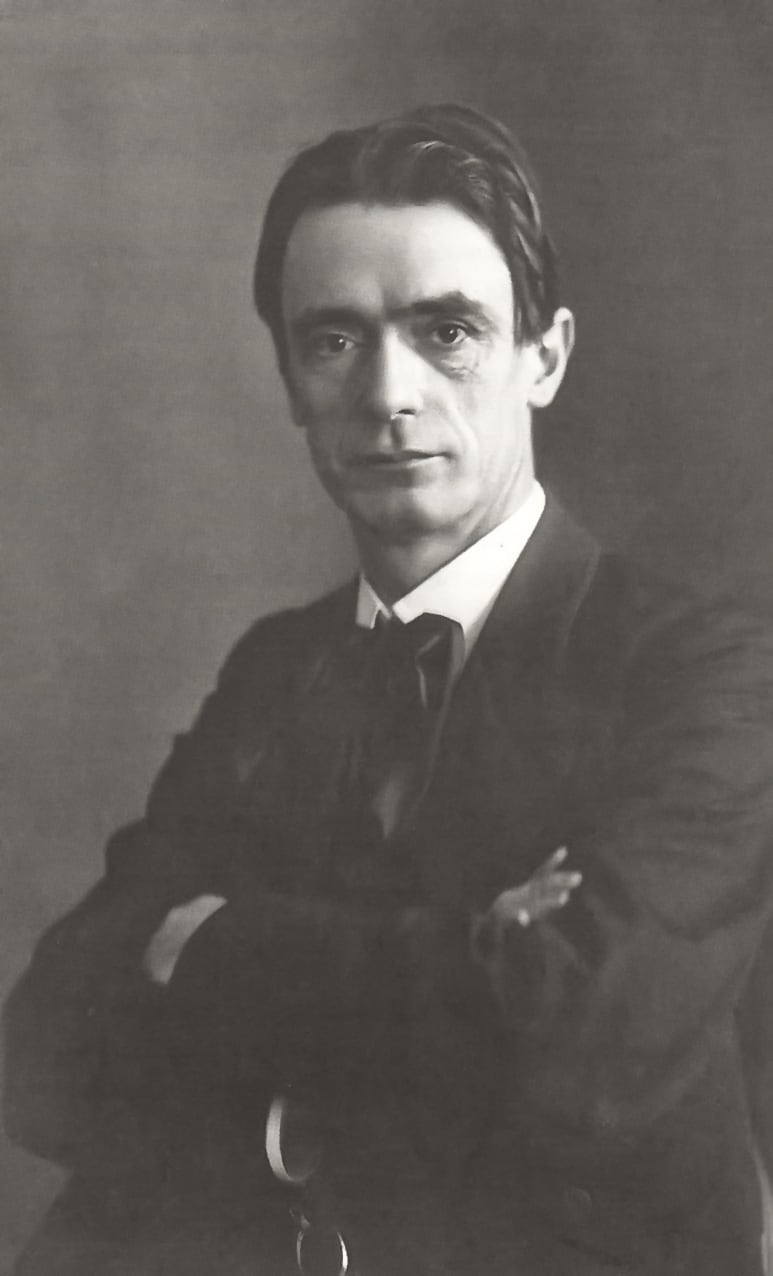
Rudolf Steiner hacia 1905 · Public domain
In their words
«Only when I follow my love for the object is it I myself who act.»Die Philosophie der Freiheit (1894), cap. «Die Idee der Freiheit»

Their central idea
Anthroposophy (spiritual science): Steiner took the term 'anthroposophy' from a book by the Austrian philosopher Robert Zimmermann (1856) and defined it as 'a path of knowledge that would lead the spiritual in the human being to the spiritual in the universe'.
See in context
Biography
5 min read
The telegraphist's son
Rudolf Joseph Lorenz Steiner was born in Kraljevec, in the Muraköz region—then part of the Kingdom of Hungary, today of Croatia—on 27 February 1861, the date he himself always gave, although family documents point to the 25th. His father, Johann Steiner, had been a gamekeeper for the Counts of Hoyos and worked as a telegraphist on the Austrian Southern Railway; his mother, Franziska Blie, had served in the same household. The family lived at small stations in Lower Austria—Mödling, Pottschach—and, from 1869, at Neudörfl, a Hungarian village just across the border, among telegraphs, trains and Alpine scenery. In his autobiography Steiner relates that as a child he found in geometry the proof that the soul can know something not seen by the senses, and that at eight or nine he had his first perception of what he would call the spiritual world. These are memories written sixty years later, and critics read them as part of the construction of his own figure.
Vienna and Goethe
He studied at the Realschule in Wiener Neustadt and, from 1879 to 1883, at the Technical University of Vienna, attending courses in mathematics, natural science, literature and philosophy without taking a degree. There he found his teacher, the Germanist Karl Julius Schröer, who in 1882 recommended him to Joseph Kürschner to edit Goethe's scientific writings in the series Deutsche National-Litteratur. The twenty-one-year-old wrote the introductions to those volumes (1883–1897) and a Theory of Knowledge Implicit in Goethe's World-Conception (1886). To earn his living he spent six years as tutor to the Specht family in Vienna, where he successfully educated a hydrocephalic boy thought incapable of learning, who went on to become a physician.
Weimar and the philosophy of freedom
In 1890 he moved to Weimar to work at the Goethe and Schiller Archive on the great edition of Goethe's works. In 1891 he took a doctorate in philosophy at the University of Rostock with a thesis on Fichte's theory of knowledge, expanded the following year as Truth and Knowledge. In 1894 he published The Philosophy of Freedom, the work he always regarded as the foundation of everything that followed: a theory of knowledge that makes thinking the activity in which the human being experiences itself as free, and an ethics of "ethical individualism" in which free action springs from love of the deed itself rather than from external norms. In those years he associated with Ernst Haeckel, admired Max Stirner and wrote Friedrich Nietzsche, a Fighter against His Time (1895); in 1896 Elisabeth Förster-Nietzsche brought him before the sick philosopher.
Berlin: from free thought to Theosophy
In 1897 he settled in Berlin as editor of the Magazin für Literatur and moved in the capital's bohemian and individualist-anarchist circles. He taught history and public speaking at the Workers' Education School founded by Wilhelm Liebknecht (1899–1904) and in 1899 married Anna Eunike, a widow in whose house he lived. In September 1900 he began lecturing at the Theosophical library of Count and Countess Brockdorff; in 1902, a member of the Theosophical Society only since January of that year, he agreed to become general secretary of the new German Section of the Theosophical Society, together with Marie von Sivers, who would be his collaborator and, from 1914, his second wife. Within a few years he published the books that form the core of his teaching: Theosophy (1904), How to Know Higher Worlds (1904–1905) and An Outline of Occult Science (1910).
Anthroposophy and the Goetheanum
Steiner steered Theosophy towards the Western esoteric tradition—Rosicrucianism, German mysticism, Goethe—and placed at its centre the "Mystery of Golgotha", the incarnation of Christ as a unique cosmic event. Tensions with the leadership at Adyar came to a head when Annie Besant proclaimed the young Jiddu Krishnamurti the coming World Teacher; in 1912–1913 most of the German Section broke away and founded the Anthroposophical Society. Between 1910 and 1913 he wrote and staged four mystery dramas in Munich, and with Marie von Sivers developed eurythmy, an art of movement. In 1913 the foundation stone of the Goetheanum was laid at Dornach near Basel: a large wooden building with two domes, designed by Steiner himself and built by volunteers from seventeen countries during the First World War.
The practical impulses
Germany's defeat in 1918 drew Steiner into social action. He proposed the "threefold social organism"—the separation of cultural, legal and economic life—in Towards Social Renewal (1919). That year, at the request of the industrialist Emil Molt, he founded in Stuttgart, for the children of the workers of the Waldorf-Astoria cigarette factory, the first Waldorf school. There followed courses for physicians, with Ita Wegman, which gave rise to anthroposophic medicine and the Weleda laboratories; a course for priests that in 1922 led to Friedrich Rittelmeyer's Christian Community; and in 1924 the agriculture course at Koberwitz, the origin of biodynamic farming. At the same time he was attacked by the nationalist right: in 1922 a lecture of his in Munich was violently disrupted.
The fire and Christmas 1923
On New Year's Eve 1922 the first Goetheanum burned to the ground, in a fire the police attributed probably to arson. Steiner designed a second building, this time in concrete, completed in 1928. At Christmas 1923 he refounded the Society as the General Anthroposophical Society, personally assumed its presidency and that of its School of Spiritual Science, and gave the Foundation Stone Meditation. The year 1924 was one of exhausting activity: hundreds of lectures, among them the cycles on karmic relationships and the courses on curative education, agriculture and the art of speech.
End and legacy
On 28 September 1924 he gave his last lecture; ill, he spent the following months in his studio at Dornach, where he went on writing his autobiography, The Course of My Life, breaking it off at the year 1907. He died there on 30 March 1925, aged sixty-four. He left more than thirty books and some six thousand lectures, most of them taken down by stenographers and not revised by him, which today make up a Gesamtausgabe of more than 350 volumes. His work has attracted both devotion and severe criticism: historians such as Helmut Zander have pointed to his borrowings from Theosophical literature, the pseudoscientific character of many claims and his theory of races, while his initiatives—more than a thousand Waldorf schools, biodynamic agriculture, anthroposophic medicine, the Camphill communities—remain active worldwide.
Sources: Steiner, Rudolf. Mein Lebensgang. Eine nicht vollendete Autobiographie (GA 28). Dornach: Philosophisch-Anthroposophischer Verlag, 1925; ed. actual Basilea: Rudolf Steiner Verlag. · Lindenberg, Christoph. Rudolf Steiner. Eine Biographie. 2 vols. Stuttgart: Verlag Freies Geistesleben, 1997. · Zander, Helmut. Rudolf Steiner. Die Biografie. Múnich: Piper, 2011 (ed. rústica 2016). · Lachman, Gary. Rudolf Steiner: An Introduction to His Life and Work. Nueva York: Jeremy P. Tarcher/Penguin, 2007. · Steiner, Rudolf. Die Philosophie der Freiheit. Grundzüge einer modernen Weltanschauung. Berlín: Emil Felber, 1894 (texto en Project Gutenberg, ebook n.º 53493).
Timeline
A life, year by year
Each point is a documented event. Click to read it, with its source and degree of certainty.
February 27, 1861age 0Kraljevec (Muraköz, Reino de Hungría; hoy Donji Kraljevec, Croacia)
Birth
The first child of the railway telegraphist Johann Steiner and Franziska Blie is born. Steiner always gave 27 February; family documents suggest the 25th.
DisputedSteiner, Rudolf. Mein Lebensgang. Eine nicht vollendete Autobiographie (GA 28). Dornach: Philosophisch-Anthroposophischer Verlag, 1925; ed. actual Basilea: Rudolf Steiner Verlag.
After their death
- September 29, 1928Second Goetheanum
- 1956The Gesamtausgabe begins
February 27, 1861 · age 0
Birth
The first child of the railway telegraphist Johann Steiner and Franziska Blie is born. Steiner always gave 27 February; family documents suggest the 25th.
Disputed
1869 · age 8
Neudörfl
The family settles in Neudörfl; Steiner would date his first supersensible experiences and his fascination with geometry to these years.
Probable
1879 – 1883 · age 18
Vienna Technical University
He studies science and attends Karl Julius Schröer's literature lectures; he leaves in 1883 without a degree.
Documented
1882 · age 21
Editor of Goethe
On Schröer's recommendation, Joseph Kürschner commissions him to edit Goethe's scientific writings (published 1883–1897).
Documented
1884 – 1890 · age 23
Tutor to the Specht family
For six years he tutors the children of the merchant Ladislaus Specht, among them a hydrocephalic boy who later becomes a physician.
Documented
1890 – 1897 · age 29
Goethe and Schiller Archive
He works on the Weimar (Sophien) edition of Goethe's scientific works until 1897.
Documented
October 1891 · age 30
Doctorate
He takes his doctorate at the University of Rostock with a thesis on Fichte's theory of knowledge.
Probable
1894 · age 33
The Philosophy of Freedom
He publishes Die Philosophie der Freiheit (dated 1894, issued at the end of 1893).
Documented
January 1896 · age 34
Before Nietzsche
Elisabeth Förster-Nietzsche takes him to see her brother, already incapacitated; for a time Steiner arranges the philosopher's library.
Probable
1897 · age 36
Magazin für Literatur
He moves to Berlin as co-owner and editor of the literary magazine; in 1899 he marries Anna Eunike and begins teaching at the Workers' Education School.
Documented
October 1902 · age 41
General Secretary of the German Section of the Theosophical Society
With Marie von Sivers he takes charge of the new German Section; he publishes Christianity as Mystical Fact.
Documented
1904 · age 43
Theosophy and the path of knowledge
He publishes Theosophy and begins serialising How to Know Higher Worlds in Lucifer-Gnosis.
Documented
May 1907 · age 46
Munich Congress
He organises the congress of the Federation of European Sections of the Theosophical Society, with a Rosicrucian aesthetic announcing his own direction.
Documented
1910 · age 49
Occult Science and the first mystery drama
Die Geheimwissenschaft im Umriss appears (dated 1910) and The Portal of Initiation is premiered in Munich.
Documented
February 1913 · age 51
Founding of the Anthroposophical Society
After expulsion from the Theosophical Society over the Krishnamurti dispute, most of the German Section forms the Anthroposophical Society.
Documented
September 20, 1913 · age 52
Foundation stone of the Goetheanum
The foundation stone of the double-domed wooden building designed by Steiner is laid.
Documented
December 24, 1914 · age 53
Marriage to Marie von Sivers
He marries his collaborator of twelve years; Anna Eunike had died in 1911.
Probable
September 7, 1919 · age 58
First Waldorf school
He opens the Freie Waldorfschule for the children of workers at Emil Molt's Waldorf-Astoria factory; that year he publishes Towards Social Renewal.
Documented
December 31, 1922 · age 61
Fire at the Goetheanum
On New Year's Eve the first Goetheanum burns to the ground; police point to arson.
Documented
December 24, 1923 – 1924 · age 62
Christmas Conference
He refounds the General Anthroposophical Society, assumes its presidency and gives the Foundation Stone Meditation (24 December 1923 – 1 January 1924).
Documented
June 7, 1924 · age 63
Agriculture course
He gives the eight lectures that originate biodynamic agriculture (7–16 June).
Documented
September 28, 1924 · age 63
Last lecture
He gives his last address, on the eve of Michaelmas; thereafter he remains ill in his studio.
Documented
March 30, 1925 · age 64
Death
He dies in his studio beside the Goetheanum under construction; the autobiography is left unfinished.
Documented
September 29, 1928
Second Goetheanum
The second Goetheanum, in concrete, built to Steiner's model, is inaugurated.
Probable
1956
The Gesamtausgabe begins
The Rudolf Steiner Nachlassverwaltung begins the complete edition (GA), which today exceeds 350 volumes.
Probable
Works
Essential works
The works without which their legacy cannot be understood.
Written work · 1894
The Philosophy of Freedom (Intuitive Thinking as a Spiritual Path)
Die Philosophie der Freiheit. Grundzüge einer modernen Weltanschauung (GA 4)
Steiner's central philosophical work. Part one, 'The Science of Freedom', analyses the observation of thinking as the secure starting point of knowledge and the relation between percept and concept; part two, 'The Reality of Freedom', founds an 'ethical individualism': free action springs from a moral intuition loved for its own sake, guided by 'moral imagination'. Steiner reissued it in 1918 with additions and regarded it as the philosophical germ of anthroposophy.
5 editions
Written work · 1904
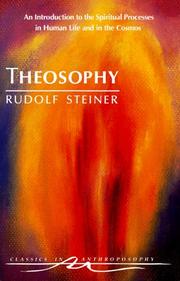
Theosophy
Theosophie. Einführung in übersinnliche Welterkenntnis und Menschenbestimmung (GA 9)
A fundamental book of his teaching. It describes the human being in three aspects—body, soul and spirit—subdivided into nine members; explains reincarnation and karma as spiritual law; surveys the three worlds (physical, soul and spiritual) through which the human being passes between death and a new birth; and ends with an outline of the 'path of knowledge'. Steiner revised it in many editions.
4 editions

Written work · c. 1904
How to Know Higher Worlds
Wie erlangt man Erkenntnisse der höheren Welten? (GA 10)
A manual of inner development serialised in Lucifer-Gnosis (1904–1905) and published as a book in 1909. It describes the conditions of discipleship—reverence, inner calm, control of thought, equanimity—meditation exercises and the stages of preparation, illumination and initiation, with the warning to take three steps in moral improvement for every step in occult knowledge.
5 editions

Written work · 1910
An Outline of Esoteric Science
Die Geheimwissenschaft im Umriss (GA 13)
His principal cosmological work, issued in December 1909 with the date 1910. It describes the nature of the human being, sleep and death, and the evolution of the cosmos through the planetary states of Saturn, Sun, Moon, Earth and the future Jupiter, Venus and Vulcan, with the intervention of the spiritual hierarchies, of Lucifer and Ahriman and of Christ; it closes with the path of knowledge of higher worlds.
5 editions
Complete works (68)

Goethean Science
1883

A Theory of Knowledge Implicit in Goethe's World-Conception
1886

Truth and Knowledge
1892

Documents on The Philosophy of Freedom
1994

Friedrich Nietzsche, Fighter for Freedom
1895

Goethe's World View
1897

Mysticism at the Dawn of the Modern Age
1901

Christianity as Mystical Fact
1902

Cosmic Memory
1904

The Stages of Higher Knowledge
1905

The Education of the Child in the Light of Anthroposophy
1907

Four Mystery Dramas
1910

The Spiritual Guidance of the Individual and Humanity
1911

A Way of Self-Knowledge
1912

The Threshold of the Spiritual World
1913

The Riddles of Philosophy
1914

The Riddle of Man
1916

Riddles of the Soul
1917

Goethe's Standard of the Soul
1918

Towards Social Renewal (The Threefold Commonwealth)
1919

The Renewal of the Social Organism
1961
Rudolf Steiner
Cosmology, Religion and Philosophy
The Conscious LibraryCosmology, Religion and Philosophy
1922

Anthroposophical Leading Thoughts
1925
Rudolf Steiner
Extending Practical Medicine (Fundamentals of Therapy)
The Conscious LibraryExtending Practical Medicine (Fundamentals of Therapy)
1925
Quotations
Quotations located in a specific work. Each carries its provenance and its level of confidence.
Only when I follow my love for the object is it I myself who act.Nur wenn ich meiner Liebe zu dem Objekte folge, dann bin ich es selbst, der handelt.
VerifiedDie Philosophie der Freiheit (1894), cap. «Die Idee der Freiheit»
Apocryphal quotes or disputed attributions (1)
«"Receive the child in reverence, educate him in love, and send him forth in freedom."»
A widely circulated Waldorf motto attributed to Steiner. We have not found this literal wording in his books or in the GA education cycles; it summarises ideas from his lectures to teachers and appears to be a later synthesis by the Waldorf movement. It should be cited as a motto, not as a verbatim quotation.
Last words
There are no verifiable records of their last words.
No reliable last words survive. He died on the morning of 30 March 1925 in his studio at Dornach, attended by the physician Ita Wegman; Marie Steiner arrived from Stuttgart after he had died. The accounts of those present, gathered by Guenther Wachsmuth, describe a peaceful death, with his hands crossed on his breast, but record no final sentence.
Source: Wachsmuth, Guenther. Die Geburt der Geisteswissenschaft. Rudolf Steiners Lebensgang von der Jahrhundertwende bis zum Tode. Dornach: Philosophisch-Anthroposophischer Verlag, 1941 (trad. ingl. The Life and Work of Rudolf Steiner, 1955).
Ask
What their work answers
Twelve great human questions and what their texts allow us to answer, with references. We never put words in their mouth.
What is the Absolute? Does God exist?
A divine-spiritual world with hierarchies of beings and a cosmic Christ
Both personal and impersonalInferred from their doctrine
Steiner hardly uses the word God in the abstract. In The Philosophy of Freedom he defends a monism that needs no lawgiver outside the world. In his anthroposophical period he describes, in An Outline of Esoteric Science, a divine-spiritual world populated by hierarchies of beings who, through the cosmic phases he calls Saturn, Sun, Moon and Earth, have guided the evolution of the human being. Within that picture he places a trinity: the paternal ground of the world, Christ as a cosmic being incarnated in Jesus, whose death at Golgotha he regards as the centre of earthly evolution, and the Spirit. The divine thus has an aspect of universal ground and another of personal beings with whom the human being relates, but both are to be known through spiritual research, not accepted on faith.
Compare this question with other teachersWho am I? Is there a true self?
The I is the spiritual core that reincarnates in body, soul and spirit
An evolving soulStated explicitly
In Theosophy, of 1904, Steiner describes the human being as body, soul and spirit, and divides these members into a physical body, an etheric or life body, an astral body and the I, to which are added spiritual members still in germ. The I is the centre: the instance that says I of itself and that no other person can utter for it. This spiritual core is not exhausted in one life; in the chapter on the reincarnation of the spirit and destiny he maintains that it incarnates again, and that the capacities and destiny of each biography are the fruit of earlier lives. Already in The Philosophy of Freedom he had placed individuality in thinking and free action. The true self is not an illusion: it is a spiritual individuality in evolution.
Compare this question with other teachersWhy do we suffer?
Destiny is the fruit of earlier lives and an organ of the I's development
Karma and the soul's learningStated explicitly
Steiner approaches suffering through karma. In Theosophy he maintains that each person's destiny, including their pains, is the consequence of what their individuality did in earlier lives; and in the lecture cycle Manifestations of Karma, of 1910, he studies how illnesses, accidents and catastrophes relate to spiritual causes. But he insists that karma is neither punishment nor fatalism: the I, before birth, in some way seeks out the circumstances it needs in order to compensate and develop, and pain can become strength and capacity in a future life. In his cosmology, moreover, suffering is inscribed in the evolution of humanity, in which act powers he calls Luciferic and Ahrimanic, which the Christ impulse makes it possible to balance.
Compare this question with other teachersWhat happens after death?
The I passes through the soul world and spirit land before reincarnating
Rebirth according to karmaStated explicitly
Steiner describes the path after death in the chapter on the three worlds in Theosophy. At death the human being leaves the physical body and, shortly afterwards, the etheric, at which point he beholds his past life as a great tableau. He then passes through the soul world, where he must free himself from desires bound to the physical, a phase he elsewhere calls kamaloka, and enters spirit land, where he works over the fruits of the completed life and prepares the next. Afterwards he incarnates again, according to accumulated karma. In his lectures he developed these stages in detail, as well as the relation between the living and the dead, to whom he recommended reading spiritual texts. Death is neither end nor fusion, but a rhythm in the evolution of the I.
Compare this question with other teachersHow is liberation or salvation attained?
A path of conscious exercises awakening organs of spiritual perception
Through conscious inner workStated explicitly
Steiner does not speak of salvation in an ecclesiastical sense, but of a development of the human being that each person can freely undertake. In How to Know Higher Worlds and in An Outline of Esoteric Science he describes a path of exercises: reverence, inner calm, a retrospective review of the day, concentration of thought, control of the will, equanimity, unprejudiced openness and meditation on images and phrases, which gradually awaken faculties of spiritual perception he calls imagination, inspiration and intuition. The moral condition is strict: for every step in occult knowledge, three must be taken in the perfection of character. To one's own work he adds the Christ impulse, which he regards as the force that makes the freedom of the I possible in the Earth's evolution, but which does not replace conscious effort.
Compare this question with other teachersIs a teacher necessary?
The teacher gives directions, but the modern pupil must test everything by thinking
Helpful but not indispensableStated explicitly
Steiner was for decades the teacher of a large movement and gave personal esoteric instruction to many pupils, but he insisted that the modern path of knowledge does not require blind obedience. In How to Know Higher Worlds he explains that the spiritual teacher can indicate the exercises and conditions, but that the pupil must travel them freely and understand what he is doing; the communications of spiritual research, he adds in other writings, can be examined with sound thinking even before one has verified them by one's own vision. Already in The Philosophy of Freedom he had argued that authentic moral action springs from one's own intuition and not from authority. He therefore recognises the guide's value, but subordinates it to the freedom of the I.
Compare this question with other teachersIs the world real?
Physical world, soul world and spirit land, in cosmic evolution
Planes of existenceStated explicitly
In Theosophy, Steiner describes three worlds: the physical, perceived by the senses; the soul world, made of forces of sympathy and antipathy, desires and feelings; and spirit land, where the archetypes of everything that exists reside. The human being belongs to all three through body, soul and spirit. In An Outline of Esoteric Science he adds a temporal dimension: the present world is the fourth phase of a cosmic evolution, preceded by those he calls Saturn, Sun and Moon, in which hierarchies of spiritual beings have gradually formed the cosmos and the human being. The physical world is real and must be studied with the rigour of natural science, which Steiner admired since his work on Goethe, but it is the outer manifestation of spiritual realities accessible to an extended knowledge.
Compare this question with other teachersWhat is love?
The Earth is the cosmos of love; free action is born of love for the deed
Love of God and neighbourStated explicitly
Steiner treats love on two levels. In The Philosophy of Freedom, truly free action proceeds not from duty or authority but from love of the action's object: only when I follow my love for the object am I the one who acts; and the maxim of free human beings is to live in love for the deed and let live in understanding of the other's will. In An Outline of Esoteric Science he gives love a cosmic dimension: the old Moon was the cosmos of wisdom, and the Earth's mission is to become the cosmos of love. In that process he assigns a central role to the Christ impulse, which he regards as the source of a love able to unite human beings without cancelling their individuality. Love is thus both the fruit of freedom and the task of evolution.
Compare this question with other teachersAre we free, or is everything determined?
Freedom is not given: it is won in pure thinking, within karma
Karma and choiceStated explicitly
The Philosophy of Freedom, of 1894, asks whether the human being is free or determined, and answers that he is neither in advance: he can become free. He is free when he acts moved by moral intuitions he himself grasps through thinking, and not by impulses, habits or others' commands; Steiner calls this view ethical individualism. In his anthroposophical period he adds the law of karma: the circumstances of each life are the consequence of earlier lives, but they do not determine how the I responds to them, which can transform them and, by present action, sow future destiny. In his writings and lectures on karma he insists that it does not contradict freedom: it inherits the starting situation, not the response.
Compare this question with other teachersWhy meditate or pray?
Meditating to awaken organs that perceive spiritual reality
Seeing reality as it isStated explicitly
Steiner conceives meditation as an instrument of knowledge. In How to Know Higher Worlds and An Outline of Esoteric Science he proposes exercises of concentration on symbolic images and phrases, such as the cross with roses, which strengthen the soul until faculties of spiritual perception awaken in it: imagination, inspiration and intuition. The aim is to see reality as it is, including what the senses do not reach, with the same clarity with which scientific thinking sees nature. Meditation must be practised in full consciousness, without losing the I or falling into trance states, and accompanied by moral work. He also wrote meditative verses for each week of the year in the Calendar of the Soul.
Compare this question with other teachersCan reason know the ultimate?
There are no limits to knowledge: thinking can investigate the spiritual
Esoteric knowledgeStated explicitly
Steiner argues expressly with Kant and with those who assert insuperable limits to knowledge. In Truth and Knowledge, in A Theory of Knowledge Implicit in Goethe's World-Conception and in The Philosophy of Freedom he holds that knowing is the synthesis of percept and concept, and that thinking, which lies beyond subject and object, grasps reality itself, not a subjective representation of it. From there he takes the step to his spiritual science: if thinking is strengthened through meditative exercises, it can investigate the spiritual worlds with a rigour comparable to that of natural science. He calls this research anthroposophy and maintains that its results, though born of supersensible experience, can be examined with sound thinking.
Compare this question with other teachersWithdraw from the world or transform it?
Spiritual science must fertilise school, farm, medicine and social order
Engage with the worldStated explicitly
Few spiritual teachers have left so practical a mark as Steiner. From 1919 he applied his spiritual science to almost every field: he founded in Stuttgart the first Waldorf school for the children of workers at a cigarette factory; in 1924 he gave the agriculture course from which biodynamic farming arose; with the physician Ita Wegman he developed anthroposophical medicine and a curative education; and in The Threefold Social Order he proposed a threefolding of the social organism into three autonomous spheres, free spiritual life, egalitarian legal life and fraternal economic life. He warned that there is no panacea for ordering social relations. Inner life is not separated from the world: it must transform it.
Compare this question with other teachers
Affinities & tensions
Affinities and tensions
Calculated question by question from their positions. The reason for each agreement or clash, on click.
Thinks most like
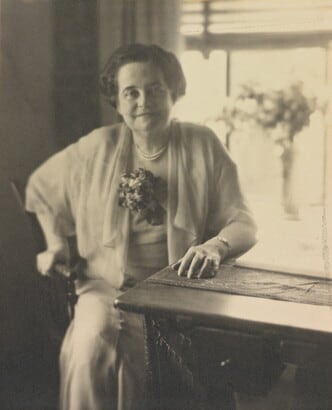
Alice A. Bailey
They agree on: What is the Absolute? Does God exist? · Who am I? Is there a true self? · Why do we suffer?
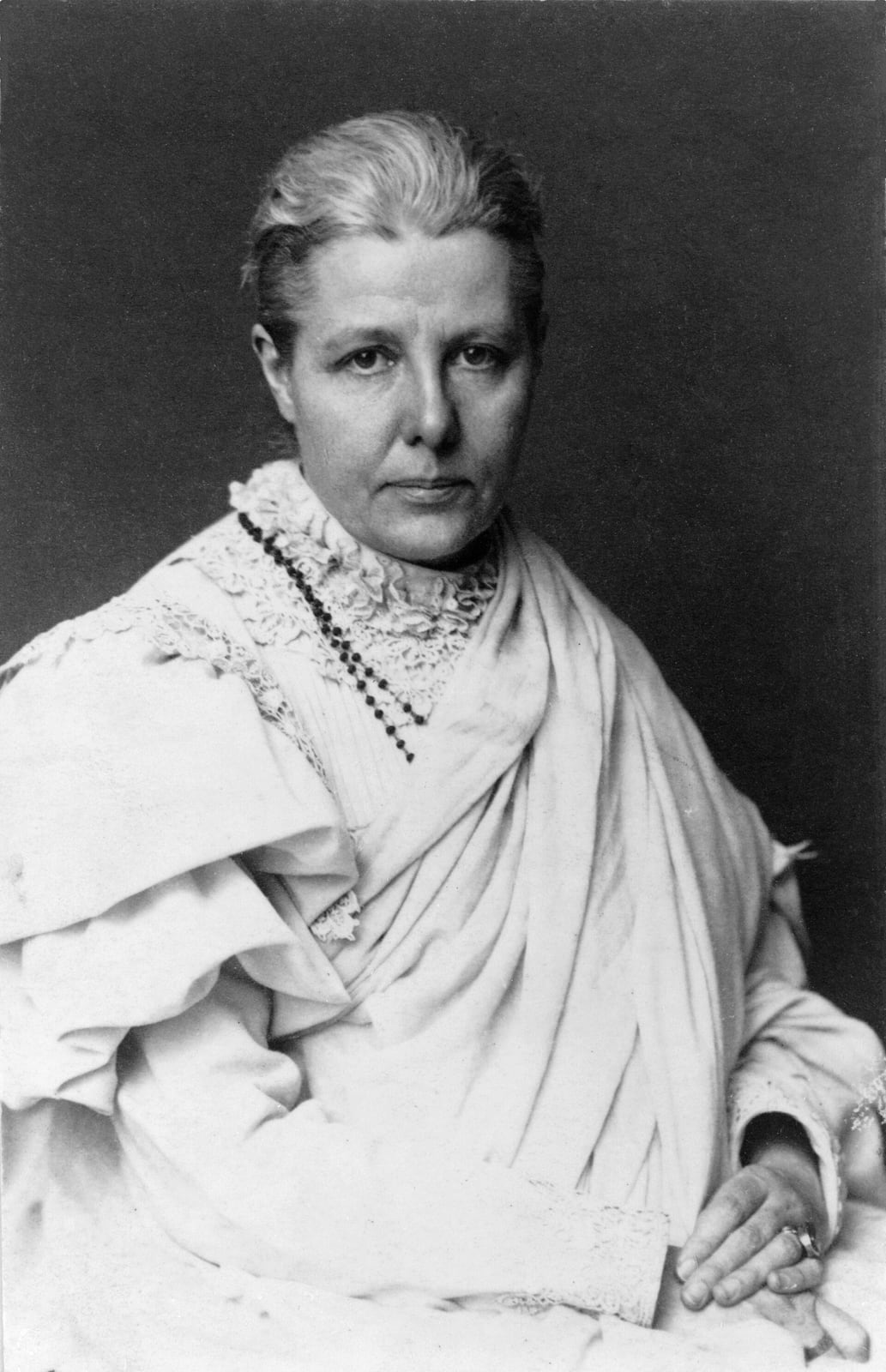
Annie Besant
They agree on: What is the Absolute? Does God exist? · Is the world real? · Who am I? Is there a true self?
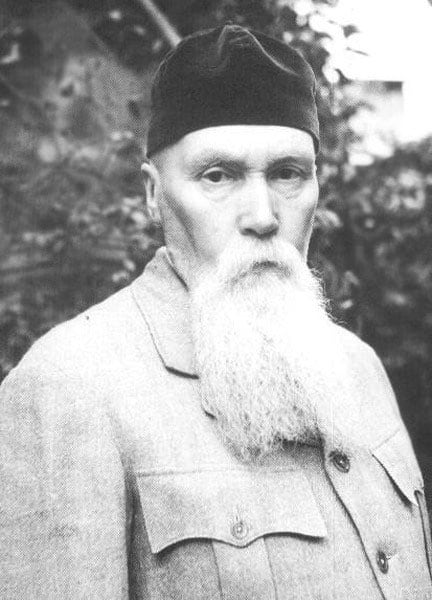
Nicholas Roerich
They agree on: Is the world real? · Can reason know the ultimate? · Withdraw from the world or transform it?
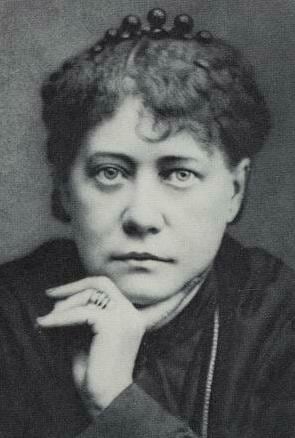
Helena Blavatsky
They agree on: Is the world real? · Who am I? Is there a true self? · Why do we suffer?


Anecdotes and stories
Anecdotes and stories
Testimonyc. 1868
The visit of the dead aunt
Origin of the story: Steiner's autobiographical lecture in Berlin, 4 February 1913 (published in the Beiträge zur Rudolf Steiner Gesamtausgabe); recorded by Lindenberg and critically discussed by Zander.
Source: Lindenberg, Christoph. Rudolf Steiner. Eine Biographie. 2 vols. Stuttgart: Verlag Freies Geistesleben, 1997.
Testimonyc. 1879–1882
The herb gatherer on the train
Origin of the story: The Course of My Life, ch. III; Koguzki's identity and house were documented by anthroposophical researchers. The figure of the 'Master' has no documentary support (Zander).
Source: Steiner, Rudolf. Mein Lebensgang. Eine nicht vollendete Autobiographie (GA 28). Dornach: Philosophisch-Anthroposophischer Verlag, 1925; ed. actual Basilea: Rudolf Steiner Verlag.
Testimony1884–1890
The boy who could not learn
Origin of the story: The Course of My Life, ch. VI. Otto Specht's medical career and death in the war are confirmed by biographers (Lindenberg); the degree of his initial disability is known only from Steiner.
Source: Steiner, Rudolf. Mein Lebensgang. Eine nicht vollendete Autobiographie (GA 28). Dornach: Philosophisch-Anthroposophischer Verlag, 1925; ed. actual Basilea: Rudolf Steiner Verlag.
Documented1896
Before the sick Nietzsche
Origin of the story: The Course of My Life, ch. XVIII, and Steiner's articles on the Nietzsche archive (1900). The lessons and the break with Elisabeth Förster-Nietzsche are documented in letters.
Source: Steiner, Rudolf. Mein Lebensgang. Eine nicht vollendete Autobiographie (GA 28). Dornach: Philosophisch-Anthroposophischer Verlag, 1925; ed. actual Basilea: Rudolf Steiner Verlag.
Documented1922–1923
The night of the fire
Origin of the story: Police reports and contemporary press; eyewitness accounts gathered by Wachsmuth and Lindenberg. Responsibility for the fire remains unproven.
Source: Zander, Helmut. Rudolf Steiner. Die Biografie. Múnich: Piper, 2011 (ed. rústica 2016).
Documented1924
The farmers of Koberwitz
Origin of the story: Transcript of the course (GA 327) and documentation of the Agriculture Section of the Goetheanum.
Source: Steiner, Rudolf. Geisteswissenschaftliche Grundlagen zum Gedeihen der Landwirtschaft. Landwirtschaftlicher Kurs (GA 327). Koberwitz, 7–16 de junio de 1924.
Teachings
Teachings
The notions that structure their thought, explained in context.
Anthroposophy (spiritual science)antroposofia
From German idealism and Goethe to Theosophy and Western esotericism.
Source: Zander, Helmut. Rudolf Steiner. Die Biografie. Múnich: Piper, 2011 (ed. rústica 2016).
Ethical individualism and free thinkingindividualismo-etico
Post-Kantian epistemology; nineteenth-century individualism.
The members of the human beingmiembros-del-ser-humano
Reworked Theosophical anthropology.
Source: Zander, Helmut. Rudolf Steiner. Die Biografie. Múnich: Piper, 2011 (ed. rústica 2016).
Reincarnation and karmareencarnacion-y-karma
Theosophy; German idealism (Lessing).
Source: Zander, Helmut. Rudolf Steiner. Die Biografie. Múnich: Piper, 2011 (ed. rústica 2016).
Imagination, Inspiration, Intuitionimaginacion-inspiracion-intuicion
Western mysticism and Rosicrucian esotericism.
Source: Steiner, Rudolf. Mein Lebensgang. Eine nicht vollendete Autobiographie (GA 28). Dornach: Philosophisch-Anthroposophischer Verlag, 1925; ed. actual Basilea: Rudolf Steiner Verlag.
The threefold social ordertriformacion-social
Postwar German crisis; European social thought.
The Mystery of Golgotha, Lucifer and Ahrimanmisterio-del-golgota
Esoteric Christology; break with the Theosophical Society.
Source: Zander, Helmut. Rudolf Steiner. Die Biografie. Múnich: Piper, 2011 (ed. rústica 2016).
Videos
Videos
Recordings, interviews and documentaries. Videos play from YouTube; they are not hosted here.
Rudolf Steiner and his Waldorf philosophy
Documentary· EN· 2025· 43 min
DW DocumentaryOfficial channel
Rudolf Steiner y su universo Waldorf
Documentary· ES· 2025· 43 min
DW DocumentalOfficial channel
Mythos Rudolf Steiner – was steckt hinter Waldorfschulen, Weleda und Demeter?
Documentary· DE· 2024· 30 min
Terra X HistoryOfficial channel
Rudolf Steiner und die Anthroposophie (Sternstunde Philosophie)
Interview· DE· 2022· 65 min
SRF Kultur SternstundenOfficial channel
Dr. Rudolf Steiner, aus seinem Lebensgang (ARTE)
Documentary· DE· 2025· 90 min
videoattac2
The Life of Rudolf Steiner (Rudolf Steiners Leben)
Documentary· DE· 59 min
Steinerfilms
The Challenge of Rudolf Steiner, part one
Documentary· DE· 93 min
Steinerfilms
The Life and Work of Rudolf Steiner with Gary Lachman
Interview· EN· 2018· 66 min
New Thinking Allowed with Jeffrey Mishlove
Rudolf Steiner's First Goetheanum with Brian Gray
Lecture· EN· 2022· 94 min
Anthroposophical Society · Faust Branch Sacramento
André Leu — Rudolf Steiner: 100 years ahead of the science of his time
Lecture· EN· 2019· 31 min
Sektion für LandwirtschaftOfficial channel
Intuitive Thinking as a Spiritual Path (The Philosophy of Freedom) — audiolibro
Third-party recording· EN· 2019· 457 min
Rudolf Steiner Press AudioOfficial channel
El desafío de Rudolf Steiner
Watch on YouTube
This video cannot be embedded; it opens on YouTube.
El desafío de Rudolf Steiner
Documentary· ES· 93 min
Benjamin Moreno
Gallery
Gallery
Images with verified licences. Each keeps its authorship and attribution.
Manuscripts
Manuscripts
Manuscript witnesses and ancient texts, with their custodian and conditions of access.
DE · Latin (Kurrent y escritura latina) · 1879–1925
Nachlass Rudolf Steiner (manuscritos, cuadernos de notas, cartas, dibujos de pizarra)
- Surviving witness
- Unos 600 cuadernos de notas, manuscritos de libros, cartas y alrededor de 1100 dibujos en pizarra
- Custodian
- Rudolf Steiner Archiv, Dornach (Suiza)
DE · Taquigrafía Gabelsberger · 1900–1924
Mitschriften der Vorträge (estenogramas)
- Surviving witness
- Unas 3700 transcripciones taquigráficas de conferencias
- Custodian
- Rudolf Steiner Archiv, Dornach
Connections
Connections
Influences, discipleships and affinities. Documented relations are distinguished from similarities identified by analysis.
Influenced by
Her cosmology (root races, Atlantis, planes) is a reworked source of Cosmic Memory and Occult Science; Steiner acknowledged her work and disagreed with its Eastern orientation.
Documented relation
Disagreed with
She appointed him head of the Esoteric School in Germany (1904); the proclamation of Krishnamurti as World Teacher led to the 1912–1913 break.
Documented relation
Disagreed with
Steiner publicly rejected the doctrine that Krishnamurti was the vehicle of the World Teacher; it was the immediate cause of the German Section's separation.
Documented relation
Met
Friedrich Nietzsche
He devoted a book to him (1895) and saw him ill at Naumburg in 1896.
Documented relation
Influenced by
Johann Wolfgang von Goethe
Editor of his scientific writings (1883–1897); his method of observation is the basis of Steiner's theory of knowledge and gives the Goetheanum its name.
Documented relation
Disciple of
Karl Julius Schröer
His teacher in Vienna, who introduced him to Goethe and recommended him to Kürschner.
Documented relation
Family of
Marie Steiner-von Sivers
Collaborator from 1902 and wife from 1914; co-founder of eurythmy and speech formation and editor of his legacy.
Documented relation
Met
Ita Wegman
Physician, co-author of Extending Practical Medicine and member of the Society's executive from 1923; she attended him in his last illness.
Documented relation
Influenced by
The first chapter of Mysticism at the Dawn of the Modern Age (1901).
Documented relation
Influenced by
Studied in Mysticism at the Dawn of the Modern Age (1901) as a precursor of his spiritual science.
Documented relation
Influenced by
The centre of his Christology: he devoted cycles to the four Gospels and to the 'fifth Gospel'.
Documented relation
Met
Édouard Schuré
Friend and collaborator; Steiner adapted and staged his dramas (GA 42), and Schuré prefaced the French translation of Christianity as Mystical Fact.
Documented relation
Influenced by
Ernst Haeckel
Steiner defended his evolutionary monism in Haeckel and His Opponents (1900) before his Theosophical period.
Documented relation
Contemporary of
Contemporaries in the German-speaking world with shared interests in Goethe, Gnosis and the life of the spirit, with no documented relationship.
Similarity identified by analysis
Contemporary of
Contemporaries in early twentieth-century European esotericism; no direct relationship is recorded.
Similarity identified by analysis
Ideas akin to
Both conceived Christ and Sophia within a religious philosophy of evolution; the affinity was noted by Russian anthroposophists, not by Steiner himself.
Similarity identified by analysis
Contemporary of
Both reworked Blavatsky's Theosophy in their own directions; there was no relationship.
Similarity identified by analysis
Sources
Sources
Bibliography and catalogues consulted for this profile.
- Steiner, Rudolf. Mein Lebensgang. Eine nicht vollendete Autobiographie (GA 28). Dornach: Philosophisch-Anthroposophischer Verlag, 1925; ed. actual Basilea: Rudolf Steiner Verlag.
- Lindenberg, Christoph. Rudolf Steiner. Eine Biographie. 2 vols. Stuttgart: Verlag Freies Geistesleben, 1997.
- Zander, Helmut. Rudolf Steiner. Die Biografie. Múnich: Piper, 2011 (ed. rústica 2016).
- Lachman, Gary. Rudolf Steiner: An Introduction to His Life and Work. Nueva York: Jeremy P. Tarcher/Penguin, 2007.
- Steiner, Rudolf. Die Philosophie der Freiheit. Grundzüge einer modernen Weltanschauung. Berlín: Emil Felber, 1894 (texto en Project Gutenberg, ebook n.º 53493).
- Goetheanum, Dornach: sede de la Sociedad Antroposófica General y de la Escuela Superior de Ciencia Espiritual.
- McDermott, Robert (ed.). The Essential Steiner. San Francisco: Harper & Row, 1984 (nueva ed. The New Essential Steiner, Lindisfarne, 2009).
- Wikipedia (de), «Rudolf Steiner» (secciones «Edition des Werkes» y «Schriften»), y Wikipedia (en), «Rudolf Steiner», consultadas el 25 de octubre de 2026.
- Wikidata, «Rudolf Steiner» (Q78484).
- Rudolf Steiner Archiv, Dornach / Rudolf Steiner Verlag, Basilea: Rudolf Steiner Gesamtausgabe (GA).
- Rudolf Steiner Archive (Steiner Online Library), rsarchive.org: índice de la GA con traducciones inglesas (p. ej. «GA 37. Writings on the History of the Anthroposophical Movement and Society 1902–1925»).
- Jonas, Margaret (comp.). GA–RSE Titles: Listing of GA volumes and published English translations. Londres: Rudolf Steiner House Library, 1999, act. 2019.
- Deutsche Nationalbibliothek, catálogo en línea (SRU): ediciones del Rudolf Steiner Verlag por número de GA.
- Project Gutenberg: obras de Rudolf Steiner en alemán e inglés (Die Philosophie der Freiheit, n.º 53493; Die Kernpunkte der sozialen Frage, n.º 28494; The Way of Initiation, n.º 39986; etc.).
- Wachsmuth, Guenther. Die Geburt der Geisteswissenschaft. Rudolf Steiners Lebensgang von der Jahrhundertwende bis zum Tode. Dornach: Philosophisch-Anthroposophischer Verlag, 1941 (trad. ingl. The Life and Work of Rudolf Steiner, 1955).
- Steiner, Rudolf. Geisteswissenschaftliche Grundlagen zum Gedeihen der Landwirtschaft. Landwirtschaftlicher Kurs (GA 327). Koberwitz, 7–16 de junio de 1924.
- Rights holder
- Dominio público en la UE (desde 1996) y en España (desde 2006) para toda la obra de Steiner (m. 1925), y en EE. UU. para lo publicado antes de 1930. Las ediciones de la GA, sus aparatos críticos y las traducciones modernas pertenecen a la Rudolf Steiner-Nachlassverwaltung / Rudolf Steiner Verlag (Basilea) y a sus editoriales.
- Official site
- www.rudolf-steiner.com/
Pending confirmation
What this profile has not yet been able to settle. We would rather say so than fill it in.
- Fecha de nacimiento: Steiner dio siempre el 27 de febrero de 1861; algunos documentos y biógrafos apuntan al 25. Se registra el 27 con certeza «disputed» en la cronología.
- Verificar el título y contenido exactos de la GA 41 y de la reordenación reciente de documentos (GA 46) que aparece en rsarchive.org; no se han registrado por falta de fuente fiable.
- Completar ISBN españoles e ingleses para varias obras escritas (GA 5, 7, 11, 14, 16, 18, 20, 22, 24–25, 29–39, 42–44) y localizar ediciones en francés, italiano y ruso.
- Registrar uno por uno los demás ciclos de conferencias significativos (p. ej. GA 107, 113, 129, 136, 146, 157, 194, 230, 233) siempre como transcripciones no revisadas.
- Cotejar con el texto alemán de GA 4 (ed. 1918) y GA 10 las dos citas marcadas como «probable».
- Confirmar las fechas marcadas como probables: doctorado (octubre de 1891), boda con Marie von Sivers (24-XII-1914), inauguración del segundo Goetheanum (29-IX-1928) e inicio de la GA (1956).
- Localizar textos alemanes de dominio público en línea (Wikisource alemán, Internet Archive con OCR limpio) de Theosophie, Wie erlangt man…? y Die Geheimwissenschaft im Umriss para la sala de lectura.
Researched on 2026-10-25