Fourth Way
G. I. Gurdjieff
Георгий Иванович Гурджиев · Գեորգի Գյուրջիև
c. 1872 – 1949Historically documented person
Spiritual teacher, writer and composer born in Russian Armenia c. 1866–1877 and died in Paris in 1949. He taught that human beings live asleep, like machines, and that waking up requires simultaneous work of body, feeling and thought in the midst of ordinary life. He founded the Institute for the Harmonious Development of Man, created the Movements, composed some two hundred pieces with Thomas de Hartmann and left the trilogy All and Everything, headed by Beelzebub's Tales to His Grandson.
- works
- 14works
- editions
- 60editions
- quotes
- 7quotes
- videos
- 10videos
- images
- 8images
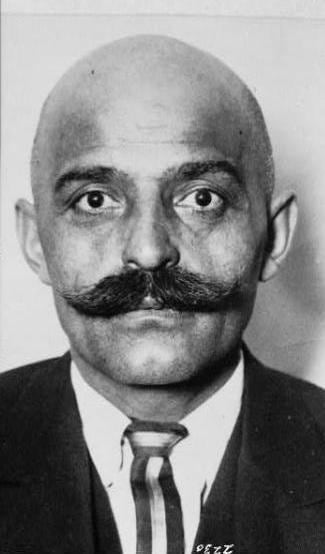
Retrato de G. I. Gurdjieff, 1925 · Public domain
In their words
«In life never do as others do.»Beelzebub's Tales to His Grandson, cap. 1, «The Arousing of Thought»: consejo de la abuela moribunda

Their central idea
Ordinary man has no single, permanent I but a multitude of small I's that take turns according to circumstance; each speaks in the name of the whole, which is why no one keeps what he promises.
See in context
Biography
5 min read
A child of the frontier
George Ivanovich Gurdjieff was born in Alexandropol—today Gyumri, in Armenia—a garrison town of the Russian Empire where Armenians, Greeks, Russians, Kurds and Turks lived side by side. The year is not known with certainty, and it is best said at the outset: passports and official papers give 1877, with the day 28 December; Gurdjieff himself spoke to pupils of a date around 1866 or 1867, which his niece Luba Gurdjieff Everitt and his biographer James Moore support; a family recollection and the plaque on his grave at Avon point to 1872. He celebrated his birthday on 1 January of the Julian calendar, 13 January in the Gregorian. His father, Ivan Ivanovich Georgiades, of Greek descent, was a cattle owner ruined by an epizootic and an ashugh, a folk bard who recited long epics from memory; his mother was Armenian, though some recent researchers think she too was Greek. The family settled in Kars, newly taken by Russia, where the boy sang in the cathedral choir and came under the tutelage of Dean Borsh, to whom he devoted one of the warmest portraits in Meetings with Remarkable Men.
The years of search
What follows, roughly from 1887 to 1911, is known almost entirely from his own account, and that account is deliberately allegorical. In Meetings with Remarkable Men Gurdjieff presents himself as a member of a group of "Seekers of Truth" who travelled through Egypt, Abyssinia, Persia, Turkestan and the Hindu Kush in search of ancient knowledge, until they reached the monastery of a Sarmoung Brotherhood in Central Asia. No independent document confirms those journeys or the existence of the brotherhood. Historians—James Webb, James Moore—accept that he travelled widely and knew Sufism, Eastern Christianity and the music and dances of the Caucasus and Central Asia at first hand, but they read the book as symbolic autobiography, and its author warned that it had to be read between the lines. He also said he made his living as a trader, hypnotist, repairer of objects and carpet dealer, and once dyed sparrows to sell them as American canaries.
Moscow, revolution and exodus
Around 1912 he appears in Moscow, married to Julia Ostrowska, a young woman of Polish origin, and begins to gather pupils. In 1915 he is met by P. D. Ouspensky, a journalist and writer on mathematical and esoteric subjects just back from India. Ouspensky's account, In Search of the Miraculous, published in 1949, remains the most orderly exposition of the teaching of those years: man as a machine that lives asleep, the absence of a permanent "I", the three centres, the law of three and the law of seven, the enneagram, the need to "remember oneself". In 1916 the composer Thomas de Hartmann and his wife Olga joined. With the revolution, Gurdjieff led a small group to Essentuki in the Caucasus; in 1919, in Tiflis, he founded the Institute for the Harmonious Development of Man, which Alexandre and Jeanne de Salzmann joined. After Constantinople and Berlin, he reached Paris in 1922.
The Prieuré at Avon
In October 1922 he installed the Institute at the Château du Prieuré des Basses Loges in Avon, near Fontainebleau. Amid exhausting farm work, building, cooking and exercises of attention, the Movements were taught there—highly demanding dances that Gurdjieff said he had gathered in monasteries and brotherhoods of the East. The writer Katherine Mansfield, ill with tuberculosis, spent her last months there and died on 9 January 1923, which earned the Prieuré a scandalous reputation in the British press. At the end of 1923 the Movements were presented at the Théâtre des Champs-Élysées, and in 1924 they toured New York and other American cities. A. R. Orage, former editor of The New Age, remained his representative in America.
The accident and the writing
In July 1924 Gurdjieff suffered a serious car accident near Fontainebleau. On recovering he announced the closing of the Institute in its former shape and turned to writing. In December of that year he began Beelzebub's Tales to His Grandson, an immense cosmic allegory in which a being from another solar system explains to his grandson the strange psychology of the inhabitants of the Earth. He worked on it for a decade, writing in Russian and Armenian in Paris cafés, reading chapters aloud to pupils and rewriting them to make them less accessible to a hasty reading. His mother died in 1925, his wife in 1926. His collaboration with de Hartmann, chiefly between 1925 and 1927, produced some two hundred piano pieces. The Prieuré closed in 1932, beset by debts. In 1933 he printed privately The Herald of Coming Good, the only book he published in his lifetime, and soon withdrew it.
Paris, the Rope and the Occupation
From 1936 he lived in a flat at 6 rue des Colonels-Renard. There he taught "the Rope", a group of women—Jane Heap, Margaret Anderson, Solita Solano, Kathryn Hulme—and, from 1940, Jeanne de Salzmann's group at Sèvres. During the Occupation he kept up his ritual meals, with toasts to the various kinds of "idiots", and meetings whose transcripts survive. After the war old pupils returned and Ouspensky's followers came, Ouspensky having died in 1947; J. G. Bennett saw him again in 1948, after twenty-five years.
Death and legacy
In 1949, already ill, he prepared the publication of Beelzebub. He died on 29 October 1949 at the American Hospital in Neuilly-sur-Seine and was buried at Avon, not far from the Prieuré. The book appeared in 1950; Meetings with Remarkable Men in French in 1960 and in English in 1963; Life Is Real Only Then, When "I Am" in a private edition in the mid-1970s. Jeanne de Salzmann, to whom he had entrusted the transmission, organised the Institut Gurdjieff in Paris, the Gurdjieff Foundation of New York, founded in 1953, the Gurdjieff Society in London and the Caracas foundation. Outside that network other lines arose, such as those of Bennett and Willem Nyland. Peter Brook brought Meetings with Remarkable Men to the screen in 1979.
Gurdjieff remains uncomfortable. His disciples describe an overwhelming presence, capable of very practical compassion and of calculated harshness; his critics, a man who asked for money without shame, who manipulated, and who fathered several children with pupils. Both pictures have documentary support. What is not in dispute is his influence: the idea that human beings live asleep, and that waking up requires working at once with body, feeling and thought, in the midst of ordinary life rather than outside it—what Ouspensky called the "fourth way"—runs through much of twentieth-century Western spirituality.
Sources: Ouspensky, P. D. In Search of the Miraculous: Fragments of an Unknown Teaching. Nueva York: Harcourt, Brace, 1949. · Moore, James. Gurdjieff: The Anatomy of a Myth. Shaftesbury: Element, 1991. · De Hartmann, Thomas y Olga de Hartmann. Our Life with Mr. Gurdjieff. Nueva York: Cooper Square, 1964 (ed. ampliada, Harper & Row, 1983). · Gurdjieff, G. I. Meetings with Remarkable Men. Londres: Routledge & Kegan Paul, 1963 (ed. francesa: Rencontres avec des hommes remarquables, París: Julliard, 1960). · Gurdjieff, G. I. All and Everything: Beelzebub's Tales to His Grandson. Nueva York: Harcourt, Brace, 1950; Londres: Routledge & Kegan Paul, 1950.
Timeline
A life, year by year
Each point is a documented event. Click to read it, with its source and degree of certainty.
c. 1872age 0Alexandropol (hoy Gyumri, Armenia)
Birth (disputed date)
Born in Alexandropol. Three versions: 1877 (28 December, in passports and official papers); c. 1866–1867 (what he told pupils; supported by his niece Luba Gurdjieff Everitt and James Moore); 1872 (a family recollection and the plaque on his grave at Avon). He celebrated his birthday on 1/13 January.
DisputedWikipedia (en), «George Gurdjieff», sección sobre la fecha de nacimiento (remite a Churton, Tobias. Deconstructing Gurdjieff, Inner Traditions, 2017, pp. 3–4 y 316–317).
After their death
- 1950Beelzebub published
- 1953Gurdjieff Foundation
- 1979Peter Brook's film
c. 1872 · age 0
Birth (disputed date)
Born in Alexandropol. Three versions: 1877 (28 December, in passports and official papers); c. 1866–1867 (what he told pupils; supported by his niece Luba Gurdjieff Everitt and James Moore); 1872 (a family recollection and the plaque on his grave at Avon). He celebrated his birthday on 1/13 January.
Disputed
c. 1878
The family in Kars
After his father's ruin the family moves to Kars, newly taken by Russia. He sings in the cathedral choir and is tutored by Dean Borsh (according to Meetings with Remarkable Men).
Tradition
c. 1887
The years of search
Period of travels (c. 1887–1911) known almost only from his allegorical account: the 'Seekers of Truth', the Sarmoung Brotherhood. No independent documentary confirmation.
Tradition
c. 1912
First groups in Moscow
He appears in Moscow, married to Julia Ostrowska, and begins to gather pupils in Moscow and St Petersburg.
Probable
1915
Meeting with Ouspensky
P. D. Ouspensky meets him in a Moscow café; from that meeting comes In Search of the Miraculous.
Documented
1916
The de Hartmanns join
The composer Thomas de Hartmann and his wife Olga become his pupils.
Documented
1917
Essentuki
With the revolution he withdraws with a small group to Essentuki, where intensive work continues.
Documented
1919
Institute for the Harmonious Development of Man
He founds the Institute in Tiflis; Alexandre and Jeanne de Salzmann join.
Documented
October 1922
The Prieuré
After Constantinople and Berlin, he installs the Institute at the Château du Prieuré des Basses Loges.
Documented
January 9, 1923
Death of Katherine Mansfield
The writer, ill with tuberculosis, dies at the Prieuré after spending her last months there.
Documented
January 1924
The Movements in America
After the Paris demonstrations (December 1923), he presents the Movements in New York and other cities.
Documented
July 1924
The accident
Serious car accident. On recovering he closes the Institute in its former shape and turns to writing.
Documented
December 1924
Beelzebub begun
He begins writing Beelzebub's Tales to His Grandson, on which he will work for a decade.
Documented
June 1926
Death of his wife
Julia Ostrowska dies of cancer; his mother had died in 1925.
Documented
1932
The Prieuré closes
The Prieuré ceases to operate, beset by debts.
Documented
1933
The Herald of Coming Good
He prints privately the only book published in his lifetime; he soon withdraws it.
Documented
1936
The Rope
He settles in the flat on rue des Colonels-Renard, where he teaches the women's group 'the Rope'.
Documented
1940
The Occupation
He begins teaching Jeanne de Salzmann's group at Sèvres; during the Occupation he keeps up meetings and ritual meals.
Documented
1948
Ouspensky's pupils arrive
After Ouspensky's death (1947), his pupils and J. G. Bennett come to Paris.
Documented
October 29, 1949
Death
He dies at the American Hospital in Neuilly; funeral at the Russian Orthodox cathedral on rue Daru and burial at Avon.
Documented
1950
Beelzebub published
All and Everything: Beelzebub's Tales to His Grandson appears.
Documented
1953
Gurdjieff Foundation
The Gurdjieff Foundation of New York is established, within the network organised by Jeanne de Salzmann.
Documented
1979
Peter Brook's film
Release of Meetings with Remarkable Men, directed by Peter Brook in collaboration with Jeanne de Salzmann.
Documented
Works
Essential works
The works without which their legacy cannot be understood.
Posthumous work · 1950
Beelzebub's Tales to His Grandson
Рассказы Вельзевула своему внуку / Beelzebub's Tales to His Grandson
First series of All and Everything. Beelzebub, a cosmic being travelling on the ship Karnak, tells his grandson Hassein what he observed on Earth over centuries: the history of a humanity that, through a cosmic accident and the atrophy of an organ that let it see reality, lives ruled by vanity, self-love and suggestibility. Beneath outsized humour and an invented vocabulary, the book sets out a complete cosmology—the law of three, the law of seven, the reciprocal feeding of everything that exists—and a relentless critique of religion, science, art and war. Gurdjieff wanted it read three times and in different ways.
14 editions · amazon.com

Posthumous work · 1963
Meetings with Remarkable Men
Встречи с замечательными людьми / Meetings with Remarkable Men
A memoir of youth organised as portraits: the bard father, Dean Borsh, Prince Yuri Lubovedsky, Professor Skridlov, Ekim Bey and other companions among the 'Seekers of Truth', up to the arrival at the monastery of the Sarmoung Brotherhood. It is at once autobiography, adventure story and training manual: each meeting teaches a quality. Critics agree it should not be read as literal chronicle; none of its exotic episodes has independent documentary confirmation. Peter Brook filmed it in 1979.
9 editions · amazon.com

Posthumous work · c. 1975
Life Is Real Only Then, When 'I Am'
Жизнь реальна только тогда, когда «Я есть» / Life Is Real Only Then, When 'I Am'
Gurdjieff's most personal book: the account of the crisis after the 1924 accident, the decision to 'remember himself' through constant effort, the break with the New York pupils in 1931 and a series of lectures on 'I am', the body and sensation. Fragmentary and sometimes abrupt, it shows the teacher applying his own method to himself and doubting it.
8 editions · amazon.com

Written work · 1933
The Herald of Coming Good
A programmatic booklet subtitled 'First appeal to contemporary humanity'. It sets out the history of the Institute, the aims of the work, the plan of the All and Everything trilogy and a long declaration of intent, in a deliberately convoluted style. Its withdrawal made it a rarity; reprinted since 1969, it is a key document for dating the crisis of 1931–1933.
6 editions · amazon.com
Complete works (14)

Views from the Real World
1973

The Struggle of the Magicians
1957
G. I. Gurdjieff
Gurdjieff–de Hartmann Music for the Piano
The Conscious LibraryGurdjieff–de Hartmann Music for the Piano
1996
G. I. Gurdjieff
Transcripts of Gurdjieff's Meetings 1941–1946
The Conscious LibraryTranscripts of Gurdjieff's Meetings 1941–1946
2008
G. I. Gurdjieff
Gurdjieff's Early Talks 1914–1931
The Conscious LibraryGurdjieff's Early Talks 1914–1931
2014

Paris Meetings 1943
2017

In Search of the Miraculous (P. D. Ouspensky)
1949

Our Life with Mr. Gurdjieff (Thomas and Olga de Hartmann)
1964

The Reality of Being (Jeanne de Salzmann)
2010

In Search of Being
2012
Quotations
Quotations located in a specific work. Each carries its provenance and its level of confidence.
In life never do as others do.VerifiedBeelzebub's Tales to His Grandson, cap. 1, «The Arousing of Thought»: consejo de la abuela moribunda
Essential ideas (editorial summary)
Out of respect for copyright, these ideas are summarised in our own words and are not presented as literal quotations.
- Ordinary man has no single, permanent I but a multitude of small I's that take turns according to circumstance; each speaks in the name of the whole, which is why no one keeps what he promises.
- Man cannot do: in him everything happens, as it rains or clears. True doing presupposes a unified being, and that unity is not a gift but the result of long work.
- Work on oneself requires conditions of friction: difficult people, uncomfortable tasks, fatigue. Without resistance there is no effort and without effort no transformation.
- Knowledge must be accompanied by an equivalent development of being; knowledge that grows without being becomes theoretical, useless or dangerous.
Apocryphal quotes or disputed attributions (1)
«'I leave you all in a fine mess' ('Je vous laisse dans de beaux draps'), as last words.»
It circulates online as Gurdjieff's final words, but it has not been found in the published testimonies of his pupils or in the biographies consulted. No primary source.
Last words
Contradictory versions
«Do everything, even the impossible, to develop what I have brought.»Do everything, even the impossible, to develop what I have brought.
There is no single, unambiguously attested final phrase; several versions of differing weight circulate. (1) Testimony attributed to Jeanne de Salzmann: the phrase above, which she reportedly received as his last words to her; it recurs in the literature on Gurdjieff, but its original publication has not been located (Wikipedia flags it 'citation needed'). (2) Instructions from his last weeks, passed on by de Salzmann and recorded by W. P. Patterson (Struggle of the Magicians, pp. 224–225): publish the first and second series 'as and when you are sure that the time has come', first prepare a nucleus of people, and the third need not be published. These are not last words in the strict sense. (3) J. G. Bennett, who saw him often in 1948–1949, narrated his last months (Witness, 1962; the diaries published as Idiots in Paris), but it has not been verified that he records a final phrase; pending. (4) His American physician William Welch left a testimony on the manner of his death—'he died like a king'—which are not Gurdjieff's words. (5) The phrase 'I leave you all in a fine mess' has no source and is treated as apocryphal.
Source: The Gurdjieff Legacy Foundation, «Jeanne de Salzmann» (archivo), que cita a William Patrick Patterson, Struggle of the Magicians, pp. 224–225.
Ask
What their work answers
Twelve great human questions and what their texts allow us to answer, with references. We never put words in their mouth.
What is the Absolute? Does God exist?
Our Common Father Endlessness created the universe and suffers for it
A personal GodStated explicitly
G. I. Gurdjieff speaks of God chiefly in Beelzebub's Tales to His Grandson (1950), a cosmic allegory in deliberately strange language. There the creator bears names such as Our Common Father, His Endlessness or Our Lord Sovereign Endlessness; He dwells on the Sun Absolute and creates the universe to counter the destructive action of time, the Heropass, establishing a system of reciprocal exchange of substances. This God has purpose, sends messengers to humanity and, according to the tale, grieves over the state of beings. The aim of inner work is partly to help Him: the conscious human being can lighten the burden of his Creator. Unlike the abstract account transmitted by Ouspensky, here the Absolute is someone with will and feeling, though wrapped in a myth designed to disconcert the reader.
Compare this question with other teachersWho am I? Is there a true self?
Man is born without a soul or an I: work must form them
There is no permanent selfStated explicitly
According to G. I. Gurdjieff's teachings as recorded by Ouspensky, ordinary man lacks individuality, a single I and will: he is a plurality of I's following one another mechanically. In one of the Moscow talks reproduced in chapter 2 of In Search of the Miraculous, Gurdjieff compares the human being to a carriage, a horse, a coachman and a master who is absent, and states that man is not born with an immortal soul: he may come to form higher bodies, and with them a permanent I, only through intense work. In Beelzebub's Tales to His Grandson he develops this idea in mythic language, speaking of bodies that a being may or may not crystallise. The self, then, is not a given substance but a possibility that most people do not realise.
Compare this question with other teachersWhy do we suffer?
The legacy of the organ Kundabuffer: man lives asleep and suffers senselessly
Ignorance of what we areStated explicitly
G. I. Gurdjieff offers in Beelzebub's Tales to His Grandson a mythic explanation of human suffering. According to the tale, at the dawn of humanity higher powers implanted in human beings an organ, the Kundabuffer, which made them perceive reality upside down and prevented them from seeing their true situation; although it was later removed, its properties — vanity, self-love, suggestibility, egoism — were passed down from generation to generation. Hence war, reciprocal destruction and mechanical life, which plunge people into a sleep of which they are unaware. In the teachings transmitted by Ouspensky, this state appears as identification and sleep. Gurdjieff distinguishes mechanical suffering, which serves no purpose, from intentional suffering, consciously accepted, which together with conscious labour is the means of the being's evolution.
Compare this question with other teachersWhat happens after death?
Immortality is not possessed: it is acquired by first dying to oneself
Dying each day to the knownStated explicitly
Gurdjieff denies that ordinary man possesses an immortal soul. According to the teaching recorded by Ouspensky in In Search of the Miraculous, man is a machine without a permanent I, and the only thing that could survive death are the higher bodies — the astral and those beyond it — which are formed only through conscious work and voluntary suffering; whoever has not formed them dies completely. In Beelzebub's Tales he speaks of the Kesdjan body and the higher being-body as achievements, not gifts. Hence the importance of an earlier death: Gurdjieff taught that to be born again one must die, and to die one must awaken; what must die is false personality, with its vanity and self-love. The decisive question is not what happens after death, but whether there is already someone capable of surviving it.
Compare this question with other teachersHow is liberation or salvation attained?
Awakening through conscious effort and voluntary suffering: the Fourth Way in ordinary life
Through conscious inner workStated explicitly
George I. Gurdjieff taught that human beings are born without a finished soul and, unless they work on themselves, remain asleep and mechanical. According to Ouspensky's testimony, he distinguished four ways: the fakir's, working on the body; the monk's, on the emotions; the yogi's, on the mind; and a Fourth Way working on all three at once without leaving ordinary life. Its means are self-observation, self-remembering, the movements and dances he designed, and what Beelzebub's Tales to His Grandson calls conscious labours and intentional sufferings. The work requires a teacher who knows and a group; the result is the formation of a real and permanent «I».
Compare this question with other teachersIs a teacher necessary?
Only one who knows can wake the sleeper: teacher and school are necessary
IndispensableStated explicitly
According to Ouspensky's testimony, George I. Gurdjieff taught that ordinary human beings cannot escape their sleep alone, because the very means they would use to wake up are asleep. They need someone who is awake, or more awake, who knows the way and enables them to work on themselves; and that knowledge is not invented but received from a source that possesses it. Gurdjieff played that role demandingly, often disconcertingly, with his pupils in Russia and later at the Prieuré in Fontainebleau. In Meetings with Remarkable Men he presents his own formation as a search for teachers and ancient knowledge through Central Asia and the Near East.
Compare this question with other teachersIs the world real?
A hierarchical cosmos of laws and matters, where everything feeds on everything
Planes of existenceStated explicitly
George I. Gurdjieff taught a cosmology in which the universe is a hierarchy of worlds governed by two fundamental laws, the law of three and the law of seven (the octave). According to Ouspensky's testimony, everything in it is material, though with different degrees of density and vibration, and everything forms part of a reciprocal exchange of substances in which each level feeds others. In Beelzebub's Tales to His Grandson he develops it in mythic form, with a Sun Absolute at the centre and the Earth as a peripheral place where mechanical humanity serves cosmic purposes it does not know. The world is fully real, but ordinary human beings do not see it as it is, because they live asleep.
Compare this question with other teachersWhat is love?
Mechanical man cannot love: only one who is conscious truly loves
What appears when the self ceasesStated explicitly
Gurdjieff denies that ordinary man is capable of loving. According to the teaching recorded by Ouspensky, mechanical man can do nothing, and cannot love either: what he calls love is a mixture of attraction, habit, identification and self-love, which changes with circumstances and easily turns into its opposite. In a talk collected in Views from the Real World he distinguishes love of the body, which depends on type and polarity; love of feeling, which evokes its opposite; and conscious love, which evokes the same in response. In Beelzebub's Tales, vanity and self-love appear as consequences of the organ Kundabuffer and as the main obstacles to development. Real love is possible only for one who, through conscious labour and intentional suffering, has ceased to be governed by those forces.
Compare this question with other teachersAre we free, or is everything determined?
No one does anything: only one who works on himself gains a will
We are machines until we awakenStated explicitly
The thesis of human mechanicalness is the core of Gurdjieff's teaching as his pupils recorded it. Man has no self but a multitude of contradictory «I»s; he is not conscious but lives asleep, and what he calls his decisions are reactions of a machine driven by external influences. In his talks collected in *Views from the Real World* and in his major work, *Beelzebub's Tales to His Grandson*, he adds that humanity, being mechanical, serves cosmic purposes it does not understand. Only conscious labour and intentional suffering can create a permanent self and a real will. Freedom is not a birthright but something that must be manufactured.
Compare this question with other teachersWhy meditate or pray?
Remembering oneself amid life, through conscious effort
Being presentStated explicitly
For Gurdjieff the human being lives asleep, and all practice has a single aim: to wake up. The main instrument, according to his pupils' testimony, is self-remembering, divided attention that includes the perceiver along with the perceived, exercised amid ordinary activities and not in retreat. To this he added practices of his own: the Movements, sacred dances requiring simultaneous attention of body, emotions and mind, exercises in sensing the body, hard physical work and what he called intentional suffering. In *Life Is Real Only Then, When «I Am»*, his last book, he describes that effort of presence as the condition for a real «I» to arise in man.
Compare this question with other teachersCan reason know the ultimate?
Real knowledge is scarce, material and transmitted; knowledge without being is useless
Esoteric knowledgeStated explicitly
According to Ouspensky's testimony in *In Search of the Miraculous*, Gurdjieff held that there is a true knowledge, preserved by an esoteric circle of humanity and transmitted through schools, and that this knowledge is in a certain sense material and limited: it cannot be shared out to everyone. He insisted on distinguishing knowledge from being: a man may know a great deal and be unable to do anything, and knowledge that grows without the development of being produces only theories. In *Meetings with Remarkable Men* he narrates his youthful search for that knowledge across the East, with the «Seekers of Truth». Ordinary reason belongs to the man-machine; real understanding requires transformation.
Compare this question with other teachersWithdraw from the world or transform it?
Wars cannot be stopped from outside: mechanical man cannot do
The revolution is innerStated explicitly
Gurdjieff holds that ordinary man cannot do anything: everything happens to him, as rain happens. According to the 1915 conversation recorded by Ouspensky, when asked in the midst of the world war whether war could be stopped, he answered that it could not, because it is the result of cosmic influences and of the mechanicalness of millions of people, and that only men who had ceased to be machines could change things. In Beelzebub's Tales the periodic «reciprocal destruction» of the beings of the Earth is the most terrible symptom of their lack of consciousness. That is why he proposes no social reforms but work on oneself. Nor withdrawal: his Institute for the Harmonious Development of Man, at the Prieuré in Fontainebleau-Avon, was a community of intense physical work, sacred dances and deliberate friction between people, that is, life in the world used as a school.
Compare this question with other teachers
Affinities & tensions
Affinities and tensions
Calculated question by question from their positions. The reason for each agreement or clash, on click.
Thinks most like
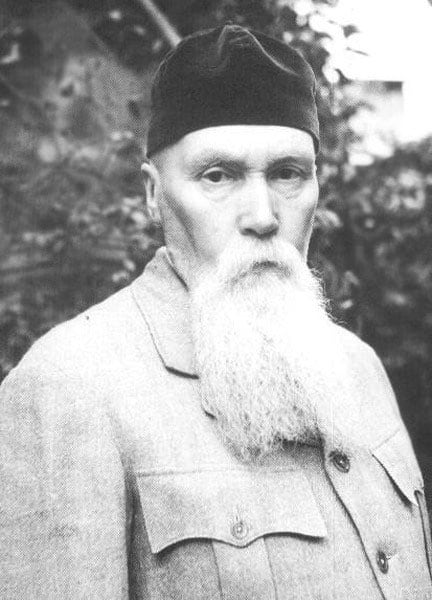
Nicholas Roerich
They agree on: Is a teacher necessary? · Is the world real? · Can reason know the ultimate?
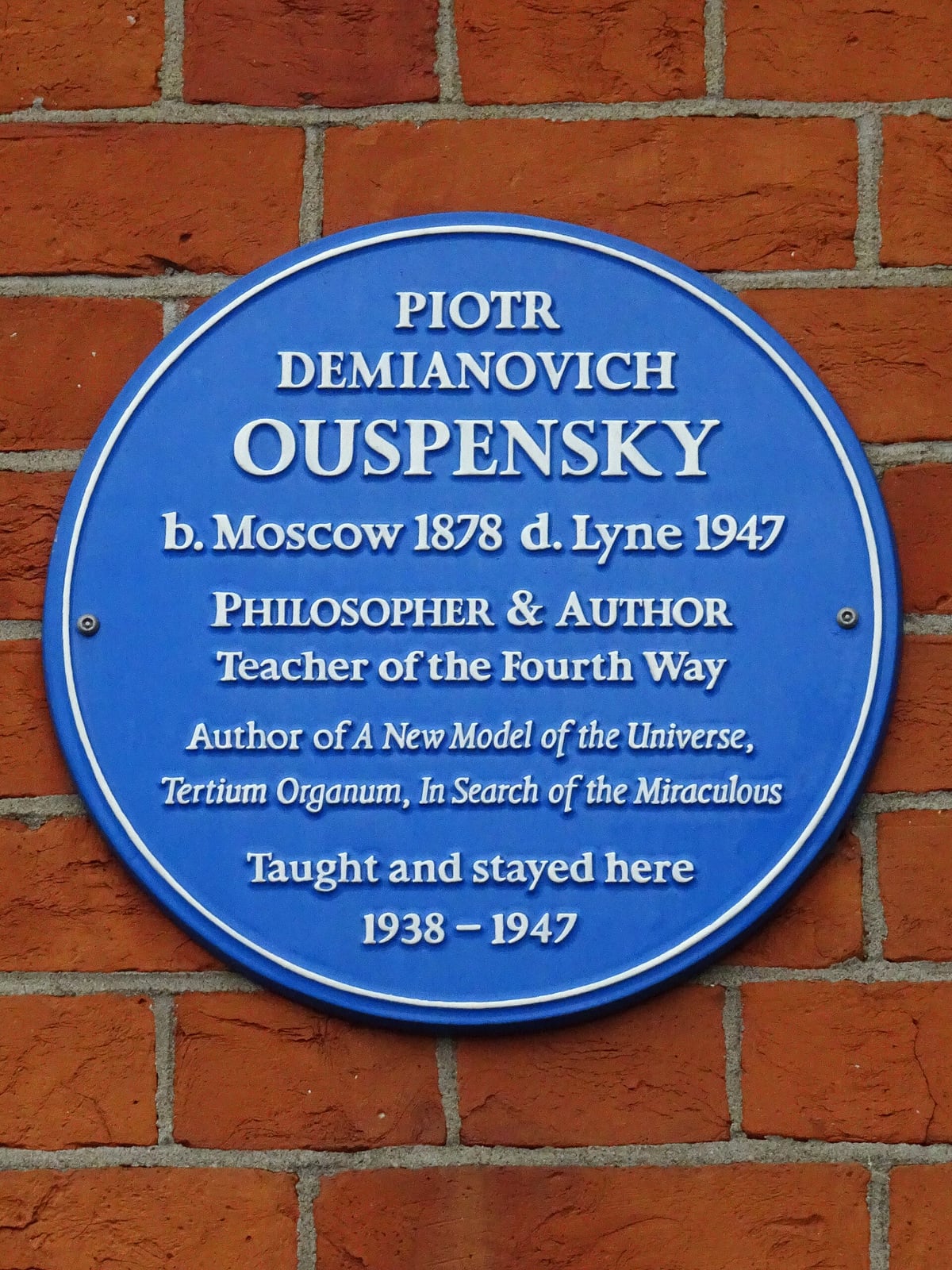
P. D. Ouspensky
They agree on: Who am I? Is there a true self? · Why do we suffer? · How is liberation or salvation attained?
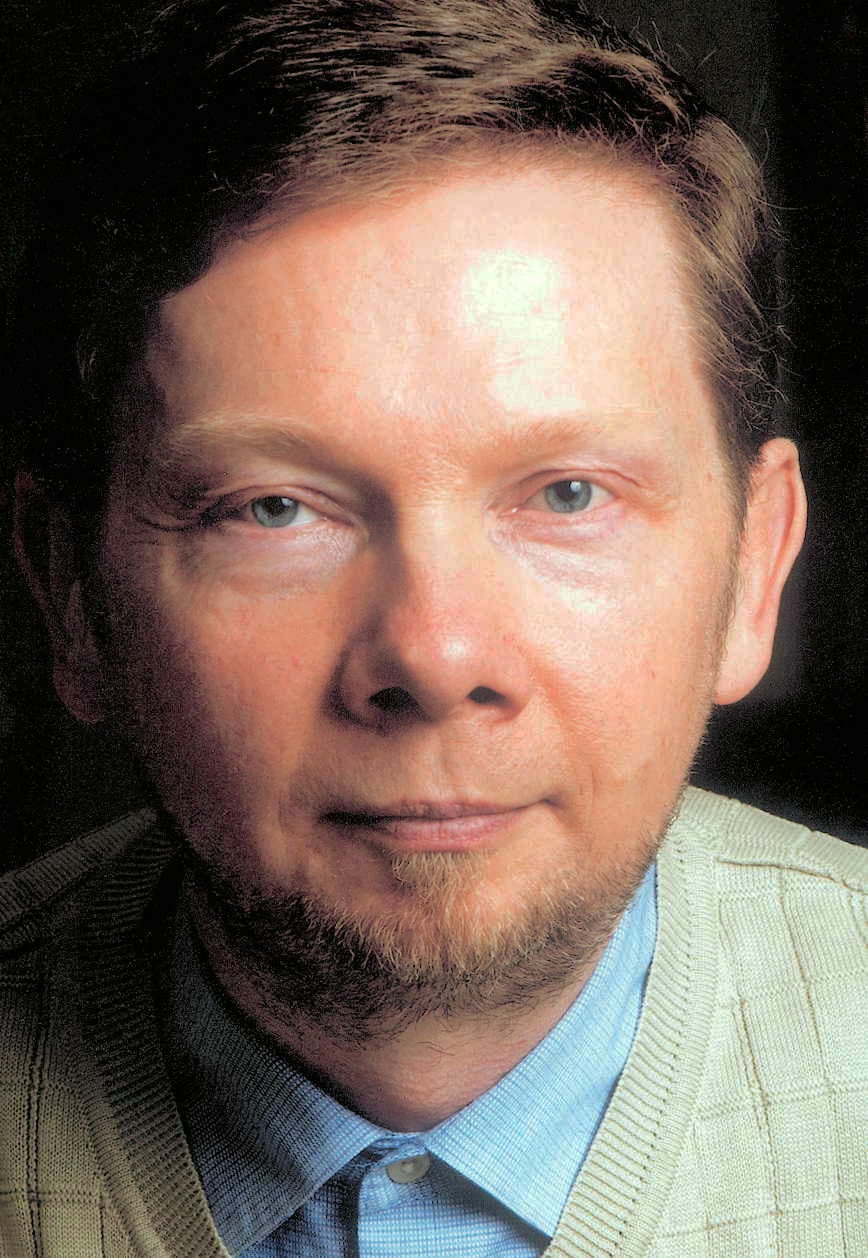
Eckhart Tolle
They agree on: What is love? · Are we free, or is everything determined? · Why meditate or pray?
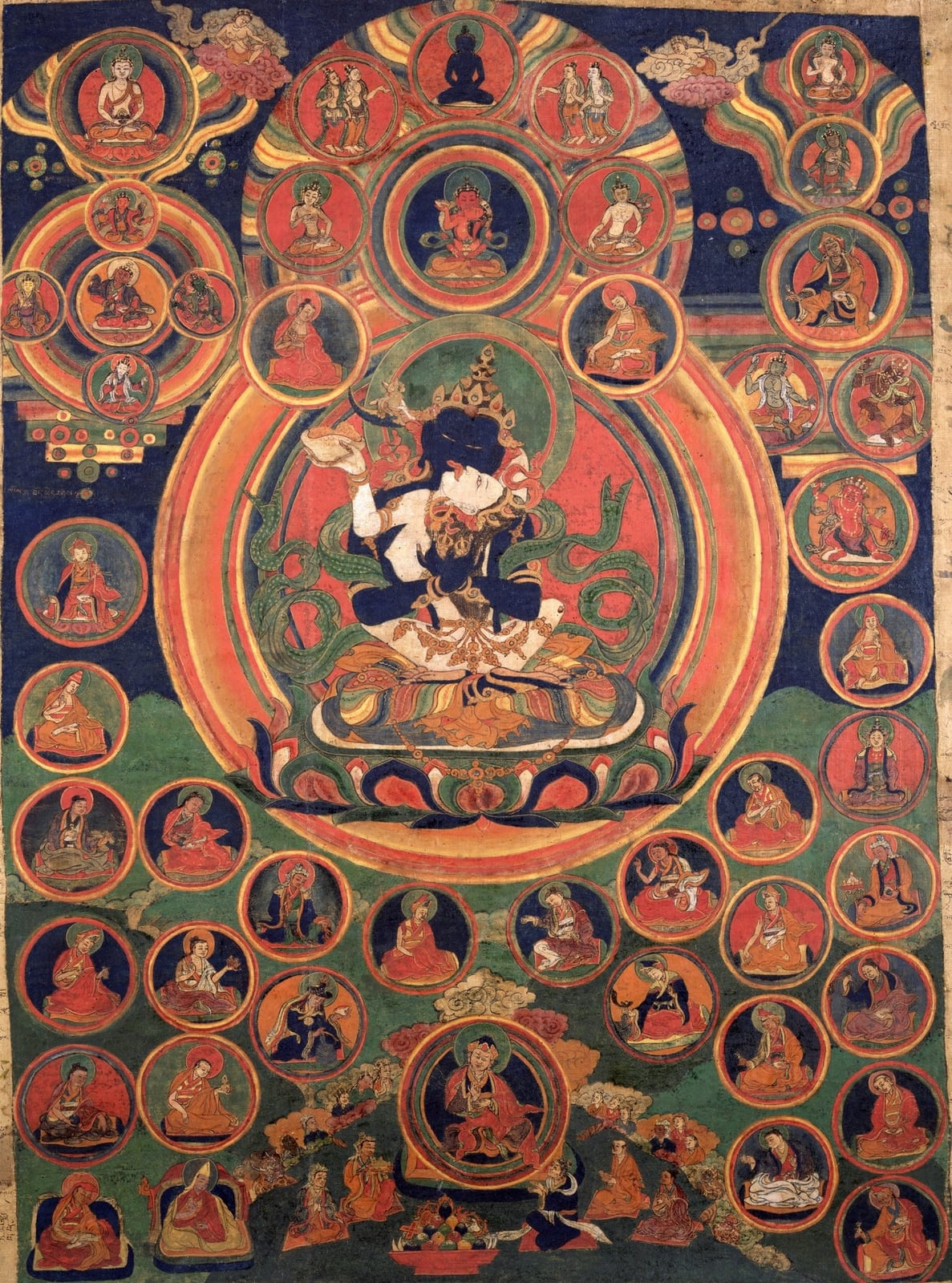
Padmasambhava
They agree on: Who am I? Is there a true self? · Why do we suffer? · Is a teacher necessary?
Thinks most unlike

Nikolai Berdyaev
They clash on: Who am I? Is there a true self? · Is a teacher necessary?
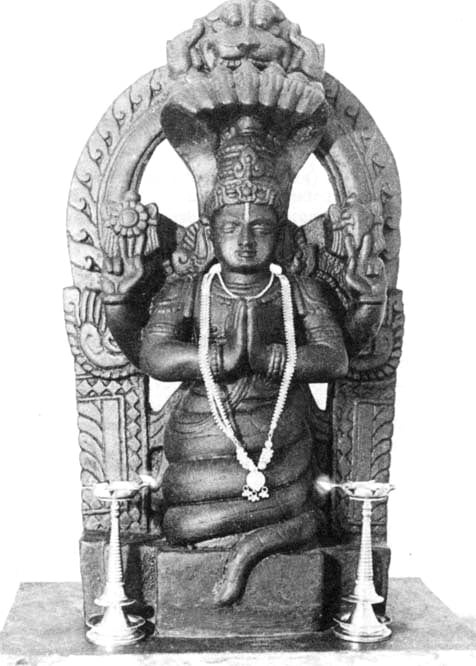
Patañjali
They clash on: What is the Absolute? Does God exist? · Who am I? Is there a true self?
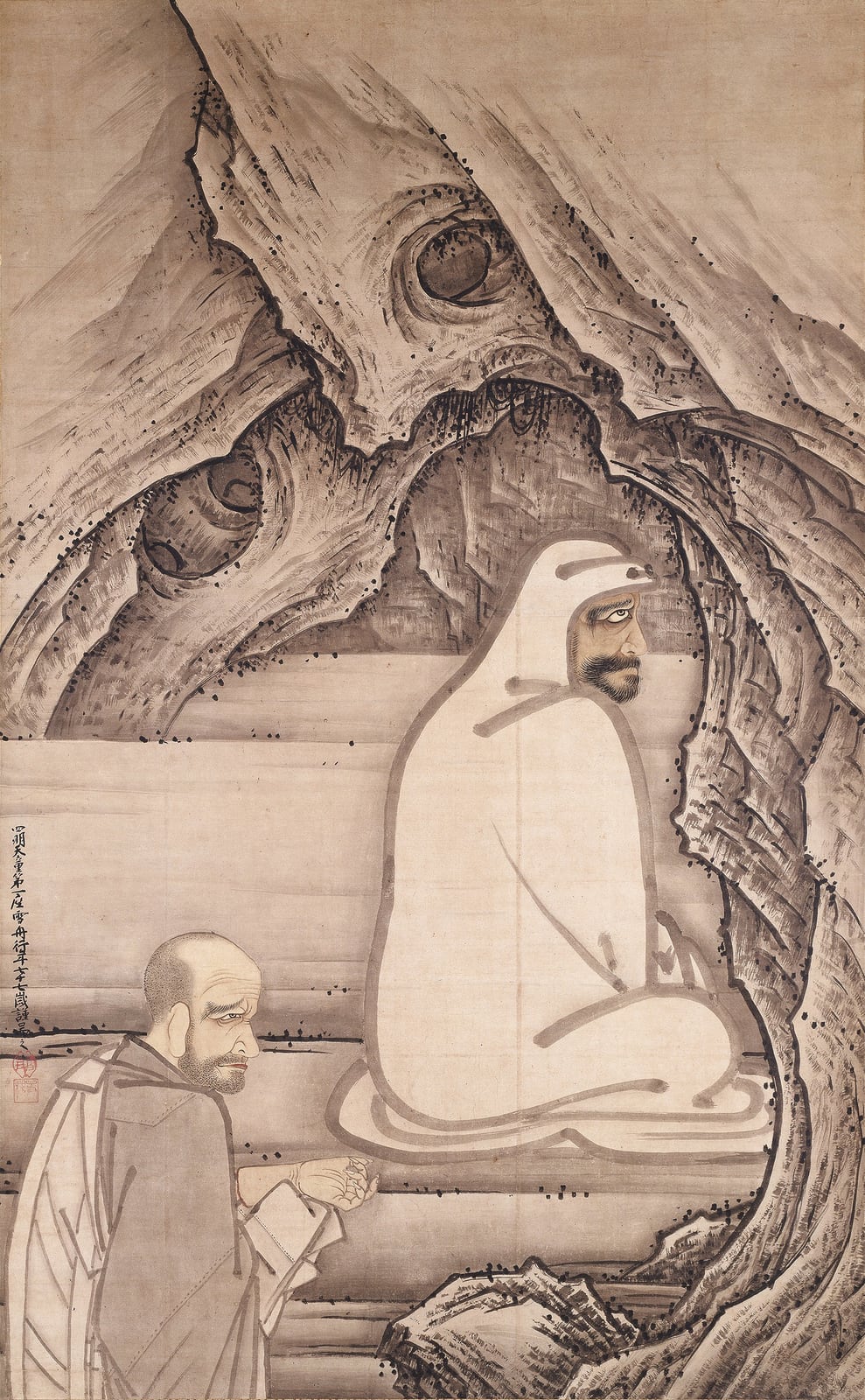
Bodhidharma
They clash on: Who am I? Is there a true self?
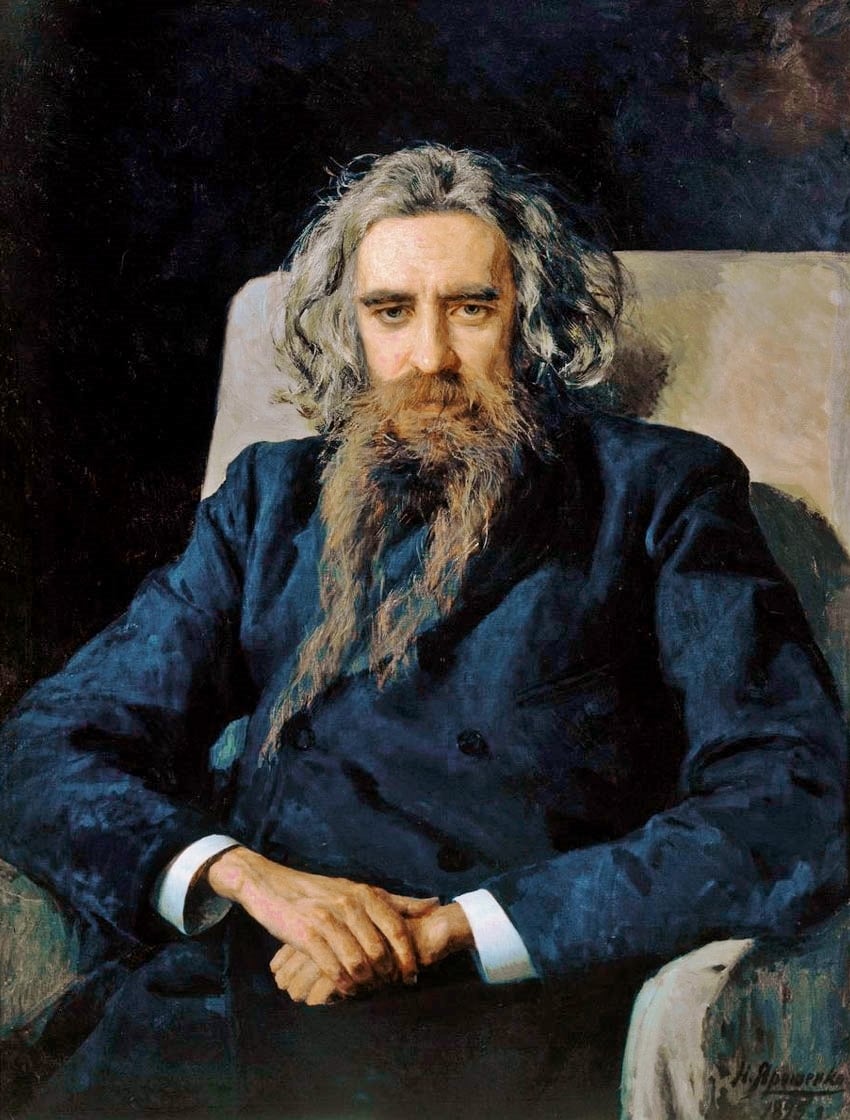
Vladimir Solovyov
They clash on: Who am I? Is there a true self?
They clash onApparent contradiction
G. I. Gurdjieff · Ramana Maharshi
Conscious effort versus being what one already is: a smaller conflict than it seems
Why: The contradiction is largely apparent because they speak from different levels. Gurdjieff describes the human being from the side of sleep and the machine, and his effort is the condition for something to awaken; Ramana speaks from the Self, for which effort produces nothing new, and he admits it only as a means of stopping the ego from interfering. Both deny the ordinary doer. A real difference remains, however, and should not be glossed over: for Gurdjieff the permanent self does not exist and must be created; for Ramana it already exists and one need only stop veiling it. In one effort builds; in the other, it clears away.
They agree on
G. I. Gurdjieff · P. D. Ouspensky
Man is a machine: the master and the disciple who systematised his teaching
Why: The affinity is that of a master and his most systematic disciple: Ouspensky worked with Gurdjieff in Russia between 1915 and 1918 and transmitted that teaching in In Search of the Miraculous, published posthumously in 1949. The relationship broke down: Ouspensky withdrew in 1918 and definitively in the 1920s, and led his own groups in London, centred on the study of the system rather than on the figure of the master. They agree in doctrine, not in style: Gurdjieff taught in a demanding and disconcerting way, with dances, movements and provoked situations; Ouspensky, intellectually and in an orderly fashion. Hence they part on the question of the master: one deems him indispensable; the other stresses the school.
They clash onFundamental disagreement
G. I. Gurdjieff · Teresa of Ávila
The soul as gift or as achievement: the diamond castle versus an immortality to be manufactured
Why: The contradiction is real and touches the core of both anthropologies. Teresa speaks from the Christian doctrine of creation, in which God gives each soul its immortal being and grace precedes effort. Gurdjieff builds a cosmology of his own, of laws and materials, in which immortality is conditional and must be acquired. There is nonetheless a point of contact: both think that most people live outside themselves, in the outer courtyard of the castle or in sleep, and that knowing oneself demands long and painful work. But in Teresa what is unknown is already there, and in Gurdjieff what is unknown is that there is not yet anyone.
They clash onFundamental disagreement
G. I. Gurdjieff · Jiddu Krishnamurti
Both see man as conditioned; one demands a school and effort, the other forbids them
Why: The contradiction is real and comes from two opposite experiences of teaching. Gurdjieff presents himself as a seeker of an ancient knowledge transmitted in schools of Central Asia, and believes that this knowledge, scarce and almost material, can pass only from one who has it to one who works. Krishnamurti was raised precisely within an esoteric organisation with masters, grades and initiations, and his break in 1929 made the rejection of all authority the centre of his teaching. Both distrust comfortable spirituality and inherited beliefs; they part over whether directed effort awakens or lulls.
Anecdotes and stories
Anecdotes and stories
Testimonyc. 1870s–1880s
The grandmother's advice
Origin of the story: It comes from Gurdjieff himself, in chapter 1 of Beelzebub's Tales ('The Arousing of Thought'). There are no independent witnesses; it is an autobiographical account within an allegorical work.
Source: Gurdjieff, G. I. All and Everything: Beelzebub's Tales to His Grandson. Nueva York: Harcourt, Brace, 1950; Londres: Routledge & Kegan Paul, 1950.
Testimonyc. 1890s
The sparrows of Samarkand
Origin of the story: Gurdjieff's own account in Meetings with Remarkable Men. No independent confirmation; its parable-like character is obvious.
Source: Gurdjieff, G. I. Meetings with Remarkable Men. Londres: Routledge & Kegan Paul, 1963 (ed. francesa: Rencontres avec des hommes remarquables, París: Julliard, 1960).
Testimony1915
Ouspensky in the Moscow café
Origin of the story: Ouspensky's testimony in chapter 1 of In Search of the Miraculous (1949), written years after the events.
Source: Ouspensky, P. D. In Search of the Miraculous: Fragments of an Unknown Teaching. Nueva York: Harcourt, Brace, 1949.
Documented1922–1923
Katherine Mansfield in the cowshed
Origin of the story: Documented by Mansfield's letters (ed. Murry, 1928) and by Moore's biographies (Gurdjieff and Mansfield, 1980; The Anatomy of a Myth, 1991).
Source: Mansfield, Katherine. The Letters of Katherine Mansfield. Ed. J. Middleton Murry. Londres: Constable, 1928 (cartas desde el Priorato, octubre de 1922 – enero de 1923).
Testimony1920s
Rachmilievitch, the necessary irritant
Origin of the story: Fritz Peters's testimony in Boyhood with Gurdjieff (1964), written some thirty years later; Gurdjieff's words are the author's reconstruction.
Source: Peters, Fritz. Boyhood with Gurdjieff. Nueva York: E. P. Dutton, 1964.
Documented1924
The 1924 accident
Origin of the story: The accident is documented (Moore; de Hartmann; WRSP). The details of the cushion and of the recovery come from pupils' testimonies; the interpretation, from Gurdjieff himself.
Source: Moore, James. Gurdjieff: The Anatomy of a Myth. Shaftesbury: Element, 1991.
Unverifiablec. 1900
The Sarmoung Brotherhood
Origin of the story: Sole source: Meetings with Remarkable Men. Webb (The Harmonious Circle) and Moore analyse the hypotheses about its location without finding confirmation.
Source: Gurdjieff, G. I. Meetings with Remarkable Men. Londres: Routledge & Kegan Paul, 1963 (ed. francesa: Rencontres avec des hommes remarquables, París: Julliard, 1960).
Teachings
Teachings
The notions that structure their thought, explained in context.
Self-rememberingrecuerdo-de-si
Set out in Fragments (ch. 7) and in the Prieuré aphorisms; it runs through every phase of the teaching.
Source: Ouspensky, P. D. In Search of the Miraculous: Fragments of an Unknown Teaching. Nueva York: Harcourt, Brace, 1949.
Sleep and man-machinesueno-y-mecanicidad
Core of the Russian teaching (1915–1918) according to Ouspensky; it reappears satirically in Beelzebub.
Source: Ouspensky, P. D. In Search of the Miraculous: Fragments of an Unknown Teaching. Nueva York: Harcourt, Brace, 1949.
The three centrestres-centros
Basis of the Institute's name and of the 'fourth way' concept, which works on all three centres at once as against the ways of the fakir, the monk and the yogi.
Source: Ouspensky, P. D. In Search of the Miraculous: Fragments of an Unknown Teaching. Nueva York: Harcourt, Brace, 1949.
The law of three and the law of sevenley-de-tres-y-ley-de-siete
Set out by Ouspensky (chs. 4–5 and 7) and developed in mythic key in Beelzebub.
Source: Ouspensky, P. D. In Search of the Miraculous: Fragments of an Unknown Teaching. Nueva York: Harcourt, Brace, 1949.
The enneagrameneagrama
Ouspensky transmits it in chapter 14 of Fragments.
Source: Ouspensky, P. D. In Search of the Miraculous: Fragments of an Unknown Teaching. Nueva York: Harcourt, Brace, 1949.
The fourth waycuarto-camino
Origin of the tradition's name (fourth-way) in the Atlas.
Source: Ouspensky, P. D. In Search of the Miraculous: Fragments of an Unknown Teaching. Nueva York: Harcourt, Brace, 1949.
Conscious labour and intentional sufferingtrabajo-consciente-y-sufrimiento-intencional
Doctrine of the Prieuré period and of Beelzebub.
Source: Gurdjieff, G. I. All and Everything: Beelzebub's Tales to His Grandson. Nueva York: Harcourt, Brace, 1950; Londres: Routledge & Kegan Paul, 1950.
Retreats
Retreats and centres
Places and gatherings linked to their teaching. We put you in touch with the organisers.
Nueva York (Upper East Side) · Estados Unidos
Gurdjieff Foundation of New York
The Gurdjieff Foundation of New York
The Gurdjieff Foundation of New York belongs to the network of foundations established after Gurdjieff's death by his pupil Jeanne de Salzmann, together with the Institut Gurdjieff in Paris and the Gurdjieff Society in London. Its first president, Lord Pentland, had been a pupil of Ouspensky before working with Gurdjieff, and many of Ouspensky's pupils joined this work. It offers weekly group meetings led by senior students, classes in the Movements, the sacred dances and exercises Gurdjieff taught, meditation and retreats. Access is gradual and begins with introductory events.
San Francisco y Guerneville (Sonoma), California · Estados Unidos
Gurdjieff Foundation of California
The Gurdjieff Foundation of California
The Gurdjieff Foundation of California was founded in 1955 under the direction of Lord John Pentland, whom Gurdjieff himself had entrusted with the early American groups, and describes itself as the oldest group in California devoted to his teaching of inner development. It is a non-profit voluntary community based in San Francisco, with a second property in Guerneville, Sonoma County, where practical work takes place. It offers group meetings, Movements, sittings, study of the ideas and music, and belongs to the International Association of the Gurdjieff Foundations alongside Paris, New York and London.
Londres · Reino Unido
Gurdjieff Studies, London
Gurdjieff Studies Ltd (organización benéfica registrada)
Gurdjieff Studies is a London charity devoted to the Fourth Way that offers group meetings, reading groups, practical activities, Movements classes and intensive residential stays. It holds that the teaching is passed on from teacher to pupil in direct lines of transmission, and maintains two reference websites: one on Gurdjieff's life and work, with his music, dances and chronology, and another devoted to P. D. Ouspensky, reconstructing his work in England, including the Lyne Place period. It is independent of the network of foundations established by Jeanne de Salzmann.
Videos
Videos
Recordings, interviews and documentaries. Videos play from YouTube; they are not hosted here.
June 18, 1949 (improvisación al armonio)
Original recording· ZXX· 1949· 2 min
G. I. Gurdjieff - Topic
Mme de Salzmann in New York 1988
Original recording· EN· 1988· 3 min
Gurdjieff Meetings
Jacob Needleman - Gurdjieff: A Life in the Work
Lecture· EN· 116 min
CommonwealNewSchoolOfficial channel
'Meetings with Remarkable Men' – An interview with Peter Brook
Interview· EN· 10 min
Clarendon Events
The Gurdjieff Work and Gurdjieff Movements – J.G. Bennett at Sherborne, 1973
Original recording· EN· 1973· 3 min
Avrom Altman
Gurdjieff: The Rascal Saint – Sadhguru Exclusive
Analysis· EN· 7 min
SadhguruOfficial channel
Gurdjieff : un maître spirituel unique en son genre
Analysis· FR· 7 min
Sadhguru FrançaisOfficial channel
L'avenir de Gurdjieff avec Pierre Schaeffer par Michel Camus
Interview· FR· 20 min
Résonance[s]
El Cuarto Camino, Gurdjieff, 1992 (documental de TVE2, La tabla redonda)
Documentary· ES· 1992· 56 min
beapuertas
Георгий Гурджиев / George Gurdjieff. Жизнь Замечательных Людей
Documentary· RU· 62 min
ЖИЗНЬ ЗАМЕЧАТЕЛЬНЫХ ЛЮДЕЙ
Gallery
Gallery
Images with verified licences. Each keeps its authorship and attribution.
Connections
Connections
Influences, discipleships and affinities. Documented relations are distinguished from similarities identified by analysis.
Teacher of
His pupil from 1915; he separated from him in the 1920s and taught independently in London. His In Search of the Miraculous is the main exposition of the Russian teaching.
Documented relation
Teacher of
Thomas de Hartmann
Composer, pupil from 1916 and collaborator on some two hundred piano pieces until 1929.
Documented relation
Teacher of
Jeanne de Salzmann
Pupil from 1919 in Tiflis; continuer of the teaching and organiser of the foundations after 1949.
Documented relation
Teacher of
J. G. Bennett
Met him in Constantinople in 1920 and studied with him in 1923 and 1948–1949; later founded his own line at Coombe Springs and Sherborne.
Documented relation
Teacher of
A. R. Orage
Editor of The New Age; pupil from 1922 and his representative in New York (1924–1931); collaborated on the translation of Beelzebub.
Documented relation
Met
Katherine Mansfield
Spent her last months at the Prieuré (1922–1923).
Documented relation
Ideas akin to
Both presented ancient knowledge transmitted by Eastern masters; Gurdjieff nonetheless mocked Theosophists and parlour occultism.
Similarity identified by analysis
Contemporary of
Contemporaries in interwar Europe; both gave movement—eurythmy or dance—a central place in spiritual training. No meeting is recorded.
Similarity identified by analysis
Ideas akin to
Both insisted on self-observation without illusions about the 'I'; unlike Gurdjieff, Krishnamurti rejected every method and every school.
Similarity identified by analysis
Sources
Sources
Bibliography and catalogues consulted for this profile.
- Ouspensky, P. D. In Search of the Miraculous: Fragments of an Unknown Teaching. Nueva York: Harcourt, Brace, 1949.
- Wikidata, «George Gurdjieff» (Q217771).
- Moore, James. Gurdjieff: The Anatomy of a Myth. Shaftesbury: Element, 1991.
- De Hartmann, Thomas y Olga de Hartmann. Our Life with Mr. Gurdjieff. Nueva York: Cooper Square, 1964 (ed. ampliada, Harper & Row, 1983).
- Gurdjieff, G. I. Meetings with Remarkable Men. Londres: Routledge & Kegan Paul, 1963 (ed. francesa: Rencontres avec des hommes remarquables, París: Julliard, 1960).
- Gurdjieff, G. I. All and Everything: Beelzebub's Tales to His Grandson. Nueva York: Harcourt, Brace, 1950; Londres: Routledge & Kegan Paul, 1950.
- Gurdjieff, G. I. Views from the Real World: Early Talks of Gurdjieff. Nueva York: E. P. Dutton, 1973.
- World Religions and Spirituality Project (Virginia Commonwealth University), «Gurdjieff» (perfil y cronología).
- The Gurdjieff Legacy Foundation, «Jeanne de Salzmann» (archivo), que cita a William Patrick Patterson, Struggle of the Magicians, pp. 224–225.
- The Gurdjieff Legacy Foundation, «Final Years» (últimos años, muerte y funeral).
- Wikipedia (en), «George Gurdjieff», sección sobre la fecha de nacimiento (remite a Churton, Tobias. Deconstructing Gurdjieff, Inner Traditions, 2017, pp. 3–4 y 316–317).
- Webb, James. The Harmonious Circle: The Lives and Work of G. I. Gurdjieff, P. D. Ouspensky, and Their Followers. Londres: Thames & Hudson, 1980.
- Peters, Fritz. Boyhood with Gurdjieff. Nueva York: E. P. Dutton, 1964.
- Bennett, J. G. Witness: The Story of a Search. Londres: Hodder & Stoughton, 1962.
- Open Library, registros de autor y ediciones de Georges Ivanovitch Gurdjieff (consultados para los ISBN).
- Gurdjieff Society of Austin, «Aphorisms» (aforismos inscritos en la Study House del Priorato; recogidos en Views from the Real World).
- Mansfield, Katherine. The Letters of Katherine Mansfield. Ed. J. Middleton Murry. Londres: Constable, 1928 (cartas desde el Priorato, octubre de 1922 – enero de 1923).
- Shambhala Publications, ficha de In Search of Being: The Fourth Way to Consciousness, por G. I. Gurdjieff, ed. Stephen A. Grant (2012; reed. 2021).
- Rights holder
- Derechos vigentes sobre los textos póstumos y sus traducciones. Las ediciones autorizadas en inglés salen bajo el sello Triangle Editions (vinculado a la Gurdjieff Foundation de Nueva York) y Penguin; en francés, las de la red del Institut Gurdjieff. Pendiente de confirmar el titular exacto en cada territorio.
- Official site
- institut-gurdjieff.com/
Pending confirmation
What this profile has not yet been able to settle. We would rather say so than fill it in.
- Fecha de nacimiento: no resoluble con las fuentes disponibles (1866/1867, 1872, 1877); el campo birth usa 1872 «approx» como valor central, con las tres versiones en la cronología.
- Localizar la publicación original de las palabras «Do everything, even the impossible, to develop what I have brought», atribuidas a Jeanne de Salzmann.
- Comprobar en Witness (Bennett, 1962/1974) y en Idiots in Paris si Bennett recoge una frase final de Gurdjieff.
- Cotejar contra un ejemplar de Views from the Real World la redacción y la página de los aforismos citados (verificados contra la lista de la Gurdjieff Society of Austin).
- ISBN de las ediciones inglesas de Book Studio (Transcripts 1941–1946; Early Talks) y de Paris Meetings 1943; editor de la edición de 2008 de Struggle of the Magicians.
- Ediciones italianas de editoriales establecidas (Incontri con uomini straordinari, Racconti di Belzebù): no localizadas con ISBN en Open Library.
- Titular exacto de los derechos por territorio (Triangle Editions / herederos / Institut Gurdjieff).
- Fechas de fundación del Institut Gurdjieff (París) y de la Gurdjieff Society (Londres): solo se ha confirmado 1953 para Nueva York.
- Obras completas (2026-10-25): cotejado el catálogo de Open Library (OL767343A y variantes). Todo lo publicado de Gurdjieff está registrado; además existen grabaciones de sus improvisaciones al armonio (1948–1949) editadas en disco, que no son libros y no se registran como obras. Las entradas atribuidas a Gurdjieff de Psychology of Man's Possible Evolution, Tertium Organum, A Further Record o The Theory of Conscious Harmony son errores de catálogo (obras de Ouspensky y de Rodney Collin).
- Sala de lectura (2026-10-25): sin textos registrables. Lo único publicado en vida, The Herald of Coming Good (París, 1933, en inglés, traductores no identificados), tiene escaneo en Internet Archive (in.ernet.dli.2015.127965), pero su OCR no es limpio y la obra no cumple los tres derechos: libre en la UE desde 2020 (autor fallecido en 1949), no en España hasta 2030 (80 años) ni en EE. UU. hasta 2029 (obra extranjera de 1933 restaurada por la URAA, 95 años). Las demás obras son póstumas (1950 en adelante) y tienen derechos vigentes de Triangle Editions y de sus traductores. Revisar en 2030.
Researched on 2026-10-23