Theosophy · Fourth Way
P. D. Ouspensky
Пётр Демьянович Успенский
1878 – 1947Historically documented person
Pyotr Demyanovich Uspensky (1878–1947), known as P. D. Ouspensky, was a Russian journalist and thinker who moved from speculation on the fourth dimension (Tertium Organum, 1912) to become the great expositor of G. I. Gurdjieff's teaching, with whom he worked from 1915 to 1924. From London and later New Jersey he taught the 'Fourth Way' for twenty-five years to groups that produced pupils such as Maurice Nicoll and Rodney Collin. In Search of the Miraculous, published posthumously, remains the clearest account of that system.
- works
- 17works
- editions
- 42editions
- quotes
- 8quotes
- videos
- 11videos
- images
- 3images
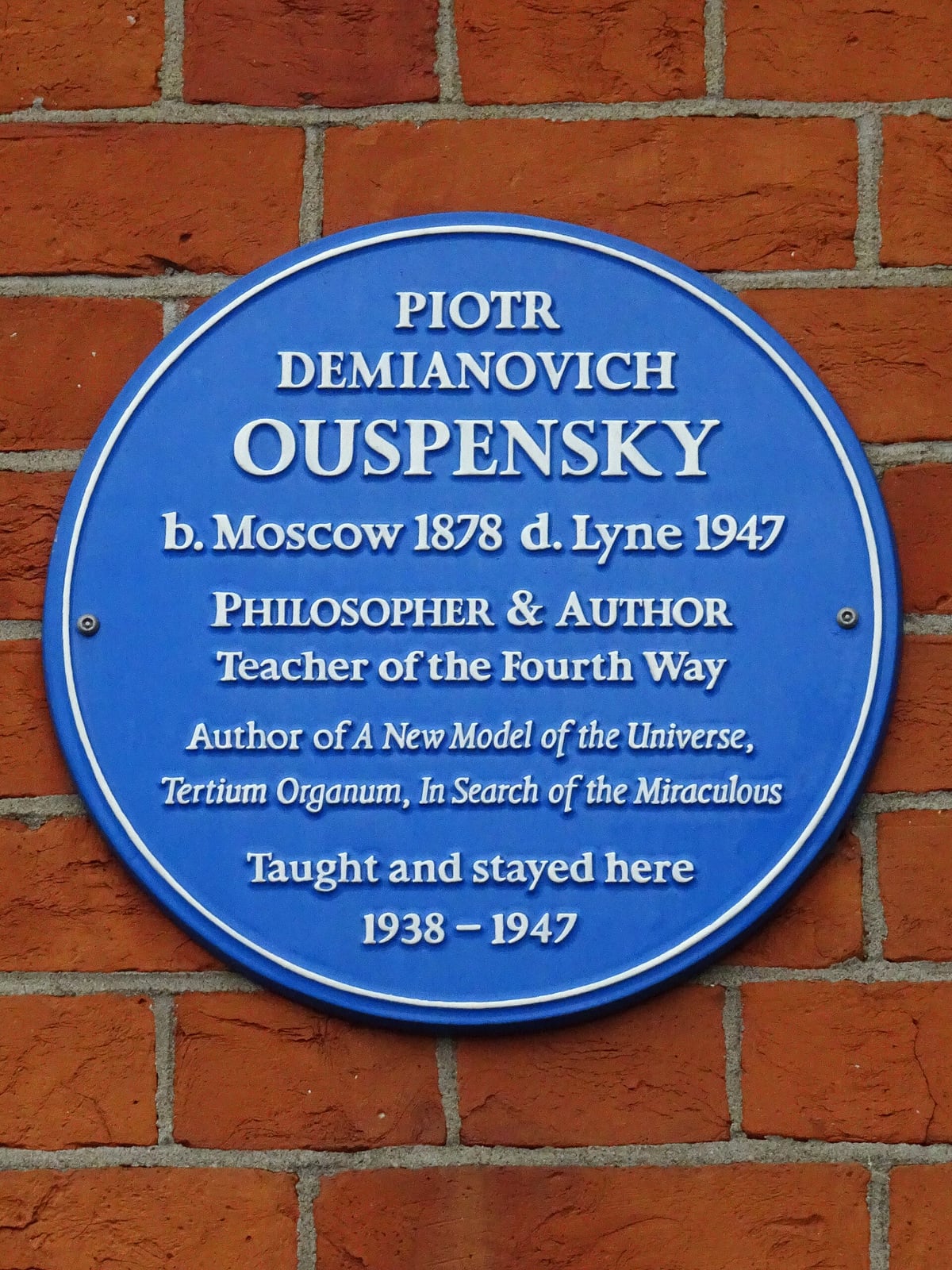
Placa azul de P. D. Ouspensky en Colet House · CC BY-SA 4.0
In their words
«Man does not know himself.»The Psychology of Man's Possible Evolution, primera conferencia

Their central idea
Ordinary man does not 'do': everything happens to him, just as wars and revolutions happen to nations. Only one who has achieved inner unity and consciousness can act in the proper sense.
See in context
Biography
4 min read
A self-taught man in fin-de-siècle Moscow
Pyotr Demyanovich Uspensky was born in Moscow in March 1878 into a family of officials of modest origin: his father served in the land-survey administration and at the Foundling Home; his mother was a merchant's daughter. Sources disagree on the exact day, since the Julian calendar was still in use in Russia. He attended the Second Moscow Gymnasium, from which he was expelled at about sixteen — biographical tradition says — for painting graffiti in full view of a visiting inspector. From then on he educated himself, with an early passion for mathematics, psychology and the phenomena that the science of his day left aside.
Journalist and seeker
In the first years of the century he worked as a journalist in Moscow and St Petersburg. Around 1907 he discovered Theosophy, then spreading rapidly in Russia, and in 1908 made a first journey to the East. The following year he published The Fourth Dimension, a booklet indebted to Charles Howard Hinton in which the fourth dimension is an extension of space our perception fails to grasp. From that intuition came Tertium Organum (1912), his first major work: a 'third canon of thought', after Aristotle's Organon and Bacon's Novum Organum, that denies the ultimate reality of space and time and proposes a higher logic in which A is both A and not-A. In the same years he published an essay on the symbolism of the Tarot, two lectures on the 'inner circle' and the superman, a booklet on yoga, Talks with a Devil and the novel Kinemadrama, which became Strange Life of Ivan Osokin.
In 1913–1914 he travelled to Egypt, India and Ceylon in search of a living school of esoteric knowledge; he visited the Theosophical headquarters at Adyar, but the outbreak of the First World War forced him home without having found it. In the spring of 1915 he gave lectures on his travels in St Petersburg and Moscow under the title, precisely, In Search of the Miraculous.
The meeting with Gurdjieff
That same year, after resisting several invitations, he agreed to meet in a small Moscow café a man of oriental appearance, with a black moustache and piercing eyes, who struck him as 'disguised': George Ivanovich Gurdjieff. The conversation changed his life. Over the following years Ouspensky belonged to the St Petersburg group, took meticulous notes of the teacher's explanations of man as a machine, the centres, the law of three and the law of seven, the enneagram and 'self-remembering', and lived through experiences he would recount with scrupulous sobriety, such as the telepathic communication he said he had with Gurdjieff in Finland in August 1916.
The Revolution scattered the group. Ouspensky followed Gurdjieff to Essentuki in 1917, drew away from him in 1918 and survived the civil war in southern Russia; from there he sent the dispatches A. R. Orage published in London, later collected as Letters from Russia, 1919. In 1920 he took refuge in Constantinople.
London and independence
Meanwhile Tertium Organum had reached America: the architect Claude Bragdon translated it with Nicholas Bessaraboff, published it in 1920, and its success made an unknown émigré a celebrated author. With Lady Rothermere's support Ouspensky settled in London in 1921, where his lectures drew writers, doctors and journalists; sources name Aldous Huxley, T. S. Eliot and Gerald Heard among his listeners. He helped raise funds for Gurdjieff to open his Institute at Fontainebleau, but in 1924 announced that he would continue alone. In the last chapter of In Search of the Miraculous he explains the decision in a sentence of rare nobility: Gurdjieff's way might be more correct than his, but it was not his way.
For fifteen years he taught in London — from 1938 also at Colet House — and at Lyne Place in Surrey, where his groups combined study of the ideas with practical work. In 1931 A New Model of the Universe appeared, gathering and expanding the essays written before Gurdjieff. His pupils included Maurice Nicoll, Kenneth Walker, Robert S. de Ropp, Rodney Collin and, for a time, J. G. Bennett.
America and the end
The Second World War took him to the United States in 1941; there he settled with his wife, Sophia Grigorievna, on a farm in New Jersey and kept giving talks in New York. Gravely ill, he returned alone to England in 1947. In meetings during those months he disconcerted his pupils by insisting they must start again and not rely on the 'system' they had learned; Rodney Collin took this to mean he had abandoned the teaching, a reading the records of those meetings do not clearly confirm. He died at Lyne Place on 2 October 1947 and is buried in the churchyard of Holy Trinity, Lyne.
A body of work in two movements
Shortly after his death In Search of the Miraculous appeared — with Gurdjieff's own approval, tradition says — together with The Psychology of Man's Possible Evolution, five lectures designed as an introduction. The Fourth Way (1957) and several collections of meetings followed. Ouspensky's work thus has two movements: that of the thinker seeking a logic beyond common sense, and that of the pupil who set down, with a journalist's precision, another man's teaching. The clarity of that record explains why the Fourth Way is still known, even today, mainly through his voice. His papers are held at Yale University Library.
Sources: Lachman, Gary. In Search of P. D. Ouspensky: The Genius in the Shadow of Gurdjieff. Wheaton: Quest Books, 2004. · Ouspensky, P. D. In Search of the Miraculous: Fragments of an Unknown Teaching. Nueva York: Harcourt, Brace & World, 1949; Londres: Routledge & Kegan Paul, 1950. · Ouspensky, P. D. The Psychology of Man's Possible Evolution. Nueva York: Hedgehog Press, 1950. · Webb, James. The Harmonious Circle: The Lives and Work of G. I. Gurdjieff, P. D. Ouspensky, and Their Followers. Nueva York: G. P. Putnam's Sons, 1980. · Ouspensky, P. D. Tertium Organum: The Third Canon of Thought, a Key to the Enigmas of the World. Trad. de Nicholas Bessaraboff y Claude Bragdon. Rochester (NY): Manas Press, 1920.
Timeline
A life, year by year
Each point is a documented event. Click to read it, with its source and degree of certainty.
March 1878age 0Moscú
Born in Moscow
Pyotr Demyanovich Uspensky is born, son of Demyan Petrovich Uspensky, an official, and Ekaterina Semyonovna Borisova. Sources give 4, 5 or 17 March, depending on the calendar used.
DocumentedWikidata, «Peter Demianovich Ouspensky» (Q434266): fechas y lugares de nacimiento y muerte (registra tres fechas de nacimiento: 4, 5 y 17 de marzo de 1878).
After their death
- 1949In Search of the Miraculous published
March 1878 · age 0
Born in Moscow
Pyotr Demyanovich Uspensky is born, son of Demyan Petrovich Uspensky, an official, and Ekaterina Semyonovna Borisova. Sources give 4, 5 or 17 March, depending on the calendar used.
Documented
c. 1894 · age 16
Expelled from the gymnasium
He is expelled from the Second Moscow Gymnasium, tradition says for graffiti painted in view of an inspector. From then on he is self-taught.
Probable
1907 · age 29
Journalism and Theosophy
He works as a journalist on the Moscow daily Utro (The Morning) and discovers Theosophy, which will shape his first books.
Documented
1909 · age 31
The Fourth Dimension
He publishes his first book, on theories of the fourth dimension.
Documented
1912 · age 34
Tertium Organum
Tertium Organum appears, his first major work, proposing a higher logic and a theory of cosmic consciousness.
Documented
1913 – 1914
Journey to the East
He travels to Egypt, India and Ceylon in search of an esoteric school; he visits Adyar. The war forces him back to Russia.
Documented
February 1915 · age 36
Lectures 'In Search of the Miraculous'
In February and March he lectures in St Petersburg on his travels under the titles 'In Search of the Miraculous' and 'The Problems of Death'.
Documented
1915 · age 37
Meeting Gurdjieff
In a small Moscow café he meets G. I. Gurdjieff and joins his work group.
Documented
August 1916 · age 38
The Finland experiences
By his own account he has telepathic communication with Gurdjieff at a Finnish country house. He himself admits he cannot prove it.
Disputed
1918 · age 40
First separation from Gurdjieff
Having followed him to the Caucasus, he decides to leave Gurdjieff and continue the work independently.
Documented
1919 · age 41
Letters from Russia
During the civil war he sends dispatches that A. R. Orage publishes in London in The New Age.
Documented
1920 · age 42
Exile in Constantinople; Tertium Organum in English
A refugee in Constantinople, he is unaware that in Rochester Claude Bragdon has published Tertium Organum in English with great success.
Documented
August 1921 · age 43
Arrival in London
He leaves Constantinople in August and settles in London with Lady Rothermere's support; he begins lecturing.
Documented
1924 · age 46
Final break with Gurdjieff
He announces in London that he will continue teaching independently, apart from Gurdjieff and his Fontainebleau Institute.
Documented
1931 · age 53
A New Model of the Universe
The collection of his pre-Gurdjieff essays is published in English.
Documented
1938 · age 60
Colet House
He teaches at Colet House, later the home of The Study Society, where a blue plaque now commemorates him.
Documented
1941 · age 63
Move to the United States
Because of the war he moves to the United States; with his wife Sophia Grigorievna he settles on a New Jersey farm and lectures in New York.
Probable
October 2, 1947 · age 69
Death at Lyne Place
Having returned to England that year, he dies at Lyne Place. He is buried in Holy Trinity churchyard, Lyne.
Documented
1949
In Search of the Miraculous published
In Search of the Miraculous is published posthumously and becomes the standard account of Gurdjieff's system.
Documented
Works
Essential works
The works without which their legacy cannot be understood.
Written work · 1912
Tertium Organum: A Key to the Enigmas of the World
Tertium Organum. Ключ к загадкам мира
His first major work: after Aristotle's Organon and Bacon's Novum Organum, it proposes a 'third canon of thought' that denies the ultimate reality of space and time, explores cosmic consciousness (Bucke, the mystics) and formulates a higher logic in which A is both A and not-A. It was a success in America in the 1920s.
4 editions · amazon.com

Written work · 1931
A New Model of the Universe
A collection of essays on esotericism, the fourth dimension, the superman, Christianity and the New Testament, the Tarot, yoga, dreams, eternal recurrence, sex and evolution, unified by the 'psychological method': examining each problem from the level of consciousness of the one who thinks it.
4 editions · amazon.com

Posthumous work · 1949
In Search of the Miraculous
In Search of the Miraculous: Fragments of an Unknown Teaching
A first-person chronicle of the years with Gurdjieff in Moscow, St Petersburg and the Caucasus and a systematic account of his teaching: man as a machine, the seven categories of man, the centres, self-remembering, the laws of three and seven, the ray of creation, the enneagram. It is the standard introduction to the Fourth Way.
7 editions · amazon.com

Published lectures · 1950
The Psychology of Man's Possible Evolution
The five lectures Ouspensky read to newcomers: man does not know himself, is a machine capable of knowing it, lives in lower states of consciousness and can evolve only through conscious work on himself. It is the shortest and clearest gateway to his teaching.
4 editions · amazon.com
Complete works (17)
P. D. Ouspensky
The Fourth Dimension
The Conscious LibraryThe Fourth Dimension
1909

The Symbolism of the Tarot
1912
P. D. Ouspensky
The Inner Circle: On the Superman
The Conscious LibraryThe Inner Circle: On the Superman
1913

What Is Yoga?
1913

Strange Life of Ivan Osokin
1915

Talks with a Devil
1916

The Fourth Way
1957

Letters from Russia, 1919
1978

Conscience: The Search for Truth
1979

A Further Record
1986

The Cosmology of Man's Possible Evolution
1989

A Record of Meetings
1992
P. D. Ouspensky
Memory
The Conscious LibraryMemory
1953
Quotations
Quotations located in a specific work. Each carries its provenance and its level of confidence.
Man does not know himself.VerifiedThe Psychology of Man's Possible Evolution, primera conferencia
Essential ideas (editorial summary)
Out of respect for copyright, these ideas are summarised in our own words and are not presented as literal quotations.
- Ordinary man does not 'do': everything happens to him, just as wars and revolutions happen to nations. Only one who has achieved inner unity and consciousness can act in the proper sense.
- There are four possible states of consciousness — sleep, ordinary waking state, self-consciousness and objective consciousness — and man lives almost always in the first two while believing he has the last two.
- Human evolution is neither automatic nor collective: it is an individual possibility requiring knowledge, conscious effort and the guidance of a school.
- Time is the way we imperfectly perceive a higher dimension of space; hence the possibility that life recurs, an idea he dramatised in Strange Life of Ivan Osokin.
- Every great question of science, religion or art should be examined with a 'psychological method', asking from what level of consciousness it is posed.
Last words
There are no verifiable records of their last words.
There is no reliable record of his last words. Accounts of his final months — notably Rodney Collin's and the records of the 1947 meetings — report his insistence that pupils 'start again', but transmit no verifiable final words.
Ask
What their work answers
Twelve great human questions and what their texts allow us to answer, with references. We never put words in their mouth.
What is the Absolute? Does God exist?
At the top of the ray of creation, the Absolute, subject to one law
An impersonal AbsoluteInferred from their doctrine
P. D. Ouspensky approached the Absolute in two stages. In Tertium Organum (1912), before meeting Gurdjieff, he speculates on higher dimensions of space and on a cosmic consciousness the human being may attain, without appealing to a personal God. In In Search of the Miraculous (1949), where he records what he learned from Gurdjieff, he sets out the ray of creation: a scale of worlds descending from the Absolute, subject to one law, down to the Moon, subject to ninety-six; each level is more mechanical the further it is from the source. The Absolute appears there as the principle from which everything proceeds and whose will reaches directly only the first level, not as someone with whom one has dealings. His interest is not devotional but cosmological and psychological: to understand where the human being stands on that scale.
Compare this question with other teachersWho am I? Is there a true self?
Man has no permanent I, only many I's taking turns
There is no permanent selfStated explicitly
P. D. Ouspensky sets out in In Search of the Miraculous (1949) and The Psychology of Man's Possible Evolution (1950) the central thesis of the Fourth Way: the ordinary human being has no single, permanent I. Each thought, desire or sensation says «I» for a moment and is replaced by another; there are hundreds of small I's, often contradictory, taking turns in command without any of them representing the whole. Man in this state is a machine: everything happens to him, he does nothing. Self-observation reveals this multiplicity, and seeing it is the first step. Unlike Buddhist non-self, however, the teaching holds that a real I can come to be formed through long and conscious work; the point is not to discover a Self already given but to create what does not yet exist.
Compare this question with other teachersWhy do we suffer?
We suffer from identification, imagination and needless negative emotions
Ignorance of what we areStated explicitly
P. D. Ouspensky sets out in The Psychology of Man's Possible Evolution (1950) and The Fourth Way (1957) a psychological explanation of suffering. Ordinary man lives asleep: he identifies with every thought, emotion or circumstance, loses himself in it and believes he is that. To identification are added imagination, which produces uncontrolled scenarios, and the expression of negative emotions, which Ouspensky regards as unnecessary: they have no centre of their own in the organism, are maintained by habit and justified by reasoning. Much human suffering, he holds, comes from this mechanical functioning, which passes for natural. Self-observation, non-identification and ceasing to express negative emotions make it possible to reduce it. The teaching further distinguishes this useless mechanical suffering from the conscious suffering that work on oneself may demand.
Compare this question with other teachersWhat happens after death?
Life repeats itself: eternal recurrence, which only consciousness can change
Rebirth according to karmaStated explicitly
Ouspensky defended throughout his life an idea of his own, eternal recurrence, which he sets out in A New Model of the Universe and fictionalises in Strange Life of Ivan Osokin. At death, the human being does not pass into another world or a different body: he is born again into the same life, at the same time and with the same circumstances, because time has more dimensions than we perceive. Most people repeat the same things mechanically; only someone who acquires memory and self-consciousness can introduce changes into the repetition. In In Search of the Miraculous he also records Gurdjieff's doctrine: ordinary man does not have an immortal soul already given, but the possibility of forming higher bodies through work, and only what has crystallised can survive the death of the body.
Compare this question with other teachersHow is liberation or salvation attained?
Man is a sleeping machine; awakening requires self-remembering within a school
Through conscious inner workStated explicitly
Peter D. Ouspensky sets out in In Search of the Miraculous the teaching he received from Gurdjieff between 1915 and 1918, and in The Psychology of Man's Possible Evolution the version he himself taught. The starting point is that ordinary human beings live asleep: each is a machine moved by external influences, without a permanent «I» but with a multitude of small I's succeeding one another. Evolution is neither automatic nor guaranteed; it is only possible for those who undertake it consciously. Its tools are self-observation, «self-remembering», effort against mechanicalness and work with others within a school, because no one can awaken alone. The end of that development is higher states of consciousness.
Compare this question with other teachersIs a teacher necessary?
No one awakens alone: a school is needed, with its system and group work
Community and traditionStated explicitly
In In Search of the Miraculous, Peter D. Ouspensky transmitted the idea, received from Gurdjieff, that a sleeping man cannot wake himself: he needs a system of knowledge and other people to remind him of his sleep. That is the reason for schools, organised groups working with rules, with knowledge coming from a higher source and with common tasks. After separating from Gurdjieff in 1918 and definitively in the 1920s, Ouspensky led his own groups in London for decades, centred on studying the system. His emphasis falls more on the school and collective work than on the personal figure of the teacher.
Compare this question with other teachersIs the world real?
The ray of creation: worlds of differing density and number of laws
Planes of existenceStated explicitly
In In Search of the Miraculous, Peter D. Ouspensky sets out the cosmology he received from Gurdjieff: the ray of creation, a scale of worlds running from the Absolute to the Moon through all worlds, our galaxy, the Sun, the planets and the Earth. Each level is subject to an increasing number of laws, so that the Earth, subject to many, is a place of great mechanicalness. Human beings live in one of the worst places in the universe, in the system's expression, and their possible evolution consists in freeing themselves from some of those laws. Before meeting Gurdjieff, in Tertium Organum, he had already argued that the three-dimensional world is a limited perception of a reality of more dimensions.
Compare this question with other teachersWhat is love?
Love is a cosmic phenomenon that can open onto higher consciousness
Longing and unionInferred from their doctrine
In Tertium Organum, P. D. Ouspensky treats love as a cosmic phenomenon not made to the measure of human ends: people use it for reproduction, pleasure or possession, but its nature exceeds all of that and belongs to an order of reality of higher dimensions. That is why, he holds, love can momentarily open a higher perception, akin to the mystical consciousness he studies in the same book, and also why it is degraded when shut up in the personal. In A New Model of the Universe, in the chapter on sex and evolution, he examines sexual energy as a force that can serve inner evolution or be wasted. Later, within the Fourth Way, he would add that mechanical man cannot truly love as long as he lacks a permanent I.
Compare this question with other teachersAre we free, or is everything determined?
Man is a machine: everything happens to him, he does nothing
We are machines until we awakenStated explicitly
*In Search of the Miraculous* (1949) records as the starting point of Gurdjieff's teaching the thesis that ordinary man is a machine: he cannot do, everything happens to him, as it rains or clears up. Ouspensky makes it the axis of his own lectures, published as *The Psychology of Man's Possible Evolution*: the human being has no single permanent self but many small «I»s that take turns, and therefore has no will. Freedom is not a given but a possibility. Only through work on oneself, beginning with self-remembering, can a centre capable of doing be formed. Most people, he warns, will never leave mechanicalness.
Compare this question with other teachersWhy meditate or pray?
Self-remembering: being present to oneself while acting
Being presentStated explicitly
In the Fourth Way Ouspensky sets out in *In Search of the Miraculous* and *The Fourth Way*, the central practice is neither sitting meditation nor prayer but self-remembering: dividing attention so that, while looking at something, one is at the same time aware of oneself looking. Ouspensky recounts that when he tried it he discovered he almost never remembered himself and that most of his life passed in sleep. To that effort are added non-judgemental self-observation and the struggle against identification and the expression of negative emotions. The aim is to wake from mechanicalness and form a permanent self; self-remembering is the first step towards consciousness.
Compare this question with other teachersCan reason know the ultimate?
A higher logic and a school knowledge ordinary science cannot reach
Esoteric knowledgeStated explicitly
Ouspensky trained as a mathematician and journalist, and his first answer was intellectual: in *Tertium Organum* (1912) he proposed a «third logic» to surpass those of Aristotle and Bacon in order to think about consciousness and the higher dimensions of space. Meeting Gurdjieff in 1915 convinced him that something more was needed: an esoteric knowledge preserved by schools, which, according to *In Search of the Miraculous*, is not transmitted through books but from teacher to pupil, and only to one who has prepared his being to receive it. That knowledge must be verified personally: nothing is to be accepted on faith. The ordinary, mechanical intellect cannot reach it; one developed by work on oneself can.
Compare this question with other teachersWithdraw from the world or transform it?
The Fourth Way requires no withdrawal: one works in ordinary life
Contemplation in actionStated explicitly
In In Search of the Miraculous, P. D. Ouspensky sets out Gurdjieff's classification of the traditional ways: that of the fakir, who works on the body; that of the monk, on the emotions; and that of the yogi, on the mind. All three require leaving ordinary life and withdrawing. The Fourth Way, by contrast, does not ask one to go to the desert or the monastery: it is followed in the conditions of ordinary life, which are considered the best possible for work on oneself, and it works at once on body, emotions and mind. The practitioner keeps his trade and his family, but uses them as material for self-remembering and for observing his mechanicalness. Ouspensky led groups for decades, in London and later in the United States, on this basis. As for society, he was sceptical: collective changes, he said, happen mechanically.
Compare this question with other teachers
Affinities & tensions
Affinities and tensions
Calculated question by question from their positions. The reason for each agreement or clash, on click.
Thinks most like
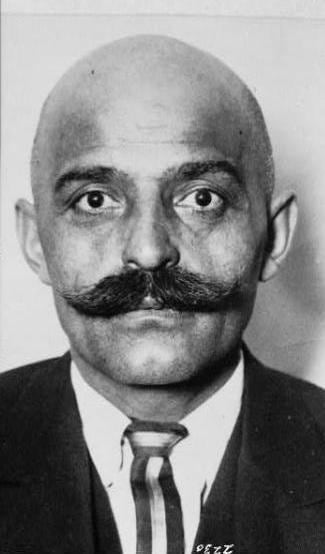
G. I. Gurdjieff
They agree on: Who am I? Is there a true self? · Why do we suffer? · How is liberation or salvation attained?
Sri Yukteswar
They agree on: What is the Absolute? Does God exist? · Why do we suffer? · What happens after death?
Helena Roerich
They agree on: What is the Absolute? Does God exist? · What happens after death? · Is the world real?
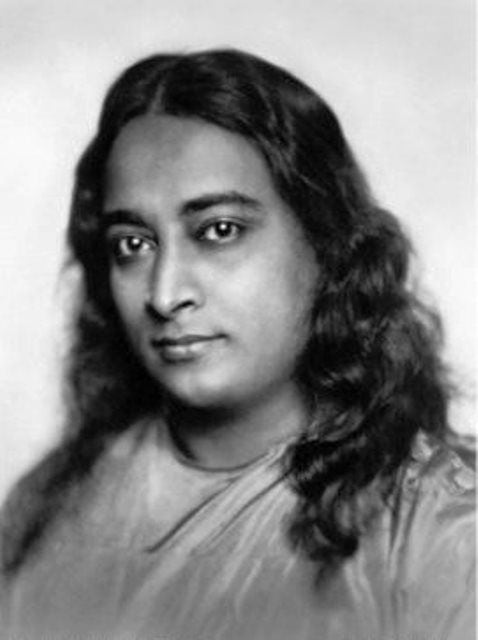
Paramahansa Yogananda
They agree on: What happens after death? · Is the world real? · What is love?
Thinks most unlike

Nikolai Berdyaev
They clash on: Who am I? Is there a true self? · What happens after death?
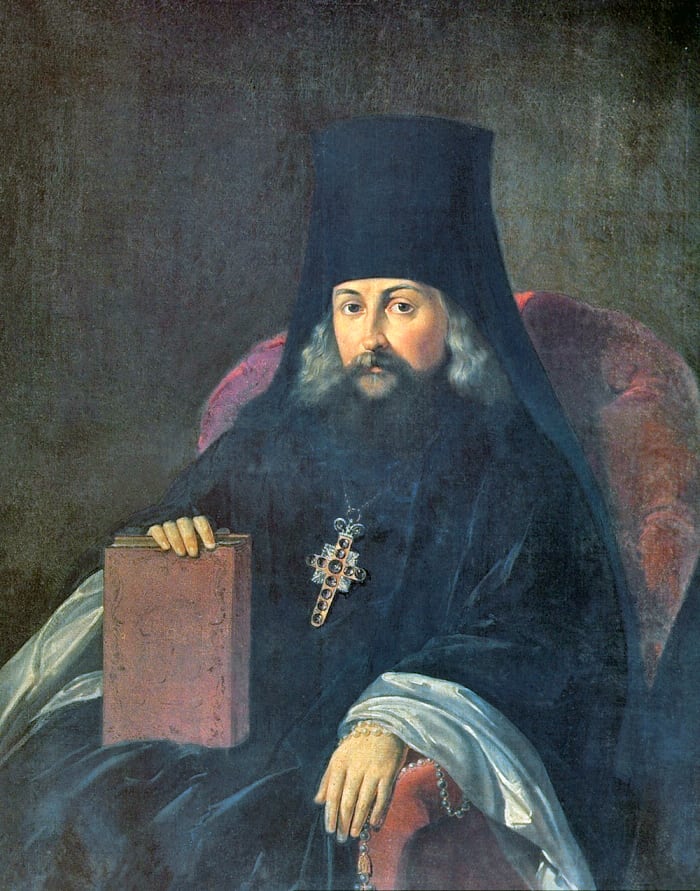
Ignatius Brianchaninov
They clash on: Who am I? Is there a true self? · What happens after death?
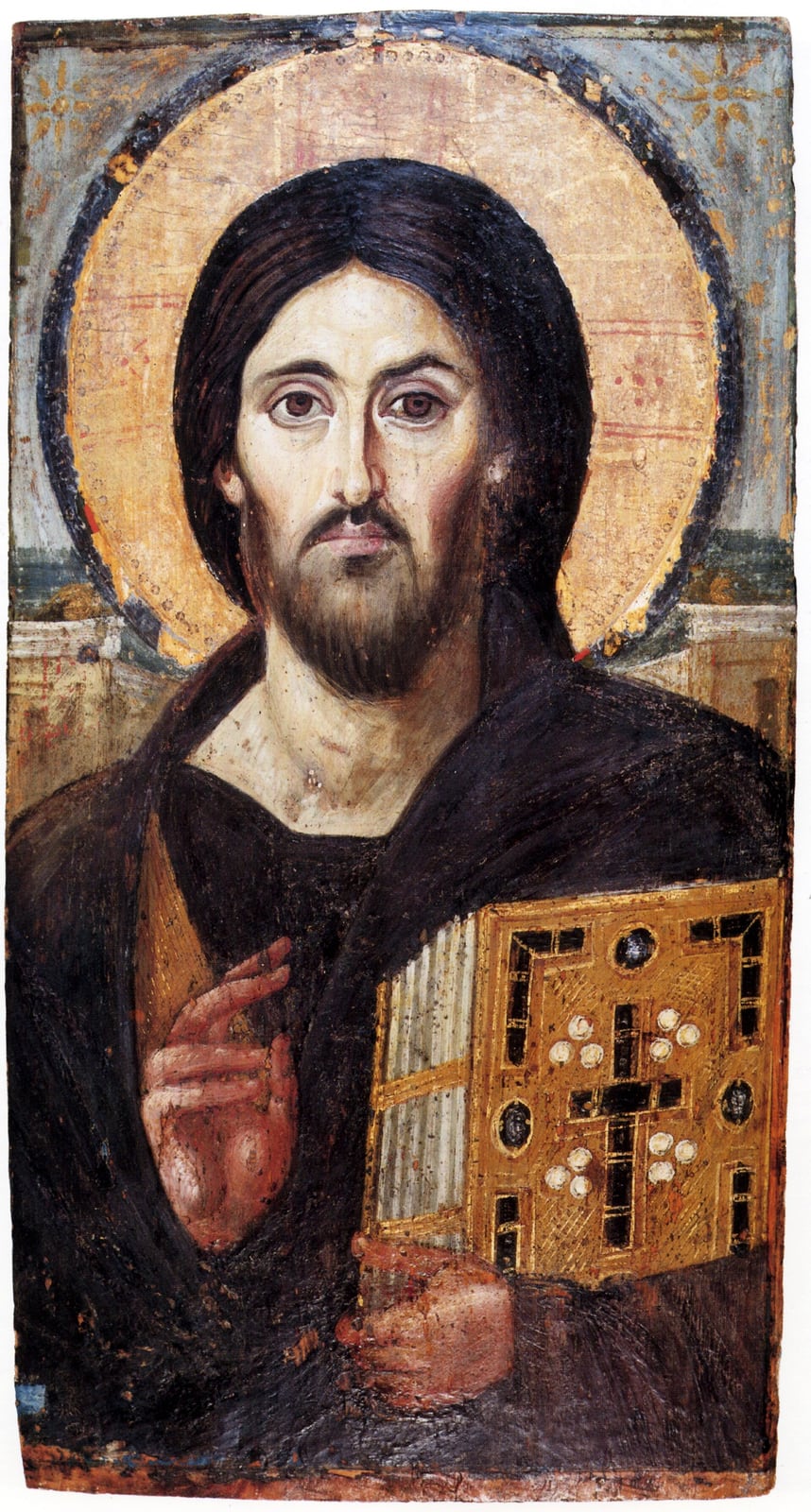
Jesus of Nazareth
They clash on: Who am I? Is there a true self? · What happens after death?
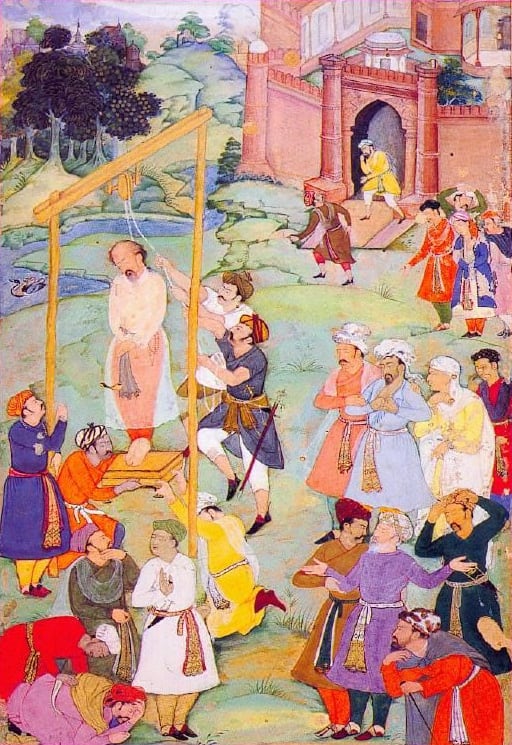
Al-Hallaj
They clash on: Who am I? Is there a true self? · What happens after death?
They clash onApparent contradiction
P. D. Ouspensky · Ramana Maharshi
Many I's or a single Self: the same word for two levels
Why: The contradiction is apparent at the level of diagnosis because they use the word I for different levels: Ouspensky calls I's the psychological states of ordinary man; Ramana reserves the term Self for the awareness that witnesses them all, which is neither a state nor a content. Ramana's ego and Ouspensky's many I's are the same reality seen from two systems. There is a real difference in the goal: the Fourth Way aims to build a permanent I through work, whereas for Ramana the Self is not built but recognised. One starts from a psychology of the machine; the other, from a Vedantic metaphysics.
They agree on
P. D. Ouspensky · G. I. Gurdjieff
Man is a machine: the master and the disciple who systematised his teaching
Why: The affinity is that of a master and his most systematic disciple: Ouspensky worked with Gurdjieff in Russia between 1915 and 1918 and transmitted that teaching in In Search of the Miraculous, published posthumously in 1949. The relationship broke down: Ouspensky withdrew in 1918 and definitively in the 1920s, and led his own groups in London, centred on the study of the system rather than on the figure of the master. They agree in doctrine, not in style: Gurdjieff taught in a demanding and disconcerting way, with dances, movements and provoked situations; Ouspensky, intellectually and in an orderly fashion. Hence they part on the question of the master: one deems him indispensable; the other stresses the school.
They agree on
P. D. Ouspensky · Eckhart Tolle
Waking from automatic pilot: self-remembering and the power of now
Why: There is no documented relationship between them, although the vocabulary of awakening and automatic pilot found in contemporary spirituality owes much to the Fourth Way. The affinity has clear limits. Self-remembering demands effort, a deliberate division of attention and a system of group work, and its goal is to form a permanent self that does not yet exist; Tolle's presence is presented as something not manufactured or reached in time but recognised as one's own being. Ouspensky writes for a school with discipline and hierarchy; Tolle, for individual readers without a tradition. They agree on the first step, not on the path or the goal.
Anecdotes and stories
Anecdotes and stories
Testimony1915
The disguised man in the Moscow café
Origin of the story: In Search of the Miraculous, ch. 1, written by Ouspensky years later from his notes.
Testimony1915–1916
The cigarettes on the Nevsky
Origin of the story: In Search of the Miraculous, ch. 7. Autobiographical account; there are no other witnesses.
Testimony1916
The voice in the chest: Finland, August 1916
Origin of the story: In Search of the Miraculous, ch. 13. Ouspensky deliberately omits the content of the questions.
Documented1920–1921
The book that travelled to America on its own
Origin of the story: Documented by the Manas Press edition (1920) and recounted by Wikipedia and Lachman (2004).
Source: Wikipedia (en), «P. D. Ouspensky» (vida, obras y bibliografía).
Disputed1947
'Start again': the 1947 meetings
Origin of the story: English Wikipedia records Collin's view and qualifies it with A Record of Meetings; the detailed version is in Lachman (2004) and the published records.
Source: Wikipedia (en), «P. D. Ouspensky» (vida, obras y bibliografía).
Teachings
Teachings
The notions that structure their thought, explained in context.
Self-rememberingrecuerdo-de-si
In many respects the functional equivalent of Buddhist mindfulness or the 'watchfulness' of other traditions, though framed in its own psychological vocabulary.
Man as a machinehombre-maquina
It comes from Gurdjieff; Ouspensky made it the core of his introductory exposition.
Source: Ouspensky, P. D. The Psychology of Man's Possible Evolution. Nueva York: Hedgehog Press, 1950.
The four states of consciousnessestados-de-conciencia
Ouspensky had already explored 'cosmic consciousness' in Tertium Organum before meeting Gurdjieff.
Source: Ouspensky, P. D. The Psychology of Man's Possible Evolution. Nueva York: Hedgehog Press, 1950.
The Fourth Waycuarto-camino
It gives its name to the Atlas's fourth-way tradition.
Source: Wikipedia (en), «P. D. Ouspensky» (vida, obras y bibliografía).
Eternal recurrence and the fourth dimensioneterno-retorno
It is in dialogue with Nietzsche, Hinton and early twentieth-century theories of time.
Retreats
Retreats and centres
Places and gatherings linked to their teaching. We put you in touch with the organisers.
Nueva York (Upper East Side) · Estados Unidos
Gurdjieff Foundation of New York
The Gurdjieff Foundation of New York
The Gurdjieff Foundation of New York belongs to the network of foundations established after Gurdjieff's death by his pupil Jeanne de Salzmann, together with the Institut Gurdjieff in Paris and the Gurdjieff Society in London. Its first president, Lord Pentland, had been a pupil of Ouspensky before working with Gurdjieff, and many of Ouspensky's pupils joined this work. It offers weekly group meetings led by senior students, classes in the Movements, the sacred dances and exercises Gurdjieff taught, meditation and retreats. Access is gradual and begins with introductory events.
Barons Court, Londres · Reino Unido
The Study Society, Colet House (London)
The Study Society
The Study Society was registered in 1951, four years after Ouspensky's death, at the initiative of his pupil Dr Francis Roles, to continue his work as a school of the Fourth Way. It is based at Colet House in west London, which presents itself as a spiritual gateway in the centre of the city. Its current programme brings together meditation, the Movements, study groups on the Masnavi and meetings devoted to Rumi, the dervish turning and a Sunday Advaita gathering. Its main website sometimes rejects automated requests; the Colet House site responds normally.
Londres · Reino Unido
Gurdjieff Studies, London
Gurdjieff Studies Ltd (organización benéfica registrada)
Gurdjieff Studies is a London charity devoted to the Fourth Way that offers group meetings, reading groups, practical activities, Movements classes and intensive residential stays. It holds that the teaching is passed on from teacher to pupil in direct lines of transmission, and maintains two reference websites: one on Gurdjieff's life and work, with his music, dances and chronology, and another devoted to P. D. Ouspensky, reconstructing his work in England, including the Lyne Place period. It is independent of the network of foundations established by Jeanne de Salzmann.
Videos
Videos
Recordings, interviews and documentaries. Videos play from YouTube; they are not hosted here.
Gary Lachman - Gurdjieff, Ouspensky, and the Fourth Way
Lecture· EN· 80 min
Theosophical Society in England & Wales
Gary Lachman on P.D. Ouspensky — Kensington Central Library
Lecture· EN· 96 min
Gary Lachman
P. D. Ouspensky and the Gurdjieff Work with Gary Lachman
Interview· EN· 83 min
New Thinking Allowed with Jeffrey Mishlove
The Philosophy of the Cosmic Dance 2017 pt1. The Story of Colet House
Lecture· EN· 57 min
Philip Jacobs
The Strange Life of P.D. Ouspensky
Analysis· EN· 6 min
Theodore Nottingham
С. А. Панин — Семинар: «Эзотерический текст как форма философии. П. Д. Успенский, Tertium Organum»
Lecture· RU· 2020· 96 min
АИЭМ · ASEM
Шелковников А. Ю. — Пётр Демьянович Успенский — философ эзотеризма
Lecture· RU· 2026· 27 min
АИЭМ · ASEM
Валерий Бондаренко «Пётр Успенский. Искатель чудесного»
Lecture· RU· 2019· 127 min
СМИБС
Tertium Organum by P.D. Ouspensky (Book Review)
Analysis· EN· 2026· 32 min
Hermitix Podcast
Gurdjieff in Finland, Pinpointing the Legendary Ouspensky Telepathy Incident
Interview· EN· 2022· 7 min
Appleknocker Radio
¿Quién fue P.D. Ouspensky?
Third-party recording· ES· 2023· 7 min
Vojo Talks
Gallery
Gallery
Images with verified licences. Each keeps its authorship and attribution.
Manuscripts
Manuscripts
Manuscript witnesses and ancient texts, with their custodian and conditions of access.
RU · Cyrillic / Latin · 1900–1947
P. D. Ouspensky Memorial Collection
- Surviving witness
- Papeles, manuscritos y notas de reuniones (1935–1947)
- Custodian
- Yale University Library, Manuscripts and Archives · MS 840
- Digitisation
- hdl.handle.net/10079/fa/mssa.ms.0840…
Connections
Connections
Influences, discipleships and affinities. Documented relations are distinguished from similarities identified by analysis.
Disciple of
Gurdjieff's pupil from 1915 to 1918 in Russia and intermittent collaborator until 1924; author of the most widely read account of his teaching.
Documented relation
Disagreed with
He separated from him in 1918 and definitively in 1924; in In Search of the Miraculous he explains that Gurdjieff's way was not his.
Documented relation
Influenced by
Ouspensky was interested in Theosophy from 1907 and visited Adyar in 1913–1914; the influence is that of the Theosophical movement generally, not a personal relationship (Blavatsky had died in 1891).
Similarity identified by analysis
Contemporary of
Contemporaries from the Theosophical milieu who founded their own esoteric schools in the interwar English-speaking world; no relationship between them is recorded.
Similarity identified by analysis
Linked from other profiles
Sources
Sources
Bibliography and catalogues consulted for this profile.
- Lachman, Gary. In Search of P. D. Ouspensky: The Genius in the Shadow of Gurdjieff. Wheaton: Quest Books, 2004.
- Open Library, autor OL2263413A (Uspenskiĭ, Petr Demʹi͡anovich): obras y ediciones con ISBN.
- Ouspensky, P. D. In Search of the Miraculous: Fragments of an Unknown Teaching. Nueva York: Harcourt, Brace & World, 1949; Londres: Routledge & Kegan Paul, 1950.
- Wikidata, «Peter Demianovich Ouspensky» (Q434266): fechas y lugares de nacimiento y muerte (registra tres fechas de nacimiento: 4, 5 y 17 de marzo de 1878).
- Ouspensky, P. D. The Psychology of Man's Possible Evolution. Nueva York: Hedgehog Press, 1950.
- Webb, James. The Harmonious Circle: The Lives and Work of G. I. Gurdjieff, P. D. Ouspensky, and Their Followers. Nueva York: G. P. Putnam's Sons, 1980.
- Ouspensky, P. D. Tertium Organum: The Third Canon of Thought, a Key to the Enigmas of the World. Trad. de Nicholas Bessaraboff y Claude Bragdon. Rochester (NY): Manas Press, 1920.
- Ouspensky, P. D. A New Model of the Universe: Principles of the Psychological Method in Its Application to Problems of Science, Religion, and Art. Londres: Kegan Paul, Trench, Trubner, 1931.
- Wikipedia (en), «P. D. Ouspensky» (vida, obras y bibliografía).
- Wikipedia (ru), «Успенский, Пётр Демьянович» (familia, primeras publicaciones rusas y bibliografía).
- Yale University Library, Manuscripts and Archives. P. D. Ouspensky Memorial Collection (MS 840).
- Wikisource en ruso, «Автор:Пётр Демьянович Успенский» (página de autor con la relación de textos de dominio público: Tertium Organum, Символы Таро, Странная жизнь Ивана Осокина, Разговоры с дьяволом).
- Wikidata, «Nicholas Bessaraboff» (Q26244034): musicólogo estadounidense, cotraductor de Tertium Organum (1894–1973).
- Rights holder
- Herederos de P. D. Ouspensky y editoriales titulares de cada obra (Knopf/Penguin Random House, Routledge, Harcourt). Fallecido en 1947: dominio público en los países con plazo de 70 años post mortem desde 2018; en EE. UU. siguen protegidas las obras publicadas desde 1931.
Pending confirmation
What this profile has not yet been able to settle. We would rather say so than fill it in.
- «Obispon invita», en la transcripción original del encargo, podría referirse a P. D. Ouspensky (posible error de dictado de «Ouspensky»); confirmarlo con quien hizo el encargo.
- Día exacto de nacimiento: Wikipedia (en) da el 5 de marzo de 1878, Wikipedia (ru) el 17 de marzo (5 de marzo del calendario juliano) y Wikidata registra además el 4; se deja con precisión de mes.
- Año de la primera edición rusa de Tertium Organum (1911 o 1912) y de El simbolismo del tarot (1912 o 1913); de Kinemadrama / Iván Osokin (1915 o 1917).
- Edición castellana verificada de Conversaciones con el diablo, La cuarta dimensión y de las recopilaciones póstumas (A Further Record, Cosmology, A Record of Meetings).
- Fecha y circunstancias exactas de su traslado a EE. UU. (enero de 1941 según algunas biografías) y del regreso a Inglaterra en 1947.
- Obras menores no registradas como obra: Memory (Stourton Press, 1953), New Horizons (Globe Press, 1990) y las traducciones de Kipling, Bret Harte, Poe, Ouida, Mark Twain, Edward Carpenter y Hinton que Ouspensky hizo al ruso (fuente: Open Library OL2263413A y Wikipedia ru). Los títulos de Kessinger (Superman, What Is Yoga?, etc.) son capítulos sueltos de A New Model of the Universe.
- No hay en Wikimedia Commons un retrato fotográfico de Ouspensky con licencia libre verificada; buscar fotografías anteriores a 1917 en archivos rusos de dominio público.
- Sala de lectura (2026-10-25): los seis textos registrados quedan con caution por la regla española de 80 años (Ouspensky †1947, libre en España el 1 de enero de 2028). Además: la traducción inglesa de Tertium Organum lleva derechos de Bessaraboff (†1973) en la UE y en España; falta la fecha de muerte de R. R. Merton, traductor de A New Model of the Universe (en EE. UU. libre el 1 de enero de 2027); y hay que fijar qué redacción reproducen las páginas rusas de Символы Таро y de Iván Osokin. No registrados: Четвёртое измерение (sin texto en línea fiable localizado) y Letters from Russia 1919 (la copia de Internet Archive lleva la introducción de la edición de 1978, con derechos; el texto original está en The New Age, 1919, en el Modernist Journals Project, en números sueltos).
- Vídeos (2026-10-25): en español solo se ha localizado una semblanza divulgativa breve (Vojo Talks); no hay conferencias académicas en castellano ni documentales de televisión pública sobre Ouspensky en YouTube.
Researched on 2026-10-25