البوذية · ماهايانا
Shinran
親鸞 · 愚禿釋親鸞 · 範宴 · 藤井善信 · 見真大師
1173 – 1263شخصية موثّقة تاريخيًا
راهب ياباني (1173–1263)، تلميذ هونين والمؤسس، بعد وفاته، لمدرسة جودو شينشو، أي «المدرسة الحقّة للأرض الطاهرة». بعد عشرين عامًا على جبل هيئي اعتنق ترديد اسم أميدا، ونُفي عام 1207، وعاش منذ ذلك الحين «لا راهبًا ولا علمانيًا»، متزوجًا وأبًا لأبناء. علّم أن الولادة في الأرض الطاهرة لا تتوقف على الجهد الذاتي، بل على الثقة (شينجين) التي يمنحها نذر أميدا. أعظم مؤلفاته «كيوغيوشينشو»، وأكثر أقواله قراءةً ما حفظه «تانيشو».
- مؤلَّفًا
- 30مؤلَّفًا
- طبعة
- 37طبعة
- اقتباسًا
- 9اقتباسًا
- مقطع فيديو
- 11مقطع فيديو
- صورة
- 6صورة
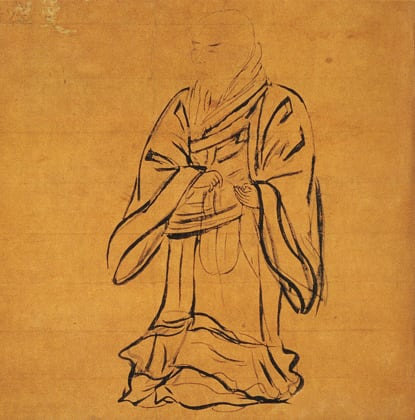
Retrato de Shinran «del espejo» (Kagami no goei) · Public domain
بكلماته
«I, Shaku Shinran, the foolish bald-headed one, in the year of the metal rooster of the Kennin era [1201], abandoned the sundry practices and took refuge in the Primal Vow.»Kyōgyōshinshō, epílogo del capítulo sobre los budas y tierras transformados. Traducción propia.
فكرته المحورية
Other Power (tariki): A term taken from Tanluan's commentary that Shinran makes the key to his whole teaching.
السيرة
4 دقيقة قراءة
ترجمة مُعانة من الأصل الإسباني، بانتظار مراجعة مترجم من أهل اللغة.
نبيل صغير على الجبل
وُلد شينران عام 1173 في هينو، جنوب شرق كيوتو، في فرع متواضع من عشيرة فوجيوارا؛ وكان أبوه، هينو أرينوري، موظفًا في البلاط. ولا يكاد يُعرف عن طفولته شيء على وجه اليقين. فالسيرة التي وضعها حفيد حفيده كاكونيو عام 1295 تروي أن جيين، رئيس دير شورين-إن وبطريرك مدرسة تنداي فيما بعد، رسمه راهبًا في التاسعة من عمره، وأنه قضى العقدين التاليين على جبل هيئي. وتوضّح رسائل زوجته إيشيني أنه خدم هناك «راهبَ قاعة» (دوسو) في أحد الأجنحة المخصّصة للترديد المتواصل لاسم البوذا أميدا.
حلم روكّاكودو ولقاء هونين
في عام 1201، وهو في التاسعة والعشرين، غادر الجبل. وبحسب رواية إيشيني، اعتكف مئة يوم في معبد روكّاكودو بكيوتو، المكرّس للأمير شوتوكو، وفي فجر اليوم الخامس والتسعين تلقّى في المنام وحيًا من الأمير. فقصد عندئذ هونين، الذي كان يعظ في يوشيميزو بأن ترديد اسم أميدا (نمبوتسو) يكفي للولادة في أرضه الطاهرة، ولازمه يستمع إليه مئة يوم أخرى. وقد لخّص شينران ذلك بعد سنوات في عبارة شهيرة: في ذلك العام «تركتُ الممارسات المتفرقة ولُذتُ بالنذر الأصلي».
وكان من التلاميذ المقرّبين. ففي عام 1205 أذن له هونين بنسخ كتابه الرئيس، «سنتشاكوشو»، ونسخ صورته، وكتب بخطّ يده الاسم الجديد لتلميذه. وقد سجّل شينران ذلك بتأثّر في خاتمة «كيوغيوشينشو»، إذ لم يحظَ بهذا الامتياز إلا قليلون.
لا راهب ولا علماني
في عام 1207 حظر البلاط حركة النمبوتسو إثر فضيحة تورّطت فيها سيدات من القصر؛ فأُعدم أربعة من التلاميذ، ونُفي هونين إلى إقليم توسا، وشينران إلى إتشيغو على ساحل بحر اليابان، بعد أن جُرّد من الرهبنة وأُعطي اسم فوجي يوشيزانه. فردّ على ذلك باتخاذ هوية جديدة: لم يعد راهبًا، ولم يصر علمانيًا أيضًا، وصار يوقّع منذ ذلك الحين باسم غوتوكو، أي «الأصلع الأحمق». وفي وقت ما من تلك السنوات تزوّج إيشيني، ابنة ميوشي تامينوري بحسب التقاليد، وهو موظف كانت له مصالح في إتشيغو، وأنجب منها عدة أبناء.
وحين عُفي عنه عام 1211 لم يعد إلى كيوتو؛ وتوفي هونين في العام التالي. وفي عام 1214 انتقل مع أسرته إلى منطقة كانتو في شرق البلاد. وقد روت إيشيني لاحقًا حادثة من تلك الرحلة: بدأ شينران يتلو سوترات الأرض الطاهرة الثلاث ألف مرة لنفع الكائنات، ثم توقّف بعد أيام قليلة حين أدرك أنه يتّكل على جهده الخاص لا على اسم أميدا.
عشرون عامًا في كانتو
عاش شينران نحو عقدين في إقليم هيتاتشي وما حوله، يعلّم فلاحين ومحاربين وتجارًا كانوا يجتمعون في قاعات صغيرة للممارسة (دوجو) لا في المعابد. ومن تلك الحقبة تعود المسودة الأولى لـ«كيوغيوشينشو»، التي تؤرّخها المدرسة بعام 1224 استنادًا إلى إشارة داخل النص؛ أما مخطوطته بخطّ يده، المعروفة بنسخة باندو، وفيها تصحيحات عمر كامل، فمحفوظة في معبد هيغاشي هونغان-جي ومصنّفة كنزًا وطنيًا.
كيوتو: كتابة الشيخوخة
نحو عام 1235، وقد جاوز الستين، عاد إلى كيوتو، حيث عاش حتى وفاته في بيوت مُعارة، معتمدًا على تبرعات أتباعه في كانتو. وكانت تلك أخصب مراحل كتابته: فقد أتمّ «كيوغيوشينشو»، الذي كان يأذن بنسخه منذ عام 1247؛ ونظم باليابانية مئات الأناشيد (واسان) التي قرّبت العقيدة ممن لا يقرؤون الصينية؛ وكتب شروحًا على نصوص معلّمين آخرين، وأدار مراسلات غزيرة مع جماعات الشرق.
وتكشف تلك المراسلات أيضًا مأساة سنواته الأخيرة. فقد انقسمت جماعات كانتو بين من رأوا أنهم، وقد خلّصهم أميدا، يستطيعون اقتراف الشر دون اكتراث، ومن أوجبوا جهودًا أخلاقية وممارسات إضافية. فأرسل شينران ابنه زنران ليعيد النظام، لكن هذا أخذ ينشر تعاليم من عنده، زاعمًا أنه تلقّى من أبيه عقيدة سرية. وفي عام 1256، وهو في الثالثة والثمانين، تبرّأ منه شينران برسالة.
إيمانٌ موهوب
في صميم فكره تجذيرٌ لتعليم هونين. فعند شينران لا يستطيع أي فعل بشري، ولا حتى ترديد الاسم، أن يُحدث الولادة في الأرض الطاهرة: فكل شيء يصدر عن «قوة الآخر» (تاريكي)، أي النذر الذي التزم به أميدا بخلاص الكائنات جميعًا. والحاسم هو الثقة الصادقة (شينجين)، وهي ليست مكسبًا يحرزه المؤمن، بل هبة يمنحه إياها أميدا؛ ومنذ اللحظة التي تنبثق فيها يغدو مصير الولادة محسومًا في هذه الحياة نفسها. ولا يعود ترديد الاسم ممارسةً تُكسب الاستحقاق، بل يصير تعبيرًا عن الامتنان.
الموت والمدرسة
توفي في كيوتو في الشهر الحادي عشر من عام 1262 بحسب التقويم الياباني، أي في يناير 1263، عن تسعة وثمانين عامًا، في بيت أخيه الأصغر. وكتبت ابنته كاكوشيني، التي لازمته، إلى أمها في إتشيغو؛ وجاء ردّ إيشيني، المحفوظ إلى اليوم، يواسي الابنة ويؤكد لها أن ولادة شينران في الأرض الطاهرة مضمونة، أيًّا كانت الطريقة التي مات بها. وفي عام 1272 شيّدت كاكوشيني ضريحًا في أوتاني صار فيما بعد معبد هونغان-جي، ومنه نظّم حفيدها كاكونيو مدرسة جودو شينشو.
ونحو عام 1290 جمع تلميذ يُدعى يويين في «تانيشو» أقوالًا للمعلّم سمعها من فمه، ليصحّح الانحرافات التي رآها في جماعته؛ وبمفارقته الشهيرة عن «الإنسان الشرير» بوصفه موضوع النذر، صار منذ أواخر القرن التاسع عشر أكثر نصوص شينران قراءةً. وفي مطلع القرن العشرين ذهب بعض المؤرخين إلى حدّ التشكيك في وجوده التاريخي، لأن كل ما كان يُعرف عنه تقريبًا مصدره مدرسته نفسها؛ ثم حسم المسألةَ العثورُ عام 1921 على رسائل إيشيني في أرشيف نيشي هونغان-جي. واليوم يشكّل الفرعان الرئيسان لجودو شينشو أكبر أسرة بوذية في اليابان.
المصادر: Dobbins, James C. Jōdo Shinshū: Shin Buddhism in Medieval Japan. Bloomington: Indiana University Press, 1989 (reimpr. Honolulu: University of Hawai'i Press, 2002, ISBN 9780824826208). · Dobbins, James C. Letters of the Nun Eshinni: Images of Pure Land Buddhism in Medieval Japan. Honolulu: University of Hawai'i Press, 2004. ISBN 9780824826673. · Hirota, Dennis (dir.) et al. (trads.). The Collected Works of Shinran. 2 vols. Kioto: Jōdo Shinshū Hongwanji-ha, 1997. Edición en línea del Hongwanji. · Bloom, Alfred. Shinran's Gospel of Pure Grace. Tucson: University of Arizona Press, 1965. ISBN 9780816504053. · Ueda, Yoshifumi; Hirota, Dennis. Shinran: An Introduction to His Thought. Kioto: Hongwanji International Center, 1989.
الخط الزمني
الحياة عامًا بعد عام
كل نقطة حدث موثّق. انقر لتقرأه مع مصدره ودرجة اليقين فيه.
14 مايو 1173أقل من عامHino (Kioto)
Birth
Born on the 1st day of the 4th month of Jōan 3 (14 May 1173 Julian; 21 May proleptic Gregorian, the date celebrated by the school), son of Hino Arinori.
موثّقWikidata, entidad Q512934 «Shinran» (P31=Q5; 28 enlaces entre wikis; nacimiento 1173, muerte 1263 en Kioto; firma 愚禿釋親鸞).
بعد وفاته
- 1272Ōtani mausoleum
- 1295Kakunyo's illustrated biography
- 1876Title of Kenshin Daishi
- 1921Discovery of Eshinni's letters
14 مايو 1173 · أقل من عام
Birth
Born on the 1st day of the 4th month of Jōan 3 (14 May 1173 Julian; 21 May proleptic Gregorian, the date celebrated by the school), son of Hino Arinori.
موثّق
1181 · 8 أعوام
Ordination
According to Kakunyo's biography, he receives the tonsure at nine from Jien under the name Han'en.
تقليد
1201 · 28 عامًا
Rokkakudō retreat and joining Hōnen
Leaves Mount Hiei after twenty years, receives a revelatory dream at the Rokkakudō and becomes Hōnen's disciple: "I abandoned the sundry practices and took refuge in the Primal Vow".
موثّق
1205 · 32 عامًا
Copy of the Senchakushū
Hōnen allows him to copy the Senchakushū and his portrait and gives him a new name, according to the postscript of the Kyōgyōshinshō.
موثّق
1207 · 34 عامًا
Exile to Echigo
The Jōgen persecution: Hōnen is exiled to Tosa and Shinran to Echigo under a lay name. From then on he declares himself "neither monk nor layman" and signs as Gutoku.
موثّق
1211 · 38 عامًا
Pardon
Receives a pardon but remains in Echigo; Hōnen dies in Kyoto the following year.
موثّق
1214 · 41 عامًا
Move to Kantō
Settles with his family in the Kantō region, where he will teach for some twenty years.
موثّق
1224 · 51 عامًا
First draft of the Kyōgyōshinshō
The date the school assigns to the composition of the Kyōgyōshinshō, on the basis of an internal reference to the year Gennin 1, and regards as its founding.
مرجَّح
نحو 1235 · 62 عامًا
Return to Kyoto
Returns to Kyoto at about sixty-two; he will live there on the donations of his followers.
مرجَّح
1248 · 75 عامًا
Hymns of the Pure Land and of the Masters
Composes the Jōdo wasan and the Kōsō wasan, aged seventy-five.
موثّق
1256 · 83 عامًا
Disowning of Zenran
On the 29th day of the 5th month he signs the letter breaking with his son Zenran over his teachings.
موثّق
1258 · 85 عامًا
Hymns of the Dharma-Ages
Completes the Shōzōmatsu wasan; the same year his disciple Kenchi records his words on jinen hōni.
موثّق
9 يناير 1263 · 89 عامًا
Death
Dies on the 28th day of the 11th month of Kōchō 2 (9 January 1263 Julian; 16 January proleptic Gregorian) at his brother Jin'u's house, aged eighty-nine.
موثّق
1272
Ōtani mausoleum
His daughter Kakushinni builds a mausoleum that will be the origin of the Honganji.
موثّق
1295
Kakunyo's illustrated biography
Kakunyo composes the Godenshō, the basis of the traditional image of Shinran.
موثّق
1876
Title of Kenshin Daishi
Emperor Meiji grants him the posthumous title Kenshin Daishi.
موثّق
1921
Discovery of Eshinni's letters
His wife's letters are discovered in the Nishi Honganji archives, confirming the essential facts of his life.
موثّق
المؤلَّفات
المؤلَّفات الأساسية
المؤلَّفات التي لا يُفهم إرثه من دونها.
Shinran
Kyōgyōshinshō (The True Teaching, Practice and Realization of the Pure Land Way)
مؤلَّف مكتوب · نحو 1247
Kyōgyōshinshō (The True Teaching, Practice and Realization of the Pure Land Way)
顕浄土真実教行証文類
Shinran's major doctrinal work and the founding text of Jōdo Shinshū. In six chapters —Teaching, Practice, Shinjin, Realization, True Buddha and Land, Transformed Buddhas and Lands— it gathers and comments on hundreds of passages from sutras and the seven Pure Land patriarchs to show that everything, from practice to entrusting, is transferred by Amida. It includes the "Hymn of True Shinjin and the Nembutsu" (Shōshinge) and an autobiographical postscript.
4 طبعات
Shinran
Shōshinge (Hymn of True Shinjin and the Nembutsu)
مؤلَّف مكتوب · نحو 1247
Shōshinge (Hymn of True Shinjin and the Nembutsu)
正信念仏偈
Sixty seven-character verses (120 lines) summarising Jōdo Shinshū doctrine: they praise Amida and his Vow and celebrate the teaching of the seven patriarchs of India, China and Japan. Since Rennyo in the 15th century it has been the text recited daily by the school's followers.
طبعة واحدة
Shinran
Sanjō wasan (The Three Collections of Hymns)
مجموعة لاحقة · نحو 1258
Sanjō wasan (The Three Collections of Hymns)
三帖和讃
Some three hundred and fifty four-line Japanese hymns that spread the doctrine among followers who could not read Chinese and form, with the Shōshinge, the core of the school's liturgy. They celebrate Amida and his land, the seven patriarchs and the situation of beings in the final Dharma age, culminating in Gutoku's hymns of lament and reflection.
طبعتان

مجموعة لاحقة · نحو 1288
Tannishō (A Record in Lament of Divergences)
歎異抄
A short book of eighteen chapters with preface and epilogue, the most read text of the tradition. It contains the most famous sayings attributed to Shinran: "if even a good person attains birth, how much more the evil person!", that he has not a single disciple, that he never recited the nembutsu for his parents, or that the Vow, properly considered, was "for me, Shinran, alone". Popularised from the Meiji era, it influenced 20th-century Japanese philosophers and writers.
7 طبعات
جميع مؤلَّفاته (30)
Shinran
Kyōgyōshinshō, ch. 1: Chapter on Teaching
The Conscious LibraryKyōgyōshinshō, ch. 1: Chapter on Teaching
1247
Shinran
Kyōgyōshinshō, ch. 2: Chapter on Practice
The Conscious LibraryKyōgyōshinshō, ch. 2: Chapter on Practice
1247
Shinran
Kyōgyōshinshō, ch. 3: Chapter on Shinjin
The Conscious LibraryKyōgyōshinshō, ch. 3: Chapter on Shinjin
1247
Shinran
Kyōgyōshinshō, ch. 4: Chapter on Realization
The Conscious LibraryKyōgyōshinshō, ch. 4: Chapter on Realization
1247
Shinran
Kyōgyōshinshō, ch. 5: Chapter on the True Buddha and Land
The Conscious LibraryKyōgyōshinshō, ch. 5: Chapter on the True Buddha and Land
1247
Shinran
Kyōgyōshinshō, ch. 6: Chapter on Transformed Buddha-Bodies and Lands
The Conscious LibraryKyōgyōshinshō, ch. 6: Chapter on Transformed Buddha-Bodies and Lands
1247
Shinran
Jōdo monrui jushō (Passages on the Pure Land Way)
The Conscious LibraryJōdo monrui jushō (Passages on the Pure Land Way)
1251
Shinran
Gutokushō (Gutoku's Notes)
The Conscious LibraryGutokushō (Gutoku's Notes)
1255
Shinran
Nyūshutsu nimon geju (Hymn of the Two Gateways of Entrance and Emergence)
The Conscious LibraryNyūshutsu nimon geju (Hymn of the Two Gateways of Entrance and Emergence)
1256
Shinran
Jōdo sangyō ōjō monrui (Passages on the Types of Birth in the Three Pure Land Sutras)
The Conscious LibraryJōdo sangyō ōjō monrui (Passages on the Types of Birth in the Three Pure Land Sutras)
1255
Shinran
Songō shinzō meimon (Notes on the Inscriptions on Sacred Scrolls)
The Conscious LibrarySongō shinzō meimon (Notes on the Inscriptions on Sacred Scrolls)
1255
Shinran
Ichinen tanen mon'i (Notes on Once-calling and Many-calling)
The Conscious LibraryIchinen tanen mon'i (Notes on Once-calling and Many-calling)
1257
Shinran
Yuishinshō mon'i (Notes on Essentials of Faith Alone)
The Conscious LibraryYuishinshō mon'i (Notes on Essentials of Faith Alone)
1250
Shinran
Nyorai nishu ekō mon (Passages on the Two Aspects of the Tathāgata's Directing of Virtue)
The Conscious LibraryNyorai nishu ekō mon (Passages on the Two Aspects of the Tathāgata's Directing of Virtue)
1256
Shinran
Mida nyorai myōgō toku (The Virtue of the Name of Amida Tathāgata)
The Conscious LibraryMida nyorai myōgō toku (The Virtue of the Name of Amida Tathāgata)
1260
Shinran
Jōdo wasan (Hymns of the Pure Land)
The Conscious LibraryJōdo wasan (Hymns of the Pure Land)
1248
Shinran
Kōsō wasan (Hymns of the Pure Land Masters)
The Conscious LibraryKōsō wasan (Hymns of the Pure Land Masters)
1248
Shinran
Shōzōmatsu wasan (Hymns of the Dharma-Ages)
The Conscious LibraryShōzōmatsu wasan (Hymns of the Dharma-Ages)
1258
Shinran
Kōtaishi Shōtoku hōsan (Hymns in Praise of Prince Shōtoku)
The Conscious LibraryKōtaishi Shōtoku hōsan (Hymns in Praise of Prince Shōtoku)
1255
Shinran
Dai Nihonkoku zokusan-ō Shōtoku taishi hōsan (Hymns to Prince Shōtoku, Ruler of Great Japan)
The Conscious LibraryDai Nihonkoku zokusan-ō Shōtoku taishi hōsan (Hymns to Prince Shōtoku, Ruler of Great Japan)
1257
Shinran
Jinen hōni shō (On Jinen Hōni)
The Conscious LibraryJinen hōni shō (On Jinen Hōni)
1258
Shinran
Mattōshō (Lamp for the Latter Ages)
The Conscious LibraryMattōshō (Lamp for the Latter Ages)
1333
Shinran
Goshōsoku shū (A Collection of Letters)
The Conscious LibraryGoshōsoku shū (A Collection of Letters)
1260
Shinran
Letter Disowning Zenran
The Conscious LibraryLetter Disowning Zenran
1256
الأقوال
أقوال محدَّدة الموضع في مؤلَّف بعينه. كل منها يحمل مصدره ودرجة الثقة به.
I, Shaku Shinran, the foolish bald-headed one, in the year of the metal rooster of the Kennin era [1201], abandoned the sundry practices and took refuge in the Primal Vow.然愚禿釋鸞、建仁辛酉暦、棄雜行兮歸本願。
متحقَّق منهKyōgyōshinshō, epílogo del capítulo sobre los budas y tierras transformados. Traducción propia.
أقوال منحولة أو مختلَف في نسبتها (1)
«"Though my life come to its end and I return to the Pure Land, I shall come back again and again like the waves of Waka bay. When you are alone and rejoice, think that there are two; when you are two and rejoice, think that there are three: that other one is Shinran."»
This is the so-called Gorinmatsu no gosho ("Deathbed Writing"), dated the 11th month of 1262 and signed "Gutoku Shinran, fully ninety years old". Widespread in popular piety, scholarship regards it as apocryphal: it appears neither in the early collections of his writings nor in Kakunyo's biography. It was transmitted in later compilations, such as Shimaji Daitō's Seiten (1928).
الكلمات الأخيرة
نسبة تقليدية
«"He did not mingle worldly matters in his words; he spoke only of the depth of the Buddha's benevolence. His voice uttered nothing else: the invocation of the name never ceased."»口に世事をまじへず、ただ仏恩のふかきことをのぶ。声に余言をあらはさず、もつぱら称名たゆることなし。
No last words of Shinran survive. This passage from Kakunyo's biography (Godenshō, 1295), written thirty-two years later, describes his last days: from the end of the 11th month he was ill, spoke only of gratitude to the Buddha and recited Amida's name unceasingly, until he died lying on his right side, head to the north and face to the west. Eshinni's letter to her daughter Kakushinni, written after receiving the news, transmits no words of his and simply affirms that his birth in the Pure Land was certain. The "Deathbed Writing" circulating under his name is apocryphal.
المصدر: Kakunyo. Honganji Shōnin Shinran den'e (Godenshō, «Biografía ilustrada de Shinran»), 1295. Trad. inglesa en The Life of Shinran Shonin: The Journey to Self-Acceptance, de Alfred Bloom (Leiden: Brill, 1968).
اسأل
بماذا يجيب أثره
اثنا عشر سؤالًا كبيرًا من أسئلة الإنسانية، وما تتيح نصوصه الإجابة به عنها، مع المراجع. ولا نقوّله ما لم يقل أبدًا.
ما المطلق؟ هل الله موجود؟
Amida is compassion that calls, and also the form of the formless
شخصي وغير شخصي معًايقوله صراحةً
For Shinran, the ultimate manifests as Amida, the Buddha of Immeasurable Light and Immeasurable Life, whose Vow seeks out and embraces beings: a face that knows and calls. But Amida is not a creator god, and Shinran does not stop at the face. Following Tanluan, in his Notes on «Essentials of Faith Alone» he distinguishes a dharma-body as suchness, without colour or form, and a dharma-body as compassionate means, from which the bodhisattva Dharmākara and his Vow arise. In the brief On Jinen Hōni he says it more plainly: the supreme Buddha is formless, and Amida is the means by which we come to know that reality which works of itself (jinen). The personal face is true, but it is the form the formless takes to reach beings.
قارن هذا السؤال مع معلّمين آخرينمن أنا؟ هل توجد ذات حقيقية؟
No speculation on the self: he knows himself a fool full of passions
لم يُبدِ رأيًا
Shinran does not pronounce on the ontology of the self; he takes the Buddhist framework for granted and does not discuss it. What he says of himself is of another order: existential and moral. He calls himself Gutoku, the foolish bald one; in the Hymns of the Dharma Ages he confesses that, though he has taken refuge in the true teaching, he is false and insincere and there is no trace of a pure heart in him. In the chapter on shinjin of the Kyōgyōshinshō he takes from Shandao the two sides of deep faith: recognising oneself as an ordinary being, bound by karma from time without beginning, with no way out by one's own powers, and trusting at the same time that Amida's Vow embraces one. Who am I, for Shinran, is answered in the light of the Vow, not by introspection.
قارن هذا السؤال مع معلّمين آخرينلماذا نتألّم؟
We are beings bound by blind passions, unable to escape by our own power
التعلّق والشهوةيقوله صراحةً
Shinran locates the root of suffering in the blind passions (bonnō) that fill the ordinary being until the last moment of life, and in the karma carried from a beginningless past. What is specific to his diagnosis is what he adds: in the final age of the Dharma, lamented in his Hymns of the Dharma Ages, no one can cut off those passions by their own effort. The Tannishō, compiled by his disciple Yuien, attributes to him the idea that the good and evil we do depend on past karma more than on our will. Hence the remedy is not a discipline but Amida's Vow, which embraces beings as they are, without requiring them first to stop suffering or desiring.
قارن هذا السؤال مع معلّمين آخرينماذا يحدث بعد الموت؟
With shinjin, birth is already settled: at death one attains nirvana
الحياة الأبدية والقيامةيقوله صراحةً
For Shinran, whoever has received shinjin is already, in this life, among those whose birth in the Pure Land is assured. That is why, in the first of the letters collected in Lamp for the Latter Ages, he holds that one need not wait for the hour of death nor rely on Amida's coming at the deathbed, as other schools taught: birth is settled at the moment shinjin arises. At death the ordinary being is born in the Pure Land, which for Shinran is not a paradise of enjoyment but the immediate realisation of great nirvana, as the chapter on realisation of the Kyōgyōshinshō sets out. And from there one returns to this world to guide others.
قارن هذا السؤال مع معلّمين آخرينكيف يُبلَغ التحرّر أو الخلاص؟
Not even faith is one's own merit: all is the work of Amida's Vow
بالنعمة والمحبةيقوله صراحةً
Shinran takes the doctrine of other-power (tariki) further than anyone in his tradition. Birth in the Pure Land depends not on practices, merits or virtues but on Amida's Vow; and shinjin itself is not an act of the practitioner but Amida's mind given to him, as the third chapter of the Kyōgyōshinshō argues. Even the nembutsu is the activity of the name, not an effort. Hence the sentence the Tannishō attributes to him: if even the good person attains birth, how much more the evil one, because whoever relies on good works still leans on their own power. The human being neither prepares nor cooperates: he receives, and responds with gratitude.
قارن هذا السؤال مع معلّمين آخرينهل نحتاج إلى معلّم؟
He has no disciples: all are companions receiving the same Vow
الجماعة والتقليديقوله صراحةً
Shinran acknowledges an immense debt to his teacher Hōnen: according to the Tannishō, he said that even if Hōnen had deceived him and he fell into hell for saying the nembutsu, he would have no regrets. And he devoted the Hymns of the Pure Land Masters to the seven patriarchs who transmitted the teaching from India onwards. But he refuses to occupy the place of teacher himself: the same text attributes to him the sentence «I, Shinran, do not have a single disciple», because shinjin is given by no human being but by Amida. Those who listen with him are companions on the way (dōbō), and the teaching lives in that community of equals and in the texts that transmit it, not in a personal authority.
قارن هذا السؤال مع معلّمين آخرينهل العالم حقيقي؟
This world is a burning house; only the nembutsu is true
ظاهرٌ فوق الحقيقة الواحدةيقوله صراحةً
Shinran does not develop a metaphysics of the world, but he judges it harshly. In the epilogue of the Tannishō, his disciple Yuien records a sentence he attributes to him: for an ordinary being full of passions, in this impermanent world, which is like a burning house, all things are empty and false, with nothing true; only the nembutsu is true. The Hymns of the Dharma Ages also describe the period as the final age, in which the teaching declines and practices no longer bear fruit. The world is real as a place of suffering and karma, but lacks ultimate truth; the only true thing is what comes from Amida's Vow, and the Pure Land is a realm of light beyond any conceivable form.
قارن هذا السؤال مع معلّمين آخرينما الحب؟
Our compassion falls short; only Amida's saves all
رحمة بلا حدوديقوله صراحةً
Shinran is clear-sighted about the limits of human love. The fourth chapter of the Tannishō attributes to him a distinction between two compassions: that of the path of sages, which consists in pitying, loving and caring for beings, but rarely manages to save them completely; and that of the Pure Land, which consists in saying the nembutsu, swiftly attaining buddhahood and, with great compassion, freely benefiting beings. However much one loves and pities in this life, that love does not persevere. True compassion is Amida's, whose Vow, according to a sentence the same text's epilogue attributes to him, was for him, Shinran, alone. The human response is gratitude and return to the world after birth.
قارن هذا السؤال مع معلّمين آخرينهل نحن أحرار أم أن كل شيء مقدَّر؟
Nothing rests on one's calculation: evil comes from karma, salvation from the Vow
لا يوجد فاعليقوله صراحةً
Shinran radically distrusts self-will where salvation is concerned. In On Jinen Hōni he explains that birth in the Pure Land comes about of itself (jinen), without the practitioner's calculation (hakarai), because it is the working of the Vow; shinjin itself is given, not chosen. The Tannishō, compiled by Yuien, further attributes to him the idea that the good and evil we do depend on the conditions of past karma: if conditions led to it, one might kill a thousand people. But Shinran does not draw a licence from this: in his letters he rebukes those who justify evil by the Vow, like someone who takes poison because an antidote exists.
قارن هذا السؤال مع معلّمين آخرينلماذا نتأمّل أو نصلّي؟
The nembutsu is neither practice nor merit: it is gratitude to one who embraces
صداقة مع اللهيقوله صراحةً
Shinran does not teach meditation: he regards meditative practices and good works as efforts of self-power, insufficient in the final age. What remains is the nembutsu, saying the name of Amida. But its meaning changes completely: according to the Tannishō, for the one who says it, it is neither a practice nor a good act, because it is not done by one's own calculation and produces no merit. In the chapter on practice of the Kyōgyōshinshō he presents it as the working of the name itself, transferred by the Vow. Saying it is, at bottom, a response of gratitude to a compassion that has already embraced the person, as the opening lines of the Shōshinge express: I take refuge in the Tathāgata of Immeasurable Life.
قارن هذا السؤال مع معلّمين آخرينهل يستطيع العقل أن يعرف الحقيقة القصوى؟
The sutras and the masters, not one's own judgement, show the way
النصّ المقدّس والاستدلاليقوله صراحةً
Shinran's major work, the Kyōgyōshinshō, is largely an anthology: it gathers passages from the sutras and from the masters of India, China and Japan, and orders and comments on them to show the true teaching. His method is scriptural: authority lies in the Larger Sutra of Immeasurable Life, which reveals the Vow, and in the chain of the seven patriarchs. Shinran interprets with great freedom, sometimes reading the Chinese in unusual ways to draw out a new sense, but he does not appeal to autonomous reason; he distrusts one's own calculation (hakarai), which he treats as a way of leaning on self-power. The ultimate, nirvana or what is naturally so, lies beyond what the mind can conceive.
قارن هذا السؤال مع معلّمين آخرينالانسحاب من العالم أم تغييره؟
Neither monk nor layman: ordinary family life is the place of the Vow
التأمّل في الفعليقوله صراحةً
Shinran broke with the monastic model in which he had trained for twenty years on Mount Hiei. After the exile of 1207 he declared himself, in the epilogue of the Kyōgyōshinshō, neither monk nor layman, and took as his surname the character for «bald». He married, had children and lived among peasants and ordinary people in the Kantō region, where the first communities formed. Since Amida's Vow embraces beings as they are, there is no need to abandon ordinary life to receive it: the home, the trade and the family are the place where shinjin is lived and answered with gratitude. He preached no organised social action, but no withdrawal either.
قارن هذا السؤال مع معلّمين آخرين
التقارب والتوتّر
التقارب والتوتّر
محسوبة سؤالًا سؤالًا انطلاقًا من مواقفه. وسبب كل اتفاق أو اختلاف يظهر بالنقر.
يقترب في تفكيره من
Vyasa
يتّفقان في: ما المطلق؟ هل الله موجود؟ · لماذا نتألّم؟ · هل نحن أحرار أم أن كل شيء مقدَّر؟
Ibn Arabi
يتّفقان في: ما المطلق؟ هل الله موجود؟ · ماذا يحدث بعد الموت؟ · هل نحن أحرار أم أن كل شيء مقدَّر؟
Vladimir Solovyov
يتّفقان في: ما المطلق؟ هل الله موجود؟ · ماذا يحدث بعد الموت؟ · كيف يُبلَغ التحرّر أو الخلاص؟

Theophan the Recluse
يتّفقان في: ماذا يحدث بعد الموت؟ · كيف يُبلَغ التحرّر أو الخلاص؟ · هل نحتاج إلى معلّم؟
حكايات وروايات
حكايات وروايات
شهادة1201
The dream of the ninety-fifth day
أصل الرواية: Eshinni's letter to her daughter Kakushinni (1263), discovered in 1921 at Nishi Honganji: testimony of his wife, who heard it from him. The Kannon verse comes from the so-called Shinran muki and Kakunyo's biography.
المصدر: Dobbins, James C. Letters of the Nun Eshinni: Images of Pure Land Buddhism in Medieval Japan. Honolulu: University of Hawai'i Press, 2004. ISBN 9780824826673.
شهادة1214 y 1231
The interrupted thousand readings
أصل الرواية: Eshinni's letters (1263), written half a century later but by a direct witness.
المصدر: Dobbins, James C. Letters of the Nun Eshinni: Images of Pure Land Buddhism in Medieval Japan. Honolulu: University of Hawai'i Press, 2004. ISBN 9780824826673.
موثّق1207
"Neither monk nor layman"
أصل الرواية: Postscript of the Kyōgyōshinshō, in Shinran's own words; the list of those executed and exiled appears in the appendix to the Tannishō.
موثّق1256
The disowning of Zenran
أصل الرواية: Letter of disownment (Kenchi's copy, Senju-ji) and letter to Shōshin of the same date, in the collections of Shinran's letters.
موثّق1263
Eshinni's letter to her daughter
أصل الرواية: Eshinni's autograph letters (Nishi Honganji), discovered in 1921 and published by Washio Kyōdō.
المصدر: Dobbins, James C. Letters of the Nun Eshinni: Images of Pure Land Buddhism in Medieval Japan. Honolulu: University of Hawai'i Press, 2004. ISBN 9780824826673.
التعاليم
التعاليم
المفاهيم التي ينتظم بها فكره، مشروحة في سياقها.
Other Power (tariki)tariki
Kyōgyōshinshō, Yuishinshō mon'i, letters and Tannishō.
المصدر: Ueda, Yoshifumi; Hirota, Dennis. Shinran: An Introduction to His Thought. Kioto: Hongwanji International Center, 1989.
True entrusting (shinjin)shinjin
Kyōgyōshinshō, third chapter (Shinjin).
The evil person as the true object of the Vow (akunin shōki)akunin-shoki
Tannishō, ch. 3; letters of the Mattōshō.
المصدر: Unno, Taitetsu (trad.). Tannisho: A Shin Buddhist Classic. Honolulu: Buddhist Study Center Press, 1984 (ed. rev. 1996). ISBN 9780938474043.
Naturalness (jinen hōni)jinen-honi
Jinen hōni shō (1258), recorded by Kenchi; Yuishinshō mon'i.
Neither monk nor layman (hisō hizoku)hiso-hizoku
Postscript of the Kyōgyōshinshō.
المصدر: Dobbins, James C. Jōdo Shinshū: Shin Buddhism in Medieval Japan. Bloomington: Indiana University Press, 1989 (reimpr. Honolulu: University of Hawai'i Press, 2002, ISBN 9780824826208).
The two aspects of transference: going and returning (ōsō ekō, gensō ekō)oso-genso-eko
Kyōgyōshinshō (chs. 1 and 4); Nyorai nishu ekō mon.
The truly settled (shōjōju)shojoju
Kyōgyōshinshō (chs. 3 and 4); Mattōshō, letter 1.
مقاطع الفيديو
مقاطع الفيديو
تسجيلات ومقابلات وأفلام وثائقية. تُشغَّل مقاطع الفيديو من YouTube؛ ولا تُستضاف هنا.
親鸞聖人の生涯~ご誕生から入滅まで~
فيلم وثائقي· JA· 2024· 5 min
真宗大谷派東本願寺【公式】القناة الرسمية
立教開宗の書 教行信証《坂東本》の世界
فيلم وثائقي· JA· 2023· 36 min
真宗大谷派東本願寺【公式】القناة الرسمية
本廟創立と東本願寺の歴史―親鸞聖人の示寂と大谷廟堂の創建―
فيلم وثائقي· JA· 2021· 4 min
真宗大谷派東本願寺【公式】القناة الرسمية
「初めて学ぶ〈親鸞聖人のご生涯〉講座」第1回(比叡山時代の親鸞聖人)
محاضرة· JA· 2025· 63 min
浄土真宗本願寺派القناة الرسمية
2021 Annual Symposium: The Radical Other Power of Shinran (1173-1263)
محاضرة· EN· 2022· 107 min
UBC Asian Studiesالقناة الرسمية
Mark Blum, "Critically Reading the Tannisho", February 10, 2017
محاضرة· EN· 2017· 77 min
Smith College Buddhist Studiesالقناة الرسمية
Mark Unno - Shin Buddhism in Interreligious Dialogue: A World of Teaching and Learning
محاضرة· EN· 2010· 46 min
The University of British Columbiaالقناة الرسمية
Introduction to Buddhism-Shinran ①
محاضرة· EN· 2021· 22 min
American Buddhist Study Center
Shinran's Understanding of Pure Land Buddhism by Reverend Professor Kemmyo Taira Sato
المشاهدة على YouTube
لا يسمح هذا الفيديو بالتضمين؛ وسيُفتح على YouTube.
Shinran's Understanding of Pure Land Buddhism by Reverend Professor Kemmyo Taira Sato
محاضرة· EN· 2025· 89 min
The Buddhist Societyالقناة الرسمية
El Buda Amida y Su Tierra Pura y La Fe y el Nembutsu no son creados por nuestras mentes
تسجيل من طرف ثالث· ES· 2020· 14 min
Templo Internacional Amidaji de Hispanoamérica
Shinran et le bouddhisme de la Terre Pure - Sagesses bouddhistes - France 2
فيلم وثائقي· FR· 2022· 15 min
Inspiration- Zen
المعرض
المعرض
صور بترخيص متحقَّق منه. كل منها تحتفظ بمؤلّفها ونسبتها.
المخطوطات
المخطوطات
شواهد مخطوطة ونصوص قديمة، مع جهة حفظها وشروط الاطّلاع عليها.
ZH · Kanji con anotaciones en katakana · Redacción iniciada hacia 1224 y corregida hasta la década de 1250
顕浄土真実教行証文類 (坂東本)
- الشاهد المحفوظ
- Seis volúmenes con numerosas correcciones, tachaduras y hojas añadidas por el autor
- جهة الحفظ
- Shinshū Ōtani-ha, Higashi Honganji (Kioto)
- الرقمنة
- commons.wikimedia.org/wiki/File:Kyogyoshinsho.jp…
JA · s. XIII
紙本墨画親鸞聖人像 (鏡御影)
- الشاهد المحفوظ
- Rollo colgante, tinta sobre papel, 35,2 × 33 cm
- جهة الحفظ
- Jōdo Shinshū Hongwanji-ha, Nishi Honganji (Kioto)
- الرقمنة
- commons.wikimedia.org/wiki/File:Shinran_Shonin.j…
JA · Kana y kanji · 1256–1268
恵信尼消息
- الشاهد المحفوظ
- Diez cartas de Eshinni a su hija Kakushinni
- جهة الحفظ
- Nishi Honganji (Kioto)
JA · Kanji y kana · Copia del siglo XV
歎異抄 (蓮如書写本)
- الشاهد المحفوظ
- Manuscrito más antiguo conservado del Tannishō, con la nota de Rennyo que restringe su lectura
- جهة الحفظ
- Nishi Honganji (Kioto)
العلاقات
العلاقات
تأثيرات وتلمذة وتقارب في الأفكار. تُميَّز العلاقة الموثّقة عن التشابه المستخلَص بالتحليل.
تلميذ
Hōnen
Shinran's teacher from 1201; Shinran regards him as the true master who revealed to him the nembutsu path and includes him among the seven patriarchs.
علاقة موثّقة
من عائلة
Eshinni
His wife; her letters to their daughter Kakushinni (1256–1268) are the main independent source on his life.
علاقة موثّقة
من عائلة
Kakushinni
His youngest daughter, who cared for him at the end of his life and founded the Ōtani mausoleum, origin of the Honganji.
علاقة موثّقة
من عائلة
Zenran
His eldest son, whom he disowned in 1256 for spreading teachings he attributed to a secret transmission from his father.
علاقة موثّقة
معلّم
Yuien
A Kantō disciple, compiler of the Tannishō around 1288.
علاقة موثّقة
أثّر في
Kakunyo
Shinran's great-grandson and third custodian of the mausoleum, author of the illustrated biography (1295) and organiser of the Honganji as a school.
علاقة موثّقة
تأثّر بـ
First of the seven Pure Land patriarchs in the Shōshinge and the Kōsō wasan, for his presentation of the "easy path".
علاقة موثّقة
معاصر لـ
Contemporaries in Kamakura-period Kyoto and founders of the two most numerous Japanese schools, with opposite paths: trust in Amida's power and seated practice. There is no record that they met.
علاقة موثّقة
أفكار قريبة من
A distant contemporary: poverty, preaching to simple people and a movement that overflowed the religious institutions of its time. A typological comparison, without contact.
تشابه مستخلَص بالتحليل
مرتبط من صفحات أخرى
المصادر
المصادر
المراجع والفهارس التي رُوجعت لهذه الصفحة.
- Wikidata, entidad Q512934 «Shinran» (P31=Q5; 28 enlaces entre wikis; nacimiento 1173, muerte 1263 en Kioto; firma 愚禿釋親鸞).
- Dobbins, James C. Jōdo Shinshū: Shin Buddhism in Medieval Japan. Bloomington: Indiana University Press, 1989 (reimpr. Honolulu: University of Hawai'i Press, 2002, ISBN 9780824826208).
- Dobbins, James C. Letters of the Nun Eshinni: Images of Pure Land Buddhism in Medieval Japan. Honolulu: University of Hawai'i Press, 2004. ISBN 9780824826673.
- Hirota, Dennis (dir.) et al. (trads.). The Collected Works of Shinran. 2 vols. Kioto: Jōdo Shinshū Hongwanji-ha, 1997. Edición en línea del Hongwanji.
- Bloom, Alfred. Shinran's Gospel of Pure Grace. Tucson: University of Arizona Press, 1965. ISBN 9780816504053.
- Ueda, Yoshifumi; Hirota, Dennis. Shinran: An Introduction to His Thought. Kioto: Hongwanji International Center, 1989.
- Kakunyo. Honganji Shōnin Shinran den'e (Godenshō, «Biografía ilustrada de Shinran»), 1295. Trad. inglesa en The Life of Shinran Shonin: The Journey to Self-Acceptance, de Alfred Bloom (Leiden: Brill, 1968).
- Akamatsu Toshihide. Shinran. Tokio: Yoshikawa Kōbunkan (Jinbutsu sōsho), 1961.
- «正信念仏偈», texto original de Shinran (final del capítulo de la Práctica del Kyōgyōshinshō), en Wikisource japonés, con nota sobre la variante del manuscrito autógrafo de Bandō.
- «善鸞義絶状» (carta de repudio de Zenran, 1256), texto según la copia de Kenchi conservada en el Senju-ji, en Wikisource japonés.
- Imadate, Tosui (trad.). The Tannisho (Tract on Deploring the Heterodoxies). Kioto: The Eastern Buddhist Society, 1928. Ejemplar digitalizado en Internet Archive.
- Yamabe, S.; Beck, L. Adams (trads.). Buddhist Psalms Translated from the Japanese of Shinran Shōnin. Londres: John Murray (Wisdom of the East), 1921. Project Gutenberg n.º 7015.
- Shinshū Ōtani-ha (Higashi Honganji). «親鸞聖人の生涯» (La vida de Shinran), sitio oficial.
- Unno, Taitetsu (trad.). Tannisho: A Shin Buddhist Classic. Honolulu: Buddhist Study Center Press, 1984 (ed. rev. 1996). ISBN 9780938474043.
- Suzuki, Daisetz Teitaro (trad.). The Kyōgyōshinshō. Kioto: Shinshū Ōtaniha, 1973; reed. como Shinran's Kyogyoshinsho, Nueva York: Oxford University Press, 2012. ISBN 9780199863105.
- Inagaki, Hisao (trad.). Kyōgyōshinshō: On Teaching, Practice, Faith, and Enlightenment. Berkeley: Numata Center for Buddhist Translation and Research (BDK English Tripiṭaka 105-I), 2003. ISBN 9781886439160.
- Ducor, Jérôme (trad.). Le Tannishô. Paris: Cerf (Patrimoines – Orient), 2011. ISBN 9782204093781.
- Wikipedia en japonés, «親鸞» (cronología, obras y títulos póstumos). Consultada el 25-10-2026 y contrastada con s2, s3 y s13.
- «歎異抄 (意訳聖典)», versión en japonés moderno publicada por el Honganji en Iyaku seiten (Naigai shuppan, 1923), en Wikisource japonés.
- Bandō, Shōjun; Stewart, Harold (trads.). Tannishō: Passages Deploring Deviations of Faith. Berkeley: Numata Center for Buddhist Translation and Research, 1996. ISBN 9781886439030.
- صاحب الحقوق
- Obra en dominio público. Las traducciones modernas pertenecen a sus traductores o editoriales; la traducción inglesa completa (The Collected Works of Shinran, 1997) es del Jōdo Shinshū Hongwanji-ha, que la ofrece gratuitamente en línea.
- الموقع الرسمي
- www.higashihonganji.or.jp/about/shinran/
في انتظار التأكيد
ما لم تتمكّن هذه الصفحة من حسمه بعد. نفضّل أن نقول ذلك على أن نملأ الفراغ.
- Ediciones en español: no se ha localizado en catálogos (Open Library, búsquedas generales) ninguna traducción española publicada con ISBN del Kyōgyōshinshō ni del Tannishō; existen versiones de comunidades jōdo shinshū hispanohablantes sin datos editoriales comprobados y una traducción española de «Las canciones de Shinran Shōnin» de Beatrice Lane Suzuki en Internet Archive sin traductor identificado (no incluida en la sala de lectura). Buscar en la BNE y en el Hongwanji International Center.
- Fechas en calendario juliano (14-05-1173 y 09-01-1263, como Wikidata); la escuela celebra el 21 de mayo y el 16 de enero, equivalentes en gregoriano proléptico.
- Datación de obras menores aproximada (Jōdo monrui jushō, Nyūshutsu nimon geju, Nyorai nishu ekō mon, Mida nyorai myōgō toku, notas a los sutras); confirmar con la cronología de la edición Teihon Shinran Shōnin zenshū.
- Sala de lectura: no hay en línea un texto original completo del Kyōgyōshinshō ni del Tannishō en una fuente libre de derechos editoriales comprobada (WikiArc reproduce la edición anotada del Hongwanji). Se registran el Shōshinge, la carta a Zenran, la versión de 1923 del Tannishō, la traducción inglesa de Imadate (1928) y Buddhist Psalms (1921).
- Confirmar la condición de Bien Cultural Importante de las cartas de Eshinni y la autoría tradicional del «retrato del espejo» (Sen'amidabutsu).
- Relaciones con slugs no presentes en el catálogo del Atlas (honen, eshinni, kakushinni, zenran, yuien, kakunyo): revisar si se crean fichas.
- Vídeos: la conferencia de Kemmyo Taira Sato (The Buddhist Society) no es insertable (oEmbed 401); la emisión de France 2 procede de un canal de terceros.
بُحث بتاريخ 2026-10-25