Буддизм · Тхеравада
Ajahn Chah
ชา สุภทฺโท · หลวงพ่อชา · พระโพธิญาณเถร
1918 – 1992Исторически документированная личность
Тайский буддийский монах лесной традиции тхеравады, ученик линии Аджана Муна. В 1954 году основал монастырь Ват Нонг Па Понг на северо-востоке Таиланда, а в 1975 году — Ват Па Наначат, первый в стране монастырь для западных монахов. Книг он не писал: его беседы, записанные на тайском языке и на исанском диалекте, расшифровали и перевели ученики. Благодаря им — Аджану Сумедхо, Джеку Корнфилду, Аджану Брахму — его учение об осознанности, простоте и непривязанности распространилось по Европе, Америке и Океании.
- трудов
- 23трудов
- изданий
- 34изданий
- цитат
- 8цитат
- видео
- 11видео
- изображений
- 6изображений
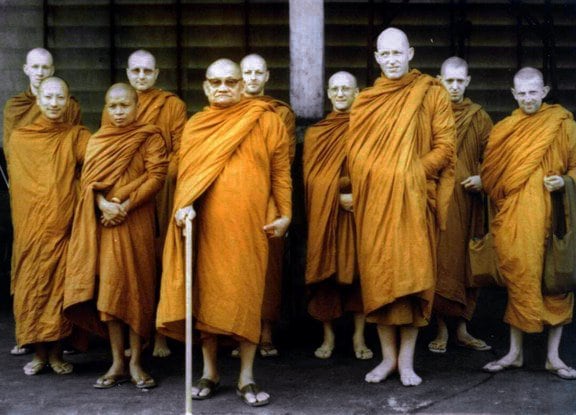
Ajahn Chah con su comunidad (1980) · Public domain
Своими словами
«Is there enough time to breathe? This is your meditation: mindfulness, naturalness in whatever you do.»Bodhinyana, «Questions and Answers» (traducción inglesa de la Sangha de Wat Pah Nanachat; original oral en tailandés o lao de Isan)

Для начала — одна книга
A Taste of FreedomГлавная мысль
Practice does not consist in reaching special states or pursuing results: the very wish to be free becomes an obstacle. It is a matter of observing attentively what arises and letting it take its natural course, without clinging or rejecting.
В контексте
Биография
4 мин чтения
Перевод с испанского оригинала, выполненный с помощью ИИ; ожидает проверки носителем языка.
Сын Исана
Ча Чуангчот родился 17 июня 1918 года в Бан Ко — деревне среди рисовых полей в нескольких километрах к югу от города Убонратчатхани, в Исане, обширном плато на северо-востоке Таиланда, чей язык и культура близки к лаосским. Он был пятым из одиннадцати детей Ма и Пим Чуангчот — крестьянской семьи, зажиточной по скромным деревенским меркам. Как почти все мальчики в округе, он провёл несколько лет послушником в местном монастыре, где научился читать и писать, а затем вернулся домой помогать в поле. Всё, что известно о его детстве, восходит к его собственным воспоминаниям, которыми он с годами делился в беседах и разговорах, и к кропотливой реконструкции его биографа, английского монаха Аджана Джаясаро.
26 апреля 1939 года, в двадцать лет, он принял полное посвящение в Ват Ко Най и палийское имя Субхаддо. Первые годы в качестве бхиккху он провёл как усердный деревенский монах: изучал Дхамму, монашескую дисциплину и язык пали и сдал официальные экзамены. Смерть отца, по его собственному признанию, заставила его почувствовать, что вся эта учёность не приближает его к концу страдания. В начале 1947 года он оставил занятия и ушёл в тудонг — странническую жизнь лесных монахов.
Лес и учитель
Семь лет он странствовал пешком по северо-востоку и центру Таиланда, ночуя под зонтом с москитной сеткой, который монахи подвешивают к деревьям, собирая подаяние в деревнях и разыскивая учителей линии, основанной Аджаном Муном Бхуридатто, великим обновителем лесного монашества. Один сезон дождей он провёл у Луанг Пу Кинари, научившего его скрупулёзной дисциплине, а в начале 1948 года пришёл в монастырь Нонг Пеу в провинции Саконнакхон, где жил Аджан Мун. Пробыл он там всего три дня. Согласно преданию монастыря, старый учитель сказал ему, что учение, при всей своей обширности, по сути очень просто: при хорошо установленной осознанности видеть, что всё возникает в сердце-уме. Впоследствии Аджан Ча рассказывал, что этот совет расчистил ему путь.
Последующие годы были годами предельной практики. Он сам рассказывал в беседе конца шестидесятых о ночи, проведённой в одиночестве на месте кремации возле только что вырытой могилы ребёнка, и о следующей ночи перед горящим погребальным костром, во власти страха, который он описал с юмором и не опуская подробностей. Он практиковал в пещерах и в джунглях, где водились тигры и кобры, и научился использовать созерцание смерти как инструмент. Рассказ об этих годах опирается главным образом на его собственные слова и на собранные Джаясаро свидетельства его спутников, и читать его следует именно так.
Ват Нонг Па Понг
В 1954 году он согласился поселиться в необитаемой роще неподалёку от родной деревни — в месте, которое люди обходили стороной из-за кобр, тигров и призраков и которое он именно поэтому счёл идеальным для лесного монаха. Там и вырос Ват Нонг Па Понг. Обучение было суровым: одна трапеза в день, строгое соблюдение Винаи, долгие и с виду бесполезные работы, призванные подорвать привязанность к покою, и учитель, доводивший монахов до предела их терпения. Зато манера его наставлений была простой и полной юмора: он говорил языком крестьян, с притчами о буйволах, горшках, арбузах и муравьях, и с недоверием относился и к техникам, и к необычайным состояниям. Медитация, говорил он, совершается не только сидя: она совершается, когда дышишь, метёшь или шьёшь монашеское одеяние.
Слава его привлекала тысячи тайских мирян и монахов, а с 1967 года — и западных людей. Первым был Сумедхо, недавно посвящённый американец, которого он принял без всяких поблажек: тот должен был есть то же и практиковать так же, как остальные. За ним последовали другие, и в 1975 году Аджан Ча разрешил основать Ват Па Наначат, Международный лесной монастырь, — первый в Таиланде монастырь, которым руководили англоязычные монахи и который предназначался для них. В 1976 году он получил церковный титул Пхра Бодхиньянатхера, но для всех оставался Луанг По, «досточтимым отцом».
На Запад
В 1977 году English Sangha Trust пригласил его в Лондон. Увидев серьёзный интерес, он оставил там Аджана Сумедхо с другими монахами; в 1979 году он вернулся, когда община переселялась в новый монастырь Читхёрст в Суссексе, а затем побывал в США и Канаде, где выступал в Insight Meditation Society, одним из основателей которого был его бывший ученик Джек Корнфилд. Из этой сети выросли Амаравати в Англии, Бодхиньяна в Австралии, Абхаягири в Калифорнии и десятки монастырей в Европе и Океании. Корнфилд рассказал о нём в книге «Living Buddhist Masters» (1977), а в 1985 году вместе с Полом Брейтером выпустил «Тихое лесное озеро» — антологию, принёсшую Аджану Ча славу среди англоязычных читателей.
Аджан Ча не писал книг. То, что сегодня читают под его именем, — расшифровки бесед, записанных на кассеты, часто плохого качества, на тайском языке или на исанском диалекте и переведённых монахами Ват Па Наначата, Тханиссаро Бхиккху, Полом Брейтером или подготовленных к изданию Аджаном Амаро. Его монастыри распространяют их бесплатно, как дар Дхаммы, по лицензиям, которые разрешают копировать тексты, но не продавать и не изменять их.
Десять лет молчания
С конца семидесятых диабет подтачивал его здоровье: головокружения, провалы в памяти, операция 1981 года, не остановившая паралич. 20 января 1983 года, после пяти месяцев в бангкокской больнице, самолёт военно-воздушных сил доставил его обратно в Убон; западный монах снёс его на руках по трапу. Больше он не произнёс ни слова. Более девяти лет он оставался неподвижным и безмолвным, монахи ухаживали за ним посменно, а ученики говорили, что эта болезнь — его последнее наставление о непостоянстве. Он умер в 5:20 утра 16 января 1992 года, в возрасте семидесяти трёх лет.
Его кремация, состоявшаяся ровно через год, собрала в монастыре королевскую семью и толпу, которую биограф оценивает примерно в четыреста тысяч человек, а другие источники — более чем в миллион. Сегодня у Ват Нонг Па Понга более двухсот филиальных монастырей в Таиланде и международная сеть, хранящая живой дисциплину леса. Его беседы, переведённые на десятки языков, входят в число самых читаемых на Западе современных буддийских текстов.
Источники: The Sangha, Wat Nong Pah Pong (comp. Bhikkhus Dhammajoti y Gavesako). The Teachings of Ajahn Chah: A Collection of Ajahn Chah's Dhamma Talks. Ubon Ratchathani: Wat Nong Pah Pong, 2007 (ed. 4.3), con la semblanza «About Ajahn Chah». Distribución gratuita. · Ajahn Jayasaro. Stillness Flowing: The Life and Teachings of Ajahn Chah. Panyaprateep Foundation, 2017. Distribución gratuita. · Ajahn Jayasaro. Quietud que fluye: la vida y las enseñanzas de Ajahn Chah. Trad. Ricardo Szwarcer. Panyaprateep Foundation, 2023 (ISBN 978-1-78432-207-6; licencia CC BY-NC-ND 4.0). · Kornfield, Jack; Breiter, Paul (comp. y ed.). A Still Forest Pool: The Insight Meditation of Achaan Chah. Wheaton (IL): Theosophical Publishing House / Quest Books, 1985. · Ajahn Chah. Food for the Heart: The Collected Teachings of Ajahn Chah. Ed. Ajahn Amaro, prólogo de Jack Kornfield. Boston: Wisdom Publications, 2002.
Хронология
Жизнь год за годом
Каждая точка — документированное событие. Нажмите, чтобы прочитать о нём, с источником и степенью достоверности.
17 июня 1918 г.0 летBahn Kor, Ubon Ratchathani
Birth in an Isan village
Born on the seventh day of the seventh moon of the Year of the Horse, fifth of the eleven children of Mah and Pim Chuangchot, rice farmers from a well-off village family.
ДокументированоAjahn Jayasaro. Quietud que fluye: la vida y las enseñanzas de Ajahn Chah. Trad. Ricardo Szwarcer. Panyaprateep Foundation, 2023 (ISBN 978-1-78432-207-6; licencia CC BY-NC-ND 4.0).
После смерти
- 16 января 1993 г.Cremation before a multitude
- 2017Stillness Flowing
17 июня 1918 г. · 0 лет
Birth in an Isan village
Born on the seventh day of the seventh moon of the Year of the Horse, fifth of the eleven children of Mah and Pim Chuangchot, rice farmers from a well-off village family.
Документировано
ок. 1927 · 9 лет
Novice in the village monastery
Following Isan custom he enters the local monastery as a novice, where he learns to read and write; after some years he returns home to help his parents.
Документировано
26 апреля 1939 г. · 20 лет
Ordination as a bhikkhu
He receives higher ordination and the monastic name Subhaddo; in the following years he studies the Dhamma, the Vinaya and Pali in village monasteries.
Документировано
1947 – 1954 · 28 лет
Tudong years
After his father's death he gives up his studies and takes up the wandering life of the forest monks: forests, caves and cremation grounds, following teachers such as Luang Pu Kinaree.
Документировано
1948 · 29 лет
Three days with Ajahn Mun
Early in 1948 he visits the great forest master, who teaches him that although the texts are extensive, at heart practice is very simple: to see with mindfulness that everything arises in the heart-mind.
Документировано
1954 · 36 лет
Founding of Wat Nong Pah Pong
He settles in an uninhabited grove near his home village, feared for its cobras and ghosts; there grows the monastery that will give its name to a network of over two hundred branches.
Документировано
1967 · 49 лет
The first Western disciple arrives
The newly ordained American Sumedho arrives at the monastery; Ajahn Chah accepts him without granting him any privilege for being a Westerner.
Документировано
1975 · 57 лет
Wat Pah Nanachat
The International Forest Monastery is founded, the first in Thailand run by and for English-speaking monks, with Ajahn Sumedho as abbot.
Документировано
1976 · 58 лет
Title of Phra Bodhiñāṇathera
He receives the ecclesiastical title under which he appears in official documents, though to his disciples he remains Luang Por, 'venerable father'.
Документировано
1977 · 59 лет
First journey to England
Invited by the English Sangha Trust, he travels with Ajahn Sumedho to the Hampstead Buddhist Vihara and leaves his disciple there to found a monastic community in the West.
Документировано
1979 · 61 год
Chithurst and the American tour
He returns to England as the monks move to the new monastery of Chithurst (Cittaviveka) and afterwards teaches at the Insight Meditation Society in Massachusetts and in Canada.
Документировано
20 января 1983 г. · 64 года
Return to Ubon, paralysed and speechless
After surgery in 1981 and five months in a Bangkok hospital, diabetes and its consequences leave him paralysed; a Western monk carries him in his arms from a military aircraft. He will never speak again.
Документировано
16 января 1992 г. · 73 года
Death
He dies at 5.20 in the morning, after more than nine years motionless and silent, tended in shifts by his monks.
Документировано
16 января 1993 г.
Cremation before a multitude
Exactly a year after his death the cremation takes place, attended by the royal family. His biographer estimates some four hundred thousand people; other sources speak of more than a million.
Документировано
2017
Stillness Flowing
Ajahn Jayasaro publishes the standard biography, the fruit of decades of interviews with disciples; it is distributed free and translated into Spanish in 2023 as Quietud que fluye.
Документировано
Труды
Главные труды
Труды, без которых не понять это наследие.
Позднейший сборник · 1980
A Taste of Freedom
A selection of talks to lay people and monks—'Training this Mind', 'On Meditation', 'The Path in Harmony', 'The Middle Way Within', 'Opening the Dhamma Eye', 'Convention and Liberation'—translated by the Wat Pah Nanachat community. It is one of the most reprinted collections and the first many readers encounter; it sets out the middle way, mindfulness in daily life and the difference between conventions and liberation.
3 издания

Позднейший сборник · 1985
A Still Forest Pool
A Still Forest Pool: The Insight Meditation of Achaan Chah
A thematic anthology of sayings and talk fragments gathered by Jack Kornfield and Paul Breiter, both former monks in his monasteries. Arranged by theme—right understanding, meditation, monastic life, questions and answers—it made Ajahn Chah an author known beyond Buddhist circles. The title comes from his image of the attentive mind growing still like a clear forest pool where strange animals come to drink.
2 издания

Позднейший сборник · 2002
Food for the Heart
Food for the Heart: The Collected Teachings of Ajahn Chah
The standard anthology published by Wisdom Publications, edited by Ajahn Amaro with a foreword by Jack Kornfield: it gathers in a single volume revised talks from the free-distribution collections, with an introduction on the forest tradition. It is the most widely read gateway to his teaching in English.
1 издание

Позднейший сборник · 2005
Everything Arises, Everything Falls Away
Everything Arises, Everything Falls Away: Teachings on Impermanence and the End of Suffering
Talks and fragments on impermanence and the end of suffering translated by Paul Breiter, not included in the Wat Pah Nanachat collections. Its tone is especially direct and aimed at lay readers.
3 издания
Все труды (23)
Ajahn Chah
Fragments of a Teaching
The Conscious LibraryFragments of a Teaching
1972
Ajahn Chah
Bodhinyana
The Conscious LibraryBodhinyana
1982

Living Dhamma
1992

Food for the Heart (1992 collection)
1992
Ajahn Chah
A Tree in a Forest
The Conscious LibraryA Tree in a Forest
1994

No Ajahn Chah
1994
Ajahn Chah
The Path to Peace
The Conscious LibraryThe Path to Peace
1996
Ajahn Chah
Clarity of Insight
The Conscious LibraryClarity of Insight
2000

Being Dharma
2001
Ajahn Chah
Unshakeable Peace
The Conscious LibraryUnshakeable Peace
2003

Everything Is Teaching Us
2004
Ajahn Chah
The Teachings of Ajahn Chah
The Conscious LibraryThe Teachings of Ajahn Chah
2007
Ajahn Chah
Still, Flowing Water: Eight Dhamma Talks
The Conscious LibraryStill, Flowing Water: Eight Dhamma Talks
2007
Ajahn Chah
In Simple Terms
The Conscious LibraryIn Simple Terms
2010

The Collected Teachings of Ajahn Chah
2011
Ajahn Chah
On Meditation
The Conscious LibraryOn Meditation
2018
Ajahn Chah
The Training of the Heart
The Conscious LibraryThe Training of the Heart
Ajahn Chah
Our Real Home
The Conscious LibraryOur Real Home
Ajahn Chah
Beyond Cause and Effect
The Conscious LibraryBeyond Cause and Effect
1990
Изречения
Изречения, найденные в конкретном труде. Каждое сопровождается указанием происхождения и степени надёжности.
Is there enough time to breathe? This is your meditation: mindfulness, naturalness in whatever you do.ПровереноBodhinyana, «Questions and Answers» (traducción inglesa de la Sangha de Wat Pah Nanachat; original oral en tailandés o lao de Isan)
Основные идеи (редакционное изложение)
Из уважения к авторскому праву эти идеи изложены своими словами и не выдаются за дословные цитаты.
- Practice does not consist in reaching special states or pursuing results: the very wish to be free becomes an obstacle. It is a matter of observing attentively what arises and letting it take its natural course, without clinging or rejecting.
- Meditation is not confined to the sitting posture: it can be done walking, working, eating or sewing, because it consists in sustaining mindfulness and naturalness in any activity; whoever claims to have no time to meditate still has time to breathe.
- Everything perceived as certain is in fact uncertain. Answering every desire and every aversion with a 'not sure' cuts identification with mental states and is, for him, the standard of the noble ones.
- Letting go is neither passivity nor negligence: it is a demanding practice, learned like someone who at last drops a heavy rock he had been carrying and only then discovers how light he can be.
- Monastic discipline and ascetic practices are not ends in themselves but a framework that exposes attachment and strengthens patience; monastic training should therefore be hard and, at the same time, free of fanaticism.
- The body, the house and possessions are borrowed homes that belong to the world; the only true home is the peace born of understanding impermanence, and one can return to that peace even in old age and in the face of death.
Последние слова
Проверяемых записей о последних словах не существует.
There are no recorded last words. From early 1983, after years of diabetes and a failed operation in 1981, he was paralysed, unable to express himself coherently, and stopped speaking; he died in silence on 16 January 1992, after more than nine years cared for by his monks. Ajahn Jayasaro, his biographer, notes that many disciples expected some marvel before his death and that there was none.
Источник: Ajahn Jayasaro. Quietud que fluye: la vida y las enseñanzas de Ajahn Chah. Trad. Ricardo Szwarcer. Panyaprateep Foundation, 2023 (ISBN 978-1-78432-207-6; licencia CC BY-NC-ND 4.0).
Спросить
На что отвечают эти труды
Двенадцать великих вопросов человечества и то, что позволяют на них ответить эти тексты, со ссылками. Мы никогда не вкладываем слова в чужие уста.
Что такое Абсолют? Существует ли Бог?
No god intervenes: it is enough to see the transient and let it go
Нет Бога-творцаСледует из учения
Ajahn Chah wrote no books: his teachings are talks in Thai or in the Lao of Isan, recorded and transcribed by his disciples. In them no creator God appears, nor is his existence discussed. His framework is that of the Pali canon and the Thai forest tradition: what matters is to see clearly that everything that arises is transient, imperfect and ownerless, and to let it go. When he speaks of what remains, he calls it peace or «the one who knows», and describes it as a quality of the liberated mind, not as a being. His work allows one to answer that liberation depends on no god, although he himself never made the question a subject of debate: he always turned it back to practice.
Сравнить этот вопрос с другими учителямиКто я? Существует ли истинное «я»?
There is no Ajahn Chah: everything is transient, imperfect and ownerless
Постоянного «я» нетСказано прямо
In the talks transcribed by his disciples, Ajahn Chah applies the Pali teaching of non-self to the most immediate experience. Whatever arises in the mind, pleasure or pain, is to be seen as transient, imperfect and ownerless; none of it is «mine» or «I». One of his collections is entitled No Ajahn Chah, and he himself would repeat that the teacher's name and figure are useful conventions, not an entity. Identification with the body and with mental states is what produces suffering; letting go does not mean denying them but ceasing to carry them. What remains when one lets go he called «the one who knows», a quality of attentive knowing, not a soul or a Self.
Сравнить этот вопрос с другими учителямиПочему мы страдаем?
We suffer from grasping; the glass is already broken
Жажда и привязанностьСказано прямо
Ajahn Chah's talks, transcribed and translated by his disciples, return suffering again and again to its cause in the second noble truth: clinging. In «Still, Flowing Water», from the 1981 rains retreat, he offers a domestic image: if one reflects beforehand that the glass is already broken, even when it is not, the cause of suffering ceases. It is not a matter of not using the glass, but of not demanding that it last. Phenomena he invites us to see as transient, imperfect and ownerless; everything is uncertain, and answering every desire and every aversion with «not sure» cuts identification. Pain exists, but the added suffering arises from carrying what cannot be held.
Сравнить этот вопрос с другими учителямиЧто происходит после смерти?
The body is a borrowed home; the true home is inner peace
Молчание или сдержанностьСледует из учения
Ajahn Chah's best-known talk on death, «Our Real Home», was addressed to an elderly lay disciple who was dying, and his monks transcribed it. He does not speak to her of what will come afterwards. He asks her to look at the body as what it is: something that belongs to nature and follows its course, like flowing water or an ageing tree. The body, the house and possessions are borrowed homes; the only true home is inner peace, and one can return to that peace even at the end. The task in the face of death is not to speculate but to let go now of what will have to be let go anyway. Thus he resolves the question: by shifting it from the hereafter to present practice.
Сравнить этот вопрос с другими учителямиКак достигается освобождение или спасение?
Ethics, concentration and wisdom in every posture, without chasing results
Через дисциплинированную практикуСказано прямо
Ajahn Chah taught the classical Theravāda path of ethics, concentration and wisdom, but insisted that they are not separate nor confined to the sitting posture. In his forest monasteries, the Vinaya and some ascetic practices were the framework that exposes attachment and strengthens patience. Mindfulness had to be sustained while walking, working or eating: whoever says they have no time to meditate does have time to breathe. At the same time, he warned against spiritual ambition: one should not try to get anywhere in practice, because the very desire to be free or enlightened is what prevents freedom. Liberation is the fruit of letting go with perseverance, day after day, of what is seen as transient, imperfect and ownerless.
Сравнить этот вопрос с другими учителямиНужен ли учитель?
One learns by living in the forest community, under its discipline
Община и традицияСледует из учения
Ajahn Chah trained his disciples, Thai and Western, in forest monasteries where teaching was not separated from communal life. Strict observance of the Vinaya, the monastic code, and of some ascetic practices served to expose each person's attachment, impatience and pride; the teacher observed and corrected, but the school was the whole community with its rules, its timetable and its work. At the same time, his talks always return responsibility to the practitioner: the teacher only points, and what is decisive is looking at one's own mind. That a collection of his teachings is entitled No Ajahn Chah well expresses this double attitude: a demanding presence that does not want to become an object of attachment.
Сравнить этот вопрос с другими учителямиРеален ли мир?
Everything arises, everything passes: conditioned phenomena, without an owner
Сеть причин без субстанцииСледует из учения
Ajahn Chah did no metaphysics; he described the world as it appears to someone who observes it attentively. What presents itself to the senses and the mind arises, lasts a while and ceases, according to its causes; it must be seen as transient, imperfect and ownerless. One of his collections is titled precisely Everything Arises, Everything Falls Away. He often spoke of «nature» to refer to this course of things: the body belongs to nature and follows it, like flowing water. The world is not unreal, but neither is it certain; the certainty we attribute to it is what makes us suffer. Understanding dependent origination, in his teaching, is exercised by watching how a sensation gives way to a desire, rather than in abstract analysis.
Сравнить этот вопрос с другими учителямиЧто такое любовь?
He did not make love a theme; he taught seeing affection as attachment
Не высказывался
The talks of Ajahn Chah that have been transcribed and translated contain no developed teaching on love. When affection appears, it usually does so as a form of attachment to be seen clearly: loved ones, like the body and possessions, are transient, and clinging to them prepares pain. This does not mean coldness. The Theravāda tradition in which he was trained cultivates loving-kindness (mettā) and compassion as practices, and he himself was known for his patience and humour with monks and lay people. But his emphasis lay elsewhere: on the peace that arises from letting go. From his work one can infer that mature love is the kind that does not demand that the other be certain or permanent.
Сравнить этот вопрос с другими учителямиСвободны ли мы или всё предопределено?
Kamma is action: what one does now with mindfulness changes the course
Карма и выборСледует из учения
Ajahn Chah taught within the Theravāda framework of kamma, understood as intentional action and its consequences. In his talks, transcribed by his disciples, the emphasis falls less on the past that conditions than on what can be done now: observing what arises in the mind and not acting moved by desire or aversion. Answering every impulse with «not sure» cuts automatic reaction and opens a margin of freedom. At the same time, his teaching on non-self discourages thinking that there is someone in control: mental states follow their course according to their causes. The freedom he proposes is not that of a sovereign subject but that of an attention that stops feeding the causes of suffering.
Сравнить этот вопрос с другими учителямиЗачем медитировать или молиться?
Mindfulness and naturalness in everything: seeing the transient until letting go
Видеть реальность такой, как она естьСказано прямо
For Ajahn Chah, meditation is not reduced to time spent cross-legged. To anyone who said they had no time, he would ask whether they had enough time to breathe: that is meditation, mindfulness and naturalness in whatever one does. Practice consists in being mindful and letting things take their natural course; thus the mind grows quiet in any surroundings, like a clear forest pool. That stillness is not an end: in it one sees clearly that what arises is transient, imperfect and ownerless, and this seeing is what liberates. He also warned against meditative ambition: one should not try to get anywhere, because the wish for enlightenment becomes another obstacle.
Сравнить этот вопрос с другими учителямиМожет ли разум познать предельное?
Knowing by hearsay is not knowing: understanding arises in the heart
Предельное лежит за пределами умаСледует из учения
Ajahn Chah insistently distinguished between knowledge that comes from books or from thinking about the Dhamma and knowledge born of practice. In his talks, known through his disciples' transcriptions, study appears as a useful map that does not replace the path: knowing what the texts say does not by itself transform the mind. Thought can analyse impermanence and reach correct conclusions without anything changing; true understanding occurs when the mind, quietened, sees directly that things are transient, imperfect and ownerless, and lets go. He called «the one who knows» that quality of attentive knowing which is not thought. He did not scorn the study of texts, which his monks practised, but subordinated it to experience.
Сравнить этот вопрос с другими учителямиУйти от мира или преобразить его?
Practice in every posture: whoever breathes has time to meditate
Созерцание в действииСказано прямо
Ajahn Chah was a forest monk and founded secluded monasteries where life followed a strict discipline; for monks, retreat was the condition of practice. But his teaching to laypeople, and to a large extent to the monks themselves, insisted that meditation is not confined to the sitting posture or to a place. To anyone who complained of having no time he would ask whether they had time to breathe: that is meditation, mindfulness and naturalness in whatever one does. The mind can grow quiet in any surroundings, like a clear forest pool. He did not propose reforming society, but living in its midst with attention, seeing the transience of each situation and letting go of what presents itself.
Сравнить этот вопрос с другими учителями
Созвучия и противоречия
Созвучия и противоречия
Рассчитаны вопрос за вопросом на основе позиций. Причина каждого совпадения или расхождения — по нажатию.
Ближе всего к
Thich Nhat Hanh
Совпадают в вопросах: Свободны ли мы или всё предопределено? · Кто я? Существует ли истинное «я»? · Почему мы страдаем?

Śāntideva
Совпадают в вопросах: Как достигается освобождение или спасение? · Что такое Абсолют? Существует ли Бог? · Кто я? Существует ли истинное «я»?

Siddhartha Gautama, the Buddha
Совпадают в вопросах: Что такое Абсолют? Существует ли Бог? · Кто я? Существует ли истинное «я»? · Почему мы страдаем?

Pema Chödrön
Совпадают в вопросах: Что такое Абсолют? Существует ли Бог? · Кто я? Существует ли истинное «я»? · Почему мы страдаем?
Дальше всего от

Emanuel Swedenborg
Расходятся в вопросах: Что такое Абсолют? Существует ли Бог? · Кто я? Существует ли истинное «я»?
Jesus of Nazareth
Расходятся в вопросах: Что такое Абсолют? Существует ли Бог? · Кто я? Существует ли истинное «я»?

Ignatius Brianchaninov
Расходятся в вопросах: Что такое Абсолют? Существует ли Бог? · Кто я? Существует ли истинное «я»?

Mirabai
Расходятся в вопросах: Что такое Абсолют? Существует ли Бог?
Предания и рассказы
Предания и рассказы
Свидетельствоc. 1947–1954
Two nights in the cremation ground
Происхождение рассказа: Ajahn Chah's own account in the talk 'In the Dead of Night…', given on an uposatha night at Wat Nong Pah Pong in the late 1960s and published in Food for the Heart (1992) and The Teachings of Ajahn Chah (2007). Jayasaro (Stillness Flowing) places it in the wandering years.
Свидетельство1948
Three days with Ajahn Mun
Происхождение рассказа: The visit and its length are recorded in Ajahn Jayasaro's biography, based on companions' testimony; the content of the teaching comes from Ajahn Chah's own account as given in the official Wat Nong Pah Pong profile. Ajahn Mun's supposed recognition is oral tradition that Jayasaro presents as hearsay.
Документировано1966
No privileges for the first Westerner
Происхождение рассказа: Official profile 'About Ajahn Chah' in The Teachings of Ajahn Chah (Wat Nong Pah Pong, 2007) and Ajahn Sumedho's own testimony, gathered by Jayasaro.
Устная традицияc. 1970s–1981
The glass that is already broken
Происхождение рассказа: The narrative version comes from Mark Epstein, Thoughts Without a Thinker (1995), who does not specify when or to whom Ajahn Chah said it. The simile is documented in the talk 'Still, Flowing Water' (Living Dhamma; The Teachings of Ajahn Chah, 2007).
Источник: Epstein, Mark. Thoughts Without a Thinker: Psychotherapy from a Buddhist Perspective. Nueva York: Basic Books, 1995.
Житийное повествованиеc. 1947–1954
The vision of the child in the grave
Происхождение рассказа: It circulates without a precise source in the 'Described Miracles' section of the English Wikipedia and in Thai devotional material. It does not appear in the autobiographical talk or in the Jayasaro biography consulted; it is recorded as a hagiographic tale.
Источник: Wikipedia (en), «Ajahn Chah».
Документировано1983–1992
Ten years without words
Происхождение рассказа: Opening scene of Ajahn Jayasaro's biography (Stillness Flowing, 2017; Quietud que fluye, 2023), based on eyewitnesses.
Учение
Учение
Понятия, на которых строится мысль учителя, объяснённые в их контексте.
'Not sure' (mai nae)mai-nae
A practical application of anicca, one of the three characteristics of existence in Theravada Buddhism.
Still, flowing wateragua-quieta-que-fluye
It expresses the unity of samatha and vipassana characteristic of Ajahn Mun's forest tradition.
Letting gosoltar
A practical interpretation of non-clinging (anupādāna) and the middle way.
Practice in every posturepractica-en-todas-las-posturas
It develops the Satipaṭṭhāna Sutta's teaching on mindfulness in the four postures.
'The one who knows' (Buddho)el-que-sabe
A characteristic term of the Thai forest tradition (phu ru), linked to the recitation of Buddho in Ajahn Mun's meditation.
Forest discipline (Vinaya and dhutanga)disciplina-del-bosque
The legacy of Ajahn Mun's renewal movement, which returned the Vinaya to the centre of monastic life in Isan.
Видео
Видео
Записи, интервью и документальные фильмы. Видео воспроизводятся с YouTube; здесь они не хранятся.
Ajahn Chah I The mindful Way I BBC Documentary I 1977
Документальный фильм· EN· 1977
Buddhist Teachings
Ajahn Chah - Talk About Nong Pah Pong Monastery (in Thai & English)
Оригинальная запись· TH
The Noble Path
Ajahn Chah / Talks during visit of Insight Meditation Society (IMS) in 1979 / 8/11
Оригинальная запись· TH· 1979
Buddhist Teachings
Life at Wat Nong Pah Pong with Ajahn Chah | Ajahn Tiradhammo
Интервью· EN
Wat Buddha Dhamma - Theravadin Forest MonasteryОфициальный канал
Reading: "Koṇḍañña Knows" by Ajahn Chah | Ajahn Pasanno
Оригинальная запись· EN
AbhayagiriОфициальный канал
The Art of Ajahn Chah's Training Method | Ajahn Anan
Лекция· EN· 2026
Ajahn Anan DhammaОфициальный канал
Why are We Here? | Ajahn Chah
Оригинальная запись· EN
Ajahn Anan DhammaОфициальный канал
Insegnamenti Ajahn Chah [40] - Che cos'è la contemplazione
Оригинальная запись· IT
Santacittarama Monastero BuddhistaОфициальный канал
Ajahn Chah Relic Stupa at Night | Wat Nong Pah Pong | Ajahn Dhammasiha
Документальный фильм· EN
Dhamma Talks at DhammagiriОфициальный канал
Ajahn Chah en español - "Entrenando esta mente"
Оригинальная запись· ES
Meditemosuy
Ajahn Chah - Fragments d'un enseignement [Théravada]
Оригинальная запись· FR
Le Vieux Sage
Галерея
Галерея
Изображения с проверенной лицензией. Каждое сохраняет своё авторство и атрибуцию.
Связи
Связи
Влияния, ученичество и близость взглядов. Документированная связь отличается от сходства, выявленного путём анализа.
Испытал влияние
Siddhartha Gautama, the Buddha
All his teaching presents itself as practice of the Buddha's Dhamma and Vinaya according to the Pali canon.
Документированная связь
Современник
A contemporary and parallel figure in spreading mindfulness from Asia to the West; no meeting between them is recorded.
Сходство, выявленное путём анализа
Идеи, близкие к
Both insisted on simple everyday practice rather than the pursuit of special states, and both formed Western communities in the 1960s and 1970s; there is no documented contact.
Сходство, выявленное путём анализа
Современник
The 14th Dalai Lama (Tenzin Gyatso)
A contemporary in transmitting Buddhism to the West, from the Theravada forest tradition and the Tibetan tradition respectively.
Сходство, выявленное путём анализа
Упоминается в других статьях
Источники
Источники
Библиография и каталоги, использованные для этой статьи.
- Wikidata, «Ajahn Chah» (Q411930).
- The Sangha, Wat Nong Pah Pong (comp. Bhikkhus Dhammajoti y Gavesako). The Teachings of Ajahn Chah: A Collection of Ajahn Chah's Dhamma Talks. Ubon Ratchathani: Wat Nong Pah Pong, 2007 (ed. 4.3), con la semblanza «About Ajahn Chah». Distribución gratuita.
- Ajahn Jayasaro. Stillness Flowing: The Life and Teachings of Ajahn Chah. Panyaprateep Foundation, 2017. Distribución gratuita.
- Ajahn Jayasaro. Quietud que fluye: la vida y las enseñanzas de Ajahn Chah. Trad. Ricardo Szwarcer. Panyaprateep Foundation, 2023 (ISBN 978-1-78432-207-6; licencia CC BY-NC-ND 4.0).
- Wikipedia (en), «Ajahn Chah».
- Wikipedia (es), «Ajahn Chah».
- Kornfield, Jack; Breiter, Paul (comp. y ed.). A Still Forest Pool: The Insight Meditation of Achaan Chah. Wheaton (IL): Theosophical Publishing House / Quest Books, 1985.
- Ajahn Chah. Food for the Heart: The Collected Teachings of Ajahn Chah. Ed. Ajahn Amaro, prólogo de Jack Kornfield. Boston: Wisdom Publications, 2002.
- Breiter, Paul. Venerable Father: A Life with Ajahn Chah. Nueva York: Paraview, 2004.
- Open Library, autor «Ajahn Chah» (OL2924730A, OL6725661A, OL3810410A): obras y ediciones con ISBN.
- Epstein, Mark. Thoughts Without a Thinker: Psychotherapy from a Buddhist Perspective. Nueva York: Basic Books, 1995.
- ajahnchah.org — Dhammatalks by Ajahn Chah (índice de charlas y ediciones, © Wat Nong Pah Pong).
- Kornfield, Jack. Living Buddhist Masters. Santa Cruz: Unity Press, 1977 (reed. como Living Dharma, Boston: Shambhala, 1996).
- Ajahn Chah. El sabor de la libertad. Trad. Hilda Patricia Castañeda Corona. Hemel Hempstead: Publicaciones Amaravati, 2018 (página de créditos; CC BY-NC-ND 4.0).
- Wat Nong Pah Pong, sitio oficial.
- dhammatalks.org, «Ajaan Chah Subhaddo»: traducciones de Ṭhānissaro Bhikkhu (Still, Flowing Water; In Simple Terms).
- Правообладатель
- Wat Nong Pah Pong (The Sangha) y monasterios de su red (Amaravati / Aruno Publications, Wat Pah Nanachat, Abhayagiri) para las traducciones de distribución gratuita; las ediciones comerciales pertenecen a sus editoriales y traductores (Wisdom Publications, Shambhala, Quest Books)
- Официальный сайт
- www.watnongpahpong.org
Ожидает подтверждения
То, что в этой статье пока не удалось установить. Мы предпочитаем сказать об этом, а не заполнять пробел.
- La foto principal («AjahnChahSangha.jpg») está declarada en Commons como dominio público por cesión de la comunidad («Published into the public domain by the Sangha»), con fuente en un blog; conviene confirmar la cesión con Wat Nong Pah Pong.
- Cifra de asistentes a la cremación de 1993: unas 400 000 según Ajahn Jayasaro; más de un millón según otras fuentes (Wikipedia). Sin cifra oficial localizada.
- Faltan ISBN y fechas de muchas ediciones de distribución gratuita (A Taste of Freedom 1980, Bodhinyana 1982, Living Dhamma 1992, Food for the Heart 1992, The Path to Peace, Clarity of Insight) y de las ediciones españolas «Un árbol en el bosque» y «Dhamma viviente».
- Ediciones españolas de A Still Forest Pool y Food for the Heart: no localizadas en catálogo.
- Año de In Simple Terms (Ṭhānissaro Bhikkhu) sin confirmar; fechas de los opúsculos de la Buddhist Publication Society (Bodhi Leaves 107 y 111).
- Inventario de las compilaciones originales en tailandés (ediciones de Wat Nong Pah Pong y de discípulos): solo se ha registrado una, la de Open Library.
- Sin textos para la sala de lectura: las traducciones circulan gratis, pero con licencias CC BY-NC-ND o «solo distribución gratuita», no en dominio público (Ajahn Chah murió en 1992 y los traductores viven).
- Más vídeos oficiales en tailandés (Wat Nong Pah Pong) y en español: los localizados en español son lecturas de canales no oficiales.
Исследовано 2026-10-25