
Written work · Essential works
The Bezels of Wisdom (Fusus al-hikam)
فصوص الحكم (Fusus al-hikam)
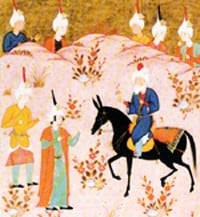
Twenty-seven chapters, each devoted to the "wisdom" of a prophet (from Adam to Muhammad, by way of Noah, Abraham, Moses, Jesus or Solomon), understood as a bezel in which a precious stone is set: an aspect of divine knowledge. It is his densest work and the one that concentrates his boldest theses on the relationship between God and the world, imagination, beliefs and the perfect human being. It was commented on more than a hundred times (al-Qunawi, al-Jandi, al-Qashani, al-Qaysari, Jami) and attacked with equal intensity, by Ibn Taymiyya among others.
amazon.com · Link to the store.
What it is about
The Fusus al-hikam — "The Bezels of Wisdom" — is Ibn Arabi's most read, most commented and most disputed work, and probably the most influential book of Sufi metaphysics. It is short compared with his major work, the Meccan Openings, but extremely dense: in twenty-seven chapters it condenses the central theses of his thought, often in their boldest formulation.
The title rests on an image from the goldsmith's craft. A fass is the bezel of a ring, the setting in which the stone is fixed. Each chapter is devoted to a prophet — from Adam to Muhammad, by way of Noah, Abraham, Joseph, Solomon, Jesus or Moses — and bears a title of the form "the bezel of divine wisdom in the word of Adam". The prophet is the setting; the stone is a particular aspect of the knowledge of God that was manifested in him. Ibn Arabi does not tell the prophets' stories but uses them as a point of departure for meditating on the Qur'anic verses and hadiths that refer to them, interpreted with a freedom that many readers found scandalous.
The vision it unfolds can be summarised thus. Only God has being in the proper sense; the world exists because God manifests Himself in it through His Names, as an image exists in a mirror. Before existing, each thing is an "immutable entity" in divine knowledge, and its existence consists in receiving being according to what it itself is. The human being holds a central place: it is the only being in which all the Names can be reflected at once, and the perfect human being — the prophet, the saint — is the polished mirror in which God contemplates Himself. From this follow theses the book develops chapter by chapter: God is both transcendent and immanent, and whoever affirms only one of the two limits Him; each believer worships the God his belief has shaped; imagination is a faculty of knowledge, not of fantasy; and divine mercy embraces all things, to the point that punishment itself can become sweet.
The Fusus matters because for centuries it set the vocabulary of philosophical mysticism in Islam. From the generation of his disciples it became a text of study, commented more than a hundred times in Arabic, Persian and Turkish, and its influence reached Persian poetry, Ottoman thought and India. At the same time it was one of the most attacked books in Islamic thought, accused of pantheism and heresy. That double history — veneration and condemnation — is part of its meaning. For today's reader it is a difficult text that demands patience and commentary, but it offers one of the deepest meditations in existence on the relation between the absolute and the relative.
Authorship note
According to the preface, the Prophet handed it to him in a dream in Damascus at the end of Muharram 627 (December 1229). A copy by Sadr al-Din al-Qunawi read before the author survives. Reference edition: Abu al-Ala Afifi (Cairo, 1946).
Context of composition
Ibn Arabi was born in Murcia in 1165, was educated in Seville and left al-Andalus around 1200, never to return. After years in Mecca and in Anatolia, where he married the mother of his disciple Sadr al-Din al-Qunawi, he settled in Damascus around 1223 and spent his last years there until his death in 1240. The Fusus is thus a mature work, written when he had already completed the first redaction of the Meccan Openings.
According to its preface, the book is not the fruit of his own reflection: in the last ten days of the month of Muharram in the year 627 of the hijra (December 1229), in Damascus, he saw the Prophet in a dream handing him a book with that title and commanding him to make it known. Ibn Arabi claims to have passed it on exactly as he received it, adding and removing nothing. It was addressed to a narrow circle of disciples already initiated into his language; it is not a popular work, and its first readers studied it with the author or with al-Qunawi.
Structure
- 01
Preface
It recounts the Damascus vision in which the Prophet hands the book to Ibn Arabi and commands him to spread it. The author declares that he merely transmits it without additions and asks God to be among those over whom the devil has no power. He thus presents the work as inspired, not as an author's treatise.
- 02
Ch. 1: Adam
"Divine wisdom in the word of Adam". The foundational chapter: God wished to see Himself in a being that would encompass everything; the world was an unpolished mirror and Adam was its polishing. It sets out the notion of the perfect human being, image of God and His vicegerent on earth.
- 03
Chs. 2–5: Seth, Noah, Idris, Abraham
They deal with divine gifts, which each being receives according to its predisposition; with the need to join transcendence and immanence, apropos of Noah's preaching; with holiness and elevation in Idris; and with Abraham's love and "intimate friendship", in which God and the human being interpenetrate.
- 04
Chs. 6–11: Isaac, Ishmael, Jacob, Joseph, Hud, Salih
They contain the theory of imagination: Abraham's dream of sacrificing his son needed to be interpreted, and the whole world is like a dream to be interpreted, according to the chapter on Joseph. With Hud comes the idea that every being walks a "straight path" because God leads it by the forelock.
- 05
Chs. 12–17: Shu'ayb, Lot, Ezra, Jesus, Solomon, David
The heart that contains God and takes on every form (Shu'ayb); the secret of predestination (Ezra); Jesus as spirit and divine breath that gives life; mercy preceding wrath, starting from Solomon's letter to the Queen of Sheba; and human vicegerency in David.
- 06
Chs. 18–24: Jonah, Job, John, Zechariah, Elijah, Luqman, Aaron
They defend the value of life and of the human body, God's work that must not be destroyed (Jonah); complaint addressed to God alone (Job); the relation between intellect and imagination (Elijah); and, in the chapter on Aaron, a reading of the golden calf according to which God is the one worshipped in every object of worship.
- 07
Chs. 25–27: Moses, Khalid ibn Sinan, Muhammad
The chapter on Moses, one of the longest, includes the controversial thesis that Pharaoh died a believer. Khalid ibn Sinan is a pre-Islamic Arab prophet whose message was lost. The book ends with Muhammad and the "wisdom of singularity", commenting on the hadith of the three things made lovable to him: women, perfume and prayer.
Main themes
The divine Names and the immutable entities
God makes Himself known through His Names — the Living, the Wise, the Merciful — and each being in the world is the locus where one or several of them are manifested. Before existing, things are "immutable entities" in divine knowledge; to exist is to receive being according to one's own predisposition. That is why each being is exactly what it can be, and receives from God nothing but what its nature asks.
The perfect human being
The human being is a microcosm gathering all the Names, and is therefore the only one capable of reflecting God whole. When that capacity is realised — in the prophet and the saint — he becomes the polished mirror of the world and God's vicegerent. The notion of *insan kamil*, the perfect human being, became through this book one of the keys of later Sufism.
Transcendence, immanence and the God of beliefs
Affirming only that God is incomparable locks Him into an abstraction; affirming only His likeness to creatures confuses Him with them. The knower joins the two. Hence the thesis that each believer worships the God his belief has shaped, and that the wise recognise God in every form in which He is worshipped without being bound to any.
Imagination as knowledge
For Ibn Arabi imagination is not fantasy but the faculty that perceives the spiritual in sensible form: in dreams, in visions, in revelation. The world itself is a form of imagination that must be interpreted, like a dream. This thesis, developed in the chapters on Isaac and Joseph, inspired Henry Corbin's twentieth-century reading.
The mercy that embraces all
Starting from the Qur'anic verse "My mercy embraces all things", the book holds that mercy precedes wrath and will finally prevail. It goes so far as to claim that punishment can turn to sweetness for the one who suffers it and that Pharaoh died a believer. It was these theses, more than the metaphysics, that provoked the harshest condemnations.
Editions and translations
Editions in your language first, without hiding the others. Each with its cover and its store.
English

The Ringstones of Wisdom
Kazi Publications (Great Books of the Islamic World), 2004
Translation: Caner K. Dagli
ISBN 1567447244
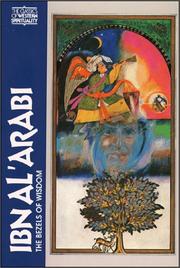
The Bezels of Wisdom (Classics of Western Spirituality)
Paulist Press, 1980
Translation: R. W. J. Austin
ISBN 9780809123315
Deutsch
Ibn Arabi
Das Buch der Siegelringsteine der Weisheitssprüche
The Conscious LibraryDas Buch der Siegelringsteine der Weisheitssprüche
Akademische Druck- u. Verlagsanstalt, 1970
Translation: Hans Kofler
Traducción alemana; sin ISBN en catálogo.
Italiano

La sapienza dei profeti
Edizioni Mediterranee, 1987
ISBN 9788827205792
Traducción italiana; traductor no verificado en catálogo.
Français

La Sagesse des prophètes
Albin Michel, 1989
Translation: Titus Burckhardt
ISBN 9782226000101
Traducción parcial publicada por primera vez en 1955.

Le Livre des chatons des sagesses
Al-Bouraq, 1997
Translation: Charles-André Gilis
ISBN 9782841610488
Traducción íntegra con comentario, 2 vols.
Español
Ibn Arabi
Los engarces de la sabiduría
The Conscious LibraryLos engarces de la sabiduría
Hiperión, 1991
Translation: Abderramán Mohamed Maanán
ISBN 8475173322
العربية

Fusus al-hikam
Dar al-Kotob al-Ilmiyah, 2009
ISBN 9782745140364
La edición crítica de Afifi (El Cairo, 1946) no tiene ISBN.
Türkçe

Fususu'l-Hikem
Ataç Yayınları, 2009
ISBN 9789756205280
Traducción turca; traductor no verificado en catálogo.
Other works by Ibn Arabi
- The Meccan Openings (al-Futuhat al-Makkiyya) · 1238
- The Interpreter of Desires (Tarjuman al-ashwaq) · 1215
- The Treasures of Lovers (commentary on the Tarjuman) · 1215
- The Spirit of Holiness (portraits of Andalusi masters) · 1203
- The Setting-Places of the Stars · 1199
- The Contemplations of the Holy Mysteries · 1194
- The Book of Theophanies · 1205
- Treatise on Unity (attributed)
- The Production of the Circles
- Divine Governance of the Human Kingdom
- The Book of Majesty and Beauty
- What the Seeker Needs
- The Adornment of the Spiritually Transformed · 1203
- Journey to the Lord of Power · 1205
- The Book of the Night Journey · 1198
- The Precious Pearl
- The Fabulous Gryphon · 1199
- The Niche of Lights (Divine Sayings) · 1203
- The Universal Tree and the Four Birds
- The Seven Days of the Heart
- The Unveiling of the Effects of the Journey
- The Secret of the Names of God
- The Brilliant Star: The Virtues of Dhu l-Nun the Egyptian
- The Tree of Being
- The Book of Mim, Waw and Nun
- The Great Diwan (mystical poetry)
- Discourse of the Righteous and Night-Talk of the Chosen
- The Profession of Faith
- Treatises of Ibn Arabi (collection) · 1948
Sources
- Ibn al-Arabi. Fusus al-hikam. Ed. Abu al-Ala Afifi. El Cairo, 1946. Trad. inglesa: R. W. J. Austin, The Bezels of Wisdom (Classics of Western Spirituality). Nueva York: Paulist Press, 1980.
Affiliate link: if you buy through it, the library may receive a commission at no extra cost to you. When an edition's real cover is not available, we show an illustrative library cover.