Pythagoras
Aristotle's testimonies on the Pythagoreans
Academic study
Aristotle's testimonies on the Pythagoreans
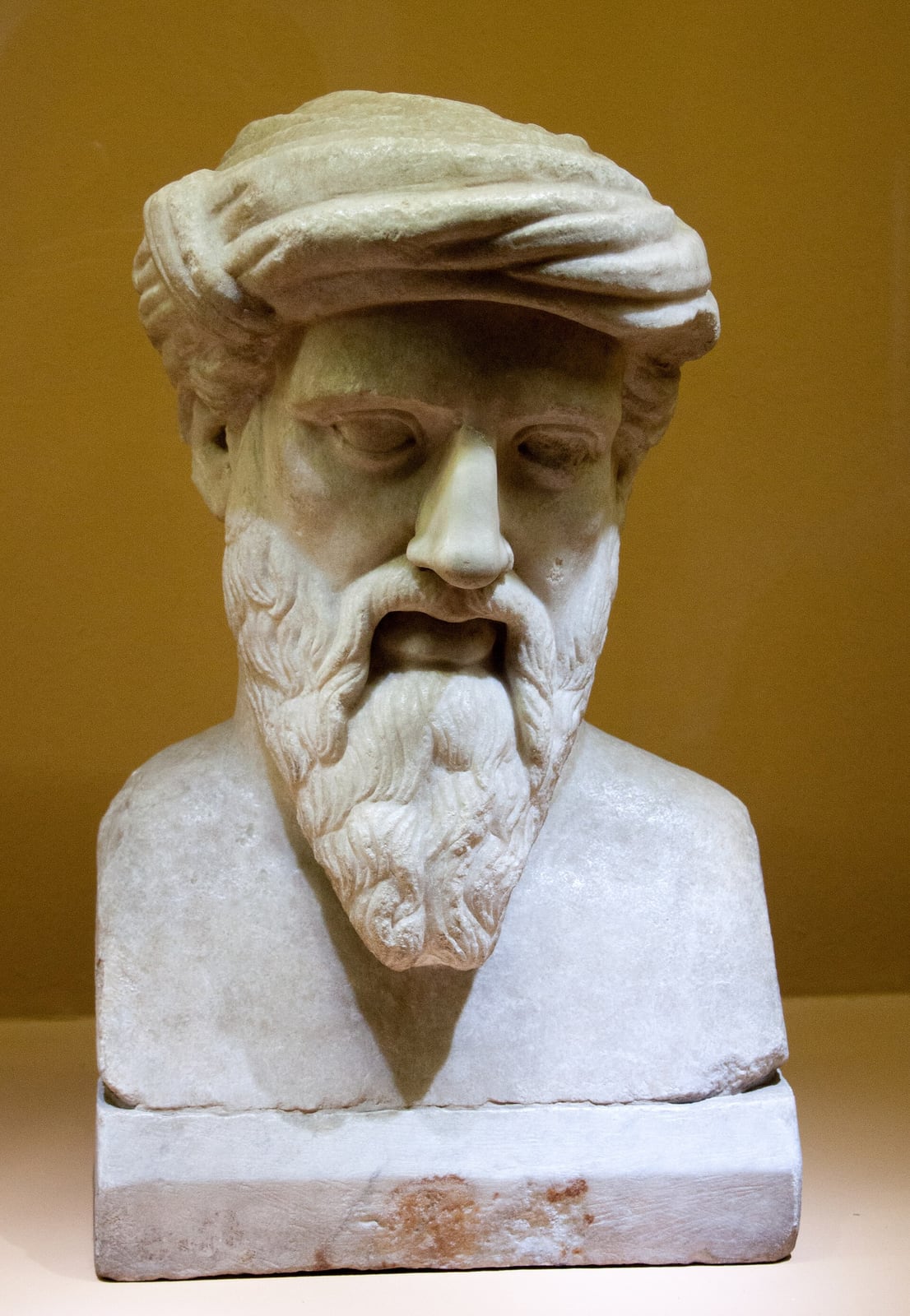
In the Metaphysics (A 5) he sets out the doctrine that things are numbers or imitate numbers, the table of ten pairs of opposites and Philolaus' cosmology of the central fire; in On the Heavens (II 9) he criticises the harmony of the spheres. The fragments of On the Pythagoreans, transmitted by Aelian, Apollonius and Iamblichus, contain the golden thigh, the simultaneous presence in Croton and Metapontum and the classification of rational beings into gods, men and beings "like Pythagoras".
No edition of this work is currently on sale in a store we have been able to verify.
Authorship note
Passages by Aristotle (384–322 BCE) and fragments of his lost treatise On the Pythagoreans. Aristotle distinguishes between "the so-called Pythagoreans", whose doctrines he sets out, and the person of Pythagoras, of whom he mainly transmits marvels and prescriptions.
Editions and translations
Editions in your language first, without hiding the others. Each with its cover and its store.
English
Pythagoras
Metaphysics (trad. W. D. Ross)
The Conscious LibraryMetaphysics (trad. W. D. Ross)
The Internet Classics Archive (MIT), 1908
Translation: W. D. Ross
Libro I (A), cap. 5.
Español
Pythagoras
Metafísica (trad. Patricio de Azcárate)
The Conscious LibraryMetafísica (trad. Patricio de Azcárate)
Filosofía en español (Obras de Aristóteles, vol. 10, Madrid, 1875), 1875
Translation: Patricio de Azcárate
Dominio público.
Other works by Pythagoras
- Golden Verses · 300
- Akousmata and symbola · 500
- On the Pythagorean Life (Iamblichus) · 300
- Life of Pythagoras (Porphyry) · 280
- Life of Pythagoras (Diogenes Laertius, Lives VIII 1–50) · 230
- Testimonies of his contemporaries (Xenophanes, Heraclitus, Empedocles, Ion of Chios, Herodotus) · 450
- Sacred Discourse (Hieros logos) · 300
- Books on Education, Politics and Nature · 300
- Letters of Pythagoras · 100
- Pseudo-Pythagorean writings · 200
- Fragments of Philolaus of Croton · 420
Sources
- Aristóteles. Metafísica A 5, 985b23–986b8, y fragmentos de Sobre los pitagóricos (ed. W. D. Ross, Fragmenta selecta, Oxford, 1955). Trad. inglesa de W. D. Ross (1908; Internet Classics Archive, MIT); trad. española de Patricio de Azcárate (Madrid, 1875).
Affiliate link: if you buy through it, the library may receive a commission at no extra cost to you. When an edition's real cover is not available, we show an illustrative library cover.