
Recorded oral teaching · Essential works
Akousmata and symbola
ἀκούσματα / σύμβολα
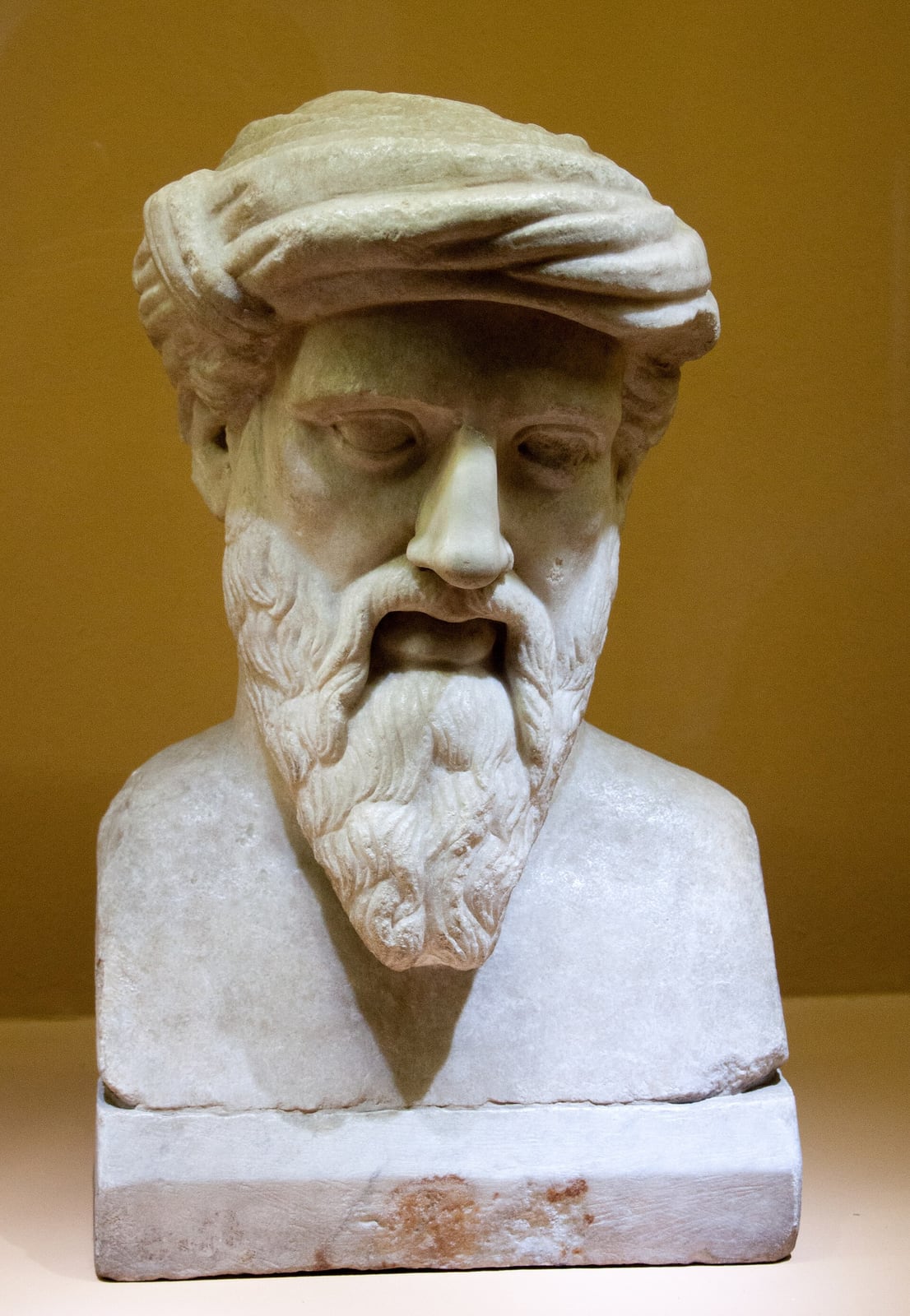
According to Iamblichus they fell into three classes: what something is ("what are the isles of the blessed? The sun and the moon"), what is most such ("what is wisest? Number"), what must be done or avoided ("do not eat beans", "do not stir the fire with a knife", "do not step over a balance", "put on the right shoe first"). Many look like archaic ritual taboos; from the fourth century BCE they were interpreted as moral symbols: stirring the fire with a knife would mean provoking the anger of someone already irritated.
No edition of this work is currently on sale in a store we have been able to verify.
Authorship note
Oral maxims that tradition traces back to Pythagoras and that his followers learnt by heart. They survive scattered in Aristotle (fragments of On the Pythagoreans), Diogenes Laertius (VIII 17–19, 34–35), Porphyry (VP 42) and Iamblichus (VP 82–86; Protrepticus 21). It is impossible to decide which come from Pythagoras himself.
Editions and translations
Editions in your language first, without hiding the others. Each with its cover and its store.
English

The Pythagorean Sourcebook and Library
Phanes Press, 1987
Translation: Kenneth Sylvan Guthrie, Thomas Taylor y Arthur Fairbanks
ISBN 9780933999510
Ed. David R. Fideler; incluye las vidas de Porfirio y Jámblico, los Versos de oro y fragmentos pitagóricos.
Español

Vidas de Pitágoras
Atalanta, 2011
Translation: David Hernández de la Fuente
ISBN 9788493846664
Reúne las vidas de Diógenes Laercio, Porfirio y Jámblico y otros testimonios.
Other works by Pythagoras
- Golden Verses · 300
- On the Pythagorean Life (Iamblichus) · 300
- Life of Pythagoras (Porphyry) · 280
- Life of Pythagoras (Diogenes Laertius, Lives VIII 1–50) · 230
- Testimonies of his contemporaries (Xenophanes, Heraclitus, Empedocles, Ion of Chios, Herodotus) · 450
- Aristotle's testimonies on the Pythagoreans · 340
- Sacred Discourse (Hieros logos) · 300
- Books on Education, Politics and Nature · 300
- Letters of Pythagoras · 100
- Pseudo-Pythagorean writings · 200
- Fragments of Philolaus of Croton · 420
Sources
- Jámblico. Sobre la vida pitagórica (De vita Pythagorica), c. 300 d. C.; ed. L. Deubner, Teubner, Leipzig, 1937. Trad. inglesa de Thomas Taylor, Londres, 1818 (Project Gutenberg n.º 63300), y de John Dillon y Jackson Hershbell, Scholars Press, Atlanta, 1991.
Affiliate link: if you buy through it, the library may receive a commission at no extra cost to you. When an edition's real cover is not available, we show an illustrative library cover.