Library Siddhartha Gautama, the Buddha

Later compilation · Essential works
Dhammapada (Verses on the Dhamma)
Dhammapada
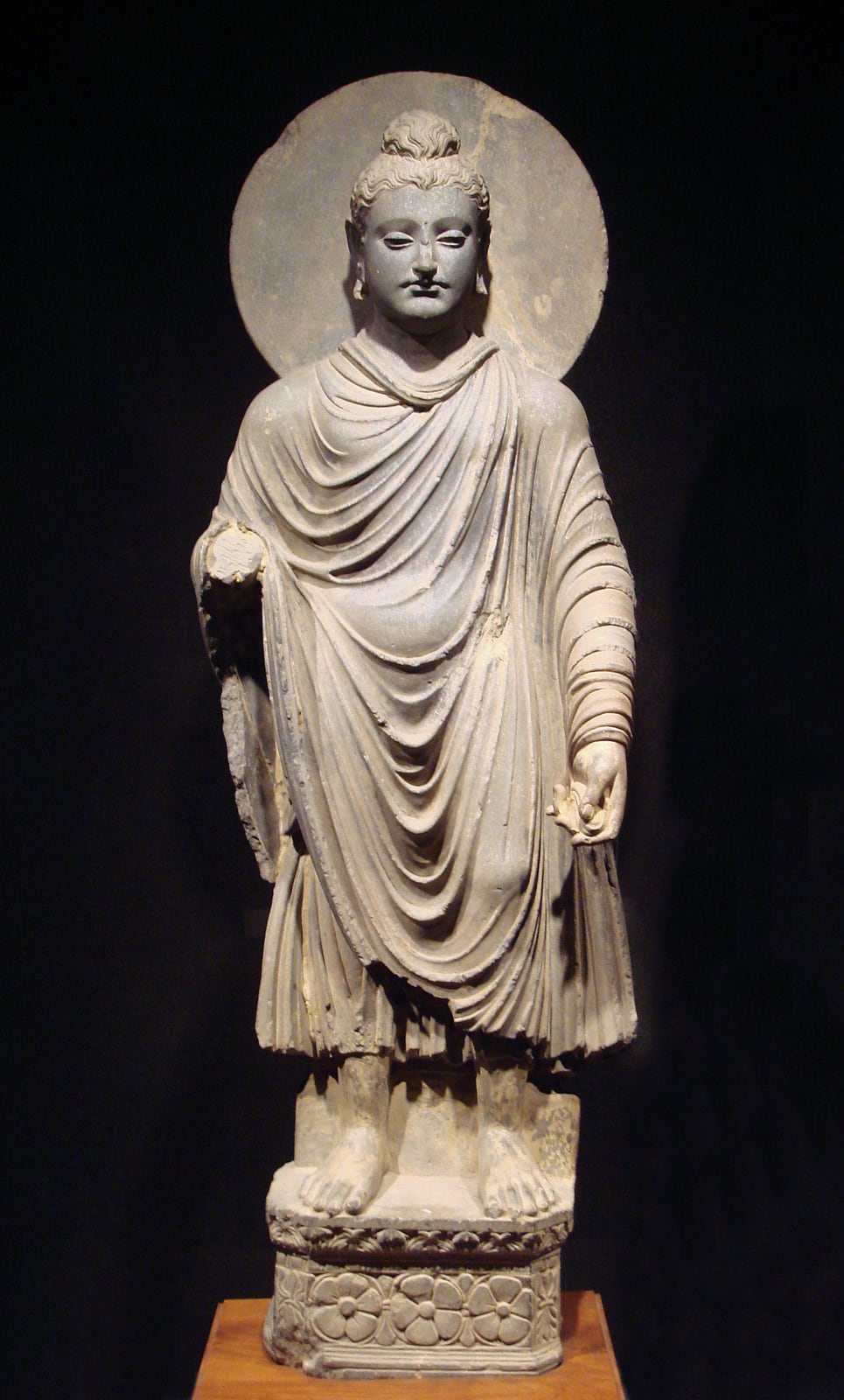
The most widely read and translated Buddhist text. Its short, memorable verses condense the ethics of the path: the primacy of mind ("Phenomena are preceded by the mind"), hatred that ceases only through non-hatred, vigilance against heedlessness, the sage likened to a deep and serene lake, the summary of the teaching of all buddhas (do no evil, cultivate the good, purify the mind). It is recited in Theravada countries and was among the first Buddhist texts translated in the West (Fausbøll into Latin, 1855; Max Müller into English, 1870 and 1881).
What it is about
The Dhammapada is the most widely read, recited and translated Buddhist work in the world. It is an anthology of 423 verses in Pali, divided into 26 chapters, belonging to the Khuddaka Nikaya, the "minor collection" of the Theravada canon. Its title joins two words of broad meaning: dhamma — the teaching, the truth, but also phenomena and mental states — and pada — step, path, word or verse — so that it can be understood both as "the words of the Dhamma" and "the path of the Dhamma". Both readings are legitimate, and the ambiguity is fruitful.
It is neither a treatise nor a narrative but a collection of verse sayings, short and memorable, often built on images from the everyday life of ancient India: the cart and the ox, the archer straightening the arrow, the farmer channelling water, the deep and tranquil lake, the bee that gathers nectar without harming the flower. That form explains its success: it is a text one learns by heart and carries about, meant for practice rather than speculation.
Its content is above all ethical and psychological. The first verse gives the key to the whole work: mind precedes phenomena, so that what we are and what befalls us depends on the quality of our inner states. From this follow the book's main lines: hatred is not quenched by hatred; vigilance or heedfulness (appamada) is the path to the deathless and heedlessness the path to death; the wise person governs himself as the archer governs the arrow; no one can purify another, and each is his own refuge. Alongside this ethics, famous verses set out the doctrinal foundations: the four noble truths, the eightfold path, impermanence, suffering and the absence of a substantial self in everything conditioned.
The last chapters sketch the ideals of life: the monk, the liberated arahant and, above all, the true brahmana, a term the text redefines polemically: a brahmin is not one born into a caste but one purified of greed, hatred and delusion. It is one of early Buddhism's most radical statements against the society of its time.
The Dhammapada matters because it is the classic gateway to Buddhism, both in Asia, where novices learn it by heart, and in the West, where it was among the first Buddhist texts to be translated. It condenses into a few pages the vision of a path that depends not on gods or rites but on the transformation of one's own mind, and it does so with a formal beauty that survives almost any translation.
Authorship note
An anthology of 423 verses in 26 chapters, included in the Khuddaka Nikaya. Tradition attributes each verse to the Buddha and a fifth-century commentary (ascribed to Buddhaghosa) assigns each an occasion; scholarship regards it as a compilation of wisdom verses, many shared with other Indian traditions. Parallel versions exist in Gandhari, Buddhist Hybrid Sanskrit (Udanavarga) and Chinese.
Context of composition
The verses of the Dhammapada come from the oral tradition of early Buddhism. Tradition ascribes them to the Buddha, who is said to have uttered each on a specific occasion; modern scholarship sees the work as an anthology formed over several centuries, gathering verses of the Buddha himself together with wisdom sayings shared with other Indian religious currents such as Jainism or brahmanical epic. Dating individual verses is impossible, but the collection existed before the Pali canon was written down in Sri Lanka, around the first century BCE.
It was not the property of a single school: parallel versions survive in Gandhari (the Khotan manuscript, on birch bark), in Buddhist Hybrid Sanskrit (the Udanavarga and the so-called Patna Dharmapada) and in Chinese. Its audience was twofold: monks, who memorised it as a compendium of the teaching, and lay people, for whom it served as a moral guide. In the fifth century a commentary, attributed to Buddhaghosa, was composed linking each verse to a story.
Structure
- 01
Chs. 1–2: The Pairs and Heedfulness
*Yamaka vagga* presents verses in contrasting pairs: the corrupted mind and the pure mind, hatred and non-hatred, the fool and the wise. *Appamada vagga* extols vigilance as the path to the deathless. Together they establish the book's two keys: the primacy of mind and attention.
- 02
Chs. 3–6: Mind, Flowers, The Fool, The Wise
The mind appears as something unsteady that must be straightened, as the archer straightens the arrow. Flowers serve as images of transience and of well-cultivated virtue. The chapters on the fool and the wise contrast two ways of living and the company worth seeking.
- 03
Chs. 7–10: The Arahant, The Thousands, Evil, The Rod
A portrait of the liberated one, serene as the earth and clear as a lake. *Sahassa* holds that one word that brings peace is worth more than a thousand empty ones, and conquering oneself more than conquering a thousand men. Then come the inescapable fruit of deeds and the rejection of violence: all fear the rod.
- 04
Chs. 11–16: Old Age, The Self, The World, The Buddha, Happiness, Affection
They contain the famous "house-builder" verses (153–154), ascribed to the moment of awakening, the summary of the teaching of the Buddhas (183) and the four noble truths (190–191). Happiness is described as the absence of hatred and greed; attachment to what is dear, as the root of sorrow.
- 05
Chs. 17–22: Anger, Impurities, The Just, The Path, Miscellany, Hell
They urge overcoming anger with gentleness and cleansing oneself of impurities as a smith refines silver. *Magga vagga* sets out the eightfold path and the three marks of the conditioned: impermanence, suffering and non-self (277–279). Warnings about falsehood and wrong conduct follow.
- 06
Chs. 23–26: The Elephant, Craving, The Monk, The Brahmin
The elephant that endures arrows in battle is an image of patience. *Tanha vagga* analyses craving, which grows like a creeper. The book culminates with the ideal monk and the long chapter redefining the brahmin by inner purity rather than birth.
Main themes
The primacy of mind
The book opens by stating that mental states precede words and deeds, and that suffering or happiness depends on their quality. It is not a metaphysical thesis about the unreality of the world, as it has sometimes been read, but a practical observation: Buddhist ethics begins with intention, and the path consists in taming, clarifying and guarding the mind.
The end of hatred and non-violence
Enmity is not resolved by returning it: it ceases only when someone stops feeding it. The chapter on the rod grounds non-violence in a shared experience — all fear punishment and love life — and asks one to put oneself in the other's place. Anger is overcome by gentleness, lies by truth, avarice by generosity.
Heedfulness against heedlessness
*Appamada*, sustained attentiveness, is perhaps the book's central virtue and, according to the canon, also the Buddha's last word. The heedless live as if already dead; the heedful do not die. Diligence is not activism but a constant lucidity about what the mind is doing, which protects against self-deception and craving.
Impermanence and the path
In very dense verses the book summarises the doctrine: all that is compounded is impermanent and unsatisfactory, and no phenomenon is a self. Seeing this with wisdom brings disenchantment and opens the eightfold path, the best of paths. The four noble truths appear as what the wise contemplate in taking true refuge.
Personal responsibility and the true brahmin
"One is one's own protector": no one can purify another, and the Buddhas only point the way. This ethic of responsibility culminates in the last chapter, which strips the word *brahmana* of its caste meaning and applies it to whoever has overcome greed and hatred. It is an explicit critique of privilege by birth.
Key passages
«Phenomena are preceded by mind, led by mind, made of mind. If one speaks or acts with a corrupted mind, suffering follows as the wheel follows the hoof of the ox that draws the cart.»
Manopubbaṅgamā dhammā, manoseṭṭhā manomayā; manasā ce paduṭṭhena, bhāsati vā karoti vā; tato naṃ dukkhamanveti, cakkaṃva vahato padaṃ.
The verse that opens the book and gives its key. The term *dhamma* has been rendered as "phenomena", "mental states" or "experiences"; each option changes the scope of the line. Verse 2 repeats the same structure with the pure mind, which happiness follows "like a shadow that never leaves".
«Never in this world is hatred quenched by hatred; by non-hatred it is quenched: this is an eternal law.»
Na hi verena verāni, sammantīdha kudācanaṃ; averena ca sammanti, esa dhammo sanantano.
Probably the most quoted verse in the book. The "eternal law" (*dhammo sanantano*) is not a commandment but a description of how enmity works. According to the commentary, the Buddha spoke it to a woman caught in a cycle of revenge across several lives.
«To do no evil, to cultivate the good, to purify one's own mind: this is the teaching of the Buddhas.»
Sabbapāpassa akaraṇaṃ, kusalassa upasampadā; sacittapariyodapanaṃ, etaṃ buddhāna sāsanaṃ.
Tradition regards this verse as a summary of the whole teaching, shared by all Buddhas. Its three members correspond to ethics, the cultivation of wholesome states and meditation. It is recited throughout the Buddhist world and appears in the parallel versions in other languages.
«"All conditioned things are impermanent": when one sees this with wisdom, one grows disenchanted with suffering. This is the path to purification.»
Sabbe saṅkhārā aniccāti, yadā paññāya passati; atha nibbindati dukkhe, esa maggo visuddhiyā.
The first of three twin verses: 278 says the same of suffering and 279 states that "all phenomena are without self". The three marks of existence are thus put into verse, and the phrase "path to purification" echoes through the whole later Theravada tradition.
Reception and influence
In Theravada countries the Dhammapada is the first text novices learn and a constant repertoire for sermons and recitations; the fifth-century commentary, with its roughly three hundred stories, also made it an inexhaustible source of popular tales. Beyond the Pali world its parallel versions show it was an anthology shared by several schools: the Sanskrit Udanavarga circulated in Central Asia and was translated into Tibetan, and in China it was translated as early as the third century.
It was among the first Buddhist texts known in Europe. The Dane Viggo Fausbøll published the Pali text in 1855 with a Latin translation; German versions followed, and Max Müller's English version, included in 1881 in the Sacred Books of the East, made it accessible to the general public. Since then it has been translated hundreds of times into almost every language, often by authors with no knowledge of Pali, which has produced very free versions.
The discovery at the end of the nineteenth century of the Gandhari manuscript from Khotan, edited by John Brough in 1962, made it possible to compare the versions and study how the anthology took shape. Translation debates centre on terms such as dhamma, citta or appamada, and on the opening verse, which some Western readings interpreted idealistically, as if the world were a creation of the mind, a reading most specialists reject.
How to read it
It can be read in one sitting, but it yields more read slowly, a chapter at a time, and reread. It is best to start with chapters 1, 2 and 3, which give the keys, and then read the rest in order. A bilingual or annotated edition is highly advisable, since many verses depend on Pali terms with several meanings; in English, K. R. Norman's translation (literal and scholarly), Valerie Roebuck's or Gil Fronsdal's (more accessible) are good choices, and in Spanish Carmen Dragonetti's version from the Pali. For the narrative context, the commentary's stories, translated by E. W. Burlingame as *Buddhist Legends*, can be read alongside.
Editions and translations
Editions in your language first, without hiding the others. Each with its cover and its store.
English
Siddhartha Gautama, the Buddha
The Dhammapada
The Conscious LibraryThe Dhammapada
Penguin Classics, 2010
Translation: Valerie J. Roebuck
ISBN 9780140449419

The Dhammapada (Oxford World's Classics)
Oxford University Press, 2000
Translation: John Ross Carter y Mahinda Palihawadana
ISBN 9780192836137

The Dhammapada
Penguin Classics, 1973
Translation: Juan Mascaró
ISBN 9780140442847
Siddhartha Gautama, the Buddha
Dhammapada, a Collection of Verses
The Conscious LibraryDhammapada, a Collection of Verses
Clarendon Press (Sacred Books of the East, vol. X) / Project Gutenberg, 1881
Translation: F. Max Müller
Dominio público. Project Gutenberg, n.º 2017.
Español
Siddhartha Gautama, the Buddha
Dhammapada
The Conscious LibraryDhammapada
Sudamericana, 1995
Translation: Carmen Dragonetti
ISBN 9789500710626
Traducción directa del pali; hay edición anterior en Sudamericana (1967).
El Dhammapada
Fondo de Cultura Económica (Tezontle), 2004
Translation: Alberto Blanco
ISBN 9789681672737

Dhammapada
Biblioteca Nueva, 2004
Translation: José Ruiz Calderón (ed.)
ISBN 9788497422659
Deutsch
Dhammapada. Die Weisheitslehren des Buddha
Herder, 2002
ISBN 9783451053054
हिन्दी
Siddhartha Gautama, the Buddha
Dhammapada
The Conscious LibraryDhammapada
Samyaka Prakāśana, 2006
Translation: Tārārāma
ISBN 9788188794317
Pali
Siddhartha Gautama, the Buddha
Dhammapada (texto pali)
The Conscious LibraryDhammapada (texto pali)
SuttaCentral
Texto pali con traducción inglesa de Sujato (CC0).
Further reading
- Sutta Nipata (The Group of Discourses)
Another verse anthology in the *Khuddaka Nikaya*, containing some of the oldest strata of the canon; it completes the ethical and ascetic picture of the *Dhammapada*.
- Tipitaka, the Pali Canon
The whole to which it belongs: many verses of the *Dhammapada* summarise doctrines that the discourses develop at length.
- The Heart of the Buddha's Teaching
A contemporary exposition of the four noble truths and the eightfold path that the *Dhammapada* states in verse.
- Daodejing
The other great book of wisdom in short sayings from ancient Asia; they share the image of the serene sage, the critique of violence and a distrust of force.
Other works by Siddhartha Gautama, the Buddha
- Tipitaka, the Pali Canon ("Three Baskets") · 25
- Digha Nikaya (The Long Discourses) · 25
- Majjhima Nikaya (The Middle Length Discourses) · 25
- Samyutta Nikaya (The Connected Discourses) · 25
- Anguttara Nikaya (The Numerical Discourses) · 25
- Sutta Nipata (The Group of Discourses) · 25
- Udana (Inspired Utterances) · 25
- Vinaya Pitaka (The Basket of Discipline) · 25
- The Discourse on Setting the Wheel of the Dhamma in Motion · 25
- Mahaparinibbana Sutta (The Great Discourse on the Final Extinguishment) · 25
- The Sutra in Forty-Two Sections · 150
- The Lotus Sutra (Saddharmapundarika) · 100
- The Diamond Sutra · 300
- The Heart Sutra · 650
- The Lankavatara Sutra · 400
- Itivuttaka (Thus It Was Said) · 25
- Khuddakapatha (The Minor Readings) · 25
- Jataka (Stories of the Buddha's Former Births) · 25
- Satipatthana Sutta (Discourse on the Foundations of Mindfulness) · 25
- Anattalakkhana Sutta (Discourse on the Characteristic of Not-Self) · 25
- Kalama Sutta (Discourse to the Kalamas) · 25
- Pure Land Sutras (Sukhavativyuha) · 150
- Avatamsaka Sutra (Flower Ornament Sutra) · 400
Sources
- Max Müller, F. (trad. Dhammapada) y Fausbøll, V. (trad. Sutta-Nipāta). The Dhammapada and the Sutta-Nipāta. Sacred Books of the East, vol. X. Clarendon Press, Oxford, 1881. Dominio público.
- Fausbøll, V. (ed. y trad.). *Dhammapadam: ex tribus codicibus Hauniensibus Palice edidit, Latine vertit*. Copenhague: Reitzel, 1855.
- Müller, F. Max (trad.). *The Dhammapada*. Sacred Books of the East, vol. X, parte 1. Oxford: Clarendon Press, 1881.
- Burlingame, Eugene Watson (trad.). *Buddhist Legends, Translated from the Original Pali Text of the Dhammapada Commentary*. Harvard Oriental Series 28–30. Cambridge (Mass.): Harvard University Press, 1921.
- Brough, John. *The Gāndhārī Dharmapada*. Londres: Oxford University Press, 1962.
- Norman, K. R. (trad.). *The Word of the Doctrine (Dhammapada)*. Oxford: Pali Text Society, 1997.
- Roebuck, Valerie J. (trad.). *The Dhammapada*. Londres: Penguin Classics, 2010.
Affiliate link: if you buy through it, the library may receive a commission at no extra cost to you. When an edition's real cover is not available, we show an illustrative library cover.