
Traditional attribution · Essential works
Daodejing (Tao Te Ching). The Book of the Way and its Virtue
道德經
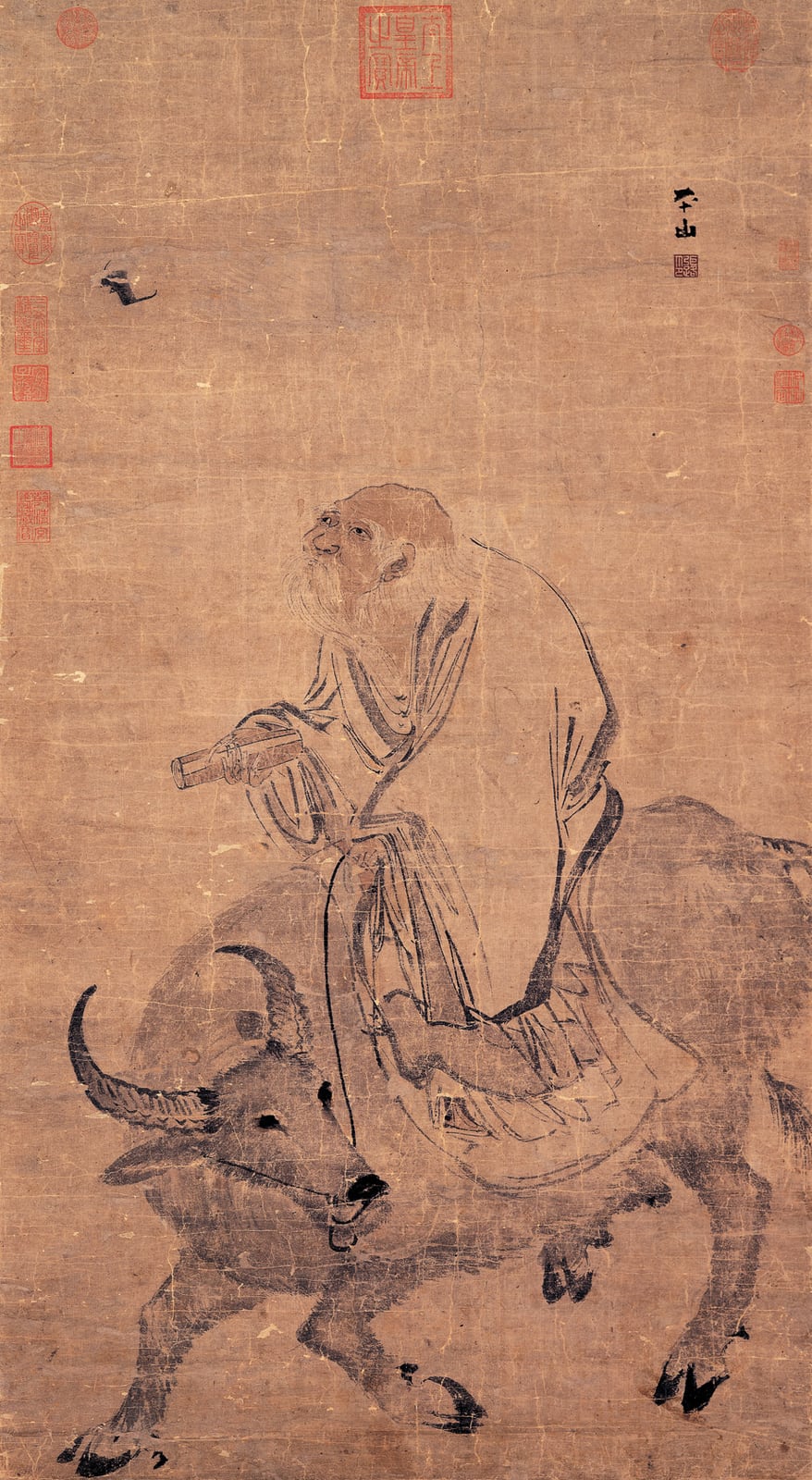
Some five thousand characters in 81 short chapters, many in verse, divided into two parts: the Way (chs. 1–37) and Virtue (38–81). It sets out an unnameable Dao, prior to heaven and earth, which engenders everything without possessing it; it proposes to ruler and sage non-action (wuwei), spontaneity (ziran), the simplicity of the uncarved block and the strength of the soft, symbolised by water. Its tone shifts between mysticism, political strategy and critique of civilisation. It is, with the Bible, one of the most translated books in the world.
What it is about
The Daodejing (Tao Te Ching in the older transcription), “The Classic of the Way and Virtue”, is a short treatise of some five thousand Chinese characters divided into eighty-one chapters, written in concise, rhythmic and often enigmatic language. Tradition attributes it to Laozi, “the Old Master”, an archivist at the Zhou court who, according to Sima Qian’s biography, wrote it at the request of a border guard before withdrawing to the west. Today scholars regard it rather as a compilation of sayings and poems that took shape between the fifth and third centuries BCE, with an ancient core and successive layers.
Its theme is the dao, the “way”: the principle prior to all things, without form or name, from which everything arises and to which everything returns. The first chapter warns at the outset that the dao that can be spoken is not the constant dao: human language and categories cannot reach the depth of the real. De, “virtue” or efficacy, is the way that principle manifests itself in each being and, in particular, in the sage who lives in accordance with it.
From this intuition follow a paradoxical ethics and politics. The Daodejing praises the soft over the hard, the low over the high, the empty over the full, the feminine over the masculine. Its favourite image is water, which benefits all things without contending and settles in the places everyone scorns. It proposes wuwei, “non-action” or action without forcing, which does not mean passivity but acting so much in tune with the course of things that no trace of effort remains. And it applies this wisdom to government: the best ruler is one whose existence is barely noticed; multiplying laws and prohibitions produces thieves; war is an ill-omened instrument used only when there is no other remedy.
The work is at once a text of political philosophy addressed to the rulers of the Warring States, a manual of self-cultivation and a metaphysics of origins. That plurality explains its astonishing fortune: it was read as a guide to government by the early Han emperors, as revealed scripture by the Daoist religion, as a meditation text by Chan Buddhists and, since the nineteenth century, as a world classic. It is one of the most translated books in the world, and its deceptive brevity invites a lifetime of rereading.
Authorship note
Attributed by tradition to Laozi. Scholarship regards it as an anthology of sayings from a wisdom tradition, formed between the 4th and 3rd centuries BCE and fixed under the Han; the Guodian witnesses (c. 300 BCE) show a partial text in a different order.
Context of composition
Nothing certain is known about Laozi. The biography in chapter 63 of Sima Qian’s Records of the Grand Historian, written around 100 BCE, already hesitates between several figures and records legends, such as his meeting with Confucius. The text, by contrast, can be dated better thanks to archaeology: the bamboo slips of Guodian, found in 1993 in a tomb sealed around 300 BCE, contain about two-fifths of the book, in a different order and with variants; the silk manuscripts of Mawangdui, from the early second century BCE, already contain an almost complete text, with the section on virtue before the one on the way. The book was born in the Warring States period (475–221 BCE), an era of incessant wars between states competing for hegemony and of flourishing schools of thought —Confucians, Mohists, Legalists— offering princes recipes for governing. The Daodejing answers that debate with a critique of ambition, accumulated knowledge and forced action.
Structure
- 01
Daojing, “Book of the Way” (chapters 1–37)
It opens with the unnameable *dao* and the pair of the named and the nameless. Chapters on origin, emptiness, water, returning to the root and the sage who does not put himself forward predominate. It ends with the *dao* that does not act and yet leaves nothing undone (ch. 37).
- 02
Dejing, “Book of Virtue” (chapters 38–81)
It begins with a critique of ostentatious virtue and ritual (ch. 38). Political chapters abound: the small state with few people (ch. 80), government that does not interfere, war and peace. It ends with the sage who does not hoard and gives to others (ch. 81).
- 03
The division into 81 chapters
The numbering into eighty-one —nine times nine— has been traditional since the Han and was fixed by the commented editions of Heshang Gong and Wang Bi. The ancient manuscripts do not always follow it: Mawangdui reverses the two parts, and Guodian groups the passages into three bundles in a different order.
Main themes
The unnameable dao
The *dao* is the origin and course of all things, yet it is not one thing among others. It cannot be seen, heard or touched, and any name limits it. Hence the constant recourse to paradox and negation: the text speaks of what cannot be said by pointing to its effects, like someone describing the wind by the movement of the leaves.
Wuwei: acting without forcing
“Non-action” is the book’s practical ideal. It does not mean doing nothing but not imposing, not adding, not wanting more than the situation asks. The sage acts like water or like a skilled craftsman: without visible effort and with maximum efficacy. Applied to government, it means reducing interference and letting things follow their course.
The strength of the weak
The soft overcomes the hard, the supple survives and the rigid breaks. The newborn, the valley, the female and water are images of a strength that does not compete and therefore cannot be defeated. It is a radical critique of the heroic and martial values of its time.
Emptiness and usefulness
Chapter 11 shows that the usefulness of the wheel, the bowl and the house depends on their hollow. Emptiness is not lack but the condition of possibility. This idea, which later tradition would relate to meditation and art, runs through the whole book.
A critique of civilisation
The text distrusts accumulated knowledge, ritual, proclaimed morality and the desire for rare goods: when the *dao* is lost, benevolence and righteousness appear, and when these are lost, ritual. Its utopia is a small, simple community where people live in peace without envying their neighbours.
Key passages
«The way that can be walked is not the constant Way; the name that can be named is not the constant Name. Nameless, it is the beginning of heaven and earth; named, it is the mother of the ten thousand things.»
道可道,非常道;名可名,非常名。無名天地之始;有名萬物之母。
The most commented opening in Chinese literature. *Dao* means both “way” and “to speak”, and the play is untranslatable. Mawangdui reads 恆 (*heng*, “constant”) instead of 常, later changed because of the taboo on a Han emperor’s name. Our own translation.
«The highest good is like water. Water benefits the ten thousand things and does not contend; it dwells in the places all people disdain: thus it is close to the Way.»
上善若水。水善利萬物而不爭,處眾人之所惡,故幾於道。
Water is the book’s central image: humble, yielding and invincible. The chapter goes on to list the virtues of the sage who resembles it. Our own translation.
«Thirty spokes share one hub: in its emptiness lies the cart’s usefulness. Clay is shaped to make a vessel: in its emptiness lies the vessel’s usefulness.»
三十輻共一轂,當其無,有車之用。埏埴以為器,當其無,有器之用。
The chapter goes on to the doors and windows of a house and concludes: what is there gives benefit, what is not there gives use. One of the clearest statements of the value of emptiness. Our own translation.
«The tree that fills one’s arms grows from a tiny shoot; the tower of nine storeys rises from a heap of earth; the journey of a thousand li begins beneath one’s feet.»
合抱之木,生於毫末;九層之臺,起於累土;千里之行,始於足下。
The source of the universal proverb of the thousand-mile journey. In context it does not exalt ambition but attention to small things before they grow: acting before things happen. Our own translation.
Reception and influence
The history of the Daodejing is the history of its commentaries. Under the Han, the commentary attributed to Heshang Gong read it as a guide to government and to cultivating longevity, and the court of the emperors Wen and Jing practised a policy inspired by “non-action”. In the third century, the young philosopher Wang Bi (226–249) interpreted it as a metaphysics of “non-being” and fixed the text read for almost two millennia. At the same time, the Daoist religion deified Laozi as Taishang Laojun and made the book sacred scripture; the Tang emperors, who shared his surname, Li, venerated him as their ancestor.
In the West, the Jesuits knew it in the seventeenth century, but the first influential complete translation was Stanislas Julien’s French version (1842), followed by James Legge’s English one (1891). Since then translations have numbered in the hundreds: few texts have been translated so often. It was read by Tolstoy, by Heidegger —who worked in 1946 on a translation with Paul Shih-yi Hsiao— and by Bertolt Brecht, who wrote a famous poem on the book’s origin (1938). The finds at Mawangdui (1973) and Guodian (1993) completely renewed scholarship and forced a rethinking of how it was formed. The ease with which it lends itself to free readings has also produced many versions that rewrite more than they translate.
How to read it
It can be read in an afternoon and reread for years. It is best read slowly, a few chapters at a time, comparing at least two translations: the concision of the Chinese leaves so much room that every version is already an interpretation. A translation made directly from the Chinese, with notes, is preferable to “poetic” versions that paraphrase. In Spanish, those by Iñaki Preciado (Trotta), which incorporates the Mawangdui and Guodian manuscripts, and Anne-Hélène Suárez (Siruela) are excellent. In English, D. C. Lau (Penguin) is sober and reliable, and Hans-Georg Moeller (Open Court) explains its political thought well.
Editions and translations
Editions in your language first, without hiding the others. Each with its cover and its store.
English

Daodejing
Oxford University Press (Oxford World's Classics), 2008
Translation: Edmund Ryden
ISBN 9780199208555
Introducción de Benjamin Penny.

Lao-Tzu: Te-Tao Ching. A New Translation Based on the Recently Discovered Ma-wang-tui Texts
Ballantine Books, 1989
Translation: Robert G. Henricks
ISBN 9780345370990
Primera traducción basada en los manuscritos de Mawangdui.

Tao Te Ching
Harper Perennial, 1988
Translation: Stephen Mitchell
ISBN 9780060812454
Versión libre muy difundida; no es una traducción filológica.

Tao Te Ching
Penguin Classics, 1963
Translation: D. C. Lau
ISBN 9780140441314
Traducción de referencia; la edición de 1963 se basa en el texto de Wang Bi.

The Texts of Taoism, Part I: The Tao Te Ching of Lao Tzu; The Writings of Chuang Tzu (Books I–XVII)
Dover Publications, 1962
Translation: James Legge
ISBN 9780486209906
Reimpresión de la edición de 1891.
Laozi
The Tao Teh King, or the Tao and its Characteristics
The Conscious LibraryThe Tao Teh King, or the Tao and its Characteristics
Clarendon Press (Sacred Books of the East, vol. XXXIX) / Project Gutenberg, 1891
Translation: James Legge
Dominio público. Texto íntegro en Project Gutenberg, nº 216.
Français
Laozi
Lao Tseu, Tao Te King. Le livre de la voie et de la vertu
The Conscious LibraryLao Tseu, Tao Te King. Le livre de la voie et de la vertu
Imprimerie Royale, París, 1842
Translation: Stanislas Julien
Primera traducción completa a una lengua europea; dominio público.

Tao-tö king
Gallimard (Folio), 1967
Translation: Liou Kia-hway
ISBN 9782070423170
ISBN de la reedición Folio 2 euros (2002).
Deutsch

Tao te king. Das Buch vom Sinn und Leben
Eugen Diederichs Verlag, 1911
Translation: Richard Wilhelm
ISBN 9783424005790
ISBN de la reedición en la Diederichs Gelbe Reihe (Bd. 19).
Español
Laozi
Dos grandes maestros del taoísmo: Lao Tse, Chuang Tzu
The Conscious LibraryDos grandes maestros del taoísmo: Lao Tse, Chuang Tzu
Editora Nacional, 1977
Translation: Carmelo Elorduy
ISBN 9788427603912
Traducción del jesuita Carmelo Elorduy, posteriormente reeditada por Tecnos como Tao Te Ching.

Tao Te Ching. Los libros del Tao
Editorial Trotta (Pliegos de Oriente), 2006
Translation: Iñaki Preciado Idoeta
ISBN 9788498797411
Edición bilingüe que traduce las versiones de Guodian, Mawangdui y el texto recibido. Preciado recibió por su primera versión (1978) el Premio Nacional de Traducción (1979). El ISBN citado corresponde a la reimpresión de 2018.

Tao Te King
Editorial Sirio, 2009
Translation: Richard Wilhelm (versión alemana), traducción al español
ISBN 9788478086252
Traducción indirecta a partir de la versión alemana de Wilhelm.

Tao Te Ching
Alianza Editorial, 2022
Translation: Gabriel García-Noblejas Sánchez-Cendal
ISBN 9788413628899
Traducción directa del chino clásico con introducción.
Italiano

Tao-tê-ching. Il libro della via e della virtù
Edizioni Mediterranee, 1997
ISBN 9788827212004
Traductor no identificado en el catálogo consultado.
Chino clásico · 文言
Laozi
道德經 (texto recibido, recensión de Wang Bi)
The Conscious Library道德經 (texto recibido, recensión de Wang Bi)
Chinese Text Project (ctext.org)
Texto chino con traducción de Legge en paralelo; acceso libre.
Further reading
- The Guodian Laozi
The oldest known version: it shows the book before it took its final shape.
- Wang Bi’s Commentary on the Laozi
The reading that fixed the text and its philosophical interpretation for almost two thousand years.
- Analects
The great counterpoint: against Confucian ritual and education, the *Daodejing* champions simplicity and non-action.
- Heart Sutra
Buddhist and Daoist emptiness met in China; Chan Buddhism drew on both.
Other works by Laozi
- The Guodian Laozi (bundles A, B and C) · 300
- The Mawangdui Laozi (silk copies A and B) · 195
- Wang Bi's Commentary on the Laozi · 240
- Heshang Gong's Commentary on the Laozi · 150
- Scripture of Western Ascension · 450
- Scripture of Laozi Converting the Barbarians · 300
- Treatise of the Most High on Action and Response · 1150
- Peking University Laozi (Western Han bamboo slips) · 100
- Scripture of Constant Purity and Stillness · 900
- Scripture of Laozi's Transformations · 185
- Xiang'er Commentary on the Laozi · 200
Sources
- Lau, D. C. (trad.). Lao Tzu: Tao Te Ching. Penguin Classics, Harmondsworth, 1963 (introducción y apéndice «The problem of authorship»). ISBN 9780140441314.
- Sima Qian, *Shiji* (Memorias históricas), cap. 63, «Biografías de Laozi y Han Feizi».
- D. C. Lau (trad.), *Lao Tzu: Tao Te Ching*, Harmondsworth, Penguin, 1963.
- Robert G. Henricks (trad.), *Lao-Tzu: Te-Tao Ching. A New Translation Based on the Recently Discovered Ma-wang-tui Texts*, Nueva York, Ballantine, 1989.
- Robert G. Henricks, *Lao Tzu’s Tao Te Ching: A Translation of the Startling New Documents Found at Guodian*, Nueva York, Columbia University Press, 2000.
- Iñaki Preciado Idoeta (trad.), *Lao Zi. Tao Te Ching. Los libros del Tao*, Madrid, Trotta, 2006.
- Hans-Georg Moeller (trad.), *Daodejing (Laozi): A Complete Translation and Commentary*, Chicago, Open Court, 2007.
- Livia Kohn y Michael LaFargue (eds.), *Lao-tzu and the Tao-te-ching*, Albany, SUNY Press, 1998.
- James Legge (trad.), *The Texts of Taoism*, Sacred Books of the East 39, Oxford, Clarendon Press, 1891.
Affiliate link: if you buy through it, the library may receive a commission at no extra cost to you. When an edition's real cover is not available, we show an illustrative library cover.