
Later compilation · Essential works
Analects (Lunyu)
論語
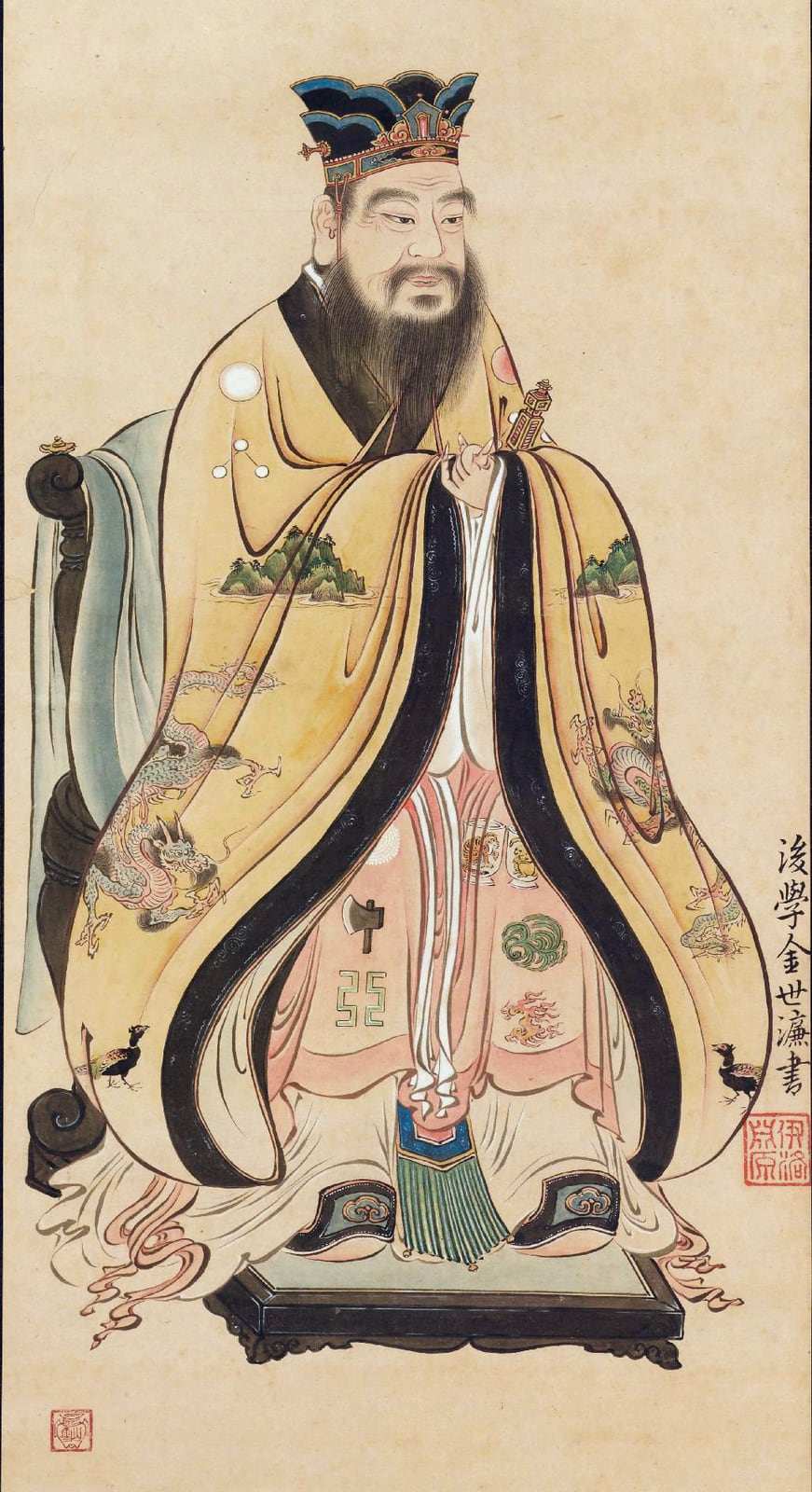
Twenty books of brief sayings, dialogues with disciples and princes, and notes on the Master's conduct. Without systematic order, they set out an ethic of self-cultivation: humaneness (ren) as the central virtue, ritual (li) as its form, study and the rectification of names as method, and the gentleman (junzi) as ideal. Three versions circulated under the Han (Lu, Qi and the "old text"); Zheng Xuan's recension and He Yan's commentary fixed the text, and Zhu Xi's (1190) made it the first of the Four Books. It is the main, and almost the only reliable, source on Confucius's thought.
What it is about
The Analects (Lunyu, literally “Ordered Sayings” or “Selected Conversations”) are the main source for our knowledge of Confucius (Kong Qiu, 551–479 BCE) and the founding text of the Confucian tradition. They are neither a treatise nor the master’s own writing: they are a collection of some five hundred short passages —maxims, dialogues with disciples, judgements on individuals, descriptions of his conduct— gathered by his followers and their followers over several generations and arranged in twenty books.
At the heart of the book is a practical question: how to become a fully human person and how to bring order to a society in crisis. Confucius’s answer turns on a few notions. Ren, translated as “humaneness”, “benevolence” or “goodness”, is the virtue that sums up all the others and consists, in essence, in treating others as one would wish to be treated. Li, “ritual”, covers everything from religious ceremonies to everyday courtesy; it is the form that channels feeling and makes life together possible. The junzi, the “gentleman” or “noble person”, is no longer the aristocrat by birth but the one who has formed himself morally; his opposite is the xiaoren, the “small person”, guided only by profit.
From this follows a politics: the ruler should govern by virtue and example, not by punishment; if he is upright, the people will follow him as grass bends before the wind. And a pedagogy: learning is the path, and Confucius presents himself not as a sage or a saint but as someone who loves learning and never tires of teaching. The study of ancient texts, music and ritual forms character; learning without thought is useless, and thought without learning is perilous.
What makes the Analects unique is not only its teaching but the human portrait it conveys. Confucius appears ironic, impatient, affectionate, grief-stricken at the death of his favourite disciple, Yan Hui, frustrated at not finding a prince who would employ him. He is a master who doubts, corrects himself and admits not knowing. This blend of moral demand and concrete humanity explains why the book shaped the conscience of China, Korea, Japan and Vietnam for two millennia, and why it is still read today as one of the great reflections on education, virtue and common life.
Authorship note
Confucius did not write the Analects. They are a compilation of his sayings and conversations made by disciples and disciples' disciples over several generations after his death (5th–3rd centuries BCE) and fixed in their present form under the Han. Books 1–9 are considered the oldest stratum; 16–20 the latest.
Context of composition
Confucius lived in the state of Lu, in present-day Shandong, during the Spring and Autumn period, when the power of the Zhou dynasty had fragmented and great families were usurping the prerogatives of princes. Born into an impoverished family of the lower nobility, he held minor offices, served for a time as a minister in Lu, and spent some fourteen years travelling through other states in search of a ruler who would put his ideas into practice, without success. He returned to Lu and devoted himself to teaching a broad group of disciples of varied origins, something new in his time. The Analects were compiled after his death, probably between the late fifth and the fourth century BCE, and some parts perhaps later. Under the Han three versions circulated —the Lu version in twenty books, the Qi version in twenty-two, and the “old text” version, found in a wall of Confucius’s house— and these were merged into the text we know.
Structure
- 01
Books 1–4: learning, governing, ritual and humaneness
Book 1 opens with the joy of learning; Book 2 deals with government by virtue and contains Confucius’s brief autobiography (2.4); Book 3 treats ritual and music, with criticism of the Ji family; Book 4, considered by many one of the oldest strata, centres on *ren*.
- 02
Books 5–9: disciples, contemporaries and self-portrait
Judgements on disciples and historical figures (5–6), the portrait of Confucius as a lover of learning (7), sayings of Zengzi and praise of the sage kings of antiquity (8), and traits of the master’s character (9).
- 03
Book 10: the master’s conduct
A singular book, almost without dialogue, describing how Confucius behaved at court, in his village, when eating, dressing or mounting a carriage. It shows ritual embodied in everyday gestures.
- 04
Books 11–15: dialogues on virtue and government
They contain many of the most quoted dialogues: the death of Yan Hui (11), the definition of *ren* as “overcoming oneself and returning to ritual” (12.1), the rectification of names (13.3) and the golden rule (15.24).
- 05
Books 16–20: later strata
Books in a different style that scholars consider later: numbered lists (16), encounters with recluses who mock Confucius (18), sayings of the disciples without the master (19), and a short final book on the ancient kings (20).
Main themes
Ren: humaneness
*Ren* is the central virtue and the hardest to define: Confucius explains it differently to each disciple according to what that disciple needs. It involves loving others, overcoming selfishness and measuring others by oneself. The master refuses to claim it for himself and almost never grants it to anyone: it is a horizon rather than a possession.
Li: ritual as the form of life
For Confucius rituals are not empty formalism: they are the grammar of human relationships. Without feeling ritual is hollow; without ritual feeling overflows. Hence he criticises both those who perform rites heartlessly and those who usurp them, like the Ji family when they staged dances reserved for the sovereign.
The junzi: nobility through cultivation
The great Confucian revolution is to redefine nobility: it is not inherited but cultivated. The *junzi* seeks what is right, is serene in adversity, demands more of himself than of others, and is ashamed when his words outrun his deeds. This ideal opened education and public service to those who were not aristocrats.
Learning without tiring
The book begins, and nearly ends, with learning. Confucius says he was not born wise but loves antiquity and seeks it eagerly. Learning involves study and reflection, constant practice, recognising what one does not know and learning from anyone: among any three people there is always a teacher.
Governing by example
If one governs by laws and punishments, the people avoid punishment but feel no shame; if one governs by virtue and ritual, they feel shame and correct themselves. Good government begins with the ruler’s uprightness and with the “rectification of names”: that each should be what their name says they are.
Key passages
«The Master said: “To learn and, in due season, practise what one has learned —is that not a pleasure? To have friends come from afar —is that not a joy? To go unrecognised by others without resentment —is that not the mark of a noble person?”»
子曰:「學而時習之,不亦說乎?有朋自遠方來,不亦樂乎?人不知而不慍,不亦君子乎?」
The book’s opening brings together its three pillars: learning put into practice, friendship, and serenity in the face of non-recognition, which Confucius himself endured. Our own translation.
«At fifteen I set my heart on learning; at thirty I stood firm; at forty I was free of doubts; at fifty I knew the mandate of Heaven; at sixty my ear was attuned; at seventy I followed my heart’s desires without overstepping the bounds.»
吾十有五而志于學,三十而立,四十而不惑,五十而知天命,六十而耳順,七十而從心所欲,不踰矩。
The shortest spiritual autobiography in history. Its final goal is that desire and norm coincide: freedom as the fruit of cultivation. Phrases such as *erli* (而立) and *buhuo* (不惑) are still used in Chinese to refer to one’s thirties and forties. Our own translation.
«Yan Yuan asked about humaneness. The Master said: “To overcome oneself and return to ritual is humaneness. On the day one overcomes oneself and returns to ritual, all under heaven will return to humaneness. Humaneness depends on oneself —how could it depend on others?”»
顏淵問仁。子曰:「克己復禮為仁。一日克己復禮,天下歸仁焉。為仁由己,而由人乎哉?」
The answer to the favourite disciple joins the two key notions, *ren* and *li*, and stresses personal responsibility. Zhu Xi made this passage one of the axes of the Neo-Confucian reading. Our own translation.
«Zigong asked: “Is there a single word that can guide one’s whole life?” The Master said: “Is it not reciprocity? What you do not wish for yourself, do not do to others.”»
子貢問曰:「有一言而可以終身行之者乎?」子曰:「其恕乎!己所不欲,勿施於人。」
The negative formulation of the golden rule, which also appears in 5.12 and 12.2. *Shu*, “reciprocity” or “consideration”, means measuring others by oneself. Our own translation.
Reception and influence
Under the Han, the Analects became basic reading for every educated person, and the scholar Zhang Yu unified its versions in the first century BCE. The collected commentary compiled by He Yan in the third century fixed the ancient interpretation until Zhu Xi (1130–1200) incorporated the book into the Four Books, with a commentary that from 1313 to 1905 was the basis of the imperial examinations. For seven centuries every candidate for office in China had to know the book by heart, and the same was true, with variations, in Korea, Japan and Vietnam. Archaeology has added early witnesses: a bamboo-slip copy from the Dingzhou tomb (55 BCE) and fragments from the tomb of the Marquis of Haihun (59 BCE), which may belong to the lost Qi version.
In Europe the Jesuits translated the book into Latin in Confucius Sinarum Philosophus (Paris, 1687), a work read by Leibniz and the Enlightenment thinkers, Voltaire among them, who saw in Confucius a model of morality without revelation. James Legge published in 1861 the English translation that remained canonical for a century, and Arthur Waley (1938) renewed it. In China, the May Fourth Movement (1919) attacked Confucius as the symbol of the traditional order, and the Cultural Revolution made him the target of political campaigns in 1973–1974; since the late twentieth century, by contrast, the book has enjoyed a popular and scholarly revival. Modern textual criticism, especially by E. Bruce and A. Taeko Brooks, has studied its successive layers of composition.
How to read it
This is not a book to read straight through like an essay: its passages are short and often depend on a context the modern reader lacks. An annotated edition that explains who the interlocutors are and what is being discussed is best. One can start with Books 1, 2, 4, 7 and 12, which contain the core of the teaching and the master’s self-portrait, and then read the rest. In Spanish, Anne-Hélène Suárez’s translation (Siruela), made directly from the Chinese, is highly recommended. In English, Edward Slingerland (Hackett) includes traditional commentaries; Simon Leys (Norton) is elegant and personal; D. C. Lau (Penguin) is sober.
Editions and translations
Editions in your language first, without hiding the others. Each with its cover and its store.
English

The Analects of Confucius
Columbia University Press (Translations from the Asian Classics), 2007
Translation: Burton Watson
ISBN 9780231141642
Confucius
Confucius: Analects, with Selections from Traditional Commentaries
The Conscious LibraryConfucius: Analects, with Selections from Traditional Commentaries
Hackett Publishing Company, 2003
Translation: Edward Slingerland
ISBN 9780872206359
Traducción académica de referencia con comentarios tradicionales.

The Analects of Confucius: A Philosophical Translation
Ballantine Books, 1998
Translation: Roger T. Ames y Henry Rosemont Jr.
ISBN 9780345434074
Basada en el manuscrito de Dingzhou.

Confucius: The Analects (Lun yü)
Penguin Classics, 1979
Translation: D. C. Lau
ISBN 9780140443486

Confucian Analects, The Great Learning and The Doctrine of the Mean
Dover Publications, 1971
Translation: James Legge
ISBN 9780486227467
Reimpresión de la edición de 1893 con texto chino, notas y prolegómenos.
Confucius
The Analects of Confucius
The Conscious LibraryThe Analects of Confucius
George Allen & Unwin, 1938
Translation: Arthur Waley
Traducción clásica, reeditada por Vintage y Routledge; ISBN de reediciones no verificado.
Confucius
The Chinese Classics, vol. 1: Confucian Analects, The Great Learning, The Doctrine of the Mean
The Conscious LibraryThe Chinese Classics, vol. 1: Confucian Analects, The Great Learning, The Doctrine of the Mean
Trübner, Londres / Project Gutenberg, 1861
Translation: James Legge
Dominio público. Texto íntegro en Project Gutenberg, nº 4094.
Latín
Confucius
Confucius Sinarum Philosophus, sive Scientia Sinensis Latine exposita
The Conscious LibraryConfucius Sinarum Philosophus, sive Scientia Sinensis Latine exposita
Daniel Horthemels, París, 1687
Translation: Philippe Couplet, Prospero Intorcetta, Christian Herdtrich, François de Rougemont
Primera traducción a una lengua europea; dominio público. Edición crítica moderna: Thierry Meynard, IHSI, 2011 (ISBN 9788870412062).
Deutsch
Confucius
Kungfutse: Gespräche (Lun Yü)
The Conscious LibraryKungfutse: Gespräche (Lun Yü)
Eugen Diederichs Verlag, 1910
Translation: Richard Wilhelm
Dominio público; múltiples reediciones.

Gespräche des Meisters Kung (Lun-yü), mit der Biographie des Meisters Kung aus den Historischen Aufzeichnungen
Deutscher Taschenbuch Verlag, 1985
Translation: Ernst Schwarz
ISBN 9783423021654
Français

Entretiens de Confucius
Éditions du Seuil (Points Sagesses), 1981
Translation: Anne Cheng
ISBN 9782020057752
Español

Lun Yu. Reflexiones y enseñanzas
Editorial Kairós, 1997
Translation: Anne-Hélène Suárez Girard
ISBN 9788472453661
Traducción directa del chino clásico, con notas.

Los cuatro libros (Analectas, Gran Enseñanza, Justo Medio, Mencio)
Ediciones Paidós (Paidós Orientalia), 2002
Translation: Joaquín Pérez Arroyo
ISBN 9788449312076
Traducción, introducción y notas; primera edición en Alfaguara (1981).

Analectas
Ediciones Akal, 2019
Translation: Ana Useros Martín (del inglés)
ISBN 9788446047865
Versión ilustrada y adaptada por C. C. Tsai, con prólogo de Michael Puett.

Analectas
Herder Editorial, 2020
ISBN 9788425443886
Traductor no identificado en el catálogo consultado.

Textos escogidos (Analectas y Libro de la piedad filial)
Alianza Editorial, 2021
Translation: Gabriel García-Noblejas Sánchez-Cendal y Carmen Torres Marín
ISBN 9788413625102
Selección con estudio preliminar.
Italiano
Confucius
Analecta
The Conscious LibraryAnalecta
Bompiani (Testi a fronte), 2016
Translation: Luigi Maggio
ISBN 9788854281211
Edición bilingüe.
Chino clásico · 文言
Confucius
論語 (texto recibido)
The Conscious Library論語 (texto recibido)
Chinese Text Project (ctext.org)
Texto chino con la traducción de Legge en paralelo; acceso libre.
Further reading
- The Four Books
Zhu Xi’s Neo-Confucian canon, in which the *Analects* stand at the centre alongside the *Mencius*, the *Great Learning* and the *Doctrine of the Mean*.
- Classic of Filial Piety
It develops filial piety, which in the *Analects* is the root of humaneness.
- Daodejing
The Daoist counterpoint: where Confucius trusts ritual and learning, the *Daodejing* proposes unlearning and non-action.
- The Golden Rule (Mt 7:12; Lk 6:31)
The positive formulation of the rule that Confucius states negatively in 15.24.
Other works by Confucius
- Spring and Autumn Annals (Chunqiu) · 481
- Book of Songs (Shijing) · 600
- Book of Documents (Shujing) · 500
- The Ten Wings of the Book of Changes · 300
- Record of Rites (Liji) · 100
- Classic of Filial Piety (Xiaojing) · 300
- Sayings of the Confucian School (Kongzi jiayu) · 240
- The Four Books (Sishu) · 1190
- The Great Learning (Daxue) · 200
- Confucius's Discussion of the Odes (Kongzi shilun) · 300
Sources
- Slingerland, Edward (trad.). Confucius: Analects, with Selections from Traditional Commentaries. Hackett Publishing Company, Indianápolis, 2003. ISBN 9780872206359.
- James Legge (trad.), *The Chinese Classics*, vol. 1: *Confucian Analects, The Great Learning, and The Doctrine of the Mean*, Hong Kong / Londres, 1861.
- Arthur Waley (trad.), *The Analects of Confucius*, Londres, George Allen & Unwin, 1938.
- D. C. Lau (trad.), *Confucius: The Analects*, Harmondsworth, Penguin, 1979.
- Simon Leys (trad.), *The Analects of Confucius*, Nueva York, W. W. Norton, 1997.
- Edward Slingerland (trad.), *Confucius: Analects, with Selections from Traditional Commentaries*, Indianápolis, Hackett, 2003.
- Confucio, *Analectas*, trad. de Anne-Hélène Suárez Girard, Madrid, Siruela, 1997.
- E. Bruce Brooks y A. Taeko Brooks, *The Original Analects: Sayings of Confucius and His Successors*, Nueva York, Columbia University Press, 1998.
- Herbert Fingarette, *Confucius: The Secular as Sacred*, Nueva York, Harper & Row, 1972.
Affiliate link: if you buy through it, the library may receive a commission at no extra cost to you. When an edition's real cover is not available, we show an illustrative library cover.