Library Siddhartha Gautama, the Buddha

Traditional attribution · Essential works
The Lotus Sutra (Saddharmapundarika)
Saddharmapuṇḍarīka Sūtra (妙法蓮華經)
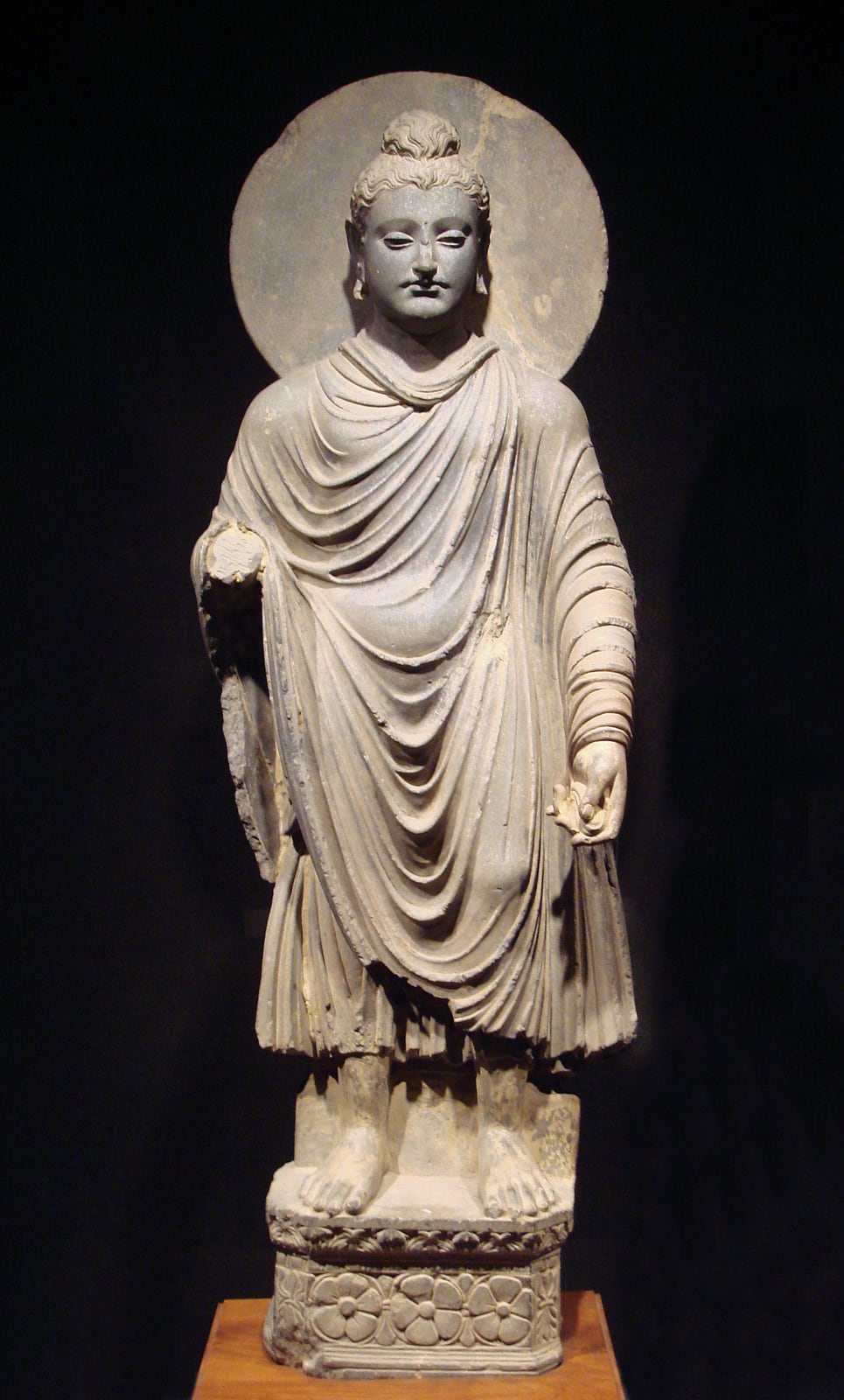
One of the most influential texts of East Asian Buddhism, the basis of the Tiantai/Tendai and Nichiren schools. It proclaims that the different vehicles are "skilful means" (upaya) of a single vehicle leading everyone to buddhahood, and reveals a Buddha whose life is immeasurably long: the Gotama who was born and died would be a pedagogical manifestation. Its parables—the burning house, the prodigal son, the phantom city—are among the most celebrated in religious literature.
Authorship note
A Mahayana sutra that puts its teachings in the Buddha's mouth. Scholarship regards it as a composition long after his death by anonymous authors of the Mahayana movements; it is attributed to the historical Gotama only through the formula "Thus have I heard". Its core is dated between the first century BCE and the second century CE; Kumarajiva's Chinese version (406) is the most influential in East Asia.
Editions and translations
Editions in your language first, without hiding the others. Each with its cover and its store.
English

The Lotus Sutra
Columbia University Press, 1993
Translation: Burton Watson
ISBN 9780231081610
Traducción de la versión china de Kumarajiva.
Siddhartha Gautama, the Buddha
The Saddharma-puṇḍarîka, or The Lotus of the True Law (Sacred Books of the East, vol. XXI)
The Conscious LibraryThe Saddharma-puṇḍarîka, or The Lotus of the True Law (Sacred Books of the East, vol. XXI)
Clarendon Press, 1884
Translation: H. Kern
Traducción del sánscrito; dominio público.
Español
Siddhartha Gautama, the Buddha
Sutra del loto de la verdadera doctrina
The Conscious LibrarySutra del loto de la verdadera doctrina
Fondo de Cultura Económica, 2000
Translation: Fernando Tola y Carmen Dragonetti
ISBN 9789681209155
Traducción del sánscrito.
Other works by Siddhartha Gautama, the Buddha
- Tipitaka, the Pali Canon ("Three Baskets") · 25
- Digha Nikaya (The Long Discourses) · 25
- Majjhima Nikaya (The Middle Length Discourses) · 25
- Samyutta Nikaya (The Connected Discourses) · 25
- Anguttara Nikaya (The Numerical Discourses) · 25
- Dhammapada (Verses on the Dhamma) · 25
- Sutta Nipata (The Group of Discourses) · 25
- Udana (Inspired Utterances) · 25
- Vinaya Pitaka (The Basket of Discipline) · 25
- The Discourse on Setting the Wheel of the Dhamma in Motion · 25
- Mahaparinibbana Sutta (The Great Discourse on the Final Extinguishment) · 25
- The Sutra in Forty-Two Sections · 150
- The Diamond Sutra · 300
- The Heart Sutra · 650
- The Lankavatara Sutra · 400
- Itivuttaka (Thus It Was Said) · 25
- Khuddakapatha (The Minor Readings) · 25
- Jataka (Stories of the Buddha's Former Births) · 25
- Satipatthana Sutta (Discourse on the Foundations of Mindfulness) · 25
- Anattalakkhana Sutta (Discourse on the Characteristic of Not-Self) · 25
- Kalama Sutta (Discourse to the Kalamas) · 25
- Pure Land Sutras (Sukhavativyuha) · 150
- Avatamsaka Sutra (Flower Ornament Sutra) · 400
Sources
- Kern, H. (trad.). The Saddharma-puṇḍarîka, or The Lotus of the True Law. Sacred Books of the East, vol. XXI. Clarendon Press, Oxford, 1884. Dominio público.
Affiliate link: if you buy through it, the library may receive a commission at no extra cost to you. When an edition's real cover is not available, we show an illustrative library cover.