
Written work · Essential works
Commentary on the Bhagavadgītā
भगवद्गीताभाष्य (Bhagavadgītābhāṣya)
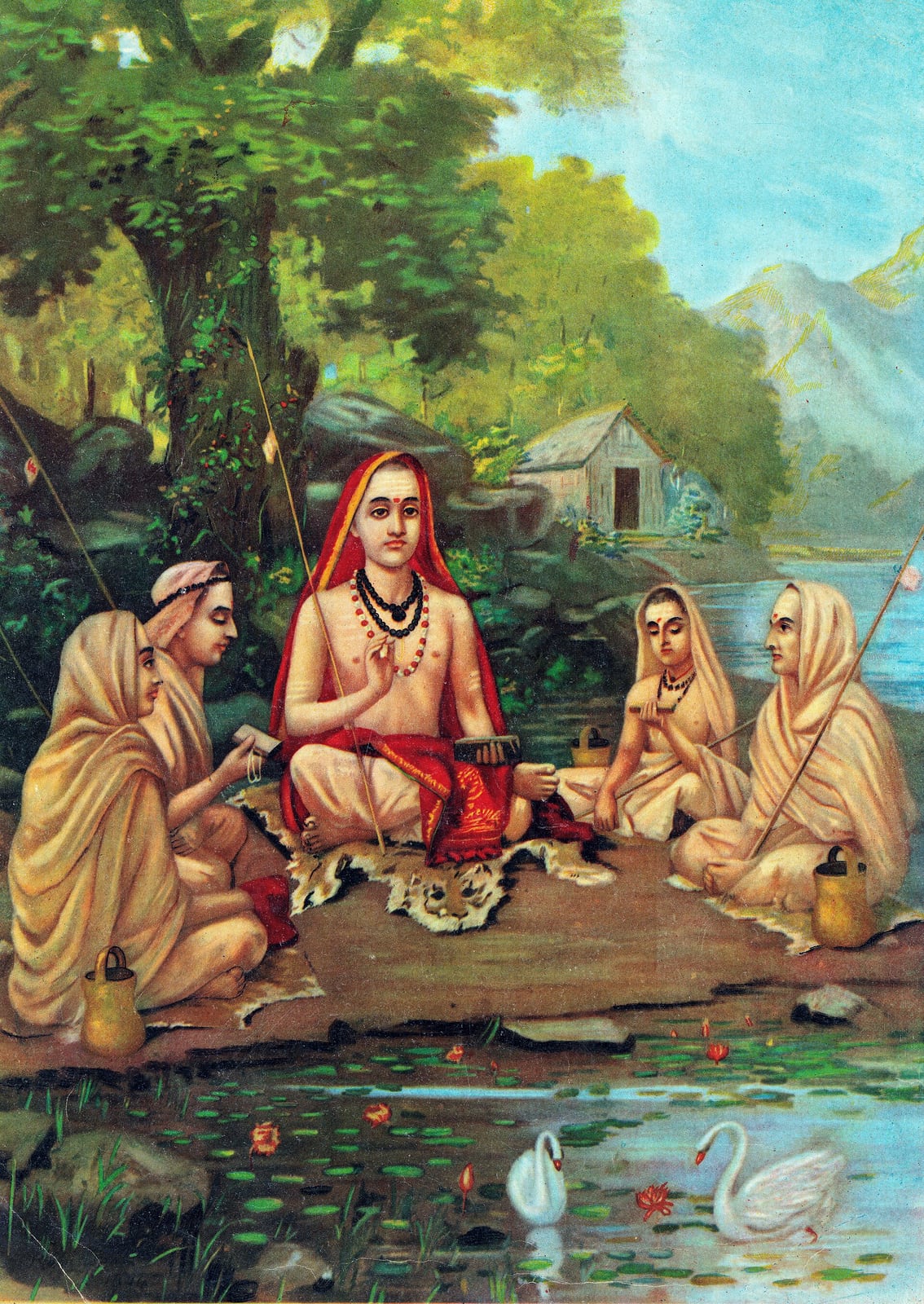
The oldest surviving commentary on the Gītā. Śaṅkara reads it as a teaching of liberating knowledge: disinterested action purifies the mind, but only knowledge of the self liberates, and renunciation is the way of life that befits it. The introduction sets out the twofold Vedic path of action and renunciation, and the commentary argues against those who combined works and knowledge. It is one of the three legs of the Vedāntic canon and, being accessible, the usual gateway into his thought.
Authorship note
Mayeda (1965) tested its authenticity with Hacker's criteria and confirmed it; scholars accept it as Śaṅkara's work.
Editions and translations
Editions in your language first, without hiding the others. Each with its cover and its store.
English

Bhagavad Gita with the Commentary of Śaṅkarācārya
Advaita Ashrama, 1984
Translation: Swami Gambhirananda
ISBN 9788175050419
Open Library registra el distribuidor Nesma Books; el prefijo ISBN 81-7505 es de Advaita Ashrama
Adi Shankara
The Bhagavad Gita with the Commentary of Sri Sankaracharya
The Conscious LibraryThe Bhagavad Gita with the Commentary of Sri Sankaracharya
Samata Books, 1977
Translation: Alladi Mahadeva Sastri
Primera edición 1897 (dominio público)
Español

Bhagavad Gita con los comentarios advaita de Śaṅkara
Editorial Trotta, 2021
Translation: Consuelo Martín
ISBN 9788498796773
7.ª edición (2.ª reimpr.); primera edición 1997, ISBN 9788481641608
Other works by Adi Shankara
- Commentary on the Brahmasūtras · 800
- Commentaries on the principal Upaniṣads
- Commentary on the Bṛhadāraṇyaka Upaniṣad
- Commentary on the Chāndogya Upaniṣad
- Commentary on the Māṇḍūkya Upaniṣad and Gauḍapāda's Kārikā
- Upadeśasāhasrī (A Thousand Teachings)
- Vivekacūḍāmaṇi (The Crest-Jewel of Discrimination)
- Ātmabodha (Self-Knowledge)
- Aparokṣānubhūti (Direct Experience)
- Bhaja Govindam (Mohamudgara)
- Nirvāṇaṣaṭkam (Six Verses on Nirvāṇa)
- Saundaryalaharī (Flood of Beauty)
- Hymn to Dakṣiṇāmūrti
- Sub-commentary on the Yogasūtras
- Commentary on the Śvetāśvatara Upaniṣad
- Commentary on the Viṣṇusahasranāma
- Pañcīkaraṇa (The Quintuplication of the Elements)
- Vākyavṛtti (Exposition of the Great Saying)
- Method of Teaching Self-Knowledge
- Laghuvākyavṛtti (Short Exposition of the Great Saying)
- Discrimination between the Seer and the Seen
- Tattvabodha (Knowledge of Truth)
- Śataślokī (A Hundred Verses)
- Svātmanirūpaṇa (Definition of One's Own Self)
- Śivānandalaharī (Wave of Śiva's Bliss)
- Sādhana Pañcakam (Five Verses on Practice)
- Commentary on the Sanatsujātīya
- Prapañcasāra Tantra (The Essence of Manifestation)
- Daśaślokī (Ten Verses)
- Kanakadhārā Stotra (Hymn of the Golden Shower)
- Commentary on the Nṛsiṃhapūrvatāpanī Upaniṣad
- Commentary on the Lalitātriśatī (The Three Hundred Names of Lalitā)
- Prabodhasudhākara (Moon of the Nectar of Awakening)
Sources
- Mayeda, Sengaku. «The Authenticity of the Bhagavadgītābhāṣya Ascribed to Śaṅkara». Wiener Zeitschrift für die Kunde Süd- und Ostasiens 9 (1965): 155–197; y «On Śaṅkara's Authorship of the Kenopaniṣadbhāṣya». Indo-Iranian Journal 10, n.º 1 (1967): 33–55.
Affiliate link: if you buy through it, the library may receive a commission at no extra cost to you. When an edition's real cover is not available, we show an illustrative library cover.