Adi Shankara
Bhaja Govindam (Mohamudgara)
Traditional attribution
Bhaja Govindam (Mohamudgara)
भज गोविन्दम् (Bhaja Govindam / Mohamudgara)
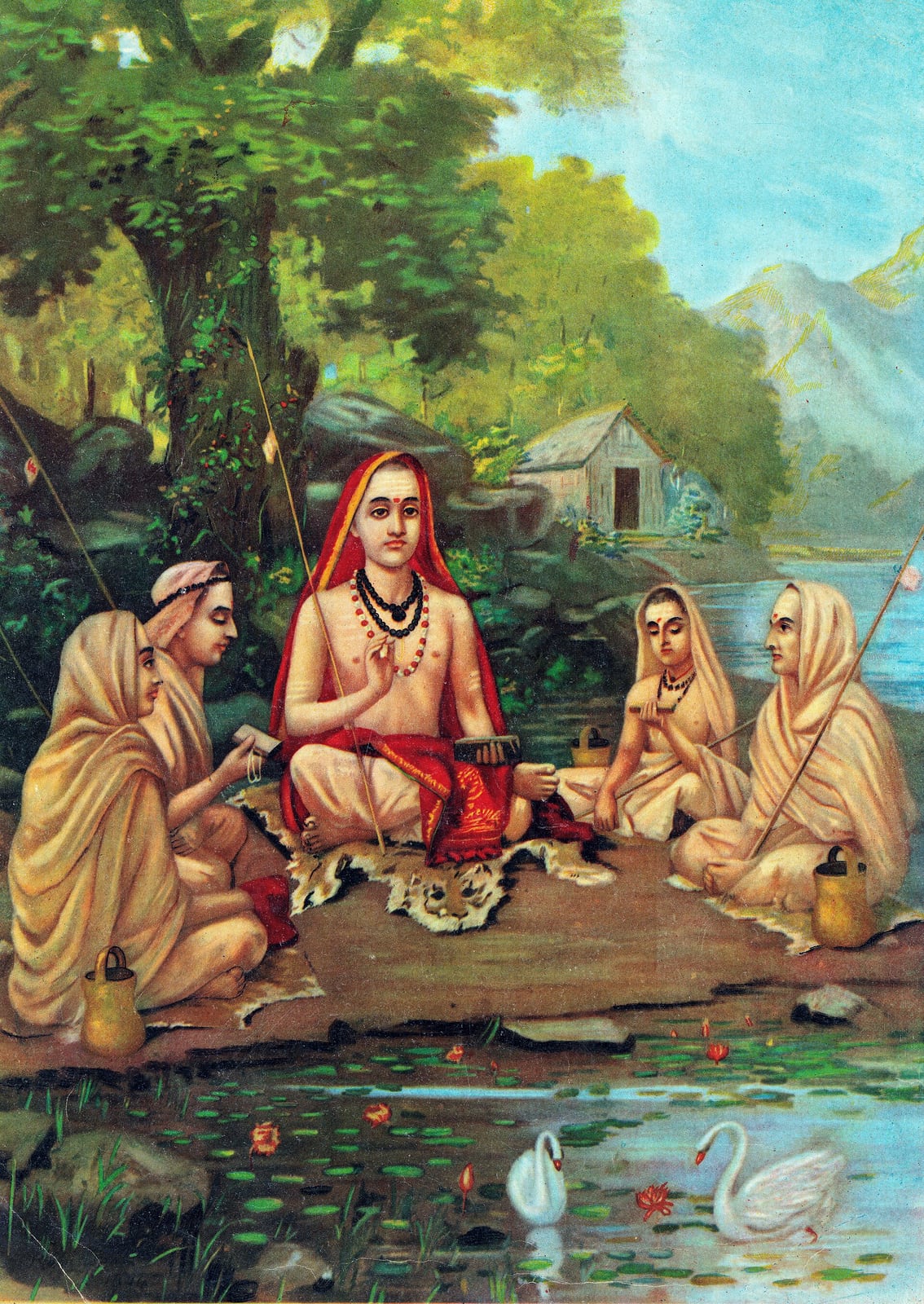
A song of some thirty verses with the refrain "worship Govinda, fool", urging the abandonment of greed and attachment in view of death. Legend has it born in Benares before an old man memorising grammatical rules. It is one of the most sung Sanskrit hymns in India.
No edition of this work is currently on sale in a store we have been able to verify.
Authorship note
A devotional hymn attributed by tradition, which also assigns verses to his disciples; scholars do not consider it a secure work of Śaṅkara.
Editions and translations
Editions in your language first, without hiding the others. Each with its cover and its store.
English
Adi Shankara
Bhaja Govindam of Sri Sankaracharya: Text in Sanskrit with English Translation and Comments
The Conscious LibraryBhaja Govindam of Sri Sankaracharya: Text in Sanskrit with English Translation and Comments
Gurudasananda, 1974
Adi Shankara
Bhaja Govindam
The Conscious LibraryBhaja Govindam
Bharatiya Vidya Bhavan, Bombay, 1965
Other works by Adi Shankara
- Commentary on the Brahmasūtras · 800
- Commentary on the Bhagavadgītā · 800
- Commentaries on the principal Upaniṣads
- Commentary on the Bṛhadāraṇyaka Upaniṣad
- Commentary on the Chāndogya Upaniṣad
- Commentary on the Māṇḍūkya Upaniṣad and Gauḍapāda's Kārikā
- Upadeśasāhasrī (A Thousand Teachings)
- Vivekacūḍāmaṇi (The Crest-Jewel of Discrimination)
- Ātmabodha (Self-Knowledge)
- Aparokṣānubhūti (Direct Experience)
- Nirvāṇaṣaṭkam (Six Verses on Nirvāṇa)
- Saundaryalaharī (Flood of Beauty)
- Hymn to Dakṣiṇāmūrti
- Sub-commentary on the Yogasūtras
- Commentary on the Śvetāśvatara Upaniṣad
- Commentary on the Viṣṇusahasranāma
- Pañcīkaraṇa (The Quintuplication of the Elements)
- Vākyavṛtti (Exposition of the Great Saying)
- Method of Teaching Self-Knowledge
- Laghuvākyavṛtti (Short Exposition of the Great Saying)
- Discrimination between the Seer and the Seen
- Tattvabodha (Knowledge of Truth)
- Śataślokī (A Hundred Verses)
- Svātmanirūpaṇa (Definition of One's Own Self)
- Śivānandalaharī (Wave of Śiva's Bliss)
- Sādhana Pañcakam (Five Verses on Practice)
- Commentary on the Sanatsujātīya
- Prapañcasāra Tantra (The Essence of Manifestation)
- Daśaślokī (Ten Verses)
- Kanakadhārā Stotra (Hymn of the Golden Shower)
- Commentary on the Nṛsiṃhapūrvatāpanī Upaniṣad
- Commentary on the Lalitātriśatī (The Three Hundred Names of Lalitā)
- Prabodhasudhākara (Moon of the Nectar of Awakening)
Sources
- Potter, Karl H. (ed.). Encyclopedia of Indian Philosophies, vol. III: Advaita Vedānta up to Śaṃkara and His Pupils. Princeton University Press / Delhi: Motilal Banarsidass, 1981.
Affiliate link: if you buy through it, the library may receive a commission at no extra cost to you. When an edition's real cover is not available, we show an illustrative library cover.