
Written work · Essential works
Divan of Shams of Tabriz
دیوان شمس تبریزی / کلیات شمس (Divan-e Shams-e Tabrizi; Divan-e kabir)
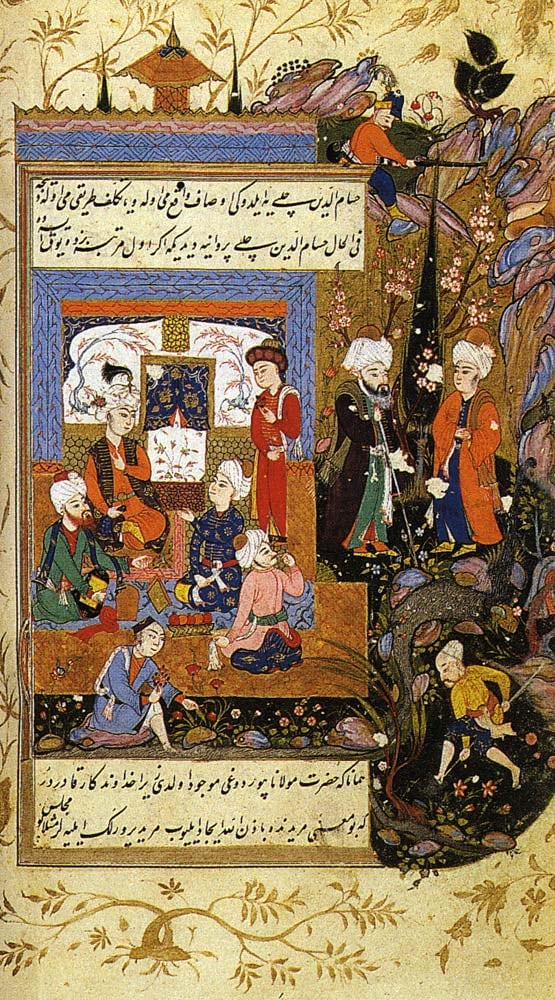
The great lyric collection: some 3,229 ghazals, forty-odd strophic poems and nearly two thousand quatrains in Foruzanfar's edition. Written out of Shams's absence and in his name, it is poetry meant to be sung, strongly rhythmic, with the vocabulary of the tavern, of wine and of the Beloved, swinging between the ecstasy of union and the tearing of separation. Alongside the summits of Persian mysticism it contains occasional poems, wordplay and verses in Arabic, Greek and Turkish. Many modern "translations" are very free paraphrases; for the demanding reader the versions of Nicholson (1898) and Arberry (1968–1979) remain the most faithful.
What it is about
The Divan of Shams of Tabriz — also called the Divan-e kabir, "the great divan" — gathers Rumi's lyric poetry: in Badi al-Zaman Foruzanfar's critical edition, some 3,229 ghazals, forty-odd strophic poems and nearly two thousand quatrains. If the Masnavi is the master who teaches, the Divan is the lover who sings. It is one of the summits of Persian poetry and, by volume and intensity, one of the greatest mystical songbooks in any literature.
The book bears another man's name. Shams of Tabriz was the wandering dervish with whom Rumi, then a respected jurist and preacher in Konya, entered from 1244 into a spiritual relationship so all-consuming that it scandalised his disciples. Shams disappeared twice, the second time for good, and from that loss Rumi's poetry was born. In most of the ghazals the closing signature, which in Persian tradition is usually the poet's own name, is that of Shams: Rumi writes in his name, as if the beloved spoke through his mouth. Shams is at once a person, a mirror of the divine and the sun (which is what his name means) that illuminates the poet.
The Divan's single, endlessly multiplied theme is love: the longing of absence, the intoxication of meeting, the dissolving of the self in the beloved. Rumi uses the repertoire of Persian lyric — wine, the tavern, the cup, the cupbearer, the beauty of the face, the garden and the spring — but charges it with a spiritual meaning that does not cancel its sensuality. Many poems were born in sama, the sessions of music and whirling dance, and keep their rhythm: refrains, repetitions, emphatic metres, lines that seem made to be sung and danced. Alongside them are poems of extreme stillness that end with an invitation to silence; Khamush, "silent", is another of the poet's signatures.
The work matters for the freedom with which Rumi pushes the limits of tradition. He mixes Persian and Arabic, with occasional Greek and Turkish words; he moves from the loftiest language to the colloquial; he breaks with the courtly serenity of the classical ghazal to give voice to an ecstasy that overflows its forms. At the same time the Divan is an uneven collection: alongside the great pieces there are occasional poems, word games and repetitions, as befits poetry improvised and written down by others over thirty years.
For today's reader the Divan is the best-known Rumi — the Rumi of the love lines that circulate everywhere — and also the worst translated, since its music is easily lost and many successful versions are free paraphrases. Read in good translations, it reveals a voice of unparalleled intensity, in which mystical experience becomes song.
Authorship note
Poems composed between c. 1246 and 1273, often improvised during *sama* and written down by disciples; the signature (*takhallus*) is usually "Shams", "Shams-e Tabrizi" or "Khamush". Badi al-Zaman Foruzanfar's critical edition (1957–1967) excluded many poems found only in late manuscripts.
Context of composition
The poems were composed over almost thirty years, from the meeting with Shams in Konya in 1244 to Rumi's death in 1273. Most were born after Shams's second disappearance, around 1247; Rumi travelled twice to Damascus in search of him and, according to his biographers, ended by finding him within himself. Some ghazals bear the signature of his later companions, Salah al-Din Zarkub and Husam al-Din Chelebi.
Rumi did not write these poems as a book. Many he recited in sama sessions and gatherings with disciples, who wrote them down; others he composed in writing for letters or particular occasions. After his death the Mevlevi circle collected and arranged them, in most manuscripts according to the final letter of the rhyme and, in some, according to metre. Their audience was first of all the Konya community and its musical sessions, not the court readers to whom much Persian lyric was addressed.
Structure
- 01
The ghazals
The core of the *Divan*: some 3,229 lyric poems of varying length in Foruzanfar's edition, mostly in Persian and some in Arabic or mixed. Rumi uses a wide variety of metres, often highly rhythmic, and usually closes them with Shams's signature or a call to silence.
- 02
The strophic poems (tarji'at)
Forty-odd long poems composed in stanzas with a refrain that repeats (*tarji'-band*) or varies. Their form makes them especially suited to collective singing, and they clearly reflect the atmosphere of *sama*.
- 03
The quatrains (ruba'iyat)
Nearly two thousand quatrains in Foruzanfar's edition, although the attribution of many is doubtful: quatrains circulated loose and were readily assigned to famous poets. They condense into four lines a flash, a paradox or a plea.
- 04
Arrangement and edition
The order is neither chronological nor thematic: the manuscripts group the poems by rhyme or by metre. Foruzanfar arranged them by the final letter of the rhyme and numbered the ghazals, a numbering that now serves as the standard reference, and excluded many poems found only in late copies.
Main themes
Shams, mirror of the beloved
Shams is the addressee and the signatory of the poems, and in them he ceases to be only a man and becomes the visible manifestation of the divine, the sun that gives life. Rumi plays with that double sense without resolving it: he loves a particular person who went away, and loves in him what cannot go away. Loss becomes an inexhaustible source.
Absence and union
The ghazals swing between the anguish of separation (*firaq*) and the bliss of union (*wisal*). Rumi does not present these states as stages to be passed through but as the very pulse of love: absence intensifies desire and presence is never possession. That oscillation gives the collection its emotional tension.
Music, dance and intoxication
*Sama*, musical listening accompanied by whirling dance, is the setting of many poems, and its rhythm can be heard in the lines. Wine and the tavern, images inherited from Persian lyric, express the spiritual intoxication that breaks with the jurist's sobriety and with a religion of appearances.
Silence
Paradoxically, a poet of so many thousands of lines asks again and again to be silent: many ghazals end with "be silent" or with the signature *Khamush*. Words are for Rumi veils to be passed through; true knowledge of love happens where language stops. Silence is not the absence of poetry but its goal.
Dying and being reborn in love
Love is for Rumi a death of the self that gives a new life. The poems celebrate that transformation — I was dead and have become alive — and even present physical death as a wedding with the beloved. Hence the name the Mevlevis give to the anniversary of his death: *Sheb-i arus*, the wedding night.
Key passages
«I was dead and became alive; I was weeping and became laughter. The fortune of love arrived, and I became everlasting fortune.»
مرده بدم زنده شدم گریه بدم خنده شدم / دولت عشق آمد و من دولت پاینده شدم
One of the most famous and most sung ghazals of the *Divan*, with an almost dancing rhythm thanks to its internal rhymes. It expresses the transformation love works in the poet and, in the rest of the poem, the dialogue with a beloved who demands that he go mad, die and stop being a sheikh in order to be free.
«O people gone on pilgrimage, where are you, where are you? The beloved is right here: come, come. Your beloved is your neighbour, wall to wall: what are you seeking, wandering in the desert?»
ای قوم به حج رفته کجایید کجایید / معشوق همین جاست بیایید بیایید — معشوق تو همسایه و دیوار به دیوار / در بادیه سرگشته شما در چه هوایید
The poem does not scorn the pilgrimage to Mecca but internalises it: further on it tells the pilgrims that, were they to see the formless form of the beloved, they would find that they themselves are the house and the Kaaba. It shows Rumi's tension between observance, which he practised, and the primacy of the heart.
«Yesterday the sheikh was going round the town with a lamp: "I am weary of demons and beasts; I long for a human being." They said: "It cannot be found; we have searched." He said: "What cannot be found, that is what I long for."»
دی شیخ با چراغ همیگشت گرد شهر / کز دیو و دد ملولم و انسانم آرزوست — گفتند یافت مینشود جستهایم ما / گفت آنک یافت مینشود آنم آرزوست
Here Rumi takes up the anecdote of Diogenes searching for a man with a lantern, which had reached the Islamic world through Greek wisdom literature. He turns it into a declaration of mystical desire: what the poet seeks is precisely the unfindable.
Reception and influence
In the Persian- and Turkish-speaking world the ghazals of the Divan have been sung for seven centuries in Mevlevi ceremonies and in Persian classical music; contemporary performers such as Shahram Nazeri have made them a popular repertoire in Iran. Its place in the history of Persian lyric is unique: critics place it beside Hafez and Saadi, but with an energy and an irregularity the court classics lack.
In Europe the German poet Friedrich Rückert published in 1819 a series of ghazals freely inspired by Rumi that found an echo in German Romanticism; Hegel cites Rumi in his Encyclopaedia as an example of mystical pantheism. Reynold A. Nicholson published a selection with English translation in 1898, and Arthur J. Arberry, in 1968 and 1979, two volumes of Mystical Poems of Rumi. Foruzanfar's critical edition (1957–1967) established the corpus and its numbering. Annemarie Schimmel devoted much of her Rumi scholarship to the Divan.
From the 1990s the Divan has been the main source of the "Rumi poems" circulating in English and other languages through free versions such as Coleman Barks's. They have given Rumi immense popularity, but they have also spread lines that are not his — the famous "Come, come, whoever you are" does not appear in the critical editions and is also attributed to other poets — and a Rumi stripped of his Islamic context.
How to read it
No one reads the *Divan* straight through, and almost no language has a complete translation. The sensible course is to begin with a good selection: in English, Arberry's (*Mystical Poems of Rumi*) or Nicholson's older one, both made from the Persian and faithful to the sense; Spanish readers should look for selections translated from the Persian, with the ghazal number given so it can be checked. Reading a few poems at a time, aloud, helps one hear the rhythm. To understand the images — wine, the cupbearer, the reed, the sun — an introduction such as Schimmel's or Franklin Lewis's is useful. Stray lines without a reference should be treated with suspicion.
Editions and translations
Editions in your language first, without hiding the others. Each with its cover and its store.
English
Rumi
Selected Poems from the Divani Shamsi Tabriz
The Conscious LibrarySelected Poems from the Divani Shamsi Tabriz
Cambridge University Press, 1977
Translation: Reynold A. Nicholson
ISBN 0521292174
Primera edición 1898 (dominio público); reimpresión de Curzon Press, 1994: 0700702776.

Mystical Poems of Rumi
University of Chicago Press, 1974
Translation: A. J. Arberry
ISBN 9780226731513
Primera selección (200 poemas); segunda serie: 9780226731520 (1991).
Persa · فارسی
Rumi
Kulliyat-e Shams ya Divan-e kabir
The Conscious LibraryKulliyat-e Shams ya Divan-e kabir
Danishgah-e Tehran / Amir Kabir, 1957
Translation: Badi al-Zaman Foruzanfar (ed.)
Edición crítica en diez volúmenes (1957–1967). Sin ISBN en catálogo.
Français

Odes mystiques (Dîvân-e Shams-e Tabrîzî)
Klincksieck, 1973
Translation: Eva de Vitray-Meyerovitch y Mohammad Mokri
ISBN 2252011416
Bolsillo: Seuil, Points Sagesses, 2003 (9782020560887).
Deutsch
Rumi
Licht und Reigen: Gedichte aus dem Diwan
The Conscious LibraryLicht und Reigen: Gedichte aus dem Diwan
Peter Lang, 1974
Translation: Johann Christoph Bürgel
ISBN 9783261013132
Colección UNESCO de obras representativas.

Aus dem Diwan
Reclam, 1986
Translation: Annemarie Schimmel
ISBN 3150089115
Edición bilingüe persa-alemán.
Español
Rumi
Poemas sufíes
The Conscious LibraryPoemas sufíes
Hiperión, 1988
ISBN 9788475172279
Antología de gazales y cuartetas; traductor no verificado en catálogo.
Türkçe
Rumi
Dîvân-ı Kebîr
The Conscious LibraryDîvân-ı Kebîr
Kültür Bakanlığı, 2000
Translation: Abdülbâki Gölpınarlı
ISBN 9751709989
Traducción turca completa en varios volúmenes.
Further reading
- Masnavi
The great didactic poem, written in the same years: what the *Divan* sings, the *Masnavi* explains through stories.
- Quatrains (Ruba'iyat)
The quatrains that accompany the ghazals in the *Divan*, often published separately; the shortest and most widely circulated form of his poetry.
- The Interpreter of Desires (Tarjuman al-ashwaq)
Arabic love poetry by a contemporary of Rumi, also inspired by a particular person and read in a mystical key; a very revealing parallel.
- Poems
Castilian mystical lyric shares with the *Divan* the language of human love and the paradox of dying in order to live.
Other works by Rumi
Sources
- Nicholson, Reynold A. (ed. y trad.). Selected Poems from the Divani Shamsi Tabriz. Cambridge: Cambridge University Press, 1898.
- Rūmī, Jalāl al-Dīn. *Kulliyāt-e Shams yā Dīvān-e kabīr*. Ed. Badī' al-Zamān Forūzānfar. 10 vols. Teherán: Universidad de Teherán, 1957–1967.
- Nicholson, Reynold A. (ed. y trad.). *Selected Poems from the Dīvāni Shamsi Tabrīz*. Cambridge: Cambridge University Press, 1898.
- Arberry, A. J. (trad.). *Mystical Poems of Rūmī*. Chicago: University of Chicago Press, 1968; *Mystical Poems of Rūmī 2*. Boulder: Westview Press, 1979.
- Schimmel, Annemarie. *The Triumphal Sun: A Study of the Works of Jalāloddin Rumi*. Londres: Fine Books / East-West Publications, 1978.
- Lewis, Franklin D. *Rumi: Past and Present, East and West*. Oxford: Oneworld, 2000.
Affiliate link: if you buy through it, the library may receive a commission at no extra cost to you. When an edition's real cover is not available, we show an illustrative library cover.