
Written work · Essential works
Masnavi (Spiritual Couplets)
مثنوی معنوی (Masnavi-ye manavi)
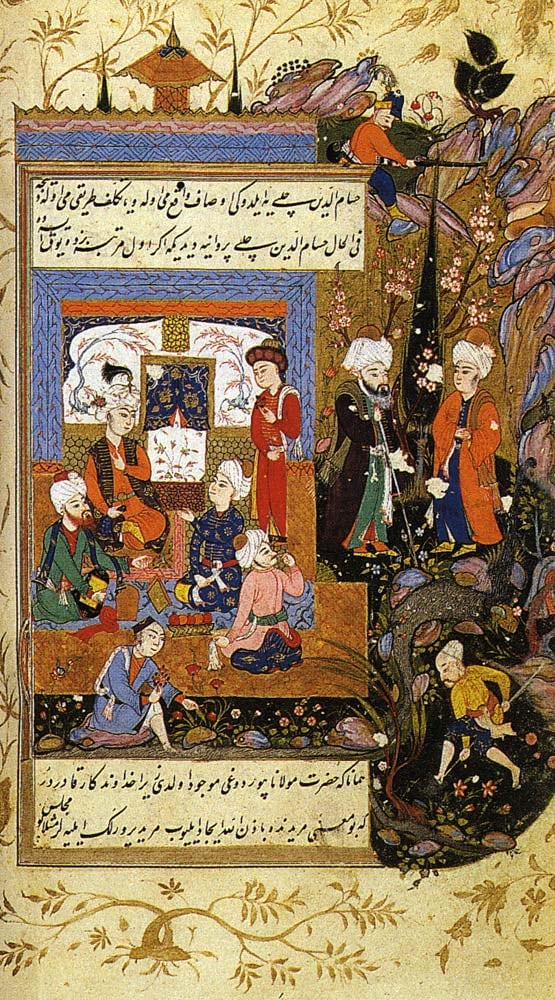
A didactic poem of some 25,600 couplets in six books, written in the ramal metre of the *masnavis* of Sanai and Attar. It opens with the lament of the reed severed from the reed-bed, image of the soul far from its origin, and moves through linked stories (the king and the handmaiden, the merchant and the parrot, the elephant in the dark, Moses and the shepherd) which the narrator interrupts to comment on in the light of the Qur'an and hadith. It follows no systematic plan: it thinks by association, retraces its steps and leaves tales unfinished. Persian tradition called it "the Qur'an in the Persian tongue" and has commented on it without pause for seven centuries.
EnglishPersaDeutschFrançaisEspañolالعربيةहिन्दीРусскийTürkçe
What it is about
The Masnavi-ye ma'navi — "spiritual couplets" or "couplets of inner meaning" — is Jalal al-Din Rumi's major work and one of the great poems of world literature. It runs to six books and some 25,600 couplets in Persian, written in the ramal metre that Sanai and Attar had already used for didactic Sufi poetry. The Persian tradition called it "the Qur'an in the Persian tongue", and although the phrase is hyperbole, it describes well the place it holds: for seven centuries, from Anatolia to India, it has been the bedside book of Persian- and Turkish-speaking Islamic spirituality.
It is neither a treatise nor an epic. Rumi proceeds by stories — animal fables, anecdotes of prophets and kings, crude jokes, Qur'anic episodes, popular legends — which are constantly interrupted to be commented upon, which give rise to further stories, and to which the narrator sometimes returns many verses later. The effect is that of an inexhaustible conversation in which the meaning never lies in the tale itself but in what the tale reveals when looked at from within. Rumi says it with his own image: the story is like the grain and the meaning like the flour; or, elsewhere, form is the vessel and meaning the water.
The poem opens with the famous "Song of the Reed": the reed flute laments because it was cut from the reed bed, and its music is longing for its origin. That image gives the key to the whole work: the human soul is separated from its divine source, and all its yearning, love and suffering are forms of that desire to return. The way back passes through love, which Rumi presents as the force that moves the universe; through the struggle against the ego (nafs), depicted as a hungry and cunning animal; through the guidance of a master who has already walked the path; and through a series of inner deaths in which the human being abandons what he believes himself to be in order to be reborn at a higher degree.
The work matters because of its extraordinary blend of depth and closeness. It contains a sophisticated metaphysics, indebted to the Sufi tradition and the Qur'an, but sets it out with examples from the life of a bazaar, a kitchen or a school. Alongside passages of dazzling lyricism there is humour, obscenity and scenes of great vividness. Some of its tales — the elephant in the dark, Moses and the shepherd, the merchant and the parrot — belong to the narrative heritage of the Islamic world and have spread far beyond it. And its vision of a love that transcends everything, including the boundaries between religions, explains why Rumi is today one of the most widely read poets in the world, though often in versions that simplify him.
Authorship note
Dictated by Rumi to Husam al-Din Chelebi between c. 1258 and his death (1273); book VI was left unfinished. The Konya manuscript of 677/1278 (Mevlana Museum no. 51), collated within Husam's circle, is the basis of Nicholson's critical edition (1925–1933).
Context of composition
Rumi was born in 1207 in Khorasan (in Balkh or Vakhsh, depending on the sources) and, after his family emigrated ahead of the Mongol advance, settled in Konya, capital of the Seljuk sultanate of Rum, where he succeeded his father as teacher of Islamic law and preacher. His encounter with the dervish Shams of Tabriz in 1244 turned him into a poet; after Shams's disappearance, his spiritual companions were the goldsmith Salah al-Din Zarkub and, later, Husam al-Din Chelebi.
It was Husam who, around 1258, asked him for a didactic poem in the manner of Sanai's Garden and Attar's Conference of the Birds, so that the disciples would not need to turn to other works. According to Aflaki's hagiography, Rumi then took from his turban the first eighteen verses, already written. The rest he dictated over fifteen years, often at night, while Husam wrote it down and read it back to him. After book I there was a pause of about two years owing to the death of Husam's wife. Book VI was left unfinished at Rumi's death in December 1273.
Structure
- 01
Prefaces and the Song of the Reed
Most of the books are preceded by a short prose preface, in Arabic or Persian; that of book I presents the poem as "the roots of the roots of the roots of religion". Book I opens with the eighteen verses of the reed lamenting that it was torn from the reed bed, the prologue to the whole work.
- 02
Book I
It turns on the ego and its deceptions. It includes the king and the slave girl, cured by a divine physician; the grocer and the parrot; the lion and the hare, on trust in God and effort; the merchant and the parrot from India, which feigns death to be free; and it closes with Ali and the warrior who spat at him.
- 03
Book II
It begins after the two-year pause. It contains the episode of Moses and the shepherd, in which God rebukes the prophet for censuring a naive prayer; the man who trusted a bear, on friendship with fools; and the dialogue between Muawiya and Iblis, the devil presenting himself as a rejected lover.
- 04
Book III
It contains the elephant in the dark, a parable of the limits of partial knowledge; the chickpea complaining in the pot and learning that the fire ripens it; the long story of the saint Daquqi; and the verses on the soul's evolution from mineral to angel.
- 05
Book IV
It explores reason and inner wisdom. It opens with the tanner who faints in the perfumers' market and comes round only with the smell of dung, an image of one who cannot bear the spiritual; it develops the story of Solomon and the Queen of Sheba and reflects on the degrees of the intellect.
- 06
Book V
It centres on purification and humility. It includes the peacock that plucks out its feathers to be rid of vanity, and the story of Ayaz, Sultan Mahmud's favourite, who keeps his shepherd's sheepskin and sandals in a secret room so as not to forget his origin.
- 07
Book VI
The last, unfinished. Its great tale is that of the three princes who, against their father's prohibition, enter the fortress of images and fall in love with a portrait; the story breaks off. A "book VII" that circulated in Ottoman times is apocryphal.
Main themes
Separation and return
The reed cut from the reed bed is the soul separated from God. For Rumi, all human longing, even when directed at the wrong objects, is at bottom a desire for the origin. The suffering of separation is not a punishment but what sets the return in motion: without that pain the soul would not seek. The whole poem can be read as a commentary on that first image.
Love as a universal force
For Rumi love is the physician of all the soul's ailments and the very movement of the cosmos: atoms, planets and beings all seek their beloved. It is not merely emotion but a knowledge higher than that of discursive intellect, which reaches only so far. Human love, rightly understood, is a bridge to divine love.
Form and meaning
The opposition between outer form (*surat*) and inner meaning (*ma'na*) runs through the whole work and is also its method: the stories are a husk that must be broken to reach the grain. Whoever stays with the form — the letter of the law, the words of prayer, the appearance of beings — argues endlessly, like those touching the elephant in the dark.
The ego and the master
The *nafs*, the attached self, appears in a thousand disguises: a dragon numbed by the cold, a thief, a greedy animal. Fighting it is the "greater war". Rumi insists that the path cannot be walked alone: one needs a guide who has died to himself, and in the poem that role is embodied by Shams, Husam and the figure of the perfect saint.
Dying to be reborn
Rumi describes existence as a ladder of fruitful deaths: the mineral dies and becomes plant, the plant animal, the animal human, and the human can die to himself to become something that cannot be imagined. The chickpea in the pot, complaining of the fire, learns the same. Hence the Sufi maxim the poem illustrates: to die before dying.
Key passages
«Listen to this reed, how it laments: it tells the tale of separations. "Ever since they cut me from the reed bed, men and women have wept at my cry."»
بشنو این نی چون شکایت میکند / از جداییها حکایت میکند — کز نیستان تا مرا ببریدهاند / از نفیرم مرد و زن نالیدهاند
The poem's first two couplets. The reed is the soul and the reed bed its origin; it is also Rumi himself, through whose mouth another breath sounds. Some manuscripts read "Listen to the reed" (*bishnaw az nay*). Whole commentaries were written on these eighteen verses.
«There was an elephant in a dark house; some Indians had brought it to show it. […] Had each of them held a candle in his hand, their words would have ceased to differ.»
پیل اندر خانهٔ تاریک بود / عرضه را آورده بودندش هنود — […] — در کف هر کس اگر شمعی بدی / اختلاف از گفتشان بیرون شدی
One who touches the trunk says it is a water pipe; one who touches the ear, a fan; one who touches the leg, a pillar. The parable, Indian in origin and already told by Sanai, becomes in Rumi a reflection on the limits of the senses and of partial doctrines.
«We do not look at the outside and the words; we look at the inside and the state of the heart.»
ما برون را ننگریم و قال را / ما درون را بنگریم و حال را
God is speaking to Moses, who has rebuked a shepherd for imagining Him as someone to be combed and given milk. Revelation corrects the prophet: each has his own language for prayer, and what counts is the sincerity of the heart, not the theological correctness of the words.
«I died as a mineral and became a plant; I died as a plant and rose as an animal. I died as an animal and became a man: why should I fear? When did dying make me less?»
از جمادی مردم و نامی شدم / وز نما مردم به حیوان سر زدم — مردم از حیوانی و آدم شدم / پس چه ترسم کی ز مردن کم شدم
The following verses continue the ladder: from man to angel, and from angel to what lies beyond imagination. It is not a biological theory of evolution, as has sometimes been claimed, but a vision of the soul's ascent through successive deaths.
Reception and influence
The Masnavi very soon became the founding text of the Mevlevi order, organised by Rumi's son Sultan Walad, in which there was an office of reader and expounder of the poem. From Konya it spread throughout the Persian- and Turkish-speaking world: in Mughal India and in the Ottoman Empire dozens of commentaries were written, among them the Turkish one by Ismail Ankaravi in the seventeenth century, and reading it formed part of literary and spiritual education. The phrase calling it "the Qur'an in the Persian tongue" is attributed to Jami, though the attribution is not certain.
In Europe, after partial translations in the nineteenth century, the orientalist Reynold A. Nicholson published between 1925 and 1940 the critical edition, a literal English translation and a commentary, which remain the basis of academic study. In the late twentieth century the free versions of Coleman Barks, made from other people's translations, turned Rumi into a best-selling poet in the United States; they have been criticised for stripping him of his Islamic and Qur'anic frame. Later translations, such as Jawid Mojaddedi's in verse and Alan Williams's, have tried to restore his density. In 2007, the eighth centenary of his birth, UNESCO declared an international year of Rumi.
In Spanish several versions circulate, many of them indirect, via English or French; it is worth checking which text each one is based on before choosing.
How to read it
It is a work to be read over months, not at a stretch. It is best to begin with book I, which contains many of the best-known stories, and to read tale by tale, accepting the digressions as part of the method. For study, Nicholson's literal English translation, with his commentary, remains indispensable; for the pleasure of reading, Mojaddedi's verse versions or Alan Williams's. Spanish readers should prefer annotated translations made from the Persian. It helps to have an introduction to Rumi's life at hand, such as Franklin Lewis's, and not to trust anthologies that present stray verses without context.
Editions and translations
Editions in your language first, without hiding the others. Each with its cover and its store.
English
Rumi
The Mathnawi of Jalalu'ddin Rumi, vol. II (trad. libros I–II)
The Conscious LibraryThe Mathnawi of Jalalu'ddin Rumi, vol. II (trad. libros I–II)
E. J. W. Gibb Memorial Trust, 2013
Translation: Reynold A. Nicholson
ISBN 9781909724013
Traducción literal completa (vols. II, IV, VI, 1926–1934) y comentario (vols. VII–VIII, 1937–1940). Reedición de Edinburgh University Press en 2025 (vol. I: 9781399559959).

Spiritual Verses: The First Book of the Masnavi-ye Ma'navi
Penguin Classics, 2006
Translation: Alan Williams
ISBN 9780140447910
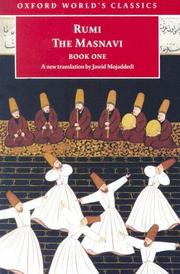
The Masnavi, Book One (Oxford World's Classics)
Oxford University Press, 2004
Translation: Jawid Mojaddedi
ISBN 9780192804389
Traducción en verso, libro a libro; Book Two: 9780199212590 (2007). Rústica de Book One: 9780199552313.

Masnavi i Ma'navi (abreviada)
Octagon Press, 1979
Translation: E. H. Whinfield
ISBN 0900860642
Traducción abreviada publicada por primera vez en 1887 (dominio público); edición bilingüe.
Rumi
Tales from the Masnavi
The Conscious LibraryTales from the Masnavi
George Allen & Unwin, Londres, 1961
Translation: A. J. Arberry
Selección de relatos.
Persa · فارسی

The Mathnawi of Jalalu'ddin Rumi (texto persa)
E. J. W. Gibb Memorial Trust, 1985
Translation: Reynold A. Nicholson (ed.)
ISBN 9780906094242
Edición crítica (Gibb Memorial, New Series IV, vols. I, III, V; 1925–1933), reimpresa en 1971 (0718902068) y 1985.
Rumi
Mesnevî (facsímil del manuscrito de Konya de 1278)
The Conscious LibraryMesnevî (facsímil del manuscrito de Konya de 1278)
Kültür Bakanlığı, 1993
ISBN 9751714524
Reproducción facsímil del ms. 51 del Museo Mevlana, con prólogo de Abdülbâki Gölpınarlı.
Deutsch

Die Flucht nach Hindustan und andere Geschichten aus dem Mathnawi
Castrum Peregrini Presse, 1989
ISBN 9789060340707
Selección traducida del persa.
Français

Mathnawî, la quête de l'Absolu
Éditions du Rocher, 1990
Translation: Eva de Vitray-Meyerovitch y Djamchid Mortazavi
ISBN 9782268010410
Primera traducción francesa completa. Reedición en dos tomos (2014): 9782268075549.
Español
Rumi
150 cuentos sufíes
The Conscious Library150 cuentos sufíes
Paidós, 1991
ISBN 9788475097039
Relatos extraídos del *Masnavi* y seleccionados por Ahmed Kudsi Erguner.
Rumi
El Masnavi
The Conscious LibraryEl Masnavi
Edicomunicación, 1998
ISBN 9788476723128
Selección en castellano; no se ha podido verificar el traductor ni si se tradujo directamente del persa.
العربية
Rumi
Mathnawi Mawlana Jalal al-Din al-Rumi
The Conscious LibraryMathnawi Mawlana Jalal al-Din al-Rumi
al-Zahra' lil-I'lam al-'Arabi, 1992
Translation: Ibrahim al-Dasuqi Shita
ISBN 9772570769
Traducción y comentario árabes.
हिन्दी
Rumi
Jalaluddin Rumi krit Masnavi
The Conscious LibraryJalaluddin Rumi krit Masnavi
Siddhartha Publications, 1996
Translation: Vinod Chandra Pandey
ISBN 8172200773
Русский

Masnavi-yi manavi (Маснави-йи ма'нави)
Peterburgskoe Vostokovedenie, 2007
ISBN 9785858033455
Traducción rusa de la serie de San Petersburgo; otros volúmenes: 9785858034032, 9785858034216.
Türkçe

Mesnevi tercümesi (libros 1–2)
İnkılâp Kitabevi, 2020
Translation: Abdülbâki Gölpınarlı
ISBN 9789751002372
Traducción y comentario turcos de referencia.
Further reading
- Divan of Shams of Tabriz
The other face of Rumi: the lyric poetry of ecstasy and absence, as against the didactic, narrative poem of the *Masnavi*.
- Fihi ma fihi (Discourses)
His prose talks, recorded by disciples, plainly explain many ideas the *Masnavi* sets out in verse.
- The Bezels of Wisdom (Fusus al-hikam)
The great metaphysical work of Sufism contemporary with Rumi; Ibn Arabi's disciple al-Qunawi lived in Konya and knew Rumi, and later commentators read the *Masnavi* in the light of Ibn Arabi.
- The Interior Castle
Another great map of the soul's journey to God, in Christian mysticism; it shares with the *Masnavi* the use of everyday images to explain the ineffable.
Other works by Rumi
Sources
- Jalaluddin Rumi. The Mathnawi of Jalalu'ddin Rumi. Ed., trad. y comentario de Reynold A. Nicholson. E. J. W. Gibb Memorial, New Series IV, 8 vols. Londres: Luzac, 1925–1940 (vol. II: trad. libros I–II, 1926; vol. IV: trad. libros III–IV, 1930).
- Rūmī, Jalāl al-Dīn. *The Mathnawí of Jalálu'ddín Rúmí*. Ed., trad. y comentario de Reynold A. Nicholson. 8 vols. E. J. W. Gibb Memorial Series. Londres: Luzac, 1925–1940.
- Lewis, Franklin D. *Rumi: Past and Present, East and West. The Life, Teachings and Poetry of Jalâl al-Din Rumi*. Oxford: Oneworld, 2000.
- Schimmel, Annemarie. *The Triumphal Sun: A Study of the Works of Jalāloddin Rumi*. Londres: Fine Books / East-West Publications, 1978.
- Chittick, William C. *The Sufi Path of Love: The Spiritual Teachings of Rumi*. Albany: State University of New York Press, 1983.
- Rūmī, Jalāl al-Dīn. *The Masnavi, Book One*. Trad. Jawid Mojaddedi. Oxford World's Classics. Oxford: Oxford University Press, 2004.
- Aflākī, Shams al-Dīn Aḥmad. *The Feats of the Knowers of God (Manāqeb al-'ārefīn)*. Trad. John O'Kane. Leiden: Brill, 2002.
Affiliate link: if you buy through it, the library may receive a commission at no extra cost to you. When an edition's real cover is not available, we show an illustrative library cover.