
Traditional attribution
Vivekacūḍāmaṇi (The Crest-Jewel of Discrimination)
विवेकचूडामणि (Vivekacūḍāmaṇi)
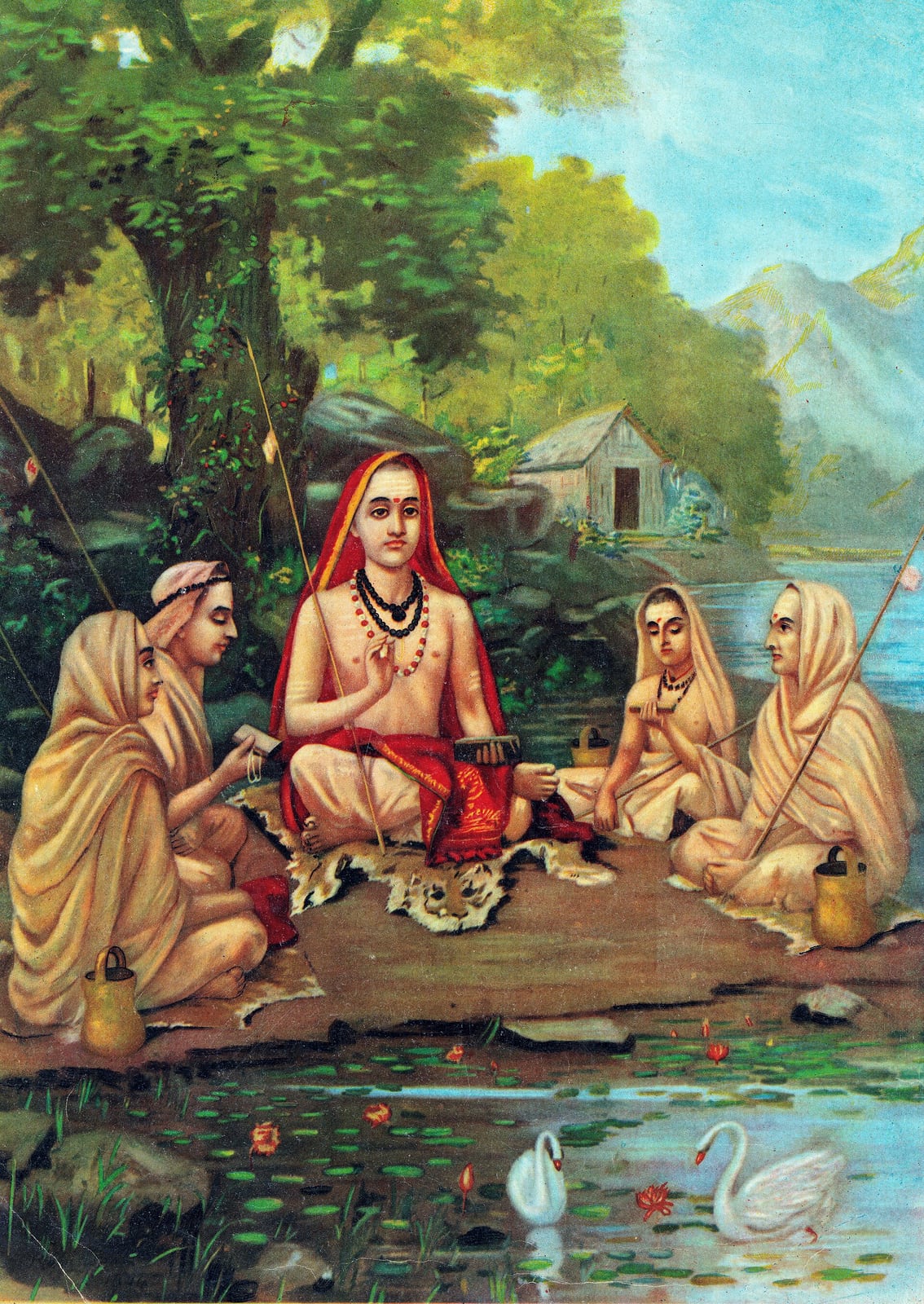
A didactic poem of some 580 verses in the form of a dialogue between teacher and pupil, probably the most widely read Advaita manual in the world. It sets out discrimination between the eternal and the transient, the four qualifications of the aspirant, the five sheaths and the figure of the one liberated in life. Its verse 20 contains the formula "brahma satyaṃ jagan mithyā". Ramana Maharshi translated it into Tamil prose.
Authorship note
Traditional attribution rejected by most modern scholars (Hacker, Mayeda, Potter): its terminology and its interest in samādhi and experience place it in later Advaita. John Grimes has argued that the question remains open.
Editions and translations
Editions in your language first, without hiding the others. Each with its cover and its store.
English

Shankara's Crest-Jewel of Discrimination
Vedanta Press, 1978
Translation: Swami Prabhavananda y Christopher Isherwood
ISBN 0874810345
Primera edición 1947
Adi Shankara
Vivekachudamani of Sri Sankaracharya
The Conscious LibraryVivekachudamani of Sri Sankaracharya
Advaita Ashrama, 1921
Translation: Swami Madhavananda
Texto, traducción y notas; reed. continua
Español

Adi Shankara
Discernimiento (Vivekacūḍāmaṇi)
The Conscious LibraryDiscernimiento (Vivekacūḍāmaṇi)
Editorial Trotta, 2006
Translation: Consuelo Martín
ISBN 9788481648430
Português

Jóia Suprema do Discernimento
Editora Pensamento, 1992
ISBN 8531503523
Other works by Adi Shankara
- Commentary on the Brahmasūtras · 800
- Commentary on the Bhagavadgītā · 800
- Commentaries on the principal Upaniṣads
- Commentary on the Bṛhadāraṇyaka Upaniṣad
- Commentary on the Chāndogya Upaniṣad
- Commentary on the Māṇḍūkya Upaniṣad and Gauḍapāda's Kārikā
- Upadeśasāhasrī (A Thousand Teachings)
- Ātmabodha (Self-Knowledge)
- Aparokṣānubhūti (Direct Experience)
- Bhaja Govindam (Mohamudgara)
- Nirvāṇaṣaṭkam (Six Verses on Nirvāṇa)
- Saundaryalaharī (Flood of Beauty)
- Hymn to Dakṣiṇāmūrti
- Sub-commentary on the Yogasūtras
- Commentary on the Śvetāśvatara Upaniṣad
- Commentary on the Viṣṇusahasranāma
- Pañcīkaraṇa (The Quintuplication of the Elements)
- Vākyavṛtti (Exposition of the Great Saying)
- Method of Teaching Self-Knowledge
- Laghuvākyavṛtti (Short Exposition of the Great Saying)
- Discrimination between the Seer and the Seen
- Tattvabodha (Knowledge of Truth)
- Śataślokī (A Hundred Verses)
- Svātmanirūpaṇa (Definition of One's Own Self)
- Śivānandalaharī (Wave of Śiva's Bliss)
- Sādhana Pañcakam (Five Verses on Practice)
- Commentary on the Sanatsujātīya
- Prapañcasāra Tantra (The Essence of Manifestation)
- Daśaślokī (Ten Verses)
- Kanakadhārā Stotra (Hymn of the Golden Shower)
- Commentary on the Nṛsiṃhapūrvatāpanī Upaniṣad
- Commentary on the Lalitātriśatī (The Three Hundred Names of Lalitā)
- Prabodhasudhākara (Moon of the Nectar of Awakening)
Sources
- Śaṅkarācārya (atrib.). Vivekachudamani of Sri Sankaracharya. Trad. Swami Madhavananda. Mayavati: Advaita Ashrama, 1921 (reed. 1932 y sucesivas).
Affiliate link: if you buy through it, the library may receive a commission at no extra cost to you. When an edition's real cover is not available, we show an illustrative library cover.