Later compilation · Essential works
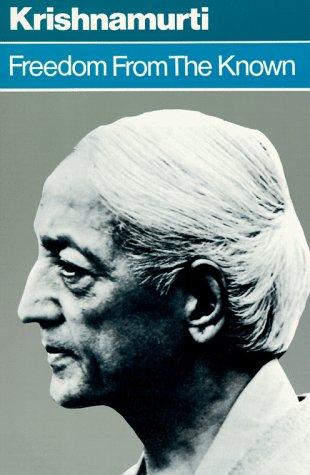
Freedom from the Known

Sixteen chapters setting out continuously the core of his teaching: the rejection of all spiritual authority, conditioning, pleasure and fear, violence, relationship, time and death, the observer and the observed, meditation. Lutyens removed the repetitions of the talks and produced a fluent text that works as a synthesis. It is probably his most translated book; in Spanish it circulates as Libérese del pasado.
amazon.com · Link to the store.
What it is about
Freedom from the Known — published in Spanish mainly as Libérese del pasado — is the most compact and readable exposition of Krishnamurti's teaching. Mary Lutyens assembled it from talks of the latter half of the 1960s, removing repetitions and questions, so that the result reads as a continuous essay moving from one theme to the next without interruption. That is why many readers consider it the best summary of his thought and the most suitable book to begin with.
The title states the thesis. The "known" is everything the mind has accumulated: personal and collective memory, culture, religion, nationality, experiences, the images we hold of ourselves and of others. That store is useful for practical life, but when it governs psychological life it turns life into repetition: we look at the world through the past, react according to inherited patterns and call that bundle of conditionings "I". The freedom Krishnamurti speaks of is not the freedom to choose between options, but that of a mind which is no longer determined by the known.
The book works methodically through the knots of that bondage. It begins by rejecting all authority in spiritual matters, including his own: no one can free another, and following a teacher is a way of avoiding looking at oneself. It then examines conditioning and the relationship between the individual and society; pleasure, which memory turns into a demand for repetition; fear, born of thought projecting the past onto the future; violence, which is not resolved by the ideal of non-violence but by observing it as it is. At the centre of the book stands Krishnamurti's most characteristic idea, that the observer is not different from the observed, and from it follow the final chapters on time, death, love and meditation.
Death has a decisive place: to die every day to the known, to accumulated memories, pleasures and hurts, is the condition for the mind to be new. Love is not defined but described by negation — it is not jealousy, nor possession, nor dependence — and meditation is not a technique but the state of an attentive mind emptied of effort. The work thus ends where the teaching begins: with an invitation to see for oneself.
Its importance lies in that synthesis. What in other books appears scattered among questions and digressions is here ordered into a path the reader can follow from beginning to end, one that allows the inner coherence of a thought often accused of vagueness to be tested.
Authorship note
Assembled by Mary Lutyens from talks of 1965–1968, with Krishnamurti's approval; it is not a book he wrote as such.
Context of composition
In the latter half of the 1960s Krishnamurti kept to a yearly cycle of talks: the summer gatherings at Saanen (Switzerland), begun in 1961, and the winter tours of India, with stays in London and California. It was also the period in which he broke away from the organisation that had until then managed his work, headed by D. Rajagopal, and in which the new Krishnamurti foundations and the school at Brockwood Park (England), opened in 1969, the year of the book, came into being.
Mary Lutyens, his friend since childhood — her mother, Emily Lutyens, had been one of his protectors in the Theosophical years — undertook to turn those talks into a continuous book. Krishnamurti approved the text, but did not write it: it is an editorial composition based on transcripts. It addressed a new public, the young people of the sixties, drawn to the East and to the critique of institutions, whom Krishnamurti warned against any new guru.
Structure
- 01
Opening chapters: the quest and authority
The book consists of sixteen numbered, untitled chapters. The first ones set out humanity's search for something beyond itself, reject all spiritual authority and present the human being as the product of the past, conditioned by culture: the individual is not different from the society that formed him.
- 02
Consciousness, conflict and pleasure
It describes consciousness as a whole fragmented into contradictions and conflict as its habitual condition. It analyses pleasure: not condemned, but shown to be prolonged by thought in memory and turned into a demand, the source of frustration and pain.
- 03
Fear, violence and relationship
Fear is studied as a product of thought and time; violence as something ideals do not cure because they create a distance between what is and what should be. Relationship appears dominated by the images each person forms of the other.
- 04
The observer and the observed; time
In the central chapters the thesis that the observer is the observed is set out: there is no separate self looking at anger or jealousy from outside. Psychological time, suffering and the possibility of a perception that does not pass through memory are examined.
- 05
Death, love and meditation
The last chapters deal with dying every day to the known, with love described by what it is not, and with communication and listening. The book ends with meditation and the religious mind: an unsought silence, without technique, in which the mind is free.
Main themes
The known as a prison
Memory is indispensable for speaking a language or driving, but when it extends into psychological life it turns that life into an echo of the past. Experiences, hurts, beliefs and identities form a centre from which everything is interpreted. The freedom the book proposes lies in seeing that mechanism so clearly that it loses its power, not in replacing it with other content.
No authority
Krishnamurti opens the book by denying that anyone — himself included — can be a guide in inner life. The authority of the teacher, the sacred book or tradition makes its follower dependent and excuses him from looking. Technical authority, that of the doctor or the engineer, is legitimate; psychological authority is, for him, the origin of imitation and fear.
Pleasure, fear and violence without escape
The book applies the same procedure to three universal experiences: not fleeing, not idealising, not condemning, but observing the whole fact. Remembered pleasure demands repetition; fear is thought about a future; violence is perpetuated in the ideal of non-violence. Looking at them without intermediaries, he argues, is the only thing that transforms them.
The observer is the observed
When I feel anger, I separate myself from it and say "I am angry", as if there were two entities. Krishnamurti holds that this separation is the work of thought and the source of the futile effort to control inner states. If one sees that the observer is the anger itself, the struggle disappears and only attention remains, which is what dissolves it.
Dying to the known: death, love and meditation
Physical death is feared because it means the end of what has been accumulated. Krishnamurti proposes dying to it every day, without waiting for the end, and sees in that letting go the condition of love — which has no place where there is possession or dependence — and of meditation, understood not as a practice but as an attentive, silent mind no longer moving from the past.
Key passages
«"Man has throughout the ages been seeking something beyond himself, beyond material welfare."»
Man has throughout the ages been seeking something beyond himself, beyond material welfare
The book opens by acknowledging the legitimacy of the religious search, only to show at once how it has degenerated into beliefs, authorities and systems. Krishnamurti does not deny that there is something beyond; he denies that it can be reached by the paths humanity has laid out towards it.
«"The observer is the observed."»
the observer is the observed
Four words that condense Krishnamurti's mature teaching. Here they are applied to a concrete case, anger, which makes them easier to grasp than in abstract formulations: the one who sets out to master the emotion is part of it, which is why control merely changes the form of the conflict.
Reception and influence
Published in 1969, at the height of Western interest in Eastern spirituality, the book quickly found readers among young people looking for teachers, even though its first page denied them any. In time it has become one of Krishnamurti's best-selling and most translated titles, and it is the one the foundations themselves usually recommend as a first read.
In Spanish it has circulated mainly as Libérese del pasado ("Free yourself from the past"), a title that stresses the book's liberating aim but loses the philosophical nuance of "the known" — which includes the past, but also knowledge, identity and experience; some editions and catalogues restore the literal form Libertad de lo conocido.
Critics have praised its clarity and power of synthesis, while noting the limits of that clarity: by removing the audience's questions, Lutyens also removed the friction that in the talks forced Krishnamurti to qualify his statements, so that some assertions sound more categorical than they were in context. Scholars who distinguish between his thought and his living "teaching" usually recommend reading it alongside a work of dialogue. Its influence is diffuse but wide: it lies in the background of many contemporary proposals for method-free mindfulness, non-authoritarian education and the critique of gurus.
How to read it
It is the best book to begin with Krishnamurti: short, continuous and free of jargon. It should be read in order, since each chapter builds on the previous one, and at a slow pace: two or three chapters per sitting, with time to test in one's own experience what is described about pleasure, fear or anger. The chapters on the observer and the observed deserve a second reading. Any complete edition will do; readers of translations will find the English original plainer than some versions. Afterwards, *The First and Last Freedom* or *The Only Revolution* show the same ideas in another register.
Editions and translations
Editions in your language first, without hiding the others. Each with its cover and its store.
English
Jiddu Krishnamurti
Freedom from the Known
The Conscious LibraryFreedom from the Known
Krishnamurti Foundation India, 2004
ISBN 8187326522

Freedom from the Known
Harper & Row, 1975
ISBN 9780060648084
Jiddu Krishnamurti
Freedom from the Known
The Conscious Library
Deutsch

Français


Se libérer du connu
Le Livre de Poche (LGF), 1995
ISBN 9782253138204
Español

Further reading
- The First and Last Freedom
Its natural predecessor: the same ideas fifteen years earlier, with the second part of questions and answers that this book leaves out.
- The Only Revolution
Also prepared by Mary Lutyens and almost contemporary, it alternates descriptions of landscape with encounters and conversations: it shows in action what this book sets out.
- The Miracle of Mindfulness
Written in the same years, it proposes attention to the present from within the Buddhist tradition and with concrete exercises; the contrast with Krishnamurti's rejection of all method is very instructive.
Other works by Jiddu Krishnamurti
- At the Feet of the Master · 1910
- The Kingdom of Happiness · 1927
- The Immortal Friend · 1928
- Truth is a Pathless Land · 1929
- Education and the Significance of Life · 1953
- The First and Last Freedom · 1954
- Commentaries on Living · 1956
- Life Ahead · 1963
- Think on These Things · 1964
- The Only Revolution · 1970
- The Urgency of Change · 1970
- The Flight of the Eagle · 1971
- You Are the World · 1972
- The Awakening of Intelligence · 1973
- Beginnings of Learning · 1975
- Krishnamurti's Notebook · 1976
- Truth and Actuality · 1977
- The Wholeness of Life · 1978
- Meditations · 1979
- Exploration into Insight · 1979
- Letters to the Schools · 1981
- Krishnamurti's Journal · 1982
- The Network of Thought · 1982
- The Ending of Time · 1985
- The Future of Humanity · 1986
- Last Talks at Saanen 1985 · 1986
- Krishnamurti to Himself · 1987
- The Future Is Now · 1988
- The Collected Works of J. Krishnamurti · 1991
- The Book of Life · 1995
- Total Freedom · 1996
- The Limits of Thought · 1999
- Education as Service · 1912
- Towards Discipleship · 1926
- The Search · 1927
- The Pool of Wisdom · 1928
- Life in Freedom · 1928
- The Song of Life · 1931
- Early Writings · 1969
- From Darkness to Light · 1980
- The Impossible Question · 1972
- Beyond Violence · 1973
- Tradition and Revolution · 1972
- Krishnamurti in India, 1970–71 · 1971
- Krishnamurti on Education · 1974
- Talks with American Students · 1988
- Questions and Answers · 1982
- Mind Without Measure · 1984
- The Flame of Attention · 1984
- The Way of Intelligence · 1985
- Washington D.C. 1985 Talks · 1988
- Meeting Life · 1991
- A Wholly Different Way of Living · 1991
- On Freedom · 1991
- On Nature and the Environment · 1991
- On God · 1992
- On Living and Dying · 1992
- On Relationship · 1992
- On Right Livelihood · 1992
- On Mind and Thought · 1993
- On Conflict · 1994
- On Fear · 1994
- On Learning and Knowledge · 1994
- On Love and Loneliness · 1994
- On Truth · 1995
- Action · 1990
- Choiceless Awareness · 1992
- The Mirror of Relationship · 1992
- Fire in the Mind · 1995
- Questioning Krishnamurti · 1996
- Krishnamurti: Reflections on the Self · 1997
- This Light in Oneself · 1999
- All the Marvelous Earth · 2000
- To Be Human · 2000
- What Are You Doing with Your Life? · 2001
- Relationships: To Oneself, to Others, to the World · 2004
- Can Humanity Change? · 2003
- Facing a World in Crisis · 2005
- Inward Revolution · 2005
- The Whole Movement of Life Is Learning · 2006
- As One Is · 2007
- In the Problem Is the Solution · 2008
- Where Can Peace Be Found? · 2011
- The Quotable Krishnamurti · 2011
- Happy Is the One Who Is Nothing · 2020
- What Are You Looking For? · 2021
- Why Should I Meditate? · 2023
- Can Conflict End? · 2023
- How to Find Peace · 2024
- The Penguin Krishnamurti Reader · 1970
- The Second Penguin Krishnamurti Reader · 1973
- Sayings of J. Krishnamurti · 1986
Sources
- Krishnamurti, J. Freedom from the Known. Ed. Mary Lutyens. Nueva York: Harper & Row; Londres: Gollancz, 1969.
- Krishnamurti, J. *Freedom from the Known*. Ed. Mary Lutyens. Londres: Victor Gollancz, 1969; Nueva York: Harper & Row, 1969.
- Lutyens, Mary. *Krishnamurti: The Years of Fulfilment*. Londres: John Murray, 1983.
- Lutyens, Mary. *The Life and Death of Krishnamurti*. Londres: John Murray, 1990.
- Jayakar, Pupul. *Krishnamurti: A Biography*. San Francisco: Harper & Row, 1986.
- Blau, Evelyne. *Krishnamurti: 100 Years*. Nueva York: Stewart, Tabori & Chang, 1995.
Affiliate link: if you buy through it, the library may receive a commission at no extra cost to you. When an edition's real cover is not available, we show an illustrative library cover.