
Recorded oral teaching
Discourses, Book I
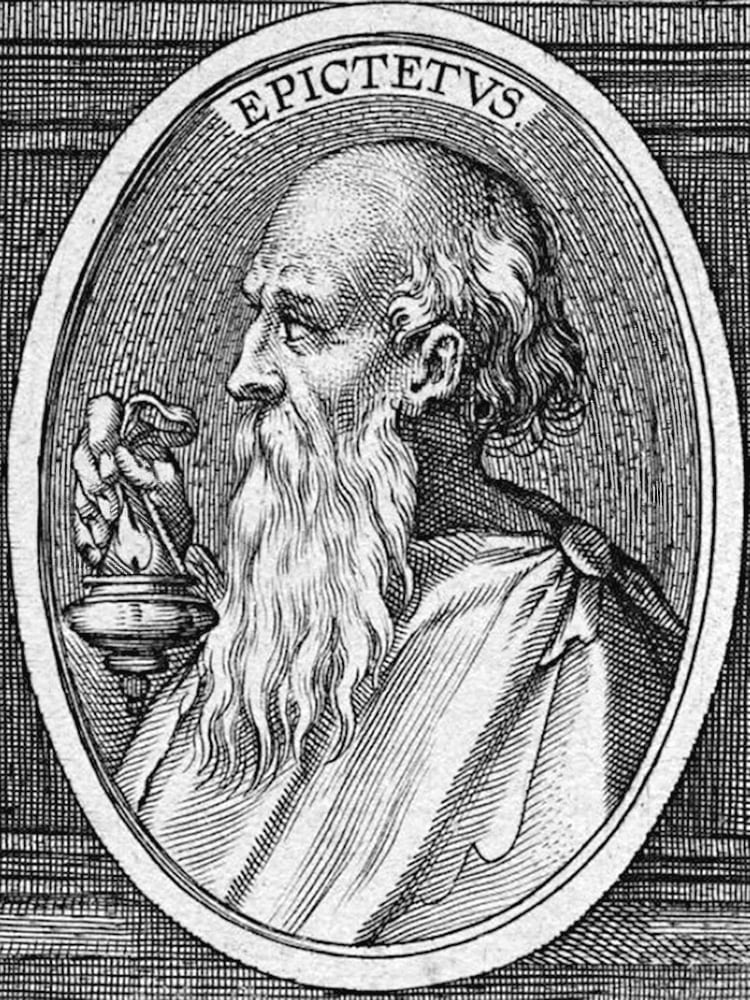
The most theoretical book: it opens with the distinction between what is and is not up to us, defends providence and man's kinship with God, discusses logic, argues against Academics and Epicureans and teaches how to behave before a tyrant. Chapters (30): 1. Of the things which are in our power, and not in our power; 2. How a man on every occasion can maintain his proper character; 3. From God being the Father of all men to the rest; 4. Of progress; 5. Against the Academics; 6. Of providence; 7. Of the use of sophistical and hypothetical arguments; 8. That the faculties are not safe to the uninstructed; 9. From our kinship with God, the consequences; 10. Against those who eagerly seek preferment at Rome; 11. Of natural affection; 12. Of contentment; 13. How everything may be done acceptably to the gods; 14. That the Deity oversees all things; 15. What philosophy promises; 16. Of providence (II); 17. That the logical art is necessary; 18. That we ought not to be angry with the errors of others; 19. How we should behave to tyrants; 20. About reason and how it contemplates itself; 21. Against those who wish to be admired; 22. Of praecognitions; 23. Against Epicurus; 24. How we should struggle with circumstances; 25. On the same; 26. What is the law of life; 27. In how many ways appearances exist; 28. That we ought not to be angry with men; 29. On constancy; 30. What we ought to have ready in difficult circumstances.
amazon.es · Español · Link to the store.
Authorship note
Epictetus wrote nothing. The Discourses are notes of his lectures taken by his pupil Flavius Arrian, who says in the prefatory letter to Lucius Gellius that he transcribed them word for word; the language (colloquial Koine, unlike the Attic of Arrian's own works) supports the view that they preserve the master's voice, though the selection and final wording are Arrian's. A minority of scholars (Robert Dobbin) has argued that Epictetus wrote them himself.
Editions and translations
Editions in your language first, without hiding the others. Each with its cover and its store.
English
Epictetus
The Discourses of Epictetus; with the Encheiridion and Fragments
The Conscious LibraryThe Discourses of Epictetus; with the Encheiridion and Fragments
George Bell and Sons; Wikisource, 1877
Translation: George Long
Dominio público.
Español

Disertaciones por Arriano
Gredos (Biblioteca Clásica Gredos, 185), 1993
Translation: Paloma Ortiz García
ISBN 9788424916282
Introducción, traducción y notas.
Other works by Epictetus
- Discourses (as reported by Arrian) · 108
- Discourses, Book II · 108
- Discourses, Book III · 108
- Discourses, Book IV · 108
- Handbook (Enchiridion) · 130
- Fragments
- Discourses, Books V–VIII (lost) · 108
- Conversations (lost)
- Life and Death of Epictetus (by Arrian, lost)
- Debate of the Emperor Hadrian and the Philosopher Epictetus
- Christian paraphrases of the Handbook
- Simplicius' Commentary on the Handbook · 530
Sources
- Epicteto. Disertaciones (por Arriano) y Manual. Texto griego en Wikisource en griego; trad. inglesa de George Long, The Discourses of Epictetus; with the Encheiridion and Fragments (Londres: George Bell, 1877), en Wikisource en inglés.
Affiliate link: if you buy through it, the library may receive a commission at no extra cost to you. When an edition's real cover is not available, we show an illustrative library cover.