Plotinus
Theology of Aristotle
Traditional attribution
Theology of Aristotle
Uthūlūjiyā Arisṭāṭālīs
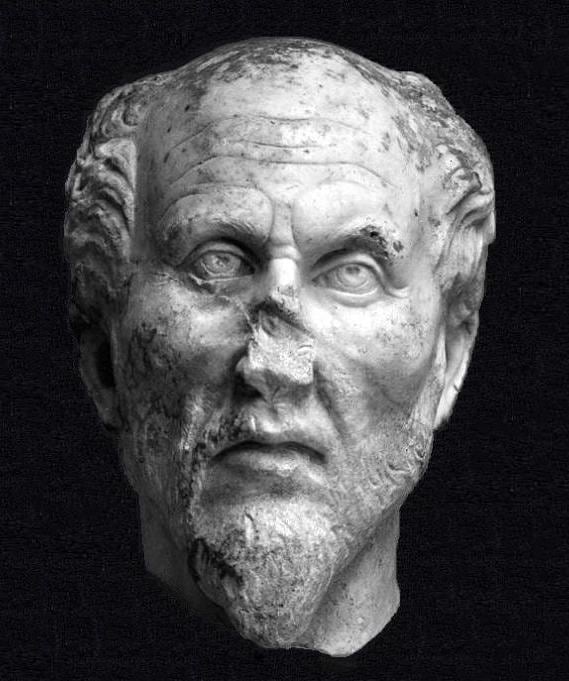
Together with the Epistle on Divine Science and the Sayings of the Greek Sage, it forms the so-called "Arabic Plotinus". Attributed to Aristotle, it allowed the philosophers of Islam—al-Farabi, Avicenna—and, through the sixteenth-century Latin translation, some Renaissance thinkers, to reconcile Plato and Aristotle in a metaphysics of emanation from the One.
No edition of this work is currently on sale in a store we have been able to verify.
Authorship note
Pseudepigraphic. An Arabic paraphrase of parts of Enneads IV–VI, translated in the ninth century by Ibn Naʿima al-Himsi and corrected by al-Kindi, which circulated as a work of Aristotle. The content comes from Plotinus, but the attribution is false and the text adapted.
Editions and translations
Editions in your language first, without hiding the others. Each with its cover and its store.
English
Plotinus
The Arabic Plotinus: A Philosophical Study of the «Theology of Aristotle»
The Conscious LibraryThe Arabic Plotinus: A Philosophical Study of the «Theology of Aristotle»
Duckworth, 2002
Estudio de Peter Adamson con traducción de pasajes.
Other works by Plotinus
- Enneads · 301
- Life of Plotinus (by Porphyry) · 301
- Ennead I.1 [53]: What is the living being, and what is man? · 268
- Ennead I.2 [19]: On virtues · 253
- Ennead I.3 [20]: On dialectic · 253
- Ennead I.4 [46]: On happiness (well-being) · 268
- Ennead I.5 [36]: Whether happiness increases with time · 263
- Ennead I.6 [1]: On beauty · 253
- Ennead I.7 [54]: On the primal good and the other goods · 268
- Ennead I.8 [51]: On what are and whence come evils · 268
- Ennead I.9 [16]: On going out of the body · 253
- Ennead II.1 [40]: On the cosmos (or on heaven) · 263
- Ennead II.2 [14]: On the movement of heaven · 253
- Ennead II.3 [52]: Whether the stars are causes · 268
- Ennead II.4 [12]: On matter (or on the two matters) · 253
- Ennead II.5 [25]: On what exists potentially and what actually · 263
- Ennead II.6 [17]: On quality and form (or on substance and quality) · 253
- Ennead II.7 [37]: On complete transfusion · 263
- Ennead II.8 [35]: On sight, or how distant objects appear small · 263
- Ennead II.9 [33]: Against the Gnostics · 263
- Ennead III.1 [3]: On fate · 253
- Ennead III.2 [47]: On providence, I · 268
- Ennead III.3 [48]: On providence, II · 268
- Ennead III.4 [15]: On our allotted guardian spirit · 253
- Ennead III.5 [50]: On love · 268
- Ennead III.6 [26]: On the impassibility of the bodiless · 263
- Ennead III.7 [45]: On eternity and time · 263
- Ennead III.8 [30]: On nature, contemplation and the One · 263
- Ennead III.9 [13]: Various considerations · 253
- Ennead IV.1 [21]: On the essence of the soul, I · 253
- Ennead IV.2 [4]: On the essence of the soul, II · 253
- Ennead IV.3 [27]: Problems of the soul, I · 263
- Ennead IV.4 [28]: Problems of the soul, II · 263
- Ennead IV.5 [29]: Problems of the soul, III, or on sight · 263
- Ennead IV.6 [41]: On sense-perception and memory · 263
- Ennead IV.7 [2]: On the immortality of the soul · 253
- Ennead IV.8 [6]: On the descent of the soul into bodies · 253
- Ennead IV.9 [8]: Whether all souls are one · 253
- Ennead V.1 [10]: On the three primary hypostases · 253
- Ennead V.2 [11]: On the origin and order of the beings after the First · 253
- Ennead V.3 [49]: On the knowing hypostases and that which is beyond · 268
- Ennead V.4 [7]: How what comes after the First derives from the First, and on the One · 253
- Ennead V.5 [32]: That the intelligibles are not outside the Intellect, and on the Good · 263
- Ennead V.6 [24]: That what is beyond being does not think · 263
- Ennead V.7 [18]: Whether there are Forms of individuals · 253
- Ennead V.8 [31]: On the intelligible beauty · 263
- Ennead V.9 [5]: On Intellect, the Forms and Being · 253
- Ennead VI.1 [42]: On the kinds of being, I · 263
- Ennead VI.2 [43]: On the kinds of being, II · 263
- Ennead VI.3 [44]: On the kinds of being, III · 263
- Ennead VI.4 [22]: On the presence of being, one and the same, everywhere as a whole, I · 263
- Ennead VI.5 [23]: On the presence of being, one and the same, everywhere as a whole, II · 263
- Ennead VI.6 [34]: On numbers · 263
- Ennead VI.7 [38]: How the multitude of the Forms came into being, and on the Good · 263
- Ennead VI.8 [39]: On free will and the will of the One · 263
- Ennead VI.9 [9]: On the Good or the One · 253
- Notes of the lectures (by Amelius, lost) · 260
- Eustochius' edition (lost)
Sources
- Adamson, Peter. The Arabic Plotinus: A Philosophical Study of the «Theology of Aristotle». Londres: Duckworth, 2002.
Affiliate link: if you buy through it, the library may receive a commission at no extra cost to you. When an edition's real cover is not available, we show an illustrative library cover.