
Written work · Essential works
The Book of Divine Works
Liber divinorum operum (De operatione Dei)
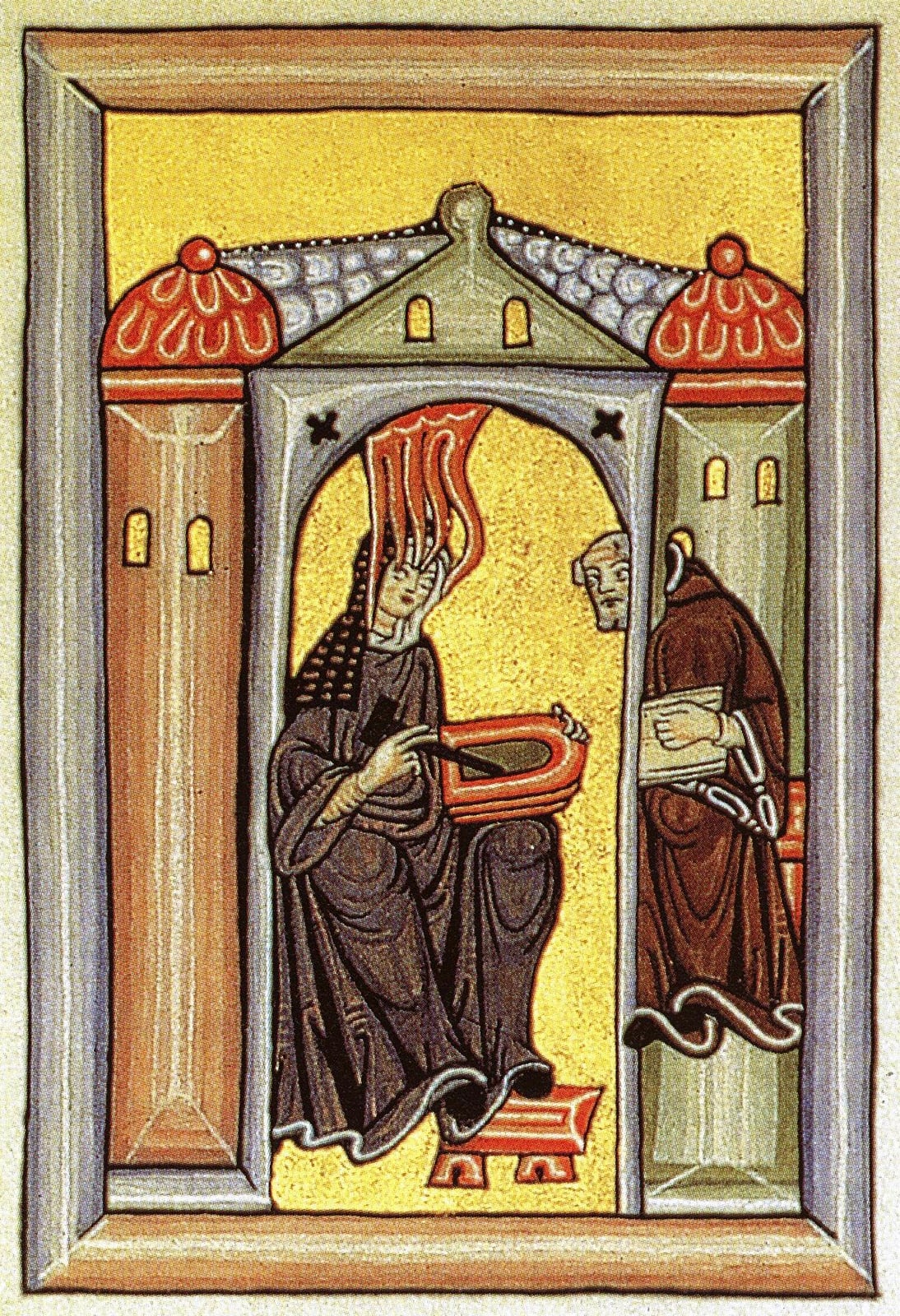
Her cosmological synthesis. Ten visions in three parts: Charity as the fiery force animating the universe; man at the centre of the cosmic spheres, with winds, stars and humours corresponding to his limbs (the figure of the 'universal man' immortalised by the Lucca codex); an extended commentary on the prologue of John's Gospel and on Genesis; and, in the third part, the city of God and history up to the Antichrist. It is the work in which the theology of viriditas and the microcosm-macrocosm relation reach their fullest formulation.
amazon.com · Link to the store.
What it is about
The Liber divinorum operum —“Book of Divine Works”, also transmitted as De operatione Dei— is the last and most ambitious of Hildegard of Bingen’s three great visionary works. Written between 1163 and 1173, when the author was approaching seventy, it is a theological cosmology in which the universe, the human body and the history of salvation appear as three expressions of one and the same work of God. Where Scivias told sacred history and the Book of Life’s Merits dealt with the moral life, this book surveys the whole of creation and asks what place human beings hold within it.
The answer organises the entire book: the human being is the centre and epitome of the cosmos. In the second vision, the best known thanks to the miniature in the Lucca manuscript, a human figure with outstretched arms is inscribed in a wheel of concentric circles —fire, ether, air, water— held by a divine figure; winds, stars and elements radiate towards it and pass through it. The idea, rooted in the ancient tradition of the microcosm, acquires a new density in Hildegard: the structure of the firmament corresponds to that of the head, the winds to the humours of the body, the seasons to the ages of life. Everything is connected, and the good or evil a person does reverberates through the order of the world.
The book is not only cosmology. The fourth vision, the longest, culminates in a commentary on the prologue of John’s Gospel: the Word through whom all things were made is the same Word made flesh, so creation and incarnation form a single work. The second part is an allegorical and moral commentary on Genesis joined to a vision of the places where souls are purified. The third surveys the history of salvation from creation to the end of time, with figures of Wisdom, Love, Humility and Peace, and ends with the coming of Antichrist and the consummation of history.
The underlying thesis is that divine love —Caritas, who introduces herself in the first vision as the “supreme and fiery power”— is the vital principle that kindles and sustains everything that lives. Hence the importance of viriditas, greenness or vital vigour, in Hildegard’s vocabulary. Because of this integrated vision of nature, body and spirit, the book has become a reference for the theology of creation and has found unexpected readers in ecology and the history of science.
Authorship note
Composed between 1163 and c. 1173–1174; Volmar died before it was finished and Hildegard completed it with the help of Guibert of Gembloux and her nephew Wezelin. Critical edition: Derolez and Dronke, CCCM 92 (1996). The Ghent manuscript (Ms. 241) was corrected under her supervision.
Context of composition
Hildegard began the book in 1163, as she relates in the prologue, after a new vision commanded her to write, and she worked on it for a decade alongside her preaching journeys and an intense correspondence. By then she was abbess of Rupertsberg, had founded a second monastery at Eibingen (1165), and was an authority consulted by the Emperor Frederick Barbarossa, with whom she would later clash over the schism. Her lifelong secretary, the monk Volmar, died in 1173, when the book was almost finished; the final revision was carried out by other collaborators, among them her nephew Wezelin and, in her last years, Guibert of Gembloux. The book belongs to a period of intellectual expansion in the twelfth century, when new translations of medical and cosmological texts were circulating, though Hildegard never cites sources and presents everything as received vision. Its addressee is not only her community: Hildegard writes for the Church of her day and, in her mind, for future readers who were to receive the complete message.
Structure
- 01
Part I, vision 1: the theophany of Divine Love
A winged figure of extraordinary beauty, fire-red, presents herself as the fiery power that gives life to all things. She explains creation, the fall of the angels and of humankind, and redemption. It is the interpretive key to the whole book (17 chapters).
- 02
Part I, visions 2–4: cosmos, body and soul
The cosmic wheel with the human being at its centre (vision 2, 47 chapters); the winds of the macrocosm and the humours of the microcosm (vision 3); and the great correspondence between firmament and human body, culminating in a commentary on the prologue of John (vision 4, 105 chapters, the longest).
- 03
Part II, vision 5: the earth and purification
The earth appears divided into five regions, some of them places where souls are purified. The vision is joined to an allegorical and moral commentary on the opening chapters of Genesis (49 chapters).
- 04
Part III, visions 6–10: the city of God and history
The city of God and the mirror of the angels; salvation history from creation to incarnation; the fountain of God’s work with Love, Humility and Peace; Wisdom and the ancient counsel; and Love upon the wheel of eternity, with the Church’s trials, Antichrist and the end.
Main themes
The human being as microcosm
The central idea: the human body reproduces the structure of the universe, and the universe exists for the human being. Hildegard draws detailed correspondences between celestial spheres and parts of the head, between winds and humours, between cosmic and bodily rhythms. This is not astrology but an anthropology of responsibility: what human beings do affects the order of creation.
Caritas, the fiery power
Divine Love opens and closes the book. Hildegard portrays it as a female figure with a radiant face and wings, speaking in the first person and identifying itself with the very life of all creation. It is one of the boldest images in her theology, which thinks of God in terms of vital energy and not only of power.
Viriditas: the greenness of life
The word *viriditas*, which Hildegard uses with exceptional frequency, names the force that makes plants sprout, sustains the body’s health and enlivens the soul’s virtue. It unites the physical and spiritual planes and explains why her medical and theological works speak the same language.
Creation and incarnation
The commentary on the prologue of John at the end of the fourth vision is the theological heart of the book: the Word through whom all things were made is the Word made flesh. For Hildegard the incarnation was foreseen from the beginning and is not a late remedy: the whole of creation is oriented towards the human being and towards Christ.
History and the end of time
The third part projects the cosmology onto time: history has an order, ages and an outcome. Hildegard announces periods of weakness in the Church and of chastisement, followed by renewal, and describes the coming of Antichrist. These pages fed her later reputation as a prophetess.
Key passages
«I am the supreme and fiery power who has kindled every living spark.»
Ego summa et ignea vis, quae omnes viventes scintillas accendi
The opening words of the speech of *Caritas*, Divine Love. God appears not as judge or architect but as fire that kindles life; the speech goes on to list that presence in fields, waters and stars. Our own translation from the Latin.
«In the beginning was the Word, and the Word was with God, and God was the Word.»
In principio erat Verbum, et Verbum erat apud Deum, et Deus erat Verbum.
Hildegard closes the greatest of her cosmological visions with a verse-by-verse exegesis of the prologue of John: cosmology flows into incarnation. The text quoted is the Vulgate, on which she comments; the translation is our own.
«The miniature of the second vision in the Lucca manuscript: a naked human figure with outstretched arms at the centre of a wheel of circles of fire, ether, air and water, held by Divine Love and crossed by the breath of the winds.»
Less a passage than an image: it is the best-known medieval representation of the human being as microcosm and visually sums up the book’s thesis. It is described here rather than quoting the long Latin text of the vision.
Reception and influence
The book survives in two principal manuscripts: Ghent (Universiteitsbibliotheek, MS 241), a fair copy prepared at Rupertsberg in Hildegard’s lifetime and regarded as the basis of the text, and Lucca (Biblioteca Statale, MS 1942), from the early thirteenth century, with ten full-page miniatures that have given the book its visual fame. The text was also included in the great Wiesbaden codex (the Riesenkodex), which gathered her works towards the end of her life.
For centuries it was less read than Scivias and known mainly through its prophetic extracts. Migne’s Patrologia Latina (vol. 197, 1855) put it back into circulation, and the critical edition by Albert Derolez and Peter Dronke (1996) established the text. Contemporary interest has been wide and at times questionable: Matthew Fox’s “creation spirituality” movement popularised an ecological reading of Hildegard in the 1980s, and the Lucca miniatures are endlessly reproduced as icons of harmony between humankind and nature. Scholarship has nuanced those readings by placing the book within monastic theology and twelfth-century science. There is a complete English translation by Nathaniel M. Campbell (2018) and a Spanish version published by Herder (2009).
How to read it
This is Hildegard’s most difficult work because of its length, its symbolic density and its long series of correspondences. It is advisable to have read *Scivias* first, or at least an introduction to her thought. The best approach is to begin with the first vision, short and decisive, and the second, with the Lucca miniature in view; then the commentary on the prologue of John at the end of the fourth vision. The second and third parts can be read selectively. In English, Nathaniel M. Campbell’s translation (Catholic University of America Press, 2018) is complete and annotated; in Spanish, the Herder edition (2009).
Editions and translations
Editions in your language first, without hiding the others. Each with its cover and its store.
English
Hildegard of Bingen
The Book of Divine Works
The Conscious LibraryThe Book of Divine Works
Catholic University of America Press, 2018
Translation: Nathaniel M. Campbell
ISBN 9780813231297
Edición rústica: 9780813234939.
Français

Le Livre des œuvres divines
Albin Michel, 1989
Translation: Bernard Gorceix
ISBN 9782226037862
Latín
Hildegard of Bingen
Liber divinorum operum (CCCM 92)
The Conscious LibraryLiber divinorum operum (CCCM 92)
Brepols, 1996
Edición crítica de Albert Derolez y Peter Dronke. ISBN no localizado en Open Library.
Español
Hildegard of Bingen
Libro de las obras divinas
The Conscious LibraryLibro de las obras divinas
Herder, 2009
Translation: María Isabel Flisfisch, María Eugenia Góngora y Beatriz Melo
Edición de Herder (Barcelona); ISBN no localizado en Open Library ni en Google Books (cuota sin clave).
Further reading
- Scivias
The first work of the trilogy: the *Book of Divine Works* takes up its egg-shaped cosmos and turns it into a wheel centred on the human being.
- Causes and Cures
The same theory of humours and elements, applied to practical medicine.
- Physica
The catalogue of creatures and their properties, complementing the cosmological vision with natural history.
Other works by Hildegard of Bingen
- Scivias (Know the Ways) · 1151
- The Book of Life's Merits (The Book of the Rewards of Life) · 1163
- Physica (Book of the Subtleties of Creatures) · 1158
- Causes and Cures · 1158
- Symphony of the Harmony of Celestial Revelations · 1158
- Ordo Virtutum (The Play of the Virtues) · 1151
- Unknown Language and Unknown Letters · 1158
- Letters · 1179
- Homilies on the Gospels · 1170
- Minor Works · 1170
- Life of Saint Hildegard · 1187
- Life of Saint Disibod · 1170
- Life of Saint Rupert · 1170
- Explanation of the Rule of Benedict
- An Explanation of the Athanasian Creed
- Solutions to Thirty-Eight Questions · 1176
- On the Excellence of Saint Martin
- Pentachronon, or Mirror of Future Times · 1220
Sources
- Hildegardis Bingensis. Liber divinorum operum. Ed. Albert Derolez y Peter Dronke. CCCM 92. Turnhout: Brepols, 1996. Trad. inglesa: Nathaniel M. Campbell, The Book of Divine Works. Washington: Catholic University of America Press, 2018.
- Hildegardis Bingensis, *Liber divinorum operum*, ed. de Albert Derolez y Peter Dronke, Turnhout, Brepols (Corpus Christianorum Continuatio Mediaevalis 92), 1996.
- Hildegard of Bingen, *The Book of Divine Works*, trad. de Nathaniel M. Campbell, Washington, Catholic University of America Press (The Fathers of the Church, Mediaeval Continuation 20), 2018.
- Hildegarda de Bingen, *Libro de las obras divinas*, Barcelona, Herder, 2009.
- Barbara Newman (ed.), *Voice of the Living Light: Hildegard of Bingen and Her World*, Berkeley, University of California Press, 1998.
- Peter Dronke, *Women Writers of the Middle Ages*, Cambridge, Cambridge University Press, 1984.
- The International Society of Hildegard von Bingen Studies, «Liber divinorum operum», hildegard-society.org (resúmenes de capítulos y datos de manuscritos).
Affiliate link: if you buy through it, the library may receive a commission at no extra cost to you. When an edition's real cover is not available, we show an illustrative library cover.