
Written work · Essential works
Scivias (Know the Ways)
Scivias (Sci vias Domini)
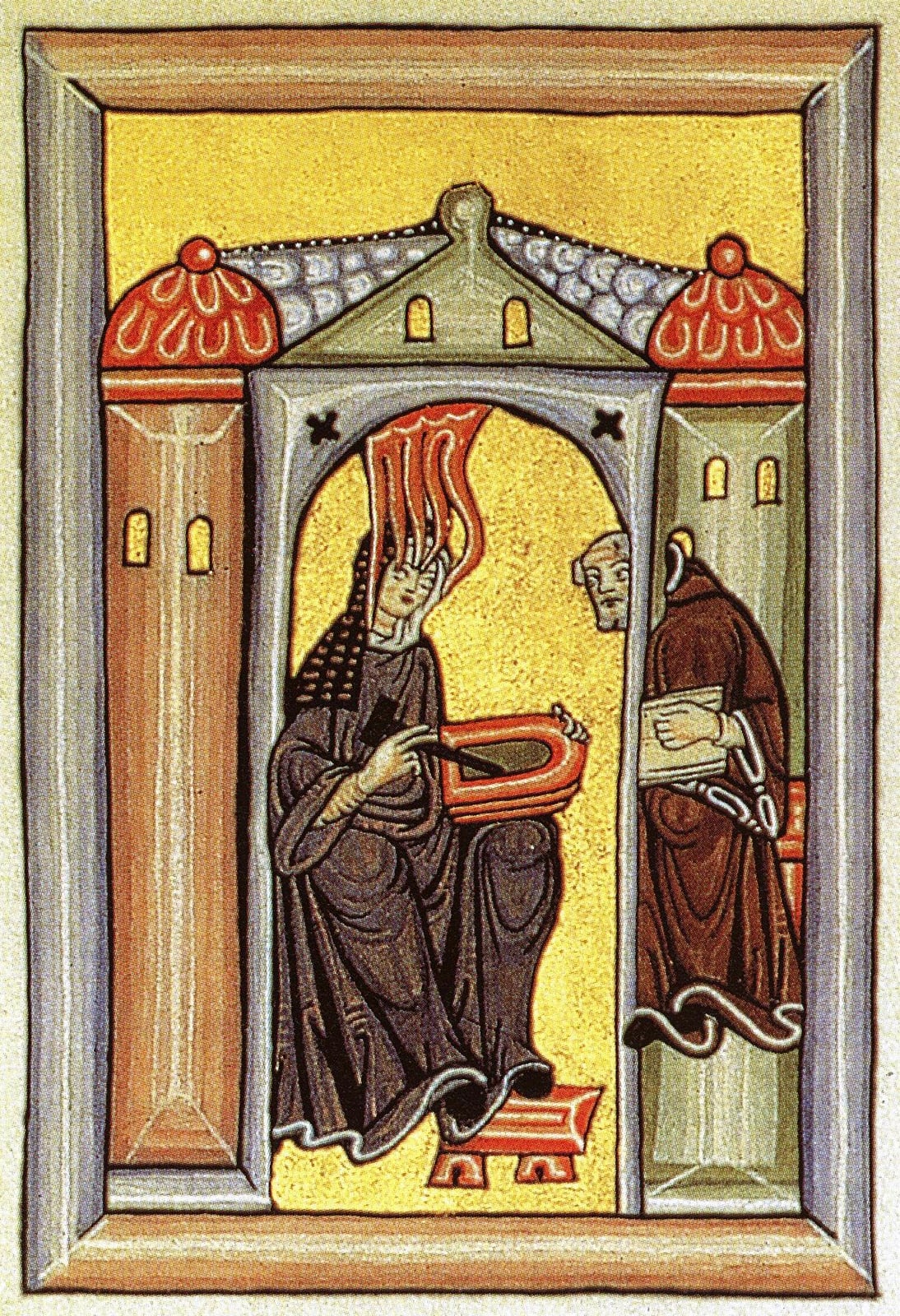
Her first and most widely read visionary work: twenty-six visions in three books (six, seven and thirteen) traversing creation and the fall, redemption through Christ and the Church as bride, and the history of salvation to the end of time, closing with the songs and the drama of the Virtues. Each vision is first presented as an image (the iron mountain, the cosmic egg, Synagogue, the building of salvation) and then explained by a heavenly voice, with a dense exegesis of Scripture. The illuminated manuscript made at Rupertsberg under her supervision was lost in 1945; its thirty-five miniatures are known from photographs and from the Eibingen copy.
amazon.com · Link to the store.
What it is about
Scivias —a contraction of Scito vias Domini, “Know the ways of the Lord”— is the first major work of Hildegard of Bingen and the book through which a hitherto unknown Benedictine nun from the Rhineland became the most listened-to prophetic voice of twelfth-century Europe. It comprises twenty-six visions distributed across three books. Each follows the same pattern: first Hildegard describes what she has seen —luminous figures, mountains, towers, wheels, crowned women, symbolic animals— and then a “voice from heaven” explains, point by point, what it means.
Taken as a whole, the book is a summa of salvation history told in images. The first book deals with creation, the fall of Lucifer and of Adam, the cosmos, and the relationship between soul and body. The second centres on redemption: Christ, the Trinity, the Church as a mother who bears the faithful in baptism, the sacraments and the struggle against the devil. The third presents the building of the edifice of salvation, with walls, towers and pillars inhabited by the virtues, and culminates in the last times, the coming of Antichrist, the Last Judgement and a symphony of praise containing the first texts of her songs and a sketch of her musical drama Ordo Virtutum.
The thesis that runs through the work is that the whole world, from the cosmos to the human body and from sacred history to the Church of her own day, forms an order willed by God which human beings are called to know and to inhabit. To know the ways is to recognise that order and return to it. Within that framework Hildegard addresses stern warnings to the clergy of her day, whom she accuses of lukewarmness and corruption: the book is also a call to reform.
Its importance is manifold. Theologically, it offers an original synthesis, independent of nascent scholasticism, in which images do not illustrate doctrine but do the thinking. As literature, it inaugurates a genre —the book of explained visions— with a long posterity. Historically, it is the work that gave Hildegard public authority: the partial approval of Pope Eugene III enabled her to preach, write to emperors and popes, and found her own monastery. And artistically, the illuminated Rupertsberg manuscript, produced under her supervision, contains some of the most astonishing images of the Middle Ages.
Authorship note
Dictated by Hildegard to her secretary Volmar between 1141 and 1151, with the help of Richardis of Stade; she herself describes the process in the Protestificatio. Critical edition: Führkötter and Carlevaris, CCCM 43–43A (1978).
Context of composition
Hildegard had lived since childhood at the double monastery of Disibodenberg, in the diocese of Mainz, and since 1136 she had been magistra of its female community. According to the book’s prologue, in 1141, at the age of forty-two years and seven months, a fiery light flooded her brain and heart and a voice commanded her to write down what she saw. Until then she had kept silent about her visions, present since childhood, out of fear and humility; she says she refused to write until she fell ill. She did so with the help of the monk Volmar, her secretary, and the nun Richardis von Stade, and it took her ten years, until 1151. In 1147 she wrote to Bernard of Clairvaux for advice, and at the Synod of Trier (1147–1148) Pope Eugene III, a Cistercian like Bernard, had part of the text read aloud and encouraged her to continue. The book was therefore born for the community and for the Church, as a prophetic message, and in parallel with the founding of the Rupertsberg monastery near Bingen, to which Hildegard moved her nuns around 1150.
Structure
- 01
Protestificatio (Declaration)
Hildegard declares the truth of her visions, dates the call to 1141, recounts her resistance to writing and the illness that overcame it, and describes the nature of her seeing: she receives it awake, with open eyes, without ecstasy or loss of the senses.
- 02
Book I: the Creator and creation (6 visions)
The Most High enthroned on an iron-coloured mountain; the fall of Lucifer and of Adam; the universe in the shape of a cosmic egg surrounded by fire; the soul and its bodily “tabernacle”; the Synagogue; the choirs of angels. It is the book of cosmology and anthropology.
- 03
Book II: the Redeemer and redemption (7 visions)
Christ as redeemer; the Trinity in a sapphire-blue figure surrounded by light and fire; the Church as an immense woman who receives her children in baptism; confirmation; the orders of life in the Church; the Eucharist; and the struggle against the devil, shown as a monstrous chained worm.
- 04
Book III: the history of salvation (13 visions)
The edifice of salvation, with walls, towers and pillars inhabited by the virtues; the last times, Antichrist and judgement; the new heavens and new earth; and a final, symphonic vision gathering songs of praise and a sketch of the *Ordo Virtutum*.
Main themes
Seeing and hearing: the nature of vision
Hildegard insists that she does not see in dreams or ecstasy but awake, in a “shadow of the living light” that accompanies her ordinary perception. Vision always comes with a word that interprets it. This double structure of image and explanation is the book’s signature and the basis of its authority: she does not invent but transmits what she sees and hears.
The cosmos as order
The third vision of the first book presents the universe as an egg with layers of fire, ether, air and water, and the earth at its centre. This is not a scientific but a theological cosmology: every element has a moral and spiritual meaning. Human beings live in an ordered world and are responsible for it; sin is disorder.
The Church as mother
Ecclesia appears as a gigantic woman, both bride of Christ and mother who conceives and gives birth to the faithful. Hildegard thinks of the Church in feminine and bodily terms, with a symbolic force unmatched in the theology of her day, and portrays her as wounded by the sins of her ministers.
The virtues as persons
In the third book the virtues —Humility, Charity, Fear of God, Obedience, Faith, Hope and many others— appear as figures with their own garments, gestures and words, working on the construction of God’s building. This living allegory prepares the *Ordo Virtutum*, in which the virtues sing and fight for a soul.
Prophecy and reform
Hildegard presents herself as a “poor little female form” to whom God speaks because learned men have fallen silent. Her prophecy does not foretell the future so much as denounce the present: simony, clerical lukewarmness, heresy. The last times in the third book are a call to the Church’s conversion.
Key passages
«And behold, in the forty-third year of my life’s course, as I clung to a heavenly vision with great fear and trembling attention, I saw a vast splendour in which a voice from heaven spoke to me, saying: “O frail human being, ash of ash and rottenness of rottenness, speak and write what you see and hear.”»
Et ecce quadragesimo tertio temporalis cursus mei anno, cum caelesti uisioni magno timore et tremula intentione inhaererem, uidi maximum splendorem, in quo facta est uox de caelo ad me dicens: O homo fragilis, et cinis cineris, et putredo putredinis, dic et scribe quae uides et audis.
The scene of vocation. The humbling of the addressee (“ash of ash”) and the command to write legitimise both the author’s humility and her authority. Our own translation from the Latin.
«It happened in the eleven hundred and forty-first year of the incarnation of Jesus Christ, Son of God, when I was forty-two years and seven months old: a fiery light of the greatest brilliance, coming from the open heavens, flooded my whole brain.»
Factum est in millesimo centesimo quadragesimo primo Filii Dei Iesu Christi incarnationis anno, cum quadraginta duorum annorum septemque mensium essem, maximae coruscationis igneum lumen aperto caelo ueniens totum cerebrum meum transfudit
The exact date of the call, with almost notarial precision. The sentence goes on to describe a flame that warms without burning, after which Hildegard says she suddenly understood the meaning of the Psalms and the Gospels. Our own translation.
«But I, though I saw and heard these things, because of doubt and bad opinion and the diversity of human words, refused for a long time to write —not out of obstinacy but out of humility— until, struck down by the scourge of God, I fell upon a bed of sickness.»
Sed ego, quamuis haec uiderem et audirem, tamen propter dubietatem et malam opinionem et propter diuersitatem uerborum hominum, tamdiu non in pertinacia, sed in humilitatis officio scribere recusaui, quousque in lectum aegritudinis flagello Dei depressa caderem.
Resistance and illness as proof: Hildegard links her health to obedience to the voice, a motif she will repeat throughout her life. Our own translation.
Reception and influence
Eugene III’s approval at Trier turned Scivias into Hildegard’s letter of introduction to all Christendom: from then on she received letters from popes, emperors, bishops and abbots seeking her counsel, and she undertook preaching journeys through the Rhineland and Swabia. The book was copied in her lifetime; the great illuminated Rupertsberg codex, with thirty-five miniatures probably made around 1165–1180, was kept in Wiesbaden until 1945, when it disappeared in Dresden, where it had been evacuated during the war. Fortunately, between 1927 and 1933 the nuns of Eibingen Abbey had made a hand-painted copy on parchment, which is now the main source for the images.
In the later Middle Ages Hildegard was read chiefly as a prophetess of the end times, thanks to Gebeno of Eberbach’s anthology Speculum futurorum temporum (1220). The first printed edition of Scivias appeared in Paris in 1513, alongside other visionary texts, at the initiative of Jacques Lefèvre d’Étaples. The twentieth century rediscovered her through the critical edition of Adelgundis Führkötter and Angela Carlevaris (1978), the studies of Peter Dronke and Barbara Newman, and a wider fascination: the neurologist Oliver Sacks suggested in Migraine (1970) that her luminous visions might be related to migraine aura, a debated but influential hypothesis. Benedict XVI canonised her by equivalence and proclaimed her a Doctor of the Church in 2012.
How to read it
It is a long, symbolic book that is not read in one go. It helps to keep the miniatures of the Rupertsberg codex at hand (in the widely reproduced Eibingen copy), since the image guides the reading of each vision. A good strategy is to read the *Declaration* first, then three or four representative visions —I.3 (the cosmos), II.2 (the Trinity), II.3 (the Church), III.13 (the symphony)— before tackling the whole. In Spanish there is the translation by Antonio Castro Zafra and Mónica Castro (Trotta, 1999). In English, the translation by Columba Hart and Jane Bishop (Paulist Press, 1990), introduced by Barbara Newman, is the standard.
Editions and translations
Editions in your language first, without hiding the others. Each with its cover and its store.
English

Scivias (Classics of Western Spirituality)
Paulist Press, 1990
Translation: Columba Hart y Jane Bishop
ISBN 9780809131303
Tapa dura: 9780809104314.
Latín
Hildegard of Bingen
Hildegardis Scivias (CCCM 43–43A)
The Conscious LibraryHildegardis Scivias (CCCM 43–43A)
Brepols, 1978
Edición crítica de Adelgundis Führkötter y Angela Carlevaris. ISBN no localizado en Open Library.
Français
Hildegard of Bingen
Scivias
The Conscious LibraryScivias
Éditions du Cerf, 1996
Translation: Pierre Monat
ISBN 9782204048644
Deutsch
Hildegard of Bingen
Scivias – Wisse die Wege
The Conscious LibraryScivias – Wisse die Wege
Herder, 1998
Translation: Walburga Storch
ISBN 9783451041150
Hildegard of Bingen
Wisse die Wege. Scivias
The Conscious LibraryWisse die Wege. Scivias
Otto Müller Verlag, 1998
Translation: Maura Böckeler
ISBN 9783701301577
Español

Scivias: Conoce los caminos
Trotta, 1999
Translation: Antonio Castro Zafra y Mónica Castro
ISBN 9788481643305
Further reading
- The Book of Divine Works
It closes the visionary trilogy that *Scivias* opens, with a much more developed cosmology and anthropology.
- Ordo Virtutum
The musical drama of the virtues grows out of the sketch that closes the final vision of *Scivias*.
- The Book of Life’s Merits
Second work of the trilogy: the struggle between vices and virtues that *Scivias* foreshadows.
- The Book of Her Life
Another woman who writes under command and under suspicion, and grounds her authority in what she has seen and heard.
Other works by Hildegard of Bingen
- The Book of Life's Merits (The Book of the Rewards of Life) · 1163
- The Book of Divine Works · 1174
- Physica (Book of the Subtleties of Creatures) · 1158
- Causes and Cures · 1158
- Symphony of the Harmony of Celestial Revelations · 1158
- Ordo Virtutum (The Play of the Virtues) · 1151
- Unknown Language and Unknown Letters · 1158
- Letters · 1179
- Homilies on the Gospels · 1170
- Minor Works · 1170
- Life of Saint Hildegard · 1187
- Life of Saint Disibod · 1170
- Life of Saint Rupert · 1170
- Explanation of the Rule of Benedict
- An Explanation of the Athanasian Creed
- Solutions to Thirty-Eight Questions · 1176
- On the Excellence of Saint Martin
- Pentachronon, or Mirror of Future Times · 1220
Sources
- Hildegardis Bingensis. Scivias. Ed. Adelgundis Führkötter y Angela Carlevaris. CCCM 43–43A. Turnhout: Brepols, 1978. Trad. inglesa: Columba Hart y Jane Bishop, Hildegard of Bingen: Scivias (Classics of Western Spirituality). Nueva York: Paulist Press, 1990. Trad. española: Scivias: Conoce los caminos, trad. Antonio Castro Zafra y Mónica Castro. Madrid: Trotta, 1999.
- Hildegardis Bingensis, *Scivias*, ed. de Adelgundis Führkötter y Angela Carlevaris, Turnhout, Brepols (Corpus Christianorum Continuatio Mediaevalis 43–43A), 1978.
- Hildegard of Bingen, *Scivias*, trad. de Columba Hart y Jane Bishop, introd. de Barbara J. Newman, Nueva York, Paulist Press (Classics of Western Spirituality), 1990.
- Hildegarda de Bingen, *Scivias: conoce los caminos*, trad. de Antonio Castro Zafra y Mónica Castro, Madrid, Trotta, 1999.
- Barbara Newman, *Sister of Wisdom: St. Hildegard’s Theology of the Feminine*, Berkeley, University of California Press, 1987.
- Sabina Flanagan, *Hildegard of Bingen, 1098–1179: A Visionary Life*, Londres, Routledge, 1989.
- Victoria Cirlot, *Hildegard von Bingen y la tradición visionaria de Occidente*, Barcelona, Herder, 2005.
- Azucena Adelina Fraboschi, «Scivias: declaración de verdaderas visiones», *Stylos*, 15 (2006).
Affiliate link: if you buy through it, the library may receive a commission at no extra cost to you. When an edition's real cover is not available, we show an illustrative library cover.