Ibn Arabi zugeschrieben
«"When the sin enters the shin, the tomb of Muhyi al-Din will appear."»
Falsch zugeschrieben
Urteil
Es steht nicht im Werk von Ibn Arabi
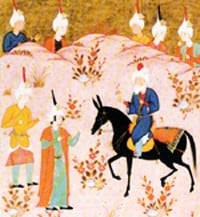
A coded prophecy that Ottoman tradition ascribes to Ibn Arabi, read as announcing that Selim (with *sin*) would enter Damascus (*Sham*, with *shin*) and restore his tomb, as he did in 1517. It comes from *al-Shajara al-numaniyya*, an apocalyptic work attributed to him without foundation; it appears in none of his authentic writings.
Quelle: Addas, Claude. Ibn ʿArabī ou la quête du Soufre Rouge. París: Gallimard, 1989. Trad. inglesa: Quest for the Red Sulphur: The Life of Ibn ʿArabī. Cambridge: Islamic Texts Society, 1993.
Was wirklich gesagt wurde
Belegte Worte von Ibn Arabi
«My heart has become capable of every form: it is a pasture for gazelles and a convent for Christian monks, And a temple for idols and the pilgrim's Ka'ba and the tables of the Tora and the book of the Koran. I follow the religion of Love: whatever way Love's camels take, that is my religion and my faith.»
Tarjuman al-ashwaq, oda XI, vv. 13–15 (trad. Nicholson, 1911, pp. 66–67). En el comentario, el autor precisa que esa religión del amor es prerrogativa de los musulmanes, por ser Muhammad el amado de Dios.
«My Beloved is three although He is One, even as the (three) Persons (of the Trinity) are made one Person in essence.»
Tarjuman al-ashwaq, oda XII, v. 4 (trad. Nicholson, 1911, p. 70)
«Do not attach yourself to any particular creed exclusively, so that you disbelieve in all the rest; otherwise, you will lose much good, nay, you will fail to recognize the real truth of the matter. God, the omnipresent and omnipotent, is not limited by any one creed, for He says, 'Wheresoever ye turn, there is the face of Allah.'»
Fusus al-hikam (doctrina del «dios creado en las creencias»), citado en la versión de Nicholson, The Mystics of Islam (1914), cap. III. Nicholson no indica el capítulo; la tradición de comentario lo sitúa en el engaste de Hud.