
Written work · Essential works
An Autobiography
Annie Besant: An Autobiography
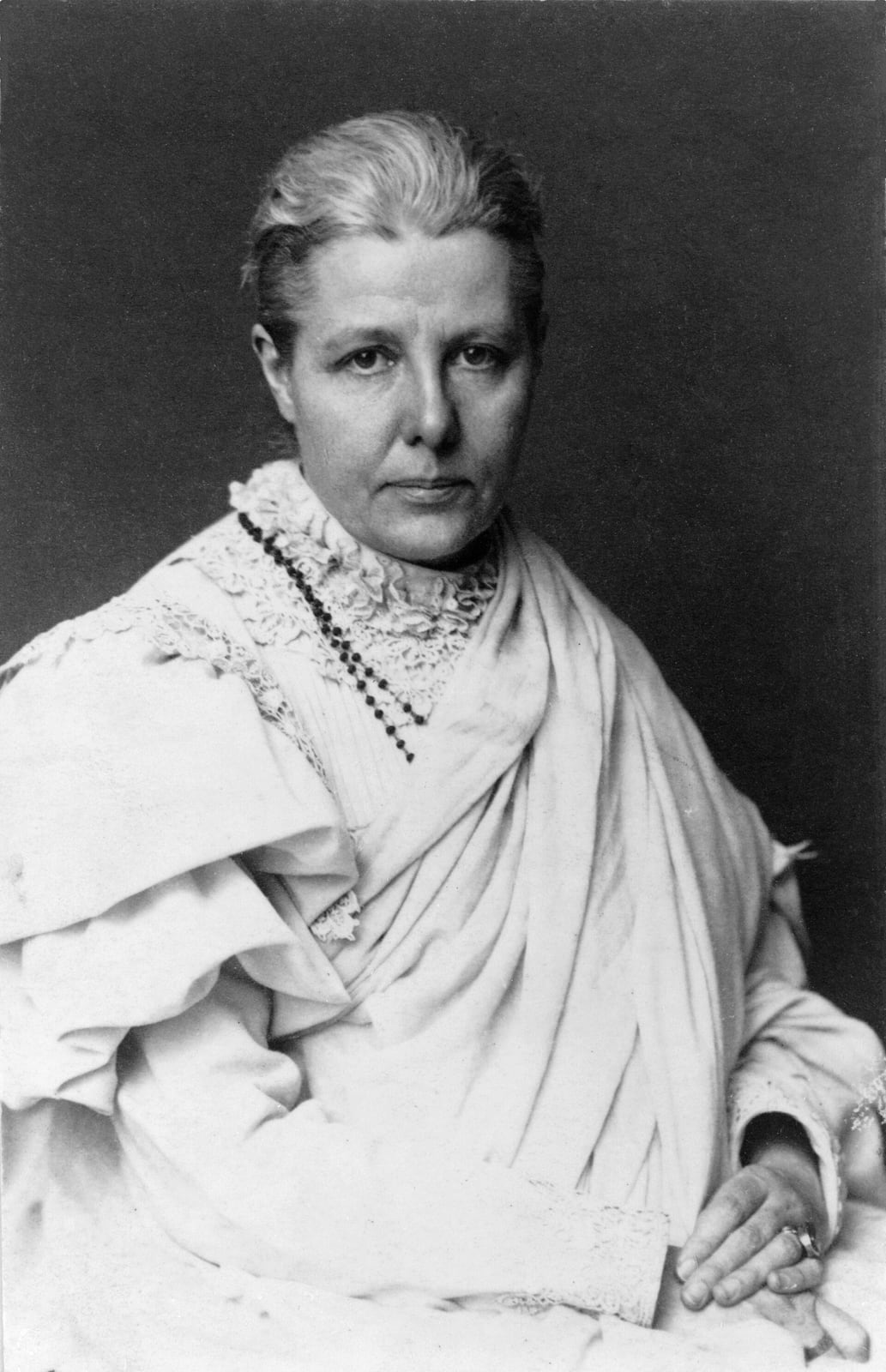
An account of her first forty-five years: the evangelical childhood, the marriage to Frank Besant, the crisis of faith, the years with Bradlaugh, the Knowlton trial, the loss of her daughter, socialism, the matchgirls' strike and, in the final chapter, 'Through Storm to Peace', the meeting with Blavatsky. Written with a candour unusual in a Victorian woman, it is the indispensable primary source and a remarkable piece of autobiographical prose.
What it is about
Annie Besant's Autobiography, published in 1893, tells the first forty-five years of one of the most intense lives of Victorian England. Written just as the author had become one of the leaders of the Theosophical Society, it is both a first-rate historical document and the account of a search: that of a woman who moved from evangelical Anglicanism to militant atheism, from atheism to socialism and from socialism to Theosophy, always with the same conviction that truth must be followed wherever it led, even at the cost of reputation, family or children.
The book goes through a pious, romantic childhood, marked by her father's early death and a careful education; marriage at twenty to the clergyman Frank Besant, and the experience of a wife without rights — a footnote welcomes the change in the law by which a married woman is now "a person, not a chattel"; the religious crisis triggered by her daughter's illness, the refusal to take communion and the separation. Then comes the best-known period: the alliance with Charles Bradlaugh in the National Secular Society, public lecturing as a trade, the 1877 trial for republishing Knowlton's pamphlet on birth control, the loss of custody of her daughter, Bradlaugh's struggle to take his seat in Parliament without swearing on the Bible, and then Fabian socialism, "Bloody Sunday" and the Bryant & May matchwomen's strike of 1888.
The last chapter, "Through Storm to Peace", narrates the conversion. W. T. Stead asks her to review The Secret Doctrine; Besant reads, is dazzled, asks to meet the author, and the meeting with Blavatsky in Lansdowne Road changes her life. The book ends with an inner peace that, she says, nothing outward can now disturb, and with the Buddhist formula that closes The Voice of the Silence: "Peace to all beings".
The work matters for several reasons. It is the primary source on Besant and, with her, on much of British freethought, feminism and socialism in the 1870s and 1880s. It is also a remarkable piece of autobiographical prose, frank to the point of discomfort for a woman of her time, in which the author reviews her past without disowning it: atheism appears as an honest stage of the same search. And it is, finally, a document of modern religious conversion, comparable in intention to the great confessions of the nineteenth century.
Authorship note
Her own work, published by T. Fisher Unwin in 1893; it expands and rewrites the 1885 Autobiographical Sketches from a Theosophical standpoint.
Context of composition
Besant had already told her life once: in 1884–1885 she serialised Autobiographical Sketches in her magazine Our Corner, collected as a book in 1885 and written from the standpoint of atheism. In 1889 her entry into the Theosophical Society scandalised her former freethinking and socialist comrades, and in 1891 the deaths of Bradlaugh and Blavatsky, a few months apart, closed a chapter. The Autobiography arises from that need to explain herself: it rewrites and expands the Sketches, keeps texts from that time and adds the Theosophical key that, in her view, gave the whole journey its meaning. It was published in London in 1893, the year Besant travelled to the Parliament of Religions in Chicago and settled in India. In the preface, dated August at the Theosophical headquarters in Avenue Road, she explains that an ordinary life may shed light on others and help those searching in the dark. It is written for a wide public: her former followers, who did not understand the conversion, and the new ones, who wanted to know their leader.
Structure
- 01
Chs. I–IV: birth, childhood, girlhood and marriage
From "Out of the Everywhere into the Here" to "Marriage": her birth in London on 1 October 1847, her father's death, her education with Ellen Marryat, an ardent youthful piety, and marriage to Frank Besant, experienced as a loss of freedom.
- 02
Chs. V–VII: the storm of doubt and atheism
Her daughter's illness opens the crisis of faith; refusal to take communion leads to separation. Then comes the meeting with Charles Bradlaugh and entry into the National Secular Society. Chapter VII sets out, with texts from the time, the atheism Besant taught.
- 03
Chs. VIII–XII: the public struggle
Her work as lecturer and publisher; the trial over Knowlton's pamphlet and the loss of custody of her daughter; the polemics of "At War All Round"; Bradlaugh's fight for his seat in Parliament, and the years of struggle that followed.
- 04
Ch. XIII: socialism
Her adherence to socialism and the Fabian Society, the partial break with Bradlaugh, Trafalgar Square's "Bloody Sunday" in 1887, the Bryant & May matchwomen's strike of 1888 and her election to the London School Board.
- 05
Ch. XIV: "Through Storm to Peace"
Her interest in psychic phenomena, the review of *The Secret Doctrine*, the meeting with Blavatsky and her entry into the Theosophical Society in 1889; the public defence of her change and the inner peace with which the book closes.
Main themes
Truth above all
The thread joining every stage is an ethic of sincerity: Besant presents herself not as someone who changes her mind but as someone who will not consent to live a lie. That consistency cost her her marriage, custody of her daughter and the regard of friends, and it gives the book its moral tension.
The woman without rights
The account of the marriage, the separation and the lawsuit over the children is a testimony to the legal position of the married woman in Victorian England. Besant tells it without self-pity and with legal precision, and links it to her later fight for birth control and women's autonomy.
Freethought and social reform
The central chapters are a first-hand chronicle of British secularism, press freedom, the unionism of unskilled women workers and Fabian socialism. Besant appears as speaker, publisher and organiser, and the book features figures such as Bradlaugh, Stead, Shaw and the labour leaders of the day.
Conversion
The final chapter describes a change of life in classic terms — dazzlement, resistance, surrender — but without disowning the past: materialism was an honest and necessary stage. Besant presents Theosophy as the answer to the questions atheism had left open about mind and suffering.
Service as religion
Before and after the conversion, Besant's life is organised around service to others. In the atheist phase she speaks of a brotherhood in which work is worship; in the Theosophical one, of service to the "great Brotherhood". The continuity is stronger than the break, and the book knows it.
Key passages
«It is a difficult thing to tell the story of a life, and yet more difficult when that life is one's own.»
It is a difficult thing to tell the story of a life, and yet more difficult when that life is one's own. At the best, the telling has a savour of vanity, and the only excuse for the proceeding is that the life, being an average one, reflects many others, and in troublous times like ours may give the experience of many rather than of one.
The preface justifies the book not by its author's uniqueness but because an "average" life reflects the doubts of a whole generation. The Spanish rendering is our own.
«And it is true now as it ever was that he who loves father or mother better than Truth is not worthy of her, and the flint-strewn path of honesty is the way to Light and Peace.»
And it is true now as it ever was that he who loves father or mother better than Truth is not worthy of her, and the flint-strewn path of honesty is the way to Light and Peace.
Written after recalling her mother on her knees, begging her not to break with the Church. Besant paraphrases the Gospel (Matthew 10:37), replacing Christ with Truth: the sentence sums up the whole book's ethic.
«As I turned over page after page the interest became absorbing; but how familiar it seemed; how my mind leapt forward to presage the conclusions, how natural it was, how coherent, how subtle, and yet how intelligible.»
As I turned over page after page the interest became absorbing; but how familiar it seemed; how my mind leapt forward to presage the conclusions, how natural it was, how coherent, how subtle, and yet how intelligible.
The scene of intellectual conversion. Besant at once adds that the effect was partly illusory and that it took her years to unravel what intuition had grasped at a stroke: an honesty uncommon in accounts of this kind.
«And thus I came through storm to peace, not to the peace of an untroubled sea of outer life, which no strong soul can crave, but to an inner peace that outer troubles may not avail to ruffle.»
And thus I came through storm to peace, not to the peace of an untroubled sea of outer life, which no strong soul can crave, but to an inner peace that outer troubles may not avail to ruffle—a peace which belongs to the eternal not to the transitory, to the depths not to the shallows of life.
The close that gives the chapter its title. The peace she describes is not retreat or rest — Besant had forty years of political struggle in India ahead of her — but an inner stability compatible with combat.
Reception and influence
The Autobiography was published in 1893 and went into a second edition the same year, with further reprints in London and, later, in Adyar. Among Theosophists it became required reading and the canonical account of their leader's conversion; among her former freethinking comrades it was received with sadness or irony, since they saw in it the reinterpretation of a combative life in the light of a belief they considered superstition.
Over time, its value as a source has outstripped its value as religious testimony. Historians of secularism, of the birth-control movement, of Fabian socialism and of women's trade unionism cite it as a first-hand document, especially for the Knowlton trial and the matchwomen's strike, though they check it against other sources: studies such as Louise Raw's on the 1888 strike have qualified the leading role Besant gives herself. The major biographies by Arthur H. Nethercot and Anne Taylor rely on it and correct it in details. Since 2004 the full text has been available on Project Gutenberg; we have not located a modern Spanish translation of reference, so most Spanish-speaking readers know it through the biographies.
How to read it
It reads like a novel and is best read in order, because the meaning of the last chapter depends on everything before it. Those short of time can focus on chapters IV and V (marriage and crisis of faith), IX (the Knowlton trial), XIII (socialism and the matchwomen's strike) and XIV (the conversion). Chapter VII, with long quotations from her atheist lectures, can be skimmed. It is useful to pair it with a critical biography, such as Anne Taylor's, to check the account against the facts. The English text is in the public domain on Project Gutenberg (#12085).
Editions and translations
Editions in your language first, without hiding the others. Each with its cover and its store.
English
Annie Besant
Annie Besant: An Autobiography
The Conscious LibraryAnnie Besant: An Autobiography
Project Gutenberg, 2004
#12085, texto íntegro.

Annie Besant: An Autobiography
Theosophical Publishing House, Adyar, 1995
ISBN 9788170592563
Reedición del centenario.
Annie Besant
Annie Besant: An Autobiography
The Conscious LibraryAnnie Besant: An Autobiography
Theosophical Publishing House, Wheaton, 1983
ISBN 9780835675680
ISBN-10 0835675688 en Open Library.
Annie Besant
Annie Besant: An Autobiography
The Conscious LibraryAnnie Besant: An Autobiography
T. Fisher Unwin, Londres, 1893
Primera edición; digitalizada en Internet Archive (anniebesantautob00besaiala).
Further reading
- Autobiographical Sketches
The first version of her life, written from atheism: comparing them shows how she rewrote her own past.
- The Secret Doctrine
The book whose review led her to Theosophy and which the last chapter describes as a revelation.
- The Voice of the Silence
Besant was with Blavatsky while she wrote it, and the autobiography ends with its very formula: "Peace to all beings".
- The Book of Her Life
Another spiritual autobiography by a woman writing to justify herself before those who judge her, three centuries earlier and from within Catholic faith.
Other works by Annie Besant
- Autobiographical Sketches · 1885
- My Path to Atheism · 1877
- The Law of Population · 1877
- Marriage, As It Was, As It Is, and As It Should Be · 1879
- Why I Became a Theosophist · 1889
- The Seven Principles of Man · 1892
- Reincarnation · 1892
- Death—and After? · 1893
- Karma · 1895
- Man and His Bodies · 1896
- The Building of the Kosmos · 1894
- In the Outer Court · 1895
- The Path of Discipleship · 1896
- The Bhagavad Gita (translation) · 1895
- Four Great Religions · 1897
- The Ancient Wisdom · 1897
- Esoteric Christianity · 1901
- Thought Power · 1901
- Thought-Forms · 1905
- A Study in Consciousness · 1904
- An Introduction to Yoga · 1908
- Occult Chemistry · 1908
- The Laws of the Higher Life · 1903
- The Pedigree of Man · 1904
- Theosophy and the New Psychology · 1904
- London Lectures of 1907 · 1907
- The Changing World · 1909
- A Study in Karma · 1912
- Initiation: The Perfecting of Man · 1912
- Man: Whence, How and Whither · 1913
- How India Wrought for Freedom · 1915
- The Case for India · 1917
- India: Bond or Free? · 1926
- Talks on the Path of Occultism · 1926
- Popular Lectures on Theosophy · 1910
- The Spiritual Life · 1912
- Evolution of Life and Form · 1899
- Avatâras · 1900
- Dharma · 1899
- Giordano Bruno · 1913
- Fabian Essays in Socialism · 1889
- The Riddle of Life · 1913
- The Doctrine of the Heart · 1914
- Ancient Ideals in Modern Life · 1901
- The Religious Problem in India · 1901
- Hints on the Study of the Bhagavad Gita · 1906
- The Wisdom of the Upanishads · 1907
- The Story of the Great War · 1899
- Shri Rama Chandra, the Ideal King · 1901
- Some Problems of Life · 1900
- The Three Paths to Union with God · 1897
- The Birth and Evolution of the Soul · 1896
- The Self and Its Sheaths · 1895
- The Ideals of Theosophy · 1912
- Theosophy · 1912
- Theosophy and the Theosophical Society · 1913
- Superhuman Men in History and Religion · 1913
- Mysticism · 1914
- Wake Up, India · 1913
- India: A Nation · 1915
- The Immediate Future · 1911
- Theosophy and Life's Deeper Problems · 1916
- Lectures on Political Science · 1919
- The Inner Government of the World · 1920
- The Future of Indian Politics · 1922
- The Birth of New India · 1917
- Buddhist Popular Lectures · 1908
- History of the Great French Revolution · 1876
- The Freethinker's Text-Book, Part II · 1876
- Charles Bradlaugh: A Sketch of His Life and Work · 1891
- The War and Its Lessons · 1920
- World Problems of Today · 1925
- Shall India Live or Die? · 1925
- The Masters · 1912
- Psychology · 1919
- Britain's Place in the Great Plan · 1921
- Duties of the Theosophist · 1917
- The Lives of Alcyone · 1924
- The Basis of Morality · 1915
- Hindu Ideals · 1904
- Legends and Tales · 1913
- Talks with a Class · 1922
- Evolution and Man's Destiny · 1924
Sources
- Open Library, autora Annie Wood Besant (OL16933A): registros de obras y ediciones con ISBN consultados el 2026-10-22; primeras ediciones digitalizadas en Internet Archive.
- Annie Besant, *Annie Besant: An Autobiography*, Londres, T. Fisher Unwin, 1893 (2.ª ed. 1893; Project Gutenberg #12085).
- Annie Besant, *Autobiographical Sketches*, Londres, Freethought Publishing Company, 1885.
- Arthur H. Nethercot, *The First Five Lives of Annie Besant*, Chicago, University of Chicago Press, 1960.
- Anne Taylor, *Annie Besant: A Biography*, Oxford, Oxford University Press, 1992.
- Louise Raw, *Striking a Light: The Bryant and May Matchwomen and Their Place in History*, Londres, Continuum, 2009.
- Anne Taylor, «Besant [née Wood], Annie (1847–1933)», *Oxford Dictionary of National Biography*, Oxford University Press, 2004.
Affiliate link: if you buy through it, the library may receive a commission at no extra cost to you. When an edition's real cover is not available, we show an illustrative library cover.