
Written work · Essential works
The Ancient Wisdom
The Ancient Wisdom: An Outline of Theosophical Teachings
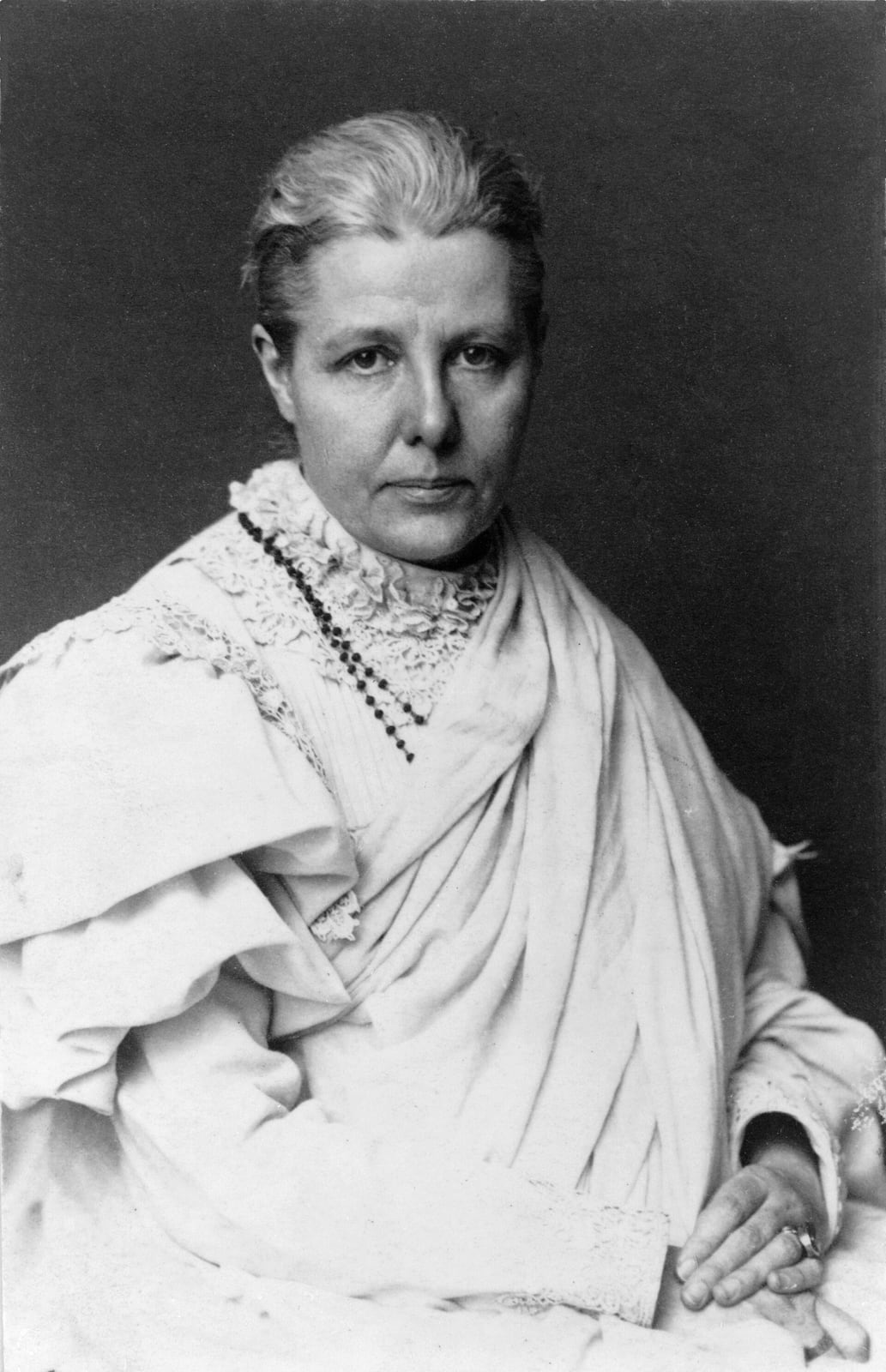
The systematic manual of Adyar Theosophy and Besant's most influential book. It sets out the planes of nature, the bodies of man, reincarnation, karma, the law of sacrifice, the ascent of man and the building of the kosmos, with an expository clarity Blavatsky never had. It was the training text of several generations of Theosophists and the way many readers—among them artists such as Kandinsky and Mondrian—came to know the doctrine.
What it is about
The Ancient Wisdom, subtitled "An Outline of Theosophical Teachings", is the book in which Annie Besant turned Theosophy into a teachable system. Where Blavatsky had left immense, disorderly works full of digressions, Besant offers in just over three hundred pages a clear, progressive, almost textbook account of the whole doctrine: from the unity of religions to the structure of the universe, from man's subtle bodies to reincarnation, karma and the final destiny of consciousness. The preface says so plainly: it aims to be a simple epitome for the elementary student and, at the same time, an introduction to Blavatsky's works.
The starting thesis, set out in the introduction, gave the book its name. All the great religions share religious, ethical and philosophical ideas, and two explanations of that agreement are possible: either they are products of primitive ignorance and nature worship, as the comparative mythology of her day held, or they derive from an original teaching kept by a brotherhood of great spiritual teachers, who have handed it to each people in the form best suited to it. Besant defends the second: that common teaching is the "ancient wisdom", called brahmavidyā in Sanskrit and theosophía in Greek.
From there the book describes a universe of planes of ever subtler matter — physical, astral, mental, buddhic and nirvanic — and a human being who has a body on each of them. It explains what happens after death, in kāmaloka and devachan; how the soul returns to incarnation to mature over many lives; how karma binds every act to its consequences; and how the law of sacrifice — the voluntary pouring out of life so that others may share it — governs everything from the manifestation of the Logos to man's ascent toward initiation and adeptship. The last chapter, "Building a Kosmos", closes the circle with cosmogony.
The book matters in two ways. For decades it was the training manual of the Adyar Theosophical Society and the doorway through which thousands of readers, artists and intellectuals among them, came to Theosophy. And it marks a turn: Besant reformulates Blavatsky's doctrine with a new terminology, shaped by Charles W. Leadbeater's "clairvoyant" investigations, which her critics later called "Neo-Theosophy". To read it is to understand Theosophy as most of its members lived it in the twentieth century.
Authorship note
Her own work, published by the Theosophical Publishing Society in 1897; conceived as a systematic manual to replace the scattered expositions of Blavatsky and Sinnett.
Context of composition
Besant wrote the book in 1897, six years after Blavatsky's death, by which time she had become the movement's most visible figure. They had been turbulent years: in 1895 most of the American section had broken away with William Q. Judge, after mutual accusations over alleged messages from the Masters, and Besant had shifted her centre of gravity to India, where she had lived since 1893 and was throwing herself into Hindu education. At the same time, together with Charles W. Leadbeater, she was publishing a series of short manuals — Man and His Bodies, Reincarnation, Karma, Death—and After? — describing the subtle planes in detail. The Ancient Wisdom gathers and orders that material in a single volume. It was meant for the lodges, for new members unable to tackle The Secret Doctrine, and for the general public interested in Eastern religions. She dedicated it to Blavatsky, "who showed me the light".
Structure
- 01
Preface and Introduction: "The Unity Underlying All Religions"
Sets out the two possible explanations of the likenesses between religions and argues for a brotherhood of teachers as their common source. Sums up the shared "spiritual verities" in five points — one eternal, unknowable Existence, a manifested triune God, hierarchies of intelligences, man as a divine reflection and his evolution through repeated incarnations — and illustrates them with Chinese, Hindu, Buddhist, Zoroastrian and Christian texts.
- 02
Chs. I–III: the physical plane, the astral plane and kāmaloka
Describes physical matter and its "etheric double", the astral plane and its inhabitants, and the state immediately following death, *kāmaloka*, where consciousness sheds desires and passions before going on its way.
- 03
Chs. IV–VI: the mental plane, devachan and the higher planes
The mental plane and its two levels, the mental and causal bodies; *devachan*, the blissful state between incarnations in which life's experiences are assimilated; and the buddhic and nirvanic planes, where consciousness knows itself one with the whole.
- 04
Chs. VII–IX: reincarnation and karma
Two chapters on reincarnation — its logic, its educational purpose and the usual objections — and one on karma as the law of cause and effect on the physical, emotional and mental planes, making each person the maker of their destiny.
- 05
Chs. X–XII: sacrifice, ascent and cosmos
The law of sacrifice, understood as joyful self-giving rather than pain; man's ascent along the paths of purification and discipleship to initiation; and the building of the cosmos by the Logos, which closes the work with an overall vision.
Main themes
The unity of religions
Besant starts from the comparative fact — religions resemble one another — and gives it a spiritual explanation: they are not developments of primitive fear but adaptations of a single teaching. The idea had huge resonance in colonial India, where it offered Hindus and Buddhists a dignity equal to Christianity's, and it is a feature of many contemporary spiritualities.
Planes and bodies
The universe is organised in planes of matter of differing subtlety, and the human being has a vehicle on each: physical, astral, mental, causal and higher. This map, sharper than Blavatsky's and differently worded, became the standard model of twentieth-century Theosophy and passed into the New Age almost unchanged.
Life after death
In a calm, almost descriptive tone, the book replaces judgement and hell with a process of purification and assimilation: *kāmaloka* sheds the passions and *devachan* turns experiences into faculties. Death ceases to be punishment or end and becomes a phase in a long apprenticeship.
Karma as justice
Besant presents karma as a natural, impersonal and exact law, not as divine punishment: every thought, desire and act produces consequences on its corresponding plane. From this follows an ethic of responsibility that the author, a former social campaigner, linked to the reform of society.
The law of sacrifice
Perhaps the book's most personal contribution: the universe is born of an act of self-giving by the Logos, is sustained by self-giving, and man is perfected by giving himself. Sacrifice is not pain but a joyful overflowing of life. In this idea the *Bhagavad Gita*, Christianity and Besant's own life converge.
Key passages
«This book is intended to place in the hands of the general reader an epitome of theosophical teachings, sufficiently plain to serve the elementary student, and sufficiently full to lay a sound foundation for further knowledge.»
This book is intended to place in the hands of the general reader an epitome of theosophical teachings, sufficiently plain to serve the elementary student, and sufficiently full to lay a sound foundation for further knowledge. It is hoped that it may serve as an introduction to the profounder works of H. P. Blavatsky, and be a convenient stepping-stone to their study.
The handbook's statement of intent: clarity for the beginner and a bridge to Blavatsky. That double aim explains both its teaching success and the criticism of those who saw it as a simplification. The Spanish rendering is our own.
«Right thought is necessary to right conduct, right understanding to right living, and the Divine Wisdom — whether called by its ancient Sanskrit name of Brahma Vidya, or its modern Greek name of Theosophia, Theosophy — comes to the world as at once an adequate philosophy and an all-embracing religion and ethic.»
Right thought is necessary to right conduct, right understanding to right living, and the Divine Wisdom—whether called by its ancient Sanskrit name of Brahma Vidya, or its modern Greek name of Theosophia, Theosophy—comes to the world as at once an adequate philosophy and an all-embracing religion and ethic.
The book's first sentence joins thought and conduct and presents Theosophy as philosophy, religion and ethic at once. The echo of Buddhist "right thought" is no accident.
«By an act of Self-sacrifice the Logos became manifest for the emanation of the universe, by sacrifice the universe is maintained, and by sacrifice man reaches perfection.»
By an act of Self-sacrifice the Logos became manifest for the emanation of the universe, by sacrifice the universe is maintained, and by sacrifice man reaches perfection.
The core of the book's most original chapter. A few lines later Besant explains that the essence of sacrifice is not pain but the voluntary and glad pouring forth of life so that others may share in it.
«Dedicated with gratitude, reverence, and love to H. P. Blavatsky, who showed me the light.»
Dedicated with gratitude, reverence, and love to H. P. Blavatsky, who showed me the light.
Six years after her death, Besant presents herself as Blavatsky's disciple and continuer, at a time when her legitimacy as heir was disputed after the 1895 split.
Reception and influence
The book was an immediate and lasting success within the Adyar Theosophical Society, which used it for decades as a study text in lodges around the world; it was reprinted in London, Benares, Adyar and the United States and soon translated into French (La Sagesse antique), German (Die uralte Weisheit, 1898), Spanish and many other languages. Its clarity made it especially influential in India, where it helped spread among the educated classes a universalist reading of Hinduism, and in European artistic circles of the early twentieth century, where the theory of planes and subtle forms found an unexpected audience.
Criticism came from two sides. From outside, historians of religion and sceptics rejected the thesis of a brotherhood of masters and the presentation as fact of what came from Leadbeater's avowed clairvoyance. From inside, Theosophists loyal to Blavatsky — notably those of the Pasadena branch and the United Lodge — pointed out that Besant altered the terminology and some doctrines of The Secret Doctrine, and coined for this version the pejorative term "Neo-Theosophy". Even so, it remains the most widely read exposition of Adyar Theosophy, and it is regularly reissued in Spanish.
How to read it
It is the best starting point for understanding Adyar Theosophy, and can be read in order from start to finish: each chapter assumes the previous one. The introduction on the unity of religions and the chapters on reincarnation, karma and sacrifice (VII–X) are the most accessible and of the broadest interest; those on the subtle planes call for patience with the terminology. It should be read knowing that many descriptions come from Leadbeater's avowed clairvoyance and differ from Blavatsky's vocabulary. The 1897 English text is in the public domain and freely digitised.
Editions and translations
Editions in your language first, without hiding the others. Each with its cover and its store.
English

The Ancient Wisdom
Theosophical Publishing House, Adyar, 1999
ISBN 9788170592044
También 9788170592037 (1972).
Annie Besant
The Ancient Wisdom
The Conscious LibraryThe Ancient Wisdom
Quest Books, Wheaton, 1986
ISBN 9780835670388
Annie Besant
The Ancient Wisdom
The Conscious LibraryThe Ancient Wisdom
Theosophical Publishing Society, Londres, 1897
Primera edición; digitalizada en Internet Archive (dli.ministry.09220).
Deutsch

Uralte Weisheit
Hirthammer / Aquamarin, 1981
ISBN 9783894273217
Primera traducción alemana (Die uralte Weisheit) de 1898.
Español
Annie Besant
La sabiduría antigua
The Conscious LibraryLa sabiduría antigua
Luis Cárcamo editor, Madrid, 2002
ISBN 9788476271247

La sabiduría antigua
Equipo Difusor del Libro, Madrid, 2014
ISBN 9788495593801
Français
Annie Besant
La Sagesse antique
The Conscious LibraryLa Sagesse antique
Hachette Livre BNF (reimpresión de la edición de 1899), 2018
ISBN 9782012861879
Further reading
- The Secret Doctrine
The work Besant wanted to make accessible; comparing them shows what she kept and what she changed.
- Man and His Bodies
One of the short 1896 manuals the book summarises; it treats the subtle vehicles in more detail.
- Thought-Forms
Written with Leadbeater, it takes the theory of planes into the visual realm and was the Theosophical book that most interested painters.
- The First and Last Freedom
The answer of the young man Besant raised as World Teacher: the rejection of every system, every hierarchy of masters and every gradual path.
Other works by Annie Besant
- An Autobiography · 1893
- Autobiographical Sketches · 1885
- My Path to Atheism · 1877
- The Law of Population · 1877
- Marriage, As It Was, As It Is, and As It Should Be · 1879
- Why I Became a Theosophist · 1889
- The Seven Principles of Man · 1892
- Reincarnation · 1892
- Death—and After? · 1893
- Karma · 1895
- Man and His Bodies · 1896
- The Building of the Kosmos · 1894
- In the Outer Court · 1895
- The Path of Discipleship · 1896
- The Bhagavad Gita (translation) · 1895
- Four Great Religions · 1897
- Esoteric Christianity · 1901
- Thought Power · 1901
- Thought-Forms · 1905
- A Study in Consciousness · 1904
- An Introduction to Yoga · 1908
- Occult Chemistry · 1908
- The Laws of the Higher Life · 1903
- The Pedigree of Man · 1904
- Theosophy and the New Psychology · 1904
- London Lectures of 1907 · 1907
- The Changing World · 1909
- A Study in Karma · 1912
- Initiation: The Perfecting of Man · 1912
- Man: Whence, How and Whither · 1913
- How India Wrought for Freedom · 1915
- The Case for India · 1917
- India: Bond or Free? · 1926
- Talks on the Path of Occultism · 1926
- Popular Lectures on Theosophy · 1910
- The Spiritual Life · 1912
- Evolution of Life and Form · 1899
- Avatâras · 1900
- Dharma · 1899
- Giordano Bruno · 1913
- Fabian Essays in Socialism · 1889
- The Riddle of Life · 1913
- The Doctrine of the Heart · 1914
- Ancient Ideals in Modern Life · 1901
- The Religious Problem in India · 1901
- Hints on the Study of the Bhagavad Gita · 1906
- The Wisdom of the Upanishads · 1907
- The Story of the Great War · 1899
- Shri Rama Chandra, the Ideal King · 1901
- Some Problems of Life · 1900
- The Three Paths to Union with God · 1897
- The Birth and Evolution of the Soul · 1896
- The Self and Its Sheaths · 1895
- The Ideals of Theosophy · 1912
- Theosophy · 1912
- Theosophy and the Theosophical Society · 1913
- Superhuman Men in History and Religion · 1913
- Mysticism · 1914
- Wake Up, India · 1913
- India: A Nation · 1915
- The Immediate Future · 1911
- Theosophy and Life's Deeper Problems · 1916
- Lectures on Political Science · 1919
- The Inner Government of the World · 1920
- The Future of Indian Politics · 1922
- The Birth of New India · 1917
- Buddhist Popular Lectures · 1908
- History of the Great French Revolution · 1876
- The Freethinker's Text-Book, Part II · 1876
- Charles Bradlaugh: A Sketch of His Life and Work · 1891
- The War and Its Lessons · 1920
- World Problems of Today · 1925
- Shall India Live or Die? · 1925
- The Masters · 1912
- Psychology · 1919
- Britain's Place in the Great Plan · 1921
- Duties of the Theosophist · 1917
- The Lives of Alcyone · 1924
- The Basis of Morality · 1915
- Hindu Ideals · 1904
- Legends and Tales · 1913
- Talks with a Class · 1922
- Evolution and Man's Destiny · 1924
Sources
- Open Library, autora Annie Wood Besant (OL16933A): registros de obras y ediciones con ISBN consultados el 2026-10-22; primeras ediciones digitalizadas en Internet Archive.
- Annie Besant, *The Ancient Wisdom: An Outline of Theosophical Teachings*, Londres y Benarés, Theosophical Publishing Society, 1897 (reimpr. Adyar/Krotona, 1918; Internet Archive, ancientwisdomout00besa).
- Annie Besant, *La sabiduría antigua*, Madrid, Luis Cárcamo, 2002.
- Arthur H. Nethercot, *The Last Four Lives of Annie Besant*, Chicago, University of Chicago Press, 1963.
- Anne Taylor, *Annie Besant: A Biography*, Oxford, Oxford University Press, 1992.
- Catherine Lowman Wessinger, *Annie Besant and Progressive Messianism (1847–1933)*, Lewiston, Edwin Mellen Press, 1988.
- Sixten Ringbom, «Art in “The Epoch of the Great Spiritual”: Occult Elements in the Early Theory of Abstract Painting», *Journal of the Warburg and Courtauld Institutes*, 29 (1966), pp. 386–418.
Affiliate link: if you buy through it, the library may receive a commission at no extra cost to you. When an edition's real cover is not available, we show an illustrative library cover.