Buddhism · Theravada
Ajahn Chah
ชา สุภทฺโท · หลวงพ่อชา · พระโพธิญาณเถร
1918 – 1992Historically documented person
Thai Buddhist monk of the Theravada forest tradition, in the line of Ajahn Mun. In 1954 he founded the monastery of Wat Nong Pah Pong in north-east Thailand, and in 1975 Wat Pah Nanachat, the country's first monastery for Western monks. He wrote no books: his talks, recorded in Thai and in the Isan dialect, were transcribed and translated by his disciples. Through them—Ajahn Sumedho, Jack Kornfield, Ajahn Brahm—his teaching of mindfulness, simplicity and letting go spread across Europe, America and Oceania.
- works
- 23works
- editions
- 34editions
- quotes
- 8quotes
- videos
- 11videos
- images
- 6images
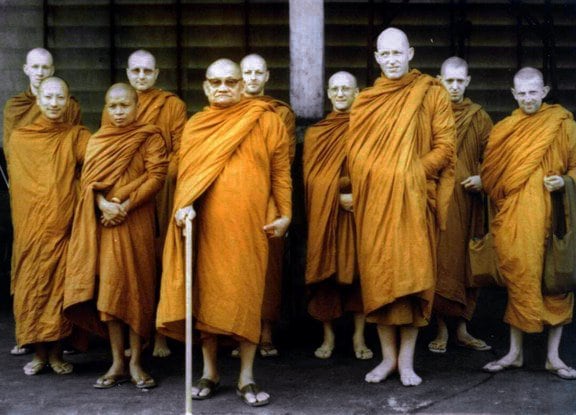
Ajahn Chah con su comunidad (1980) · Public domain
In their words
«Is there enough time to breathe? This is your meditation: mindfulness, naturalness in whatever you do.»Bodhinyana, «Questions and Answers» (traducción inglesa de la Sangha de Wat Pah Nanachat; original oral en tailandés o lao de Isan)

Their central idea
Practice does not consist in reaching special states or pursuing results: the very wish to be free becomes an obstacle. It is a matter of observing attentively what arises and letting it take its natural course, without clinging or rejecting.
See in context
Biography
5 min read
A son of Isan
Chah Chuangchot was born on 17 June 1918 in Bahn Kor, a village of rice fields a few kilometres south of the town of Ubon Ratchathani, in Isan, the great plateau of north-eastern Thailand, close to Laos in language and culture. He was the fifth of the eleven children of Mah and Pim Chuangchot, a farming family well-off by the modest standards of the village. Like almost every boy in the region, he spent some years as a novice in the local monastery, where he learned to read and write; then he went home to help in the fields. What is known of his childhood comes from his own recollections, told over the years in talks and conversations, and from the patient reconstruction of his biographer, the English monk Ajahn Jayasaro.
On 26 April 1939, aged twenty, he received higher ordination at Wat Kor Nai and the Pali name Subhaddo. His first years as a bhikkhu were those of a diligent village monk: he studied the Dhamma, the monastic discipline and the Pali language, and passed the official examinations. His father's death made him feel, by his own account, that all this study was bringing him no closer to the end of suffering. Early in 1947 he abandoned his studies and took up tudong, the wandering life of the forest monks.
The forest and the master
For seven years he walked through the north-east and centre of Thailand, sleeping under the umbrella and mosquito net that forest monks hang from trees, begging his food in the villages and seeking out the teachers of the lineage founded by Ajahn Mun Bhuridatto, the great reformer of forest monasticism. He spent a rains retreat with Luang Pu Kinaree, from whom he learned a meticulous discipline, and early in 1948 he reached the monastery of Nong Peu, in Sakon Nakhon, where Ajahn Mun lived. He stayed only three days. According to the version handed down in the monastery, the old master told him that although the teachings are vast, at heart they are very simple: with mindfulness established, to see that everything arises in the heart-mind. Ajahn Chah would later say that this advice cleared his path.
The following years were ones of extreme practice. He himself recounted, in a talk from the late 1960s, the night he spent alone in a cremation ground beside the freshly dug grave of a child, and the next night, facing a burning pyre, gripped by a fear he described with humour and without sparing detail. He practised in caves and in jungles with tigers and cobras, and learned to use contemplation of death as a tool. The account of those years rests mainly on his own words and on his companions' testimony gathered by Jayasaro, and should be read as such.
Wat Nong Pah Pong
In 1954 he agreed to settle in an uninhabited grove near his home village, a place people avoided because of cobras, tigers and ghosts, and which he therefore judged perfect for a forest monk. There Wat Nong Pah Pong grew. The training was hard: one meal a day, strict observance of the Vinaya, long and seemingly pointless work projects designed to frustrate attachment to tranquillity, and a teacher who pushed his monks to the limits of their patience. His teaching style, by contrast, was plain and full of humour: he spoke the language of farmers, with similes of buffaloes, pots, watermelons and ants, and distrusted techniques and extraordinary states. Meditation, he said, is not done only sitting: it is done while breathing, sweeping or sewing a robe.
His reputation drew thousands of Thai lay people and monks and, from 1967, Westerners. The first was Sumedho, a newly ordained American whom he accepted without concessions: he would eat the same food and practise like everyone else. Others followed, and in 1975 Ajahn Chah authorised the founding of Wat Pah Nanachat, the International Forest Monastery, the first in Thailand run by and for English-speaking monks. In 1976 he received the ecclesiastical title of Phra Bodhiñāṇathera, though to everyone he remained Luang Por, 'venerable father'.
Towards the West
In 1977 the English Sangha Trust invited him to London. Seeing serious interest, he left Ajahn Sumedho there with other monks; in 1979 he returned as the community moved to the new monastery of Chithurst in Sussex, and then travelled to the United States and Canada, where he spoke at the Insight Meditation Society co-founded by his former disciple Jack Kornfield. From that network came Amaravati in England, Bodhinyana in Australia, Abhayagiri in California and dozens of monasteries in Europe and Oceania. Kornfield had introduced him in Living Buddhist Masters (1977) and, with Paul Breiter, published in 1985 A Still Forest Pool, the anthology that made him famous among English-speaking readers.
Ajahn Chah wrote no books. What is read today under his name are transcriptions of talks recorded on cassette tapes, often of poor quality, in Thai or in the Isan dialect, translated by monks of Wat Pah Nanachat, by Ṭhānissaro Bhikkhu, by Paul Breiter, or edited by Ajahn Amaro. His monasteries distribute them free of charge, as a gift of Dhamma, under licences that allow them to be copied but not sold or altered.
Ten years of silence
From the late 1970s diabetes undermined his health: dizziness, lapses of memory, an operation in 1981 that did not halt the paralysis. On 20 January 1983, after five months in a Bangkok hospital, an air-force plane brought him back to Ubon; a Western monk carried him in his arms down the steps. He never spoke again. For more than nine years he lay motionless and silent, tended in shifts by his monks, and his disciples said that the illness was his last teaching on impermanence. He died at 5.20 in the morning of 16 January 1992, aged seventy-three.
His cremation, exactly a year later, brought to the monastery the royal family and a crowd his biographer puts at some four hundred thousand people and other sources at over a million. Wat Nong Pah Pong today has more than two hundred branch monasteries in Thailand and an international network that keeps the forest discipline alive. His talks, translated into dozens of languages, are among the most widely read contemporary Buddhist texts in the West.
Sources: The Sangha, Wat Nong Pah Pong (comp. Bhikkhus Dhammajoti y Gavesako). The Teachings of Ajahn Chah: A Collection of Ajahn Chah's Dhamma Talks. Ubon Ratchathani: Wat Nong Pah Pong, 2007 (ed. 4.3), con la semblanza «About Ajahn Chah». Distribución gratuita. · Ajahn Jayasaro. Stillness Flowing: The Life and Teachings of Ajahn Chah. Panyaprateep Foundation, 2017. Distribución gratuita. · Ajahn Jayasaro. Quietud que fluye: la vida y las enseñanzas de Ajahn Chah. Trad. Ricardo Szwarcer. Panyaprateep Foundation, 2023 (ISBN 978-1-78432-207-6; licencia CC BY-NC-ND 4.0). · Kornfield, Jack; Breiter, Paul (comp. y ed.). A Still Forest Pool: The Insight Meditation of Achaan Chah. Wheaton (IL): Theosophical Publishing House / Quest Books, 1985. · Ajahn Chah. Food for the Heart: The Collected Teachings of Ajahn Chah. Ed. Ajahn Amaro, prólogo de Jack Kornfield. Boston: Wisdom Publications, 2002.
Timeline
A life, year by year
Each point is a documented event. Click to read it, with its source and degree of certainty.
June 17, 1918age 0Bahn Kor, Ubon Ratchathani
Birth in an Isan village
Born on the seventh day of the seventh moon of the Year of the Horse, fifth of the eleven children of Mah and Pim Chuangchot, rice farmers from a well-off village family.
DocumentedAjahn Jayasaro. Quietud que fluye: la vida y las enseñanzas de Ajahn Chah. Trad. Ricardo Szwarcer. Panyaprateep Foundation, 2023 (ISBN 978-1-78432-207-6; licencia CC BY-NC-ND 4.0).
After their death
- January 16, 1993Cremation before a multitude
- 2017Stillness Flowing
June 17, 1918 · age 0
Birth in an Isan village
Born on the seventh day of the seventh moon of the Year of the Horse, fifth of the eleven children of Mah and Pim Chuangchot, rice farmers from a well-off village family.
Documented
c. 1927 · age 9
Novice in the village monastery
Following Isan custom he enters the local monastery as a novice, where he learns to read and write; after some years he returns home to help his parents.
Documented
April 26, 1939 · age 20
Ordination as a bhikkhu
He receives higher ordination and the monastic name Subhaddo; in the following years he studies the Dhamma, the Vinaya and Pali in village monasteries.
Documented
1947 – 1954 · age 28
Tudong years
After his father's death he gives up his studies and takes up the wandering life of the forest monks: forests, caves and cremation grounds, following teachers such as Luang Pu Kinaree.
Documented
1948 · age 29
Three days with Ajahn Mun
Early in 1948 he visits the great forest master, who teaches him that although the texts are extensive, at heart practice is very simple: to see with mindfulness that everything arises in the heart-mind.
Documented
1954 · age 36
Founding of Wat Nong Pah Pong
He settles in an uninhabited grove near his home village, feared for its cobras and ghosts; there grows the monastery that will give its name to a network of over two hundred branches.
Documented
1967 · age 49
The first Western disciple arrives
The newly ordained American Sumedho arrives at the monastery; Ajahn Chah accepts him without granting him any privilege for being a Westerner.
Documented
1975 · age 57
Wat Pah Nanachat
The International Forest Monastery is founded, the first in Thailand run by and for English-speaking monks, with Ajahn Sumedho as abbot.
Documented
1976 · age 58
Title of Phra Bodhiñāṇathera
He receives the ecclesiastical title under which he appears in official documents, though to his disciples he remains Luang Por, 'venerable father'.
Documented
1977 · age 59
First journey to England
Invited by the English Sangha Trust, he travels with Ajahn Sumedho to the Hampstead Buddhist Vihara and leaves his disciple there to found a monastic community in the West.
Documented
1979 · age 61
Chithurst and the American tour
He returns to England as the monks move to the new monastery of Chithurst (Cittaviveka) and afterwards teaches at the Insight Meditation Society in Massachusetts and in Canada.
Documented
January 20, 1983 · age 64
Return to Ubon, paralysed and speechless
After surgery in 1981 and five months in a Bangkok hospital, diabetes and its consequences leave him paralysed; a Western monk carries him in his arms from a military aircraft. He will never speak again.
Documented
January 16, 1992 · age 73
Death
He dies at 5.20 in the morning, after more than nine years motionless and silent, tended in shifts by his monks.
Documented
January 16, 1993
Cremation before a multitude
Exactly a year after his death the cremation takes place, attended by the royal family. His biographer estimates some four hundred thousand people; other sources speak of more than a million.
Documented
2017
Stillness Flowing
Ajahn Jayasaro publishes the standard biography, the fruit of decades of interviews with disciples; it is distributed free and translated into Spanish in 2023 as Quietud que fluye.
Documented
Works
Essential works
The works without which their legacy cannot be understood.
Later compilation · 1980
A Taste of Freedom
A selection of talks to lay people and monks—'Training this Mind', 'On Meditation', 'The Path in Harmony', 'The Middle Way Within', 'Opening the Dhamma Eye', 'Convention and Liberation'—translated by the Wat Pah Nanachat community. It is one of the most reprinted collections and the first many readers encounter; it sets out the middle way, mindfulness in daily life and the difference between conventions and liberation.
3 editions · amazon.com

Later compilation · 1985
A Still Forest Pool
A Still Forest Pool: The Insight Meditation of Achaan Chah
A thematic anthology of sayings and talk fragments gathered by Jack Kornfield and Paul Breiter, both former monks in his monasteries. Arranged by theme—right understanding, meditation, monastic life, questions and answers—it made Ajahn Chah an author known beyond Buddhist circles. The title comes from his image of the attentive mind growing still like a clear forest pool where strange animals come to drink.
2 editions · amazon.com

Later compilation · 2002
Food for the Heart
Food for the Heart: The Collected Teachings of Ajahn Chah
The standard anthology published by Wisdom Publications, edited by Ajahn Amaro with a foreword by Jack Kornfield: it gathers in a single volume revised talks from the free-distribution collections, with an introduction on the forest tradition. It is the most widely read gateway to his teaching in English.
1 edition · amazon.com

Later compilation · 2005
Everything Arises, Everything Falls Away
Everything Arises, Everything Falls Away: Teachings on Impermanence and the End of Suffering
Talks and fragments on impermanence and the end of suffering translated by Paul Breiter, not included in the Wat Pah Nanachat collections. Its tone is especially direct and aimed at lay readers.
3 editions · amazon.com
Complete works (23)
Ajahn Chah
Fragments of a Teaching
The Conscious LibraryFragments of a Teaching
1972
Ajahn Chah
Bodhinyana
The Conscious LibraryBodhinyana
1982

Living Dhamma
1992

Food for the Heart (1992 collection)
1992
Ajahn Chah
A Tree in a Forest
The Conscious LibraryA Tree in a Forest
1994

No Ajahn Chah
1994
Ajahn Chah
The Path to Peace
The Conscious LibraryThe Path to Peace
1996
Ajahn Chah
Clarity of Insight
The Conscious LibraryClarity of Insight
2000

Being Dharma
2001
Ajahn Chah
Unshakeable Peace
The Conscious LibraryUnshakeable Peace
2003

Everything Is Teaching Us
2004
Ajahn Chah
The Teachings of Ajahn Chah
The Conscious LibraryThe Teachings of Ajahn Chah
2007
Ajahn Chah
Still, Flowing Water: Eight Dhamma Talks
The Conscious LibraryStill, Flowing Water: Eight Dhamma Talks
2007
Ajahn Chah
In Simple Terms
The Conscious LibraryIn Simple Terms
2010

The Collected Teachings of Ajahn Chah
2011
Ajahn Chah
On Meditation
The Conscious LibraryOn Meditation
2018
Ajahn Chah
The Training of the Heart
The Conscious LibraryThe Training of the Heart
Ajahn Chah
Our Real Home
The Conscious LibraryOur Real Home
Ajahn Chah
Beyond Cause and Effect
The Conscious LibraryBeyond Cause and Effect
1990
Quotations
Quotations located in a specific work. Each carries its provenance and its level of confidence.
Is there enough time to breathe? This is your meditation: mindfulness, naturalness in whatever you do.VerifiedBodhinyana, «Questions and Answers» (traducción inglesa de la Sangha de Wat Pah Nanachat; original oral en tailandés o lao de Isan)
Essential ideas (editorial summary)
Out of respect for copyright, these ideas are summarised in our own words and are not presented as literal quotations.
- Practice does not consist in reaching special states or pursuing results: the very wish to be free becomes an obstacle. It is a matter of observing attentively what arises and letting it take its natural course, without clinging or rejecting.
- Meditation is not confined to the sitting posture: it can be done walking, working, eating or sewing, because it consists in sustaining mindfulness and naturalness in any activity; whoever claims to have no time to meditate still has time to breathe.
- Everything perceived as certain is in fact uncertain. Answering every desire and every aversion with a 'not sure' cuts identification with mental states and is, for him, the standard of the noble ones.
- Letting go is neither passivity nor negligence: it is a demanding practice, learned like someone who at last drops a heavy rock he had been carrying and only then discovers how light he can be.
- Monastic discipline and ascetic practices are not ends in themselves but a framework that exposes attachment and strengthens patience; monastic training should therefore be hard and, at the same time, free of fanaticism.
- The body, the house and possessions are borrowed homes that belong to the world; the only true home is the peace born of understanding impermanence, and one can return to that peace even in old age and in the face of death.
Last words
There are no verifiable records of their last words.
There are no recorded last words. From early 1983, after years of diabetes and a failed operation in 1981, he was paralysed, unable to express himself coherently, and stopped speaking; he died in silence on 16 January 1992, after more than nine years cared for by his monks. Ajahn Jayasaro, his biographer, notes that many disciples expected some marvel before his death and that there was none.
Source: Ajahn Jayasaro. Quietud que fluye: la vida y las enseñanzas de Ajahn Chah. Trad. Ricardo Szwarcer. Panyaprateep Foundation, 2023 (ISBN 978-1-78432-207-6; licencia CC BY-NC-ND 4.0).
Ask
What their work answers
Twelve great human questions and what their texts allow us to answer, with references. We never put words in their mouth.
What is the Absolute? Does God exist?
No god intervenes: it is enough to see the transient and let it go
No creator GodInferred from their doctrine
Ajahn Chah wrote no books: his teachings are talks in Thai or in the Lao of Isan, recorded and transcribed by his disciples. In them no creator God appears, nor is his existence discussed. His framework is that of the Pali canon and the Thai forest tradition: what matters is to see clearly that everything that arises is transient, imperfect and ownerless, and to let it go. When he speaks of what remains, he calls it peace or «the one who knows», and describes it as a quality of the liberated mind, not as a being. His work allows one to answer that liberation depends on no god, although he himself never made the question a subject of debate: he always turned it back to practice.
Compare this question with other teachersWho am I? Is there a true self?
There is no Ajahn Chah: everything is transient, imperfect and ownerless
There is no permanent selfStated explicitly
In the talks transcribed by his disciples, Ajahn Chah applies the Pali teaching of non-self to the most immediate experience. Whatever arises in the mind, pleasure or pain, is to be seen as transient, imperfect and ownerless; none of it is «mine» or «I». One of his collections is entitled No Ajahn Chah, and he himself would repeat that the teacher's name and figure are useful conventions, not an entity. Identification with the body and with mental states is what produces suffering; letting go does not mean denying them but ceasing to carry them. What remains when one lets go he called «the one who knows», a quality of attentive knowing, not a soul or a Self.
Compare this question with other teachersWhy do we suffer?
We suffer from grasping; the glass is already broken
Craving and attachmentStated explicitly
Ajahn Chah's talks, transcribed and translated by his disciples, return suffering again and again to its cause in the second noble truth: clinging. In «Still, Flowing Water», from the 1981 rains retreat, he offers a domestic image: if one reflects beforehand that the glass is already broken, even when it is not, the cause of suffering ceases. It is not a matter of not using the glass, but of not demanding that it last. Phenomena he invites us to see as transient, imperfect and ownerless; everything is uncertain, and answering every desire and every aversion with «not sure» cuts identification. Pain exists, but the added suffering arises from carrying what cannot be held.
Compare this question with other teachersWhat happens after death?
The body is a borrowed home; the true home is inner peace
Silence or reserveInferred from their doctrine
Ajahn Chah's best-known talk on death, «Our Real Home», was addressed to an elderly lay disciple who was dying, and his monks transcribed it. He does not speak to her of what will come afterwards. He asks her to look at the body as what it is: something that belongs to nature and follows its course, like flowing water or an ageing tree. The body, the house and possessions are borrowed homes; the only true home is inner peace, and one can return to that peace even at the end. The task in the face of death is not to speculate but to let go now of what will have to be let go anyway. Thus he resolves the question: by shifting it from the hereafter to present practice.
Compare this question with other teachersHow is liberation or salvation attained?
Ethics, concentration and wisdom in every posture, without chasing results
Through disciplined practiceStated explicitly
Ajahn Chah taught the classical Theravāda path of ethics, concentration and wisdom, but insisted that they are not separate nor confined to the sitting posture. In his forest monasteries, the Vinaya and some ascetic practices were the framework that exposes attachment and strengthens patience. Mindfulness had to be sustained while walking, working or eating: whoever says they have no time to meditate does have time to breathe. At the same time, he warned against spiritual ambition: one should not try to get anywhere in practice, because the very desire to be free or enlightened is what prevents freedom. Liberation is the fruit of letting go with perseverance, day after day, of what is seen as transient, imperfect and ownerless.
Compare this question with other teachersIs a teacher necessary?
One learns by living in the forest community, under its discipline
Community and traditionInferred from their doctrine
Ajahn Chah trained his disciples, Thai and Western, in forest monasteries where teaching was not separated from communal life. Strict observance of the Vinaya, the monastic code, and of some ascetic practices served to expose each person's attachment, impatience and pride; the teacher observed and corrected, but the school was the whole community with its rules, its timetable and its work. At the same time, his talks always return responsibility to the practitioner: the teacher only points, and what is decisive is looking at one's own mind. That a collection of his teachings is entitled No Ajahn Chah well expresses this double attitude: a demanding presence that does not want to become an object of attachment.
Compare this question with other teachersIs the world real?
Everything arises, everything passes: conditioned phenomena, without an owner
A web of causes without substanceInferred from their doctrine
Ajahn Chah did no metaphysics; he described the world as it appears to someone who observes it attentively. What presents itself to the senses and the mind arises, lasts a while and ceases, according to its causes; it must be seen as transient, imperfect and ownerless. One of his collections is titled precisely Everything Arises, Everything Falls Away. He often spoke of «nature» to refer to this course of things: the body belongs to nature and follows it, like flowing water. The world is not unreal, but neither is it certain; the certainty we attribute to it is what makes us suffer. Understanding dependent origination, in his teaching, is exercised by watching how a sensation gives way to a desire, rather than in abstract analysis.
Compare this question with other teachersWhat is love?
He did not make love a theme; he taught seeing affection as attachment
Did not address it
The talks of Ajahn Chah that have been transcribed and translated contain no developed teaching on love. When affection appears, it usually does so as a form of attachment to be seen clearly: loved ones, like the body and possessions, are transient, and clinging to them prepares pain. This does not mean coldness. The Theravāda tradition in which he was trained cultivates loving-kindness (mettā) and compassion as practices, and he himself was known for his patience and humour with monks and lay people. But his emphasis lay elsewhere: on the peace that arises from letting go. From his work one can infer that mature love is the kind that does not demand that the other be certain or permanent.
Compare this question with other teachersAre we free, or is everything determined?
Kamma is action: what one does now with mindfulness changes the course
Karma and choiceInferred from their doctrine
Ajahn Chah taught within the Theravāda framework of kamma, understood as intentional action and its consequences. In his talks, transcribed by his disciples, the emphasis falls less on the past that conditions than on what can be done now: observing what arises in the mind and not acting moved by desire or aversion. Answering every impulse with «not sure» cuts automatic reaction and opens a margin of freedom. At the same time, his teaching on non-self discourages thinking that there is someone in control: mental states follow their course according to their causes. The freedom he proposes is not that of a sovereign subject but that of an attention that stops feeding the causes of suffering.
Compare this question with other teachersWhy meditate or pray?
Mindfulness and naturalness in everything: seeing the transient until letting go
Seeing reality as it isStated explicitly
For Ajahn Chah, meditation is not reduced to time spent cross-legged. To anyone who said they had no time, he would ask whether they had enough time to breathe: that is meditation, mindfulness and naturalness in whatever one does. Practice consists in being mindful and letting things take their natural course; thus the mind grows quiet in any surroundings, like a clear forest pool. That stillness is not an end: in it one sees clearly that what arises is transient, imperfect and ownerless, and this seeing is what liberates. He also warned against meditative ambition: one should not try to get anywhere, because the wish for enlightenment becomes another obstacle.
Compare this question with other teachersCan reason know the ultimate?
Knowing by hearsay is not knowing: understanding arises in the heart
The ultimate lies beyond the mindInferred from their doctrine
Ajahn Chah insistently distinguished between knowledge that comes from books or from thinking about the Dhamma and knowledge born of practice. In his talks, known through his disciples' transcriptions, study appears as a useful map that does not replace the path: knowing what the texts say does not by itself transform the mind. Thought can analyse impermanence and reach correct conclusions without anything changing; true understanding occurs when the mind, quietened, sees directly that things are transient, imperfect and ownerless, and lets go. He called «the one who knows» that quality of attentive knowing which is not thought. He did not scorn the study of texts, which his monks practised, but subordinated it to experience.
Compare this question with other teachersWithdraw from the world or transform it?
Practice in every posture: whoever breathes has time to meditate
Contemplation in actionStated explicitly
Ajahn Chah was a forest monk and founded secluded monasteries where life followed a strict discipline; for monks, retreat was the condition of practice. But his teaching to laypeople, and to a large extent to the monks themselves, insisted that meditation is not confined to the sitting posture or to a place. To anyone who complained of having no time he would ask whether they had time to breathe: that is meditation, mindfulness and naturalness in whatever one does. The mind can grow quiet in any surroundings, like a clear forest pool. He did not propose reforming society, but living in its midst with attention, seeing the transience of each situation and letting go of what presents itself.
Compare this question with other teachers
Affinities & tensions
Affinities and tensions
Calculated question by question from their positions. The reason for each agreement or clash, on click.
Thinks most like
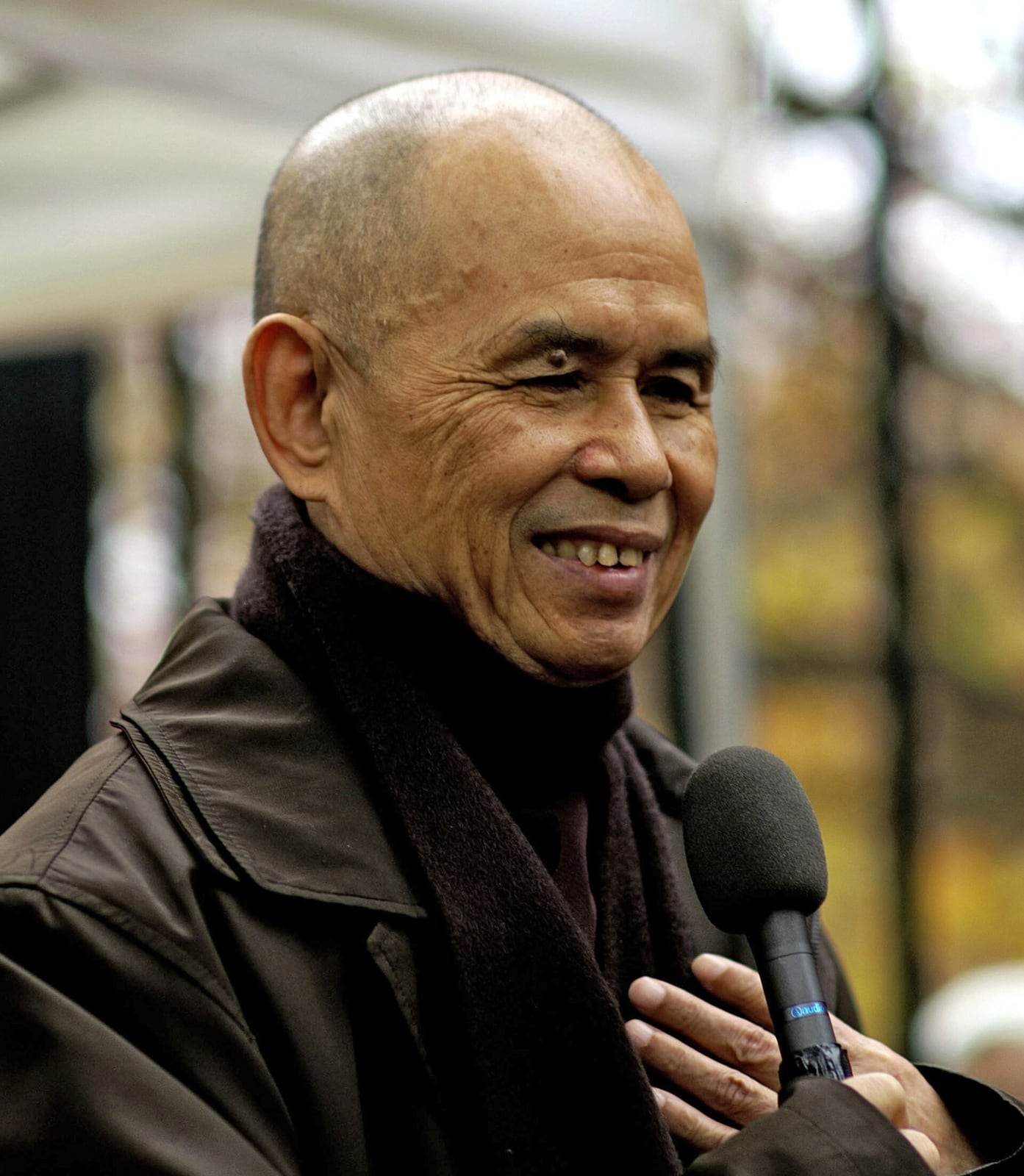
Thich Nhat Hanh
They agree on: Who am I? Is there a true self? · Why do we suffer? · How is liberation or salvation attained?
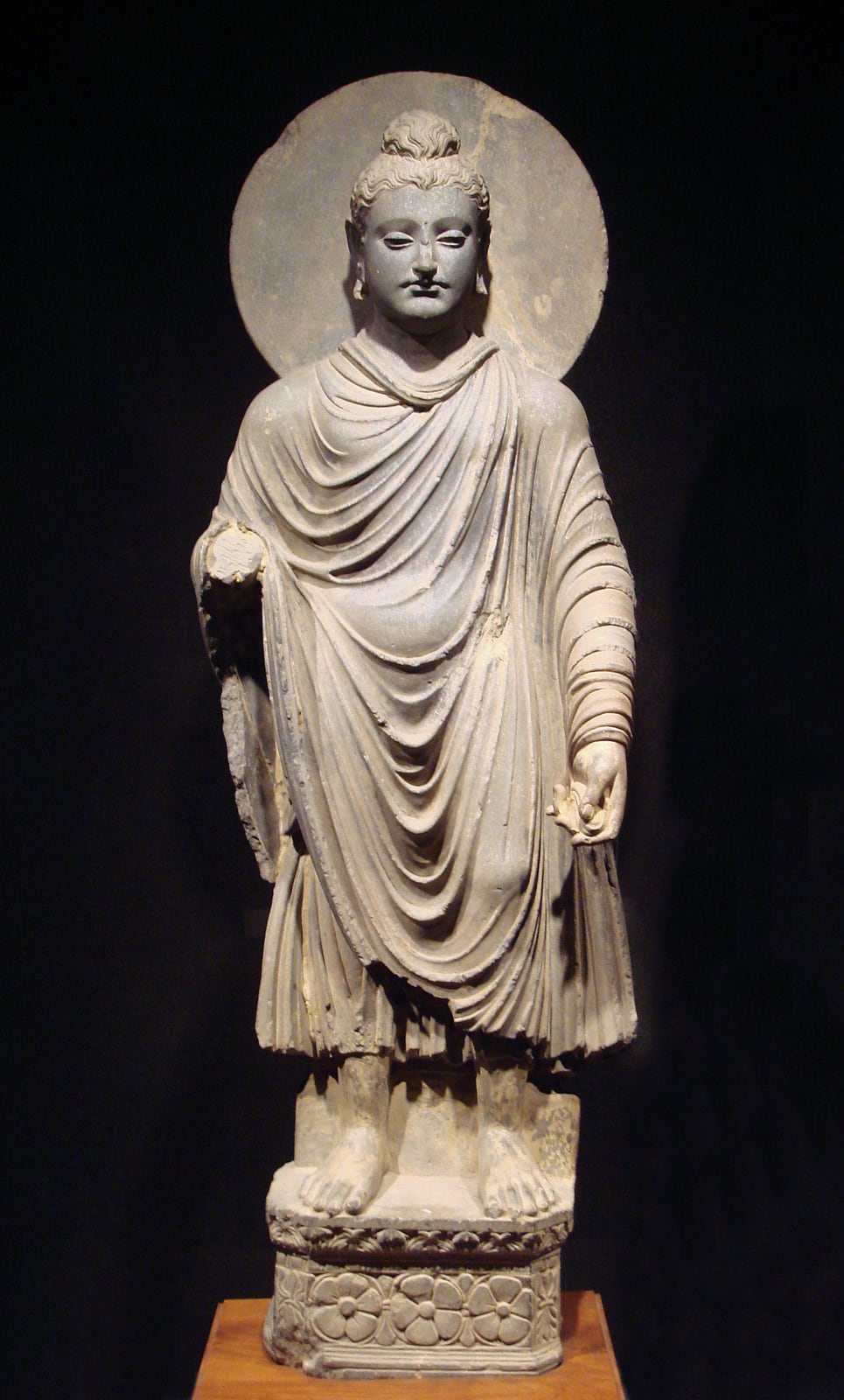
Siddhartha Gautama, the Buddha
They agree on: What is the Absolute? Does God exist? · Who am I? Is there a true self? · Why do we suffer?
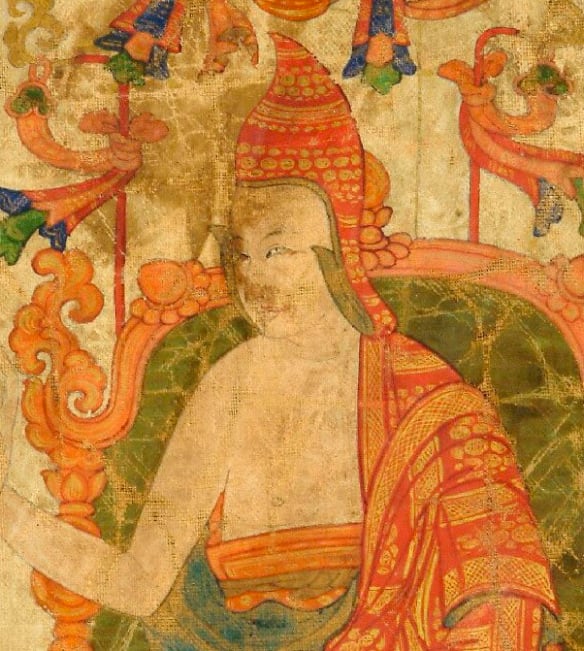
Śāntideva
They agree on: What is the Absolute? Does God exist? · Who am I? Is there a true self? · Why do we suffer?

Pema Chödrön
They agree on: What is the Absolute? Does God exist? · Who am I? Is there a true self? · Why do we suffer?
Thinks most unlike

Emanuel Swedenborg
They clash on: What is the Absolute? Does God exist? · Who am I? Is there a true self?
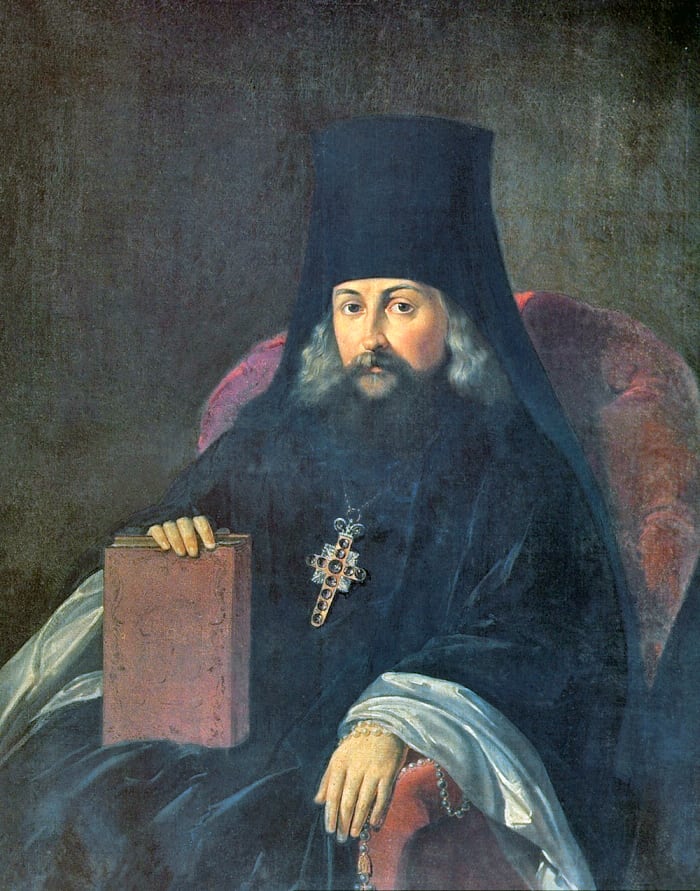
Ignatius Brianchaninov
They clash on: What is the Absolute? Does God exist? · Who am I? Is there a true self?
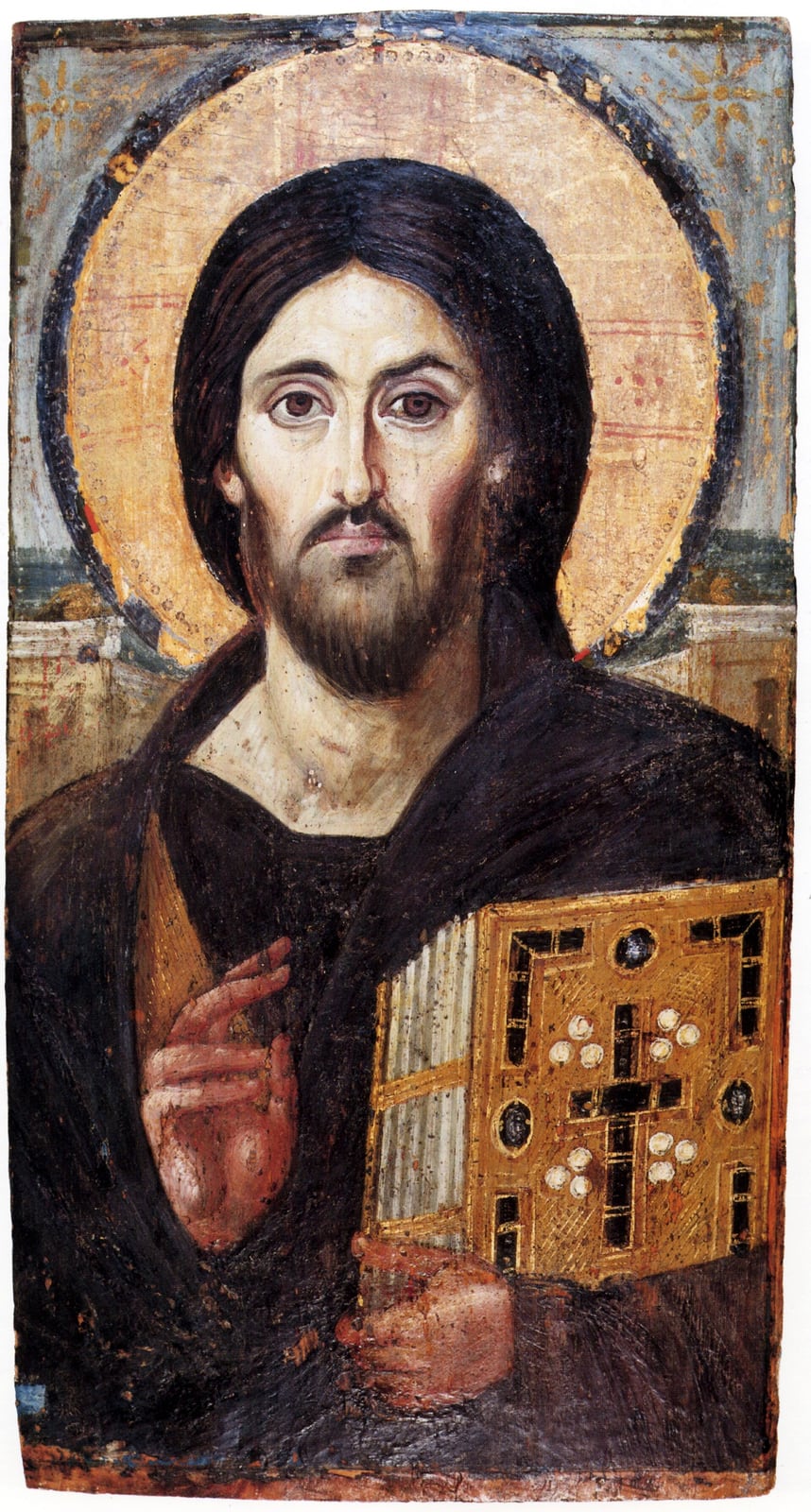
Jesus of Nazareth
They clash on: What is the Absolute? Does God exist? · Who am I? Is there a true self?

Rabia al-Adawiyya
They clash on: What is the Absolute? Does God exist?
Anecdotes and stories
Anecdotes and stories
Testimonyc. 1947–1954
Two nights in the cremation ground
Origin of the story: Ajahn Chah's own account in the talk 'In the Dead of Night…', given on an uposatha night at Wat Nong Pah Pong in the late 1960s and published in Food for the Heart (1992) and The Teachings of Ajahn Chah (2007). Jayasaro (Stillness Flowing) places it in the wandering years.
Testimony1948
Three days with Ajahn Mun
Origin of the story: The visit and its length are recorded in Ajahn Jayasaro's biography, based on companions' testimony; the content of the teaching comes from Ajahn Chah's own account as given in the official Wat Nong Pah Pong profile. Ajahn Mun's supposed recognition is oral tradition that Jayasaro presents as hearsay.
Documented1966
No privileges for the first Westerner
Origin of the story: Official profile 'About Ajahn Chah' in The Teachings of Ajahn Chah (Wat Nong Pah Pong, 2007) and Ajahn Sumedho's own testimony, gathered by Jayasaro.
Oral traditionc. 1970s–1981
The glass that is already broken
Origin of the story: The narrative version comes from Mark Epstein, Thoughts Without a Thinker (1995), who does not specify when or to whom Ajahn Chah said it. The simile is documented in the talk 'Still, Flowing Water' (Living Dhamma; The Teachings of Ajahn Chah, 2007).
Source: Epstein, Mark. Thoughts Without a Thinker: Psychotherapy from a Buddhist Perspective. Nueva York: Basic Books, 1995.
Hagiographic accountc. 1947–1954
The vision of the child in the grave
Origin of the story: It circulates without a precise source in the 'Described Miracles' section of the English Wikipedia and in Thai devotional material. It does not appear in the autobiographical talk or in the Jayasaro biography consulted; it is recorded as a hagiographic tale.
Source: Wikipedia (en), «Ajahn Chah».
Documented1983–1992
Ten years without words
Origin of the story: Opening scene of Ajahn Jayasaro's biography (Stillness Flowing, 2017; Quietud que fluye, 2023), based on eyewitnesses.
Teachings
Teachings
The notions that structure their thought, explained in context.
'Not sure' (mai nae)mai-nae
A practical application of anicca, one of the three characteristics of existence in Theravada Buddhism.
Still, flowing wateragua-quieta-que-fluye
It expresses the unity of samatha and vipassana characteristic of Ajahn Mun's forest tradition.
Letting gosoltar
A practical interpretation of non-clinging (anupādāna) and the middle way.
Practice in every posturepractica-en-todas-las-posturas
It develops the Satipaṭṭhāna Sutta's teaching on mindfulness in the four postures.
'The one who knows' (Buddho)el-que-sabe
A characteristic term of the Thai forest tradition (phu ru), linked to the recitation of Buddho in Ajahn Mun's meditation.
Forest discipline (Vinaya and dhutanga)disciplina-del-bosque
The legacy of Ajahn Mun's renewal movement, which returned the Vinaya to the centre of monastic life in Isan.
Videos
Videos
Recordings, interviews and documentaries. Videos play from YouTube; they are not hosted here.
Ajahn Chah I The mindful Way I BBC Documentary I 1977
Documentary· EN· 1977
Buddhist Teachings
Ajahn Chah - Talk About Nong Pah Pong Monastery (in Thai & English)
Original recording· TH
The Noble Path
Ajahn Chah / Talks during visit of Insight Meditation Society (IMS) in 1979 / 8/11
Original recording· TH· 1979
Buddhist Teachings
Life at Wat Nong Pah Pong with Ajahn Chah | Ajahn Tiradhammo
Interview· EN
Wat Buddha Dhamma - Theravadin Forest MonasteryOfficial channel
Reading: "Koṇḍañña Knows" by Ajahn Chah | Ajahn Pasanno
Original recording· EN
AbhayagiriOfficial channel
The Art of Ajahn Chah's Training Method | Ajahn Anan
Lecture· EN· 2026
Ajahn Anan DhammaOfficial channel
Why are We Here? | Ajahn Chah
Original recording· EN
Ajahn Anan DhammaOfficial channel
Insegnamenti Ajahn Chah [40] - Che cos'è la contemplazione
Original recording· IT
Santacittarama Monastero BuddhistaOfficial channel
Ajahn Chah Relic Stupa at Night | Wat Nong Pah Pong | Ajahn Dhammasiha
Documentary· EN
Dhamma Talks at DhammagiriOfficial channel
Ajahn Chah en español - "Entrenando esta mente"
Original recording· ES
Meditemosuy
Ajahn Chah - Fragments d'un enseignement [Théravada]
Original recording· FR
Le Vieux Sage
Gallery
Gallery
Images with verified licences. Each keeps its authorship and attribution.
Connections
Connections
Influences, discipleships and affinities. Documented relations are distinguished from similarities identified by analysis.
Influenced by
Siddhartha Gautama, the Buddha
All his teaching presents itself as practice of the Buddha's Dhamma and Vinaya according to the Pali canon.
Documented relation
Contemporary of
A contemporary and parallel figure in spreading mindfulness from Asia to the West; no meeting between them is recorded.
Similarity identified by analysis
Ideas akin to
Both insisted on simple everyday practice rather than the pursuit of special states, and both formed Western communities in the 1960s and 1970s; there is no documented contact.
Similarity identified by analysis
Contemporary of
The 14th Dalai Lama (Tenzin Gyatso)
A contemporary in transmitting Buddhism to the West, from the Theravada forest tradition and the Tibetan tradition respectively.
Similarity identified by analysis
Linked from other profiles
Sources
Sources
Bibliography and catalogues consulted for this profile.
- Wikidata, «Ajahn Chah» (Q411930).
- The Sangha, Wat Nong Pah Pong (comp. Bhikkhus Dhammajoti y Gavesako). The Teachings of Ajahn Chah: A Collection of Ajahn Chah's Dhamma Talks. Ubon Ratchathani: Wat Nong Pah Pong, 2007 (ed. 4.3), con la semblanza «About Ajahn Chah». Distribución gratuita.
- Ajahn Jayasaro. Stillness Flowing: The Life and Teachings of Ajahn Chah. Panyaprateep Foundation, 2017. Distribución gratuita.
- Ajahn Jayasaro. Quietud que fluye: la vida y las enseñanzas de Ajahn Chah. Trad. Ricardo Szwarcer. Panyaprateep Foundation, 2023 (ISBN 978-1-78432-207-6; licencia CC BY-NC-ND 4.0).
- Wikipedia (en), «Ajahn Chah».
- Wikipedia (es), «Ajahn Chah».
- Kornfield, Jack; Breiter, Paul (comp. y ed.). A Still Forest Pool: The Insight Meditation of Achaan Chah. Wheaton (IL): Theosophical Publishing House / Quest Books, 1985.
- Ajahn Chah. Food for the Heart: The Collected Teachings of Ajahn Chah. Ed. Ajahn Amaro, prólogo de Jack Kornfield. Boston: Wisdom Publications, 2002.
- Breiter, Paul. Venerable Father: A Life with Ajahn Chah. Nueva York: Paraview, 2004.
- Open Library, autor «Ajahn Chah» (OL2924730A, OL6725661A, OL3810410A): obras y ediciones con ISBN.
- Epstein, Mark. Thoughts Without a Thinker: Psychotherapy from a Buddhist Perspective. Nueva York: Basic Books, 1995.
- ajahnchah.org — Dhammatalks by Ajahn Chah (índice de charlas y ediciones, © Wat Nong Pah Pong).
- Kornfield, Jack. Living Buddhist Masters. Santa Cruz: Unity Press, 1977 (reed. como Living Dharma, Boston: Shambhala, 1996).
- Ajahn Chah. El sabor de la libertad. Trad. Hilda Patricia Castañeda Corona. Hemel Hempstead: Publicaciones Amaravati, 2018 (página de créditos; CC BY-NC-ND 4.0).
- Wat Nong Pah Pong, sitio oficial.
- dhammatalks.org, «Ajaan Chah Subhaddo»: traducciones de Ṭhānissaro Bhikkhu (Still, Flowing Water; In Simple Terms).
- Rights holder
- Wat Nong Pah Pong (The Sangha) y monasterios de su red (Amaravati / Aruno Publications, Wat Pah Nanachat, Abhayagiri) para las traducciones de distribución gratuita; las ediciones comerciales pertenecen a sus editoriales y traductores (Wisdom Publications, Shambhala, Quest Books)
- Official site
- www.watnongpahpong.org
Pending confirmation
What this profile has not yet been able to settle. We would rather say so than fill it in.
- La foto principal («AjahnChahSangha.jpg») está declarada en Commons como dominio público por cesión de la comunidad («Published into the public domain by the Sangha»), con fuente en un blog; conviene confirmar la cesión con Wat Nong Pah Pong.
- Cifra de asistentes a la cremación de 1993: unas 400 000 según Ajahn Jayasaro; más de un millón según otras fuentes (Wikipedia). Sin cifra oficial localizada.
- Faltan ISBN y fechas de muchas ediciones de distribución gratuita (A Taste of Freedom 1980, Bodhinyana 1982, Living Dhamma 1992, Food for the Heart 1992, The Path to Peace, Clarity of Insight) y de las ediciones españolas «Un árbol en el bosque» y «Dhamma viviente».
- Ediciones españolas de A Still Forest Pool y Food for the Heart: no localizadas en catálogo.
- Año de In Simple Terms (Ṭhānissaro Bhikkhu) sin confirmar; fechas de los opúsculos de la Buddhist Publication Society (Bodhi Leaves 107 y 111).
- Inventario de las compilaciones originales en tailandés (ediciones de Wat Nong Pah Pong y de discípulos): solo se ha registrado una, la de Open Library.
- Sin textos para la sala de lectura: las traducciones circulan gratis, pero con licencias CC BY-NC-ND o «solo distribución gratuita», no en dominio público (Ajahn Chah murió en 1992 y los traductores viven).
- Más vídeos oficiales en tailandés (Wat Nong Pah Pong) y en español: los localizados en español son lecturas de canales no oficiales.
Researched on 2026-10-25