Padmasambhava
Self-Liberation through Seeing with Naked Awareness
Traditional attribution
Self-Liberation through Seeing with Naked Awareness
རིག་པ་ངོ་སྤྲོད་གཅེར་མཐོང་རང་གྲོལ། (rig pa ngo sprod gcer mthong rang grol)
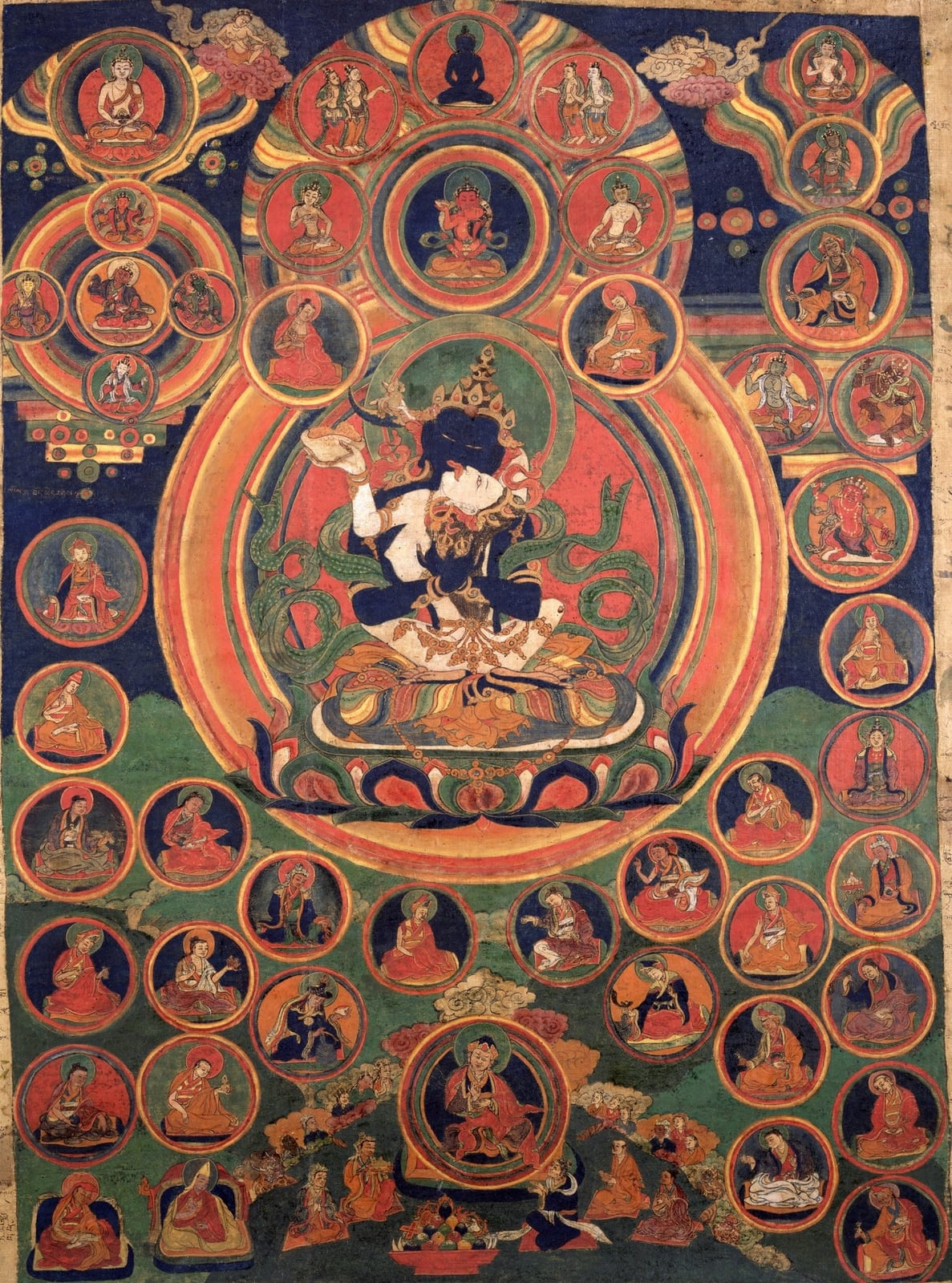
A short text from Karma Lingpa's cycle that introduces the practitioner to the nature of his own mind (rig pa) in the Great Perfection style. Its 1954 English version made it one of the most quoted Dzogchen texts outside Tibet.
No edition of this work is currently on sale in a store we have been able to verify.
Authorship note
A 'treasure' text (gter ma): Nyingma tradition holds that Padmasambhava taught it in the eighth century, that Yeshe Tsogyal wrote it down in code and that it was hidden to be revealed centuries later by a discoverer (gter ston). For historical criticism it is a composition from the revealer's period.
Editions and translations
Editions in your language first, without hiding the others. Each with its cover and its store.
English
Padmasambhava
The Tibetan Book of the Great Liberation
The Conscious LibraryThe Tibetan Book of the Great Liberation
Oxford University Press, 1954
Translation: Sardar Bahadur S. W. Laden La y otros (ed. W. Y. Evans-Wentz)
Con comentario de C. G. Jung.
Español
Padmasambhava
El libro tibetano de la gran liberación
The Conscious LibraryEl libro tibetano de la gran liberación
Kier
ISBN 9789501700534
Versión española de la edición de Evans-Wentz; ISBN según Open Library.
Other works by Padmasambhava
- The Great Liberation by Hearing in the Intermediate State (Bardo Thödol, 'Tibetan Book of the Dead') · 1350
- The Chronicle of Padma (Padma Kathang) · 1352
- The Copper Island (Zangling ma): Life of Padmasambhava · 1150
- Garland of Views: An Essential Instruction · 800
- The Self-Liberation of the Intention of the Peaceful and Wrathful Deities (Karma Lingpa's cycle) · 1350
- Dakini Teachings: Padmasambhava's Advice to Yeshe Tsogyal · 1150
- Advice from the Lotus-Born (Zhal gdams)
- The Gradual Path of the Wisdom Essence (Lamrim Yeshe Nyingpo) · 1856
- The Prayer in Seven Chapters (Le'u Dünma) · 1350
- The Seven-Line Prayer
- The Fivefold Chronicles (Kathang Denga) · 1350
- Gathering of the Sugatas of the Eight Commands (Kagye Deshek Düpa) · 1150
- The Great Treasury of Precious Termas (Rinchen Terdzö) · 1880
Sources
- Cuevas, Bryan J. The Hidden History of the Tibetan Book of the Dead. Nueva York: Oxford University Press, 2003.
Affiliate link: if you buy through it, the library may receive a commission at no extra cost to you. When an edition's real cover is not available, we show an illustrative library cover.