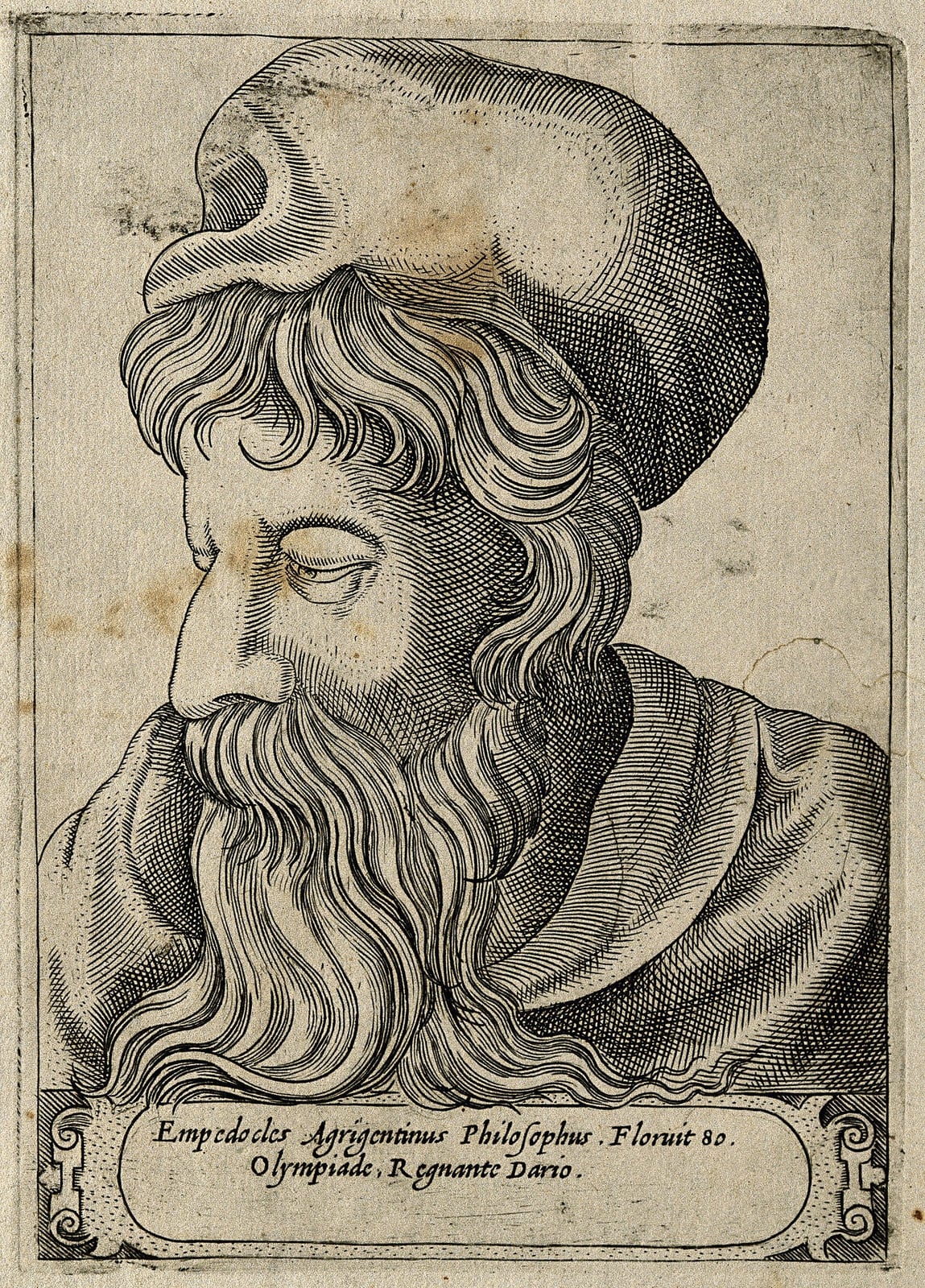
Attribuée à Empedocles
«Everything is composed of four elements: earth, water, air and fire.»
Fausse attribution
Verdict
Elle ne figure pas dans l'œuvre de Empedocles
The doctrine is his, but not the vocabulary: Empedocles speaks of "roots" (rhizomata) and names them after gods. The term "elements" (stoicheia) comes from Plato and Aristotle.
Ce qu'il a vraiment dit
Paroles vérifiées de Empedocles
«For straitened are the powers that are spread over their bodily parts.»
DK 31 B2.1, en Sexto Empírico, Contra los matemáticos VII 123. Griego: texto de Fairbanks (1898), basado en la edición de Stein; numeración Diels-Kranz. Inglés: John Burnet, Early Greek Philosophy (1908). Español: traducción propia.
«Hear first the four roots of all things: shining Zeus, life-bringing Hera, Aidoneus, and Nestis whose tear-drops are a well-spring to mortals.»
DK 31 B6, en Aecio I 3, 20, y Diógenes Laercio VIII 76 (DK lee τέσσαρα γὰρ πάντων). Griego: texto de Fairbanks (1898), basado en la edición de Stein; numeración Diels-Kranz. Inglés: John Burnet, Early Greek Philosophy (1908). Español: traducción propia.
«And I shall tell thee another thing. There is no coming into being of aught that perishes, nor any end for it in baneful death; but only mingling and change of what has been mingled. Coming into being is but a name given to these by men.»
DK 31 B8, en Plutarco, Contra Colotes 1111f, y Aecio I 30, 1. Griego: texto de Fairbanks (1898), basado en la edición de Stein; numeración Diels-Kranz. Inglés: John Burnet, Early Greek Philosophy (1908). Español: traducción propia.