
Traditional attribution · Essential works
The Life of Milarepa (Namthar)
རྗེ་བཙུན་མི་ལ་རས་པའི་རྣམ་ཐར། (rje btsun mi la ras pa'i rnam thar)
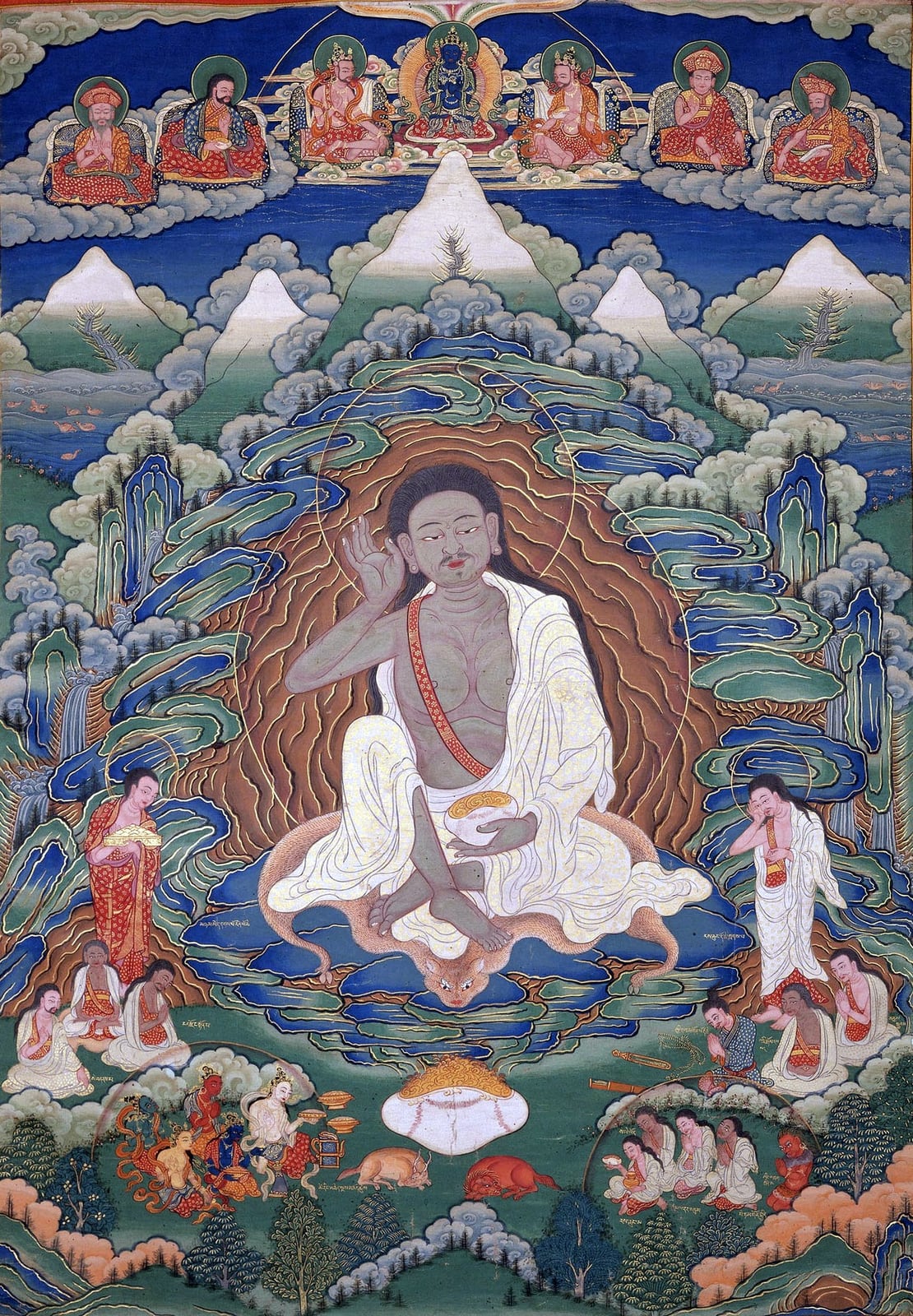
The canonical biography, divided into twelve chapters between “worldly deeds” (birth, ruin, revenge by sorcery) and “supreme deeds” (the trials with Marpa, the retreat at Drakar Taso, the teaching and the death by poison). Written as a life of the Buddha in a Tibetan key, it is at once a novel of formation, a practice manual and Tibet's most widely read book; its woodblock circulation from the late fifteenth century explains the figure's ubiquity.
amazon.com · Link to the store.
What it is about
The Life of Milarepa (rnam thar, literally "complete liberation", the Tibetan term for a saint's biography) is Tibet's most widely read book and one of humanity's great spiritual narratives. It tells the story of Mila Thöpaga, a boy from a well-to-do family in western Tibet, born according to the traditional chronology in 1040, who after his father's death sees his uncle and aunt seize the inheritance and reduce his mother, his sister and himself to poverty. Urged on by his mother, he learns black magic and takes revenge: he brings a house down during a wedding feast, killing thirty-five people, and then destroys the harvest with hail. That crime is the starting point of everything else.
Repentant and terrified of the karmic consequences of his deeds, he seeks the Dharma and ends up at the feet of Marpa the Translator, the master who had brought Naropa's teachings from India. Marpa, instead of teaching him, subjects him for years to gruelling and apparently absurd trials: building stone towers with his own hands and pulling them down again and again, until he raises the nine-storey tower still shown today in Lhodrak. Only when despair has purified his karma does Marpa initiate him. Milarepa then meditates in solitude, returns to his village, finds his mother's bones in the ruined house and resolves to devote the rest of his life to practice in the caves of the Himalaya, living on nettles until his skin turns green, clad only in a cotton cloth — hence his name, repa, "the cotton-clad" — thanks to the inner heat of tummo. In the end he attains enlightenment, trains disciples such as Rechungpa and Gampopa, and dies poisoned by a jealous scholar, whom he forgives.
The book is at once a novel of formation, a treatise on karma and a manual of practice. Its thesis is radical: even a murderer can attain Buddhahood in a single lifetime if he gives himself wholly to practice and to his master. It was composed by Tsangnyön Heruka in 1488, four centuries after the events, on the basis of earlier biographies, and written in the first person, as Milarepa's own account to his disciple Rechungpa, its structure modelled on the twelve deeds of the Buddha's life. That direct voice, the vividness of its scenes and its blend of rawness and tenderness explain why for five centuries it has been the gateway to Buddhism for Tibetans of every station and, since the twentieth century, for readers all over the world.
Authorship note
Not a work by Milarepa but about him: composed by Tsangnyön Heruka (1452–1507) in 1488, framed as the saint's own account to Rechungpa, drawing on earlier biographies by Gampopa, Ngendzong Repa, the Twelve Great Disciples cycle and the Black Treasury. The versions by Bacot (1925), Evans-Wentz/Dawa-Samdup (1928), Lhalungpa (1977), Quintman (2010) and Preciado (1994) translate this text.
Context of composition
Tsangnyön Heruka (1452–1507), "the madman of Tsang", was a Kagyu yogin who adopted the eccentric conduct of the ancient Indian siddhas — smeared in ashes, adorned with bones — as a protest against a monastic life he judged too institutional and comfortable. Composing the life of Milarepa, the great lay hermit of his lineage, was a manifesto: to put the ideal of the solitary yogin back at the centre. He worked on a rich biographical tradition, including accounts attributed to Gampopa and Ngendzong Repa, the cycle of the "Twelve Great Disciples" and the compilation known as the "Black Treasury"; Milarepa's dates are therefore uncertain, and recent research proposes dates differing from the traditional ones (1040–1123). Tsangnyön and his circle printed the work from woodblocks, which spread it with unusual speed. It was written for practitioners and lay people alike: it was read aloud, performed and narrated with pictures.
Structure
- 01
Introduction: Rechungpa's request
Before an assembly of disciples and celestial beings, Rechungpa asks Milarepa to tell his life for the benefit of others. Milarepa agrees and sums up his course: black deeds in youth, white deeds in maturity and, at the end, beyond both.
- 02
Chs. 1–3: the black deeds
Lineage and birth; the father's death, the uncle and aunt's seizure of the inheritance and the family's misery; the study of black magic, the collapse of the house during the wedding, the thirty-five deaths and the hailstorm on the harvest.
- 03
Chs. 4–6: Marpa and the trials
Repentance and the search for the Dharma; the meeting with Marpa, the towers built and pulled down, the compassionate complicity of Dagmema, Marpa's wife, the disciple's flights and returns and, at last, the initiation.
- 04
Chs. 7–10: teaching, farewell, renunciation and solitude
Practice under Marpa's guidance, a dream that calls him home and the final farewell to his master; the return to the ruined village and his mother's bones; the vow to live in the mountains and the years of meditation in the caves, with nettles, *tummo* and songs.
- 05
Chs. 11–12: the disciples and nirvana
The hermitages, the disciples and the service of beings; the poisoning ordered by the scholar Tsakpuhwa, the last teaching, the death at Chuwar, the marvels of the cremation and the testament found beneath the hearth. A colophon by the compiler closes the work.
Main themes
Karma and redemption
The book is built on a question: can someone who has killed attain liberation? Milarepa lives in terror of the weight of his deeds, and that awareness of karma is the engine of his effort. The answer is yes, but not cheaply: purification demands suffering and devotion in proportion to the harm done.
Master and disciple
The relationship with Marpa is the emotional centre of the work. The trials, which look like cruelty, are pedagogy: Marpa burns up his disciple's karma through obedience and frustration. The book makes devotion to the guru the swiftest path, while showing the tenderness hidden behind the master's harshness.
Renunciation and the mountain
After finding his mother's bones, Milarepa grasps the impermanence of all he had loved and abandons every tie with the world. The cave, the nettles and the cotton cloth are not penance but freedom. This ascetic ideal, which Tsangnyön wanted to revive, became the model of the Tibetan yogin.
Enlightenment in a single lifetime
The work presents a layman, without monastic ordination or great learning, who attains Buddhahood in one lifetime through tantric practices — *tummo*, mahāmudrā — handed down by Naropa and Marpa. It is an argument for the efficacy of the tantric path and for practice over study.
A Tibetan life of the Buddha
Tsangnyön models the biography on the twelve deeds of the Buddha: birth, renunciation, austerity, enlightenment, teaching and passing into nirvana with marvels. Milarepa thus appears as a Buddha born in Tibet, which turned his story into a national narrative and explains its presence in painting, theatre and pilgrimage.
Key passages
«In my youth I committed black deeds; in my maturity, white deeds; now I have left behind every distinction between black and white.»
Our own close rendering, based on the translations of Evans-Wentz and Lhalungpa. It is the index of the whole book: the black deeds, the white ones and the transcendence of both in realisation, defined not by morality but by freedom.
«Whoever says that Milarepa had hidden gold, let his mouth be filled with filth.»
Our own close rendering. Milarepa had left word that there was gold beneath the hearth; the disciples find only his cloth, his knife and some sugar, with instructions to share them out. The book says the line made them laugh in the midst of their grief: humour and detachment even after death.
«Seeing this Life, one is freed from the eight worldly concerns. Hearing it, faith arises of itself. Recollecting it, entanglements are severed at the root.»
A free rendering based on Quintman's translation. These are not Milarepa's words but Tsangnyön Heruka's about his own book: they declare that the biography is not mere information but a sacred object whose contact transforms the reader.
Reception and influence
From its printing, the Life circulated throughout the Tibetan world in successive woodblock editions — the oldest surviving one dates from 1538, from the Ron Wosel Puk press in Gungthang — and became the best-loved narrative text of Tibetan Buddhism, read, recited, staged as drama and painted in thangka cycles. Its influence within the tradition was such that it eclipsed the earlier biographies on which it drew, as Andrew Quintman has shown.
In the West the first translation was Jacques Bacot's French version (1925), followed by the English of Kazi Dawa-Samdup, edited by W. Y. Evans-Wentz as Tibet's Great Yogī Milarepa (1928), part of the series he had launched with the Tibetan Book of the Dead. Then came Lobsang Lhalungpa's more readable version (1977) and Quintman's for Penguin Classics (2010), the most accurate. In Spanish there is a direct translation from the Tibetan by Iñaki Preciado Idoeta (Anagrama, 1994) and another based on Bacot (Olañeta). The story has inspired films such as Liliana Cavani's Milarepa (1974) and Neten Chokling's Bhutanese production (2006), and has made Milarepa one of the best-known Buddhist figures outside Asia.
How to read it
It reads with the intensity of a novel and is best read whole and in order: the power of the final enlightenment depends on the horror of the beginning and the harshness of the trials with Marpa. In English, Andrew Quintman's translation (Penguin Classics) is the most rigorous and has an excellent introduction by Donald S. Lopez; Lhalungpa's is more fluent. Evans-Wentz's, with its Theosophical notes, is chiefly of historical interest. Afterwards, move on to *The Hundred Thousand Songs*, which show Milarepa as a master.
Editions and translations
Editions in your language first, without hiding the others. Each with its cover and its store.
English

The Life of Milarepa
Penguin Classics, 2010
Translation: Andrew Quintman (introd. Donald S. Lopez Jr.)
ISBN 9780143106227

The Life of Milarepa
Shambhala, 1985
Translation: Lobsang P. Lhalungpa
ISBN 9780877732815
Primera edición Dutton 1977; reediciones Penguin Compass
Milarepa
Tibet's Great Yogī Milarepa: A Biography from the Tibetan
The Conscious LibraryTibet's Great Yogī Milarepa: A Biography from the Tibetan
Oxford University Press, 1928
Translation: Lāma Kazi Dawa-Samdup (ed. W. Y. Evans-Wentz)
Reimpresiones indias: Winsome Book India 2005 (9788188043132). Digitalizada en Internet Archive
Tibetano · བོད་སྐད
Milarepa
rje btsun mi la ras pa'i rnam thar (xilografías de Ron Wosel Puk 1538 y posteriores)
The Conscious Libraryrje btsun mi la ras pa'i rnam thar (xilografías de Ron Wosel Puk 1538 y posteriores)
Imprentas de Gungthang, 1538
Véase manuscripts[]; texto tibetano consultable en BDRC
Français
Milarepa
Le poète tibétain Milarépa: ses crimes, ses épreuves, son nirvāna
The Conscious LibraryLe poète tibétain Milarépa: ses crimes, ses épreuves, son nirvāna
Bossard, 1925
Translation: Jacques Bacot
Primera traducción europea; reed. Fayard 1971

Milarépa: La vie
Éditions du Seuil (Points Sagesses), 1995
Translation: Marie-José Lamothe
ISBN 9782020201506
Reunida con los cantos en «Œuvres complètes», Fayard 2006 (9782213628974)
Italiano

Vita di Milarepa. I suoi delitti, le sue prove, la sua liberazione
Adelphi, 1991
Translation: A cura di Jacques Bacot
ISBN 9788845907968
Español
Milarepa
Vida de Milarepa
The Conscious LibraryVida de Milarepa
Anagrama, 1994
Translation: Iñaki Preciado Idoeta (del tibetano)
ISBN 9788433906564
Col. Argumentos; reed. Compactos 2004 (9788433967626)

Vida de Milarepa
José J. de Olañeta, 2013
Translation: A partir de la versión francesa de Jacques Bacot
ISBN 9788497166492
Русский

Великий йог Тибета Миларепа
Fair-Press, 2001
Translation: Del inglés de Evans-Wentz
ISBN 9785818303192
Further reading
- The Hundred Thousand Songs of Milarepa
The twin volume, compiled by the same Tsangnyön: the Life tells how he became a saint; the Songs, what he taught.
- The Yogin and the Madman
Andrew Quintman's study of how this biography was formed from the earlier ones.
- Mahaparinibbana Sutta
The account of the Buddha's last days and death, the model for the closing scenes of Milarepa's life.
- The Book of Her Life
Another spiritual life told in the first person, from fall to surrender, in an entirely different tradition.
Other works by Milarepa
- The Hundred Thousand Songs of Milarepa (Mgur 'bum) · 1488
- Drinking the Mountain Stream: Songs of Tibet's Beloved Saint · 1978
- Sixty Songs of Milarepa · 1966
- The Yogin and the Madman · 2014
- Milarepa: Lessons from the Life and Songs of Tibet's Great Yogi · 2017
- Miraculous Journey: Further Stories and Songs of Milarepa · 1986
Sources
- Tsangnyön Heruka. The Life of Milarepa. Trad. Andrew Quintman; introducción de Donald S. Lopez Jr. Nueva York: Penguin Classics, 2010. ISBN 9780143106227.
- Tsangnyön Heruka, *The Life of Milarepa*, trad. de Andrew Quintman, introd. de Donald S. Lopez Jr., Nueva York, Penguin Classics, 2010.
- Tsangnyön Heruka, *The Life of Milarepa*, trad. de Lobsang P. Lhalungpa, Nueva York, E. P. Dutton, 1977 (Boston, Shambhala, 1985).
- W. Y. Evans-Wentz (ed.), *Tibet's Great Yogī Milarepa: A Biography from the Tibetan*, trad. de Lāma Kazi Dawa-Samdup, Londres, Oxford University Press, 1928.
- *Vida de Milarepa*, trad. del tibetano de Iñaki Preciado Idoeta, Barcelona, Anagrama, 1994.
- Jacques Bacot, *Le poète tibétain Milarépa: ses crimes, ses épreuves, son nirvāna*, París, Bossard, 1925.
- Andrew Quintman, *The Yogin and the Madman: Reading the Biographical Corpus of Tibet's Great Saint Milarepa*, Nueva York, Columbia University Press, 2014.
- Andrew Quintman, «Wrinkles in Time: On the Vagaries of Mi la ras pa's Dates», *Acta Orientalia* 74 (2013), pp. 3–26.
- Marta Sernesi, «A Continuous Stream of Merit: The Early Reprints of gTsang smyon Heruka's Hagiographical Works», *Zentralasiatische Studien* 40 (2011), pp. 179–237.
Affiliate link: if you buy through it, the library may receive a commission at no extra cost to you. When an edition's real cover is not available, we show an illustrative library cover.