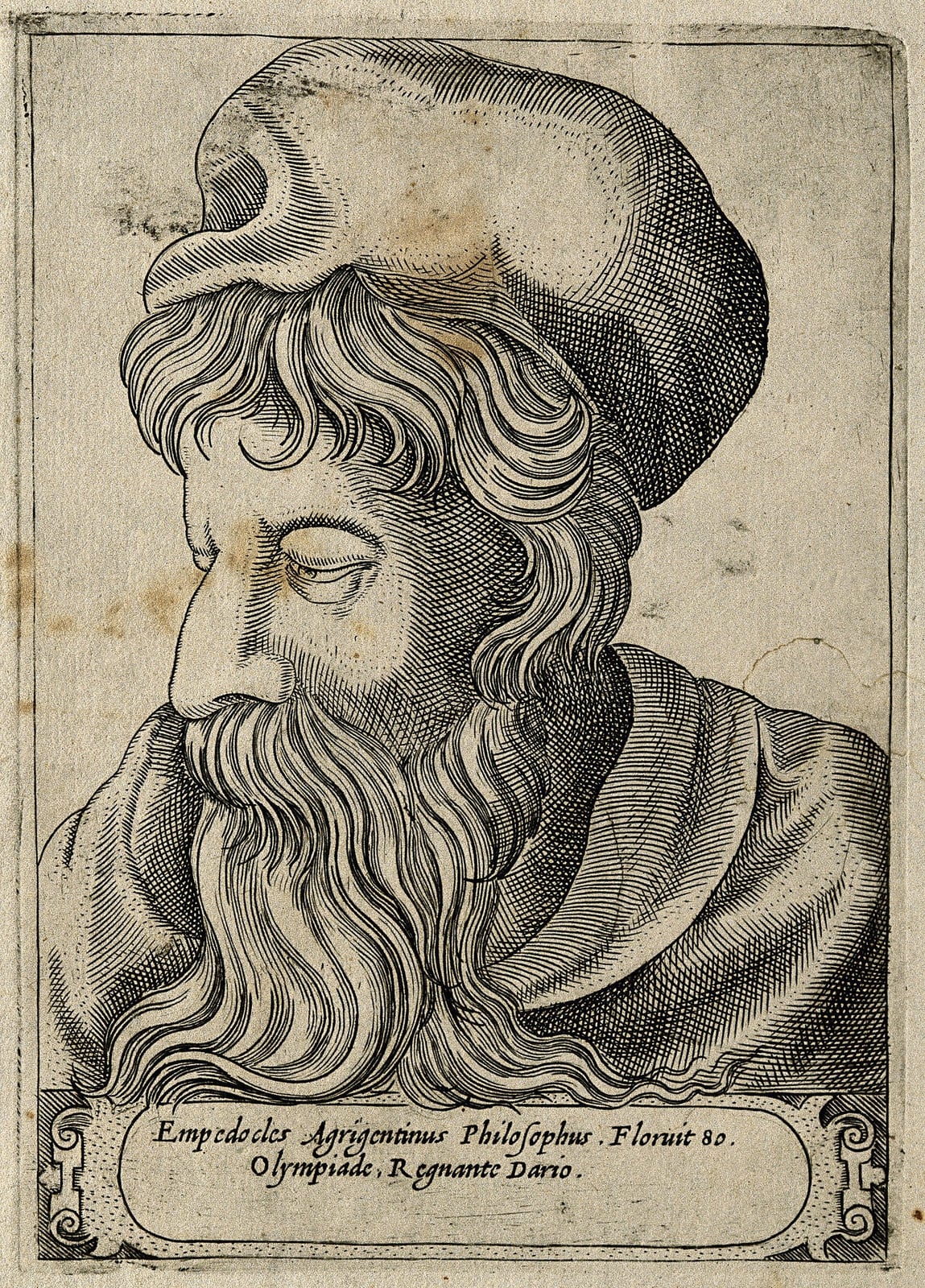
Attributed to Empedocles
«Everything is composed of four elements: earth, water, air and fire.»
Misattributed
Verdict
It is not in Empedocles's work
The doctrine is his, but not the vocabulary: Empedocles speaks of "roots" (rhizomata) and names them after gods. The term "elements" (stoicheia) comes from Plato and Aristotle.
What they did say
Verified words of Empedocles
«For straitened are the powers that are spread over their bodily parts.»
DK 31 B2.1, en Sexto Empírico, Contra los matemáticos VII 123. Griego: texto de Fairbanks (1898), basado en la edición de Stein; numeración Diels-Kranz. Inglés: John Burnet, Early Greek Philosophy (1908). Español: traducción propia.
«Hear first the four roots of all things: shining Zeus, life-bringing Hera, Aidoneus, and Nestis whose tear-drops are a well-spring to mortals.»
DK 31 B6, en Aecio I 3, 20, y Diógenes Laercio VIII 76 (DK lee τέσσαρα γὰρ πάντων). Griego: texto de Fairbanks (1898), basado en la edición de Stein; numeración Diels-Kranz. Inglés: John Burnet, Early Greek Philosophy (1908). Español: traducción propia.
«And I shall tell thee another thing. There is no coming into being of aught that perishes, nor any end for it in baneful death; but only mingling and change of what has been mingled. Coming into being is but a name given to these by men.»
DK 31 B8, en Plutarco, Contra Colotes 1111f, y Aecio I 30, 1. Griego: texto de Fairbanks (1898), basado en la edición de Stein; numeración Diels-Kranz. Inglés: John Burnet, Early Greek Philosophy (1908). Español: traducción propia.